Email Marketing for Beauty Centers: Campaigns That Drive Repeat Visits
Turn this article into takeaways for your work.


Each assistant summarizes the article only for you and suggests best practices for your work.
Social media reach is rented. Instagram can cut your organic reach in half with an algorithm update. TikTok can go dark in a market overnight. But the email list you've built from clients who've actually visited your salon? That's an owned asset. And that's the difference between a beauty business that's vulnerable to platform changes and one that isn't.
The beauty businesses that use email well don't blast promotional messages hoping something lands. They build a communication rhythm that keeps them visible between appointments, makes clients feel valued, and gives people a specific reason to book again when the timing is right. The result isn't dramatic: a 15-20% increase in visit frequency among the clients who receive emails compared to those who don't. At scale, that's the difference between a business that's growing and one that's running to stay still. Email sits alongside client communication and follow-up as a core retention tool, and the two should work together, not in isolation.
Key Facts: Email Marketing in Beauty
- Beauty industry email campaigns average a 35-40% open rate, significantly above the 21% cross-industry average (Mailchimp, 2024)
- Birthday email campaigns in the beauty industry convert at 3-5x the rate of standard promotional emails
- Salons with a structured re-engagement email sequence recover an average of 22% of lapsed clients within 60 days
- Statista's global marketing email open rate data confirms that well-segmented, personalized campaigns consistently outperform generic broadcast emails across industries. The principle applies directly to beauty
Building Your List: Collecting Emails That Matter
A list of 500 engaged clients who've visited your salon is more valuable than a list of 5,000 people who signed up for a generic discount offer and have never been through your door.
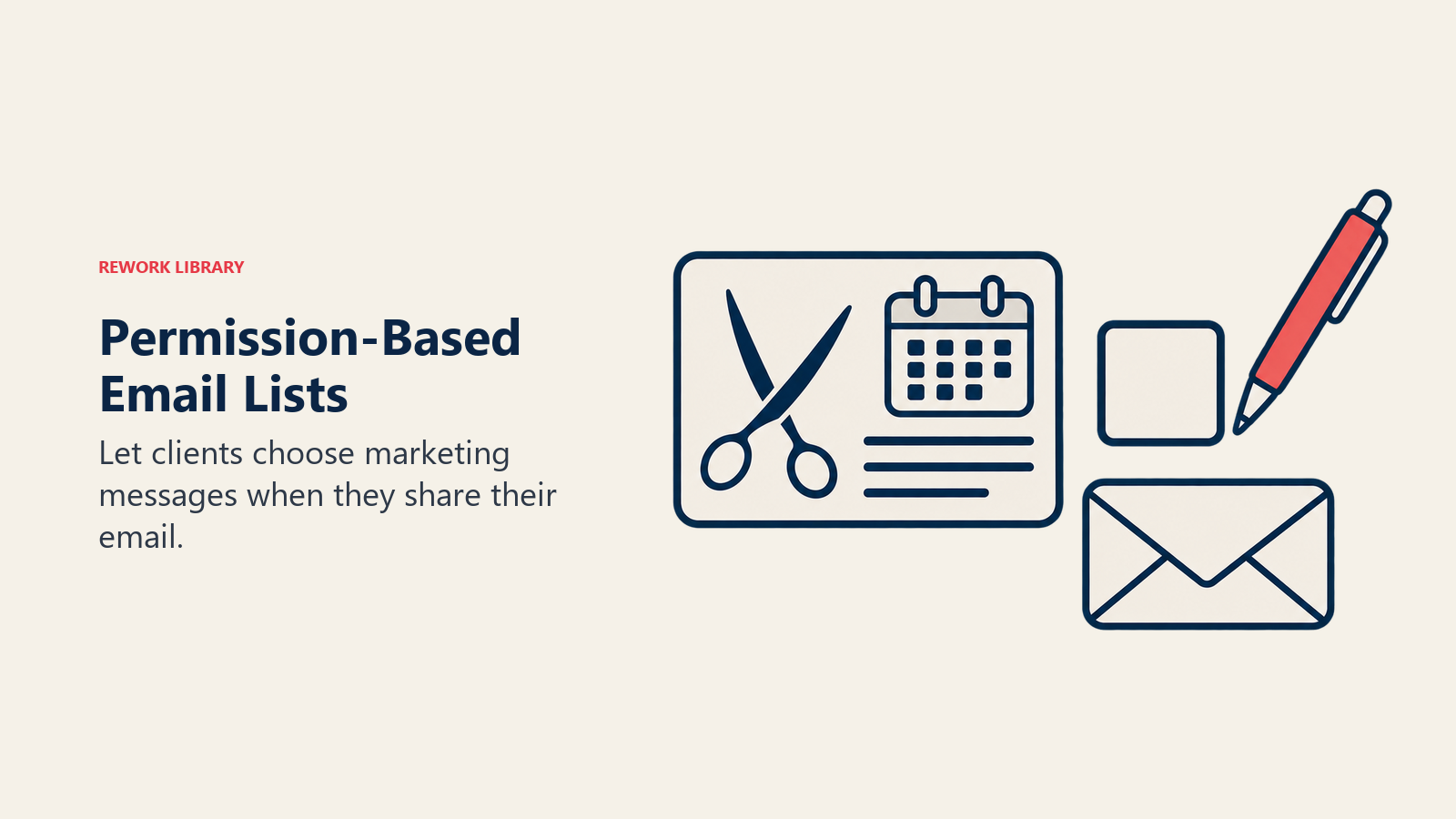
At the Point of Booking: This is your highest-conversion collection moment. When a client books online, the booking platform captures their email automatically. Make sure your platform is configured to opt clients into your marketing list with a clearly worded checkbox, not a pre-ticked default, but a genuine opt-in that they see and choose. This is one reason online booking optimization matters beyond just reducing abandonment: a well-designed booking flow also builds your email list automatically.
At the Front Desk: Train reception staff to ask every client: "Can I grab your email so we can send you appointment reminders and our occasional promotions?" The phrasing matters. Emphasizing appointment reminders first makes it feel functional rather than commercial, which increases consent rates.
In-Salon Sign-Up Incentives: A tablet or small card at reception offering a lead magnet (a seasonal hair care guide, a skincare routine PDF, a "find your service" quiz) gives people a reason to share their email beyond hoping they'll remember to book again.
Website Pop-Ups: A pop-up that triggers after 30 seconds on your website, offering a small first-visit incentive (not a heavy discount, since a complimentary treatment add-on works better for margin), converts at 2-4% of site visitors. That's meaningful volume if your site gets reasonable traffic.
Legal Requirements: In the UK and EU, GDPR requires explicit opt-in consent for marketing emails. In the US, CAN-SPAM requires an unsubscribe option in every email and honest subject lines. Use a reputable email platform (Mailchimp, Klaviyo, ActiveCampaign) that handles compliance infrastructure automatically. Don't manage this manually. The U.S. beauty and personal care market is forecast to reach $110 billion by 2028 (Statista), which means the clients on your email list are sitting in a growth market. The cost of mismanaging that list through compliance failures is higher than it might appear.
Welcome Series: The First Week Matters
The highest open rates you'll ever see on your emails are in the first week after a subscriber joins your list. People are curious, they've just opted in, and they haven't yet tuned you out.
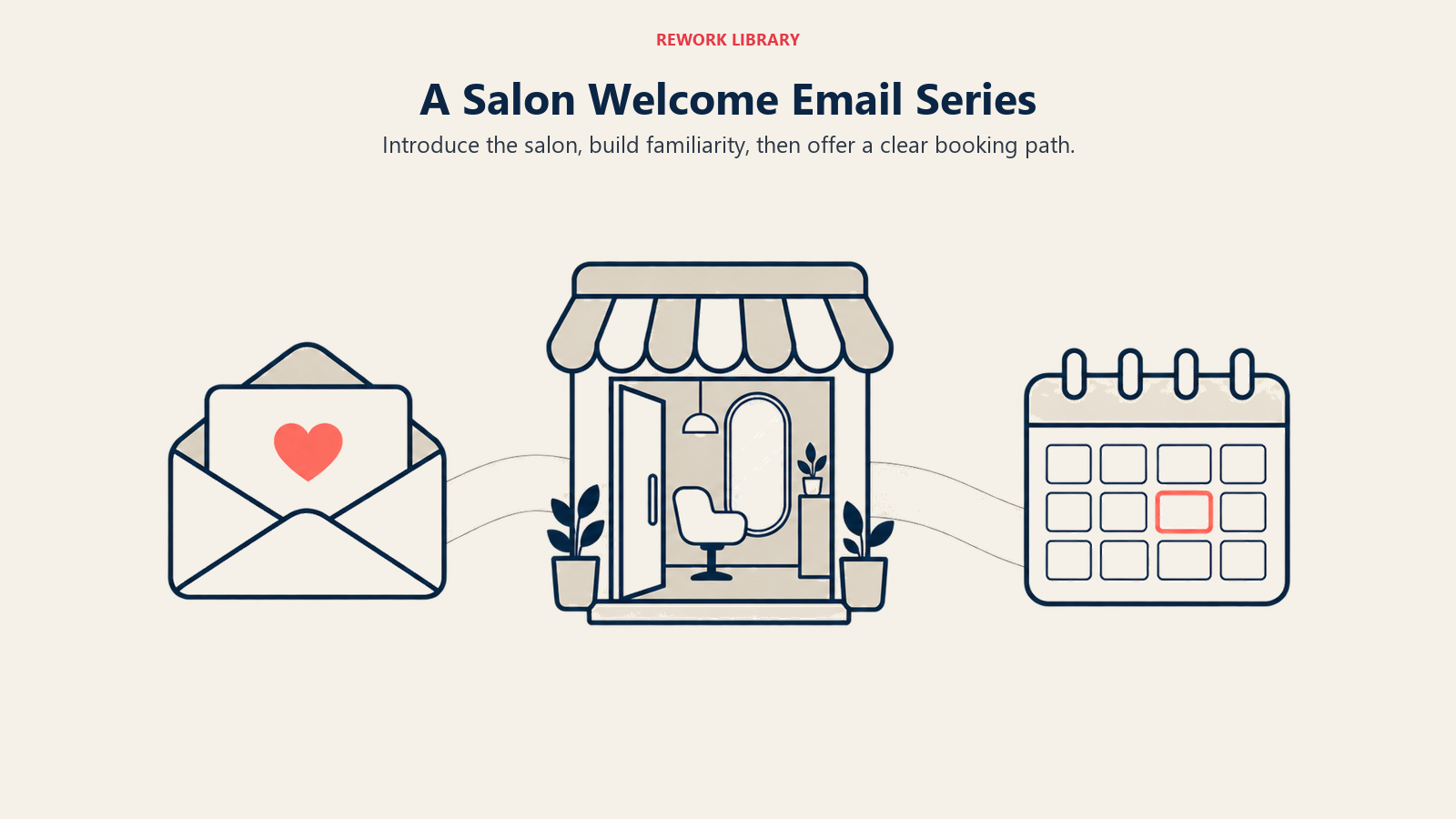
Use this window deliberately:
Day 1: Immediate Welcome:
- Thank them for joining and briefly introduce the team
- Set expectations: "We'll send you occasional updates, exclusive offers, and reminders. Nothing spammy."
- Include a single clear CTA: a first-visit offer (if they haven't booked yet) or a link to browse services
Day 4: Team and Values Introduction:
- Introduce one or two team members with a photo and a brief personal line
- Show the salon environment and what clients can expect
- Include one client testimonial or review snippet
Day 7: Service Spotlight + Booking CTA:
- Feature your most popular service with a before-and-after image
- Clear booking link with any first-visit incentive applied
This sequence converts new subscribers into first-time (or repeat) bookings at a significantly higher rate than no welcome series at all. Once set up in your email platform, it runs automatically. The before-and-after image in Day 7 has more impact when it's professionally captured. See before and after content marketing for the photography and caption standards that make these visuals sell.
Re-Engagement Campaigns: Winning Back Lapsed Clients
A client who visited six months ago and hasn't been back isn't lost. They're dormant. A targeted re-engagement sequence can recover a meaningful percentage of them.
Identifying Lapsed Clients: Set a 90-day threshold. Any client who hasn't visited in 90+ days enters your re-engagement segment. Most salon management platforms can export this list; most email platforms can sync it automatically.
The Re-Engagement Sequence:
Email 1 (Day 1 of sequence): "We miss you." Personal tone, no offer, just an acknowledgment. Subject line: "It's been a while..." Open rates on emotional, curiosity-driven subject lines significantly outperform promotional ones for lapsed clients.
Email 2 (Day 7): A specific reason to return: a seasonal offer, a new service they haven't tried, a team member they saw who has availability. Subject line: "[Name], we saved something for you."
Email 3 (Day 14): The last-chance message with a time-limited offer. Subject line: "This expires Friday, thought you should know." The urgency here is genuine. The offer does expire.
If a subscriber doesn't open or click any of the three emails, remove them from your active list. Unengaged contacts hurt your deliverability and inflate your list size without adding value.
What Works in Subject Lines for Cold Contacts: First-name personalization, curiosity gaps ("We saved something for you"), and honest urgency ("This expires Friday") consistently outperform promotional subject lines ("20% off this week!") for re-engagement. Promotional subject lines work for warm, engaged subscribers. Lapsed subscribers need a different hook.
Seasonal Promotions: The Beauty Calendar
Beauty has a natural seasonal rhythm. Clients want fresh color before summer, skin treatments in autumn when the sun damage is visible, holiday party blowouts in November and December, and something new in January when the post-holiday slump hits.
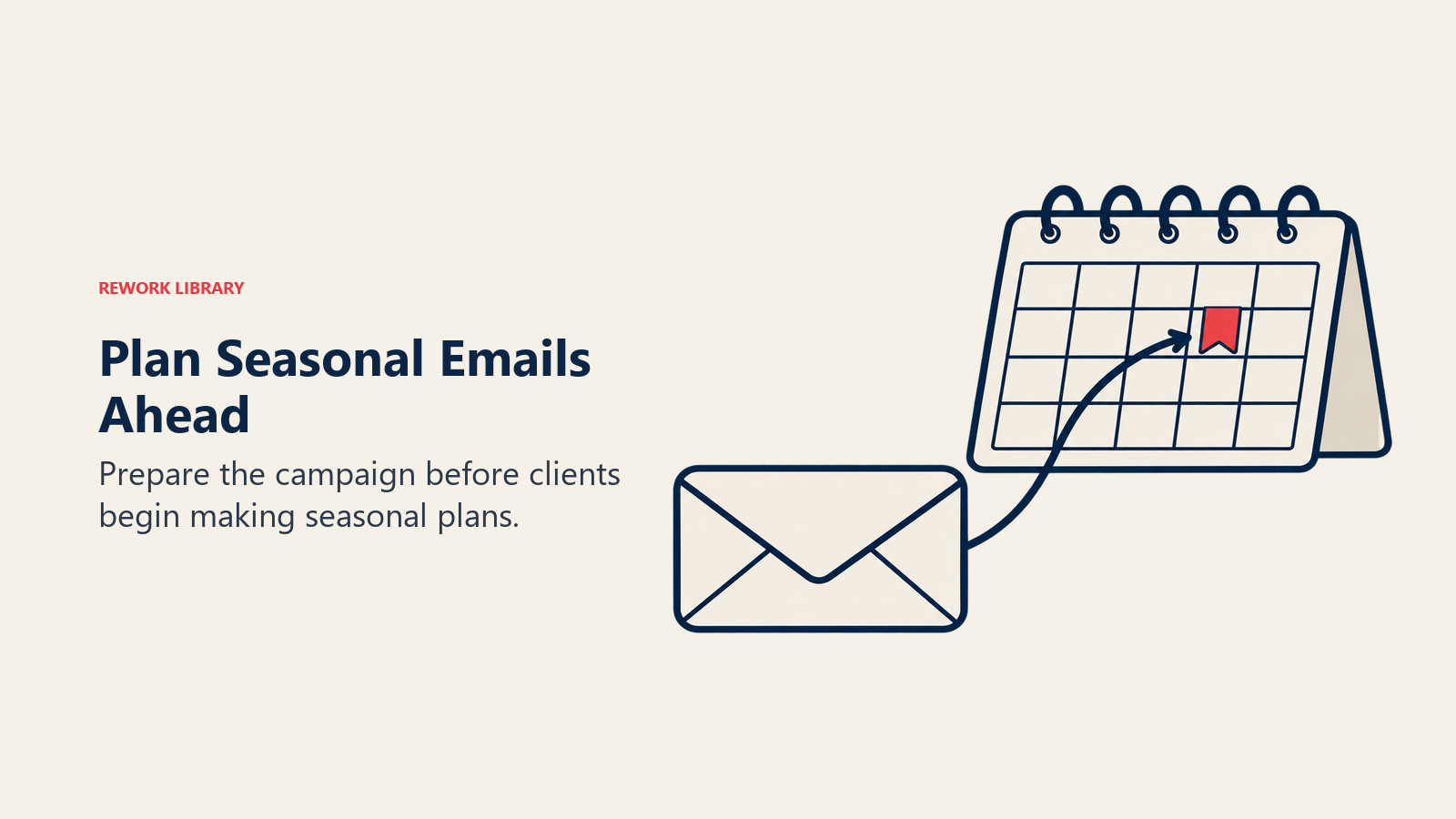
Planning seasonal promotions requires at least 3-4 weeks of lead time for email campaigns. The email that goes out the week before a promotion launches is too late. You've already lost the clients who planned ahead.
A Simplified Beauty Email Calendar:
| Month | Campaign Focus |
|---|---|
| January | "New Year, New You": consultations, color refreshes |
| February | Valentine's Day: couples packages, gifts, self-care messaging |
| March-April | Spring skin and hair prep, post-winter treatments |
| May-June | Summer-ready packages, sun protection services |
| August-September | Back-to-school refreshes, autumn colour transitions |
| October-November | Holiday pre-booking opens (start earlier than you think) |
| December | Gift vouchers, end-of-year client appreciation |
The goal of seasonal promotions isn't to discount heavily. It's to create a relevant reason to book that connects to what clients are already thinking about. "Get your colour winter-ready before the first frost" lands better than "15% off colour in October" because it connects the service to a specific client need. For the full promotional planning framework across the beauty calendar, seasonal promotions for beauty businesses covers timing, offer construction, and multi-channel promotion strategy.
Birthday Campaigns: Your Highest-Converting Automation
Birthday emails have the highest open and conversion rates of any automated campaign in the beauty industry. The personalization is genuine, the timing feels natural, and clients are already in a celebratory mindset.
Structure:
- Timing: Send one week before the birthday, not on the day. Clients need time to schedule an appointment. A birthday email that arrives on their birthday is too late for them to act on it.
- Subject line: "[Name]'s birthday is coming up, here's something special" or simply "Happy early birthday, [Name]."
- Offer: A free add-on (scalp treatment, brow tint, hand massage) with any booked service converts better than a percentage discount. It feels like a gift rather than a price reduction, and the margin impact is lower.
- Expiry: Give a two-week window: birthday week plus the week after. Too short and it doesn't convert; too long and it loses urgency.
Set this up once in your email platform as an automated campaign triggered by birth date. It runs indefinitely without ongoing management. Birthday campaigns pair naturally with your gift card and voucher programs: the two together cover both the recipient who wants to book and the person who wants to give a meaningful beauty gift.
Segmentation: Why Sending the Same Email to Everyone Underperforms
If a client has visited for nail services three times in the last six months and never had a hair appointment, sending them an email about your new colour specialist is irrelevant. Irrelevant emails train people to ignore your emails.
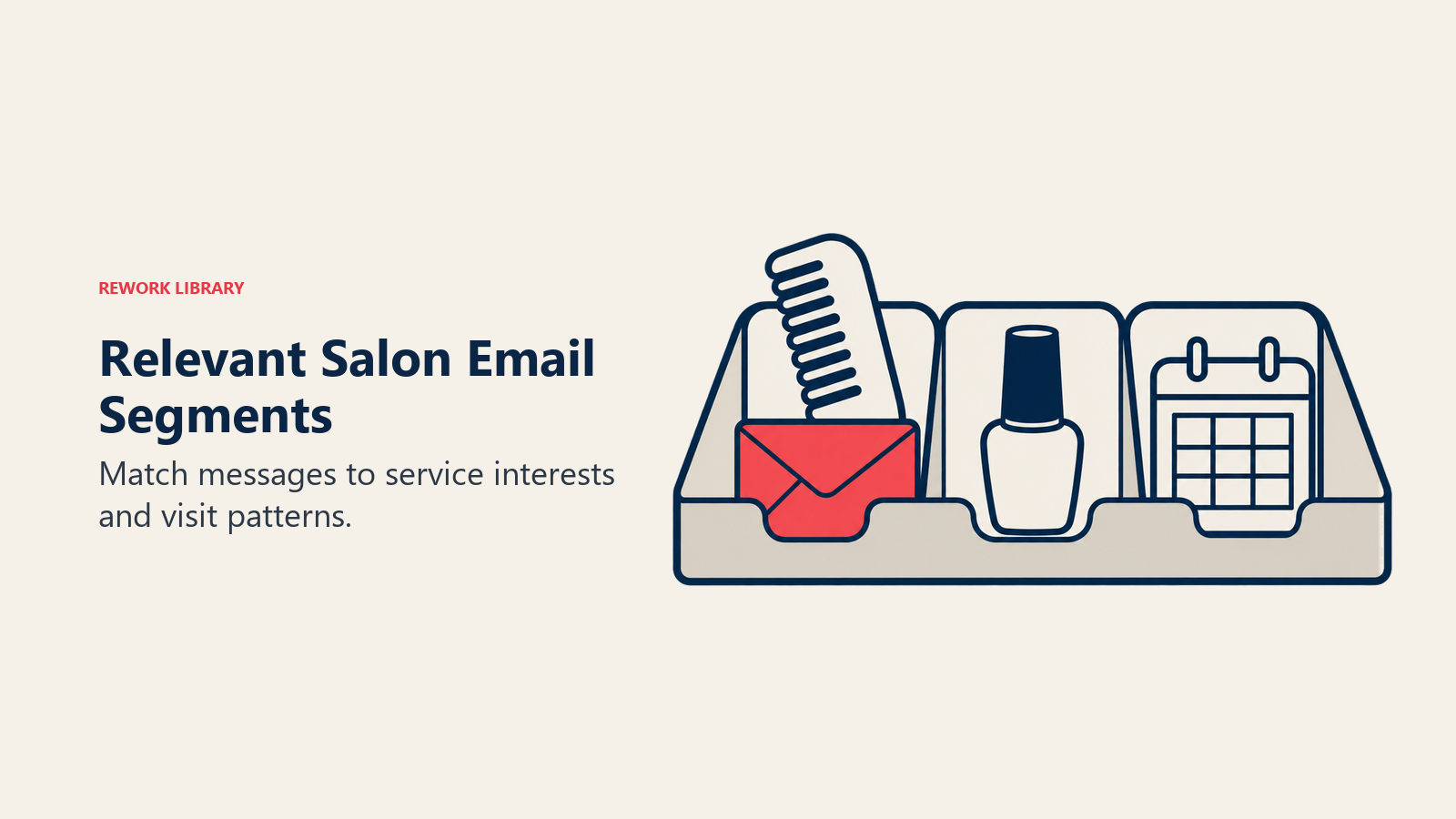
Practical Segmentation for Small Teams:
Most beauty salon software integrates with email platforms to sync client data. The segments worth maintaining:
- By service type: Hair clients, skin/facial clients, nail clients, body treatment clients
- By visit frequency: Regular (every 4-8 weeks), occasional (every 2-3 months), lapsed (90+ days)
- By spend level: High-value clients who regularly spend $200+ deserve different treatment than occasional lower-spend visitors
You don't need complex segmentation to start seeing results. Even splitting your list into "active in last 60 days" and "lapsed 60+ days" and sending different content to each group will meaningfully improve your metrics. The lapsed segment connects directly to rebooking strategies for salons, and re-engagement emails and proactive rebooking outreach should work in parallel rather than as separate efforts.
Open Rate Benchmarks and What They Mean
| Metric | Beauty Industry Average | Strong Performance |
|---|---|---|
| Open rate | 35-40% | 45%+ |
| Click-through rate | 3-5% | 7%+ |
| Conversion to booking | 1-2% of list | 3-4% |
| Unsubscribe rate per campaign | Under 0.5% | Under 0.2% |
If your open rates are below 25%, the problem is usually one of three things: a list that hasn't been cleaned recently (unengaged subscribers dragging down deliverability), subject lines that are too promotional, or a sending frequency that's too high for the content value you're delivering. Statista's breakdown of email open rates by industry provides a cross-industry benchmark that helps contextualize where beauty sits relative to other sectors and what "strong performance" actually looks like.
Subject Line Formulas That Work:
- First-name personalization: "[Name], your hair is due for attention"
- Curiosity gap: "Something new at [Salon Name] this month"
- Urgency + specificity: "3 spots left for Saturday morning"
- Question: "When did you last have a treatment, really?"
Send Time: For beauty businesses, Tuesday-Thursday, 9-11am local time tends to outperform. But run your own test. Your client base may behave differently. Most email platforms have A/B testing for send time built in.
Email doesn't require a big team or a big budget. It requires a system: a list that grows continuously, automations that run without intervention, and campaigns that connect to what clients are actually thinking about at that time of year. HBR's research on retention through professional development draws a parallel worth noting: the communication habits that keep employees engaged map closely onto the communication habits that keep clients loyal, and both require consistency, relevance, and a genuine sense that the other party is valued. The beauty businesses that build that system retain clients at meaningfully higher rates than those who rely on hoping followers see their next Instagram post. For a complete view of the retention tools available, loyalty programs for beauty centers describes the structural incentives that complement email's communication role.
Learn More

Senior Operations & Growth Strategist
On this page
- Building Your List: Collecting Emails That Matter
- Welcome Series: The First Week Matters
- Re-Engagement Campaigns: Winning Back Lapsed Clients
- Seasonal Promotions: The Beauty Calendar
- Birthday Campaigns: Your Highest-Converting Automation
- Segmentation: Why Sending the Same Email to Everyone Underperforms
- Open Rate Benchmarks and What They Mean
- Learn More