Client Experience Design: Creating Memorable Salon & Spa Visits
Turn this article into takeaways for your work.


Each assistant summarizes the article only for you and suggests best practices for your work.
Most salons focus on the service itself. The technical quality. The product choice. The stylist's skill. And those things matter enormously. But they're not what determines whether a first-time client becomes a regular.
Clients remember how they felt walking in. Whether anyone smiled at them. How long they waited and whether someone acknowledged it. Whether their stylist remembered what they talked about last time. What happened (or didn't happen) in the 24 hours after they left.
The experience surrounding the service is what determines return behavior. And unlike technical skill, which takes years to develop, experience design can be systematically improved starting this week. It also serves as the foundation that makes every other retention investment more effective: loyalty programs, rebooking systems, review requests.
Key Facts: Client Experience in Beauty
- Clients who rate their overall salon experience as "excellent" are 4x more likely to rebook than those who rate it "good" (Salon Today 2023)
- 68% of clients who switch salons cite feeling undervalued or unappreciated, not service quality (American Salon)
- A one-point improvement in experience rating correlates to a 12% increase in client retention over 12 months
McKinsey's research on experience-led growth found that companies achieving a 20% or greater improvement in customer satisfaction increased cross-sell rates by 15–25% and boosted share of wallet by 5–10%, a direct parallel to salons that convert first-time visitors into multi-service regulars.
The Client Journey Map: A Framework for Every Touchpoint
A client journey map is a structured view of every interaction between a client and your business, from the moment they first hear about you to the moment they decide (or don't decide) to come back.
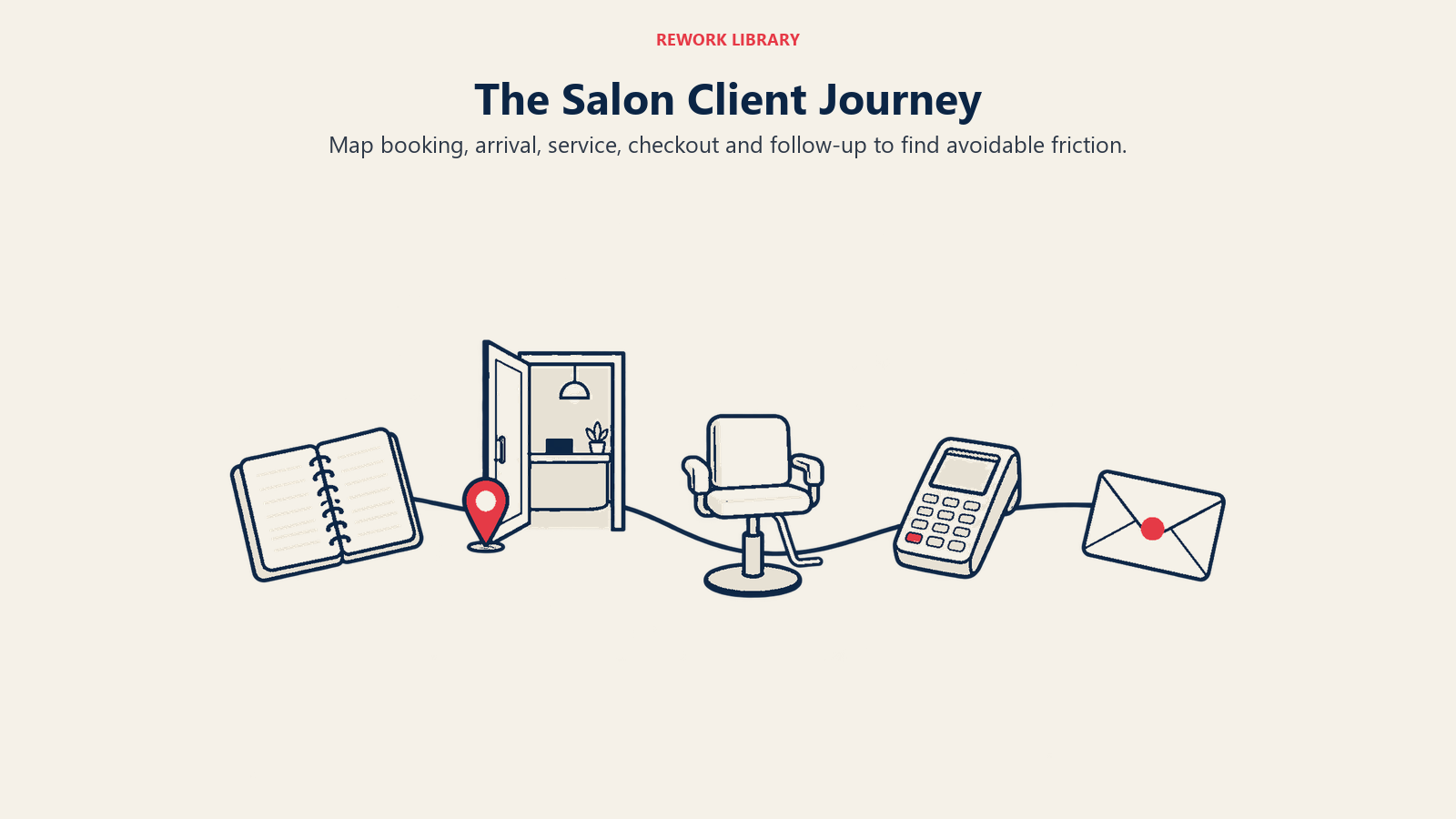
For a salon or spa, the journey looks like this:
Pre-visit touchpoints:
- Discovery (Google search, Instagram, referral)
- First impression (website, Google Business Profile, booking process)
- Booking confirmation (automated message, tone, clarity)
- Appointment reminder (timing, channel, personalization)
Arrival touchpoints:
- Parking and entrance (ease, signage, first visual impression)
- Welcome at the door (speed, warmth, name recognition)
- Wait experience (comfort, acknowledgment, duration communication)
- Consultation (preparation, listening, questions asked)
During service touchpoints:
- Setup and transition (how the client is moved through the space)
- Communication during service (check-ins, comfort confirmation)
- Product recommendations (how they're offered, not sold at)
- Stylist interaction (memory of previous visit details, personal connection)
Checkout touchpoints:
- Reveal and reaction (is there a moment of celebration?)
- Payment process (speed, clarity, options)
- Rebooking offer (naturalness of the ask)
- Farewell (name used, sincerity, any parting gesture)
Post-visit touchpoints:
- Thank-you message (timing, personalization, content)
- Aftercare follow-up (practical value, trust-building)
- Rebooking reminder (timing, channel)
- Review request (timing, friction level)
Most salons, when they map this out honestly, find 3-5 friction points clients tolerate but don't forgive. Wait times with no acknowledgment. A checkout process that feels rushed. No follow-up after a first visit. These aren't catastrophic failures, but they accumulate into a reason not to come back. The online booking optimization process is a pre-visit touchpoint that often contains the highest friction. A clunky booking flow can undermine first impressions before a client even arrives.
Prioritizing quick wins: start with the touchpoints that have the highest friction and the lowest cost to fix. Acknowledging a wait costs nothing. Sending a thank-you text costs 30 seconds of setup. Teaching staff to use client names at check-in and farewell costs a 10-minute team meeting.
Ambiance & Sensory Design
The environment makes promises before anyone says a word. Clients form their first impression in the 7 seconds between walking in the door and reaching the reception desk. That impression is almost entirely sensory.
The business case for intentional environment design:
Scent is the most emotionally potent sensory element. Research on retail environments consistently shows that the right ambient scent increases time spent and perceived quality. HBR's piece on the science of sensory marketing documents how ambient scent, music, and lighting collectively shape perceived service quality and willingness to pay, directly relevant to every touchpoint in a salon environment. For a salon or spa, this means a signature scent: subtle, consistent, unmistakably "your place." It doesn't need to be expensive: essential oil diffusers with a consistent blend ($150-$300 in equipment) create a powerful sensory signature.
Lighting quality directly affects how clients feel about their service results. Harsh overhead fluorescents make everyone look worse, including the work your team just did. Warm, adjustable lighting at styling stations makes color look richer and skin look healthier. The investment in better lighting pays back in client satisfaction scores and reviews that mention "the ambiance."
Music should be consistent with your brand, at a volume that enables easy conversation. A spa playing aggressive pop music at checkout volume is not a relaxing experience. A high-energy salon playing elevator music feels wrong. Match the energy of the room to the experience you're promising.
Temperature and cleanliness are hygiene factors. Clients don't notice them when they're right, but they absolutely notice when they're wrong. A cold treatment room during a facial. A hair station with product residue from the previous client. These break the spell of an otherwise excellent visit.
Sensory design audit checklist:
- Consistent signature scent in reception and service areas
- Lighting warm and flattering at styling stations (not overhead fluorescent)
- Music volume allows comfortable conversation
- Temperature consistent (checked at open and mid-day)
- All surfaces clean between clients (visible to arriving clients)
- Reception area uncluttered and visually calm
- Service tools organized and out of sight when not in use
- Products displayed intentionally (not overstocked or dusty)
The key word here is consistency. A single wow moment doesn't build loyalty. Consistent, predictable quality across every visit does. Clients return to businesses where they know exactly what to expect. This is the same principle behind strong market positioning for salons and spas: your brand promise needs to match the actual sensory experience clients encounter every time they walk in.
Consultation Experience
The consultation is the most underinvested touchpoint in most salons. It's treated as a formality, a quick "what are we doing today?" before the real work starts. But a great consultation does three things no technical skill can replicate: it makes the client feel heard, it reduces the chance of dissatisfied results, and it creates the foundation for a long-term relationship.
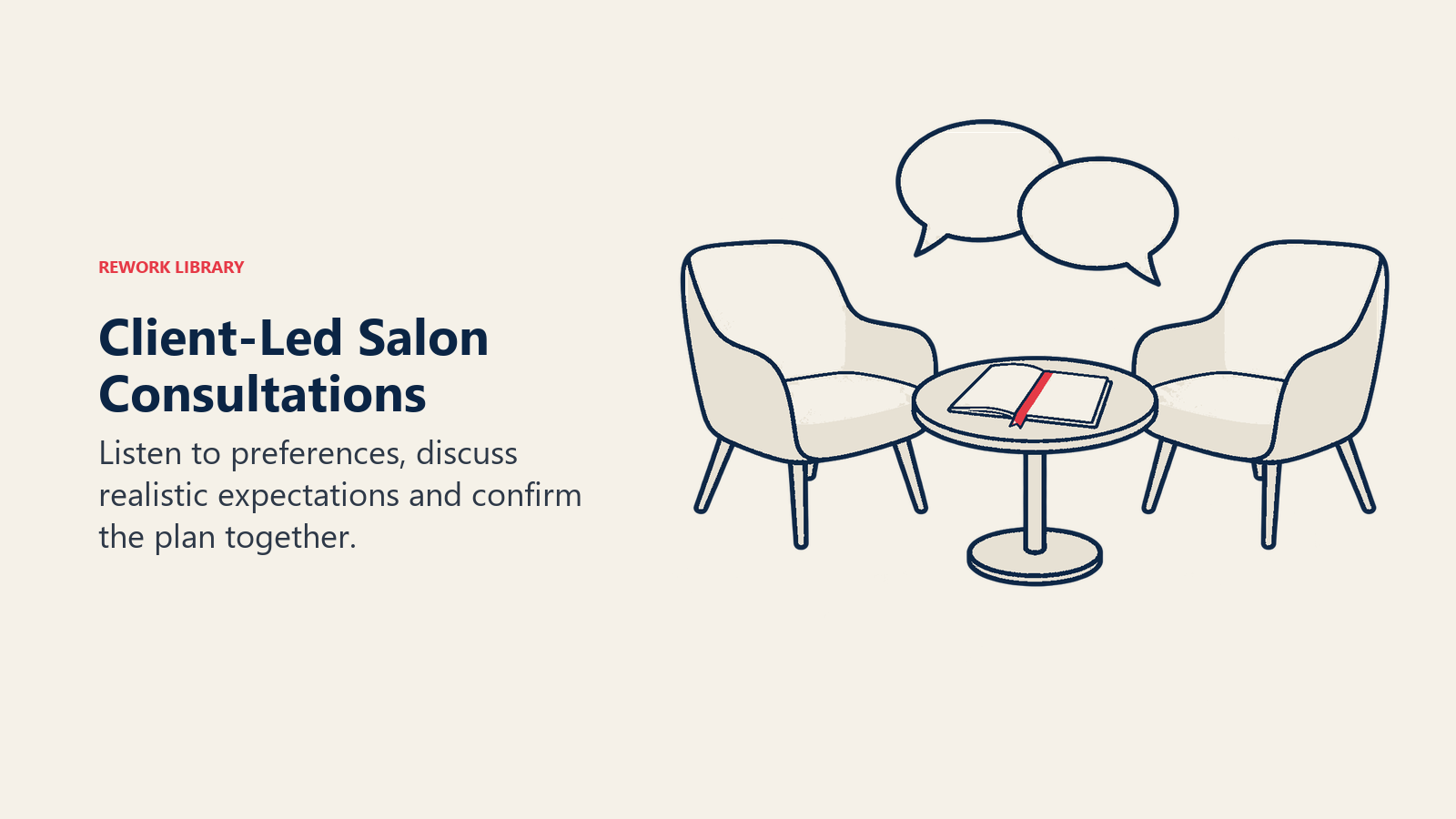
For new clients:
The new client consultation should take 5-10 minutes minimum. The questions aren't just about the service. They're about lifestyle, maintenance preferences, previous experiences, and what they want to feel like when they leave. "Walk me through what happened with your hair that made you decide to make a change" gives you far more useful information than "what are we doing today?"
A new client consultation should also include:
- Assessment of hair health, skin type, or nail condition
- Honest expectation-setting for what's achievable in one visit
- Product questions: what are they currently using at home?
- Lifestyle questions: how much time do they have for maintenance?
For returning clients:
The return consultation is about relationship continuity. It should demonstrate that you remember them. "Last time we talked about eventually going lighter. Are you still thinking about that?" signals that the client isn't just another appointment. This kind of memory, supported by notes in the client profile, is one of the most powerful retention tools available. CRM for salons and beauty centers makes this scalable. Client notes, formula history, and service preferences stored in a CRM mean any stylist can deliver a personalized consultation even if the regular stylist is unavailable.
Consultation guide structure:
New clients:
- Welcome and introduction (2 min)
- Lifestyle and maintenance questions (3 min)
- Service discussion and goal setting (3 min)
- Expectation setting and timeline (2 min)
Returning clients:
- Reference to previous visit ("How did the [service] hold up?")
- Check-in on discussed goals or changes
- Today's plan confirmation
- Any new concerns or changes since last visit
Wait Time Management
Waiting is the most consistently frustrating part of any service experience. But it's not the wait itself that damages satisfaction. It's the unacknowledged wait.
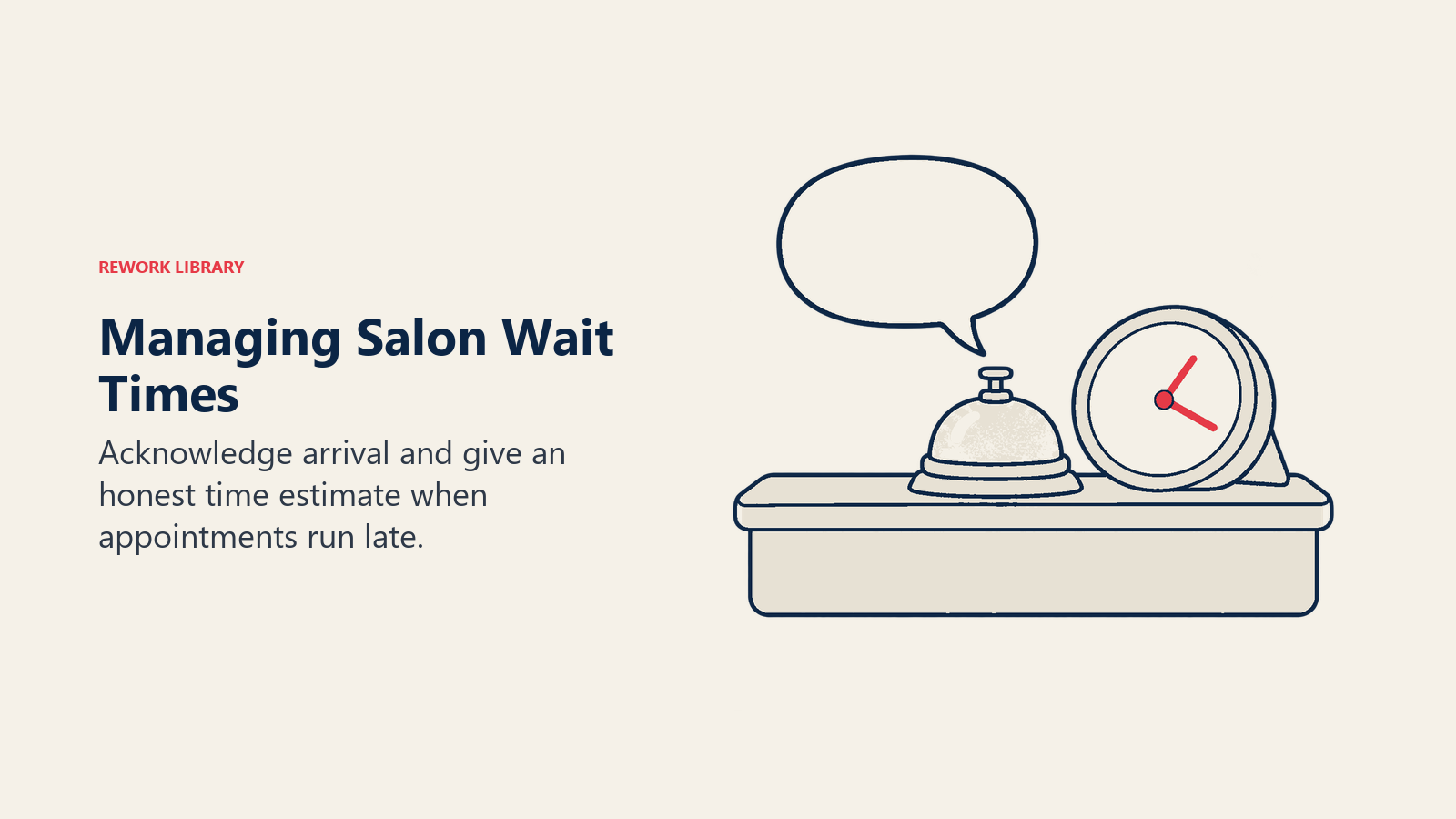
Research on service wait times shows that perceived wait duration is significantly reduced when:
- The client is acknowledged within 60 seconds of arriving
- They're given an estimated wait time
- Something of value occupies their attention during the wait
The most effective greeting protocol: every arriving client is acknowledged by name within 60 seconds, even if no one can assist them immediately. "Hi [Name], welcome! [Stylist] is just finishing up with her current client and will be with you in about 8 minutes. Can I get you a beverage while you wait?"
That single exchange transforms a frustrated wait into an acceptable one. The client feels seen. They have a timeframe. They have something to do.
Turning wait time into a touchpoint:
- Beverage service (still the highest-impact low-cost hospitality move in beauty)
- Digital intake forms on a tablet, which let clients complete consultation details while waiting and save time once the stylist is ready
- A curated lookbook or style guide relevant to their service, not just random magazines
- Product samples with a brief note from reception about what they are and what they're for
If you're running more than 10 minutes behind, the protocol matters more, not less. A personal acknowledgment from the stylist ("I'm so sorry for the wait. I really appreciate your patience and I'm going to make sure your time with me is worth it") almost always transforms frustration into goodwill. Proactive no-show and cancellation management reduces schedule disruptions that cause these delays in the first place.
Farewell & Follow-Up
The checkout is the last moment of the in-salon experience, and it's the moment most likely to be rushed. The client is happy, the work is done, the stylist is ready for the next appointment. Everyone moves quickly. And the farewell (the final sensory impression the client takes home) is often a hurried "thanks, see you!" while they're halfway out the door.
The checkout ritual that makes clients feel seen has these elements:
- A reveal moment: before the client sees themselves in the mirror, the stylist frames it: "I'm really happy with how this turned out, especially the [specific element]"
- A sincere, name-inclusive farewell: "It was great seeing you, [Name]. This color is going to look even better once it settles"
- A soft rebooking ask woven in naturally
- A parting gift if your brand supports it: a small product sample, a care card with aftercare instructions written in the stylist's handwriting
The follow-up in the 24 hours after the visit carries more retention weight than most owners realize. Clients who receive a personalized follow-up after their first visit are 70% more likely to return than those who don't hear anything. That follow-up should be specific, warm, and come from the stylist's name, not from a generic "Beauty Salon Team" sender. The full post-visit sequence (thank-you, aftercare tips, rebooking nudge) is covered in client communication and follow-up, which includes templates and timing guidance for each message type.
10-Point Client Experience Audit
Use this to assess where your current experience stands:
| Area | Question | Score (1-5) |
|---|---|---|
| Booking | Is online booking frictionless and confirmed immediately? | |
| Reminders | Are appointment reminders sent 48h and 24h before? | |
| Arrival | Is every client greeted by name within 60 seconds? | |
| Wait | Are clients given a wait estimate and offered a beverage? | |
| Consultation | Does the stylist reference previous visit details? | |
| Environment | Is scent, lighting, and music consistent and intentional? | |
| Cleanliness | Are stations visibly clean when clients arrive? | |
| Checkout | Is there a reveal moment before the client sees the mirror? | |
| Farewell | Is every client addressed by name at checkout? | |
| Follow-up | Does every new client receive a personalized thank-you within 24h? |
Score 40+: Strong experience with minor refinement needed. Score 30-39: Several gaps worth addressing systematically. Score below 30: Material experience gaps that are likely affecting retention.
HBR's research on the value of keeping the right customers puts the financial stakes in clear terms: a 5% increase in retention can lift profits by 25–95%. Experience audit scores translate directly into retention rates, which is why the lowest-scoring touchpoints deserve the earliest attention.
Run this audit honestly, then tackle the lowest-scoring items first. Small, consistent improvements compound significantly over 12 months. A salon that moves its experience audit score from 28 to 42 over one year typically sees 15-20% improvement in first-visit retention. Those retention gains translate directly into better rebooking rates for your salon, and eventually into the kind of word-of-mouth that drives sustainable growth.
The client experience isn't about hospitality instinct. It's about designing a system that delivers the right feelings at the right moments, consistently, regardless of which staff member is working.
Learn More

Senior Operations & Growth Strategist