Data-Driven Decisions for Salon Owners: KPIs That Matter
Turn this article into takeaways for your work.


Each assistant summarizes the article only for you and suggests best practices for your work.
A beauty center is a salon or spa that delivers grooming and aesthetic services such as hair, nails, skin, and treatments, run as a business. The owners who grow it track five numbers: occupancy rate, average ticket, client retention, new vs. returning ratio, and revenue per service hour. These KPIs turn a busy lot of appointments into clear operational decisions.
Consider two salons, both generating $650,000 per year. Same market, similar pricing, comparable staff size.
Salon A is growing. The owner knows that occupancy runs at 74% on weekdays and 91% on Saturdays. She knows her average ticket climbed from $82 to $94 over the past eight months. She knows that her 90-day client retention rate dropped three points last quarter and she's running a lapsed-client campaign specifically targeting that cohort.
Salon B is in quiet decline. The owner checks total revenue every month and feels comfortable because the number hasn't dropped. But she doesn't know that new client acquisition has slowed 22% year-over-year, that two of her stylists have below-average retention rates on their books, or that Tuesday and Wednesday afternoons are running at 41% occupancy while she's paying for full staff coverage.
Six months from now, Salon B's revenue problem will become obvious. By then, the compounding effects will take 12-18 months to reverse.
The difference between these two owners isn't intelligence or experience. It's what they measure and what they do with it. The right salon management software makes these metrics available in real time rather than requiring manual report compilation. McKinsey's State of Beauty analysis found that the beauty industry is growing at roughly 5% annually through 2030, meaning operators who track performance metrics and respond to them quickly will capture a disproportionate share of that growth.
Key Facts: Analytics in Salon Businesses
- Salons that track and act on occupancy, average ticket, and retention rate monthly grow revenue 2.1x faster than those that don't (Professional Beauty Association)
- Most salon owners track total revenue but only 31% consistently track client retention rate (Salon Today Annual Survey)
- A 5-point improvement in client retention rate increases annual revenue by 25-95%, depending on average ticket and visit frequency (Bain & Company retention research applied to service businesses)
The Bain & Company research underpinning that retention statistic was published in the Harvard Business Review classic Zero Defections: Quality Comes to Services, which remains one of the most cited studies on the financial impact of retention in service businesses. The compounding math applies directly to salons.
The Five KPIs That Actually Drive Growth
The beauty industry generates more data than most salon owners ever look at. The mistake is tracking too many metrics and acting on none. These five give you 90% of the insight you need:
1. Occupancy Rate
Formula: Booked appointment hours ÷ Total available staff-hours × 100
Example: 5 stylists each available 8 hours per day = 40 available hours. If 29 hours are booked, occupancy is 72.5%.
Benchmark: 70-80% is the healthy operating range. Below 65% indicates demand or scheduling problems. Above 85% indicates capacity constraints, which means growth requires adding staff or hours.
What it tells you:
Low occupancy (below 60%) signals one or more of: insufficient new client flow, high no-show rate, poor schedule management, or seasonal demand trough. Each requires a different intervention. A persistently high no-show rate will suppress occupancy regardless of booking volume, automated appointment reminders typically recover 40-60% of those lost slots.
High occupancy (above 85%) consistently is a different problem: you're turning away bookings or running staff ragged. The right response isn't "be happy with full books." It's asking whether you're priced correctly for the demand you're seeing, and whether adding a staff member or extending hours would generate more revenue than the additional cost.
Don't confuse seat occupancy with revenue. A stylist fully booked on $40 haircuts has 100% occupancy but poor revenue productivity. That's where average ticket enters the picture.
2. Average Ticket Value
Formula: Total service and retail revenue ÷ Number of appointments completed
Benchmark: Varies significantly by market and positioning. Track your own baseline and trend, not just industry averages. A 5% increase in average ticket on the same number of appointments is a 5% revenue increase with no additional client acquisition cost.
What it tells you:
Average ticket is the most sensitive leading indicator of upselling effectiveness and service mix. When average ticket drops without a corresponding change in service menu pricing, one of three things is happening: clients are downgrading services, staff aren't recommending add-ons, or promotional discounts are pulling average price down.
Segment average ticket by stylist, by service category, and by time period. A stylist with a significantly below-average ticket isn't necessarily underperforming. She might specialize in express services. But if a full-service stylist is consistently 20% below team average, that's a coaching conversation waiting to happen. Average ticket gaps often trace back to missed opportunities for upselling and cross-selling beauty services, a structured recommendation approach closes much of the gap.
3. Client Retention Rate
Formula: (Clients who returned within their service interval ÷ Total clients seen) × 100
Service interval definition: A haircut client on a 6-week cycle should rebook within 8 weeks to count as retained. A color client on a 7-week cycle has until week 10. Define your intervals by service type and measure against them, not against arbitrary 30/60/90-day windows.
Benchmark: A healthy salon retains 60-70% of clients within their expected service interval. Below 55% is a warning sign. Above 75% indicates strong loyalty and a well-functioning client relationship system.
What it tells you:
Retention is the compounding metric. A salon that keeps 70% of clients versus one that keeps 55% doesn't just have 15% more clients after year one. The difference compounds annually. After three years, the higher-retention salon has built a dramatically larger loyal client base from the same starting point.
Declining retention is often invisible in total revenue figures because new client acquisition masks the loss. But it's expensive to discover late. Track retention monthly, and investigate any drop of 3 or more points. A well-implemented CRM for salons and beauty centers surfaces lapsed clients automatically so you can act before the loss compounds.
4. New vs. Returning Client Ratio
Formula: New clients as a percentage of total clients seen per month
Benchmark: A mature, stable salon should see roughly 20-30% new clients and 70-80% returning clients per month. Newer salons (under 2 years) will see 40-60% new clients as they build their base.
What it tells you:
Too many new clients (above 40% for a salon over two years old) is a retention problem disguised as growth. You're constantly refilling a leaking bucket. The acquisition cost keeps rising as the returning base shrinks.
Too few new clients (below 15%) signals a stagnant acquisition channel. Referrals are slowing, social presence isn't generating leads, and the business is vulnerable to any attrition in its existing book.
The ratio also reveals where to invest. If retention is strong (returning clients above 75%) but growth is flat, the constraint is new client acquisition, channels like local SEO for beauty centers and referral programs address this directly. If new clients are flowing (above 30%) but retention is weak, the constraint is the first-visit experience and follow-up system.
5. Revenue Per Service Hour
Formula: Total service revenue ÷ Total service hours delivered
Benchmark: Calculate your current baseline, then track the trend. A color salon averaging $110 per service hour has a different business than a barbershop averaging $55. Neither is wrong, but both need to know their number.
What it tells you:
Revenue per service hour is the profitability metric that occupancy alone misses. A stylist who books three 30-minute haircuts at $45 each generates $270 in three hours and $90 per service hour. A stylist who books one 3-hour color treatment at $300 generates the same revenue in the same time (same revenue per service hour), but the first stylist's schedule is harder to fill while the second's carries more rebooking certainty.
Compare revenue per service hour across service categories to understand where your capacity is most profitably deployed. The IBISWorld Hair & Nail Salons industry analysis, covering over one million U.S. businesses, identifies revenue per hour as a key efficiency metric separating profitable single-location salons from those running at thin or negative margins on certain service lines.
Weekly and Monthly Reporting Cadence
The most common data failure isn't choosing the wrong metrics. It's setting up reports and never reviewing them, or reviewing them inconsistently.
Weekly review (15 minutes, Monday morning):
| Metric | This Week | Last Week | Target |
|---|---|---|---|
| Occupancy rate | 75%+ | ||
| Daily revenue vs. target | On track | ||
| No-show rate | Below 8% | ||
| New clients booked |
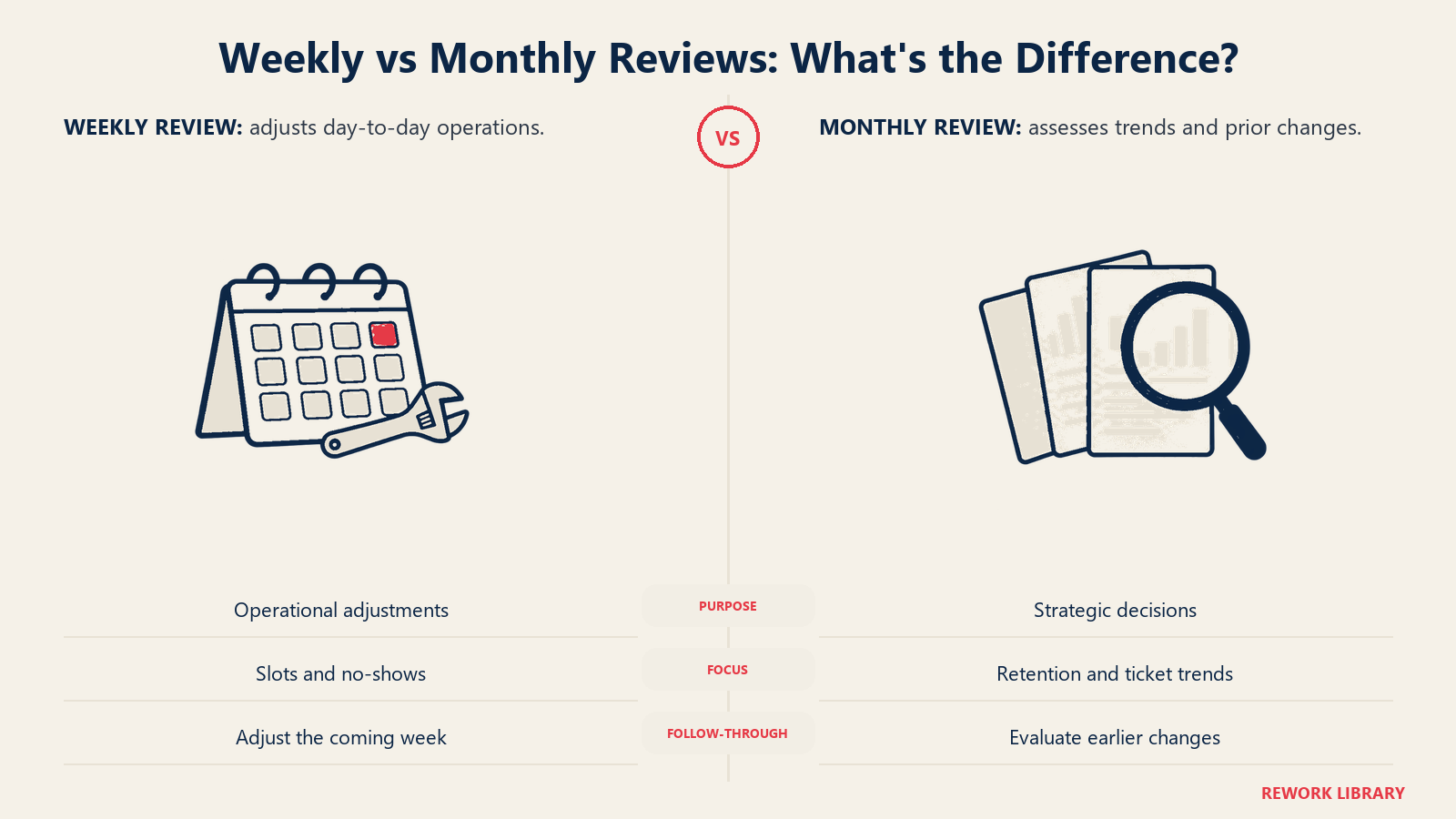
Weekly reviews are for operational adjustments: staffing the right slots, monitoring no-shows, catching scheduling problems before they become revenue problems.
Monthly review (30-45 minutes, first week of month):
| Metric | This Month | Prior Month | 3-Month Avg | Benchmark |
|---|---|---|---|---|
| Occupancy rate | 70-80% | |||
| Average ticket | Trend up | |||
| 90-day retention rate | 60-70%+ | |||
| New vs. returning ratio | 20-30% new | |||
| Revenue per service hour | Trend up | |||
| Retail as % of services | 10-20% |
Monthly reviews are for strategic decisions: identifying which metrics are trending in the wrong direction, determining which operational changes to make, and evaluating whether prior month's interventions worked.
Benchmarking Your Business
External benchmarks are useful reference points, not absolute standards. The Professional Beauty Association (PBA) salon insights platform, Salon Today's annual State of the Salon Industry survey, and NAILS Magazine annual statistics provide industry-level data. But a high-end color salon in a major metro shouldn't benchmark against the same averages as a budget haircut chain in a suburban strip mall.
The most reliable benchmark is your own historical data. Month-over-month and year-over-year comparisons tell you whether your business is improving, holding, or declining, regardless of what industry averages say. A retention rate of 62% that's been climbing from 55% over 18 months is a business heading in the right direction. A retention rate of 72% that's been declining from 80% is a business that needs attention, regardless of how it compares to industry averages.
Adjust for seasonality. January is not a fair comparison to December. August is not a fair comparison to May. Always compare same-period data when evaluating trends. Month over same month prior year is more meaningful than month over prior month for any metric with seasonal patterns.
Three Decision-Trigger Examples
Data is only valuable when it changes behavior. Here are three specific examples of metric movements and the decisions they should trigger:
Trigger 1: Retention rate drops 5 points in one quarter (from 68% to 63%)
Action: Immediately audit the lapsed client segment. How many clients haven't returned past their expected service interval? Run a targeted win-back campaign with a personalized offer. Simultaneously, review the post-visit follow-up sequence: is the 24-hour thank-you message going out? Is the rebooking prompt timing correctly?
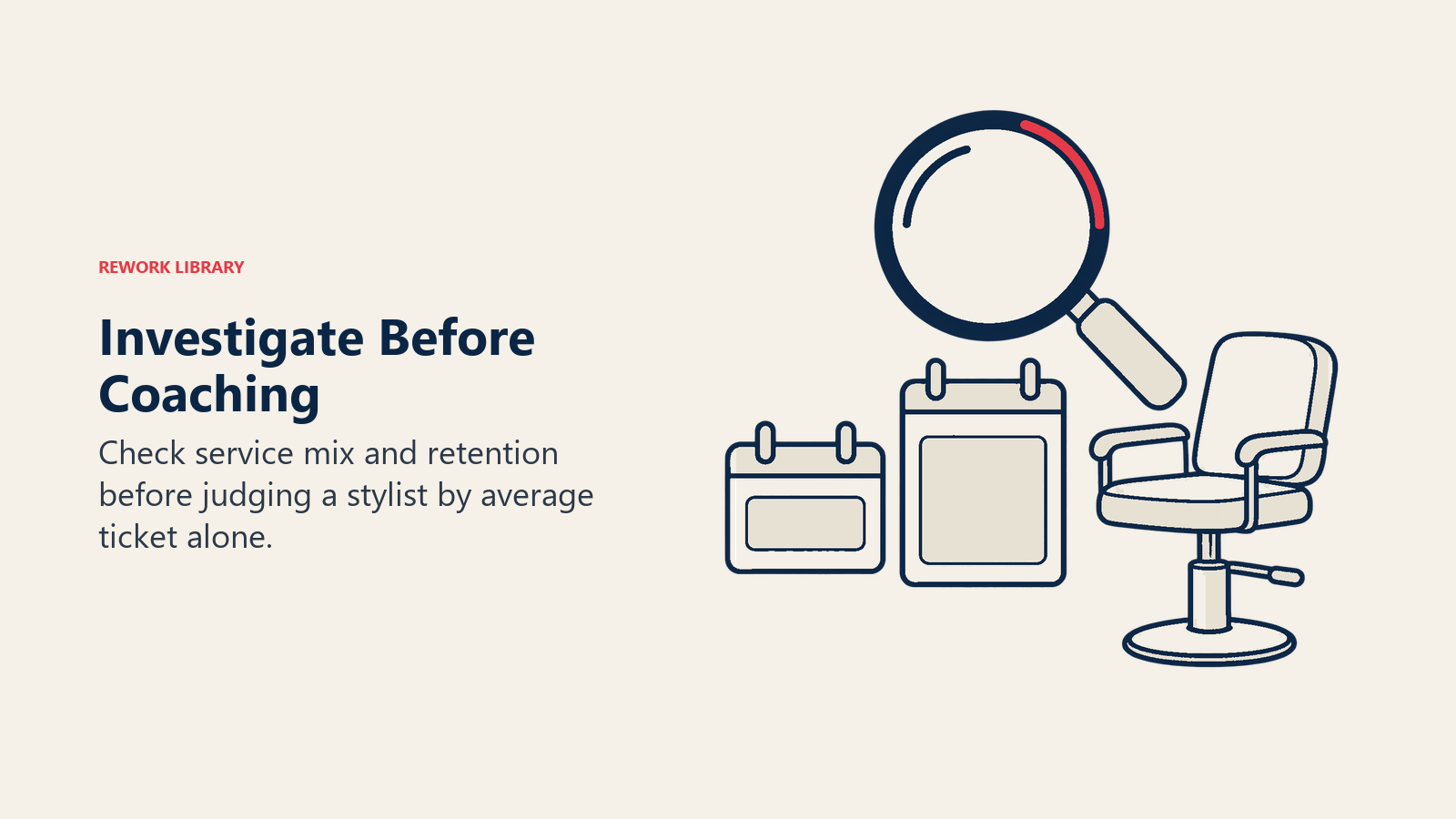
Trigger 2: One stylist's average ticket is consistently 18% below team average for three consecutive months
Action: Pull that stylist's service mix. Is she booking mostly express services that naturally carry lower tickets? If not, schedule a coaching session specifically on retail recommendation and service add-on communication. Consider pairing her with your highest-ticket stylist for a week to observe approach differences. Review her rebooking rate and retention rate for full context.
Trigger 3: Occupancy at 78% on weekdays but only 55% on Tuesdays and Wednesdays
Action: Before adding staff or capacity, fill the gap first. Consider a midweek promotion (value-add, not discount) targeted at clients who typically book weekends. Staff scheduling for salons and spas covers how to stagger coverage across the week to match actual demand patterns rather than standard full-time blocks. Shift the next new staff hire to a part-time Tuesday/Wednesday schedule rather than full-time, to fill the specific gap without adding full overhead.
Common Data Mistakes
| Mistake | Why It Happens | How to Fix It |
|---|---|---|
| Tracking 15+ metrics | Software shows everything; owners don't want to miss anything | Cut to 5 core metrics; add others only when a specific decision requires them |
| Comparing December to January | Intuitive comparison to prior month | Always compare to same month prior year for trend analysis |
| Acting on one data point | A single bad week triggers anxiety | Use 3-month rolling averages for all trend decisions |
| Ignoring stylist-level data | Feels uncomfortable to evaluate individual performance | Frame it as coaching support, not surveillance; low performers benefit from targeted help |
| Treating revenue as the only metric | Revenue is easy to measure | Revenue is a lagging indicator; retention and occupancy lead it by months |
| Confusing correlation with causation | Occupancy went up the same month you ran a promotion | Control for other variables before attributing causation; test before concluding |
Building a Data Practice That Fits Your Business
A 4-stylist salon doesn't need a data analyst. A 15-stylist multi-location operation might. Between those poles, the right data practice is one that's simple enough to actually happen and specific enough to actually inform decisions.
The minimum viable practice: five core metrics, reviewed on a consistent weekly/monthly cadence, with at least one operational decision made each month based on what the numbers show. That's it.
The goal isn't to run more reports. It's to run fewer, better ones, and to build the discipline of acting on what they tell you. The salons that get this right don't feel like they're drowning in spreadsheets. They feel like they're steering the business with their eyes open.
Frequently Asked Questions
What is a beauty center?
A beauty center is a salon or spa business that provides aesthetic and grooming services such as haircuts, coloring, nails, facials, waxing, and skin treatments. It earns revenue per appointment and per retail product sold, which is why owners track service and client metrics rather than a single revenue figure.
What KPIs should a salon owner track?
Five metrics give you most of the insight: occupancy rate (70 to 80% is healthy), average ticket value, client retention rate (60 to 70% within the service interval), the new vs. returning client ratio (roughly 20 to 30% new for a mature salon), and revenue per service hour. Track these on a weekly and monthly cadence.
What is a good salon client retention rate?
A healthy salon retains 60 to 70% of clients within their expected service interval. Below 55% is a warning sign. Above 75% signals strong loyalty. A 5-point improvement in retention can lift annual revenue by 25 to 95%, because returning clients compound over time.
How often should I review salon metrics?
Run a 15-minute weekly review for operational adjustments (occupancy, no-shows, daily revenue vs. target) and a 30 to 45 minute monthly review for strategic decisions (retention, average ticket trend, revenue per hour). Compare each metric to the same period last year, not just the prior month, to control for seasonality.
Learn More

Senior Operations & Growth Strategist
On this page
- The Five KPIs That Actually Drive Growth
- 1. Occupancy Rate
- 2. Average Ticket Value
- 3. Client Retention Rate
- 4. New vs. Returning Client Ratio
- 5. Revenue Per Service Hour
- Weekly and Monthly Reporting Cadence
- Benchmarking Your Business
- Three Decision-Trigger Examples
- Common Data Mistakes
- Building a Data Practice That Fits Your Business
- Frequently Asked Questions
- Learn More