Package Deals & Bundles: Increasing Average Ticket in Your Beauty Business
Turn this article into takeaways for your work.


Each assistant summarizes the article only for you and suggests best practices for your work.
A beauty center is a salon or spa that offers multiple grooming and wellness services under one roof, and a package deal bundles several of those services, or several visits of one service, into a single prepaid price. Bundles raise the average ticket, bring cash in before services are delivered, and turn occasional clients into committed regulars, which is why they are one of the fastest ways to grow revenue without finding new clients.
A client who books a single blowout is worth $50 today. A client who buys a 10-session prepaid blowout package is worth $450 upfront, and they'll be back nine more times. The second scenario doesn't just improve today's revenue; it locks in future visits, improves cash flow predictability, and deepens the client relationship in a way that single-session bookings simply don't.
Bundles and packages are one of the fastest ways to increase revenue without acquiring new clients. HBR's analysis on bundled pricing shows that bundles increase revenue per customer by simplifying choices and increasing perceived value, but design matters. Most salons either don't offer them at all, or they design them poorly: discounting too steeply, failing to communicate the value clearly, or choosing combinations that don't naturally make sense together.
Done right, a bundle strategy does three things at once: it increases your average transaction value, gives you cash in hand before services are delivered, and converts occasional clients into committed regulars. For salons looking to take this a step further, membership models for spas and salons extend the commitment model from a fixed package into ongoing recurring revenue.
Key Facts: Service Packages in Beauty
- Clients who purchase service packages visit 2.3x more frequently than non-package clients (Mindbody Business Intelligence, 2024)
- Prepaid packages improve a salon's monthly cash flow predictability by an average of 34% (Beauty Business Report, 2024)
- A 10–15% bundle discount generates 60–70% package adoption rates while protecting margin
Types of Beauty Packages and When to Use Each
Not all packages serve the same purpose. Understanding which type fits which situation prevents the common mistake of applying one format everywhere.
Service combination packages
Two or three complementary services combined into a single booking at a slight discount. The goal is to introduce clients to services they wouldn't have booked independently while making both services feel like a cohesive experience.
Best for: converting single-service clients into multi-service clients, building client lifetime value, introducing new services.
Prepaid visit packages
The client pays upfront for a series of the same service (5, 10, or 12 visits). They get a discount per session; you get cash now and 9 more guaranteed visits.
Best for: maintenance services with regular cadence (blowouts, nail fills, brow shaping, facials).
Wedding and event packages
Full-day or multi-session packages built around a specific event. These are typically the highest-ticket packages a salon sells and involve multiple service categories.
Best for: maximizing revenue from high-commitment clients, filling capacity around event dates.
Maintenance programs
Monthly or quarterly treatment plans that commit the client to a service schedule. Similar to memberships but usually structured as a fixed number of visits rather than recurring monthly billing.
Best for: skincare, hair treatment programs, specialty services with a progressive treatment protocol.
Service Combination Packages: Designing Complementary Pairings
The most effective combination packages feel inevitable. The two services clearly belong together. The worst feel like they were bundled because they happened to be on the same menu.
Natural pairings that work
- Haircut + blowout (already done in sequence, package formalizes the bundle)
- Full-color + conditioning treatment (color damage addressed in the same visit)
- Manicure + pedicure (hands and feet, natural pairing)
- Facial + eyebrow tidy or brow lamination
- Body treatment + massage or wrapping service
Cross-category bundles that expand client experience
More ambitious bundles pair services clients might not have combined independently. A "Head to Toe" package combining a blowout, gel manicure, and pedicure works because clients see the holistic logic. A spa day package combining a facial, massage, and body scrub makes narrative sense.
Cross-category bundles are powerful for introducing clients to service categories they've never tried in your salon. A hair client who's never had a facial is unlikely to book one separately, but they might say yes to a "Hair + Skin Refresh" package that includes both. This is also a natural application of upselling and cross-selling beauty services, where the bundle structure gives staff a low-pressure way to introduce complementary services during the consultation.
Naming matters
"Hair + Nails Combo" feels transactional. "Signature Beauty Session" feels elevated. The name is part of the perceived value. This connects to the broader principle that how customers perceive a price is as important as the price itself, and framing a bundle as a curated experience, rather than a discount, shifts the client's reference point entirely. Avoid "combo" or "deal" language in premium positioning. Use words that suggest experience and expertise: "Signature," "Restore," "Refresh," "Ritual," "Revive."
Setting the right discount level
The discount on combination packages should feel like genuine value without eroding margin beyond recovery. The typical sweet spot is 10–15% off the combined a la carte price. Below 10%, clients don't perceive meaningful value. Above 20%, you've discounted your margin unnecessarily and set a price anchor that's hard to maintain. The right discount level is closely tied to your underlying pricing strategies for beauty centers, particularly your margin per service hour, which determines how much you can offer without eroding profitability.
Prepaid Visit Packages: Cash Flow and Commitment
Prepaid packages solve two problems simultaneously: they give you revenue now, and they eliminate the uncertainty of whether a client will rebook.
Structuring the discount
The industry norm is 10–15% off the individual session price. A single blowout at $55 becomes $49.50 per session in a 10-pack, totaling $495 upfront. The client saves $55 over the full series. You receive $495 now instead of $55 spread over 10 months.
The business case for this trade-off is clear: a bird in hand. McKinsey's research on the power of pricing notes that pricing structure choices, including prepayment and bundling, can have a more immediate impact on operating profit than volume increases. Immediate cash has a time value, and the certainty of 10 visits from this client versus the probability of them rebooking each time individually is worth the 10% discount.
Expiry terms
Packages need expiry dates to prevent indefinite liability. Standard terms: 6 months for 5-session packages, 12 months for 10-session packages. At expiry, unused sessions typically forfeit or are converted to a credit at a percentage of their value.
Be transparent about expiry when selling. A client who discovers their package expired and they lost sessions will not come back, and they'll tell people. Clear communication upfront is worth more than the short-term gain of unclear terms.
When to sell prepaid packages
The best moment to present a prepaid package is at the point of first booking, particularly if the client is booking a service they're likely to need regularly. "I notice you're coming in for a blowout. We have a 10-session package that saves you $55. Want me to add that?" works better at booking than at checkout, because clients haven't spent anything yet and are mentally more open to a larger initial commitment. Your online booking optimization setup can prompt package offers automatically during the checkout flow, removing the need for staff to remember to raise it every time.
Prepaid Package Terms Template
Valid for [X] months from date of purchase. Non-transferable between clients. [Unused sessions forfeit upon expiry / may be converted to store credit at 50% value]. Sessions booked subject to standard cancellation policy.
Bundle Profitability: The Math Before the Offer
Every bundle needs to be profitable, not just revenue-positive. Work through the numbers before you launch any package.
Bundle profitability calculation
| Element | Single Session | 10-Session Package |
|---|---|---|
| Service price | $55 | $495 ($49.50/session) |
| Discount | N/A | 10% ($55 savings) |
| Product cost per session | $5 | $50 total |
| Labor cost per session | $15 | $150 total |
| Net margin per session | $35 | $29.50 |
| Total margin (10 sessions) | $350 (potential) | $295 (guaranteed) |
The package generates $55 less in total margin than 10 individual bookings, but it guarantees 10 bookings will happen. If the realistic alternative is 10 individual sessions where only 6 happen (a 60% rebooking rate), the package generates $295 guaranteed vs $210 likely. That's $85 more in real-world terms.
Minimum margin threshold
Define a minimum acceptable margin per bundle before launching. If a proposed bundle generates less than $20 per session after product and labor costs, revisit the pricing or the service combination.
Wedding and Event Packages: High-Ticket, High-Commitment Sales
Wedding packages are some of the highest-value sales a salon makes. A bridal party of 5 on a wedding day can generate $800–2,500 from a single client relationship.
Package components that work
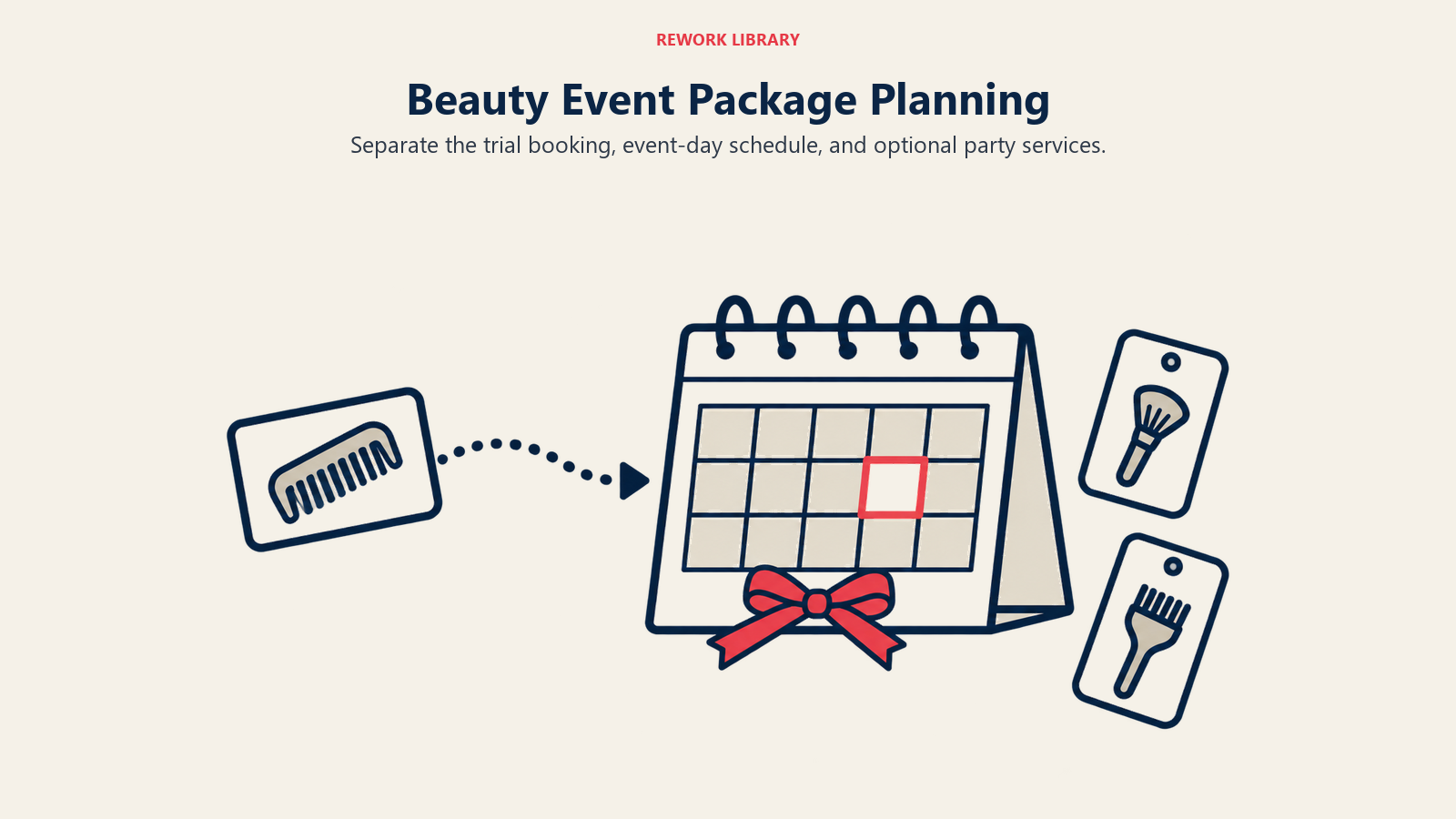
A well-structured bridal package includes: a trial appointment (hair and makeup run-through), the wedding day appointment, and optional inclusions for the bridal party. Each component has a clear price and what's included.
Why the package wins over a la carte
Brides are making purchasing decisions under significant stress and with high stakes. A clearly defined package removes uncertainty about final cost and simplifies decision-making. The U.S. spa and beauty salon industry generates over $69 billion annually, with event and bridal services representing some of the highest-value individual transactions in the market. An a la carte menu requires calculating 15 individual line items. A "Complete Bridal Experience" package at $850 is easier to say yes to. Event packages also pair naturally with seasonal promotions for beauty businesses during peak event seasons, where targeted campaigns can generate inquiries months in advance.
Deposit and cancellation structures
Wedding packages require a non-refundable deposit, typically 30–50% of the package value, at booking. This protects your business from last-minute cancellations that are impossible to fill. Standard cancellation terms: full refund minus deposit within 90 days of the event; no refund within 90 days.
Seasonal Bundles: Matching Demand Cycles
Seasonal bundles serve two purposes: they capitalize on high-demand periods and they move capacity in slow ones.
A Seasonal Bundle Calendar
| Season | Bundle Idea | Primary Goal |
|---|---|---|
| January–February | "New Year Refresh" (cut + color + conditioning) | Fill post-holiday slow period |
| March–April | "Spring Renewal Facial" (deep cleanse + brightening) | Capitalize on seasonal self-care motivation |
| May–June | "Wedding Season Ready" (styling + mani/pedi) | Ride wedding demand |
| July–August | "Summer Glow" (tan, body treatment, express facial) | Upsell in high-traffic period |
| September | "Back to Routine" (cut + color, monthly facial plan) | Capture routine re-establishment mindset |
| October–December | "Holiday Ready" (blowout package, gift sets) | Gift card revenue + holiday appointments |
Limited-time framing
Seasonal bundles work because they're time-limited. "Our Summer Glow package is available through August 31" creates urgency that a permanent menu item can't. Use countdown language in your email campaigns and social media to reinforce the window.
Gift-Worthy Packages: Turning Bundles into Retail
Packages bundled as gift certificates represent a distinct revenue opportunity. They bring in payment today and a new client (or a returning client) sometime in the next 12 months.
Packaging matters for gifting
A digital gift card emailed in a branded template works. A physical gift card in a nice envelope with the package details printed on card stock works better for in-person gifting occasions (Mother's Day, Christmas, birthdays). The perceived value of a physical gift is higher.
The dual benefit of gift packages
When someone buys a package as a gift, they pay you now. When the recipient redeems it, you have an opportunity to convert them into a loyal client. A Mother's Day "Pamper Package" given to someone who's never been to your salon is effectively a complimentary introduction, funded by the gift-giver. This overlap with gift revenue makes bundled packages a key component of any gift card and voucher program strategy, where packaging and perceived value matter as much as the price point.
Tracking Bundle Redemption: Keeping Operations Clean
Packages create operational complexity. Someone needs to know who has active packages, how many sessions they've used, and when they expire.
Most booking platforms (Vagaro, Mindbody, Boulevard, Fresha) have built-in package tracking. Use it. Staff should see a client's active package status before every appointment. This prevents double-charging, ensures accurate session deduction, and allows proactive communication when a package is running low. A salon management software guide can help you evaluate which platform handles package redemption, expiry tracking, and client notifications most reliably for your business size.
Reactivation for expiring packages
Send an automated message 30 days before a package expires: "Your [X]-session package expires on [date]. You have [Y] sessions remaining, so let's get them booked." This message consistently generates appointment bookings from clients who'd let the package lapse. Combining this with loyalty programs for beauty centers creates a parallel retention system: packages keep clients committed in the short term, while loyalty rewards build long-term behavioral change.
Frequently asked questions
What does "beauty center" mean? A beauty center is a salon or spa that delivers several beauty and wellness services, such as hair, nails, facials, and body treatments, in one location. Package deals combine those services, or repeat visits of one service, into a single prepaid offer.
What discount should a beauty package offer? The typical sweet spot is 10 to 15 percent off the combined a la carte price. Below 10 percent clients perceive little value; above 20 percent you erode margin and set a price anchor that is hard to maintain.
Are prepaid packages better than single bookings? For maintenance services, yes. A 10-session prepaid package secures the cash upfront and guarantees the visits, so even at a 10 percent discount it usually beats the realistic rebooking rate of individual sessions.
Should beauty packages have an expiry date? Yes. Standard terms are 6 months for 5-session packages and 12 months for 10-session packages. Be transparent about expiry at the point of sale to protect the client relationship.
Learn More

Senior Operations & Growth Strategist
On this page
- Types of Beauty Packages and When to Use Each
- Service Combination Packages: Designing Complementary Pairings
- Prepaid Visit Packages: Cash Flow and Commitment
- Bundle Profitability: The Math Before the Offer
- Wedding and Event Packages: High-Ticket, High-Commitment Sales
- Seasonal Bundles: Matching Demand Cycles
- Gift-Worthy Packages: Turning Bundles into Retail
- Tracking Bundle Redemption: Keeping Operations Clean
- Frequently asked questions
- Learn More