Teori Dua Faktor Herzberg tentang Motivasi
Turn this article into takeaways for your work.


Each assistant summarizes the article only for you and suggests best practices for your work.
Teori dua faktor Herzberg ialah salah satu kerangka yang paling banyak dirujuk dalam penyelidikan motivasi, dan sebaik sahaja anda memahaminya, anda tidak akan berfikir tentang penglibatan pekerja dengan cara yang sama lagi. Frederick Herzberg menerbitkannya pada tahun 1959 selepas menemubual 200 jurutera dan akauntan di Pittsburgh, meminta mereka menerangkan saat-saat apabila mereka berasa sangat baik atau sangat teruk di tempat kerja. Apa yang ditemuinya mengejutkannya, dan ia masih mengejutkan pengurus hari ini: perkara yang membuat orang tidak bahagia di tempat kerja hampir sepenuhnya berbeza daripada perkara yang membuatkan mereka bermotivasi.
Apakah Teori Dua Faktor Herzberg?
Teori dua faktor Herzberg mencadangkan bahawa kepuasan kerja dan rasa tidak puas hati dalam kerja bukan dua hujung bertentangan pada satu skala. Ia didorong oleh dua set faktor yang berbeza sepenuhnya.
Frederick Herzberg, seorang ahli psikologi Amerika, membangunkan teori ini dalam buku The Motivation to Work tahun 1959. Tuntutan terasnya: menghilangkan apa yang membuat pekerja tidak bahagia tidak secara automatik membuat mereka bermotivasi. Ia hanya menjadikan mereka neutral. Untuk mendapat motivasi yang tulen, anda memerlukan satu set syarat yang berbeza dan berasingan.
Beliau menamakan kedua-dua set itu sebagai faktor kebersihan dan faktor motivasi.
Fakta Utama
- Kajian asal Herzberg melibatkan 200 jurutera dan akauntan dan diterbitkan pada tahun 1959 (Herzberg, Mausner & Snyderman, The Motivation to Work, 1959).
- Penyelidikan Gallup mendapati hanya 23% pekerja di seluruh dunia aktif terlibat dalam kerja, sementara 62% tidak terlibat (Gallup State of the Global Workplace, 2024).
- Syarikat dengan pekerja yang sangat terlibat menunjukkan keuntungan 23% lebih tinggi berbanding mereka yang mempunyai penglibatan rendah (Gallup, 2024).
Faktor Kebersihan vs Faktor Motivasi
Wawasan utama teori ini ialah perbezaan antara dua kategori ini.
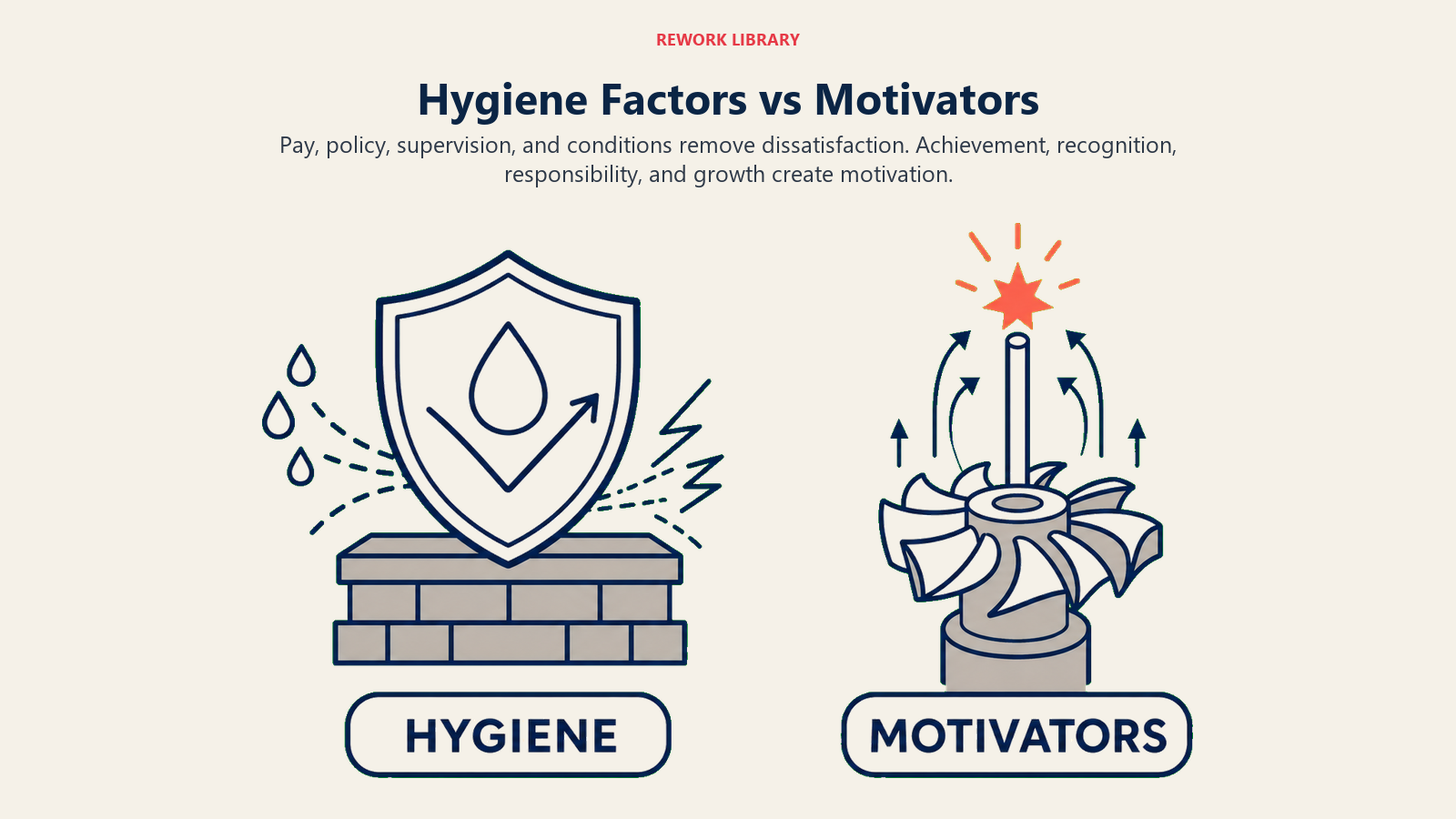
Faktor kebersihan ialah syarat asas sesebuah pekerjaan. Apabila ia tidak ada atau lemah, pekerja menjadi tidak puas hati dan tidak terlibat. Tetapi apabila ia hadir dan mencukupi, ia tidak memotivasikan sesiapa pun. Ia hanya menghalang rasa tidak puas hati. Fikirkan faktor kebersihan seperti paip dalam sebuah bangunan: anda menyedarinya apabila ia rosak, tetapi tiada siapa yang teruja dengan paip yang berfungsi.
Faktor motivasi ialah faktor yang berkaitan dengan kandungan kerja itu sendiri. Apabila hadir, ia menjana kepuasan, penglibatan, dan dorongan yang tulen. Inilah sebab seseorang tinggal lewat bukan kerana terpaksa tetapi kerana mereka mahu menyiapkan sesuatu yang bermakna.
| Kategori | Contoh | Kesan |
|---|---|---|
| Faktor Kebersihan | Gaji, keselamatan kerja, polisi syarikat, keadaan kerja, kualiti penyeliaan, hubungan rakan sebaya, status | Ketiadaan menyebabkan rasa tidak puas hati. Kehadiran membawa kenetralan, bukan motivasi. |
| Faktor Motivasi | Pencapaian, pengiktirafan, kerja itu sendiri, tanggungjawab, kemajuan, pertumbuhan peribadi | Kehadiran mendorong kepuasan dan motivasi dalaman. Ketiadaan membawa kepada sikap tidak peduli, bukan rasa tidak puas hati yang aktif. |
Perbezaan ini sangat penting dalam amalan. Ramai pengurus cuba memotivasikan pasukan mereka dengan meningkatkan gaji atau menambah faedah. Penyelidikan Herzberg mengatakan langkah-langkah tersebut boleh menghilangkan sumber rasa kecewa, tetapi tidak boleh mewujudkan penglibatan yang tulen. Itu memerlukan satu set tindakan yang berbeza sepenuhnya.
Herzberg vs Hierarki Maslow
Teori Herzberg berkait rapat dengan hierarki keperluan Maslow. Kedua-dua teori berkaitan dengan motivasi manusia di tempat kerja, dan kedua-dua kerangka saling melengkapi. Tetapi mereka membingkai masalah secara berbeza.
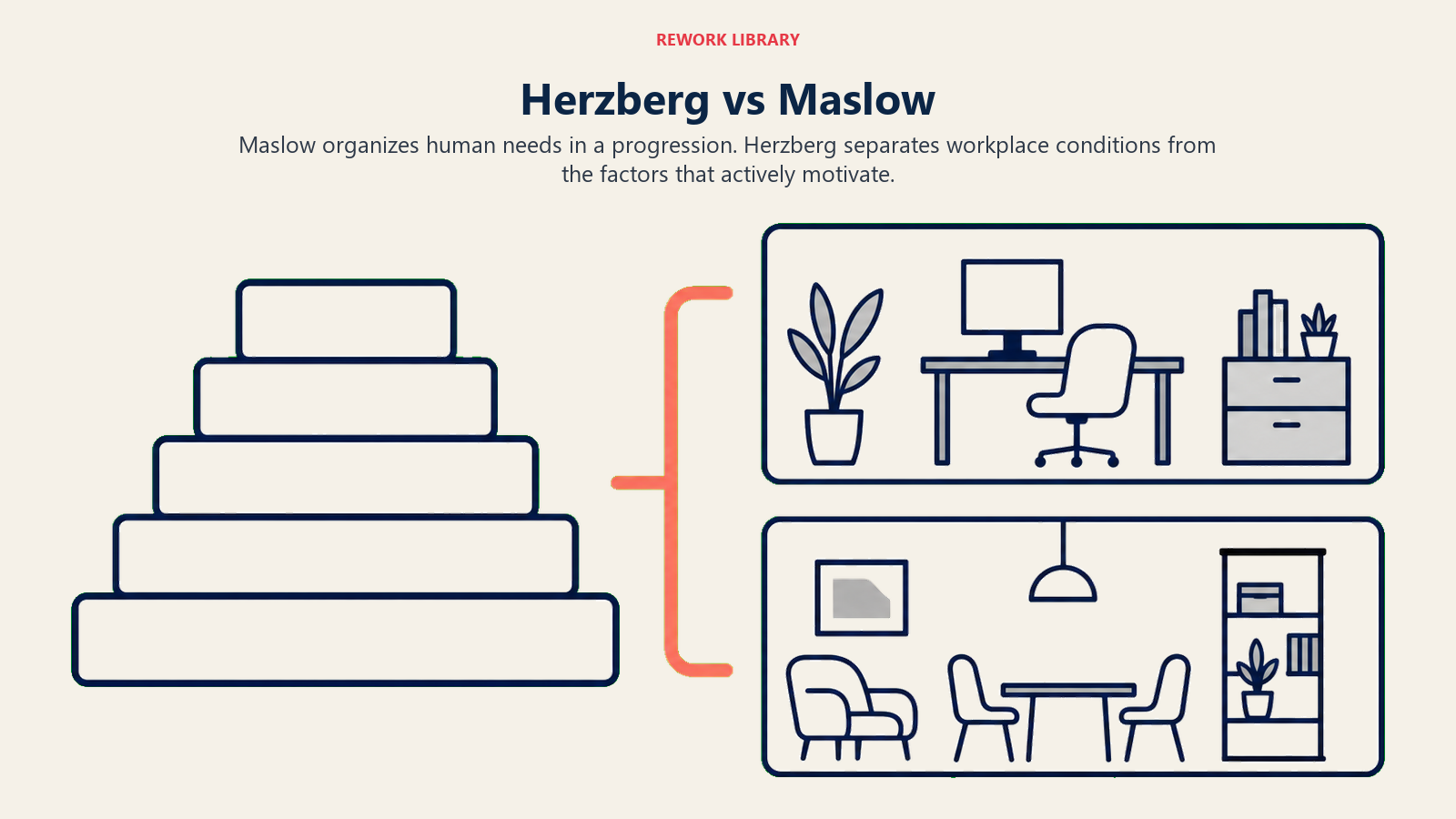
Maslow menggambarkan motivasi sebagai hierarki keperluan yang bergerak ke atas dari kelangsungan hidup asas hingga ke aktualisasi diri. Sebaik sahaja keperluan yang lebih rendah dipenuhi, ia berhenti memotivasikan dan tahap seterusnya menjadi relevan. Herzberg mengambil sudut pandang yang berbeza. Beliau tidak menyusun motivasi ke dalam piramid. Sebaliknya, beliau memisahkan dua proses selari: satu yang menghalang kesakitan dan satu yang mewujudkan makna.
| Dimensi | Teori Dua Faktor Herzberg | Hierarki Keperluan Maslow |
|---|---|---|
| Idea teras | Dua dimensi bebas: kebersihan (menghilangkan rasa tidak puas hati) dan motivasi (mewujudkan kepuasan) | Piramid lima keperluan, setiap tahap diaktifkan sebaik sahaja keperluan yang lebih rendah dipenuhi |
| Diterbitkan | 1959 | 1943 |
| Apa yang memotivasikan | Faktor dalaman: pencapaian, pertumbuhan, kerja itu sendiri | Pergerakan ke atas hierarki ke arah harga diri dan aktualisasi diri |
| Apa yang menyahkan motivasi | Kegagalan kebersihan: pengurusan yang buruk, gaji rendah, keadaan tidak selamat | Keperluan tahap rendah yang tidak dipenuhi: keselamatan, kepunyaan, jaminan |
| Implikasi pengurusan | Baiki kebersihan dahulu, kemudian bina faktor motivasi | Kenal pasti tahap mana pekerja tersekat dan atasi tahap tersebut |
| Hubungan antara faktor | Kepuasan dan rasa tidak puas hati adalah skala bebas | Kepuasan dan rasa tidak puas hati berada di hujung berlawanan satu skala |
Perbezaan praktikal: Maslow mengatakan sebaik sahaja anda membayar seseorang cukup untuk memenuhi keperluan asas mereka, wang tidak lagi memotivasikan mereka. Herzberg bersetuju, tetapi melangkah lebih jauh. Beliau mengatakan gaji yang mencukupi tidak memotivasikan walaupun pada masa anda memberikannya. Ia hanya menghalang rasa tidak puas hati. Motivasi sentiasa datang dari kandungan kerja itu sendiri.
Mengapa Teori Dua Faktor Penting bagi Pemimpin
Sebab teori ini kekal selama lebih 60 tahun ialah ia membetulkan kesilapan pengurusan yang berterusan.
Kebanyakan organisasi menghabiskan jumlah masa, wang, dan tenaga yang tidak seimbang pada faktor kebersihan. Pakej faedah yang lebih baik. Pejabat yang lebih selesa. Polisi kerja dari rumah yang fleksibel. Faedah seperti makan tengah hari percuma atau keahlian gim. Tiada satu pun daripada ini adalah idea yang buruk. Tetapi jika ia adalah strategi utama untuk meningkatkan penglibatan, ia tidak akan berkesan.
Kerangka Herzberg menerangkan mengapa pekerja bergaji tinggi di syarikat yang berupaya masih boleh tidak terlibat. Kotak kebersihan ditanda, tetapi tiada siapa yang menangani faktor motivasi: sama ada orang mempunyai kerja yang bermakna, sama ada mereka berkembang, sama ada mereka mempunyai pemilikan tulen atas sesuatu yang penting.
Ini berkait terus dengan bagaimana teori kepimpinan telah berkembang. Peralihan daripada pendekatan transaksi kepada transformasi pada dasarnya ialah peralihan daripada pengurusan kebersihan kepada pengurusan faktor motivasi. Lihat kepimpinan transformasi berbanding kepimpinan transaksi untuk melihat bagaimana ini berlaku dalam amalan.
Bagi pengurus, teori ini menetapkan urutan yang jelas: baiki perkara yang menyebabkan rasa tidak puas hati dahulu, kemudian laburkan dalam perkara yang menjana motivasi. Melangkau langkah pertama tidak berkesan. Jika seseorang dibayar rendah atau bekerja di bawah penyelia yang kasar, tidak ada jumlah "kerja bermakna" yang akan mengimbanginya. Tetapi langkah pertama sahaja juga tidak mencukupi.
Cara Mengaplikasikan Teori Herzberg di Tempat Kerja
Berikut ialah urutan praktikal untuk mengaplikasikan kerangka ini:

1. Audit faktor kebersihan anda. Mulakan dengan melihat langsung pada perkara asas. Adakah gaji bersaing? Adakah polisi syarikat jelas dan adil? Adakah persekitaran kerja fizikal atau jauh berfungsi dan selamat? Adakah orang merasa cukup selamat dalam peranan mereka? Adakah hubungan interpersonal antara ahli pasukan dan penyelia secara amnya berfungsi? Baiki jurang yang jelas dahulu. Ini tidak memotivasikan untuk diselesaikan, tetapi kegagalan menyelesaikannya menyekat segalanya.
2. Kenal pasti sumber rasa tidak puas hati yang aktif. Jangan andaikan kebersihan baik hanya kerana tiada siapa yang mengadu dengan kuat. Jalankan tinjauan ringkas tanpa nama, adakan sesi 1:1 yang memberi tumpuan kepada rasa kecewa, dan pantau corak pusing ganti pekerja. Rasa tidak puas hati sering muncul dalam perolehan atau ketidakhadiran sebelum ia muncul dalam maklum balas.
3. Beralih kepada faktor motivasi melalui pengayaan kerja. Pengayaan kerja ialah preskripsi khusus Herzberg: reka bentuk semula peranan secara sengaja untuk menyertakan lebih banyak pencapaian, pengiktirafan, tanggungjawab, dan pertumbuhan. Ini berbeza daripada pembesaran kerja (hanya memberikan orang lebih banyak tugas jenis yang sama). Pengayaan bermakna memberi orang kerja yang mencabar mereka, pemilikan tulen atas hasilnya, dan pengiktirafan yang tulen apabila mereka menyampaikannya.
4. Berikan pengiktirafan yang khusus dan tepat waktu. Pengiktirafan ialah salah satu faktor motivasi terkuat Herzberg, dan ia tidak memerlukan kos. Tetapi ia hanya berkesan jika ia khusus. "Kerja bagus suku ini" ialah pengakuan tahap kebersihan. "Cara anda menyusun semula pembentangan pelanggan hari Selasa itu mengubah hasil urusan tersebut" ialah faktor motivasi.
5. Bina laluan kemajuan. Orang kekal terlibat apabila mereka dapat melihat hala tuju. Ini tidak semestinya bermakna kenaikan pangkat. Ia boleh bermakna tanggungjawab yang diperluaskan, projek baharu, kemahiran baharu, atau perbualan yang jelas tentang matlamat kerjaya. Ketiadaan mana-mana laluan adalah isyarat bahawa pertumbuhan (faktor motivasi) telah dibuang daripada pekerjaan itu.
6. Semak dan ulang. Keperluan motivasi berubah dari semasa ke semasa. Faktor motivasi pekerja baharu berbeza daripada faktor motivasi pekerja kanan. Bina titik sentuh yang kerap dalam irama pengurusan anda untuk menyemak tahap kebersihan dan motivasi.
Contoh Faktor Kebersihan dan Faktor Motivasi
| Faktor | Jenis | Contoh dunia nyata |
|---|---|---|
| Gaji bersaing | Kebersihan | Membayar pada atau melebihi kadar pasaran menghilangkan rasa tidak puas hati tetapi tidak meningkatkan usaha budi bicara |
| Keselamatan kerja | Kebersihan | Pekerja dengan kontrak tidak stabil sering berprestasi rendah tanpa mengira faktor lain |
| Polisi syarikat yang jelas | Kebersihan | Peraturan perbelanjaan yang kabur atau kriteria penilaian yang tidak jelas mewujudkan rasa kecewa latar belakang |
| Keadaan kerja yang baik | Kebersihan | Persediaan kerja jauh yang berfungsi, beban mesyuarat yang munasabah, ruang kerja fizikal yang selamat |
| Penyeliaan yang menyokong | Kebersihan | Pengurus yang tidak memantau terlalu rapat atau merendahkan menghilangkan sumber utama ketidakterlibatan |
| Pencapaian | Motivasi | Menyiapkan projek yang dihantar, menutup urusan, atau menyelesaikan masalah sebenar |
| Pengiktirafan | Motivasi | Pengakuan awam yang khusus atas sumbangan mengikut nama dan tindakan |
| Kerja itu sendiri | Motivasi | Kerja yang benar-benar menarik dan mencabar keupayaan seseorang |
| Tanggungjawab | Motivasi | Pemilikan atas produk, pelanggan, pasukan, atau hasilnya tanpa pengawasan berterusan |
| Kemajuan | Motivasi | Kenaikan pangkat, jawatan baharu, atau skop yang diperluaskan yang mencerminkan pertumbuhan |
| Pertumbuhan peribadi | Motivasi | Mempelajari kemahiran baharu, menjalankan jenis projek baharu, membimbing seseorang |
Jadual ini juga berguna sebagai alat diagnostik. Jika anda kehilangan seseorang dan ingin memahami mengapa, telusuri kedua-dua lajur dan tanya faktor mana yang tidak ada dalam peranan semasa mereka.
Kritikan dan Keterbatasan
Teori Herzberg mempunyai kelemahan yang nyata. Penting untuk memahaminya sebelum memperlakukan kerangka ini sebagai preskripsi sejagat.

Kritikan metodologi. Kajian asal menggunakan sampel kecil dan homogen (jurutera dan akauntan, semuanya orang Amerika, kebanyakannya lelaki) pada tahun 1959. Pengkritik berhujah bahawa penemuan mungkin tidak boleh digeneralisasikan merentasi budaya, industri, atau jenis kerja. Beberapa percubaan untuk meniru hasilnya dalam konteks berbeza menghasilkan penemuan yang tidak konsisten.
Kecenderungan atribusi. Kaedah penyelidikan meminta orang mengingat kembali pengalaman baik dan buruk di tempat kerja. Orang secara semula jadi mengatributkan pengalaman baik kepada usaha mereka sendiri dan pengalaman buruk kepada kekuatan luar. Kecenderungan ini mungkin telah mengembungkan peranan faktor motivasi dalaman secara buatan dan membesar-besarkan keasingan kedua-dua kategori.
Variasi individu. Tidak semua orang dimotivasikan oleh perkara yang sama. Sesetengah orang benar-benar lebih mengambil berat tentang keselamatan kerja berbanding pencapaian. Yang lain mendapati pengiktirafan tidak selesa dan lebih suka autonomi. Kerangka Herzberg mempersembahkan struktur dua faktor sebagai sejagat, tetapi motivasi sebenar lebih bersifat individu daripada itu.
Masalah pertindihan. Garis antara kebersihan dan faktor motivasi tidak sentiasa jelas. Gaji, sebagai contoh, boleh menjadi isyarat pengiktirafan (kenaikan gaji sebagai pengakuan prestasi) dan faktor kebersihan secara serentak. Kerangka ini tidak menangani kes-kes yang samar-samar ini dengan baik.
Konteks kerja moden. Kerja jauh, peranan ekonomi gig, dan pekerjaan yang ditambah AI mewujudkan dinamik motivasi yang tidak dijangka oleh Herzberg. Pembangun yang kerjanya sebahagiannya diautomasikan mungkin mendapati "kerja itu sendiri" kurang bermakna, tanpa mengira cara kerangka mengklasifikasikannya.
Walaupun dengan keterbatasan ini, wawasan teras kekal: kepuasan dan rasa tidak puas hati bukan imej cermin, dan membaiki satu tidak secara automatik menangani yang lain.
Amalan Terbaik
Beberapa prinsip yang bertahan dalam kebanyakan konteks organisasi:
Jangan gunakan kebersihan sebagai jalan pintas. Kenaikan gaji, snek, dan cuti pada hari Jumaat boleh menghilangkan rasa kecewa, tetapi ia tidak menggantikan kerja yang bermakna. Jangan biarkan penambahbaikan kebersihan menggantikan kerja yang lebih keras membina faktor motivasi ke dalam peranan.
Urutan penting. Baiki kebersihan sebelum menambahkan faktor motivasi. Pekerjaan yang menarik secara teknikal di bawah pengurus yang kasar masih akan mendorong pusing ganti pekerja. Tangani persekitaran dahulu.
Pengayaan kerja berbanding pembesaran kerja. Menambahkan lebih banyak tugas jenis yang sama (pembesaran) tidak memotivasikan. Menambahkan kedalaman, kerumitan, pemilikan, atau tanggungjawab (pengayaan) memotivasikan.
Kaitkan pengiktirafan kepada perkara yang khusus. Kuasa motivasi pengiktirafan terletak pada butirannya. Namakan tindakan, namakan impaknya, namakan orangnya. Pujian generik lebih hampir kepada kebersihan berbanding motivasi.
Gunakan kerangka sebagai alat diagnostik, bukan senarai semak. Model dua faktor ialah kanta untuk mengajukan soalan yang lebih baik tentang pasukan anda. Ia bukan formula. Gabungkannya dengan perbualan langsung dan pemerhatian untuk memahami apa yang sebenarnya berlaku bagi setiap orang.
Gabungkan dengan kerangka yang saling melengkapi. Herzberg sepadan dengan Teori X dan Teori Y McGregor (yang mendiagnosis andaian anda tentang mengapa orang bekerja) dan 5 Tahap Kepimpinan (yang memetakan berapa banyak kuasa dan pengaruh yang sebenarnya anda miliki untuk membina faktor motivasi). Digunakan bersama, ia memberikan gambaran yang lebih lengkap berbanding mana-mana kerangka tunggal.
Soalan Lazim
Apakah dua faktor Herzberg?
Dua faktor ialah faktor kebersihan dan faktor motivasi. Faktor kebersihan (gaji, keselamatan kerja, keadaan kerja, polisi syarikat, penyeliaan) mempengaruhi rasa tidak puas hati. Ketiadaan mereka membuat orang tidak bahagia, tetapi kehadiran mereka tidak mewujudkan motivasi. Faktor motivasi (pencapaian, pengiktirafan, kerja itu sendiri, tanggungjawab, pertumbuhan) mempengaruhi kepuasan. Kehadiran mereka menjana penglibatan dan dorongan yang tulen.
Adakah teori Herzberg masih relevan hari ini?
Ya, perbezaan teras kekal: membaiki rasa tidak puas hati dan mewujudkan motivasi memerlukan tindakan yang berbeza. Di mana teori menunjukkan usiannya ialah dalam kepelbagaian sampel dan keuniversalan budaya. Ia berfungsi terbaik sebagai kanta diagnostik yang digabungkan dengan pengetahuan langsung tentang pasukan anda, bukan sebagai preskripsi yang tegar.
Apakah perbezaan antara Herzberg dan Maslow?
Maslow menggambarkan motivasi sebagai hierarki di mana memenuhi keperluan yang lebih rendah membebaskan orang untuk mengejar keperluan yang lebih tinggi. Herzberg mencadangkan dua dimensi bebas: satu yang mengawal rasa tidak puas hati (kebersihan) dan satu yang mengawal kepuasan (faktor motivasi). Maslow melihat satu skala dari tidak dipenuhi hingga dipenuhi. Herzberg melihat dua proses berasingan yang berjalan selari. Kedua-duanya bersetuju bahawa faktor pertumbuhan dalaman ialah bentuk motivasi tertinggi.
Apakah pengayaan kerja dalam teori Herzberg?
Pengayaan kerja ialah aplikasi praktikal faktor motivasi. Ia bermakna mereka bentuk semula peranan untuk menyertakan kerja yang lebih bermakna, tanggungjawab yang nyata, peluang untuk pencapaian, dan peluang untuk kemajuan. Ia berbeza daripada pembesaran kerja, yang hanya menambahkan lebih banyak tugas jenis yang sama tanpa meningkatkan kedalaman atau pemilikan.
Bagaimana saya tahu sama ada pasukan saya mempunyai masalah kebersihan atau masalah motivasi?
Lihat pada gejalanya. Jika orang tidak terlibat tetapi tidak tidak bahagia, mengadu tentang beban kerja atau pengurusan, atau meninggalkan untuk peranan dengan gaji yang sama di tempat lain, itu sering menunjuk kepada masalah kebersihan. Jika mereka kelihatan cukup berpuas hati dengan keadaan tetapi masih menumpukan usaha minimum, menunjukkan sedikit inisiatif, atau menggambarkan kerja mereka sebagai tidak bermakna, itu adalah masalah faktor motivasi. Dalam amalan, pasukan sering mempunyai kedua-duanya, dan membaiki kebersihan dahulu menjadikan kerja faktor motivasi lebih berkesan.
Mengurus motivasi bukan penyelesaian satu kali. Keadaan kebersihan terhakis dari semasa ke semasa apabila perniagaan berubah, pasukan berkembang, dan jangkaan beralih. Faktor motivasi yang berkesan untuk seseorang pada tahun pertama mungkin tidak berkesan pada tahun kelima. Kerangka Herzberg tidak memberikan anda penyelesaian kekal. Tetapi ia memberikan anda peta yang boleh dipercayai untuk mengajukan soalan yang betul tentang mengapa tenaga pasukan anda tinggi atau rendah, dan apa yang perlu dilakukan mengenainya.
Jika anda ingin mendalami bagaimana andaian individu membentuk tingkah laku kepimpinan, Teori X dan Teori Y McGregor ialah bacaan semula jadi berikutnya. Untuk bagaimana teori ini sesuai dengan landskap motivasi dan penyelidikan kepimpinan yang lebih luas, apakah teori kepimpinan yang wujud memberikan gambaran yang lebih penuh.

Senior Operations & Growth Strategist