UX Designer Job Description (Template + Examples)
Turn this article into takeaways for your work.


Each assistant summarizes the article only for you and suggests best practices for your work.
A strong ux designer job description is the difference between a flood of mismatched applicants and a shortlist of candidates who can actually ship great products. This guide gives you a copy-paste template, a skills and tools breakdown, role comparison tables, interview questions, and sourced salary data to anchor your offer.
Use it as-is or adapt it to your product stage, team size, and tech stack.
What does a UX designer do?
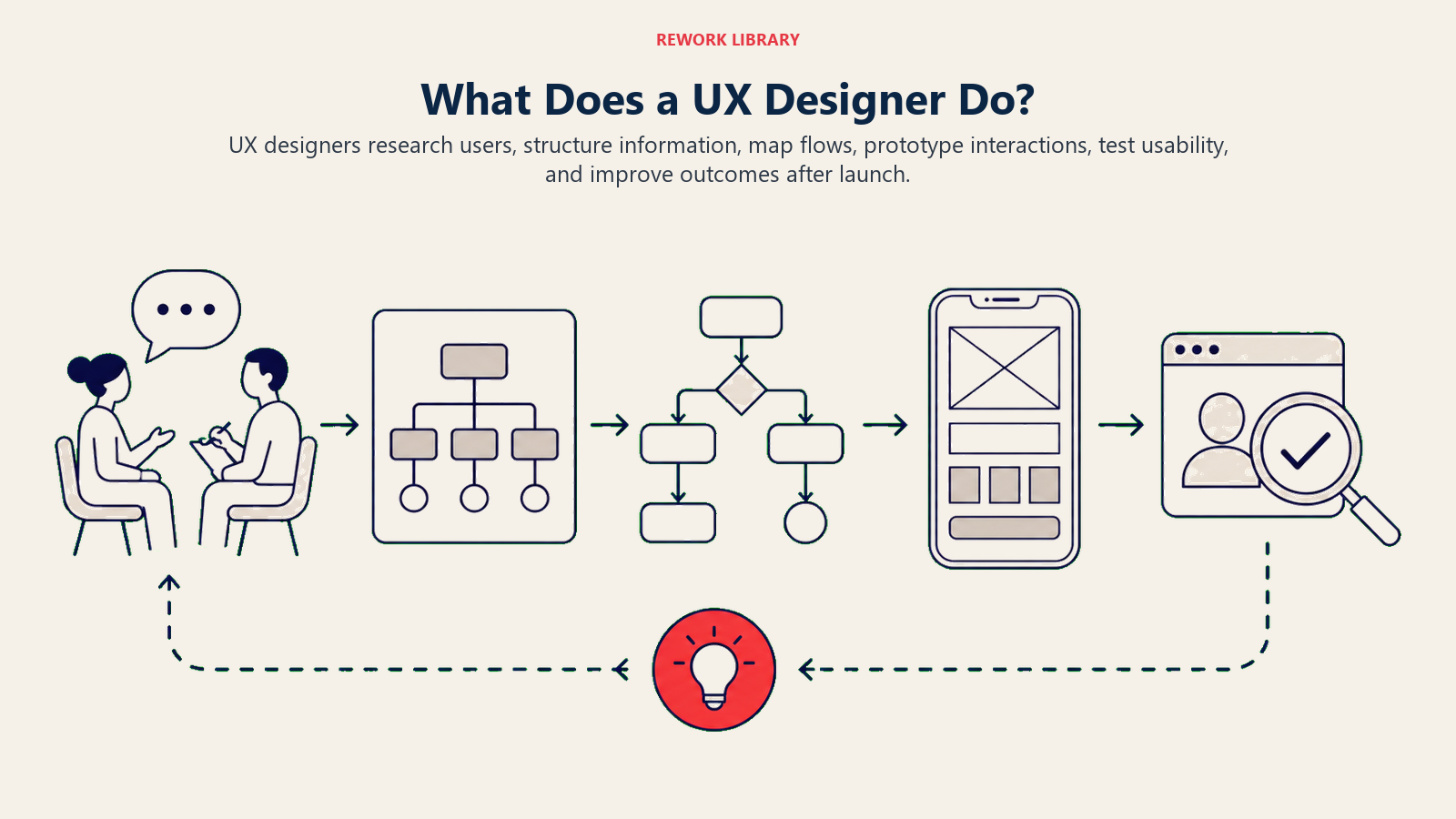
A UX designer shapes how people experience a product. They translate user needs and business goals into interfaces that are easy to understand, satisfying to use, and measurably effective. The day-to-day work spans user research, information architecture, wireframing, interactive prototyping, and usability testing. At every stage, the goal is the same: reduce friction and make the product work for real people, not just in demos.
UX is often confused with UI. The distinction matters when you're writing a job description. A UI designer owns the visual layer: color, type, spacing, iconography, and the polished look of each screen. A UX designer owns the experience layer: the flow between screens, the mental model a user builds, and whether the product solves their problem without frustration. In practice, most mid-size product teams want some overlap, but the core accountability differs. If you need someone to run research, map journeys, and reduce task completion time, you need a UX designer.
Key Facts
- Median annual wage for web and digital interface designers (which includes UX designers) in the United States was $83,240 in May 2023. Source: U.S. Bureau of Labor Statistics, Occupational Employment and Wage Statistics, 2024.
- Employment in this category is projected to grow 8% from 2023 to 2033, faster than the average for all occupations. Source: U.S. Bureau of Labor Statistics, Occupational Outlook Handbook, 2024.
- The most common tools in UX job postings are Figma, Sketch, Adobe XD, and InVision, with Figma appearing in over 70% of postings. Source: UX Tools Survey, 2023.
UX designer job description template
Use the block below as a starting point. Replace bracketed fields with your specifics.
UX Designer - [Company Name]
About the role
We're looking for a UX Designer to join [team name or product area]. You'll work closely with product managers, engineers, and researchers to design experiences that serve [target user type] and drive [key business outcome]. This is a [individual contributor / lead] role reporting to [Design Manager / Head of Product Design].
Key responsibilities
- Conduct user research (interviews, surveys, contextual inquiry) to surface unmet needs and validate assumptions
- Define user flows, information architecture, and interaction patterns for new features and redesigns
- Create low-fidelity wireframes and high-fidelity prototypes in Figma
- Plan and run usability tests; synthesize findings into actionable design changes
- Collaborate with engineers during implementation to ensure designs are built accurately
- Contribute to and maintain the design system for consistency across the product
- Present design decisions to stakeholders and incorporate feedback iteratively
- Advocate for accessibility standards (WCAG 2.1 AA) across all surfaces
Required qualifications
- [3-5] years of UX design experience on a shipped digital product
- Strong portfolio demonstrating end-to-end UX work: research, wireframes, prototypes, and outcomes
- Proficiency in Figma for both design and prototyping
- Experience planning and facilitating usability tests with real users
- Ability to communicate design rationale clearly to non-designers
- Familiarity with accessibility standards and inclusive design practices
Preferred qualifications
- Experience with quantitative research methods (surveys, analytics analysis)
- Working knowledge of HTML and CSS sufficient to collaborate effectively with front-end developers
- Exposure to design systems thinking and component libraries
- Prior work in [relevant domain: SaaS, e-commerce, fintech, healthcare, etc.]
What we offer
- [Salary range]
- [Equity / bonus structure]
- [Remote / hybrid / in-office policy]
- [Meaningful benefits: health, learning budget, PTO policy]
- A design team that values craft, research, and honest critique
Key skills and tools
| Skill or tool | Why it matters |
|---|---|
| User research (interviews, surveys) | Grounds design decisions in real user behavior rather than assumptions |
| Information architecture | Determines how users navigate and find what they need |
| Wireframing | Communicates structure and flow quickly before investing in visual polish |
| Figma (prototyping) | Industry standard; enables rapid iteration and realistic user testing before build |
| Interaction design | Defines transitions, states, and micro-interactions that make a product feel responsive |
| Usability testing | Surfaces problems early, when fixes are cheap |
| Accessibility (WCAG 2.1) | Expands reach and reduces legal risk; required in many enterprise and government contexts |
| Cross-functional collaboration | UX work is inherently shared; designers who communicate well ship faster |
UX designer vs UI designer vs product designer
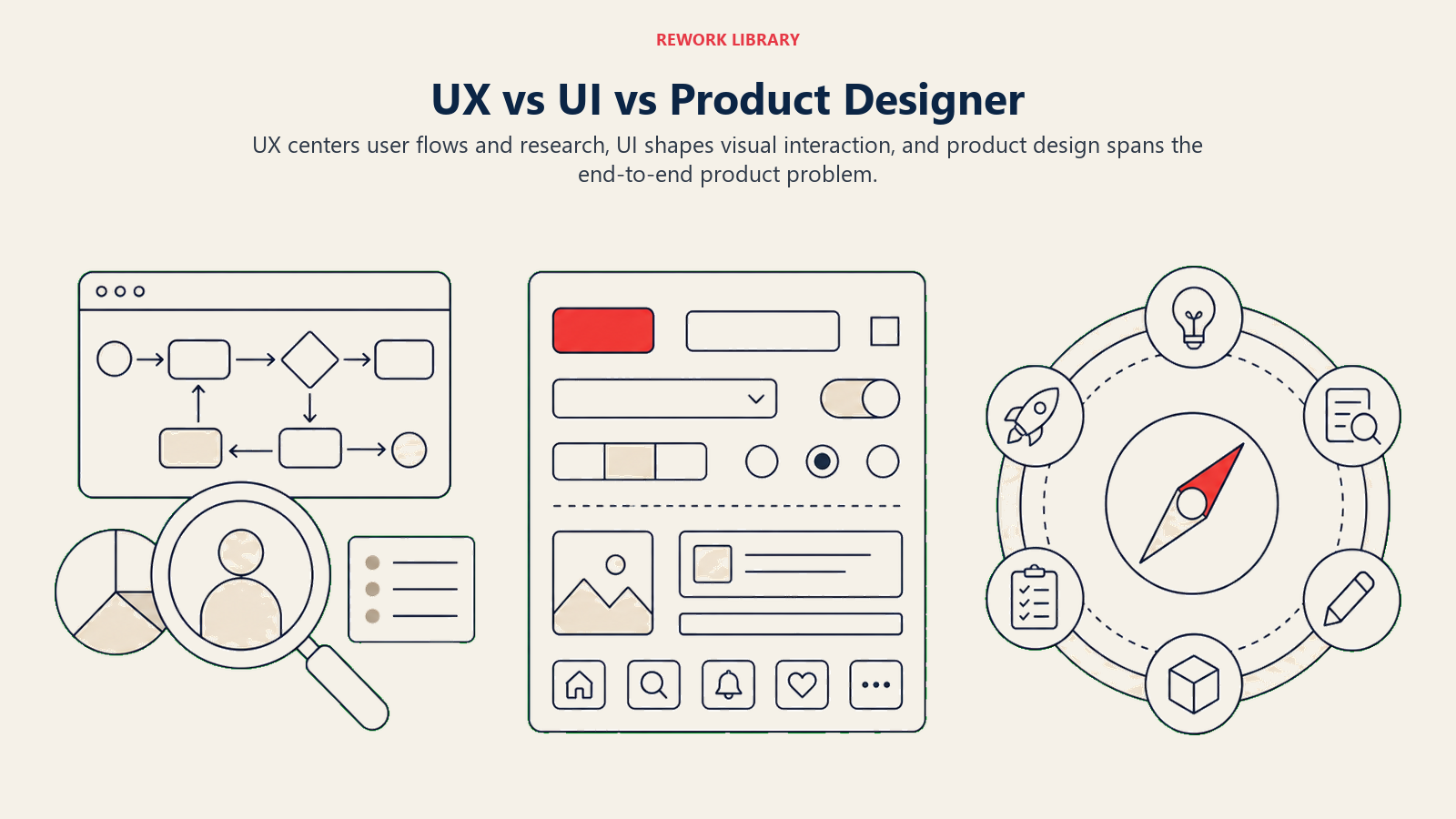
These three roles frequently appear in job postings with overlapping or inconsistent descriptions. This table shows how they differ in practice.
| Dimension | UX designer | UI designer | Product designer |
|---|---|---|---|
| Primary focus | User flows, research, usability | Visual layer: color, type, spacing, components | End-to-end product thinking combining UX and UI |
| Core deliverables | Journey maps, wireframes, research reports, prototypes | High-fidelity mockups, design system components, style guides | Full product specs from discovery through polished UI |
| Research ownership | Yes, typically leads or co-leads user research | Rarely; often receives research outputs | Varies by team; often does lighter-weight research |
| Visual design | Limited; focuses on structure over aesthetics | Strong; responsible for final visual quality | Expected to do both, at least at a journeyman level |
| Engineering handoff | Works closely with front end on behavior and states | Provides visual specs, redlines, assets | Owns the full handoff package |
| Common title overlap | UX researcher, interaction designer | Visual designer, UI/UX designer | Senior designer, lead designer |
At smaller companies, one person often covers all three. At larger teams, the roles split out. When writing your job description, decide which accountability is primary so candidates self-select correctly.
How to write an effective UX designer job description
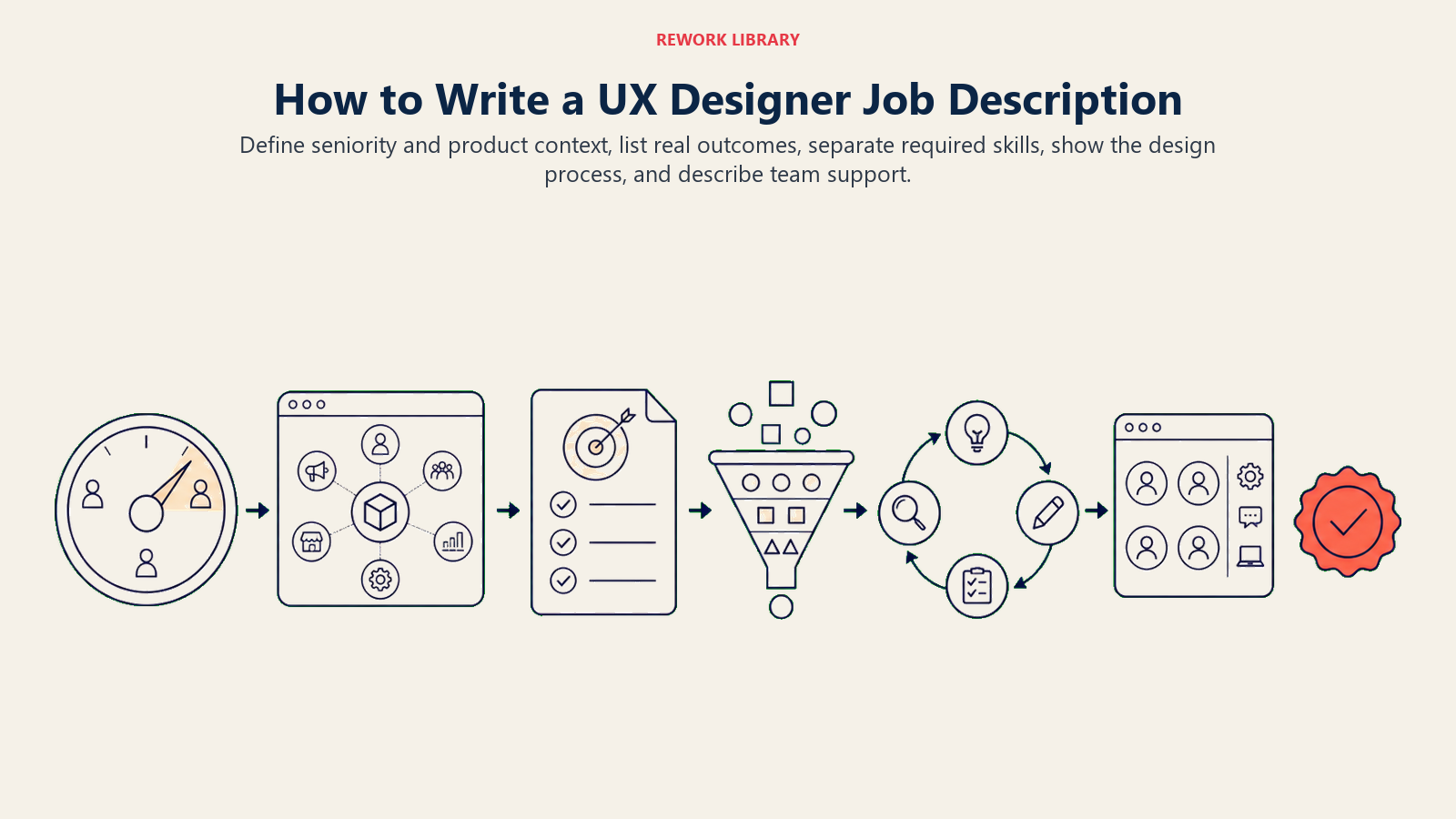
Define seniority and product context, list real outcomes, separate required skills, show the design process, and describe team support.
Step 1: Define the seniority and product context
A mid-level UX designer at a 10-person startup runs their own research, facilitates stakeholder reviews, and designs solo. A mid-level UX designer at a 500-person company might specialize in one product surface and hand off research to a dedicated researcher. Both are legitimate, but the job descriptions need to reflect those differences or you'll get candidates optimized for the wrong environment.
State the product stage (0-to-1, growth, scale), the team structure, and whether this person will be the first designer or joining an existing team.
Step 2: List outcomes, not just tasks
"Design wireframes" is a task. "Reduce the checkout drop-off rate from 42% to under 25% through a redesigned flow" is an outcome. Candidates who think in outcomes will self-select in. Candidates who just want to make things look nice will hesitate. Write 2-3 outcome statements alongside the task list.
Step 3: Separate must-haves from nice-to-haves
Research consistently shows that candidates, especially women and underrepresented groups, apply less often when they don't meet all listed requirements. Keep the required section short and literal: the skills someone genuinely needs on day one. Move anything that can be learned in the role to preferred qualifications.
Step 4: Name the tools and process
Teams that use Figma and run weekly design critiques are different from teams using Sketch and doing async reviews in Notion. Naming your actual tools and rituals filters for cultural fit and reduces onboarding time. Don't just say "prototyping tools" if you want someone who already knows Figma cold.
Step 5: Include portfolio expectations and compensation
Stating that you require a portfolio link eliminates the back-and-forth of asking for it later. Being specific helps: "We expect to see at least two end-to-end case studies that walk through research, ideation, iteration, and shipped outcomes."
Including a salary range upfront reduces wasted time for everyone. In many US states, pay transparency is now legally required. Even where it isn't, posting a range improves the quality of your applicant pool. Anchor it to the BLS or comparable market data.
Interview questions for UX designers
Portfolio walkthrough
- Walk me through a project where the research findings surprised you and changed your design direction. What did you do differently as a result?
- Show me a design that went through significant iteration. What drove each major change?
Research methods
- When you can't talk to users directly (tight timelines, access restrictions), what do you do instead?
- How do you decide between moderated and unmoderated usability testing for a given feature?
Handling feedback
- Tell me about a time a stakeholder pushed back hard on a design you believed was right. How did you handle it?
- How do you give feedback to engineers when the implementation doesn't match your intent?
Accessibility
- Walk me through how you'd audit an existing flow for WCAG 2.1 AA compliance. What do you look for first?
UX Designer Job Description FAQ
What's the difference between a UX designer and a UI designer?
UX designers focus on user flows, research, information architecture, and usability. UI designers focus on the visual execution: color, typography, components, and spacing. In many smaller teams the roles overlap, but the core accountability differs. If you need someone to run research and reduce task completion time, hire for UX. If you need someone to own the visual layer and design system quality, hire for UI.
What's the difference between a junior and senior UX designer?
Junior UX designers typically work on scoped features with guidance, run basic usability tests, and produce clean wireframes and prototypes. Senior UX designers lead discovery for full product areas, mentor others, push back effectively on poor product decisions, and own the relationship between design and engineering for a significant part of the product. The gap is less about tool proficiency and more about independent judgment and strategic influence.
Do UX designers need to know how to code?
No, coding is not a core requirement. But working knowledge of HTML and CSS makes collaboration with front-end developers significantly faster and reduces implementation surprises. Designers who understand constraints like layout systems, browser behavior, and state management ship more faithfully built designs. It's a strong differentiator, not a baseline expectation.
How important is a portfolio for UX designer candidates?
The portfolio is the primary hiring signal. Resumes tell you where someone worked; the portfolio shows you how they think. Look for case studies that include the problem definition, research methods, key decisions made along the way, and measurable outcomes. A polished UI without any process documentation is a red flag for a UX role.
Should we require a design degree?
Not necessarily. Many strong UX designers come from psychology, anthropology, cognitive science, bootcamp programs, or self-taught paths. The degree matters less than evidence of solid research practice, clear thinking in the portfolio, and the ability to communicate design decisions to a non-design audience.
Writing a UX designer job description that attracts the right candidates comes down to specificity. State the seniority, the product context, the tools, the process, and what success looks like in the first six months. Pair that with an honest salary range and a clear portfolio ask, and you'll spend less time screening and more time having conversations that matter.
For related design and product roles, see the digital designer job description, graphic designer job description, and product designer job description. If you're building out a broader product team, the engineering manager job description, junior product manager job description, and group product manager job description cover adjacent hiring decisions. For skills frameworks that complement this role, see creativity and critical thinking in the employee competencies library.

Senior Customer Retention Strategist
On this page
- What does a UX designer do?
- UX designer job description template
- Key skills and tools
- UX designer vs UI designer vs product designer
- How to write an effective UX designer job description
- Step 1: Define the seniority and product context
- Step 2: List outcomes, not just tasks
- Step 3: Separate must-haves from nice-to-haves
- Step 4: Name the tools and process
- Step 5: Include portfolio expectations and compensation
- Interview questions for UX designers