Revenue Enablement Manager Job Description Template
Turn this article into takeaways for your work.


Each assistant summarizes the article only for you and suggests best practices for your work.
A strong revenue enablement manager job description attracts candidates who can align your entire go-to-market team around a consistent, measurable approach to winning and retaining customers. This role sits at the intersection of sales, customer success, and marketing, making it one of the highest-leverage hires a revenue leader can make in 2026.
What does a revenue enablement manager do?
A Revenue Enablement Manager equips every team that touches revenue with the training, content, tools, and processes they need to perform at their best. That scope is wider than traditional sales enablement. Where a sales enablement role typically focuses on the sales team alone, a revenue enablement manager extends that work to customer success, account management, and sometimes marketing, creating a unified capability layer across the full customer journey.
In practice, this person designs onboarding programs for new reps, builds playbooks that guide customer success conversations, owns the enablement tech stack, and tracks whether any of it actually moves the needle on quota attainment and retention. They spend as much time analyzing data as they do building content, and they communicate findings upward to the CRO and downward to front-line managers.
Key Facts
- Companies with dedicated revenue enablement functions report faster ramp times for new hires, with some B2B SaaS organizations citing rep ramp reductions from six months to three (Forrester, 2025).
- The average enablement team size grew from 1.4 to 3.1 people between 2021 and 2024 as organizations expanded coverage beyond the sales org (Sales Enablement Society, 2024).
- Enablement roles that span sales and customer success see higher cross-sell and upsell revenue because they standardize the handoff process and equip CS teams with the same quality of objection-handling content that sales uses (Gartner, 2024).
Revenue enablement manager responsibilities
The role runs onboarding, maintains playbooks, owns enablement tools, targets pipeline gaps, and measures whether programs improve revenue outcomes.
- Design and run onboarding programs for new sales, customer success, and account management hires, targeting full productivity within 90 days.
- Build and maintain a library of playbooks, battle cards, and conversation guides that reflect current product positioning and competitive landscape.
- Own the enablement tech stack, including the sales engagement platform, content management system, and conversation intelligence tools; evaluate new vendors as needs evolve.
- Partner with product marketing to translate new product releases and competitive changes into rep-ready training materials within agreed SLAs.
- Align with revenue operations on pipeline data to identify where deals stall, then build targeted enablement interventions for those specific stages.
- Run recurring skills clinics and certification programs that keep experienced reps sharp, not just onboard new ones.
- Measure enablement impact through leading indicators (content usage, training completion, time-to-first-deal) and lagging indicators (win rate, average deal size, net revenue retention).
- Facilitate cross-functional alignment sessions between sales and customer success to reduce handoff friction and improve customer experience continuity.
- Manage a content calendar that keeps enablement materials current, retiring outdated assets and flagging gaps before they show up in lost deals.
- Report monthly to revenue leadership on enablement program performance, surfacing patterns and recommending program adjustments.
Requirements and qualifications
Must-have
- 3 to 5 years in a sales, customer success, or revenue operations role, with at least 2 years in an enablement-focused position.
- Demonstrated experience building and delivering training programs, not just contributing to them.
- Proficiency with at least one enablement platform (Highspot, Seismic, Showpad, or equivalent) and one CRM (Salesforce or HubSpot).
- Strong analytical skills: comfortable pulling reports from CRM and BI tools to connect enablement activity to revenue outcomes.
- Excellent written and verbal communication; able to simplify complex product information into materials a new rep can use on day one.
- Proven ability to manage projects with multiple stakeholders across sales, marketing, and CS without a formal reporting line over those teams.
Nice-to-have
- Background in instructional design, adult learning, or corporate training.
- Experience with conversation intelligence tools (Gong, Chorus, or similar).
- Familiarity with revenue operations workflows and attribution modeling.
- SaaS industry experience, especially in a product-led or hybrid sales motion.
- Certification from the Sales Enablement Society or equivalent professional body.
Revenue enablement manager job description template
Use this copy-paste block as the foundation for your job posting. Adjust the bracketed fields to match your company context.
Role summary
[Company Name] is hiring a Revenue Enablement Manager to build and run the programs that help our sales, customer success, and account management teams perform at their highest level. You'll own the full enablement lifecycle: from onboarding new hires to coaching experienced reps on complex deals, and from building playbooks to measuring whether they actually work. You'll report to the [CRO / VP of Revenue / VP of Sales] and work closely with product marketing, revenue operations, and front-line managers across the revenue org.
Key responsibilities
- Design and deliver onboarding and continuous learning programs for sales and CS teams.
- Build and maintain playbooks, battle cards, conversation guides, and competitive content.
- Own the enablement tech stack and vendor relationships.
- Partner with product marketing on new release readiness and competitive positioning.
- Use CRM and BI data to identify performance gaps and design targeted interventions.
- Run certification programs and recurring skills clinics.
- Report on enablement impact (content usage, ramp time, win rate, net revenue retention) to revenue leadership on a monthly cadence.
- Align sales and CS teams around consistent customer handoff and expansion motions.
Required qualifications
- 3 to 5 years in sales, customer success, or revenue operations, with at least 2 years in an enablement role.
- Experience building and delivering training programs from scratch.
- Proficiency with an enablement platform (Highspot, Seismic, or Showpad) and a CRM (Salesforce or HubSpot).
- Strong data skills: able to connect enablement activity to pipeline and retention metrics.
- Excellent communicator across written content, live training, and executive presentations.
Preferred qualifications
- Instructional design or adult learning background.
- Experience with Gong, Chorus, or a comparable conversation intelligence tool.
- SaaS or B2B software industry experience.
- Revenue operations or attribution modeling familiarity.
What we offer
- Competitive base salary in the range of [range for your location/level].
- [Equity / bonus / commission] structure.
- Remote/hybrid flexibility with [office days per week if applicable].
- Professional development budget for certifications and conferences.
- [Health, dental, vision, 401k, or equivalent benefits].
Salary and career outlook
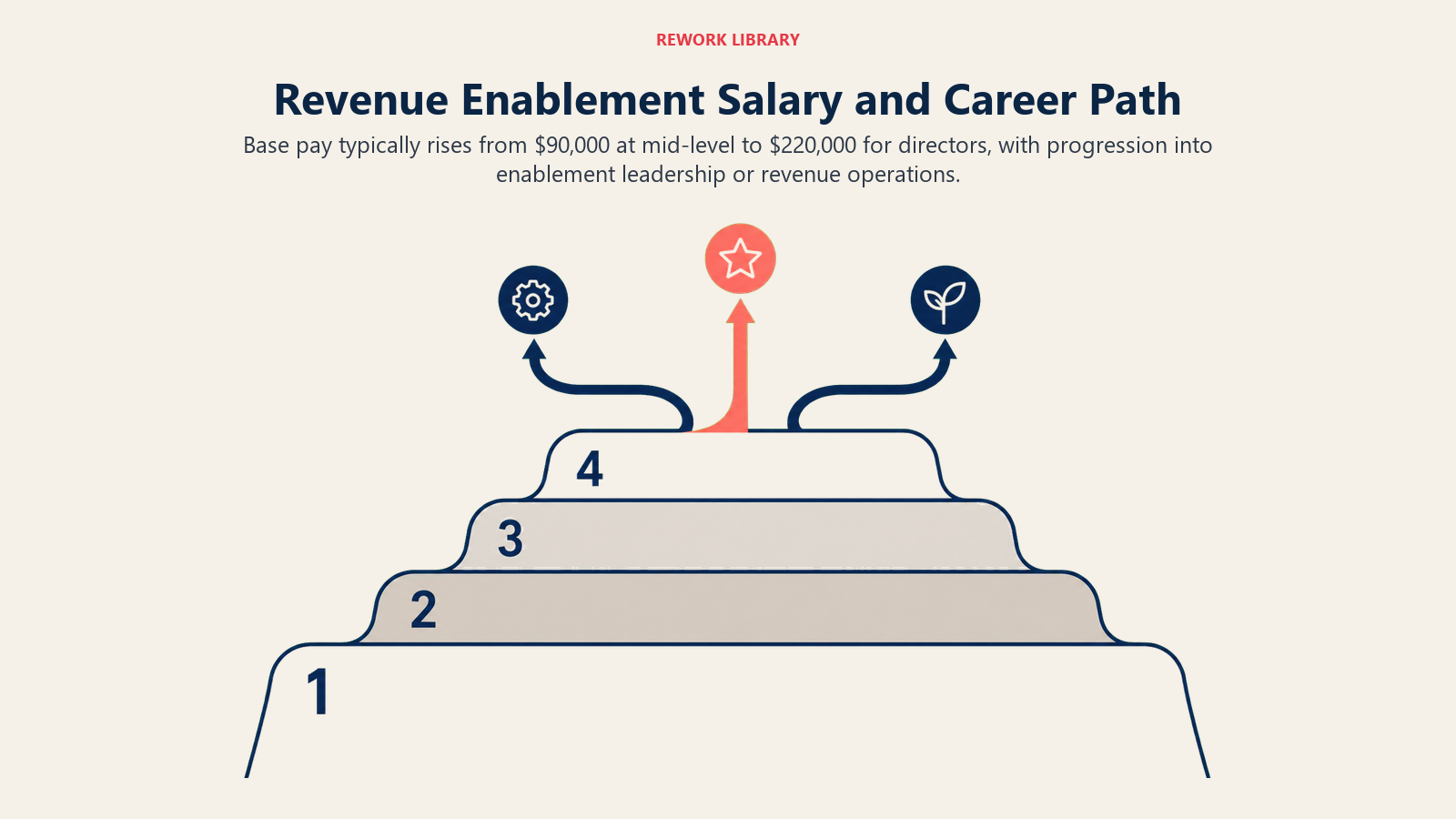
Compensation for this role varies considerably by market, company stage, and scope. The table below reflects 2025 market data for the United States, where the role is most mature.
| Level | Typical annual base range |
|---|---|
| Mid-level (2-4 years experience) | $90,000 to $120,000 |
| Senior (5-8 years experience) | $120,000 to $155,000 |
| Principal or Lead (8+ years, team lead) | $150,000 to $185,000 |
| Director of Revenue Enablement | $170,000 to $220,000 |
Total compensation often includes a bonus tied to pipeline or retention targets (10 to 20% of base at most companies) and equity at growth-stage or public SaaS organizations. Remote candidates outside major metro areas typically see base salaries 10 to 20% lower than those in San Francisco, New York, or Boston.
Career progression from this role usually runs toward Director of Revenue Enablement, VP of Sales Effectiveness, or a lateral move into Revenue Operations. The skills built here (cross-functional influence, data analysis, instructional design) translate well to chief of staff and go-to-market strategy roles at later stages.
For more context on adjacent roles and their compensation overlap, see the Sales Enablement Manager job description and the Revenue Operations Manager job description.
Related roles and how they differ
Hiring managers often conflate revenue enablement with sales enablement or revenue operations. The distinctions below help you decide which role you actually need.
| Role | Primary focus | Hire when |
|---|---|---|
| Revenue Enablement Manager | Training, content, and process for the full revenue team (sales + CS + marketing) | Your CS and sales teams share quota responsibility and need consistent enablement coverage across both |
| Sales Enablement Manager | Training, content, and tools for the sales team only | Your CS team is separate and self-sufficient; the immediate gap is sales rep performance and ramp time |
| Revenue Operations Manager | CRM infrastructure, data integrity, forecasting, and process automation | You have reliable revenue performance but lack the systems and reporting to scale it predictably |
| Sales Operations Manager | Quota planning, territory design, comp plan administration, and sales reporting | Your sales process is well-defined but the operational work (comp, territories, forecasting) is consuming manager time |
A useful shortcut: if your biggest gap is "reps don't know what to say or how to say it," hire for revenue or sales enablement. If your biggest gap is "we can't see what's happening in our pipeline and can't trust our forecast," hire for revenue or sales operations.
See also: the Sales Enablement Specialist job description for an individual-contributor version of the enablement work, and the Sales Trainer job description if your immediate need is live skills training rather than a strategic enablement function.
A Revenue Enablement Manager is one of the few roles where the investment compounds over time. The playbooks built today shape how new hires ramp six months from now. The certification program launched this quarter affects win rates next year. Companies that treat enablement as a cost center rather than a revenue driver consistently leave those gains unrealized. Getting this hire right starts with a job description that's honest about scope, clear on metrics, and specific enough to filter for candidates who've actually built these programs before.
For a deeper look at how enablement fits into your broader pipeline strategy, see what is sales pipeline and how it connects to rep coaching and deal review cadences.