Creativity at Work: Why It Matters and How to Build It
Turn this article into takeaways for your work.


Each assistant summarizes the article only for you and suggests best practices for your work.
Creativity at work is no longer a soft skill reserved for designers and ad agencies. It's now a core competency employers rank alongside data literacy and communication when deciding who to hire, promote, and trust with hard problems.
And the pressure is real: the World Economic Forum's Future of Jobs Report 2025 puts creative thinking in the top 3 fastest-rising skills globally. If you're building a team or trying to grow in your career, this is the competency worth investing in right now.
What is creativity at work?
Creativity at work is the ability to generate new and useful ideas, then turn them into outcomes the business can actually ship. It's not daydreaming or artistic expression. It's a repeatable capability that shows up when someone frames a problem differently, connects two existing concepts in a novel way, or proposes a solution nobody had considered.
Three terms get conflated constantly, and the distinction matters for how you hire, train, and reward:
- Creativity is the generation of ideas. It asks: what could we do?
- Ideation is the structured process of filtering and developing ideas. It asks: which ideas are worth pursuing?
- Innovation is the commercialization of a selected idea. It asks: did it create value in the market?
You can have creativity without innovation (ideas that never ship), and you can have innovation without much creativity (incremental improvements). The best teams build all three muscles. An innovation mindset at the team level depends on individual creativity as its raw material.
Key Facts
Key Facts: Creativity at Work
- The World Economic Forum Future of Jobs Report 2025 ranks creative thinking among the top 3 skills rising fastest in demand across industries globally.
- LinkedIn's 2024 Most In-Demand Skills report lists problem solving and creativity in the top 10 skills across all job functions, including roles in finance, engineering, and operations.
- A 2024 IBM CEO study found that 75% of CEOs expect competitive advantage to depend on which organizations pair generative AI with the most creative human talent.
The 4 stages of the creative process
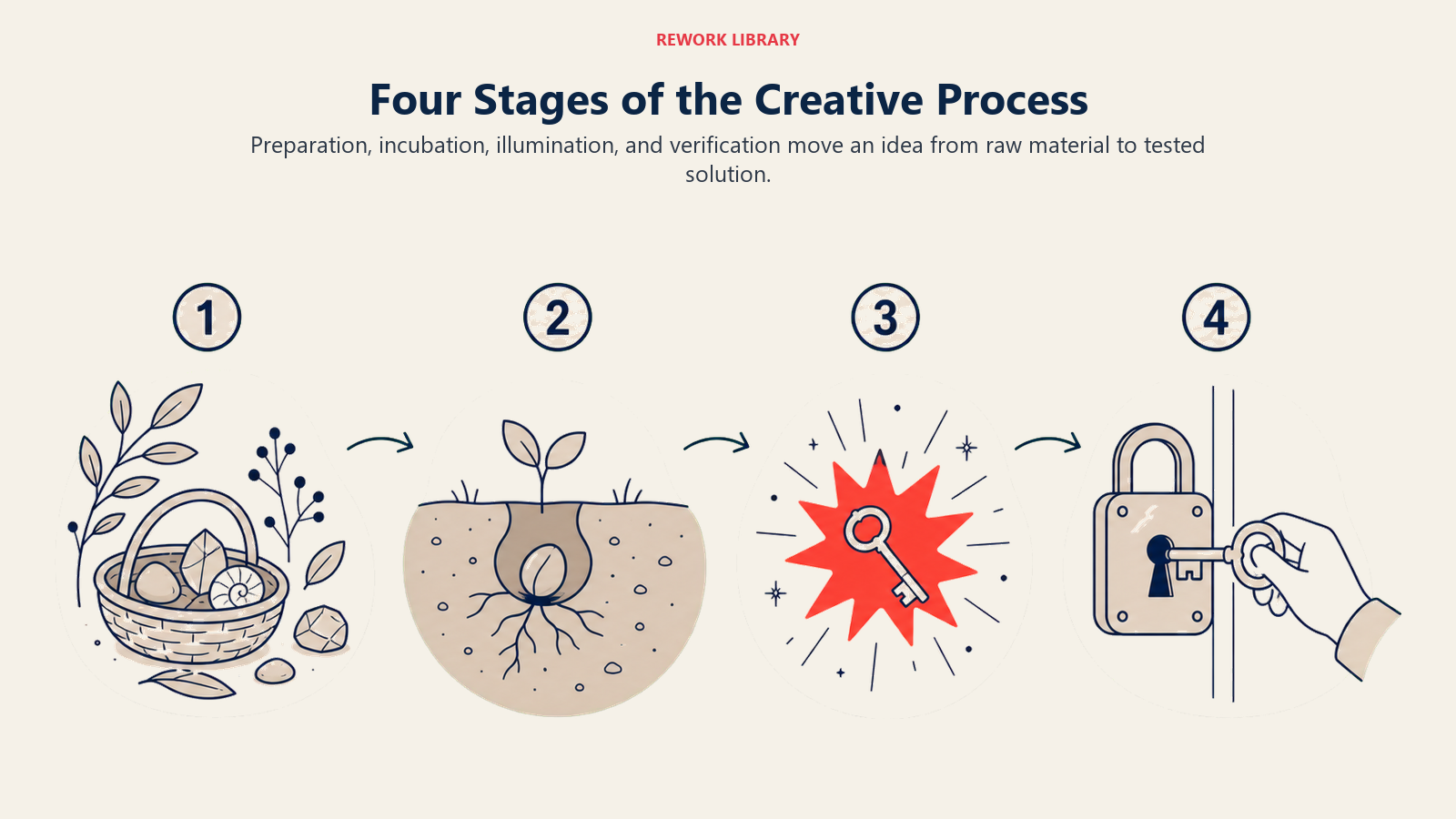
This model comes from Graham Wallas' 1926 work "The Art of Thought." It's been validated by decades of cognitive research and is still the most practical framework for understanding how ideas actually form.
1. Preparation
You fill the tank. You read, research, question, and absorb everything relevant to the problem. In a work context, this looks like a product manager spending two days reading customer support tickets before a discovery session, or a sales engineer benchmarking five competitor demos before proposing a new pitch framework.
The key mistake here: people skip this stage when they're busy, then wonder why the ideas in their brainstorm feel thin.
2. Incubation
You stop trying to solve it consciously. The brain keeps working in the background while you do something else. Research from the University of California Santa Barbara shows that tasks requiring lower direct attention (like walking or showering) allow the default mode network to surface connections your focused mind misses.
In practice, this means that "sleeping on it" is not procrastination. Blocking focused problem-solving time and then doing something else before the decision deadline is a legitimate creative strategy.
3. Illumination
The insight arrives, usually unexpectedly. You're midway through lunch or on the way to a 1:1 and the answer clicks. This is the moment that looks like sudden inspiration from the outside, but is actually the output of stages 1 and 2 doing their work.
Building capture habits (more on this in Section 6) makes sure this moment doesn't evaporate before you get back to a keyboard.
4. Verification
You test the idea. Does it actually work? Does it fit constraints the incubation stage didn't factor in? This is where critical thinking meets creativity. The idea gets stress-tested, refined, and either developed or shelved. Most creative people underinvest here, which is why great ideas die in implementation.
Why creativity matters in every role (not just design)
The myth that creativity is for "creative roles" keeps good ideas off the table in most organizations. Here's where it shows up function by function:
- Sales: Reps who reframe a product's value for an unexpected use case close deals the pitch deck never anticipated. Creativity is the difference between reciting features and solving the prospect's specific problem.
- Customer support: Agents who find novel workarounds to a technical limitation keep customers from churning while the product team ships the fix. Support creativity directly protects retention.
- Engineering: Creative engineers write less code by finding simpler architectures. The first solution is rarely optimal. The third or fourth iteration usually is.
- Finance: Creative financial analysts spot non-obvious cost structures or funding approaches that unlock projects everyone else wrote off as too expensive.
- HR / People ops: Creative people teams design interview processes and onboarding experiences that attract candidates and reduce early attrition in ways generic templates never do.
- Operations: Process creativity, which might be the highest-leverage form, finds ways to eliminate waste without cutting corners. This is the foundation of Kaizen and continuous improvement thinking.
Creativity vs innovation vs critical thinking
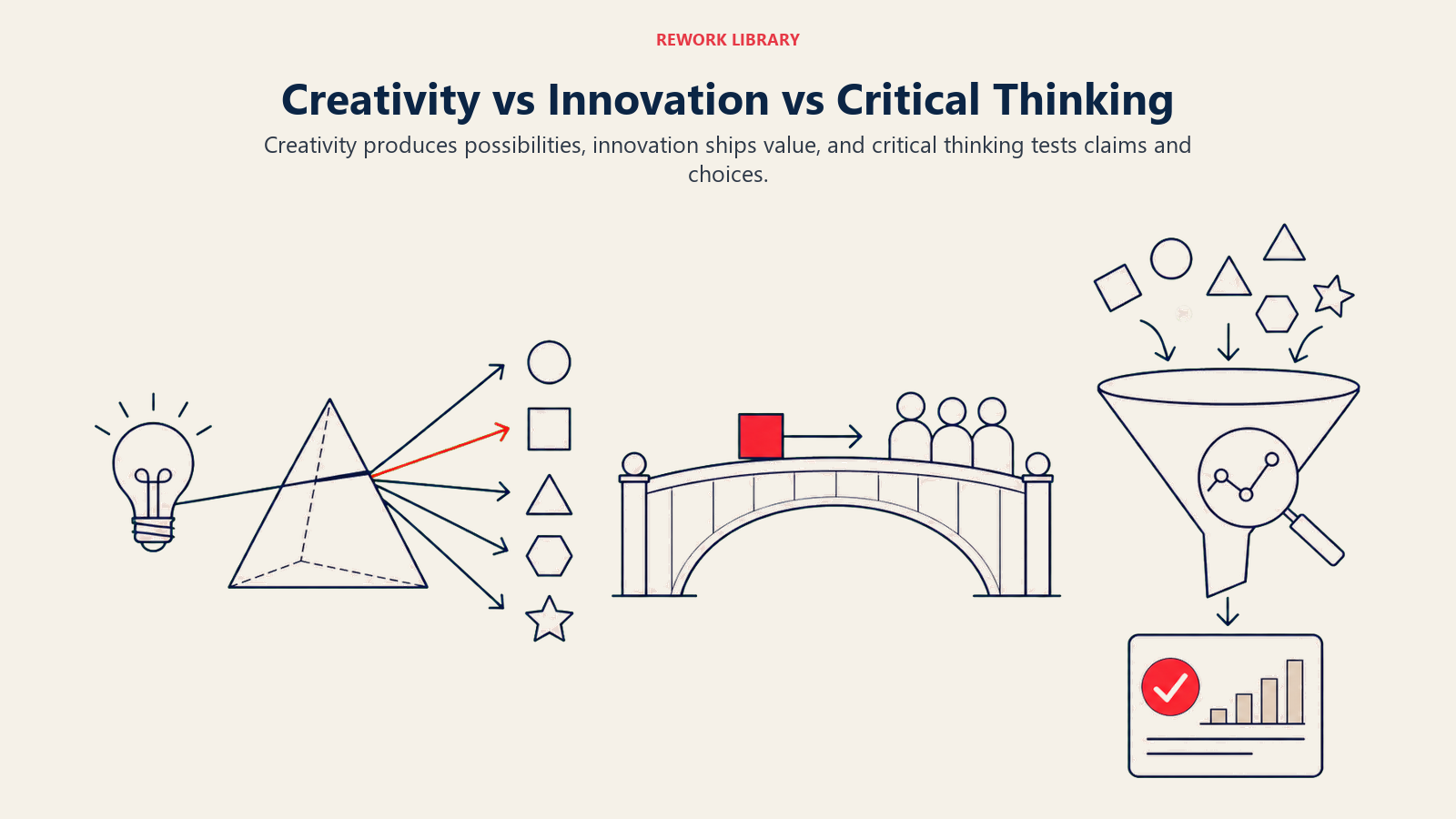
Creativity produces possibilities, innovation ships value, and critical thinking tests claims and choices.
| Skill | What it produces | Output | Example |
|---|---|---|---|
| Creativity | New ideas | Possibilities | "What if we priced this by outcome instead of seat?" |
| Innovation | Shipped value | Revenue or efficiency gains | Launched the outcome-based pricing model, grew NRR 18% |
| Critical thinking | Sound judgments | Decisions | "Of the 12 pricing options we generated, here is the one most defensible given our cost structure" |
These skills reinforce each other. Strategic thinking ties them together at the system level, helping leaders decide which creative ideas are worth innovating on and which critical analyses to run first.
How to develop creativity at work in 8 ways
Creativity is a trainable skill. The neuroscience is clear: behaviors that widen associative networks and give the default mode network space to operate build creative capacity over time. Here are eight practices that work.
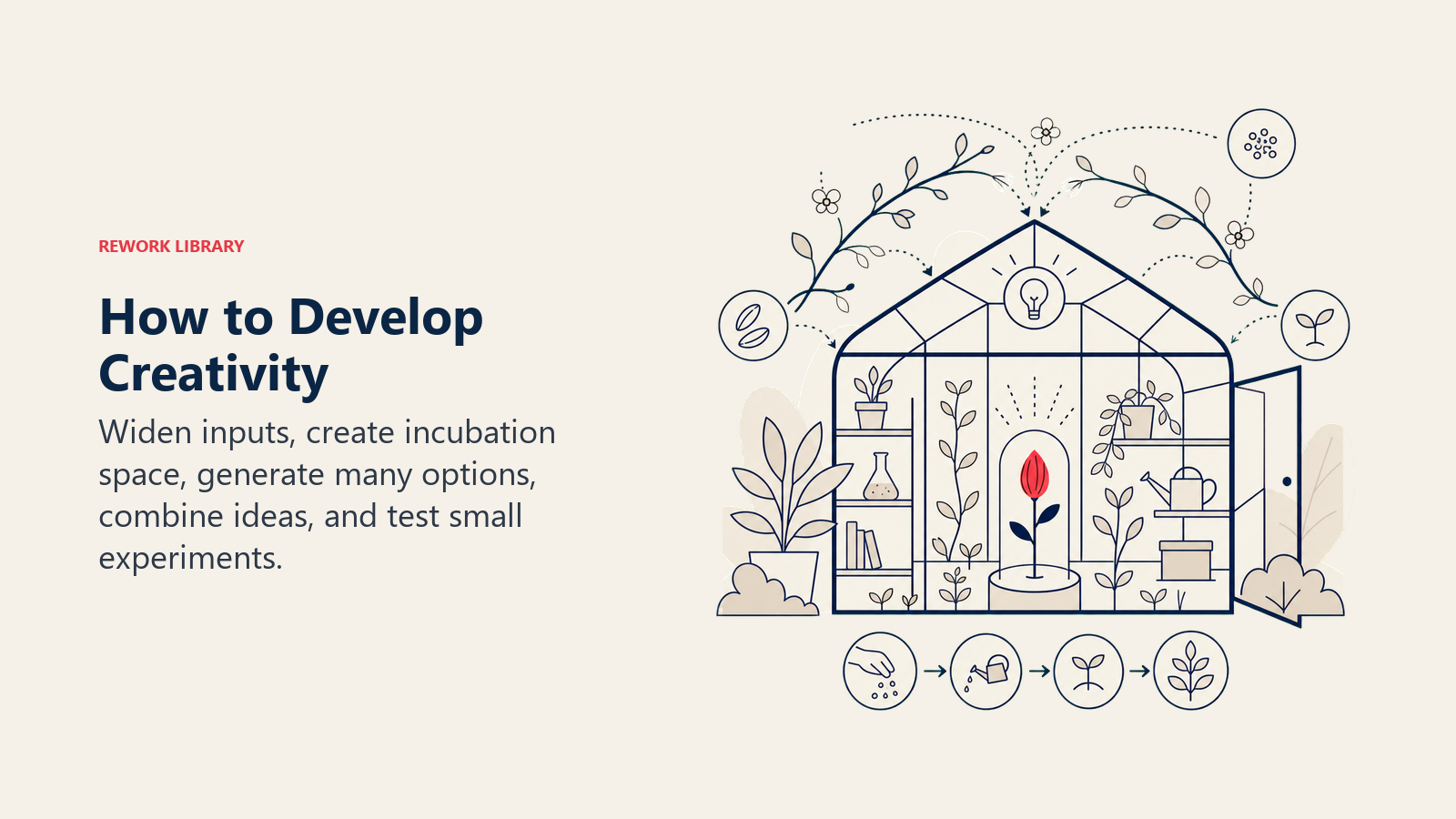
1. Schedule diffuse-mode time. Block 30 minutes of low-stimulation time each day. No tasks, no meetings, no notifications. Walk, stare out a window, do something physical. This is not wasted time; it's when your subconscious processes the inputs from focused work and surfaces novel connections.
2. Capture inputs (the commonplace book method). Keep a running note of interesting ideas, quotes, data points, and observations from outside your industry. When you accumulate enough raw material, your brain starts making unexpected connections during the incubation phase. Continuous learning habits feed this directly.
3. Use idea constraints (SCAMPER, Crazy 8s). Unconstrained brainstorms produce mediocre ideas. Constraints force creative leaps. SCAMPER (Substitute, Combine, Adapt, Modify, Put to other uses, Eliminate, Reverse) gives your brain a structured lens. Crazy 8s forces you to sketch 8 concepts in 8 minutes, which kills perfectionism before it starts.
4. Borrow from outside your industry. The most powerful creative insight usually comes from applying a solution that works in one domain to a problem in another. Hospital operating rooms borrowed pit-stop choreography from Formula 1 racing to reduce surgical errors. Subscription models came from newspapers and publishing, not software.
5. Run remix exercises. Take an existing solution in your space and deliberately try to invert or recombine it. What would this product look like if the buyer and seller swapped roles? What if the constraint you've always treated as fixed could move? Remix exercises build the "recombination" muscle that characterizes prolific creative thinkers.
6. Ship small experiments. Creativity atrophies when ideas never get tested. Committing to small, low-risk tests of new ideas creates feedback loops that teach you what works. This pairs directly with initiative: the willingness to move an idea from concept to small experiment without waiting for permission.
7. Get fast feedback. Share early-stage ideas with trusted colleagues before they're fully formed. Feedback at this stage is generative: it adds constraints, surfaces blind spots, and often sparks better versions of the original idea. The longer you protect an idea from outside input, the worse it tends to get.
8. Debrief misses. When a creative bet doesn't work, run a brief retrospective. Not to assign blame, but to extract pattern-level learning. What did the idea teach you about the problem? What would you try next? Teams that debrief misses without punishment build the psychological safety that makes the next creative attempt more likely.
What blocks creativity at work
Most creative potential at work gets killed before it's ever expressed. The culprits are predictable:
- Fear of looking foolish. When people believe a bad idea will be held against them, they filter aggressively before speaking. The result is meetings where everyone sounds sensible and nothing new gets proposed.
- Premature judgment. Evaluating ideas too early in the generation phase shuts down the associative thinking that produces good ideas. Diverge first, converge later.
- Back-to-back calendars. Incubation requires white space. A day with six hours of consecutive meetings leaves no room for the default mode network to operate. Packed schedules produce operational output, not creative output.
- Perfectionism. Waiting until an idea is fully formed before sharing it means most ideas never surface. Perfectionism in the ideation phase is a creativity killer disguised as quality control.
- Lack of psychological safety. Research from Amy Edmondson at Harvard Business School consistently shows that teams with high psychological safety generate more novel ideas, share concerns earlier, and iterate faster. Without it, the eight practices above are nearly impossible to sustain.
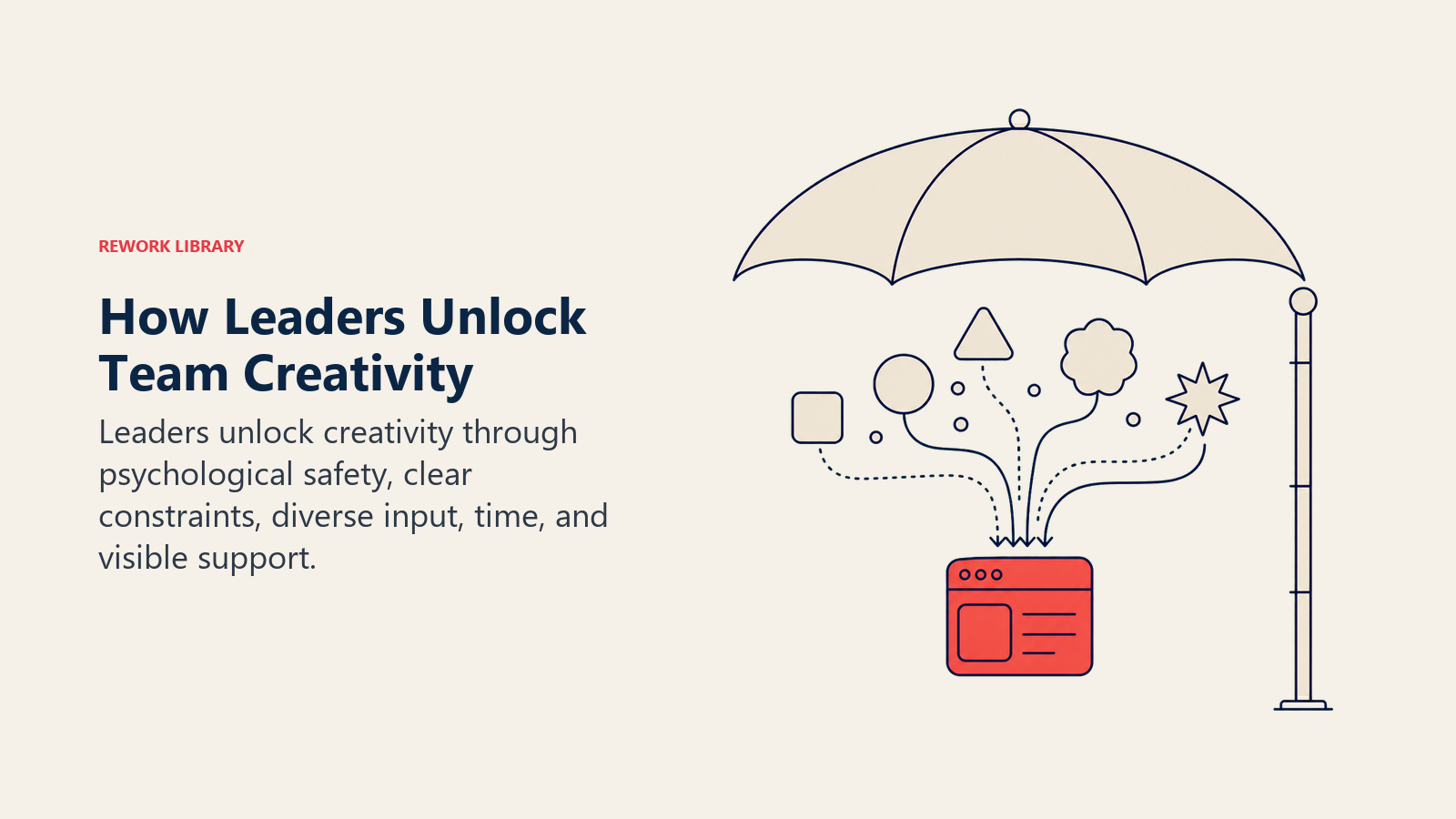
How leaders unlock team creativity
Leadership behavior is the single biggest predictor of whether a team's creative potential actually shows up at work. Six practices make the biggest difference:
- Model psychological safety actively. Share your own half-formed ideas, admit mistakes openly, and thank people who raise concerns. Tone at the top shapes what the team believes is safe to say.
- Protect time blocks for creative work. If creative time isn't on the calendar, it doesn't happen. Leaders who block "thinking time" for themselves and their teams signal that this kind of work is legitimate and valued.
- Pair people across functions. Cross-functional pairs generate more creative output than same-function groups because the knowledge distance forces different framings. Assign problems to pairs that don't usually work together.
- Default to "yes, and." In ideation sessions, replace "yes, but" with "yes, and." The former closes possibilities; the latter builds on them. This single change in meeting language measurably increases idea quality.
- Set brief idea quotas. Ask each person to bring one rough idea to a weekly meeting. Not a polished proposal, just one rough idea. Low bars produce more volume, and volume produces better eventual quality.
- Celebrate small creative wins explicitly. When someone's novel approach solves a problem, name it in a team meeting. Recognition of creative behavior, even on small problems, reinforces the belief that creativity is rewarded here.
A growth mindset at the leadership level, the belief that capability expands with effort and learning, is the underlying condition that makes all six practices sustainable rather than performative.
How to show creativity on a resume and in interviews
Creativity is easy to claim and hard to prove. These STAR-format examples show how to make it concrete.
Resume examples:
- Redesigned the customer onboarding sequence using a constraint-based approach, cutting time-to-first-value by 34% without adding headcount
- Developed a cross-industry analogy framework for sales discovery that lifted average deal size by 22% across the team
- Proposed and piloted a "reverse demo" format (prospects demo their current workflow first) that increased close rate on enterprise deals by 18%
- Created a remix exercise for quarterly planning that produced 40% more strategic options for the leadership team to evaluate
- Built a shared idea-capture system across three teams that surfaced two features now in the product roadmap
Interview Q&As:
- "Tell me about a time you solved a problem in a way nobody expected." Walk through the four stages: what you absorbed (preparation), what you let sit (incubation), where the idea came from (illumination), and how you pressure-tested it (verification). Concrete numbers help.
- "How do you generate ideas when you're stuck?" Describe a real practice, such as borrowing from outside your industry or using a constraint-based method like SCAMPER. Specificity signals the behavior is real, not rehearsed.
- "What was a creative idea that didn't work, and what did you learn?" This question screens for debrief habits and psychological safety tolerance. Answer it directly without over-qualifying. The learning, not the failure, is what the interviewer is evaluating.
Frequently Asked Questions about Creativity at Work
Is creativity a skill you can learn?
Yes. Creativity is not a fixed trait distributed randomly at birth. Research in cognitive psychology consistently shows that behaviors like broad input capture, constraint-based ideation, diffuse-mode rest, and debrief practices build creative capacity over time. The ceiling matters less than the direction of travel.
What is the difference between creativity and innovation?
Creativity produces ideas. Innovation ships them as value. You need creativity as input, but creativity alone doesn't create business outcomes. The bridge between the two is a structured process for evaluating, selecting, and testing which ideas are worth building.
How do you measure creativity at work?
Direct measurement is hard, but proxy measures exist: volume of ideas generated per team per quarter, percentage of ideas that reach the testing stage, number of cross-functional initiatives proposed from the bottom up, and time-to-first-experiment on new approaches. Managers who track at least one of these signal that creativity is taken seriously as an operational capability.
Does AI make creativity less valuable?
The opposite. AI accelerates the execution of predictable tasks, which raises the premium on what humans do that AI cannot easily replicate: framing novel problems, making unexpected connections, and deciding which ideas are worth building. The 2024 IBM CEO study cited in Key Facts above captures this: the organizations expecting to win are betting on AI-plus-creative-human talent, not one or the other.
What jobs need the most creativity?
Any role that involves non-routine problem-solving benefits from creativity. That includes product management, engineering, sales, marketing, strategy, operations design, and people leadership. The distinction isn't "creative job vs. non-creative job." It's "routine work vs. non-routine work." As automation handles more routine tasks, creative judgment becomes the differentiator in almost every function.
Creativity at work is not a personality trait reserved for the naturally inventive. It's a competency built from specific practices, protected by leaders who design the conditions for it, and measured by the ideas that actually ship. The teams that treat creativity as infrastructure, not inspiration, are the ones building advantages that compound over time.

Senior Customer Retention Strategist
On this page
- What is creativity at work?
- Key Facts
- The 4 stages of the creative process
- 1. Preparation
- 2. Incubation
- 3. Illumination
- 4. Verification
- Why creativity matters in every role (not just design)
- Creativity vs innovation vs critical thinking
- How to develop creativity at work in 8 ways
- What blocks creativity at work
- How leaders unlock team creativity
- How to show creativity on a resume and in interviews