MLOps Engineer Job Description (Template + Skills)
Turn this article into takeaways for your work.


Each assistant summarizes the article only for you and suggests best practices for your work.
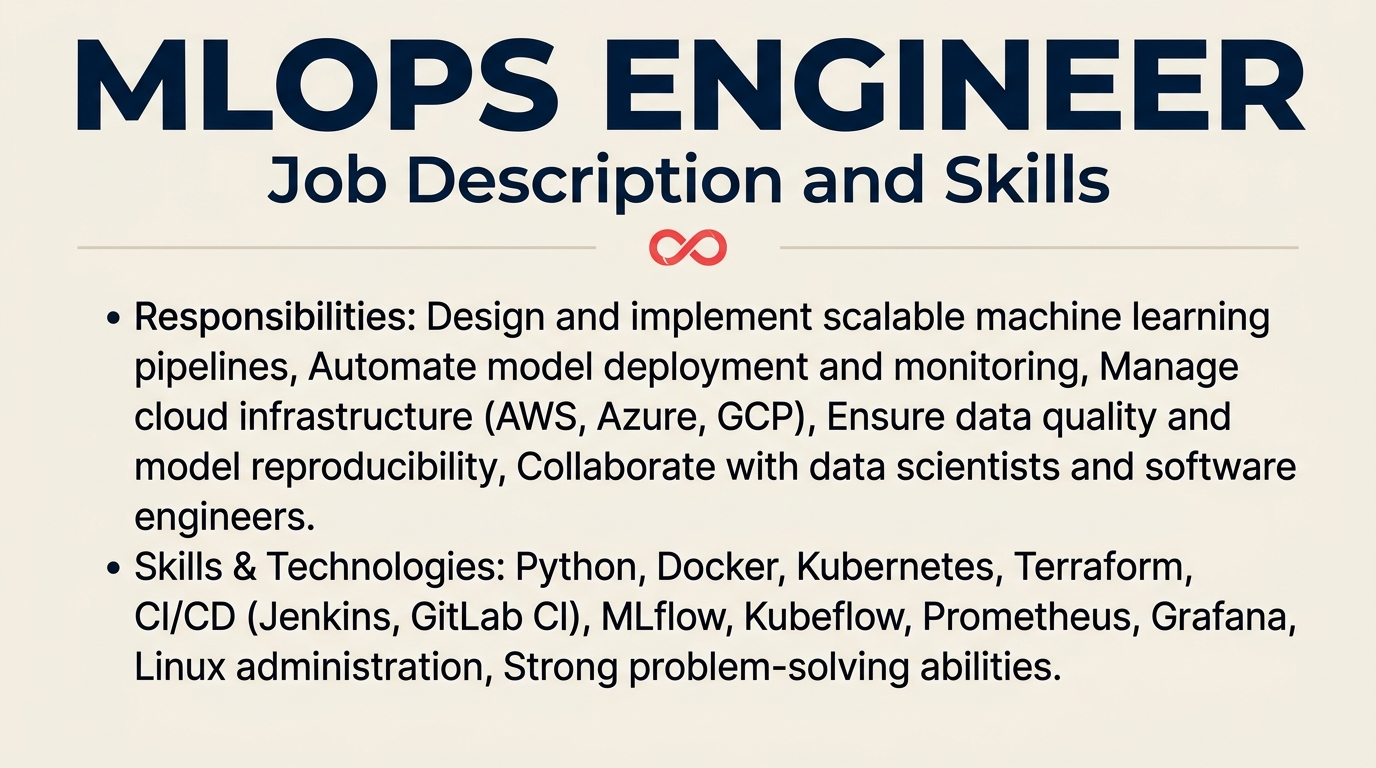
A well-crafted mlops engineer job description is the difference between attracting candidates who can actually ship production ML systems and those who've only ever trained models in Jupyter notebooks. MLOps is a discipline that sits at the intersection of machine learning, software engineering, and infrastructure operations, and it's still young enough that many hiring teams write vague descriptions that pull in the wrong candidates.
This guide gives you a full template, a clear skills breakdown, salary benchmarks, and a comparison of related roles so your team can hire the right person the first time.
What does an MLOps engineer do?
An MLOps engineer owns the operational side of machine learning. While data scientists focus on building and improving models, MLOps engineers make sure those models actually work reliably in production: they get deployed on time, perform consistently, scale under load, and can be updated or rolled back without incident.
The discipline borrows from both DevOps engineering and traditional ML engineering. From DevOps, it takes CI/CD pipelines, infrastructure-as-code, and observability practices. From ML, it takes an understanding of training workflows, feature engineering, model versioning, and the statistical quirks (like data drift) that make ML systems fail in ways that ordinary software doesn't.
A senior MLOps engineer typically handles the full model lifecycle: from the moment a data scientist hands off a trained model, through containerization, automated testing, staged deployment, production monitoring, retraining triggers, and eventually deprecation. In smaller teams, they may also build and maintain the feature store and the experiment tracking infrastructure that data scientists use upstream.
Key Facts
- MLOps is among the fastest-growing specializations in AI engineering, with job postings roughly tripling between 2021 and 2024 as companies moved from ML experimentation to production deployment at scale (LinkedIn Workforce Report, 2024).
- A majority of enterprise ML projects fail to reach production, with infrastructure and operationalization gaps cited as the primary cause. MLOps roles exist specifically to close this gap (Gartner, 2023).
- Median total compensation for mid-level MLOps engineers in the US ranges from roughly $145,000 to $185,000 depending on location and stack, with senior roles at large tech companies reaching well above $200,000 (Levels.fyi, 2025).
MLOps engineer responsibilities
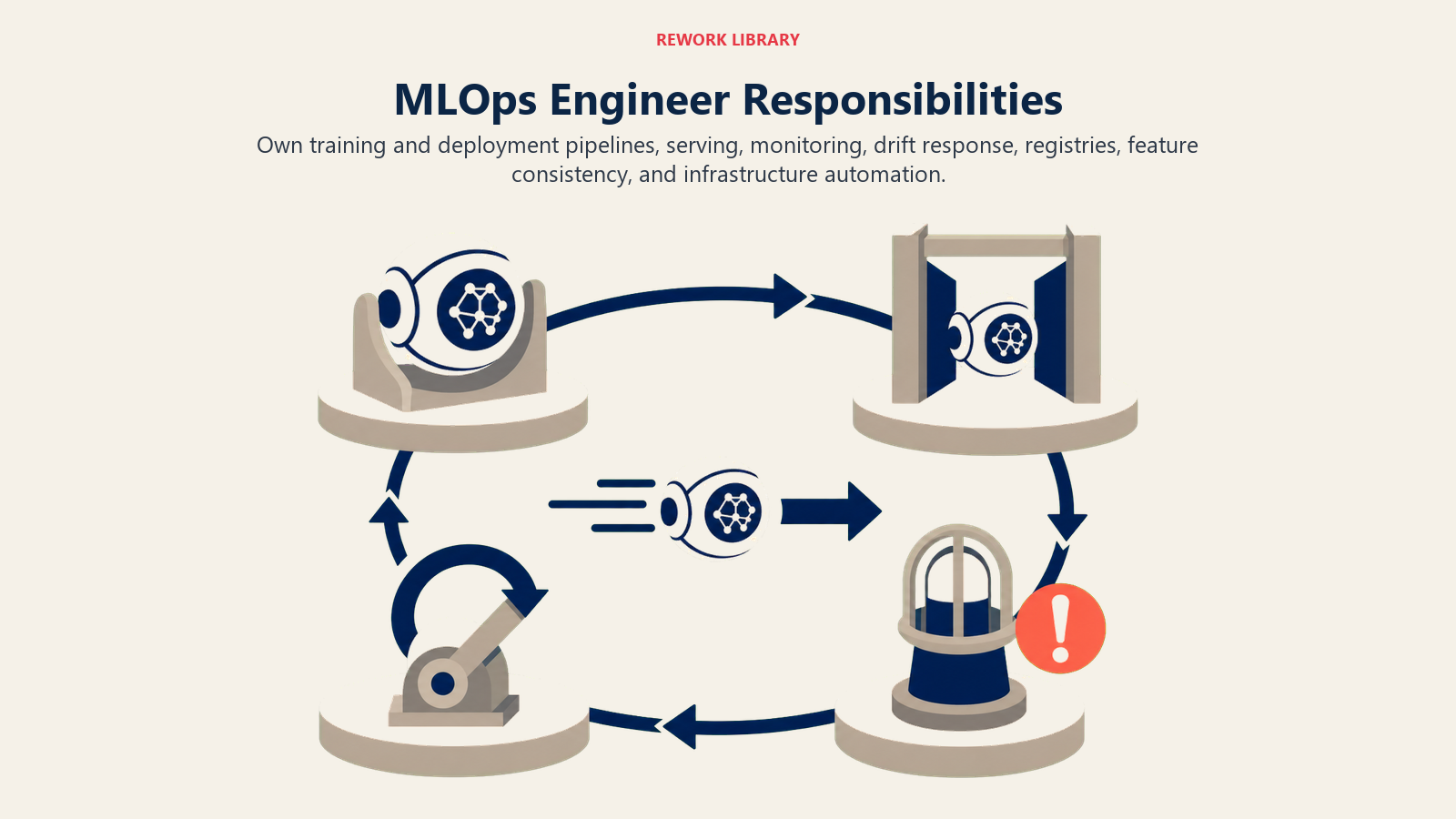
Own training and deployment pipelines, serving, monitoring, drift response, registries, feature consistency, and infrastructure automation.
- Build and maintain CI/CD pipelines specifically designed for ML workflows, including automated model training, evaluation gates, and staged rollouts.
- Deploy models to production using containerization (Docker) and orchestration (Kubernetes), and manage serving infrastructure for both batch and real-time inference.
- Monitor live models for accuracy degradation, data drift, and concept drift. Set up alerting and automated retraining pipelines when performance falls below defined thresholds.
- Design and operate feature stores to ensure consistent, reproducible feature computation between training and serving environments.
- Manage model registries and versioning systems (MLflow, Weights and Biases, or equivalent) so teams can reproduce any past model state and compare experiment results.
- Write infrastructure-as-code (Terraform, Pulumi, or cloud-native IaC) to provision and manage ML training clusters, serving endpoints, and data pipelines.
- Collaborate with data scientists to review model code for production readiness: memory footprint, latency profile, error handling, and logging.
- Partner with data engineers to ensure training data pipelines are reliable, versioned, and auditable.
- Define and enforce SLAs for model serving: uptime, latency percentiles, and throughput targets.
- Lead incident response for ML-related production issues, including rollbacks, shadow deployments, and A/B testing setups.
Requirements and qualifications
Look for production Python, ML orchestration, containers, cloud infrastructure, CI/CD, observability, and collaborative debugging.
Must-have skills and experience
- 3+ years of software engineering experience, with at least 2 years working on ML systems in production.
- Strong Python skills. You'll write production code, not just scripts.
- Hands-on experience with at least one major ML orchestration tool: Kubeflow, MLflow, Metaflow, Airflow for ML workflows, or Vertex AI Pipelines.
- Container and orchestration proficiency: Docker for packaging, Kubernetes for deployment and scaling.
- Cloud platform experience: AWS (SageMaker, EKS, S3), Google Cloud (Vertex AI, GKE), or Azure (Azure ML, AKS). Multi-cloud experience is a plus.
- Understanding of CI/CD principles and experience adapting them to ML-specific workflows (dataset versioning, model evaluation as a pipeline gate, etc.).
- Familiarity with observability tooling: Prometheus, Grafana, or cloud-native equivalents for tracking model performance metrics alongside infrastructure metrics.
- Solid grasp of distributed systems concepts relevant to ML serving: load balancing, horizontal scaling, caching, and latency budgets.
Nice to have
- Experience with GPU cluster management for training workloads.
- Knowledge of feature store platforms (Feast, Tecton, or cloud-native equivalents).
- Background in data engineering: Spark, dbt, or streaming pipelines (Kafka, Pub/Sub).
- Familiarity with responsible AI practices: model cards, bias auditing, explainability tools.
- Prior work with LLM deployment and serving (vLLM, TGI, or similar inference frameworks).
- Contributions to open-source MLOps tooling.
Education
Most teams accept a Bachelor's degree in Computer Science, Software Engineering, or a related field. Equivalent practical experience working on production ML systems is equally valued. There's no standard certification path for MLOps yet, though cloud ML certifications (AWS ML Specialty, Google Professional ML Engineer) are useful signals.
MLOps engineer job description template
Role summary
[Company name] is hiring an MLOps Engineer to take our machine learning models from experimentation to reliable production systems. You'll work alongside data scientists and platform engineers to build the pipelines, infrastructure, and tooling that keep our models running accurately at scale. This is a hands-on technical role with real ownership over production systems.
Key responsibilities
- Design, build, and maintain CI/CD pipelines for ML model training, evaluation, and deployment.
- Deploy and serve models using Docker, Kubernetes, and cloud-managed serving infrastructure.
- Monitor production models for data drift, prediction drift, and serving degradation. Automate retraining and alert workflows.
- Manage the model registry and experiment tracking system so teams can reproduce, compare, and audit model versions.
- Develop and maintain feature store infrastructure for consistent feature computation across training and serving.
- Write infrastructure-as-code for ML training and serving environments.
- Support data scientists in productionizing research models: reviewing code, defining interfaces, and setting up logging.
- Respond to and lead resolution of ML production incidents.
Required qualifications
- 3+ years of software engineering experience, including 2+ years with production ML systems.
- Proficient in Python for production-grade code.
- Experience with ML orchestration: Kubeflow, MLflow, Metaflow, Airflow, or equivalent.
- Container experience: Docker and Kubernetes.
- Cloud platform experience: AWS, GCP, or Azure ML services.
- CI/CD fundamentals applied to ML workflows.
- Observability and monitoring tooling experience.
Preferred qualifications
- GPU cluster or distributed training experience.
- Feature store platform experience (Feast, Tecton).
- Data engineering background (Spark, dbt, streaming).
- LLM serving experience (vLLM, TGI, or similar).
- Cloud ML certification.
What we offer
- [Salary range: $X to $Y depending on experience and location]
- Equity participation
- Remote/hybrid work arrangements
- Learning and development budget for certifications and conferences
- Access to cutting-edge ML infrastructure and research partnerships
Salary and career outlook
The MLOps market is still maturing, so salary ranges vary widely based on company size, location, stack complexity, and how much the role overlaps with platform engineering.
| Level | Typical range (US, 2025) |
|---|---|
| Junior (0-2 years) | $110,000 to $140,000 |
| Mid-level (2-4 years) | $145,000 to $185,000 |
| Senior (5+ years) | $185,000 to $230,000 |
| Staff / Principal | $220,000 to $280,000+ |
| Ranges include base salary and exclude equity. Source: Levels.fyi and industry surveys, 2025. |
Career progression from an MLOps role typically branches in two directions. One path leads to machine learning engineering proper, where the focus shifts toward model research and architecture. The other path leads to ML platform engineering or infrastructure leadership, closer to a site reliability engineer or cloud engineer background but specialized for ML workloads. A small number of experienced practitioners move into ML architect roles, designing the end-to-end ML strategy for an organization.
Demand continues to grow as more companies move past proof-of-concept ML and need operational rigor. The role is particularly in demand at companies running multiple models in production simultaneously, where manual deployment and monitoring becomes unsustainable.
Related roles and how they differ
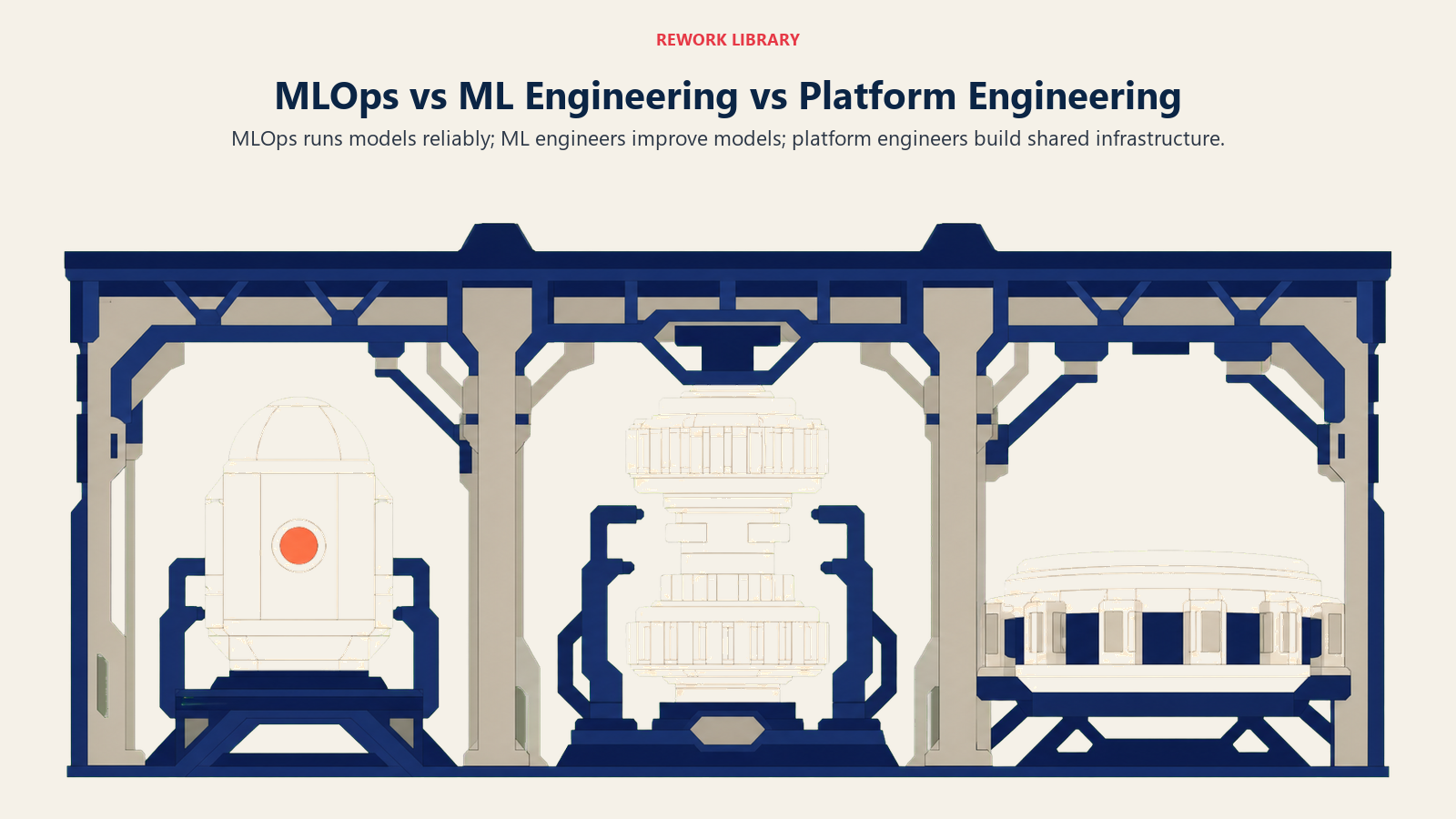
Hiring managers often confuse MLOps with adjacent roles. Here's a direct comparison to help you decide which role your team actually needs.
| Role | Primary focus | Hire when |
|---|---|---|
| MLOps Engineer | ML lifecycle operations: CI/CD for models, deployment, monitoring, drift detection, retraining pipelines | You have models in production (or nearly there) and need reliable, scalable serving + ongoing model health |
| Machine Learning Engineer | Building and improving ML models; productionizing research into reusable systems | You need someone who can both build models and integrate them into applications, but you don't yet have dedicated ML infrastructure |
| DevOps Engineer | Software CI/CD, infrastructure automation, cloud provisioning, SRE-adjacent | You need general deployment and infrastructure automation without ML-specific needs |
| Data Engineer | Data pipelines, storage, transformation, and reliability of data flowing into ML training | Your ML bottleneck is data quality and pipeline reliability upstream of model training, not model deployment |
One practical rule of thumb: if your team is asking "how do we get this model into production reliably?", hire an MLOps engineer. If they're asking "how do we build a better model?", hire an AI engineer or machine learning engineer.
Frequently Asked Questions about MLOps Engineer Job Description
What's the difference between MLOps and DevOps?
DevOps focuses on software delivery pipelines: building, testing, and deploying code. MLOps applies the same thinking to machine learning systems, but adds ML-specific concerns that software CI/CD doesn't cover. Models degrade in ways that code doesn't (data drift, concept drift). Model "testing" requires statistical evaluation, not just unit tests. Retraining is a routine operation with no software equivalent. A DevOps engineer can build excellent infrastructure, but they'll typically need guidance from someone with ML knowledge to handle these concerns correctly.
Do MLOps engineers need to know how to build ML models?
They don't need to be ML researchers, but they need enough ML knowledge to work effectively with data scientists. That means understanding how models are trained, what hyperparameters matter, how evaluation metrics work, and what can go wrong in production (data distribution shift, label drift, serving skew). The best MLOps engineers can review a data scientist's code and spot production risks before deployment.
Is MLOps the same as ML platform engineering?
They overlap significantly but aren't identical. ML platform engineering tends to focus on the shared internal infrastructure: the feature store, the experiment tracking system, the training cluster, the model registry. MLOps is broader and often includes per-model deployment, monitoring, and the operational processes around specific models. At large companies, these are separate teams; at smaller companies, one person does both.
What cloud certifications are relevant for MLOps roles?
The most relevant are the AWS Certified Machine Learning Specialty, Google Cloud Professional Machine Learning Engineer, and the Azure AI Engineer Associate. These cover cloud-specific ML tooling and MLOps workflows on each platform. They're useful signals but not required. Practical experience with production ML systems matters more to most hiring teams.
How do you evaluate MLOps candidates during interviews?
Focus on production experience, not just ML knowledge. Ask them to describe a model they've deployed, including how they set up monitoring, what went wrong after launch, and how they handled it. System design questions around model serving pipelines, feature store design, and retraining triggers reveal how candidates think operationally. Asking about their approach to CI/CD for ML, including how they gate deployments on model performance metrics, is another reliable signal.
As ML systems become central to how companies operate, the teams that build reliable, scalable model infrastructure will have a significant operational advantage. A well-written job description is where that advantage starts: it shapes who applies, who gets screened in, and whether the person you hire can actually do what the role requires. Use this template as a starting point, then tailor the stack specifics and seniority markers to your actual environment.
For related hiring resources, see our job description guides for DevOps engineers, data engineers, and AI engineers.