Theory of Constraints: Find and Fix Your Bottleneck
Turn this article into takeaways for your work.


Each assistant summarizes the article only for you and suggests best practices for your work.
The theory of constraints (ToC) is a management philosophy built on one insight: every system has exactly one constraint that limits its output, and until you fix that constraint, nothing else you improve will move the needle. If you've ever wondered why a process improvement project delivered great local results but didn't change overall throughput, ToC explains why, and tells you what to do instead.
What is the theory of constraints?
The theory of constraints is a systematic approach to identifying the single factor that most limits a system's ability to achieve its goal, and then restructuring the entire system around eliminating or managing that constraint.
Eliyahu M. Goldratt introduced ToC in his 1984 business novel The Goal, written with Jeff Cox. The book follows a fictional plant manager named Alex Rogo who has 90 days to turn around a failing factory. Through conversations with his mentor Jonah, Alex learns that his plant has been optimizing the wrong things: maximizing local efficiencies at every station while ignoring the one resource that was actually limiting output. The Goal has sold more than seven million copies and is still assigned reading at business schools and operations programs worldwide.
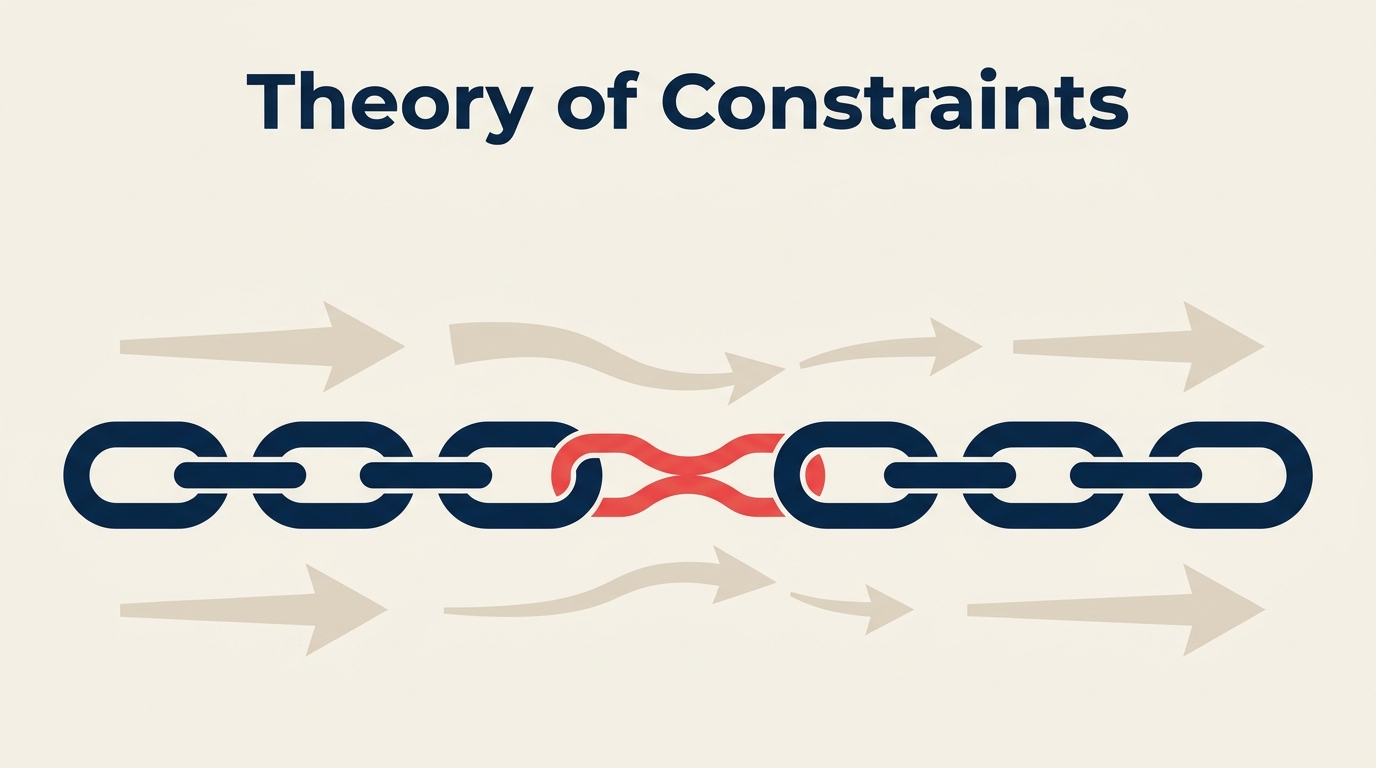
Goldratt's central claim is deceptively simple: a chain is only as strong as its weakest link. No matter how fast the other links move, throughput is capped by the slowest one. Improving any non-constraint step produces no net gain, just larger piles of work-in-progress that stack up in front of the bottleneck.
ToC is not just a manufacturing framework. Teams have applied it in software development, healthcare, logistics, and professional services. The underlying logic transfers anywhere a system has a goal and a limiting factor.
For the general concept of bottlenecks (what they are and how they appear across different frameworks), see Business Bottlenecks. This article focuses on Goldratt's named method and its specific tools.
Key Facts
Origin: Eliyahu Goldratt introduced the theory of constraints in The Goal (1984), a business novel that has sold over seven million copies and remains required reading at many top engineering and MBA programs (Goldratt Institute).
Throughput accounting: ToC introduced a new set of financial measures, specifically throughput, inventory, and operating expense, to replace traditional cost-accounting metrics that Goldratt argued actively encouraged the wrong decisions (Goldratt, The Goal, 1984).
The core assertion: Goldratt argued that in any complex system at any point in time, there is most often only ONE constraint, and that "focusing on anything other than that constraint is an illusion of improvement" (The Goal, 1984).
The five focusing steps
Goldratt codified ToC into a repeatable cycle called the five focusing steps. The steps are sequential and designed to loop continuously. Once you elevate a constraint, you return to step one because the constraint will have shifted somewhere else.
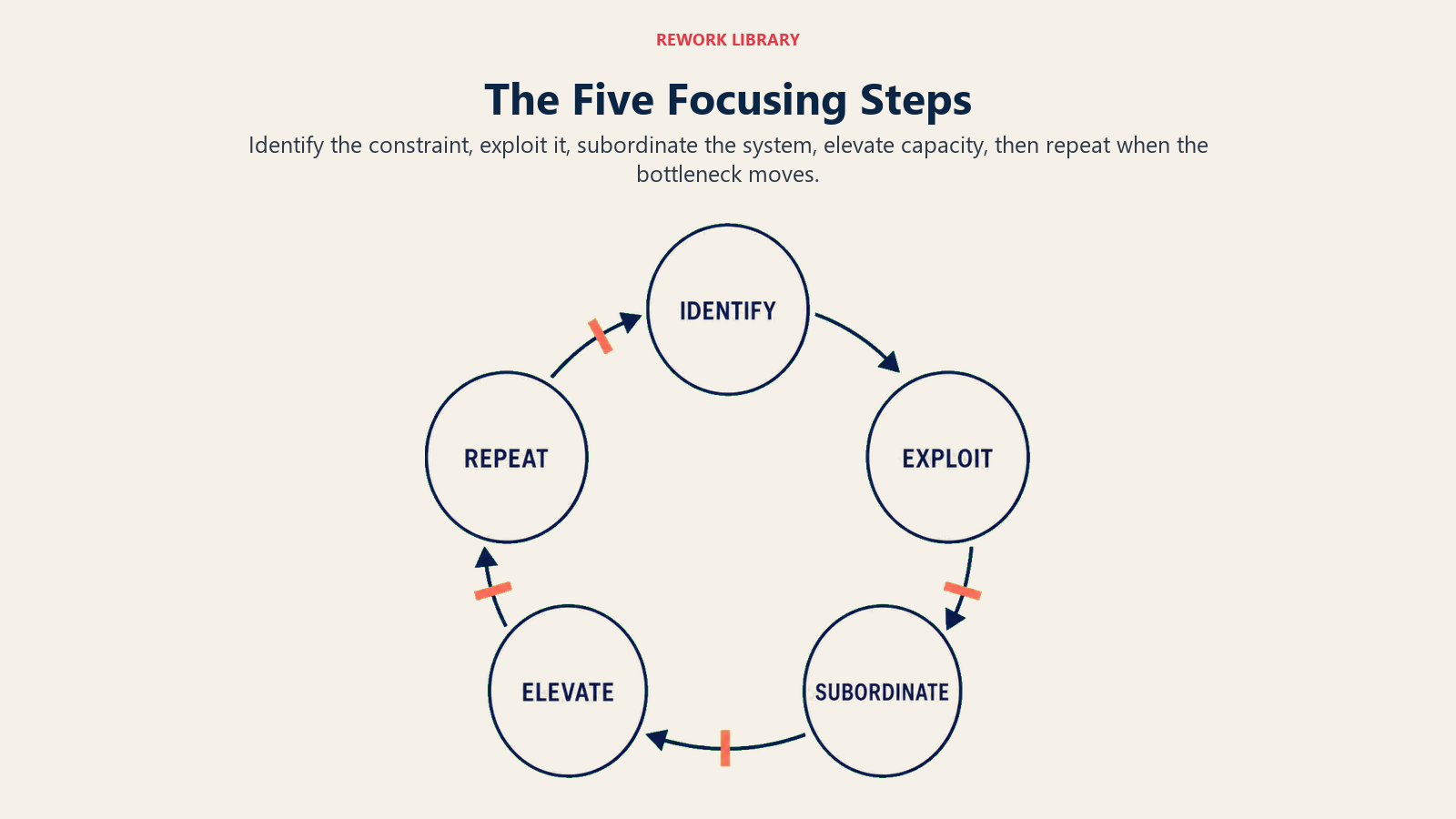
Step 1: Identify the constraint
Find the one resource, policy, or process that is limiting overall system throughput right now. In a factory, it's often a machine with a queue always building in front of it. In a software team, it might be code review. In a consulting firm, it might be partner sign-off on proposals.
Signs of a constraint: work piles up before it, it runs at or near 100% capacity, downstream resources are often starved waiting for it.
Step 2: Exploit the constraint
Before spending money or adding resources, get maximum output from the constraint as it currently exists. Eliminate downtime, improve scheduling, reduce defects that force rework through it. If the constraint is a machine, keep it running during breaks. If it's a person, protect their time fiercely.
Exploit means: squeeze everything you can out of it without changing the fundamental setup.
Step 3: Subordinate everything else to the constraint
This is the hardest step psychologically. Every other part of the system should operate in a way that supports the constraint, even if that means non-constraint resources deliberately run below their maximum capacity. Feeding work faster than the constraint can absorb it just creates inventory buildup. Other departments running "efficiently" in isolation will actively harm system throughput if they ignore the constraint.
Step 4: Elevate the constraint
If the constraint still limits the system after exploitation, invest to increase its capacity. Add a machine. Hire another specialist. Redesign the bottleneck step. This is the step where capital investment is justified, but only after you've confirmed that exploitation (step 2) has been fully applied.
Step 5: Return to step 1 (avoid inertia)
Once the constraint is elevated, it will often cease to be the binding limit. The constraint moves somewhere else in the system. Return to step 1 and identify the new one. Goldratt specifically warned against inertia: don't let the rules and assumptions built around the old constraint become a new constraint themselves.
Key concepts: throughput, inventory, and operating expense
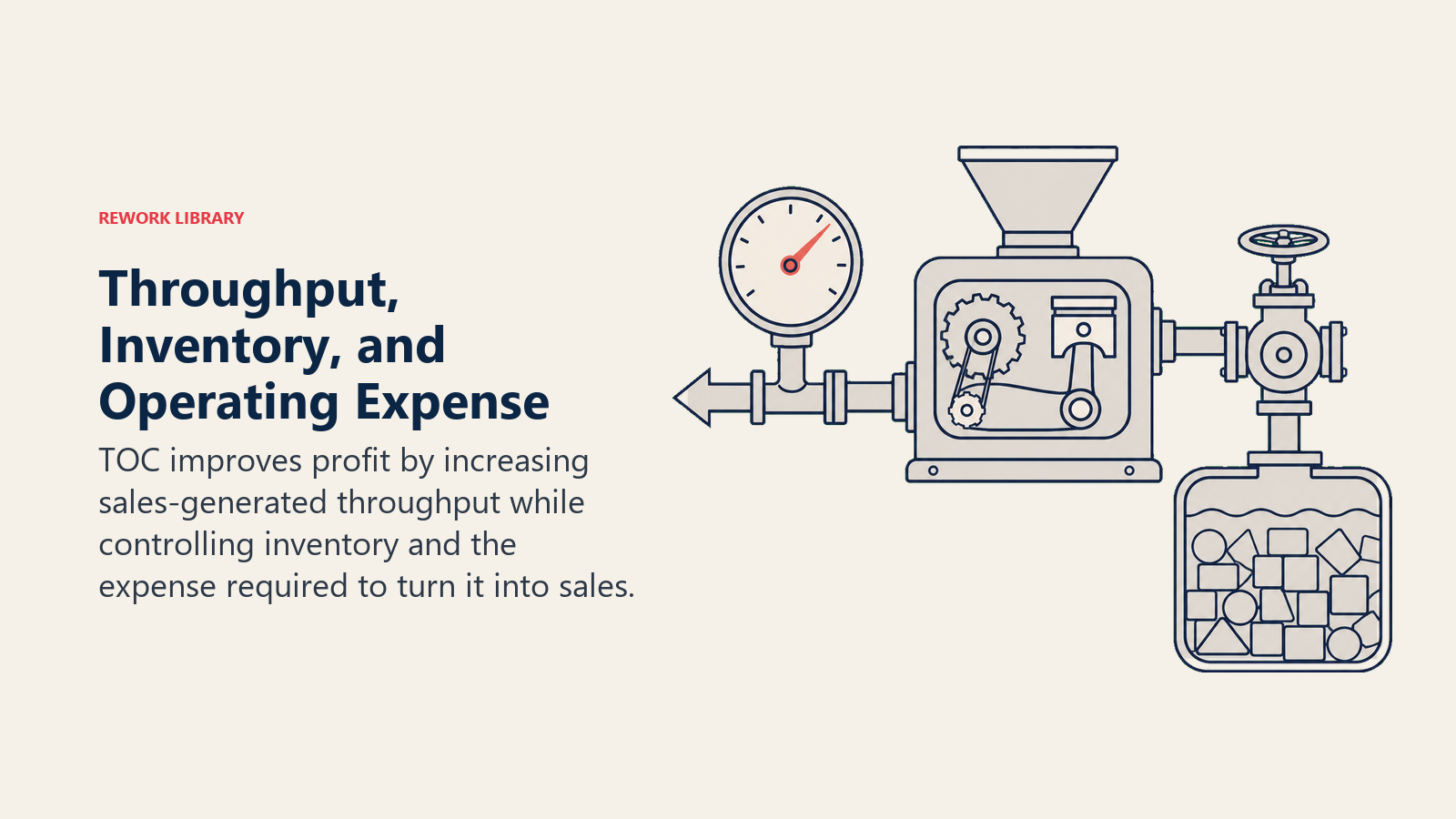
Goldratt rejected traditional cost-accounting because it encouraged managers to reduce local costs even when doing so hurt overall output. He proposed three measures that together describe a system's performance from a ToC perspective.
| Measure | Definition | What it drives |
|---|---|---|
| Throughput (T) | The rate at which the system generates money through sales (revenue minus truly variable costs) | Primary goal: maximize |
| Inventory (I) | All money the system has invested in things it intends to sell, including work-in-progress | Secondary: minimize |
| Operating Expense (OE) | All money the system spends turning inventory into throughput (labor, overhead) | Secondary: minimize |
The ToC decision rule: before taking any action, ask whether it increases T, decreases I, or decreases OE, in that priority order. Actions that boost T rank above those that only cut OE, which is the opposite of most cost-accounting instincts.
Drum-buffer-rope explained
Drum-buffer-rope (DBR) is the ToC production scheduling method. It translates the five focusing steps into a practical shop-floor tool.
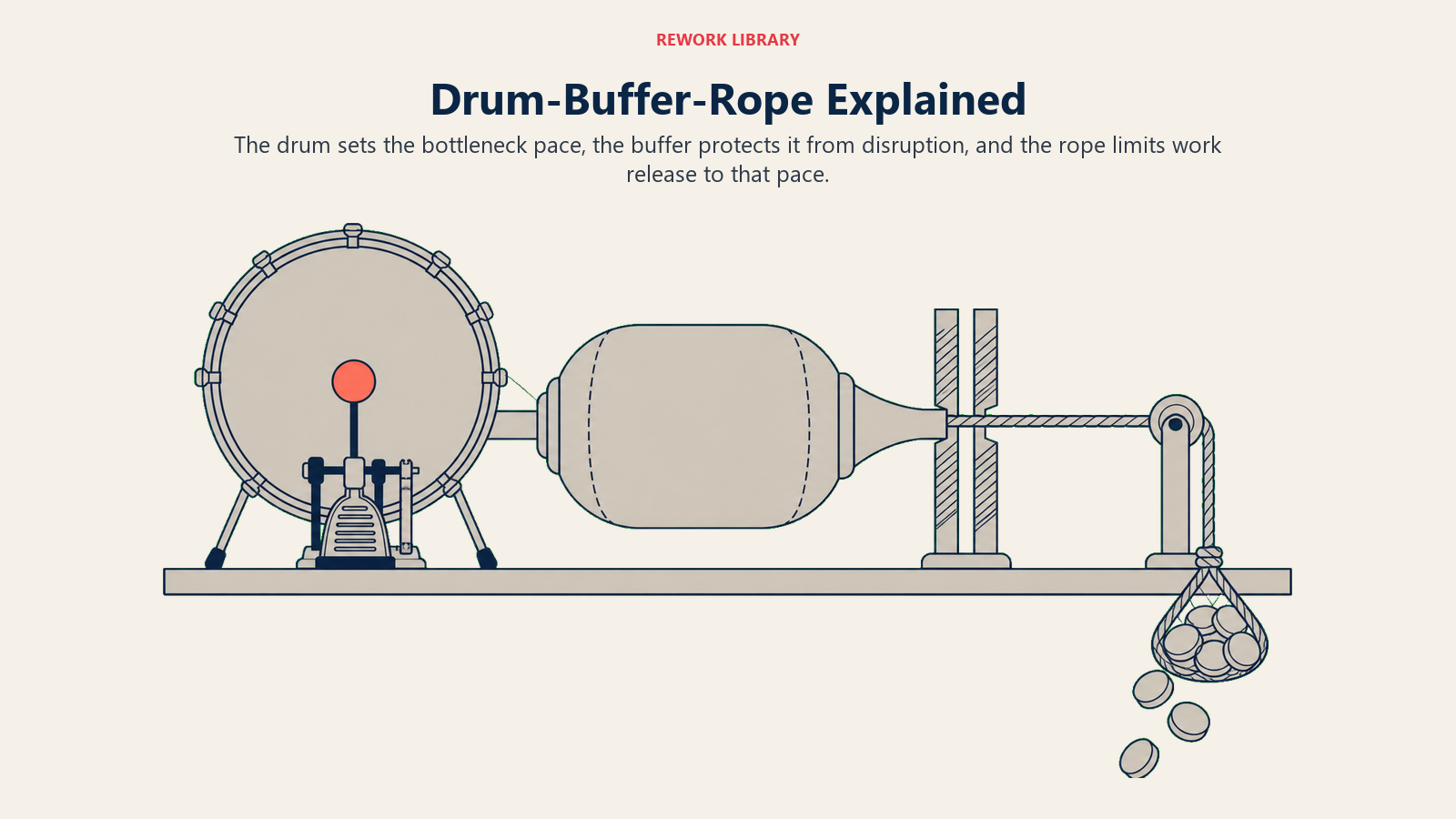
- Drum: The constraint sets the pace (the beat) for the entire system. Everyone else matches the constraint's rhythm, not their own local optimal speed.
- Buffer: A time buffer of work-in-progress is placed just upstream of the constraint to protect it from running dry due to variability elsewhere in the system. The constraint must never starve.
- Rope: A communication signal (originally a literal rope in Goldratt's illustrations) ties the input point of the system to the drum. Material is released into the system only at the rate the drum can process it, preventing pileups everywhere else.
DBR makes subordination (step 3) operational. Non-constraint resources don't run at full speed because the rope limits how much work enters the system. This runs counter to local-efficiency thinking but is correct from a system perspective.
Theory of constraints vs lean vs six sigma
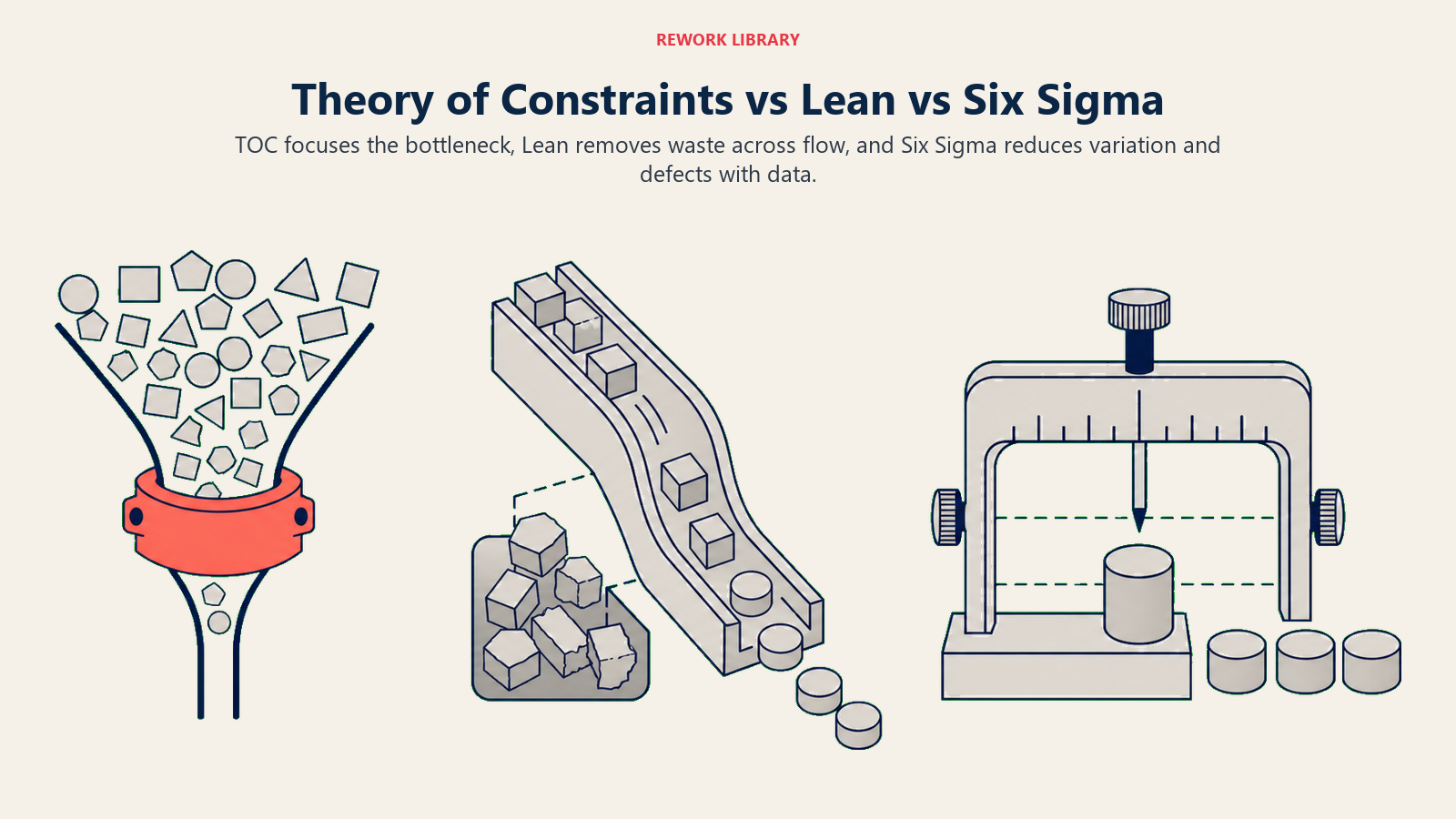
All three frameworks target process improvement, but they differ sharply in focus, scope, and where they direct energy first.
| Dimension | Theory of Constraints | Lean | Six Sigma |
|---|---|---|---|
| Primary focus | The single limiting constraint | Waste elimination across the value stream | Variation and defect reduction |
| Improvement target | Throughput of the whole system | Flow and efficiency everywhere | Quality and consistency |
| Where to start | Find the constraint first, ignore the rest | Map the entire value stream | Measure defects and variation |
| Core tool | Five focusing steps + drum-buffer-rope | Value stream mapping, 5S, kanban | DMAIC, statistical analysis |
| Speed of result | Fast (focused intervention) | Medium (requires cultural shift) | Slower (data-intensive) |
| Best situation | Clear throughput bottleneck limits output | Broad waste distributed across many steps | High defect rate or costly variation |
| Risk | Constraint shifts after improvement; requires iteration | Improvements may not move the needle if a hidden constraint exists | Complexity can slow implementation |
In practice, many operations teams combine them. ToC tells you where to focus, Lean tells you how to eliminate waste from that area, and Six Sigma tells you how to stabilize quality. For a deeper look at Lean, see Lean Methodology. For Six Sigma specifically, see Six Sigma.
How to apply the theory of constraints
Step 1: Define your system's goal
Write it down in measurable terms. For a business, the goal is usually to make money now and in the future. For a hospital unit, it might be patient throughput without compromising safety. The goal gives you a basis for measuring whether throughput is actually increasing.
Step 2: Map the current process
Use a process map or value stream map to document each step, its capacity, its actual utilization, and the queue building in front of it. You're looking for the step where work consistently piles up.
Step 3: Confirm the constraint with data
Don't rely on gut feel. Measure queue length, wait time, and utilization at each step over at least a week. The constraint will show the longest queue and highest utilization simultaneously.
Step 4: Apply exploit actions
Before any investment, list every way to get more from the constraint without adding resources. Common tactics: reduce changeover time, eliminate defects that require rework through the constraint, dedicate staff to feeding and supporting the constraint, remove administrative delays.
Step 5: Subordinate non-constraints
Adjust scheduling and work-release rules so the rest of the system feeds the constraint at its actual pace. Use drum-buffer-rope or a simple kanban signal to control flow. Prepare for pushback from teams whose utilization will visibly drop because that drop is correct behavior.
Step 6: Elevate if necessary, then iterate
If exploitation isn't enough, add capacity at the constraint. After elevating, run the five focusing steps again because the constraint will have moved. Track throughput (T), not local efficiency numbers, to confirm the improvement is real.
Theory of constraints examples
| Industry | The constraint | How ToC was applied | Result |
|---|---|---|---|
| Manufacturing | One punch-press machine with a growing queue | Eliminated changeovers on that machine, added a time buffer upstream, slowed input release | Plant throughput increased without adding equipment |
| Software development | Code review by two senior engineers | Protected review time, batched small reviews, hired one junior reviewer for simple PRs | Feature release cycle shortened from 3 weeks to 11 days |
| Hospital (ER) | Radiology turnaround for admitted patients | Dedicated a radiology slot to ER, all other departments timed their work to radiology's pace | Average patient flow-through time dropped by 30% |
| Professional services | Partner review of client deliverables | Templated deliverables to reduce review time, created a pre-review checklist done by associates | Partner bottleneck eliminated; capacity doubled without new hires |
See also cycle time vs lead time for how to measure the impact of constraint removal on throughput speed, and poka-yoke for error-proofing techniques that reduce defect-driven rework through the constraint.

Customer Success Operations Manager
On this page
- What is the theory of constraints?
- Key Facts
- The five focusing steps
- Step 1: Identify the constraint
- Step 2: Exploit the constraint
- Step 3: Subordinate everything else to the constraint
- Step 4: Elevate the constraint
- Step 5: Return to step 1 (avoid inertia)
- Key concepts: throughput, inventory, and operating expense
- Drum-buffer-rope explained
- Theory of constraints vs lean vs six sigma
- How to apply the theory of constraints
- Step 1: Define your system's goal
- Step 2: Map the current process
- Step 3: Confirm the constraint with data
- Step 4: Apply exploit actions
- Step 5: Subordinate non-constraints
- Step 6: Elevate if necessary, then iterate
- Theory of constraints examples