Standard Work: The Foundation of Lean Improvement
Turn this article into takeaways for your work.


Each assistant summarizes the article only for you and suggests best practices for your work.
Standard work is the starting point for every lean improvement. Without it, teams have no reliable baseline to measure against, and any change they make is a guess rather than a genuine improvement.
This article covers what standard work actually is, how it differs from a standard operating procedure, the three core elements, and a practical six-step approach to creating it in your own operations.
What is standard work?
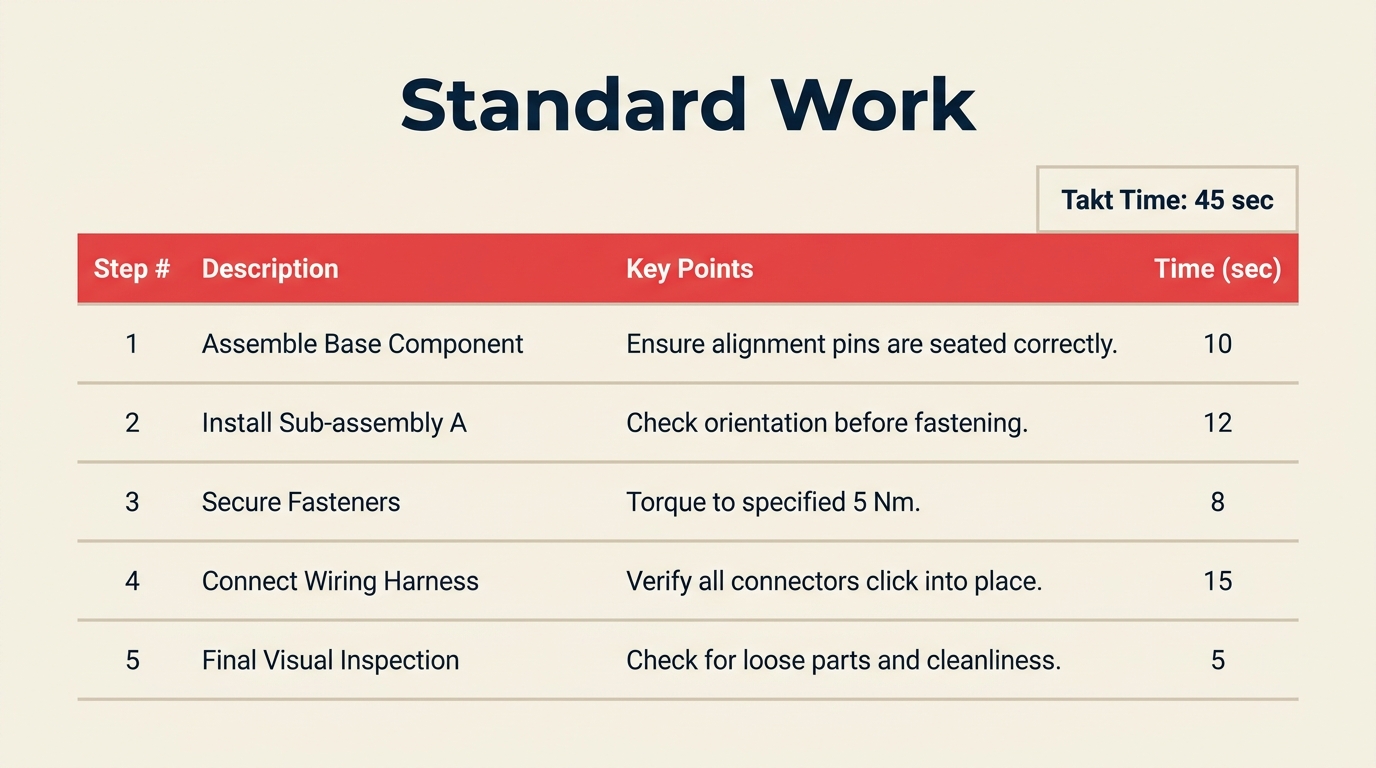
Standard work is the documented description of the current best, safest, and most efficient method for performing a repeatable task. It captures the specific sequence of steps, the time each step should take relative to customer demand, and the exact amount of inventory or materials needed at each point in the process.
The term comes directly from the Toyota Production System (TPS), where Taiichi Ohno and Shigeo Shingo treated standard work not as a rigid rulebook but as the current agreed-upon best method, updated whenever a better way was proven. That distinction matters: standard work is a living document, not a monument.
Key Facts
- Toyota defines standard work as one of three pillars of the TPS alongside just-in-time production and jidoka (built-in quality). (Toyota Motor Corporation, 2023)
- A Lean Enterprise Institute study found that operations teams with documented standard work reduced their defect rates by 25 to 35 percent compared to teams that relied on informal tribal knowledge. (Lean Enterprise Institute, 2022)
- The Association for Manufacturing Excellence reports that 60 percent of improvement gains from kaizen events evaporate within 12 months when standard work is not updated to reflect the new method. (AME, 2021)
The 3 elements of standard work
Standard work is built from three specific components. Leave any one out and what you have is closer to a general procedure than a lean standard.
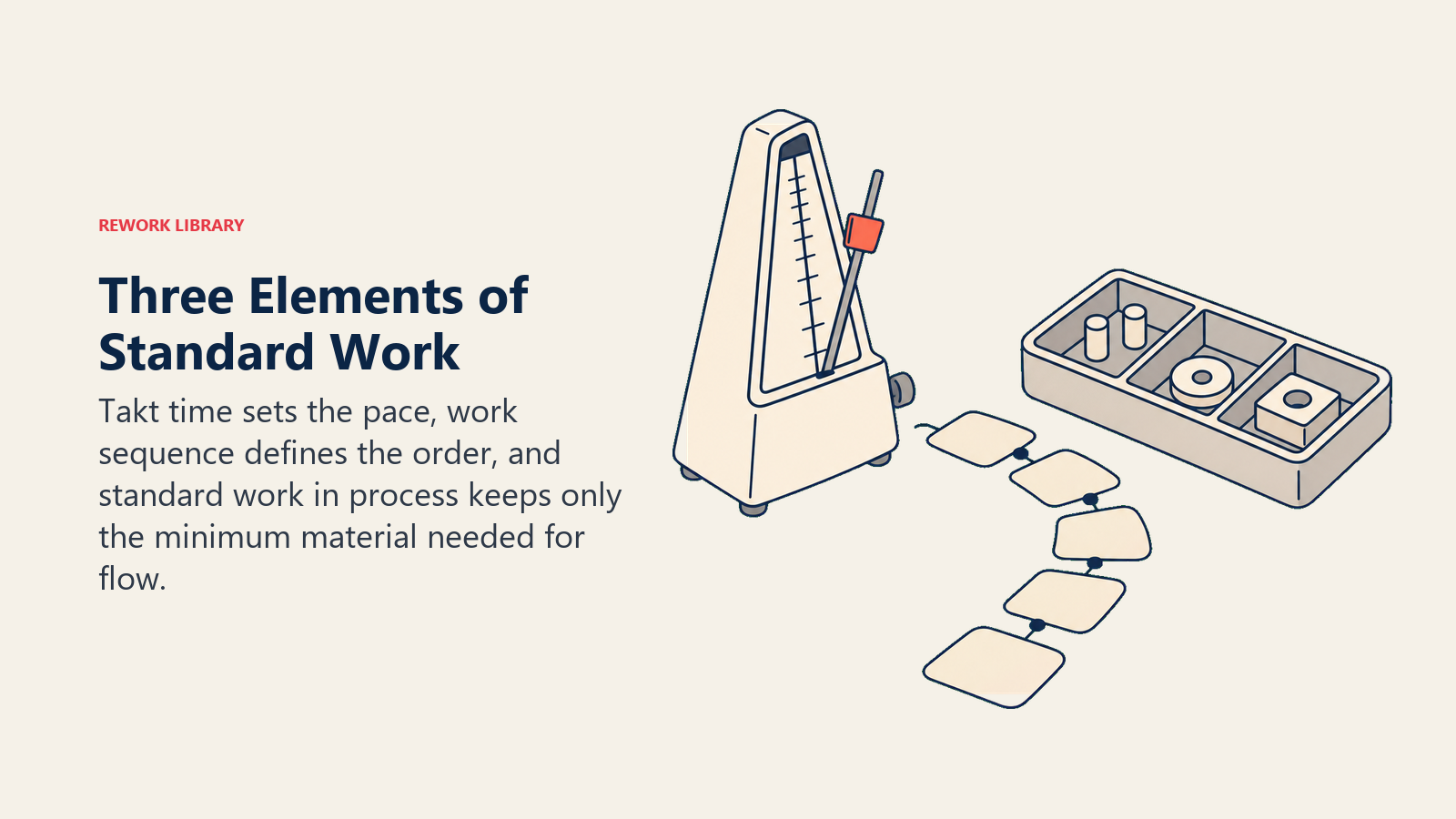
| Element | What it defines | Why it matters |
|---|---|---|
| Takt time | The available production time divided by customer demand; the pace at which one unit must be completed | Sets the rhythm the entire process must match to meet demand without overproduction |
| Work sequence | The precise order in which a worker performs each task within takt time | Eliminates variation in how operators approach the same job; surfaces waste in movement and waiting |
| Standard work-in-process (SWIP) | The minimum quantity of parts or materials needed in the process at any moment to maintain flow | Prevents both starvation (line stoppages) and accumulation (excess WIP that hides problems) |
Together, these three elements give a team a complete, measurable description of the current best method.
Standard work vs standard operating procedure (SOP)
These two documents serve different purposes and operate at different levels of the organization. Teams frequently confuse them, which leads to either over-engineering simple tasks or under-specifying critical ones.
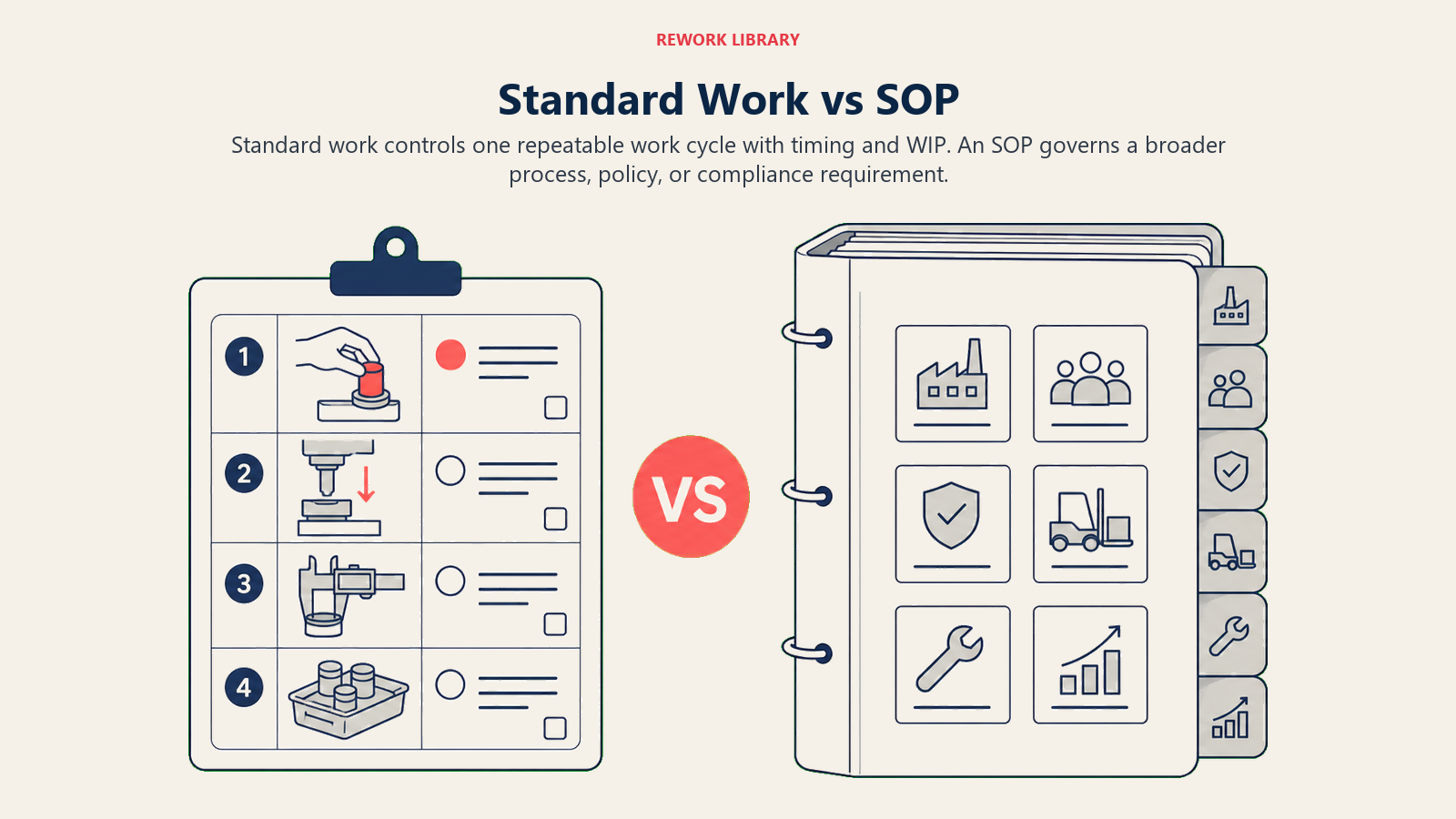
| Dimension | Standard work | Standard operating procedure (SOP) |
|---|---|---|
| Scope | A single repeatable task or work cycle at the operator level | A broader process, policy, or compliance requirement, often spanning multiple steps or departments |
| Level of detail | Granular: sequence, timing, SWIP, visual layout of the workstation | Variable: enough to ensure compliance, but typically not cycle-time precise |
| Primary owner | The frontline operator and team leader who perform the task | A process owner, quality manager, or compliance function |
| Update frequency | Updated whenever a better method is proven through kaizen or improvement work | Updated on a defined review cycle or when regulatory/policy changes occur |
| Primary purpose | Create a baseline for continuous improvement; detect deviation in real time | Ensure consistency, compliance, and repeatability across the organization |
In short: a standard operating procedure tells you what to do and why; standard work tells you exactly how to do it, in what order, and in how much time. They're complementary, and many organizations need both.
For a deeper look at SOPs, see Standard Operating Procedure.
Benefits of standard work
Standard work is called the foundation of lean improvement for a simple reason: you can't improve what you haven't defined. Here's what organizations consistently gain by establishing it:
A stable baseline for kaizen. Kaizen events and daily improvement work both require a documented current state to measure against. Without standard work, a team might "improve" a process only to return it to something close to the original method within weeks.
Faster and more consistent training. New operators can be trained to the documented standard rather than learning ad hoc from whoever happens to be on shift. This is especially valuable in high-turnover environments.
Visible deviation. When the standard is clear, any departure from it is immediately noticeable. That visibility is what allows team leaders to catch quality issues or safety risks before they escalate.
Cross-shift consistency. In multi-shift operations, standard work eliminates the drift that builds up when each shift develops its own informal approach. The morning crew and the night crew follow the same sequence.
A forcing function for improvement. Because the standard is explicit, any operator who finds a better way can propose a revision backed by evidence. Improvement becomes structured rather than accidental.
Process standardization covers the broader organizational approach to building consistency across a process portfolio.
How to create standard work
Creating standard work is a shop-floor activity, not a documentation exercise done in a conference room. The people who do the work must be central to every step.
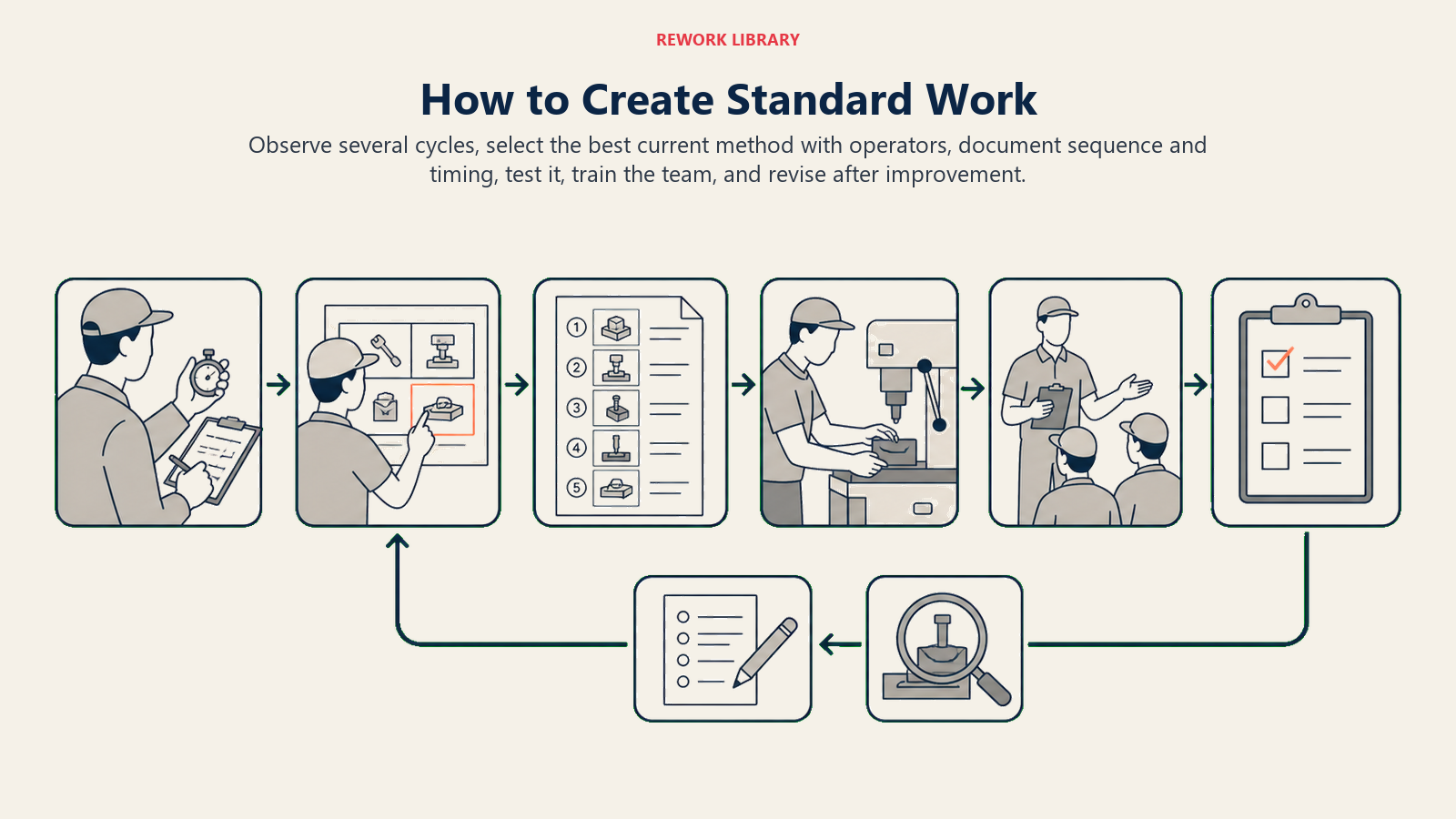
Step 1: Observe and time the current process
Go to the gemba. Watch multiple operators complete the task and record actual cycle times for each step. Don't rely on memory, estimates, or previous records. Time at least five to ten complete cycles to account for natural variation.
Step 2: Identify the best current method
Review the observations and select the sequence that consistently produces the best quality in the least time with the least movement and effort. This becomes your starting point. It should reflect what already works, not an idealized version that no one actually uses.
Step 3: Define takt time
Calculate takt time using the formula: available production time divided by customer demand within that period. This number becomes the pace constraint that the work sequence must fit within.
Step 4: Document with a standard work sheet
Capture the work sequence, takt time, and SWIP on a standard work sheet (also called a standard work combination table or standard work chart depending on the format). The document should be visual, simple, and posted at the workstation, not filed in a binder. Include a layout diagram showing the physical movement of the operator through the cell or work area.
Step 5: Train and verify
Walk each operator through the documented standard. Have them perform the task while you observe and compare their method to the documented sequence. Correct deviations before the standard is considered live. The goal is confirmation, not audit.
Step 6: Review and improve
Schedule regular reviews, typically during or after each kaizen event or after any quality issue is resolved. When a better method is proven, update the standard immediately. A standard that never changes is a sign either that improvement has stalled or that the document has been abandoned.
Value stream mapping is a useful companion tool here. It shows where standard work will have the highest impact by revealing where flow breaks down across the full value stream.
Standard work examples
Standard work applies across industries wherever repeatable tasks exist. The concept is the same; the format adapts to the context.
| Setting | Example task | What the standard work captures |
|---|---|---|
| Manufacturing cell | Assembling a sub-component in an automotive plant | Sequence of 12 pick-and-place steps, 58-second takt time, 2 parts SWIP at each station |
| Hospital nursing | Bedside medication administration | Safety check sequence, verification steps, 8-minute target time per patient, one tray of supplies staged per room |
| Software release | Deploying a hotfix to production | Ordered checklist: code review, automated tests, staging verification, change-board approval, deployment command, monitoring window, rollback criteria |
| Customer support | Resolving a billing dispute | Call flow sequence, system lookup steps, escalation criteria, 6-minute average handle time, one open ticket per interaction |
The manufacturing example is where standard work originated in the Toyota Production System, but the nursing and software examples show how readily it transfers. Any task that is repetitive, consequential, and improvable benefits from documentation.
For related lean scheduling concepts, see heijunka and just-in-time production.
Common mistakes
Treating standard work as permanent. The most common error is writing the standard, laminating it, and never touching it again. Standard work is the current best method, not the final one. If a year passes without a revision, something is wrong.
Writing it without operators. When engineers or managers create standard work in isolation and hand it to operators, adoption fails. The people doing the task know the nuances, the workarounds, and the real constraints. Their input is not optional.
No visual management. Standard work kept in a filing cabinet or a shared drive does nothing. It belongs at the workstation, posted where operators can reference it and team leaders can audit compliance during a gemba walk. Visual standards catch deviations before they become defects.
Confusing standard work with work instructions. Work instructions explain how to operate equipment or perform a specific technical action. Standard work integrates those instructions into a time-sequenced flow that fits takt time and accounts for SWIP. They're related but not the same document.
Skipping the SWIP component. Teams often document sequence and takt time but forget standard work-in-process. Without SWIP, the process has no buffer definition and operators must make judgment calls that create variation. Cycle time and lead time analysis can help establish the right SWIP levels.
The improvement starts with the standard
Standard work doesn't slow teams down. It gives them something concrete to push against. Every improvement in a lean operation begins the same way: someone documents the current best method, someone else finds a better one, and the standard moves forward.
That cycle, from standard to kaizen to new standard, is what drives sustainable operational excellence. Without the first step, the rest of the cycle has no anchor.
For the broader lean context, see lean methodology and 5S methodology.

Customer Success Operations Manager
On this page
- What is standard work?
- The 3 elements of standard work
- Standard work vs standard operating procedure (SOP)
- Benefits of standard work
- How to create standard work
- Step 1: Observe and time the current process
- Step 2: Identify the best current method
- Step 3: Define takt time
- Step 4: Document with a standard work sheet
- Step 5: Train and verify
- Step 6: Review and improve
- Standard work examples
- Common mistakes
- The improvement starts with the standard