Process Standardization: Benefits and How to Do It
Turn this article into takeaways for your work.


Each assistant summarizes the article only for you and suggests best practices for your work.
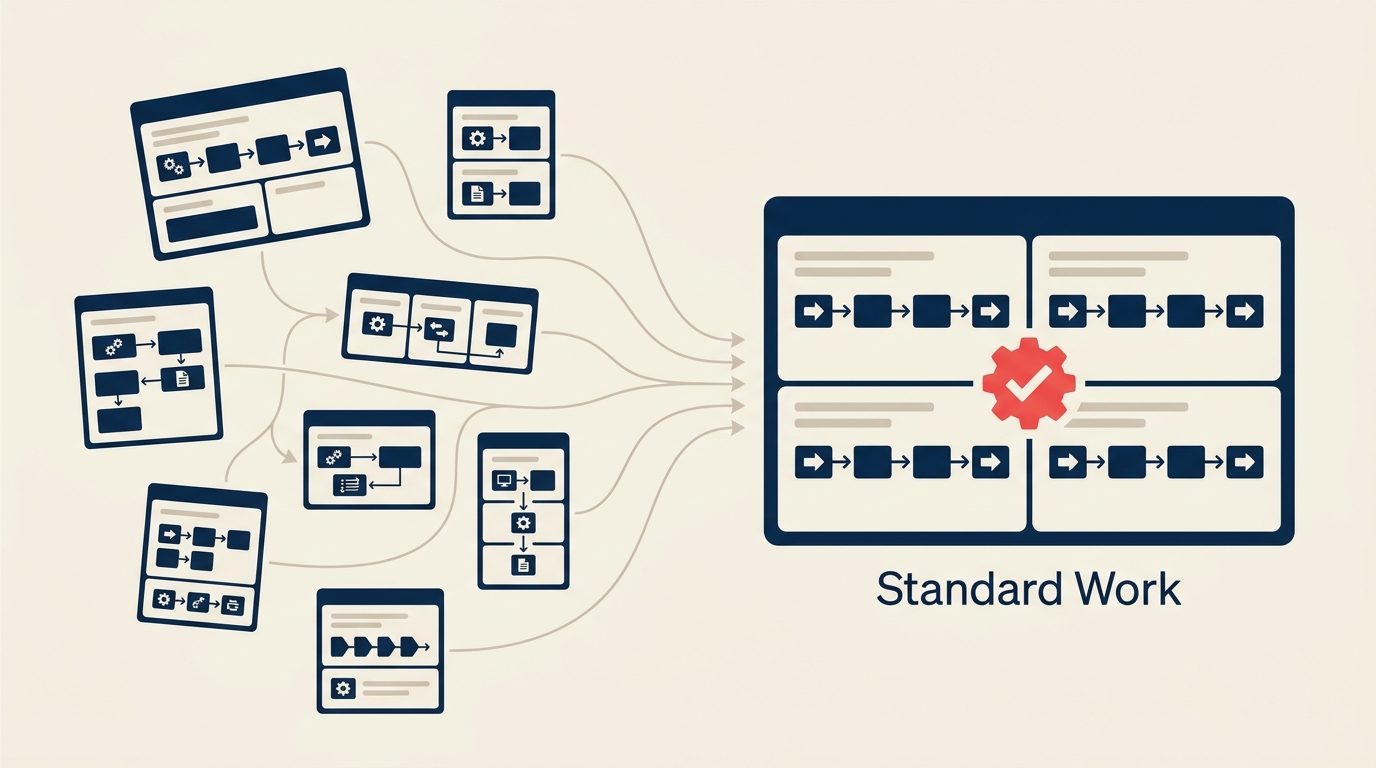
Process standardization is the discipline of establishing one consistent, repeatable best way to run a process across every team, site, and shift. When you standardize, you replace the dozens of slightly different ways people do the same task with a single agreed method that everyone follows. The result is predictable output, faster onboarding, and a reliable baseline for improvement.
It's not complicated in theory. But it's harder in practice than most managers expect, and it's easy to confuse with related concepts like writing an SOP or documenting a workflow. This guide untangles those ideas and walks through exactly how to do it.
What is process standardization?
Process standardization is the act of defining and enforcing one best-known method for a repeatable process, then making that method the default across all people and locations who perform that process.
The key word is "discipline." Writing down a process is process documentation. Publishing that document as an official instruction is creating a standard operating procedure (SOP). Standardization is the broader commitment: you pick the best method, you train everyone on it, you audit for adherence, and you only change the method through a controlled improvement cycle.
Three terms matter here:
- Standard work is the documented version of the standardized method. It captures the sequence, timing, and quality checks in a form workers can follow.
- Process standardization is the organizational discipline of establishing and maintaining that standard work.
- Standard operating procedure (SOP) is the document format that often carries the standard work for compliance-sensitive or safety-critical tasks.
Key Facts
"Companies that standardize core processes report up to 20% lower operating costs compared to those that allow significant process variation across teams." (McKinsey & Company, 2023)
ISO 9001-certified organizations, which require documented standardized processes, show an average 16% improvement in on-time delivery within three years of certification. (ASQ Quality Progress, 2022)
In manufacturing, process variation accounts for roughly 85% of quality defects according to W. Edwards Deming's research, which underpins the argument that standardizing the process removes most defect risk before it starts.
Process standardization vs SOPs vs documentation
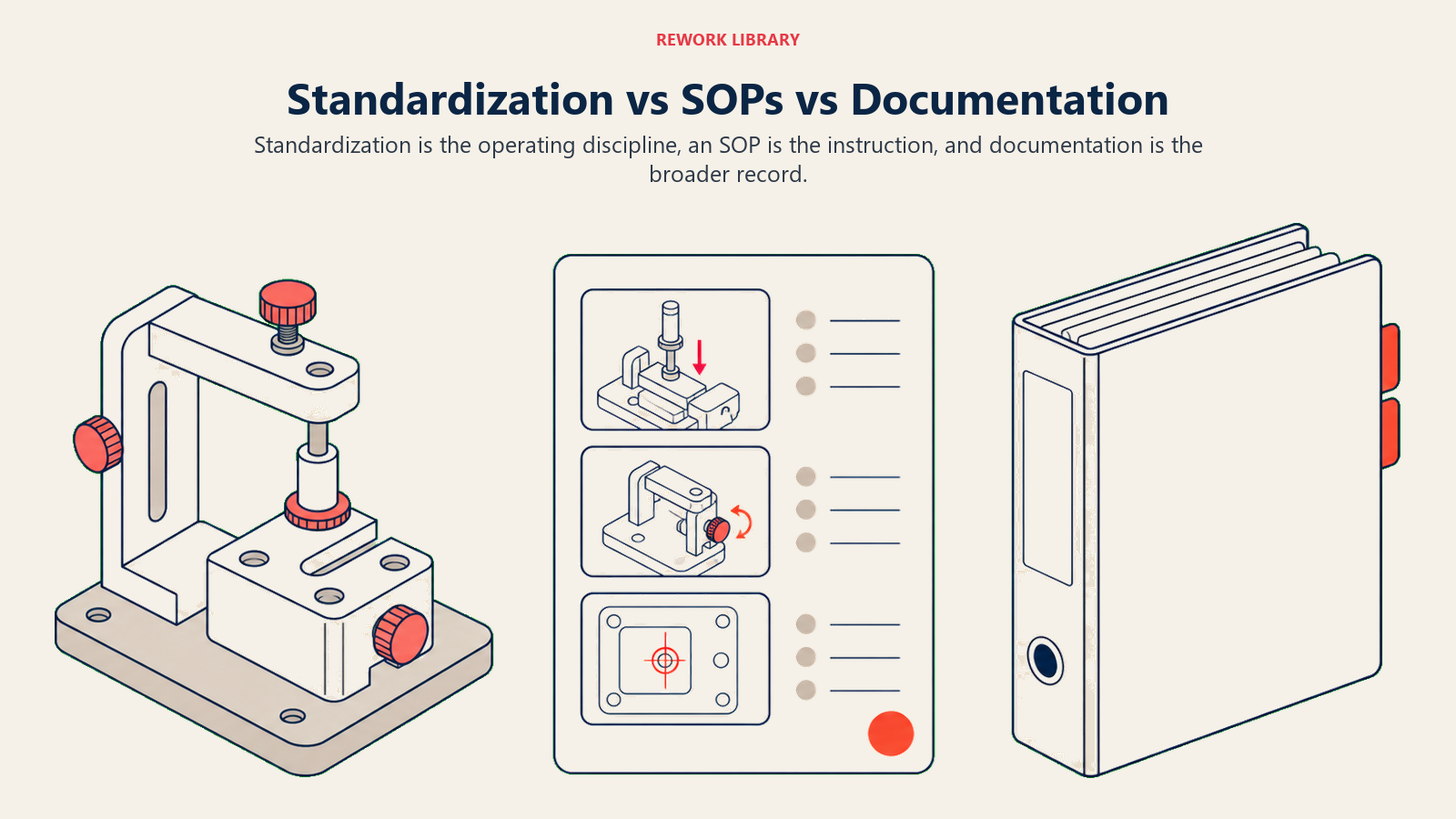
These three concepts overlap, so it helps to see them side by side.
| Concept | What it is | Primary output | Scope |
|---|---|---|---|
| Process standardization | Organizational discipline of picking and enforcing one best method | Trained workforce following a single method | Entire organization or function |
| Standard operating procedure (SOP) | Formal document describing how to perform a specific task | A written instruction document | One specific task or activity |
| Process documentation | Capturing how a process currently works (or should work) | Flowchart, narrative, or work instruction | Varies; often a single process or step |
The practical sequence is: document the current state, identify the best method, standardize it across the org, then keep an SOP on hand for reference and compliance. Skipping straight to the SOP without the standardization discipline means you have a document nobody consistently follows.
Benefits of process standardization
Done well, standardization delivers measurable results in four areas.
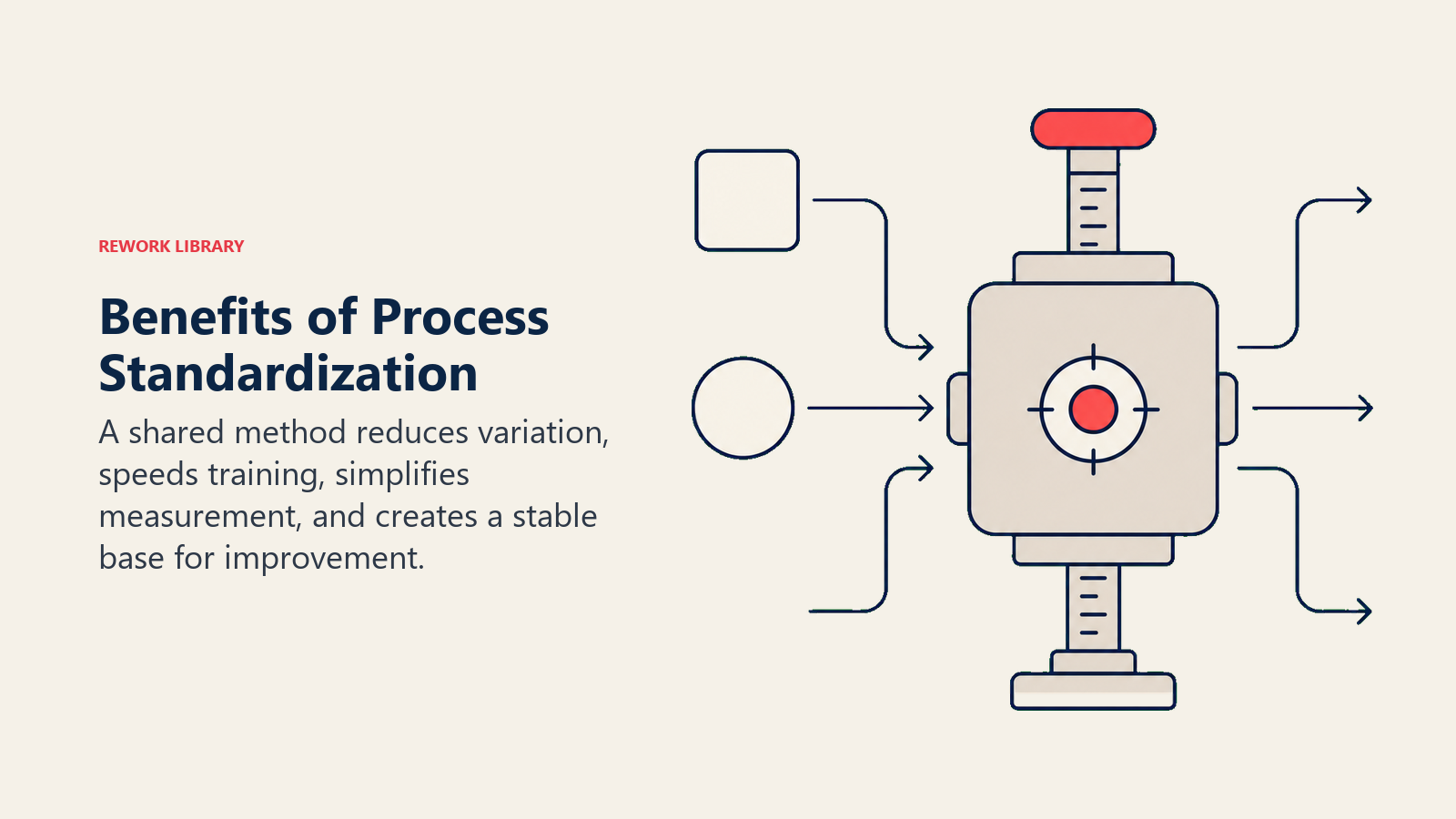
Quality and consistency. When everyone follows the same method, output variation drops. Customers get the same experience whether they deal with your team in Chicago or your team in Singapore. Defect rates fall because the process no longer depends on individual judgment for routine steps.
Faster onboarding and training. New hires learn one correct way instead of picking up habits from whichever senior colleague they shadow. Training time shrinks, and new staff reach full productivity sooner. This matters especially in high-turnover industries.
Cost reduction. Rework, waste, and defect correction are expensive. Standardization removes the variation that produces most of those costs. Lean practitioners use value stream mapping to find where non-standard steps create the most waste, then standardize to eliminate it.
Continuous improvement foundation. You can't improve something that isn't stable. Once a process is standardized, you have a baseline to measure against. Every PDCA (Plan Do Check Act) cycle starts from that baseline, making improvement efforts faster and more reliable.
Audit and compliance readiness. Regulated industries require documented, consistent processes. Standards like ISO 9001 are built on the premise that your processes are defined, followed, and reviewed. Standardization is what makes certification achievable.
When NOT to standardize
Process standardization isn't right everywhere. Here's where it helps to hold back.
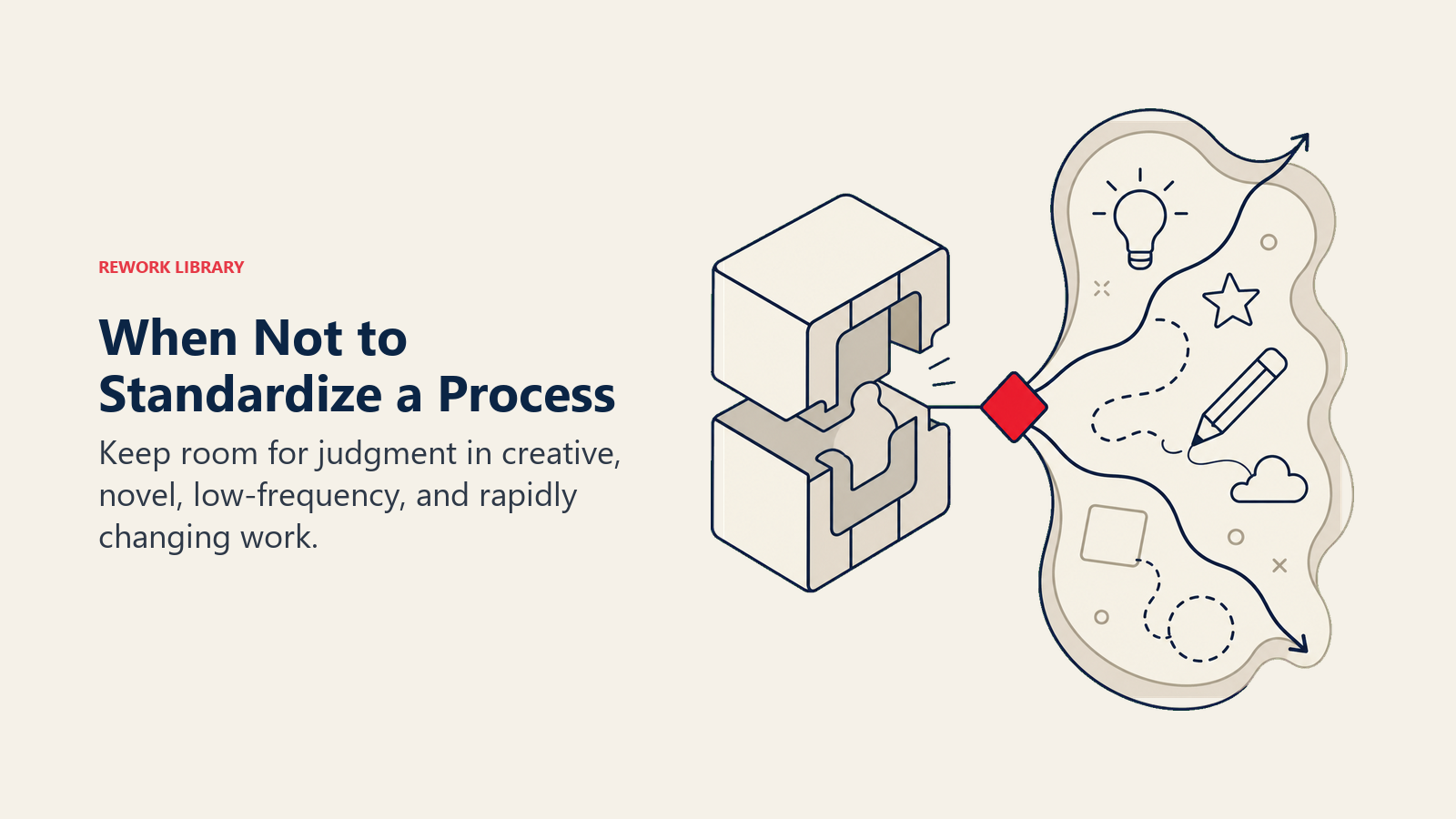
Creative and knowledge work. Writing, design, research, and strategic planning benefit from individual judgment and experimentation. Forcing a rigid method onto these activities slows people down and produces mediocre output. You can standardize the workflow around the creative work (how briefs are submitted, how reviews are scheduled) without standardizing the creative work itself.
Emerging or fast-changing processes. If a process is changing every few weeks because the product or market is evolving, standardizing it too early locks in a method that may be wrong. Wait for the process to stabilize.
Low-frequency, high-judgment tasks. Exception handling, complex negotiations, and escalation scenarios depend on reading context. A standard method helps frame these situations, but rigid adherence can make outcomes worse.
When variation is the product. Artisan goods, bespoke consulting, and tailored professional services sometimes derive their value from customization. Standardizing them removes the differentiation customers pay for.
The key trade-off is predictability vs. flexibility. Standardize where predictability creates value, and protect flexibility where judgment creates value.
How to standardize a process
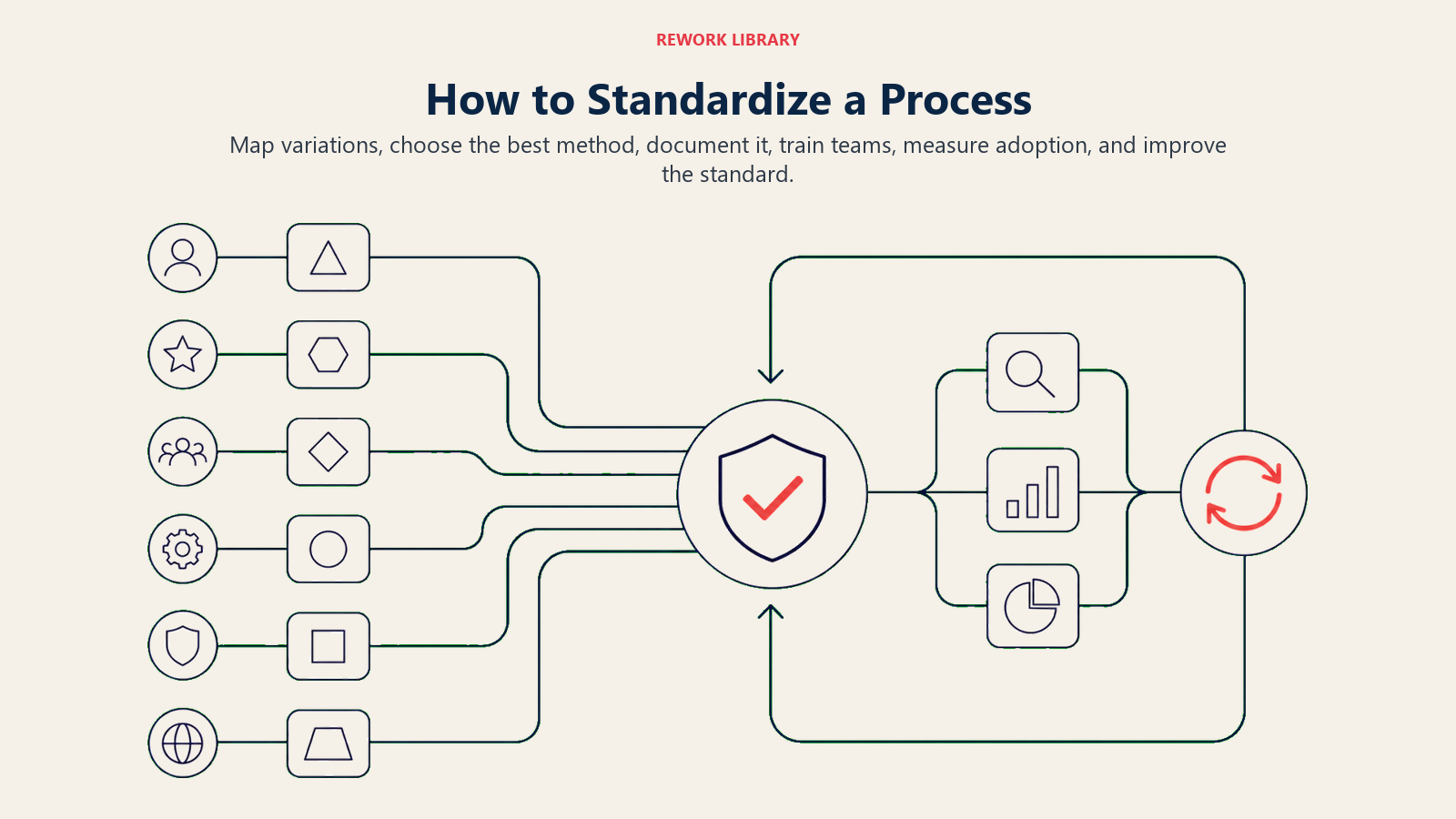
Map variations, choose the best method, document it, train teams, measure adoption, and improve the standard.
Step 1: Map current variations
Before you can set a standard, you need to see the full picture of how the process actually runs today. Interview the people who perform it. Watch them work. Collect data on timing, error rates, and outcomes. You'll almost always find that four people in the same role do the same task four different ways.
Business process mapping gives you a visual of each variation. Some teams use a current vs. future state map to capture where they are now and where they want to go.
Step 2: Define the best method
Review the variations you found and ask: which one produces the best outcome with the least waste and risk? Factor in quality, speed, safety, and compliance requirements. Involve the people who do the work. They know the practical constraints that managers often miss, and their buy-in is what makes the standard stick.
Don't aim for perfect. Aim for the best currently known method. You'll improve it later.
Step 3: Document the standard work
Write the method down clearly enough that someone who has never done the job can follow it. Include the sequence of steps, the tools or materials required, the quality checks at key points, and the expected time per step if timing matters.
Keep the documentation practical. A one-page visual beats a 20-page manual for shop-floor work. A checklist beats a narrative for safety-critical steps. Pair written instructions with visuals where the physical setup or hand position matters.
Step 4: Train and roll out
Training is where most standardization efforts succeed or fail. A document that sits on a shared drive isn't a standard; it's a file. The standard exists only when people are trained to follow it and when they understand why the method was chosen.
Roll out in phases if you have multiple sites or shifts. Train supervisors first so they can reinforce the standard during normal work. Use kaizen events to introduce the new method in focused, short-duration workshops where the team practices together and gives feedback.
Step 5: Audit for adherence
After rollout, verify that the standard is being followed. Conduct process audits, check outputs against the expected range, and review the process KPIs you defined before launch.
Audits aren't about catching people doing things wrong. They're about identifying where the standard is unclear, where it's harder to follow than expected, or where conditions have changed. The audit findings feed directly into the next step.
Step 6: Improve the standard via PDCA
A standard that never changes is a standard that falls behind reality. Build a regular review cadence, quarterly for most processes, monthly for high-volume or safety-critical ones. Use PDCA (Plan Do Check Act) to run controlled experiments on potential improvements. When a better method is confirmed, update the standard work, retrain the team, and restart the audit cycle.
This is how kaizen (continuous improvement) works in practice: the standard is always the current best known method, never the final word.
Process standardization examples
| Industry / Function | What was standardized | Result |
|---|---|---|
| Manufacturing (Toyota) | Assembly sequence and timing for each station on a production line | Defect rate dropped, production time per unit became predictable, new worker ramp-up cut from weeks to days |
| Retail (McDonald's) | Food preparation steps, temperature checks, and serving sequence at every location worldwide | Customer receives the same product regardless of location; kitchen throughput and food safety both improved |
| Healthcare (Cleveland Clinic) | Surgical prep checklists and post-op handoff scripts for high-risk procedures | Surgical site infection rates fell significantly after standardizing the prep and handoff sequence |
| Customer support | Ticket triage, escalation path, and response templates for common issue categories | Average handle time dropped; CSAT scores improved because agents stopped reinventing responses for routine cases |
Best practices
Do:
- Involve frontline workers in defining the standard. They'll follow a method they helped create.
- Make the standard visible at the point of work, not buried in a shared drive.
- Set a review date at the time of launch. Every standard should have a "review by" date.
- Measure adherence and outcomes separately. Adherence tells you if the standard is being followed; outcomes tell you if the standard is good.
- Start with high-volume or high-risk processes where variation causes the most pain.
Don't:
- Confuse documenting with standardizing. The document is just the artifact; the discipline is the standard.
- Over-engineer the documentation. A usable one-pager beats a comprehensive manual that nobody reads.
- Standardize and forget. A static standard becomes a liability as conditions change.
- Penalize variation before training is complete. People deviate from a standard they haven't properly learned yet.
- Try to standardize everything at once. Pick the highest-impact processes first and build from there.
Process standardization isn't a one-time project. It's an operating discipline that compounds over time: each improvement cycle raises the baseline, which makes the next improvement more impactful. Teams that treat their standards as living, owned methods, not filed documents, are the ones that close the gap between how work is supposed to happen and how it actually does.
Related reading

Customer Success Operations Manager
On this page
- What is process standardization?
- Key Facts
- Process standardization vs SOPs vs documentation
- Benefits of process standardization
- When NOT to standardize
- How to standardize a process
- Step 1: Map current variations
- Step 2: Define the best method
- Step 3: Document the standard work
- Step 4: Train and roll out
- Step 5: Audit for adherence
- Step 6: Improve the standard via PDCA
- Process standardization examples
- Best practices
- Related reading