Lean Six Sigma: How the Two Methods Combine
Turn this article into takeaways for your work.


Each assistant summarizes the article only for you and suggests best practices for your work.
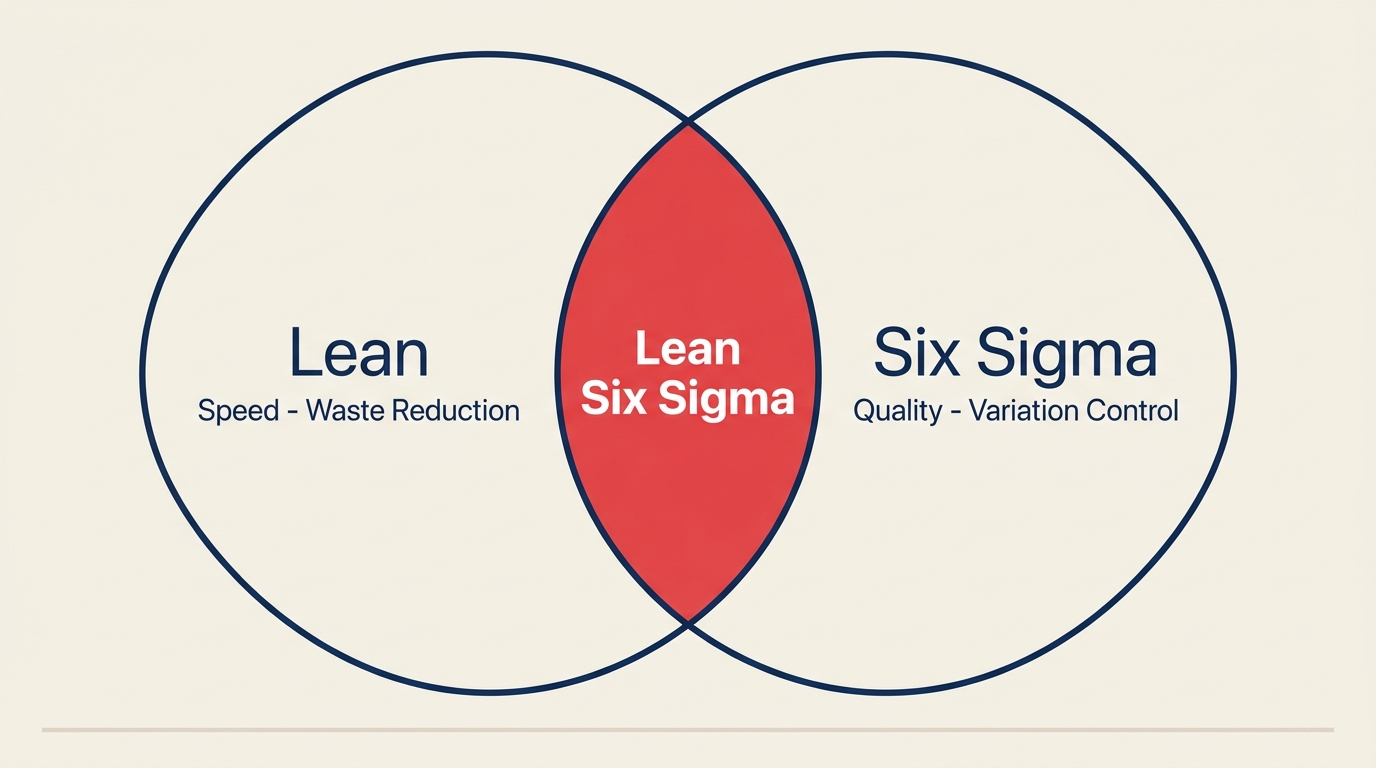
Lean Six Sigma is a process improvement method that combines Lean's focus on eliminating waste and speeding up flow with Six Sigma's focus on reducing variation and defects. Most organizations that adopt it don't have two separate programs running side by side. They run one integrated system that borrows the best tools from both.
It's become one of the most widely used improvement frameworks in manufacturing, healthcare, financial services, and software development.
What is Lean Six Sigma?
Lean Six Sigma is a structured methodology for improving processes by attacking two distinct root causes of poor performance: waste and variation. Lean targets activities that consume resources without adding customer value. Six Sigma targets the statistical inconsistency that causes defects and errors. Taken alone, each method has real blind spots. Together, they cover the full picture.
Key facts
- Six Sigma targets a defect rate of no more than 3.4 Defects Per Million Opportunities (DPMO), which translates to 99.99966% accuracy.
- Motorola, where Six Sigma originated in 1986, reported over $16 billion in savings from the method in its first decade. General Electric added another $12 billion by the late 1990s. (ASQ, reported in multiple peer-reviewed quality management journals)
- A 2020 survey by the American Society for Quality found that organizations using Lean Six Sigma reported median cost savings of $50,000 to $200,000 per project.
The "Lean" side of the equation comes from the Toyota Production System (TPS), refined over decades at Toyota plants and later popularized in the West through the MIT study that coined the term "lean manufacturing." The "Six Sigma" side was formalized at Motorola by engineer Bill Smith and later by statistician Mikel Harry. GE's Jack Welch made it famous in the 1990s when he rolled it out across the entire company.
The formal merger into "Lean Six Sigma" happened gradually through the early 2000s as practitioners recognized that Lean projects often failed to hold their gains (because underlying variation wasn't addressed) and Six Sigma projects often moved too slowly (because waste wasn't removed first).
Lean vs Six Sigma vs Lean Six Sigma
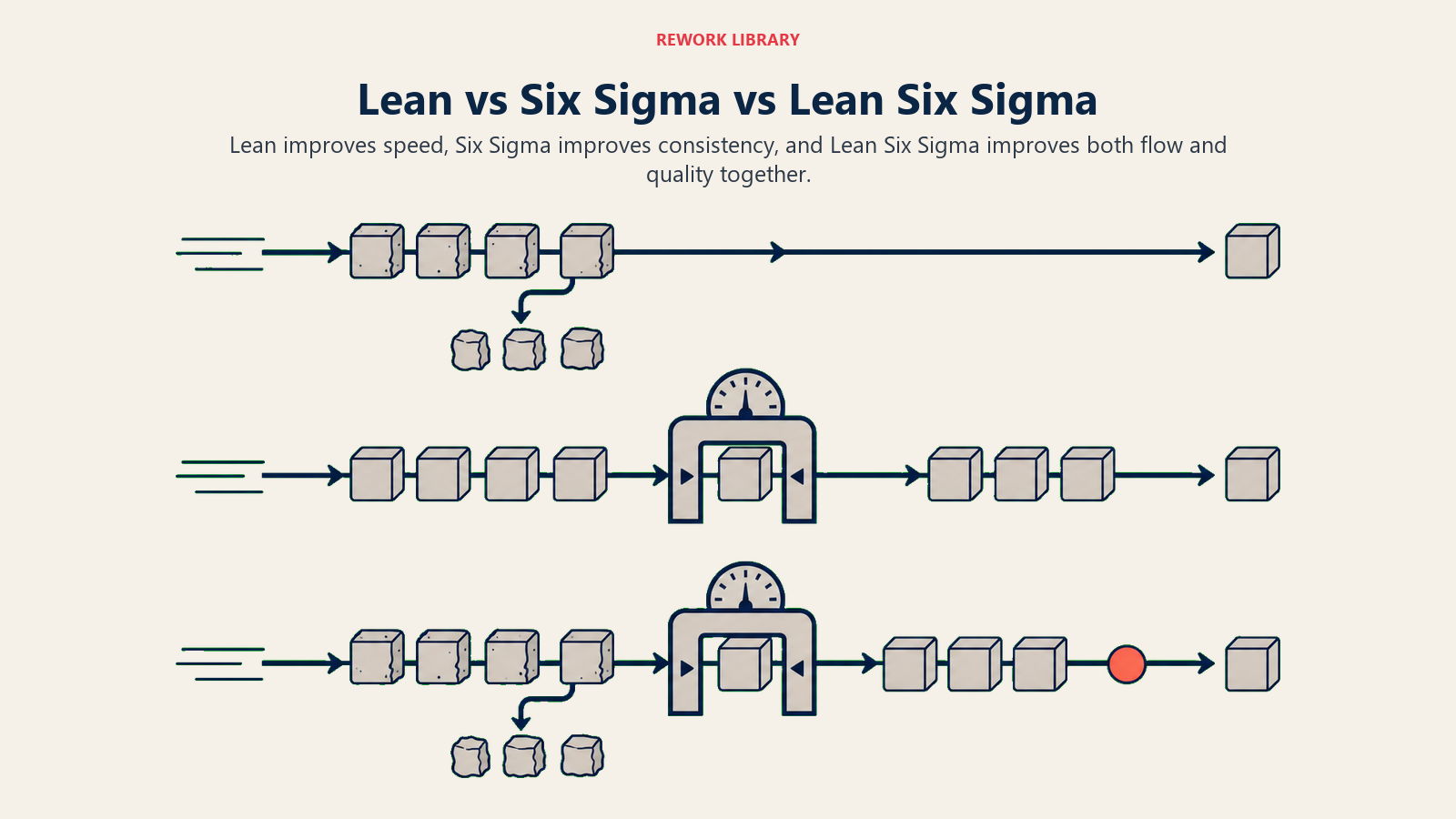
Understanding how the three relate helps you know which tools to reach for.
| Dimension | Lean | Six Sigma | Lean Six Sigma |
|---|---|---|---|
| Primary goal | Eliminate waste, increase speed | Reduce variation and defects | Both simultaneously |
| Core focus | Flow and customer value | Statistical quality control | Waste removal + process stability |
| Key tools | Value stream mapping, 5S, Kanban, Kaizen | DMAIC, control charts, DPMO, DOE | Full toolkit from both |
| Primary metric | Cycle time, lead time, throughput | Defects per million opportunities (DPMO) | Both speed and quality metrics |
| Origin | Toyota Production System (Japan, 1950s) | Motorola (USA, 1986) | GE and consultants (early 2000s) |
| Best for | Processes with too much waiting or rework | Processes with inconsistent output quality | Complex processes with both problems |
In practice, most modern practitioners train in Lean Six Sigma rather than one or the other. The tools overlap heavily, and the problems that actually show up in organizations rarely fit neatly into one category.
The 8 wastes and the variation problem
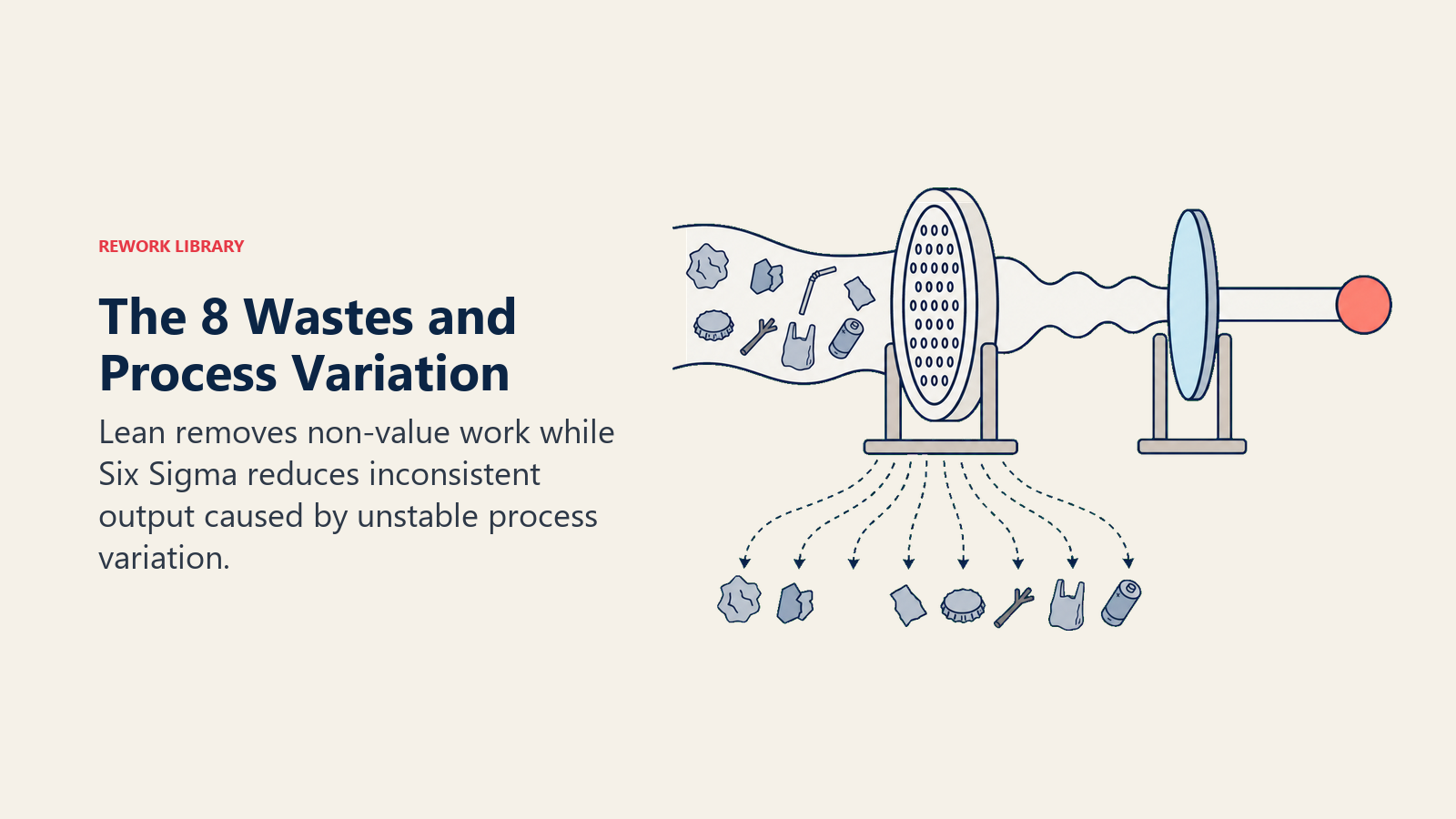
Lean defines eight types of waste under the acronym DOWNTIME. Six Sigma addresses a different failure mode entirely. Knowing the difference tells you which method's tools to deploy first.
The 8 DOWNTIME wastes (Lean):
- Defects: work that must be redone or scrapped
- Overproduction: making more than the customer currently needs
- Waiting: people or materials sitting idle between steps
- Non-utilized talent: skills and knowledge that go unused
- Transportation: moving materials or information unnecessarily
- Inventory: excess stock that ties up capital and hides problems
- Motion: unnecessary physical movement by people
- Extra processing: doing more work than the customer values
You can explore these further in the full article on muda, mura, and muri, which covers the three broader categories of Lean waste.
Six Sigma tackles a different problem. Even a process with no obvious waste can produce wildly inconsistent output. A call center might handle calls in roughly the right time on average, but some calls take two minutes and others take forty. That unpredictability destroys customer trust and makes planning impossible.
Six Sigma's answer is statistical: measure the variation, find its sources, and reduce it until the process runs within tight control limits. The DPMO and sigma level framework gives you a precise number to work with. A 3-sigma process produces about 66,800 defects per million opportunities. A 6-sigma process produces 3.4.
Value stream mapping is one of the most useful bridging tools between the two methods. It shows you both where waste accumulates (Lean perspective) and where variation creates bottlenecks (Six Sigma perspective) in a single visual.
The DMAIC backbone
Lean Six Sigma runs almost entirely on the DMAIC framework: Define, Measure, Analyze, Improve, Control. DMAIC gives the project a structured investigation sequence that prevents teams from jumping to solutions before they understand the problem.
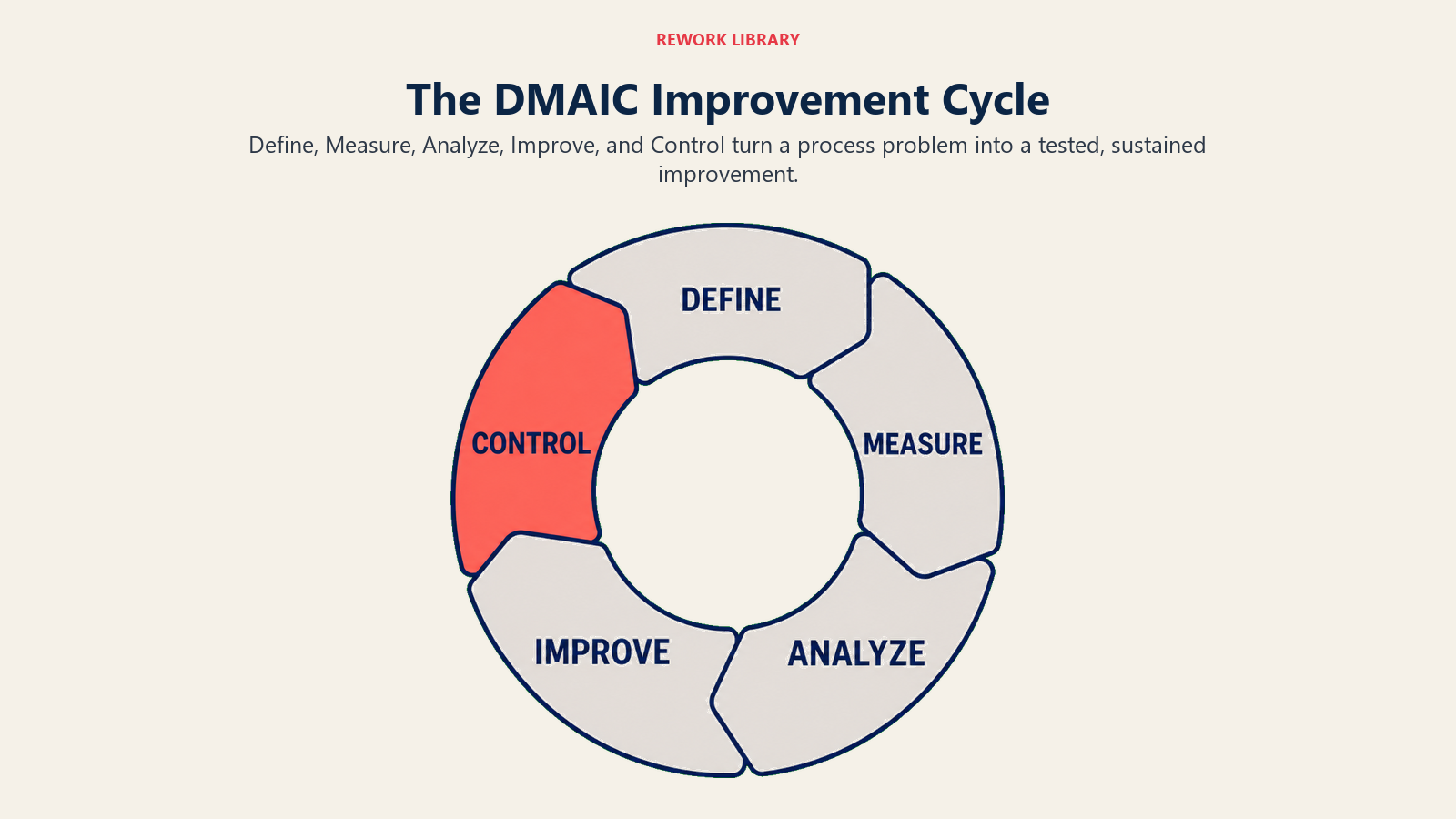
You can read the full breakdown in the DMAIC guide, but here's the skeleton:
- Define: Lock down the problem statement, scope, and customer requirements (voice of the customer).
- Measure: Collect baseline data on the current process performance.
- Analyze: Identify root causes of defects or waste using statistical and qualitative tools.
- Improve: Test and implement solutions.
- Control: Put monitoring systems in place so the gains stick.
When a process doesn't yet exist and needs to be designed from scratch rather than improved, teams switch to DMADV (Define, Measure, Analyze, Design, Verify), also called DFSS (Design for Six Sigma).
Belt levels in Lean Six Sigma
Lean Six Sigma uses a belt certification system borrowed loosely from martial arts. Each level represents a different depth of training and project responsibility.
| Belt | Training depth | Typical role | Project scope |
|---|---|---|---|
| White Belt | Awareness only (1-2 days) | Team member, process contributor | Supports projects but doesn't lead them |
| Yellow Belt | Introductory tools (2-3 days) | Team member with basic data skills | Assists on defined improvement tasks |
| Green Belt | Core methodology (2-3 weeks) | Project lead for mid-complexity improvements | Runs full DMAIC projects part-time |
| Black Belt | Full statistical toolkit (4-5 months) | Dedicated project lead | Runs complex, high-impact projects full-time |
| Master Black Belt | Advanced statistics, coaching, strategy | Program leader, mentor | Trains belts, guides organizational strategy |
See the detailed breakdown of responsibilities and training requirements in the article on Six Sigma belts.
Most organizations start by training a handful of Green Belts and one or two Black Belts rather than trying to certify everyone. The Green Belt is the practical workhorse level for most day-to-day improvement work.
Benefits of Lean Six Sigma
When done well, Lean Six Sigma delivers measurable results across several dimensions.
Cost reduction. Removing waste and defects directly reduces the cost of poor quality (COPQ). See the full analysis in the article on cost of quality. Rework, scrap, warranty claims, and inspection overhead shrink as process capability improves.
Speed and throughput. Lean tools cut cycle time and lead time by removing non-value-added steps. Customers get what they ordered faster.
Quality consistency. Six Sigma's statistical controls bring processes into a predictable range. When output is consistent, customer expectations are met reliably.
Employee engagement. Structured improvement projects give frontline workers a formal channel to surface and solve problems. That recognition tends to reduce turnover and build ownership.
Data-driven decisions. The DMAIC process requires measurement before action. Teams stop guessing and start working with actual process data. Tracking process KPIs becomes routine rather than occasional.
Cultural improvement. Organizations that sustain Lean Six Sigma programs typically develop a culture of continuous improvement, where problems are treated as learning opportunities rather than crises.
Limitations and common mistakes
Lean Six Sigma isn't a universal solution. Knowing where it struggles saves you from expensive mistakes.
It's slow for urgent problems. DMAIC is a rigorous investigation process. If your building is on fire, you don't start a Define phase. Fast-moving crises need faster intervention tools.
Statistical tools require real training. Green and Black Belt training takes weeks or months. Organizations that hand someone a belt after a two-day seminar and expect GE-level results are setting themselves up for disappointment.
It can become bureaucratic. Some organizations layer so much paperwork and gate reviews onto projects that the method itself becomes a source of waste. The tools should serve the problem, not the other way around.
Culture fit matters. Lean Six Sigma works in environments where leaders support data-driven decisions and give teams time to work on improvement. If management reverts to firefighting every time a project kicks off, the program stalls.
Not all problems need DMAIC. Simple problems with obvious root causes don't need a full six-month project. Use a Kaizen event or a quick PDCA cycle instead.
How to run a Lean Six Sigma project
This maps directly to DMAIC.
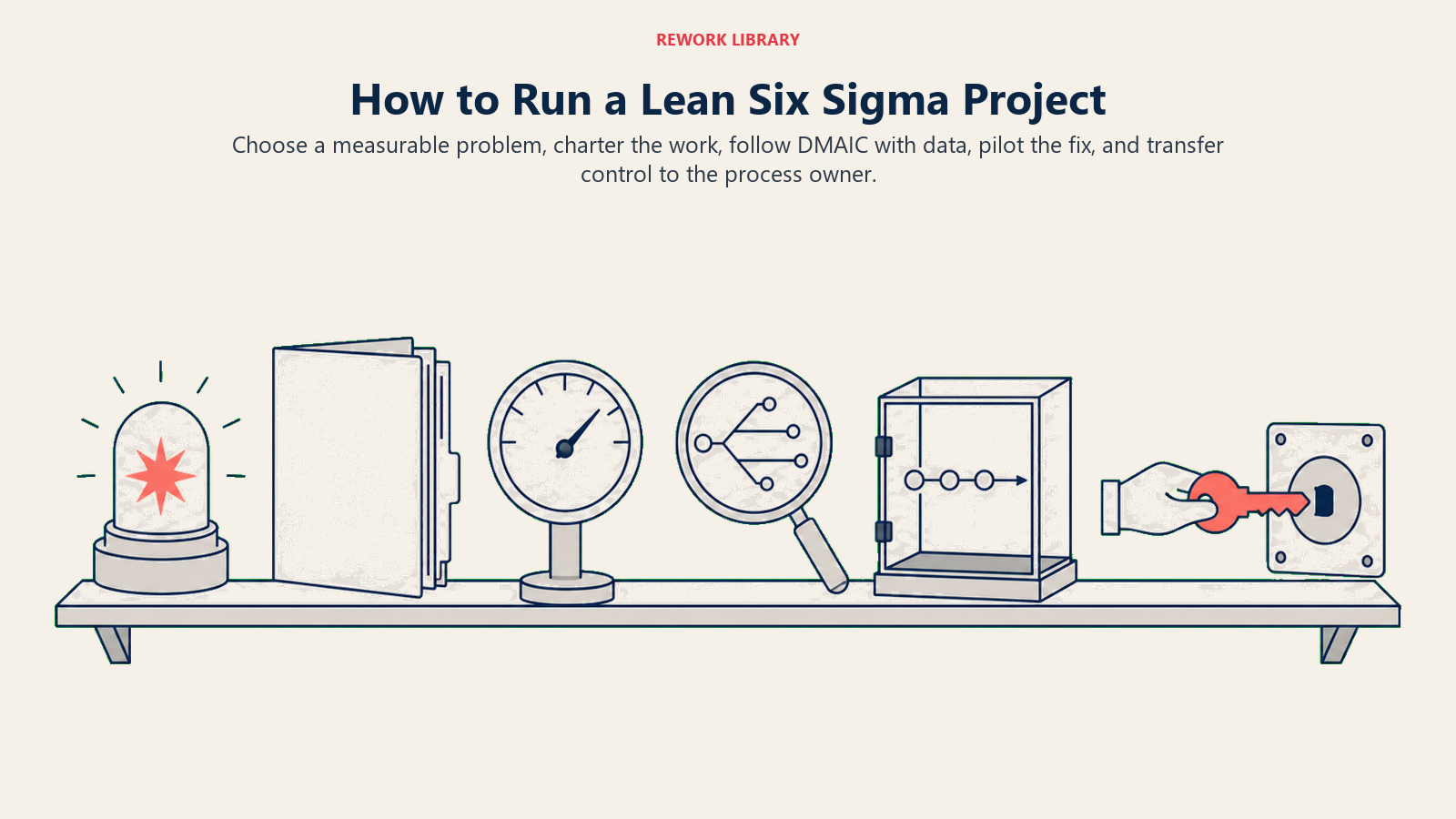
Step 1: Define the problem
Write a clear problem statement. What is happening? Where? How often? What's the business impact in dollars, time, or customer satisfaction? Define the project scope so it's manageable, and document the customer requirements (critical to quality, or CTQ).
Step 2: Measure the current state
Collect baseline data on the process. Map the current state with a value stream map or process flow diagram. Calculate the current sigma level or defect rate. You can't improve what you haven't measured.
Step 3: Analyze root causes
Use statistical and visual tools to find what's actually causing the problem. Common tools include fishbone diagrams, Pareto charts, scatter plots, and regression analysis. The goal is to separate the vital few causes from the trivial many.
Step 4: Improve the process
Design and test solutions that address the root causes you confirmed in Step 3. Run pilots before full deployment. Use mistake-proofing (poka-yoke) and standardized work to lock in the improvement.
Step 5: Control the gains
This is where most projects fail. Without a control plan, processes drift back to old habits. Set up control charts, assign process owners, and build monitoring into the daily routine. Document the new standard operating procedure.
Frequently Asked Questions about Lean Six Sigma
Is Lean Six Sigma still relevant in 2026?
Yes. The methods are well over 30 years old, but the underlying problems they solve (waste and variation) haven't gone away. If anything, the tools have become more accessible with digital process monitoring and low-code automation. Many organizations combine Lean Six Sigma with agile and digital transformation programs rather than treating them as alternatives.
Which belt should I start with?
For most professionals who want to lead improvement projects but aren't in a dedicated quality role, Green Belt is the right starting point. It covers the full DMAIC methodology without requiring the deep statistical training of Black Belt. If you're just getting exposure to the concepts, Yellow Belt is sufficient.
How long does a typical Lean Six Sigma project take?
Green Belt projects typically run three to six months. Black Belt projects, which tend to be more complex and data-intensive, often run six to twelve months. That timeline includes all five DMAIC phases plus the control period to verify the gains are holding.
What's the difference between a Lean Kaizen event and a Six Sigma DMAIC project?
A Kaizen event is a focused, short sprint (usually three to five days) where a cross-functional team attacks a specific problem together. It's fast and practical. A DMAIC project is longer, more data-driven, and suited to problems where the root cause isn't obvious. Both have their place in a mature improvement program.
Can small businesses use Lean Six Sigma?
Absolutely. The formal belt structure and large-scale project machinery are designed for organizations with dedicated quality functions. But the core tools, like value stream mapping, DMAIC thinking, and waste identification, scale down to a team of five just as well as a factory of five hundred.
Lean Six Sigma has outlasted dozens of management trends because it works when it's applied honestly. The belt system gives you a career path. The DMAIC structure gives you a repeatable process. And the combined Lean-Six Sigma toolkit gives you answers to two of the most common reasons processes underperform: too much waste and too much variation.
If you're starting out, pick one real process problem, get basic Green Belt training, and run it all the way through DMAIC. The fastest way to understand the method is to use it.
Related reading

Customer Success Operations Manager
On this page
- What is Lean Six Sigma?
- Lean vs Six Sigma vs Lean Six Sigma
- The 8 wastes and the variation problem
- The DMAIC backbone
- Belt levels in Lean Six Sigma
- Benefits of Lean Six Sigma
- Limitations and common mistakes
- How to run a Lean Six Sigma project
- Step 1: Define the problem
- Step 2: Measure the current state
- Step 3: Analyze root causes
- Step 4: Improve the process
- Step 5: Control the gains
- Related reading