ISO 9001: What the Quality Standard Requires
Turn this article into takeaways for your work.


Each assistant summarizes the article only for you and suggests best practices for your work.
ISO 9001 is the world's most widely adopted standard for a quality management system (QMS). It tells organizations exactly what they need to put in place to consistently deliver products and services that meet customer and regulatory requirements. If you're building or auditing a QMS, this is the spec to understand first.
What is ISO 9001?
ISO 9001 is an international standard published by the International Organization for Standardization (ISO). It defines the requirements for a quality management system. The current version is ISO 9001:2015, which replaced the previous 2008 edition.
The standard is part of the broader ISO 9000 family. ISO 9000 provides the vocabulary and foundational concepts; ISO 9001 is the one organizations actually certify against. ISO 9004 offers guidance for sustained success beyond the certification requirements.
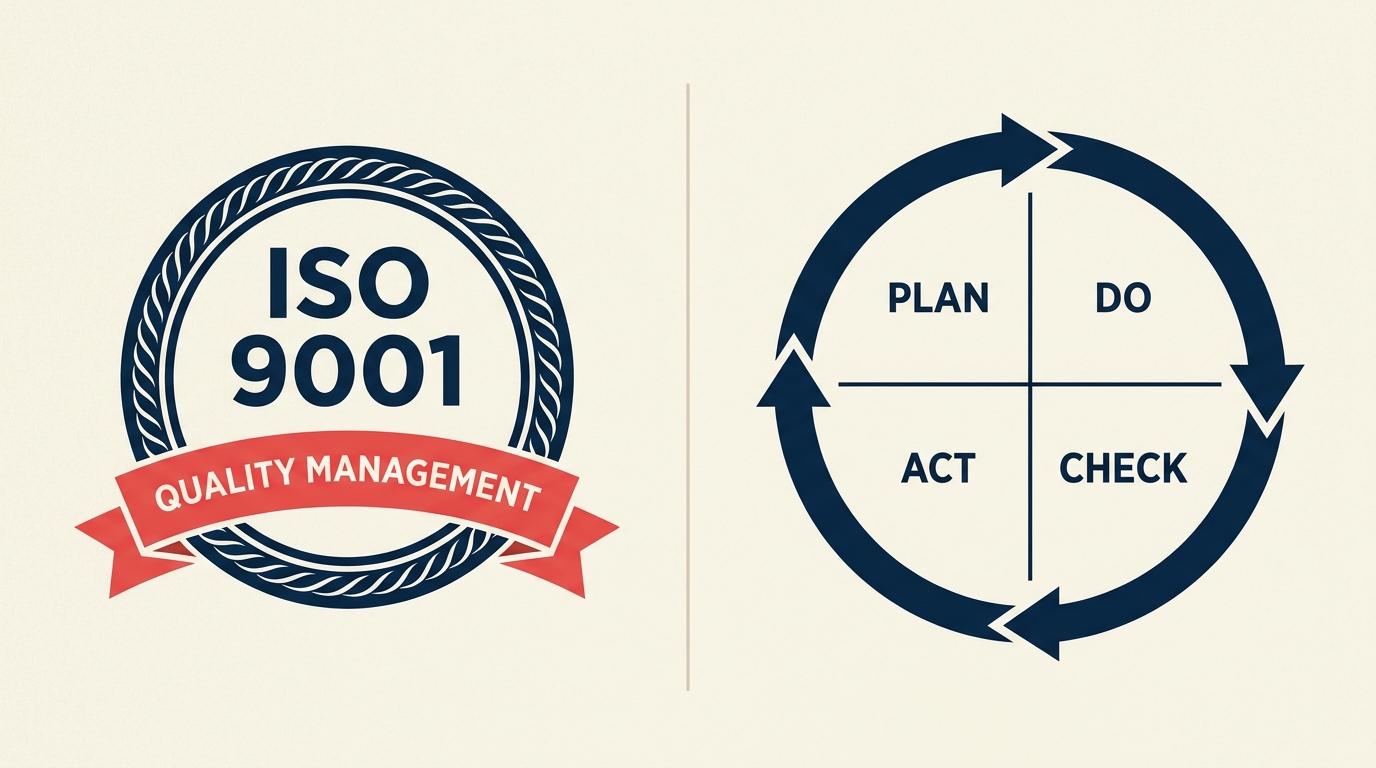
ISO 9001:2015 is built on a Plan-Do-Check-Act (PDCA) cycle and uses risk-based thinking throughout. It doesn't prescribe specific procedures or documentation formats. It says what outcomes a QMS must achieve, and leaves implementation choices to the organization.
Key facts
- Over 1 million ISO 9001 certificates have been issued in more than 170 countries (ISO Survey, 2022).
- The current revision (ISO 9001:2015) introduced risk-based thinking as a core requirement for the first time.
- ISO 9001 applies to any organization regardless of size, sector, or whether it produces goods or services.
The 7 quality management principles
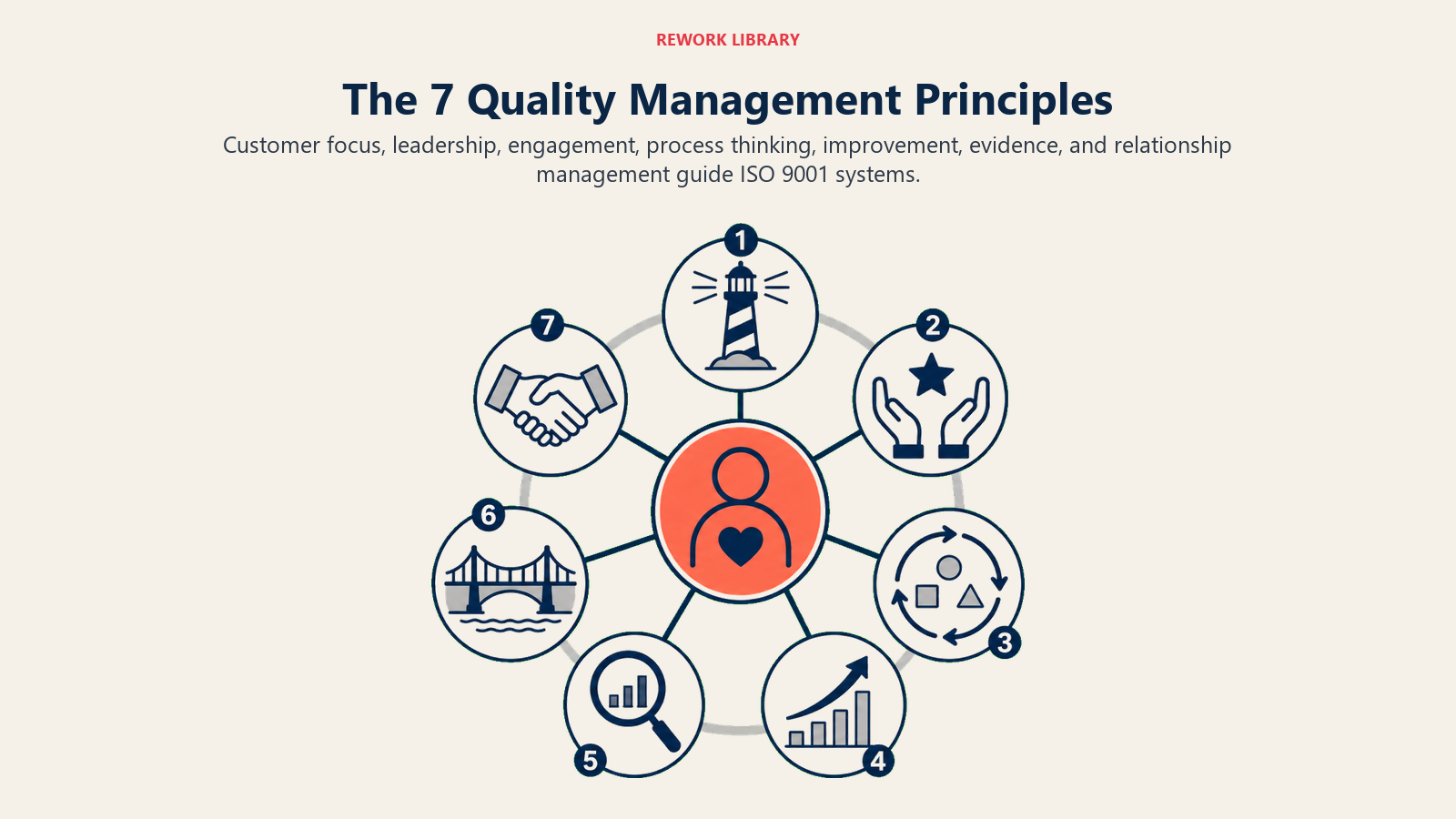
ISO 9001:2015 is grounded in seven quality management principles defined in ISO 9000. These aren't requirements to certify against directly, but they explain the reasoning behind every clause in the standard.
| Principle | What it means in practice |
|---|---|
| Customer focus | Understand current and future customer needs; measure customer satisfaction and act on results |
| Leadership | Top management must own the QMS, not delegate it to a quality department |
| Engagement of people | People at every level contribute to quality; competence and involvement matter |
| Process approach | Manage activities as interconnected processes with defined inputs, outputs, and owners |
| Improvement | Continual improvement is a permanent objective, not a one-time project |
| Evidence-based decision making | Decisions are based on analysis of data, not assumption or habit |
| Relationship management | Manage relationships with suppliers and partners as they affect the ability to deliver consistently |
These seven principles connect directly to the PDCA logic running through the clauses. Customer focus and leadership sit at the Plan stage. Process approach and engagement drive the Do stage. Evidence-based decisions power the Check stage. And improvement cycles back into Act.
The structure: clauses 4 to 10
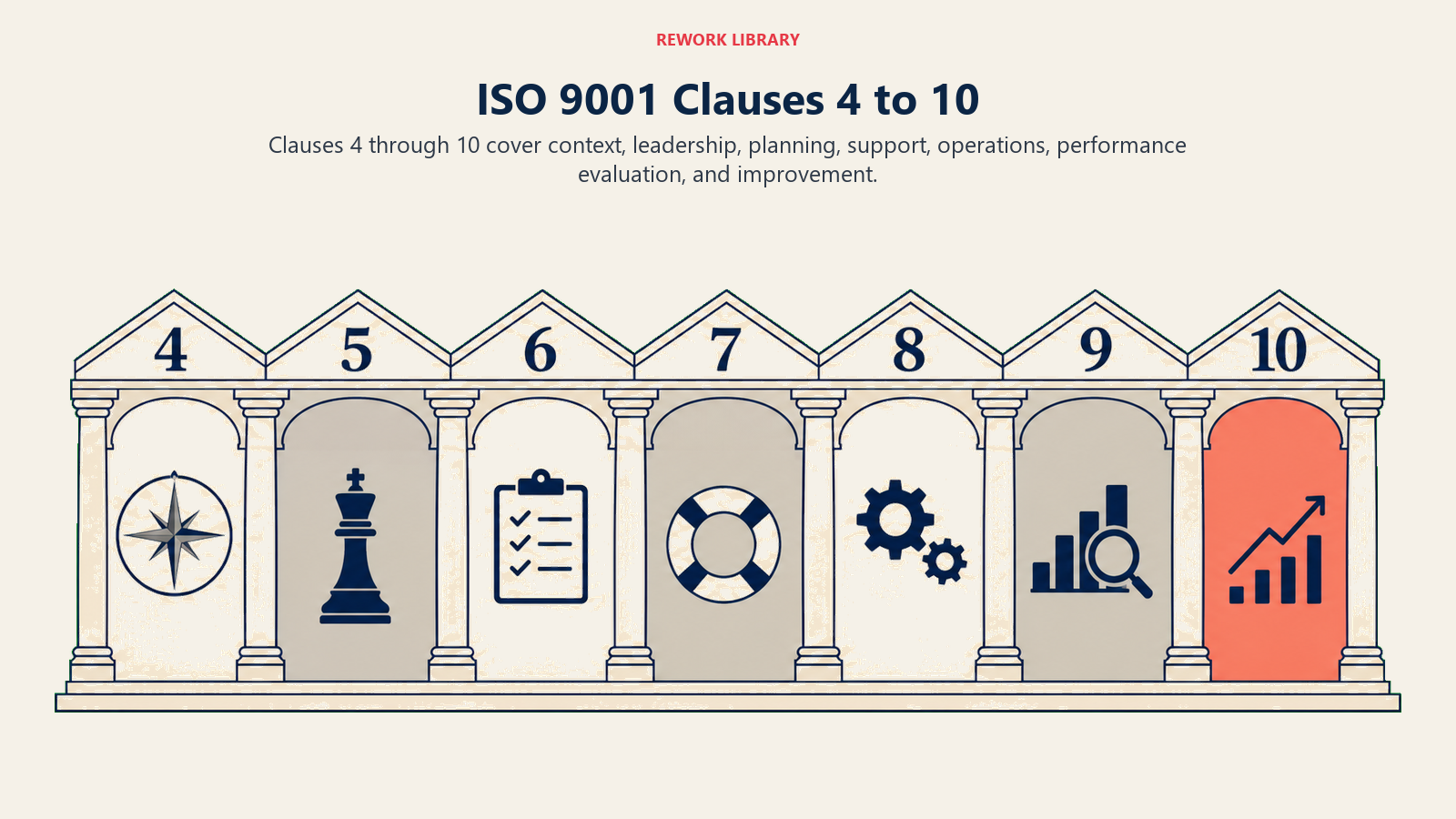
ISO 9001:2015 follows the High Level Structure (HLS) used across ISO management system standards. This makes it easier to integrate with ISO 14001 (environmental management) or ISO 45001 (occupational health and safety). Clauses 1 to 3 cover scope, references, and definitions. The actual requirements start at clause 4.
| Clause | Title | Core requirement |
|---|---|---|
| 4 | Context of the organization | Define internal and external issues affecting the QMS; identify interested parties and their requirements |
| 5 | Leadership | Top management must demonstrate commitment; set a quality policy; assign QMS responsibilities |
| 6 | Planning | Identify risks and opportunities; set quality objectives with measurable targets |
| 7 | Support | Provide resources, competent people, infrastructure, and documented information |
| 8 | Operation | Plan and control processes for delivering products and services; manage external providers |
| 9 | Performance evaluation | Monitor, measure, analyze, and evaluate; run internal audits and management reviews |
| 10 | Improvement | Address nonconformities, take corrective actions, and pursue continual improvement |
Clause 8 is typically the largest section in practice. It covers everything from design and development through delivery and post-delivery activities. For service organizations, clause 8 often looks quite different from manufacturing, but the underlying requirements are the same.
The PDCA logic maps directly: clauses 4-6 are Plan, clause 7-8 are Do, clause 9 is Check, and clause 10 is Act.
ISO 9001 vs other standards
ISO 9001 vs ISO 9000 family. ISO 9001 is the certifiable standard. ISO 9000 defines terms. ISO 9004 is a guidance document for going beyond certification. You certify to ISO 9001; you use 9000 and 9004 as reference material.
ISO 9001 vs Six Sigma. Six Sigma is a methodology, not a standard. It uses statistical tools (DMAIC or DFSS) to reduce defect rates. ISO 9001 doesn't prescribe how you reduce defects; it requires that you have a system to consistently meet requirements and improve. Many organizations use both: ISO 9001 as the system framework, Six Sigma as the improvement method inside it.
ISO 9001 vs Lean Six Sigma. The same distinction applies. Lean Six Sigma combines waste elimination (Lean) with defect reduction (Six Sigma). ISO 9001 and Lean Six Sigma are complementary. The standard's clause 10 (improvement) and clause 9 (performance evaluation) give Lean Six Sigma projects their governance structure.
ISO 9001 vs Total Quality Management (TQM). TQM is a philosophy. ISO 9001 is a certifiable specification. TQM influenced the design of the standard, particularly the seven principles, but TQM has no audit body and no certificate.
ISO 9001 vs PDCA. PDCA is the structural logic running through ISO 9001, not a competing standard. Clause structure maps directly to the four stages.
Benefits of ISO 9001 certification
Certification signals to customers and partners that the organization has a verified quality system. But the operational benefits often matter more than the certificate itself.
Consistent delivery. The process approach in clause 8 forces organizations to document how work gets done, who owns each step, and what the acceptance criteria are. That consistency reduces rework and customer complaints.
Faster onboarding. Standard operating procedures and process documentation required under clause 7 give new employees a clear reference for how work should be done. Training becomes less ad hoc.
Supplier control. Clause 8.4 requires organizations to evaluate, select, and monitor external providers. This gives procurement teams a structured way to manage supplier quality rather than reacting when problems appear.
Risk reduction. Clause 6.1 requires identifying risks and opportunities and planning responses. This isn't a full risk management framework, but it does force quality-related risks onto the management agenda.
Market access. In regulated industries (medical devices, aerospace, automotive), ISO 9001 is often a contract requirement. Without it, the organization can't bid.
Continual improvement culture. The combination of internal audits, management reviews, and clause 10 corrective action creates a feedback loop. Problems get documented, root causes get analyzed, and changes get tracked.
Common mistakes and limitations
ISO 9001 certification doesn't guarantee good products. It guarantees the organization has a system in place to consistently produce whatever it committed to producing. If the commitment is low, the certificate confirms a low-quality system is consistently applied.
Common implementation mistakes:
- Treating documentation as the goal. Clause 7.5 requires documented information, but only where it's needed to support process operation. Over-documentation creates bureaucracy without adding quality.
- Delegating QMS ownership to quality managers. Clause 5.1 explicitly requires top management leadership. When the QMS becomes a quality department project, it loses organizational traction.
- Skipping root cause analysis. Clause 10.2 requires corrective action that addresses root causes. Many organizations close nonconformities by fixing the symptom, which means the same issues recur at the next audit.
- Disconnecting quality objectives from business objectives. Clause 6.2 requires quality objectives that are measurable and consistent with the quality policy. Generic objectives ("maintain customer satisfaction") with no baseline or target don't satisfy this requirement and don't drive improvement.
- Confusing the audit with the system. Preparing for an audit is not the same as running a QMS. Organizations that only activate their quality system in audit season fail their internal audit cycles and miss improvement opportunities.
Business process management and process maturity models can help organizations develop the underlying process discipline that makes ISO 9001 sustainable rather than performative.
How to get ISO 9001 certified
The certification process involves an accredited third-party certification body. The path typically takes 6 to 18 months depending on organization size and starting point.
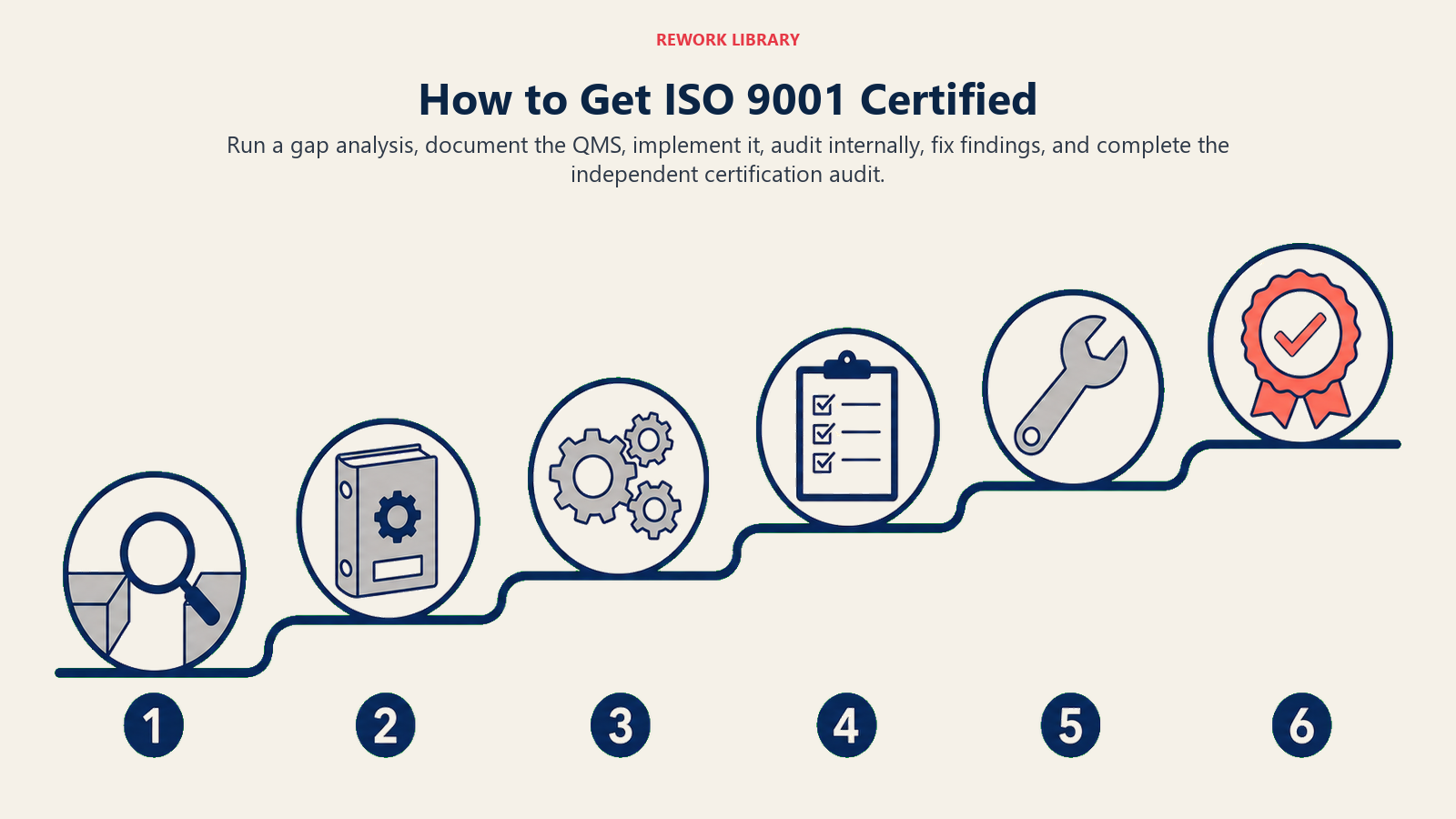
Step 1: Gap analysis
Compare current practices against each clause in ISO 9001:2015. Document what's in place, what's missing, and what needs to change. This is the baseline for the project plan.
Step 2: Build and document the QMS
Develop or formalize the processes, procedures, and records required by the standard. This includes the quality policy, quality objectives, process maps, and documented information required under clauses 7 and 8. Review process documentation practices to make sure records are controlled and retrievable.
Step 3: Internal audit
Run an internal audit against all clauses before inviting an external auditor. The internal audit identifies nonconformities that need corrective action before stage 1. Many organizations underinvest here and are caught out at stage 1 with gaps that could have been closed internally.
Step 4: Management review
Clause 9.3 requires a formal management review of the QMS before certification. This is not an informal check-in. It must cover audit results, quality objectives performance, nonconformities, customer feedback, and resource needs. Management review outputs must be documented.
Step 5: Certification audit, stage 1
The certification body reviews the documented QMS. Auditors check that documentation meets the standard's requirements and that the organization is ready for stage 2. Stage 1 findings must be addressed before proceeding.
Step 6: Certification audit, stage 2 and surveillance
Stage 2 is an on-site audit of implementation. Auditors verify that the documented processes are actually followed, that records exist, and that the QMS is operating as described. On passing, the certificate is issued for three years. Annual surveillance audits check that the system is maintained. Recertification audits at year three verify continued compliance.
Related reading

Customer Success Operations Manager
On this page
- What is ISO 9001?
- The 7 quality management principles
- The structure: clauses 4 to 10
- ISO 9001 vs other standards
- Benefits of ISO 9001 certification
- Common mistakes and limitations
- How to get ISO 9001 certified
- Step 1: Gap analysis
- Step 2: Build and document the QMS
- Step 3: Internal audit
- Step 4: Management review
- Step 5: Certification audit, stage 1
- Step 6: Certification audit, stage 2 and surveillance
- Related reading