Takt Time: Formula and How to Calculate It
Turn this article into takeaways for your work.


Each assistant summarizes the article only for you and suggests best practices for your work.
Takt time is the maximum time allowed to produce one unit if you want to meet customer demand exactly, no more, no less. It's the single number that ties your production pace to the real world outside your factory or office.
What is takt time?
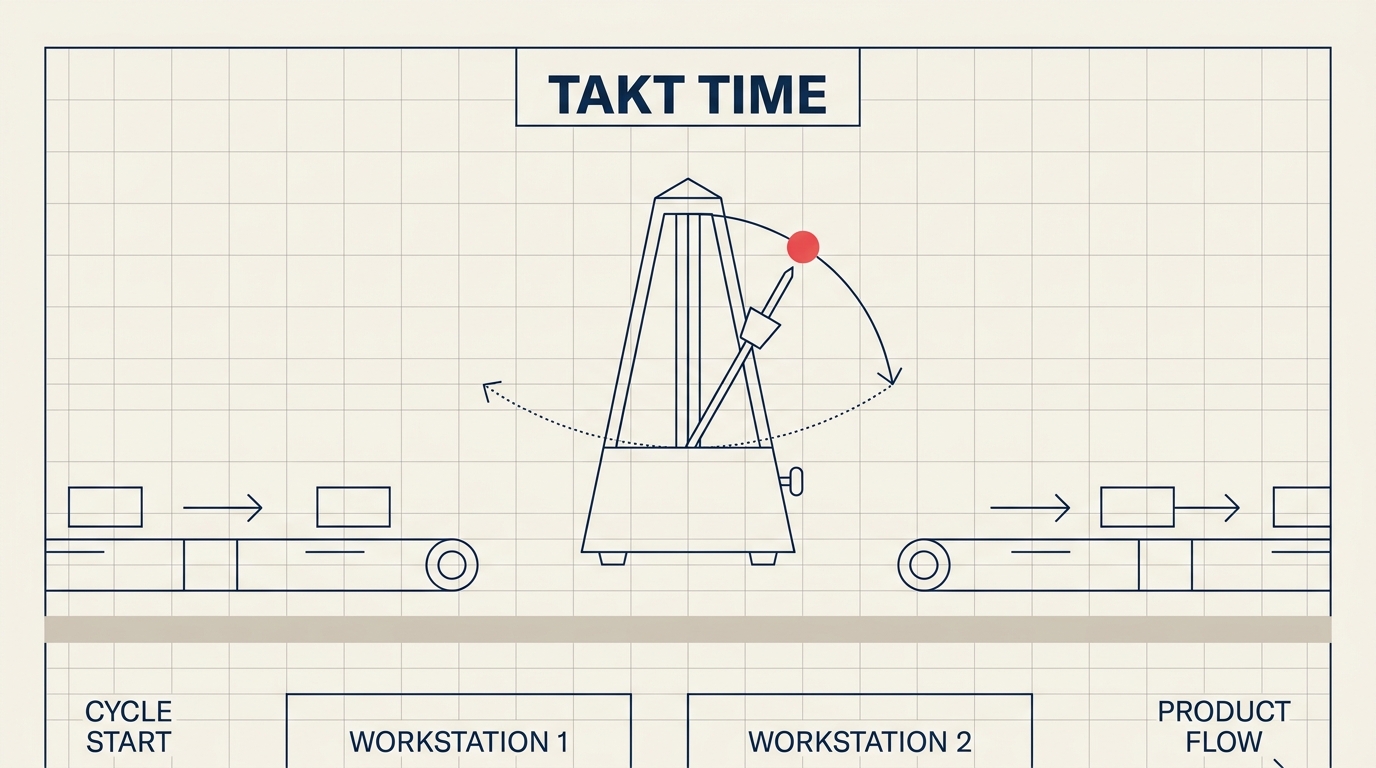
Takt time is the rate at which a process must complete one unit of output to satisfy customer demand within available working time. In plain terms, it answers: "How many seconds (or minutes) do we have per unit?" The word takt comes from the German word for a musical beat or baton, the conductor's steady rhythm that keeps every player in sync. That analogy is exact: takt time is the metronome of your production line.
The formula in words: divide your net available production time by customer demand over the same period.
Key facts: takt time
- Toyota popularized takt time as a core scheduling tool within the Toyota Production System in the 1950s-60s; it remains the primary pacing mechanism in world-class automotive and electronics manufacturing today (Liker, The Toyota Way, 2004).
- A 2019 study published in the International Journal of Production Research found that facilities that explicitly track takt time report up to 23% lower work-in-progress inventory compared to facilities using only throughput-based scheduling (IJPR, Vol. 57).
- The concept entered Western manufacturing vocabulary broadly after Womack, Jones, and Roos described Toyota's pacing discipline in The Machine That Changed the World (1990, MIT IMVP).
The takt time formula
The formula is:
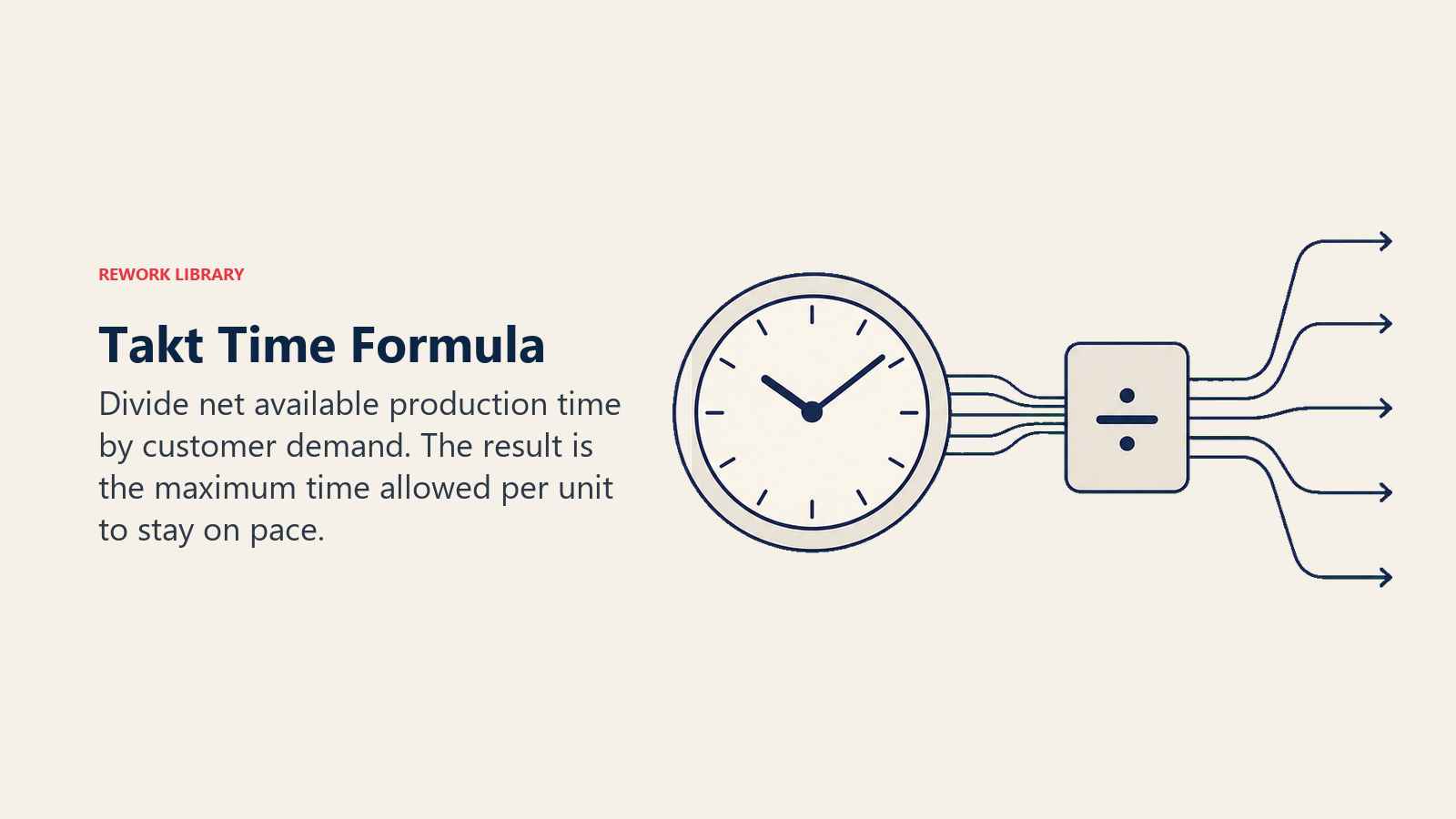
Takt time = Net available production time / Customer demand
Units matter. If net available time is in seconds and demand is in units, takt time comes out in seconds per unit. Keep your units consistent throughout the calculation.
Worked example:
- Shift length: 8 hours
- Breaks: two 15-minute breaks + one 30-minute lunch = 60 minutes total
- Net available time: 8 hours - 1 hour = 7 hours = 420 minutes = 25,200 seconds
- Customer demand for the shift: 180 units
Takt time = 25,200 seconds / 180 units = 140 seconds per unit
That means your line must complete one unit every 2 minutes and 20 seconds to stay exactly in step with demand. If any workstation takes longer than 140 seconds on average, you'll miss the shift target.
You can scale the same formula to a week or a month. Just make sure "net available time" and "customer demand" cover the exact same window.
Takt time vs cycle time vs lead time
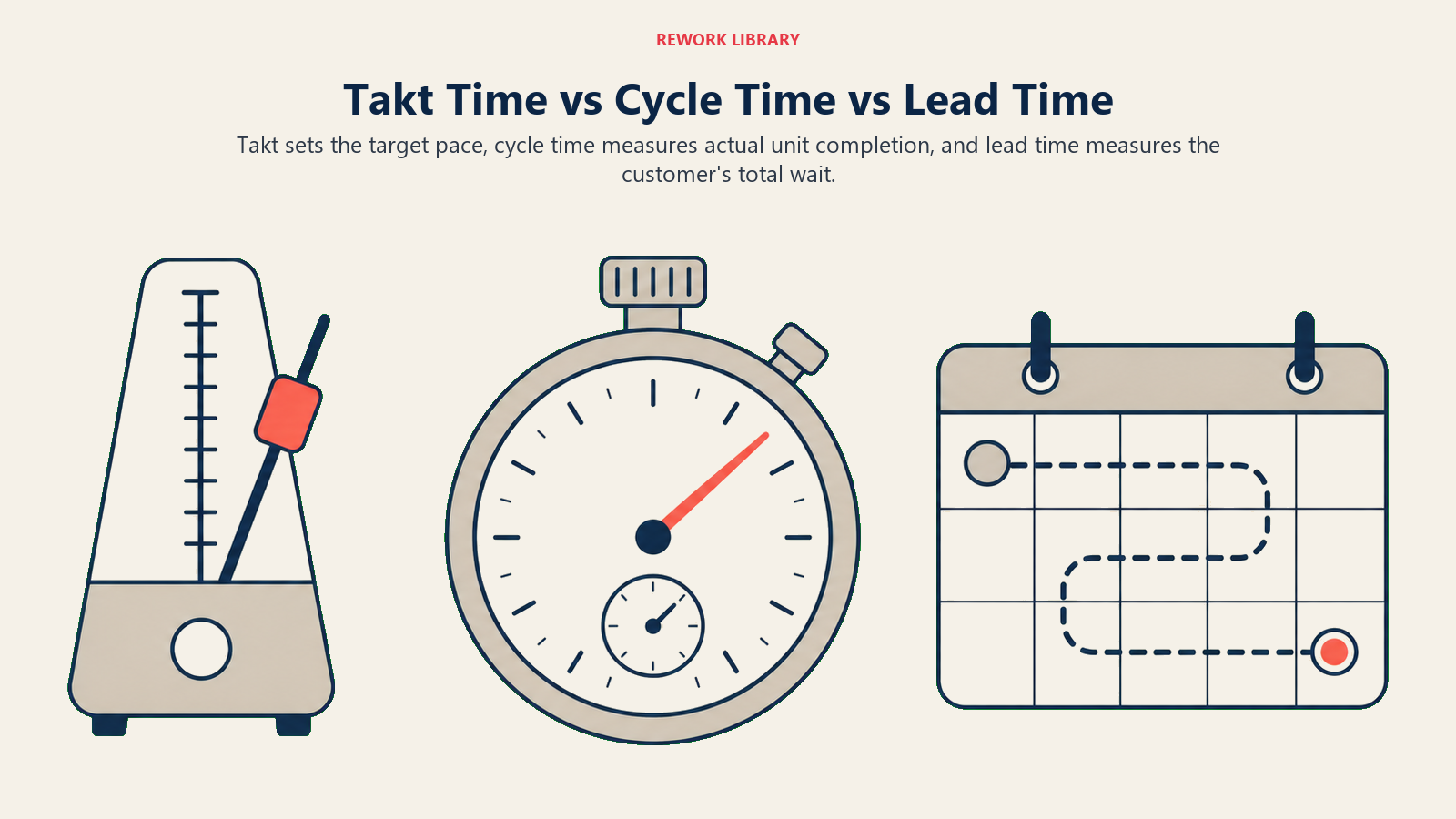
These three metrics are often confused, but each measures something different. Getting them mixed up leads to bad decisions on staffing and scheduling.
| Metric | Definition | What it measures | Formula |
|---|---|---|---|
| Takt time | Target pace set by customer demand | How fast you should produce | Net available time / demand |
| Cycle time | Actual time to complete one unit at a workstation | How fast you do produce | Elapsed time from start to finish of one unit |
| Lead time | Total time from order received to order delivered | End-to-end customer wait | Time of delivery - time of order |
Takt time is a target derived from outside the process (the customer). Cycle time is a measurement taken inside the process (your actual performance). Lead time is a customer experience metric that includes queue time, transport, and everything else between order and delivery.
A healthy process has cycle time at or slightly below takt time at every workstation. If any station's cycle time exceeds takt time, that station is a bottleneck and demand won't be met. If cycle time is dramatically below takt time, you're producing faster than needed, building inventory, burning capacity, and hiding business bottlenecks elsewhere in the system.
Why takt time matters
Takt time gives operations teams a single shared reference point that connects the shop floor or service desk to real customer demand. Without it, production targets are guesses.
It prevents overproduction. Overproduction is the first waste in Lean methodology because it generates inventory, hides defects, and consumes capacity that could be used elsewhere. A process running faster than takt time is, by definition, overproducing.
It reveals imbalances. When you lay cycle times for each workstation next to the takt time, bottlenecks become visible immediately. One station at 170 seconds in a 140-second takt tells you exactly where to focus improvement effort, rather than spreading effort across the whole line.
It stabilizes scheduling. Teams that know their takt time can calculate how many operators they need, how many shifts to run, and when to scale up or down, without spreadsheet acrobatics. This connects naturally to just-in-time production, where output timing is synchronized with actual orders rather than pushed by a forecast.
It supports continuous improvement. Tracking cycle time against takt over time is a direct measure of whether improvement work, Kaizen events, process redesign, training, is actually moving the needle.
Common mistakes when using takt time
Using gross available time instead of net. If you forget to subtract scheduled breaks, lunches, and planned maintenance, your takt time will look longer (more relaxed) than it really is. When people actually take their breaks, the line falls behind, and nobody understands why.
Using a demand average that's too coarse. A monthly average demand of 3,000 units sounds simple, but if orders spike in the last week, your daily takt time in week 4 is much tighter than your monthly calculation suggested. Recalculate takt time whenever the demand pattern changes meaningfully.
Confusing takt time with the target for individual operators. Takt time is a system-level target, not a personal speed quota. Treating it as individual performance pressure creates stress, shortcuts, and quality problems.
Setting takt time and never updating it. Demand shifts. Planned maintenance windows change. A takt time calculated in January may be wrong by April. Revisit it at least monthly, or any time demand changes by more than 10%.
Ignoring the gap between takt and cycle time. Calculating takt time is only useful if you then compare it to real cycle times at each step. The comparison is the action trigger. On its own, takt time is just a number on a whiteboard.
How to calculate takt time
Step 1: Determine net available production time
Start with your scheduled production hours for the period (shift, day, week). Subtract all planned downtime: breaks, lunches, shift changeovers, planned preventive maintenance, team meetings, and any other time the line is not running. Do not subtract unplanned downtime, that's a capacity loss you'll address separately.
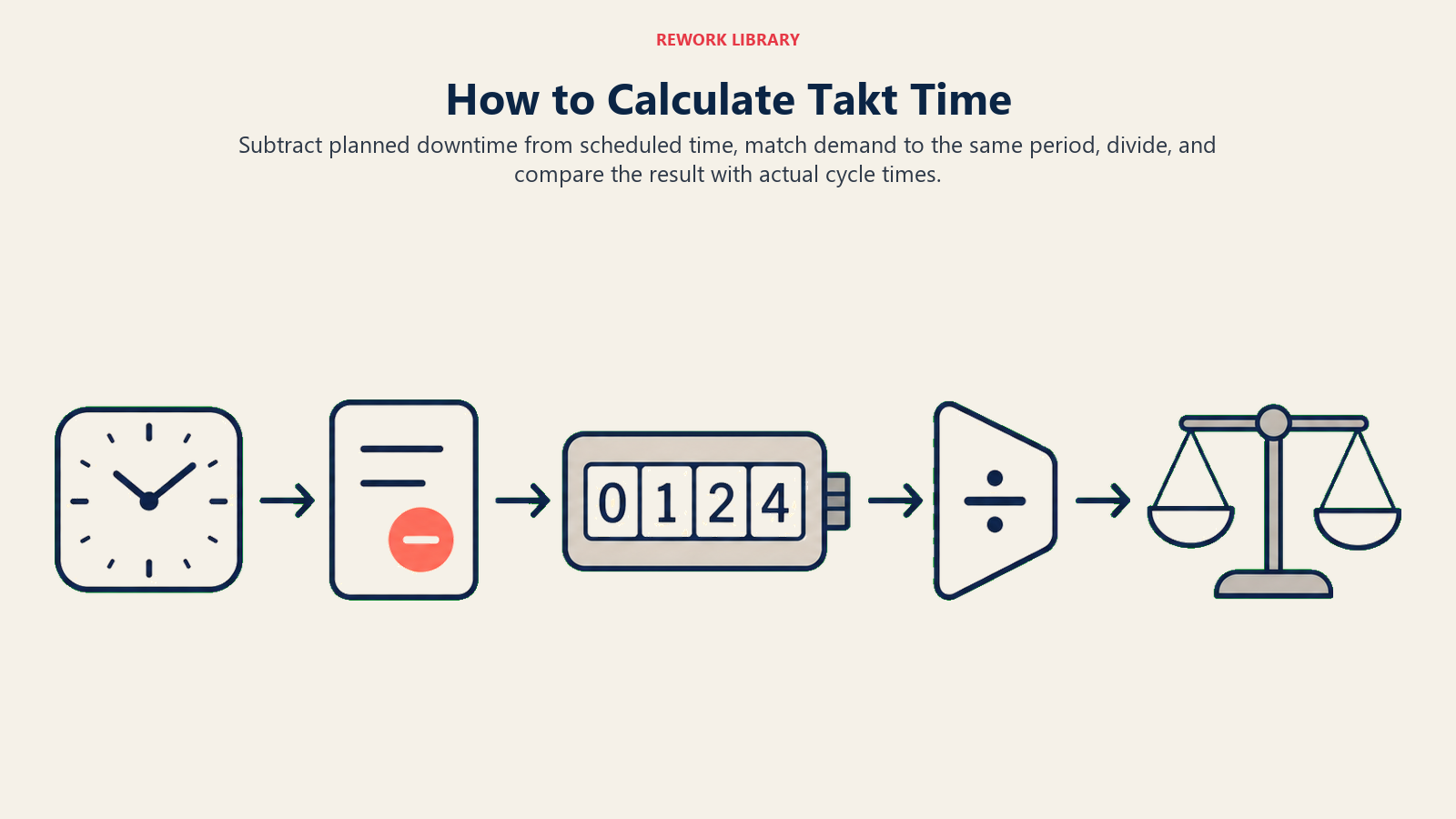
For the worked example above: 8-hour shift minus 60 minutes of breaks = 420 minutes net.
Step 2: Find customer demand for the same period
Pull your actual customer orders or a reliable demand signal for the exact same window. If you're using a weekly figure, make sure your net available time is also weekly. Takt time breaks down instantly if the time windows don't match.
Watch out for seasonal spikes or promotional periods. If demand doubles in December, your December takt time is roughly half your November takt time. Run separate calculations for each period.
Step 3: Divide and confirm units
Divide net available time by demand. Pick the unit of time that makes the result actionable: seconds per unit works well for high-volume lines (automotive, electronics), minutes per unit for mid-volume processes, hours per unit for complex, low-volume assembly or service work.
Example: a software support team with 6 hours of net available time and 12 tickets per day has a takt time of 30 minutes per ticket.
Step 4: Compare to actual cycle times and rebalance
Pull the measured cycle time for every workstation or process step. Plot them on a bar chart next to the takt line. Any bar above takt is a bottleneck requiring immediate attention. Any bar dramatically below takt is a candidate for sharing capacity with an overloaded neighbor.
This comparison is where value stream mapping becomes a natural partner: the value stream map shows you the full sequence; the takt-vs-cycle comparison tells you which steps in that sequence are holding the whole system back. Use the Pareto analysis approach to prioritize which bottlenecks to fix first.
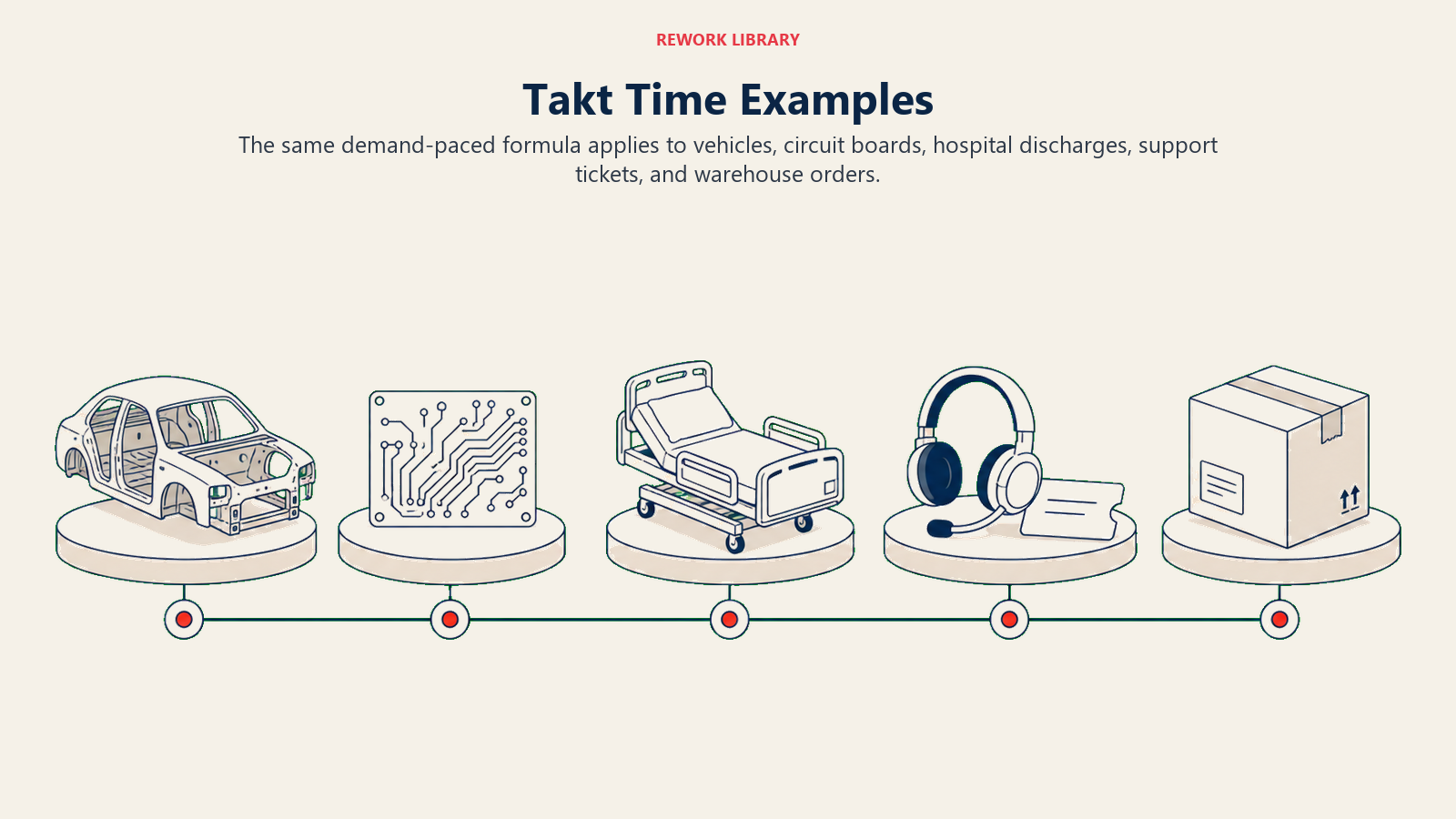
Takt time examples
| Setting | Net available time | Demand | Takt time |
|---|---|---|---|
| Automotive assembly (1 shift) | 420 min | 84 vehicles | 5 min/vehicle |
| Electronics PCB line (8 hrs, 45 min breaks) | 435 min | 870 boards | 30 sec/board |
| Hospital discharge process (10 hrs) | 600 min | 20 patients | 30 min/patient |
| Software support team (6 hrs net) | 360 min | 24 tickets | 15 min/ticket |
| Order fulfillment warehouse (shift) | 450 min | 900 orders | 30 sec/order |
Manufacturing line: A car plant runs one 8-hour shift with two 15-minute breaks and a 30-minute shift changeover at the end. Net time = 8 hrs - (30 + 30) min = 420 minutes. If the plant must produce 84 vehicles to meet daily dealer orders, takt time = 420 / 84 = 5 minutes per vehicle. Every workstation on that line, welding, painting, trim, final check, must complete its portion in 5 minutes or less.
Service/ticket queue: A support team handles customer escalations from 8 AM to 5 PM with 3 hours of meetings and admin. Net available time = 6 hours = 360 minutes. Daily demand is 24 tickets. Takt time = 360 / 24 = 15 minutes per ticket. If the team's average handle time is 20 minutes, they need either faster resolution workflows, one additional agent, or a reduction in ticket volume, the math makes the staffing decision clear.
Software/Kanban: A product squad processes a sprint with 6 working days and 2 developers. Net available dev time = 2 x 6 x 6 productive hours = 72 hours. If they committed to 18 user stories, takt time = 72 / 18 = 4 hours per story. If most stories are being estimated at 8 hours, the team is consistently over takt, a signal to right-size stories or reduce sprint scope before the sprint starts. This connects to muda, mura, and muri: a sprint full of oversized stories is a classic case of mura (unevenness) and muri (overburden).
Best practices
Recalculate takt time at the start of every planning period. Don't let a stale number drive decisions. It takes five minutes, and it forces the conversation about whether your current capacity can actually meet demand before the period starts, not after.
Post takt time visibly. Put it on the line-side board, the sprint board, or the team dashboard next to actual cycle time. When the two numbers are in the same eyeline, discrepancies become a daily topic rather than a monthly surprise.
Use takt time to drive staffing decisions, not just line speed. If customer demand drops, don't just run faster and overproduce, run fewer shifts or reassign people. If demand rises, calculate whether existing takt time can absorb the increase or whether you need to add capacity.
Pair takt time with standard work. Once you know the target cycle time (from takt), document the sequence of steps an operator should follow to hit it consistently. Standard work turns takt time from a target into a repeatable process.
Treat a takt miss as a system signal, not a people problem. When cycle time consistently exceeds takt, the system is telling you it needs redesign: better tooling, reduced handoffs, smaller batch sizes, or rebalanced workstation loads. This is exactly the continuous improvement mindset that keeps Lean sustainable.
Related reading
- Just-in-time production, how takt time drives pull-based scheduling
- Muda, mura, muri, the three forms of waste that takt imbalance creates
- Value stream mapping, visualizing where cycle times exceed takt
- Lean methodology, the broader system takt time supports
- Business bottlenecks, diagnosing constraints when cycle time exceeds takt

On this page
- What is takt time?
- The takt time formula
- Takt time vs cycle time vs lead time
- Why takt time matters
- Common mistakes when using takt time
- How to calculate takt time
- Step 1: Determine net available production time
- Step 2: Find customer demand for the same period
- Step 3: Divide and confirm units
- Step 4: Compare to actual cycle times and rebalance
- Takt time examples
- Best practices
- Related reading