Root Cause Analysis: Methods and Examples
Turn this article into takeaways for your work.


Each assistant summarizes the article only for you and suggests best practices for your work.
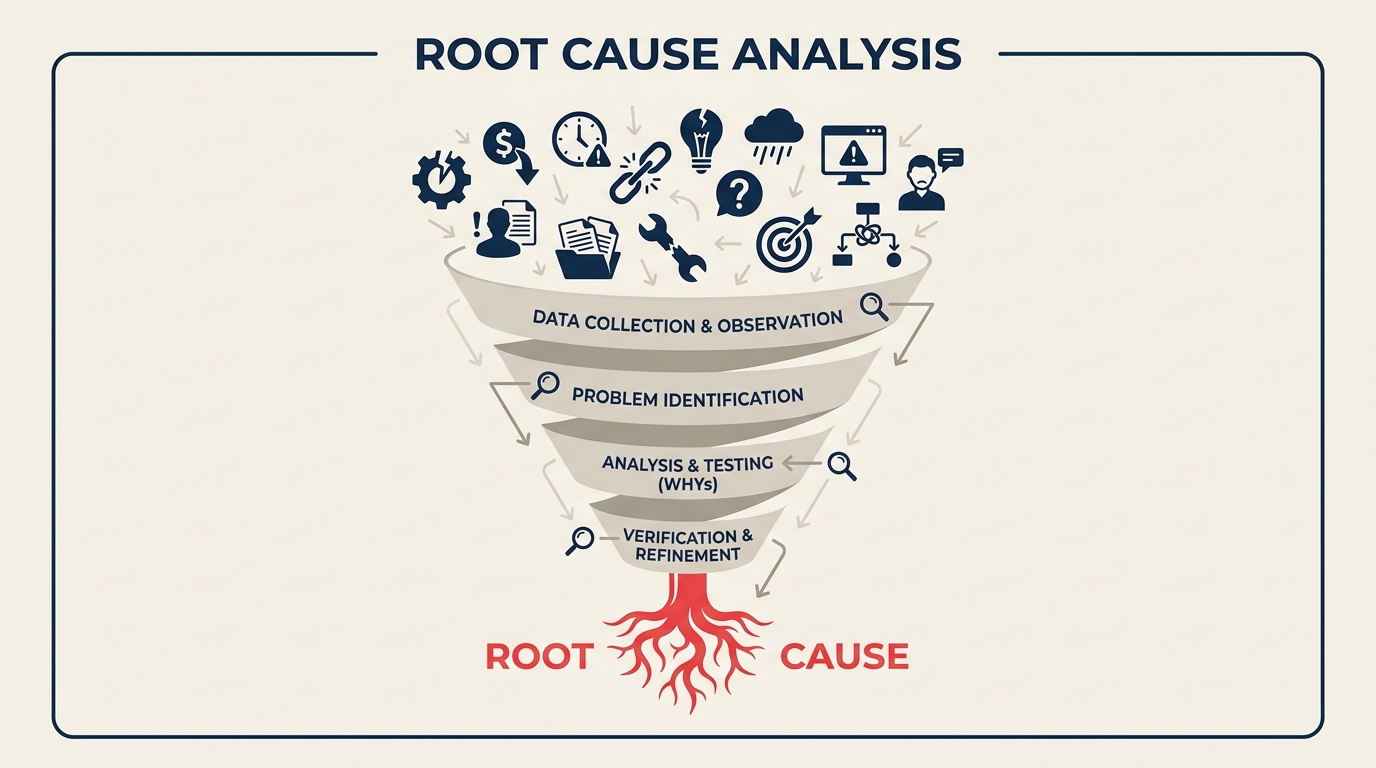
Most teams spend their time treating symptoms. Root cause analysis (RCA) is the practice of digging past those symptoms to find what actually triggered the problem in the first place, so you can fix it once and stop seeing it come back.
What is root cause analysis?
Root cause analysis is a structured problem-solving method that identifies the underlying cause of a problem rather than addressing its visible effects. The core premise is simple: if you only treat a symptom, the same problem will resurface. But if you eliminate the source, the problem goes away permanently.
RCA is not a single tool. It's a discipline with several methodologies behind it, each suited to different types of problems. What they share is a commitment to asking "why did this happen?" repeatedly until you reach the cause that, if removed, would prevent the problem from recurring.
The difference between RCA and ordinary troubleshooting is depth. Troubleshooting gets things working again. RCA makes sure they don't break the same way twice.
Key Facts
- The American Society for Quality (ASQ) estimates that poor quality costs U.S. businesses between 5% and 30% of gross sales, with a large portion attributable to defects and failures that go unresolved at the root level.
- A study by the Aberdeen Group found that organizations using formal root cause methodologies resolve recurring problems up to 3x faster than those relying on ad-hoc fixes.
- ISO 9001:2015, the international quality management standard, explicitly requires organizations to determine the causes of nonconformities and take corrective action at the root level, not just the surface.
Root cause analysis methods compared
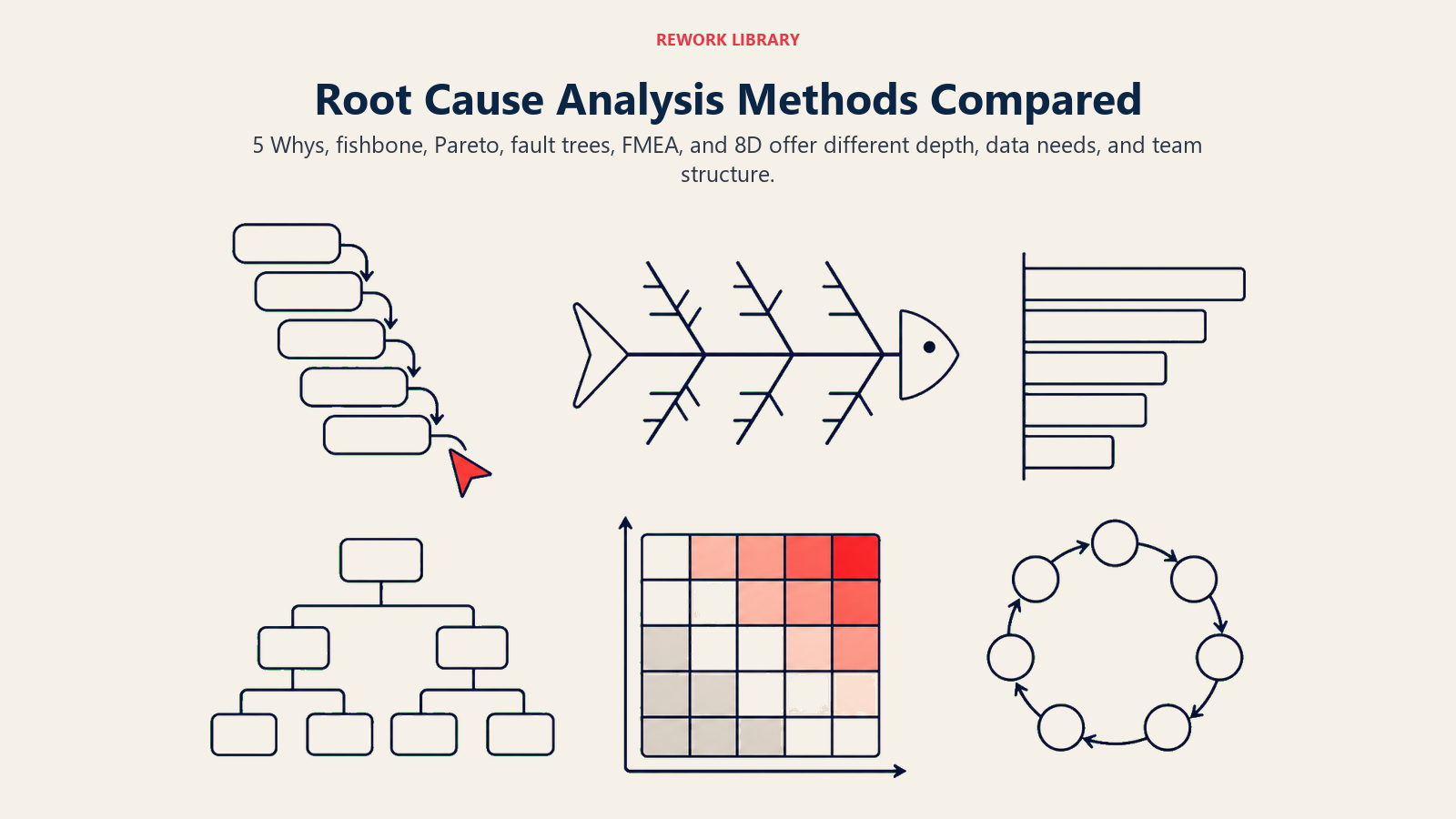
Several proven RCA techniques exist. Choosing the right one depends on how complex the problem is, how much data you have, and how many people need to be involved.
| Method | Best for | How it works | Complexity |
|---|---|---|---|
| 5 Whys | Simple to moderately complex problems | Ask "why" 5 times to trace back to the root | Low |
| Fishbone diagram (Ishikawa) | Multi-cause problems needing team input | Map causes across 6M categories (Man, Machine, Method, Material, Measurement, Mother Nature) | Medium |
| Pareto analysis | Prioritizing which problems to tackle first | Apply the 80/20 rule to identify which causes drive most of the impact | Medium |
| Fault Tree Analysis (FTA) | Safety-critical and engineering failures | Top-down logic tree mapping how failures combine | High |
| FMEA | Proactive risk identification before failures occur | Score failure modes by severity, occurrence, and detectability | High |
| 8D Problem Solving | Complex cross-functional manufacturing or quality issues | Eight-discipline team process with interim and permanent corrective actions | High |
Each method has trade-offs. The 5 Whys is fast and accessible but can be superficial on complex problems. FMEA is thorough but resource-intensive. For most operational problems in business, starting with a fishbone diagram and then drilling down with 5 Whys covers the majority of cases well.
Benefits of root cause analysis
Done consistently, RCA changes how an organization relates to problems. Instead of cycling through the same incidents on a six-month loop, teams build institutional knowledge about why things break.
Permanent fixes, not patches. The most obvious benefit is that problems stop recurring. When you address the cause, you eliminate the mechanism that produces the failure.
Cost reduction. Rework, warranty claims, customer churn, and incident response all carry real costs. Eliminating the root cause cuts those costs at the source rather than managing them indefinitely.
Cross-functional learning. RCA almost always reveals that a problem has multiple contributing factors across departments. The process creates shared understanding that siloed troubleshooting never would.
Better process design. Recurring root causes often point to design flaws in how work is structured. A good RCA program surfaces those design problems and feeds them into continuous improvement initiatives like DMAIC or Six Sigma.
Cultural shift. Teams that practice RCA regularly get better at asking "why" instead of assigning blame. That's a foundational shift toward a total quality management culture.
Common mistakes and limitations
RCA is powerful, but it's easy to do badly. These are the failure modes that show up most often.
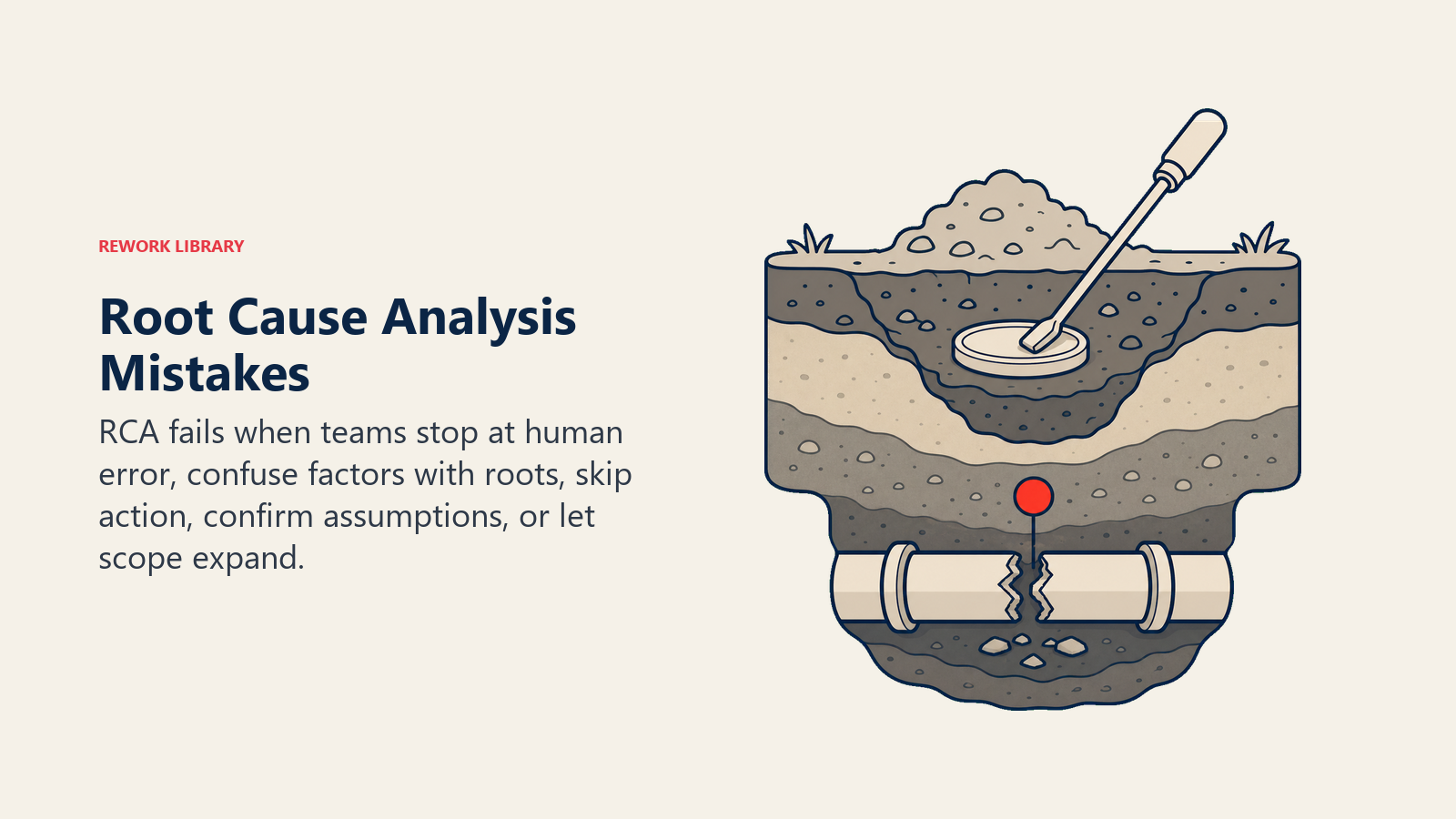
Stopping too early. The most common mistake is declaring a root cause before you've actually reached it. "Human error" is almost never a root cause. It's a symptom of missing training, unclear procedures, or inadequate tooling.
Confusing contributing factors with root causes. A problem can have several contributing causes without any single one being the root. An RCA that doesn't distinguish between them leads to scattered corrective actions that don't fully resolve the issue.
Analysis without action. RCA produces a report, but the report doesn't fix anything. Without a clear owner, a deadline, and a verification step, insights stay on paper.
Confirmation bias. Teams often anchor on the first plausible explanation and stop looking. Structured methods like the fishbone diagram help by forcing you to consider multiple cause categories before narrowing down.
Scope creep. An RCA that tries to explain every bad outcome at once tends to produce vague findings. Keeping the problem statement tight produces sharper results.
How to conduct a root cause analysis (step by step)
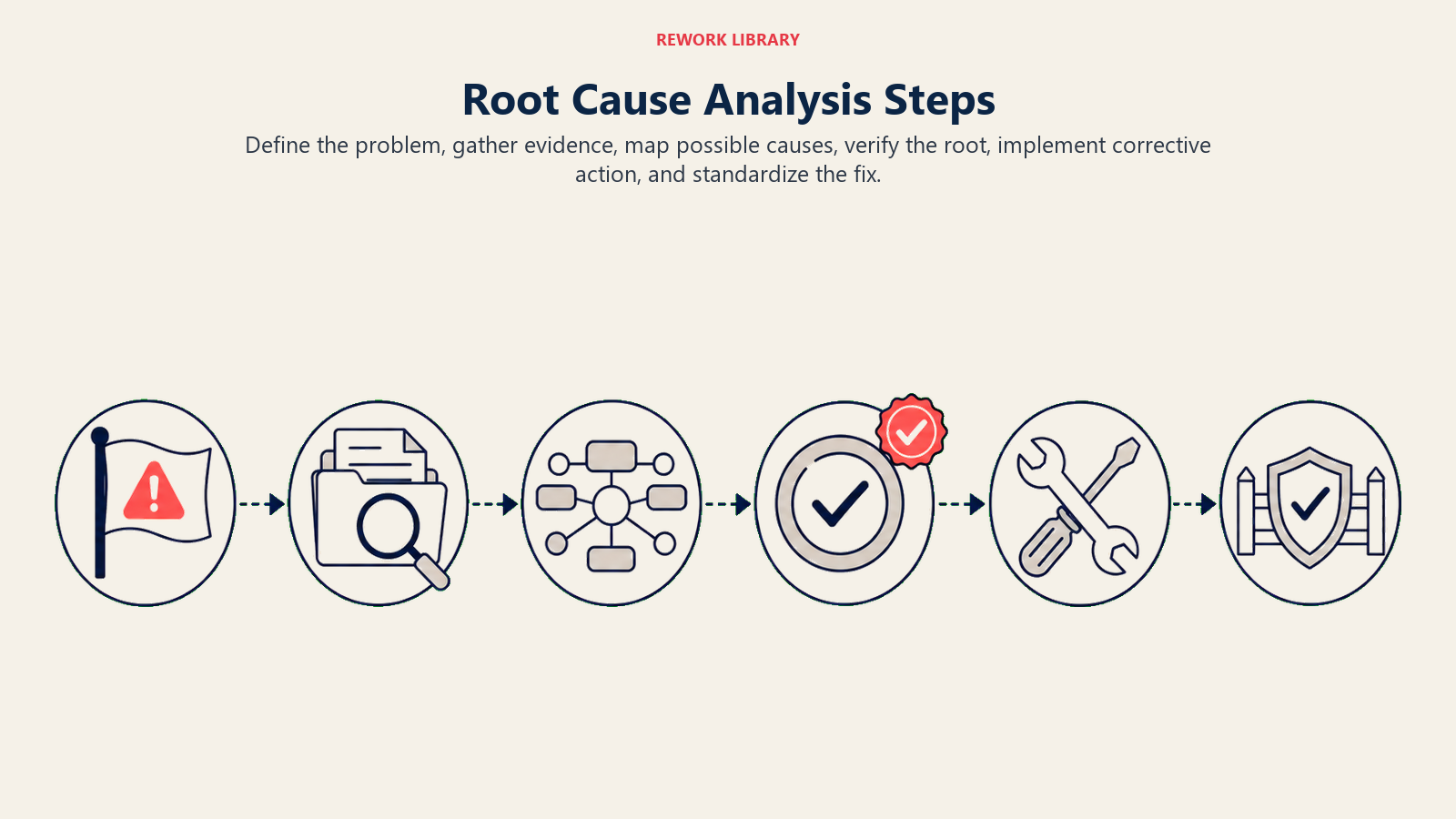
A disciplined RCA moves from a clearly bounded problem to evidence, tested causes, corrective action, and follow-up verification.
Step 1: Define the problem clearly
Write a specific, measurable problem statement. "Customer complaints are up" is too vague. "Customer-reported defect rate increased from 1.2% to 3.8% in Q1 2026, concentrated in the mobile checkout flow" is something you can investigate. A tight problem statement prevents the analysis from wandering and helps you know when you've actually solved it.
Step 2: Gather data
Collect facts before forming hypotheses. This includes incident logs, process data, customer feedback, timestamps, and any other evidence that describes what happened, when, and where. Skipping this step and jumping to causes is how teams end up fixing the wrong thing.
Step 3: Identify possible causes
Use a structured method, like a fishbone diagram, to map out all the possible causes across categories. Involve people from different functions. The goal at this stage is breadth, not depth. You want to surface every plausible cause before you start ruling things out.
Step 4: Find the root cause
Apply your chosen method to drill down from possible causes to actual causes. If you're using the 5 Whys, ask "why does this happen?" at each level until you reach a cause that is both fundamental and actionable. If you're using Pareto analysis, use frequency or impact data to identify which causes account for the majority of the problem. Validate your conclusion against the data you collected in Step 2.
Step 5: Implement and verify corrective action
Design a corrective action that addresses the root cause directly. Assign a clear owner and timeline. Then verify that the fix actually works by measuring whether the problem has stopped occurring. This verification step is where most RCA processes fall short. Without it, you can't distinguish a real fix from a lucky coincidence.
Step 6: Standardize to prevent recurrence
Once the fix is verified, update the relevant procedures, training materials, or system controls to embed the change. This is the step that turns a one-time fix into a permanent improvement. It's also the step that connects RCA to broader frameworks like PDCA, lean methodology, and value stream mapping.
Root cause analysis examples
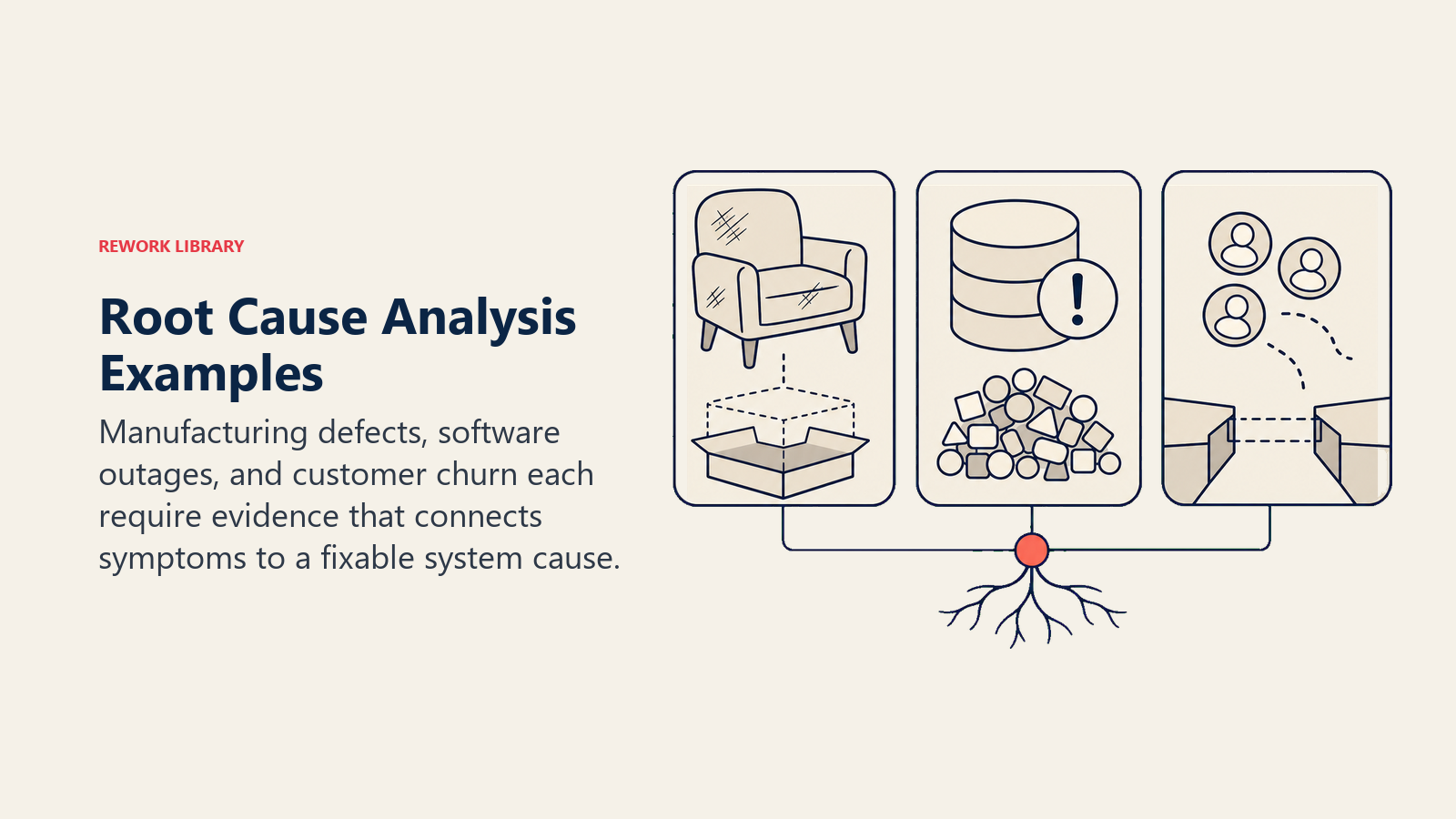
The examples below show how the same discipline connects a visible symptom to a fixable system cause in very different settings.
Manufacturing defect
A furniture manufacturer saw a 4% increase in surface scratches on finished units. Instead of increasing final inspection, they ran an RCA.
| Why level | Finding |
|---|---|
| Why are units arriving scratched? | They are being scratched during packaging. |
| Why are they scratched during packaging? | Foam padding is not covering the full surface area. |
| Why is the foam coverage incomplete? | Foam sheets are cut to a standard size that doesn't fit the new product line. |
| Why weren't the cut sizes updated? | The packaging spec was never revised when the product dimensions changed. |
| Root cause | No change-control process exists to update packaging specs when product designs change. |
The fix was a change-control checklist. Scratch rate returned to baseline within two production cycles.
Software service outage
A SaaS company experienced three separate database timeout incidents in a single month. Their incident review identified the pattern: all three occurred on Monday mornings after weekend batch jobs ran.
The batch job was writing large amounts of temporary data to a shared table and not cleaning it up. Over weeks, table bloat caused query times to spike. The root cause was a missing cleanup routine in the batch job, combined with no automated alerting on table size. Both issues were fixed, and the incidents stopped.
Customer churn spike
A B2B software company noticed a sharp increase in churn from customers in their 90-to-180-day cohort. Account managers assumed it was a pricing issue. RCA revealed something different.
A fishbone diagram session across sales, customer success, and product identified that customers in this cohort were consistently failing to complete the integration step that unlocked the platform's core value. The root cause was that the integration required technical knowledge most buyers didn't have, and the onboarding sequence didn't offer a guided path for non-technical stakeholders. A structured onboarding update reduced churn in that cohort by 34% over the following quarter.
Best practices
Start with a clear problem statement. Vague problems produce vague causes. Specificity is the foundation of useful RCA.
Distinguish the problem from the symptom. Before you start asking "why," make sure you're asking about the right thing. Symptoms often masquerade as problems.
Involve people close to the work. The people who actually do the work know where the cracks are. An RCA run entirely by management tends to miss the real picture.
Don't stop at one root cause. Most real-world problems have more than one. After you find the first root cause, ask whether there are contributing causes that also need addressing.
Make verification non-negotiable. A corrective action that isn't verified is just a hypothesis. Build the verification step into your standard RCA template.
Connect RCA to your broader improvement system. Standalone RCA findings that don't feed into process redesign or continuous improvement programs tend to get shelved. Route findings into your DMAIC cycles or operational review cadences.
Track repeat incidents. If the same root cause appears multiple times across different incidents, that's a signal of a systemic issue. Aggregate your findings over time and look for patterns.
Problems that recur are problems that were never actually solved. RCA is the practice that closes that gap, and teams that build it into their standard operating rhythm spend far less time firefighting and far more time improving. The method you use matters less than the discipline of following through to a verified, standardized fix.
Related reading

Customer Success Operations Manager
On this page
- What is root cause analysis?
- Root cause analysis methods compared
- Benefits of root cause analysis
- Common mistakes and limitations
- How to conduct a root cause analysis (step by step)
- Step 1: Define the problem clearly
- Step 2: Gather data
- Step 3: Identify possible causes
- Step 4: Find the root cause
- Step 5: Implement and verify corrective action
- Step 6: Standardize to prevent recurrence
- Root cause analysis examples
- Manufacturing defect
- Software service outage
- Customer churn spike
- Best practices
- Related reading