Kaizen Event: How to Run a Rapid Improvement Blitz
Turn this article into takeaways for your work.


Each assistant summarizes the article only for you and suggests best practices for your work.
A kaizen event is a time-boxed, cross-functional workshop designed to fix one specific process in three to five days. The team walks in, maps the problem, experiments with solutions, and walks out with working changes already implemented on the floor. That's the whole idea: compress months of gradual improvement into a single focused sprint.
It's also called a kaizen blitz or a rapid improvement event, and it's one of the most effective tools in the lean toolkit when you use it on the right problem.
What is a kaizen event?
A kaizen event (also called a kaizen blitz or rapid improvement event) is a dedicated, short-duration improvement workshop focused on one process, one area, and one team. A facilitator brings together frontline operators, supervisors, and sometimes engineers for three to five uninterrupted days to analyze the current state, identify waste, implement changes, and document the new standard.
The key word is event. Unlike the broader practice of kaizen continuous improvement, which is a philosophy of small ongoing improvements every day, a kaizen event is a bounded project with a start date, an end date, and a specific improvement target. You plan it, staff it, and measure its results.
Key terms to know:
- Kaizen (from Japanese): change for the better
- Kaizen blitz: informal name emphasizing the fast, intensive nature of the event
- Rapid improvement event (RIE): the term preferred in healthcare and government lean programs
- Kaizen workshop: used interchangeably, typically in service-sector contexts
Key Facts
- Companies that run structured kaizen events report cycle time reductions of 30-50% on targeted processes, according to the Lean Enterprise Institute (2023).
- A meta-analysis of 47 lean manufacturing implementations found that kaizen events generated an average 25% reduction in defect rates within 90 days of completion (Journal of Operations Management, 2021).
- The Toyota Production System, which popularized kaizen events, credits focused rapid-improvement workshops with eliminating over 3 million hours of waste annually across its global facilities (Toyota Sustainability Report, 2022).
One quotable framing: a kaizen event is not a brainstorming session. It ends with things changed, not a list of recommendations.
Kaizen event vs continuous kaizen
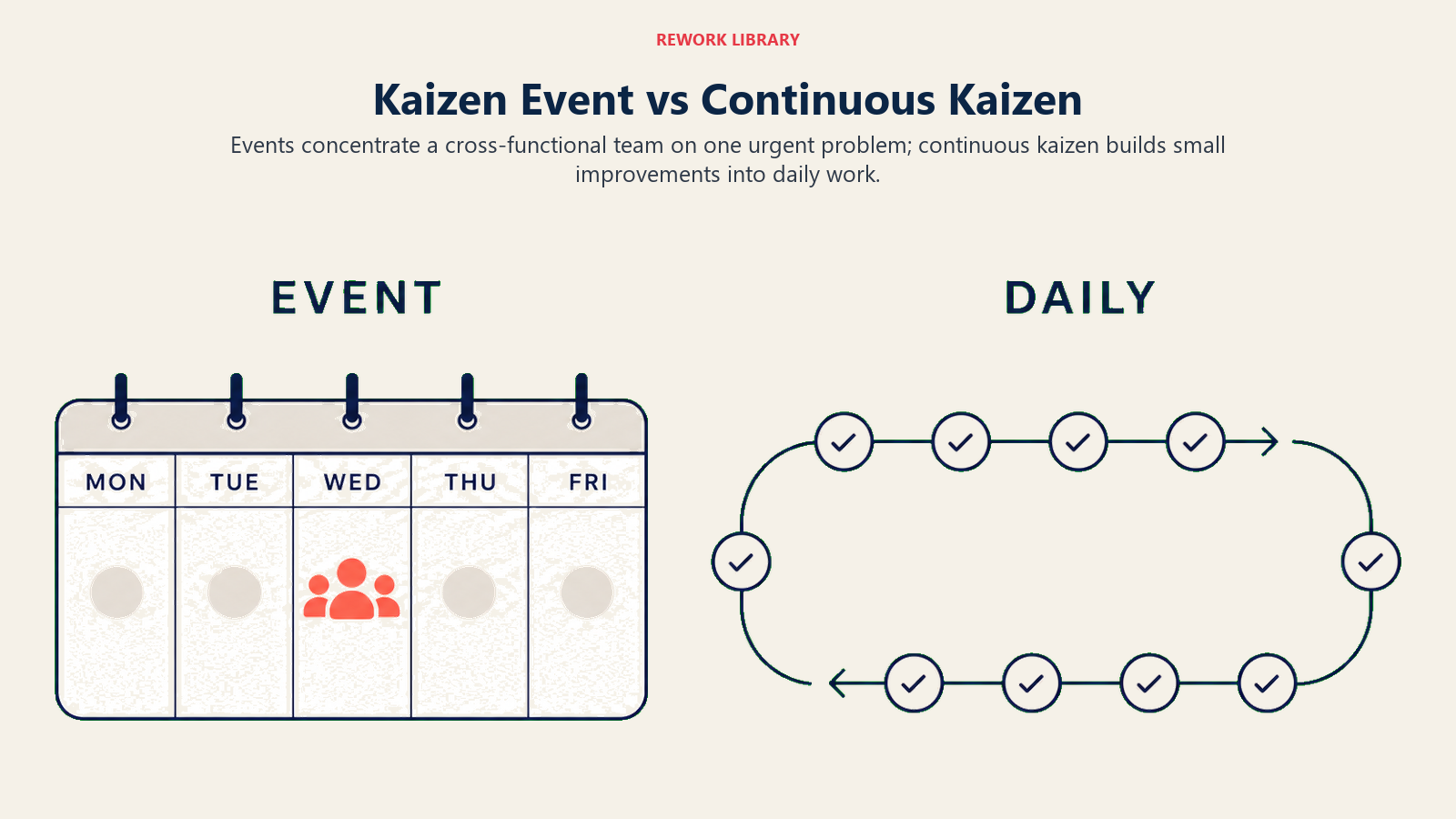
Both the kaizen event and daily kaizen come from the same philosophy. But they're built for different jobs.
| Dimension | Kaizen event | Continuous kaizen |
|---|---|---|
| Cadence | One-time project, typically 3-5 days | Ongoing, every day |
| Scope | One specific process or work cell | Company-wide culture and habits |
| Who is involved | Cross-functional team, 5-10 people | Every employee |
| Duration | Days | Indefinitely |
| Trigger | Identified problem, leadership priority | Always on |
| Output | Implemented change + new standard | Incremental culture shift |
| Best for | Fixing a known, measurable bottleneck fast | Sustaining gains and building habits over time |
Think of them as complementary. A kaizen event breaks through a stubborn problem. Daily kaizen keeps the gains from slipping and builds the improvement muscle that makes the next event more effective.
The structure of a kaizen event
Most kaizen events follow a five-day format, though three-day versions work well for smaller scope problems.
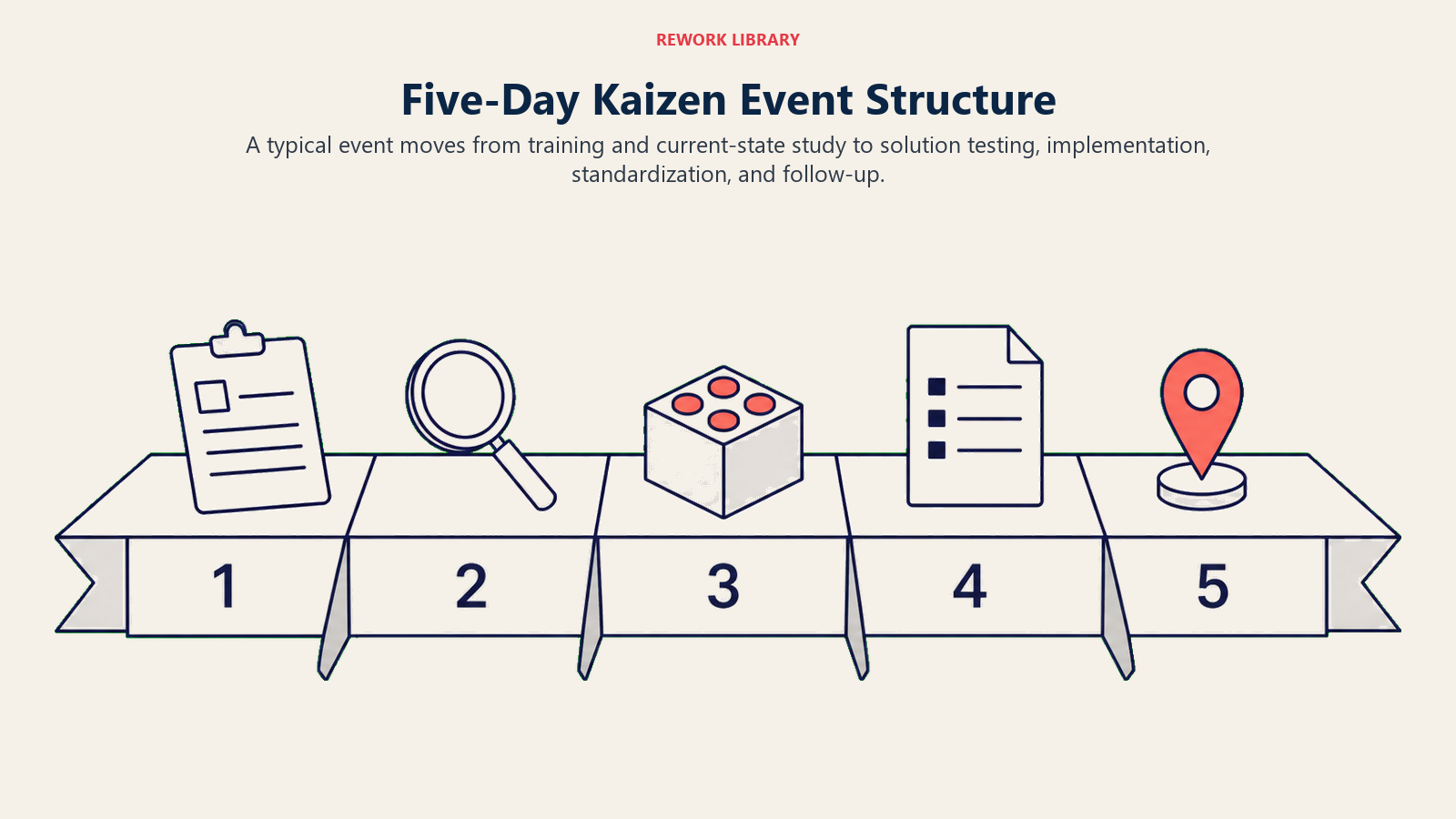
Day 1: Train and define The team reviews lean principles, waste categories, and the event's charter. Everyone agrees on the target process, the improvement goal, and the boundaries of the event. A gemba walk to observe the process in person is usually part of Day 1.
Day 2: Map the current state The team documents exactly how the process works today. This often involves value stream mapping or a detailed process map of each step, handoff, and delay. Data collected in pre-work (cycle times, defect rates, queue lengths) gets pinned to the wall. The team identifies where waste lives.
Day 3: Identify waste and design the future state Using tools like five whys, fishbone diagrams, and A3 problem solving, the team digs into root causes. Then they design the future state: a process that eliminates the identified waste. For physical processes, this often means rearranging equipment, redesigning handoffs, or applying 5S (sort, set in order, shine, standardize, sustain) to the work area.
Day 4: Implement changes This is where most improvement initiatives stall, but a kaizen event doesn't let that happen. The team implements the redesigned process during the event itself. They test it, observe it, and adjust it in real time. Changes that don't work get revised on the spot.
Day 5: Standardize and present The team writes the new standard operating procedure, creates visual controls, and updates any relevant documents. They present results to leadership: before/after metrics, a list of completed changes, and a tracking board for any open items that need follow-up.
Benefits of kaizen events
Speed. A typical improvement initiative moves through committees and approval chains for months. A kaizen event compresses that cycle into days. Changes that would otherwise sit on a backlog get done before Friday afternoon.
Buy-in from the people doing the work. Because frontline operators are in the room, they help design the new process. They're not handed a solution from above. That shift makes adoption far easier.
Measurable results. Every kaizen event starts with a target (reduce setup time from 45 minutes to under 20, cut defect rate by 30%) and ends with before/after data. Leadership gets a clear ROI picture.
Cross-functional visibility. Putting engineers, operators, and supervisors in the same room for five days surfaces assumptions and miscommunications that data alone never would. Problems that looked like equipment issues often turn out to be communication gaps.
Sustainability. Because the new standard is documented and trained during the event, there's a higher chance the change sticks. It's not a pilot; it's the new way.
Common mistakes
Picking the wrong problem. A kaizen event works best on a specific, bounded process with measurable waste. Picking something too broad ("improve our supply chain") or too vague ("reduce errors") sets the team up for frustration. The scope should fit on a single process map.
Not freeing participants from their regular jobs. If team members spend half their time in the event and half on their normal workload, they can't focus. The event loses momentum and drags out.
Skipping the pre-work. Arriving on Day 1 without baseline data wastes the first day collecting information. Measure cycle times, defect rates, and queue depths before the event starts.
Implementing changes that can't survive after the event ends. Solutions that depend on extra staffing or temporary workarounds won't last. Every change needs to be sustainable with normal resources.
Letting open items slide. Kaizen events almost always end with a short list of follow-up actions that didn't get finished. Without a 30/60/90-day review process, those items quietly disappear. The event's gains erode.
Treating it as a one-time fix. A single kaizen event on one process is a start. The organizations that see the most improvement run them regularly, building a pipeline of targeted events across multiple processes throughout the year.
How to run a kaizen event
Define a tight scope, free the team from daily work, test changes at the gemba, and lock the gains into standard work.
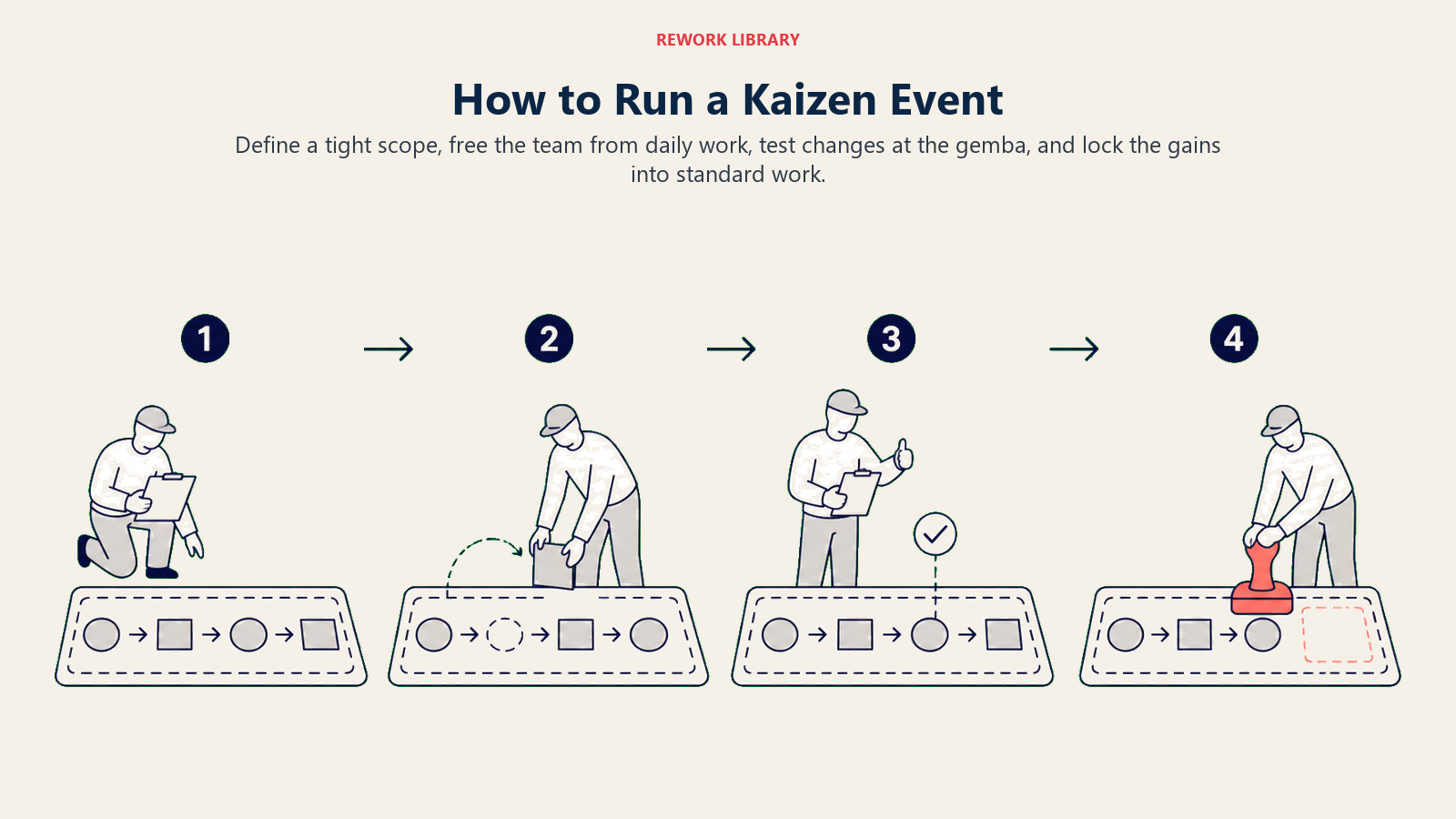
Step 1: Define scope and write the charter
Pick one process with a clear, measurable problem. Write a one-page charter that states: the process being improved, the improvement target (specific metric), the team members, the dates, and the boundaries (what's in scope and what's not). Leadership signs off before anything else happens.
Good candidates for a first event: a high-defect assembly step, a document approval process with long queue times, or a changeover procedure that's eating into production capacity.
Step 2: Select the team
Aim for five to ten people. The team should include two or three frontline operators who actually do the work, a supervisor or process owner, a facilitator (internal lean practitioner or external coach), and one or two cross-functional contributors such as a quality engineer, an IT contact, or a maintenance tech. Avoid loading the team with managers who don't touch the process.
Step 3: Complete pre-work and gather data
Two to three weeks before the event: collect baseline metrics (cycle time, defect rate, throughput, lead time), document the current process, gather any complaints or near-miss reports, and identify any resources needed during the week (equipment, materials, IT access). The better the pre-work, the faster Day 2 moves.
Also review current and future state mapping concepts so the team arrives ready to use them.
Step 4: Run the five-day event
Follow the Day 1-5 structure above. Keep sessions tightly facilitated. Use a visual project board (often called a kaizen newspaper) to track ideas, decisions, and open items in real time. Run PDCA cycles on each change: plan it, do a small test, check whether it worked, then adjust or standardize.
Keep leadership out of the room during the working sessions but brief them at the end of each day. They need to stay informed without derailing the team's momentum.
Step 5: Implement on the floor
Don't wait for sign-off. The kaizen event gives the team authority to implement changes within the agreed scope. Rearrange the work cell. Rewrite the SOP. Create new visual controls. Apply process standardization practices so the new method is the default, not an option.
Step 6: Follow up at 30, 60, and 90 days
Assign an owner for each open item from the event. Schedule check-ins at 30, 60, and 90 days to verify the changes held, re-measure the target metric, and close out any remaining actions. This follow-up phase is where most events either stick or slip. Without it, teams slide back to old habits within weeks.
Kaizen event examples
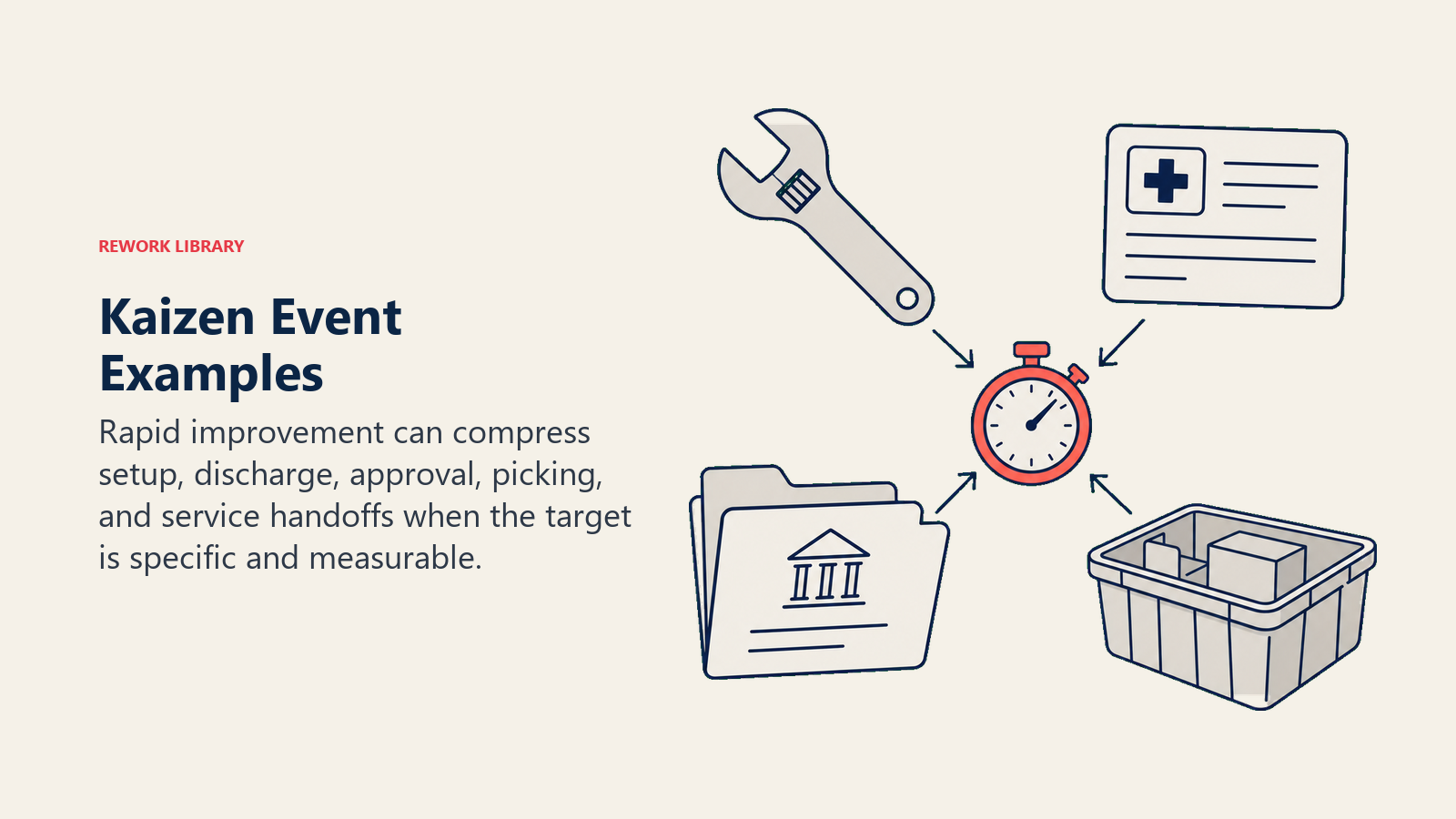
Rapid improvement can compress setup, discharge, approval, picking, and service handoffs when the target is specific and measurable.
| Industry | Process targeted | Result |
|---|---|---|
| Automotive manufacturing | Machine changeover (SMED) | Setup time cut from 90 minutes to 22 minutes in one 5-day event |
| Healthcare (hospital) | Patient discharge process | Average discharge time reduced from 4.2 hours to 1.8 hours; bed availability up 30% |
| Financial services | Loan application review | Handoffs reduced from 12 steps to 5; approval lead time dropped from 9 days to 2 days |
Each of these was a focused, bounded event. The automotive team didn't try to fix the entire production line; they targeted one changeover on one machine. That's what makes the results achievable in five days.
Best practices
Do:
- Run a gemba walk before finalizing the event scope: seeing the process in person often changes the target
- Set a specific numeric improvement goal (not "improve" but "reduce cycle time by 40%")
- Keep the scope tight; if you find a second problem worth fixing, schedule a second event
- Celebrate the team's results publicly; it builds appetite for the next event
- Link each event to a broader improvement strategy (this is where business process reengineering frameworks can help for larger systemic work)
Don't:
- Start an event without executive sponsorship; you'll need authority to change things
- Fill the team with people who can't actually implement anything
- Skip documentation; a new process with no written standard reverts to the old one
- Let the event become a complaint session; redirect energy from venting to root cause analysis
- Use business process reengineering approaches (whole-system redesign) when the problem calls for the surgical focus of a kaizen event
Kaizen events work best when they're part of a broader improvement culture, not a one-time rescue mission. Teams that run three to four events per year, each targeting a different problem, build the habits, tools, and confidence that make continuous improvement sustainable long-term. The event format is the accelerator; the culture is the engine.
Related reading

Customer Success Operations Manager
On this page
- What is a kaizen event?
- Kaizen event vs continuous kaizen
- The structure of a kaizen event
- Benefits of kaizen events
- Common mistakes
- How to run a kaizen event
- Step 1: Define scope and write the charter
- Step 2: Select the team
- Step 3: Complete pre-work and gather data
- Step 4: Run the five-day event
- Step 5: Implement on the floor
- Step 6: Follow up at 30, 60, and 90 days
- Kaizen event examples
- Best practices
- Related reading