Poka-Yoke: Mistake-Proofing in Lean (With Examples)
Turn this article into takeaways for your work.


Each assistant summarizes the article only for you and suggests best practices for your work.
Poka-yoke is a lean technique that designs errors out of a process so that mistakes become impossible to make, or impossible to miss. It's one of the simplest, highest-leverage ideas in quality management, and it shows up everywhere from factory floors to the software your team uses every day.
What Is Poka-Yoke?
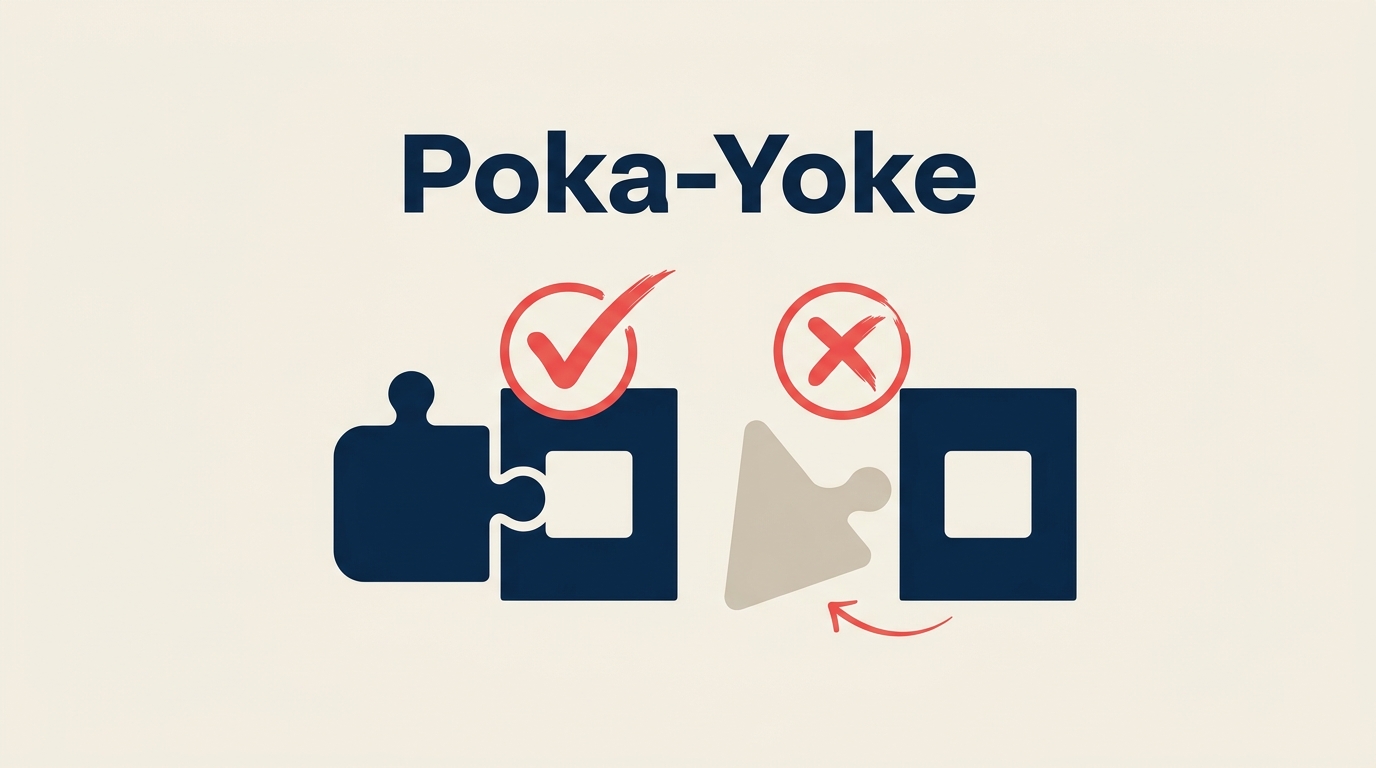
Poka-yoke (ポカヨケ) is a Japanese term meaning "mistake-proofing" or "inadvertent error prevention." The literal translation breaks down as poka (inadvertent mistake) + yoke (to avoid). In practice, a poka-yoke is any mechanism built into a product or process that prevents an error from occurring, or that makes an error immediately obvious so it gets caught before it becomes a defect.
The concept was developed by Shigeo Shingo, an industrial engineer at Toyota, in the 1960s as part of the Toyota Production System (TPS). Shingo originally called it baka-yoke ("fool-proofing"), but renamed it after a factory worker took offense at the implication. The new name stuck, and so did the idea.
The core logic is simple: humans make mistakes. Instead of training harder or disciplining people for errors, redesign the process so the mistake can't happen in the first place. Or, if it does happen, make it impossible to continue without noticing.
Key Facts
- Shigeo Shingo developed the poka-yoke concept at Toyota in the 1960s, codifying it in his 1986 book Zero Quality Control: Source Inspection and the Poka-Yoke System.
- Poka-yoke is one of two key defect-prevention mechanisms in the Toyota Production System, working alongside jidoka (autonomous defect detection).
- IBM research found that fixing a software defect after production costs 100x more than catching it at the design stage, which is exactly the problem poka-yoke is built to solve.
Types of Poka-Yoke
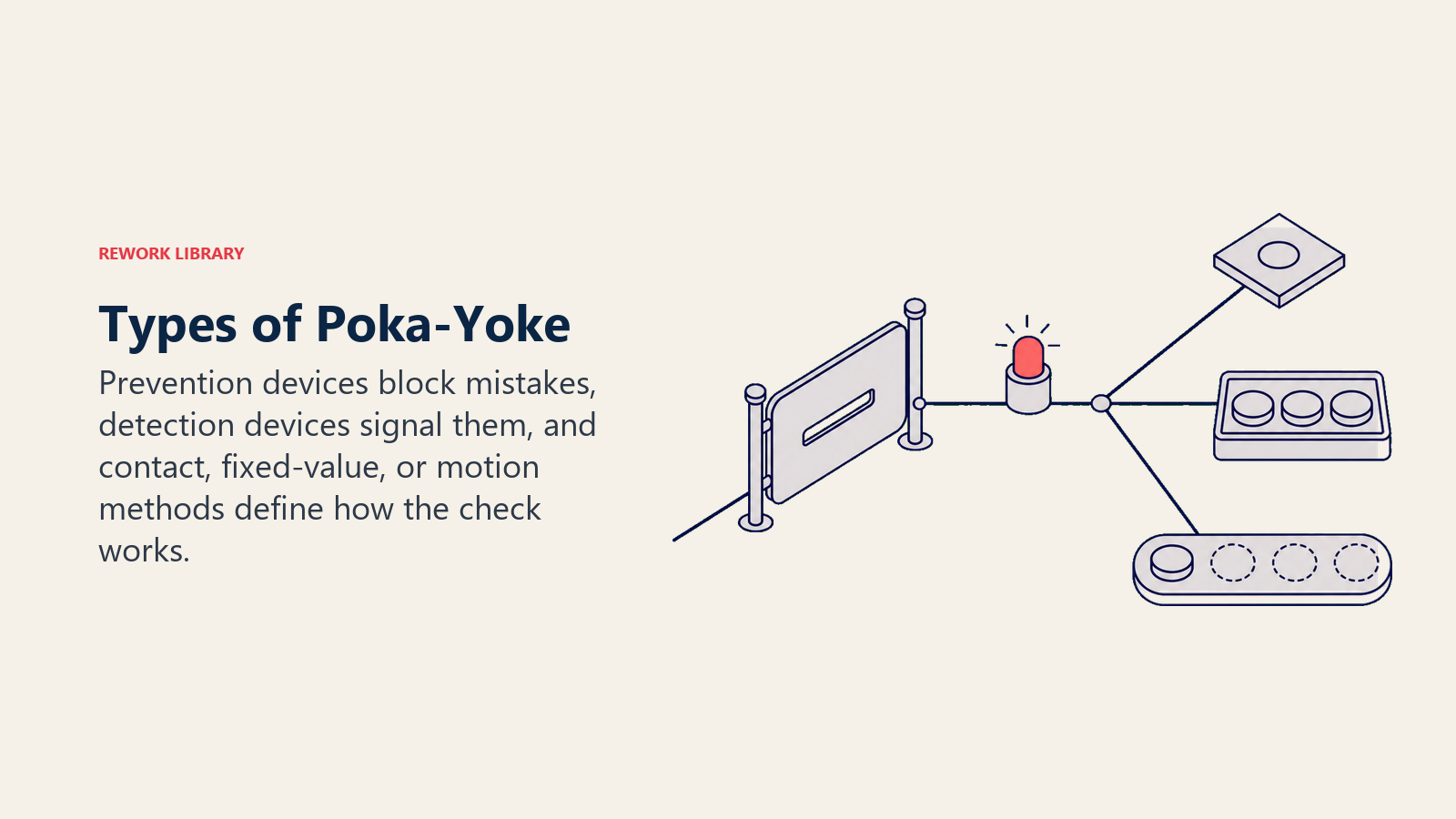
Poka-yoke mechanisms fall into two broad categories: those that prevent a mistake from happening, and those that detect a mistake the moment it occurs.
Prevention (Control) Poka-Yoke
A prevention poka-yoke physically or digitally blocks the error before it can happen. The process cannot proceed until the correct action is taken. These are the strongest form of mistake-proofing because there's no window for the defect to slip through.
Examples: a USB-A connector that only inserts one way; a required field on a form that blocks submission if blank; a car ignition that won't start unless the gear is in Park.
Detection (Warning) Poka-Yoke
A detection poka-yoke allows the process to proceed but immediately signals when something is wrong. It's a safety net, not a wall. Useful when preventing the error entirely would make the process too rigid.
Examples: a warning alarm when a machine runs without a guard; a dashboard light when seatbelts aren't fastened; spell-check underlining a misspelled word in red.
Three Methods (Shingo's Classification)
Shingo also classified poka-yokes by the physical or logical method they use:
| Method | How It Works | Example |
|---|---|---|
| Contact method | Detects incorrect shape, size, or position through physical or sensor contact | SIM cards with a notched corner so they can only be inserted one way |
| Fixed-value method | Counts parts or steps to confirm the right quantity was used | A kit tray with exactly 12 cavities for 12 screws: an empty cavity means one is missing |
| Motion-step method | Confirms the correct sequence of steps was followed | A surgical checklist that must be completed in order before an incision |
Poka-Yoke vs Jidoka and Other Lean Tools
Poka-yoke is often discussed alongside other lean quality tools. Here's how they relate:
| Tool | What It Does | When to Use It |
|---|---|---|
| Poka-yoke | Prevents or detects errors at the source | When a specific known error keeps recurring |
| Jidoka | Stops the line automatically when any defect appears | When you need system-level defect containment across a production flow |
| Five Whys | Finds the root cause of a problem | After a defect escapes, to understand why |
| DMAIC | Structured six sigma improvement cycle | When you need a full process improvement framework around quality |
| Kaizen | Continuous incremental improvement | Ongoing culture of small daily improvements |
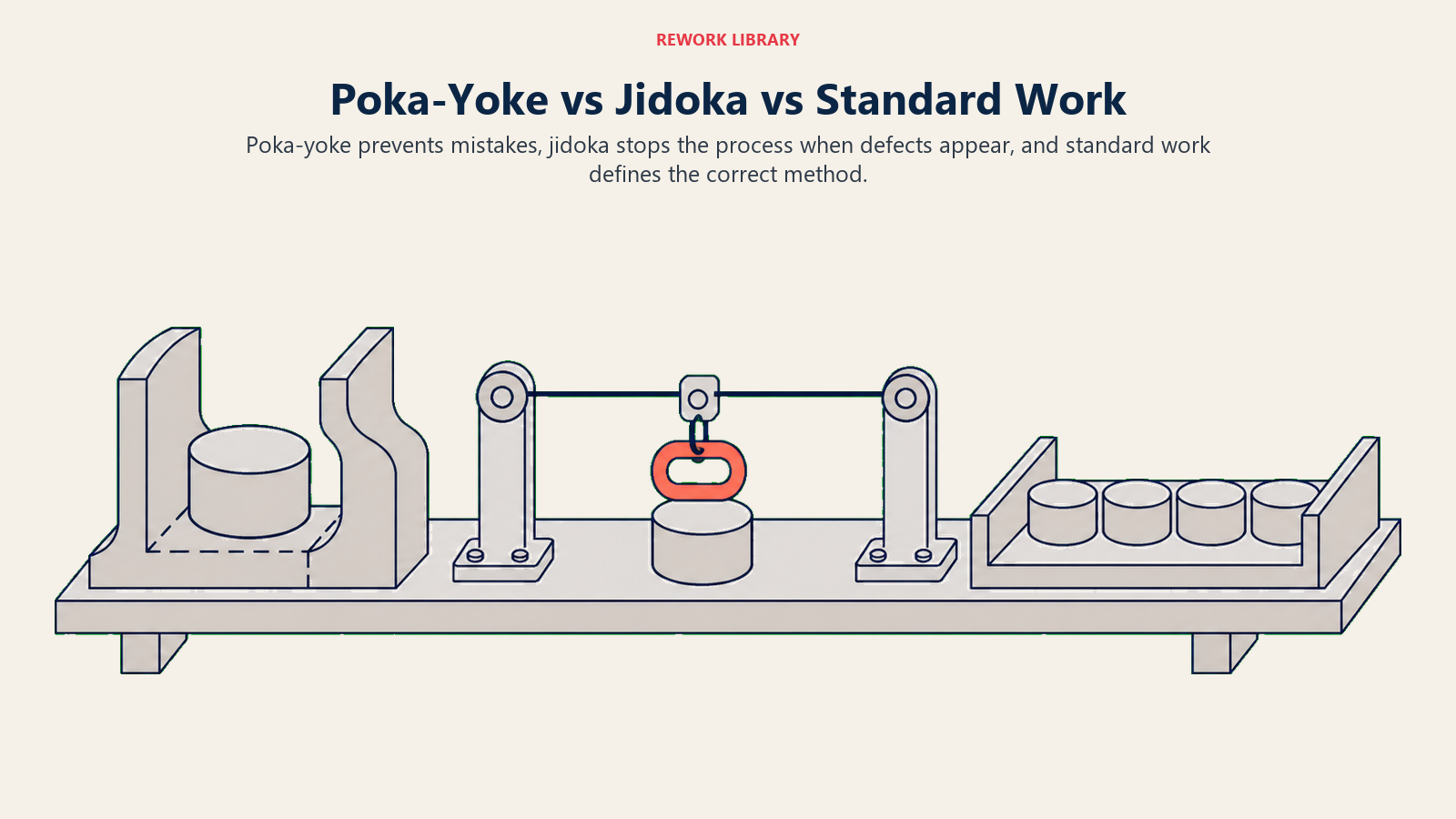
Poka-yoke and jidoka work as a pair. Jidoka stops the process when something goes wrong; poka-yoke tries to prevent it from going wrong at all. Combining them is more effective than either one alone.
Benefits of Poka-Yoke
The business case is strong:
- Fewer defects. Errors get caught or blocked at the source, not after they've traveled through five more process steps.
- Lower rework costs. When defects don't escape, you don't spend time and materials fixing them downstream.
- Reduced training burden. When a process is mistake-proof, new employees need less time to learn what not to do.
- Faster processes. Inspection checkpoints can be reduced or removed when the process itself guarantees correctness.
- Higher employee confidence. Workers aren't blamed for human error when the process design carries the weight of prevention.
- Better customer experience. Fewer defects mean fewer warranty claims, returns, and support tickets.
A well-designed poka-yoke pays for itself quickly. The harder question is whether you're investing time in solving the right recurring errors.
How to Implement Poka-Yoke
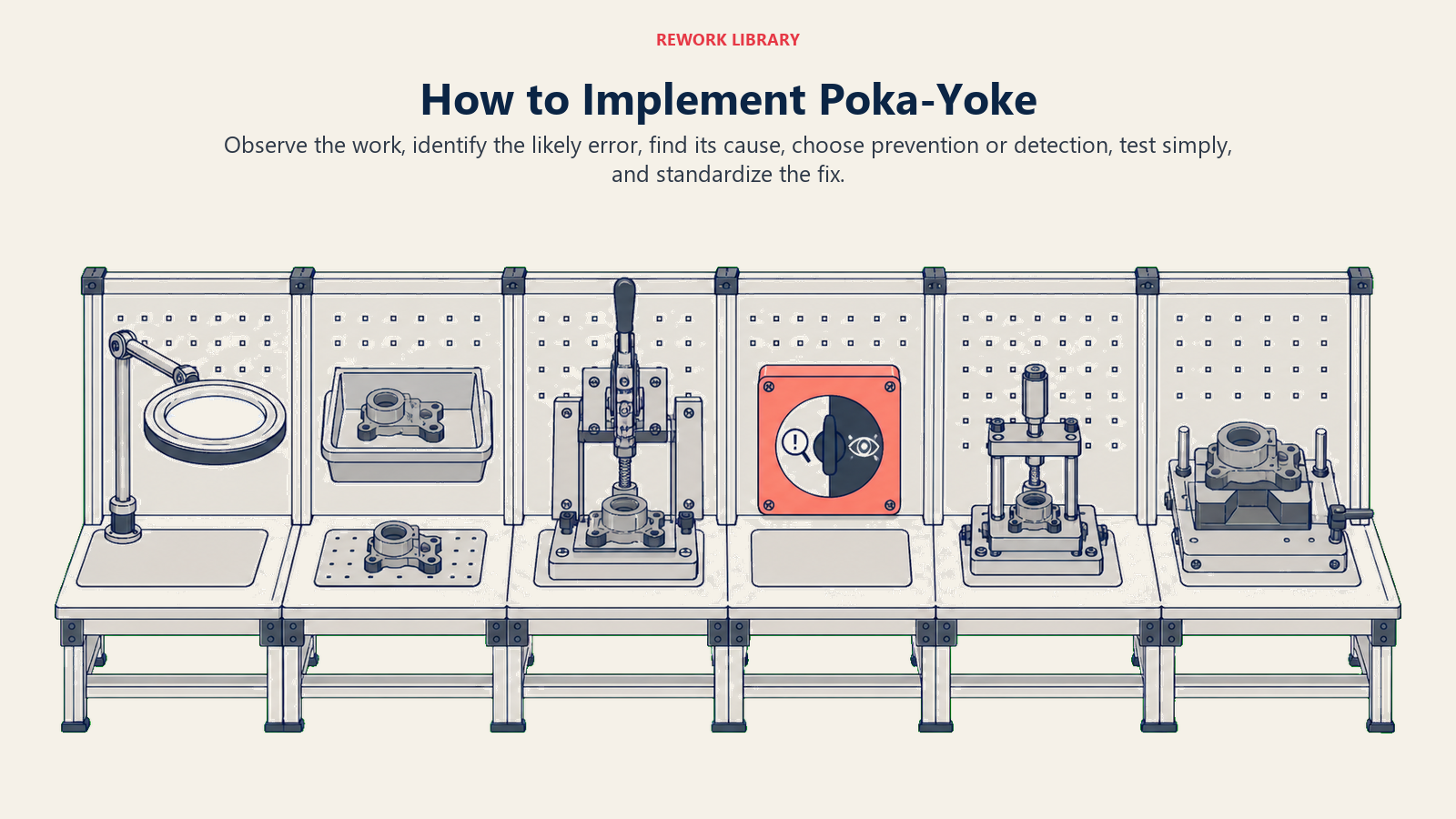
Step 1: Find the error
Start with real data. Where do defects occur most often? Where does rework pile up? Use a check sheet or look at cycle time vs lead time variations to surface the bottlenecks. Talk to the people doing the work, not just the people reviewing the reports.
Step 2: Understand why the error happens
Don't jump to a solution yet. Use Five Whys or a fishbone diagram to trace the error to its actual cause. A poka-yoke that fixes the symptom but not the cause will fail.
Step 3: Decide: prevent or detect?
If the error is completely avoidable by changing the process design, build a prevention poka-yoke. If some variation is unavoidable and you need a safety net, build a detection poka-yoke. Prevention is always preferable when feasible.
Step 4: Choose the method
Match the method to the type of error:
- Wrong part or wrong orientation? Use a contact method (physical shape, sensor).
- Wrong quantity? Use a fixed-value method (count, kit tray, checklist).
- Wrong sequence? Use a motion-step method (lock that only opens after prior step).
Step 5: Prototype and test
Build a simple version first. Test it on the actual process with real operators. A poka-yoke that slows down the line by 30% isn't a net win, even if it catches errors.
Step 6: Standardize and document
Once proven, document the mechanism in your standard operating procedure. Add it to training materials. And monitor it: poka-yokes can fail or be bypassed over time.
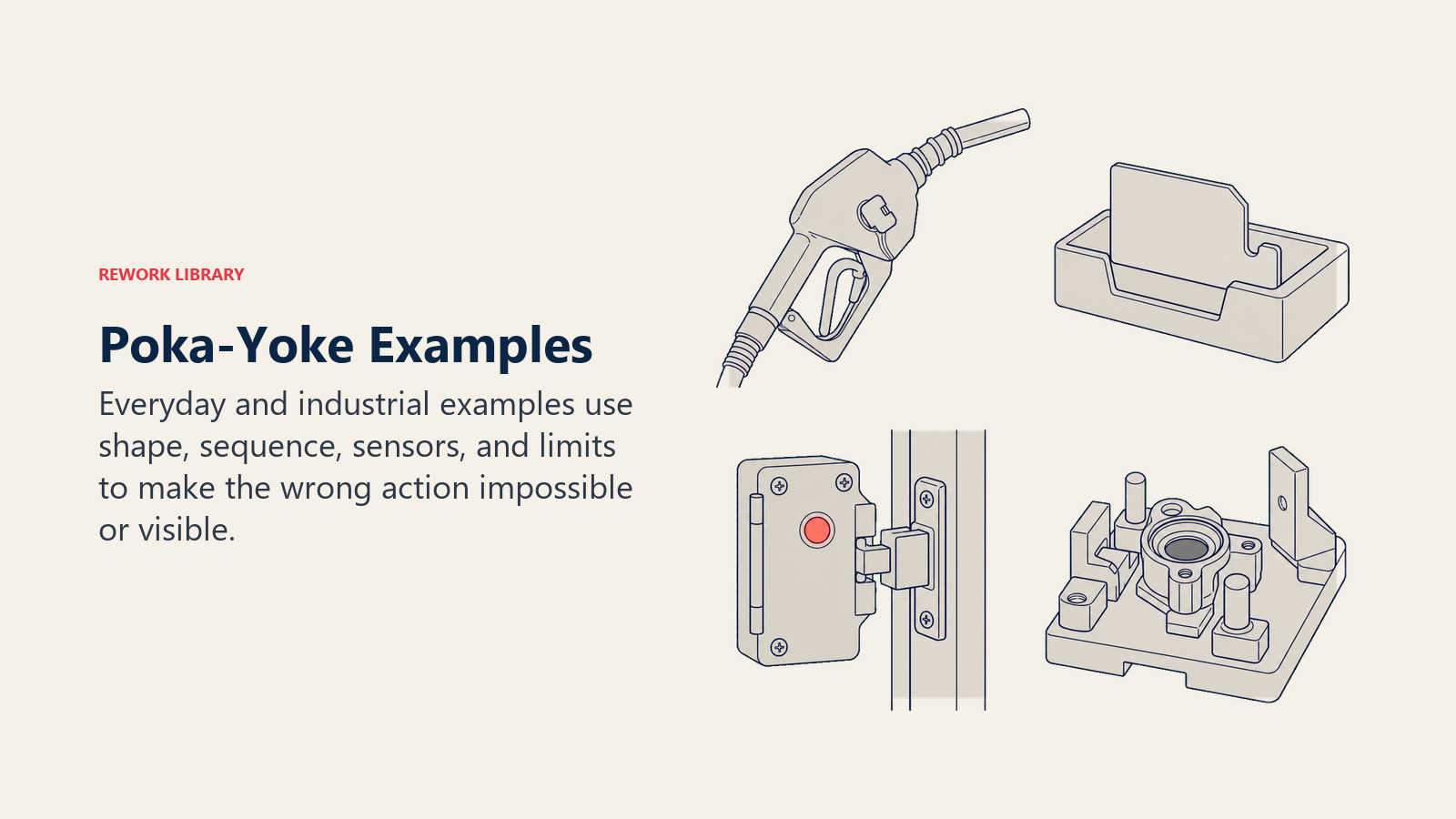
Poka-Yoke Examples
Poka-yoke is everywhere once you start looking for it:
| Setting | Error It Prevents | Mechanism |
|---|---|---|
| USB-A connector | Wrong orientation | Asymmetric shape, only fits one way |
| Car ignition (automatic) | Driving off without the vehicle in Park | Gear interlock prevents ignition in Drive/Reverse |
| Microwave door | Running with door open | Magnetic interlock cuts power if door opens |
| SIM card notch | Inserting upside-down | Clipped corner on the card and slot match only one way |
| Required field (web form) | Submitting incomplete data | Submit button disabled until all required fields are filled |
| Email "Reply All" warning | Accidental mass replies | Warning modal when reply-all recipient count exceeds threshold |
| Surgical count protocol | Leaving instruments in patients | Instrument count before and after procedure must match |
| Color-coded blood tubes | Drawing wrong tube type | Each tube cap color signals required anticoagulant type |
| Gas pump nozzle sizing | Diesel in a petrol car (or vice versa) | Diesel nozzle is wider than petrol filler necks |
In software specifically, poka-yoke shows up as: input validation that rejects wrong formats, dropdowns that replace free-text fields, confirmation dialogs before irreversible actions, and two-factor authentication flows that block access until both steps complete.
Common Mistakes to Avoid
Solving the wrong error. Teams often design poka-yokes for the most visible problem, not the most costly one. Do the math on defect cost before choosing what to tackle first.
Over-engineering. A poka-yoke doesn't need to be sophisticated. A colored label, a physical guide pin, or a required checkbox can outperform a complex sensor system. Start simple.
Ignoring operator input. The people closest to the process know exactly where errors happen and why. Designing a poka-yoke without them usually creates friction they'll route around.
No testing before full rollout. A poorly designed prevention poka-yoke can block legitimate process steps, not just errors. Prototype first.
Treating it as a one-time fix. Processes change. Poka-yokes need to be audited periodically to confirm they still address the right errors in the current process.
Frequently Asked Questions about Poka-Yoke
What is poka-yoke?
Poka-yoke is a lean quality technique that prevents or detects errors at the source before they become defects. It does this by designing a process or product so that incorrect actions are physically impossible, or immediately visible when they occur.
Who invented poka-yoke?
Shigeo Shingo developed poka-yoke at Toyota in the 1960s as part of the Toyota Production System. He formalized the concept in his 1986 book Zero Quality Control: Source Inspection and the Poka-Yoke System.
What are the types of poka-yoke?
There are two categories (prevention vs detection) and three methods (contact, fixed-value, and motion-step). Prevention poka-yokes block errors before they happen; detection poka-yokes catch them immediately after.
What is a real example of poka-yoke?
A USB-A connector is a classic example. The asymmetric shape means it can only plug in one way, making it physically impossible to insert backwards. A web form that won't submit until required fields are filled is a software equivalent.
How does poka-yoke differ from jidoka?
Poka-yoke targets a specific known error and prevents or detects it at the source. Jidoka is a broader system-level principle where an entire production line automatically stops when any defect is detected, triggering human investigation. They complement each other: poka-yoke reduces the frequency of errors; jidoka contains them when they still occur.
What does poka-yoke mean in Japanese?
It means "mistake-proofing" or "inadvertent error prevention." Poka means inadvertent mistake; yoke means to avoid. Shigeo Shingo originally called it baka-yoke ("fool-proofing") before renaming it to the less blunt version still used today.
Process teams that implement poka-yoke consistently find that the hardest part isn't the mechanism itself. It's finding the highest-leverage error to fix first. Start there, build one simple device, watch what changes, then expand. The lean methodology framework gives you the broader system to do this sustainably. And if you want to understand which errors are costing you the most, theory of constraints is the next tool worth studying.

Customer Success Operations Manager
On this page
- What Is Poka-Yoke?
- Types of Poka-Yoke
- Prevention (Control) Poka-Yoke
- Detection (Warning) Poka-Yoke
- Three Methods (Shingo's Classification)
- Poka-Yoke vs Jidoka and Other Lean Tools
- Benefits of Poka-Yoke
- How to Implement Poka-Yoke
- Step 1: Find the error
- Step 2: Understand why the error happens
- Step 3: Decide: prevent or detect?
- Step 4: Choose the method
- Step 5: Prototype and test
- Step 6: Standardize and document
- Poka-Yoke Examples
- Common Mistakes to Avoid