Capability Maturity Model (CMMI): The 5 Levels Explained
Turn this article into takeaways for your work.


Each assistant summarizes the article only for you and suggests best practices for your work.
The capability maturity model is the clearest map most operations leaders have for answering one hard question: how mature are our processes, really? Not feelings, not opinions. A structured, level-by-level picture of where your organization stands today and what it takes to move up.
Capability Maturity Model Integration (CMMI) builds on decades of process research. It gives teams a shared language for diagnosing gaps, setting priorities, and demonstrating progress to stakeholders who want proof, not promises.
What is the Capability Maturity Model?
The Capability Maturity Model is a framework for assessing and improving how mature and repeatable an organization's processes are. In practice, it tells you whether your team is winging it each time or following defined, measured, and continuously improving methods.
The original CMM came out of the Software Engineering Institute (SEI) at Carnegie Mellon University in the late 1980s. The U.S. Department of Defense funded that early work because defense contractors needed a consistent way to evaluate software supplier capability. SEI published the first formal CMM model in 1991, focused entirely on software development.
Over the following decade, separate maturity models emerged for systems engineering, integrated product development, and supplier sourcing. The Capability Maturity Model Integration (CMMI) version 1.0 launched in 2002 to consolidate those separate frameworks into one. Today CMMI is stewarded by ISACA (which acquired the CMMI Institute in 2016) and has grown to cover product development, services, and supplier management.
Key Facts
- CMM was first published by the SEI at Carnegie Mellon in 1991, primarily for evaluating U.S. defense software contractors.
- CMMI version 1.0 launched in 2002, merging three separate maturity models into a single integrated framework.
- ISACA, the global IT governance body, now owns and maintains CMMI after acquiring the CMMI Institute in 2016.
The 5 maturity levels
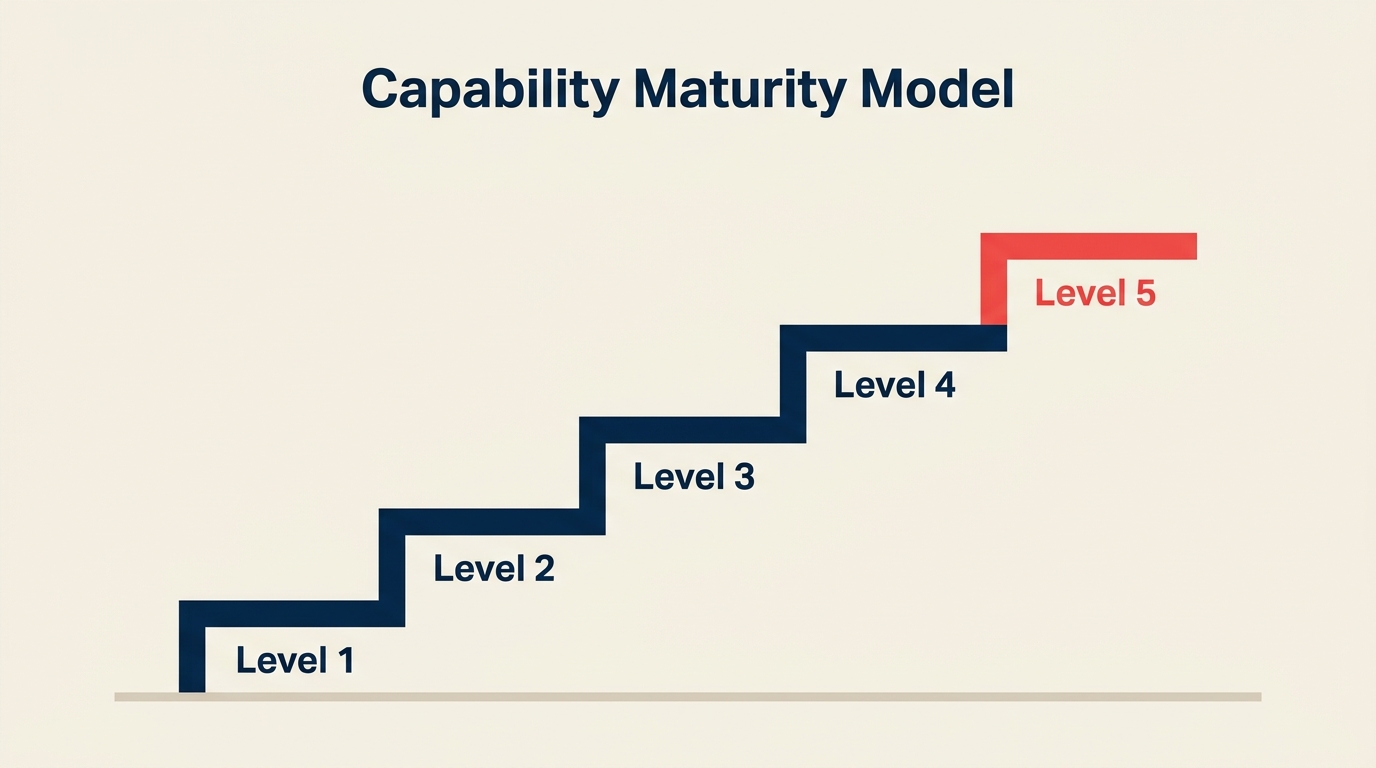
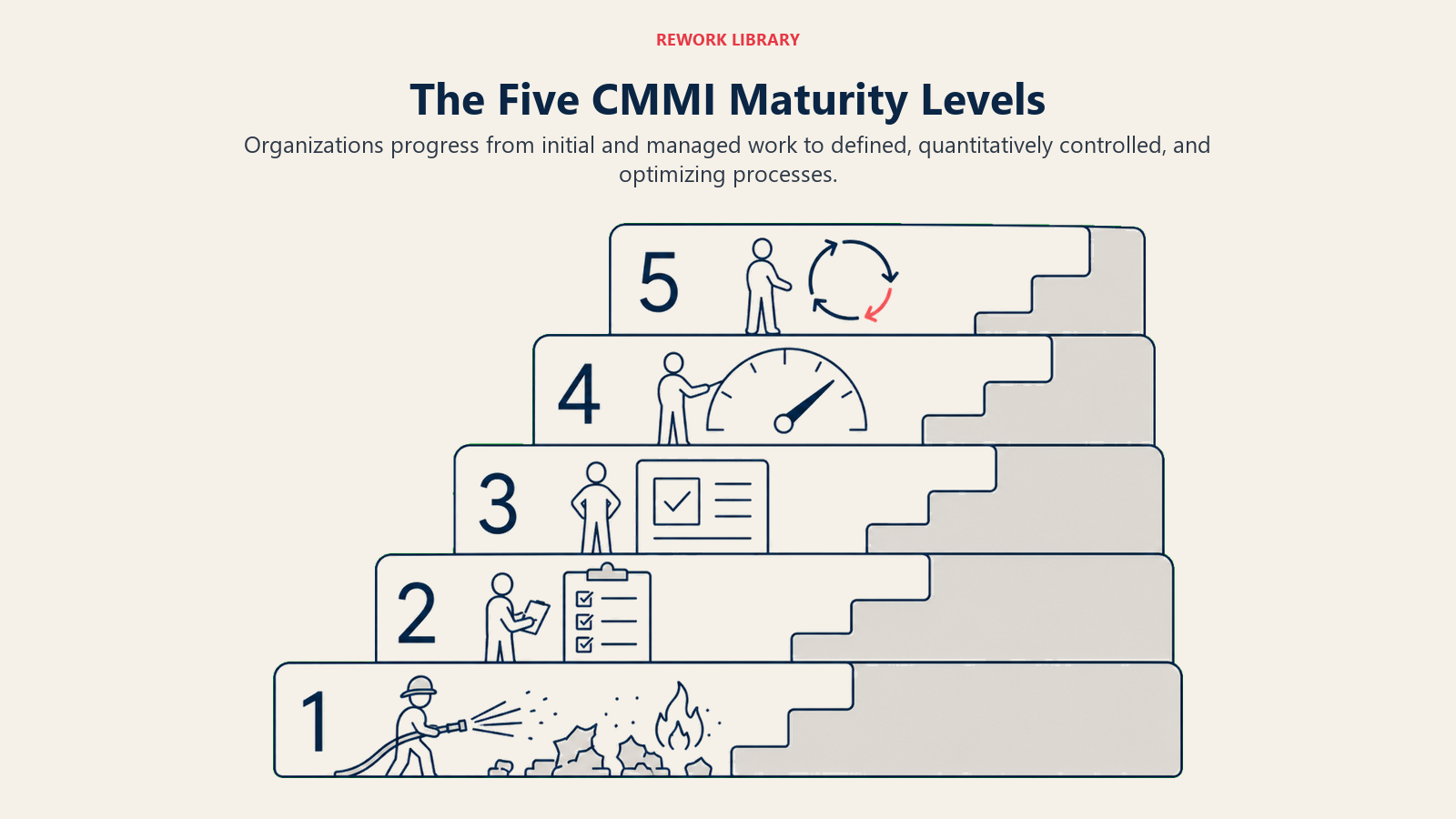
The capability maturity model groups organizational process capability into five numbered levels. Each level builds directly on the one below it, so you can't skip from Level 1 to Level 4 without doing the foundational work in between.
Level 1: Initial
At Level 1, processes are unpredictable and largely reactive. Work gets done because individuals figure it out, not because the organization has a reliable method. Success depends on who's in the room, not on how the room runs.
Projects at this level routinely exceed budgets and miss deadlines. When experienced people leave, their knowledge leaves with them. Documentation is thin or inconsistent. Crises are the norm, and firefighting is a full-time job.
Most new businesses start here. The problem isn't starting at Level 1. The problem is staying there after the team grows past a handful of people.
Level 2: Managed
At Level 2, basic project management practices are in place. Teams plan work, track status, and take corrective action when things go sideways. Requirements are managed, and work products get reviewed.
The key distinction: processes are managed at the project level, not the organization level. Each project team may operate slightly differently, but they're all working from recognizable plans rather than pure improvisation. Results become more predictable within individual projects.
Many growth-stage companies sit at Level 2. The processes work, but they're inconsistently applied, and scaling them requires significant coordination overhead.
Level 3: Defined
Level 3 is where the organization, not just individual project teams, owns the process. A standard set of processes gets documented, tailored for use across all projects, and actively maintained.
Teams no longer reinvent the wheel for each engagement. When a new person joins, they learn the organization's defined approach. Lessons learned from past projects feed back into the standard process library. This is where true scalability begins.
Moving from Level 2 to Level 3 is often the hardest step because it requires organizational will, not just project discipline. Someone has to own the standard process, train people in it, and resist the pressure to let every team do its own thing.
Level 4: Quantitatively Managed
At Level 4, management has moved from intuition to data. Organizations at this level collect quantitative data on process performance and use statistical methods to understand and control variation.
Teams set measurable quality and performance objectives. They can predict outcomes with reasonable confidence because they understand their processes well enough to model them. When something goes wrong, they know exactly which subprocess deviated and by how much.
This level demands investment in measurement infrastructure, a culture that treats data as useful rather than threatening, and enough process stability (from Level 3) to have meaningful baselines to measure against.
Level 5: Optimizing
Level 5 organizations don't wait for defects to surface. They proactively identify weaknesses in their processes and address them before problems appear. Continuous improvement is baked into how the work gets done, not bolted on as an annual initiative.
Innovation is systematic. When teams discover a better method, there's a clear path to testing it, validating the improvement through data, and rolling it into the standard process. The organization gets measurably better over time.
Very few organizations reach Level 5. Those that do tend to set industry benchmarks for quality and efficiency.
The five levels at a glance
| Level | Name | Key characteristics | Typical outcome |
|---|---|---|---|
| 1 | Initial | Unpredictable, reactive, hero-dependent | Frequent cost and schedule overruns |
| 2 | Managed | Project-level planning and tracking | More predictable results per project |
| 3 | Defined | Standard organizational processes | Scalable, consistent delivery |
| 4 | Quantitatively Managed | Statistical process control | Highly predictable outcomes |
| 5 | Optimizing | Continuous improvement, proactive innovation | Measurably improving performance over time |
CMM vs CMMI
The original CMM (Capability Maturity Model) was purpose-built for software development. It had five levels, was specific to software processes, and was widely adopted through the 1990s.
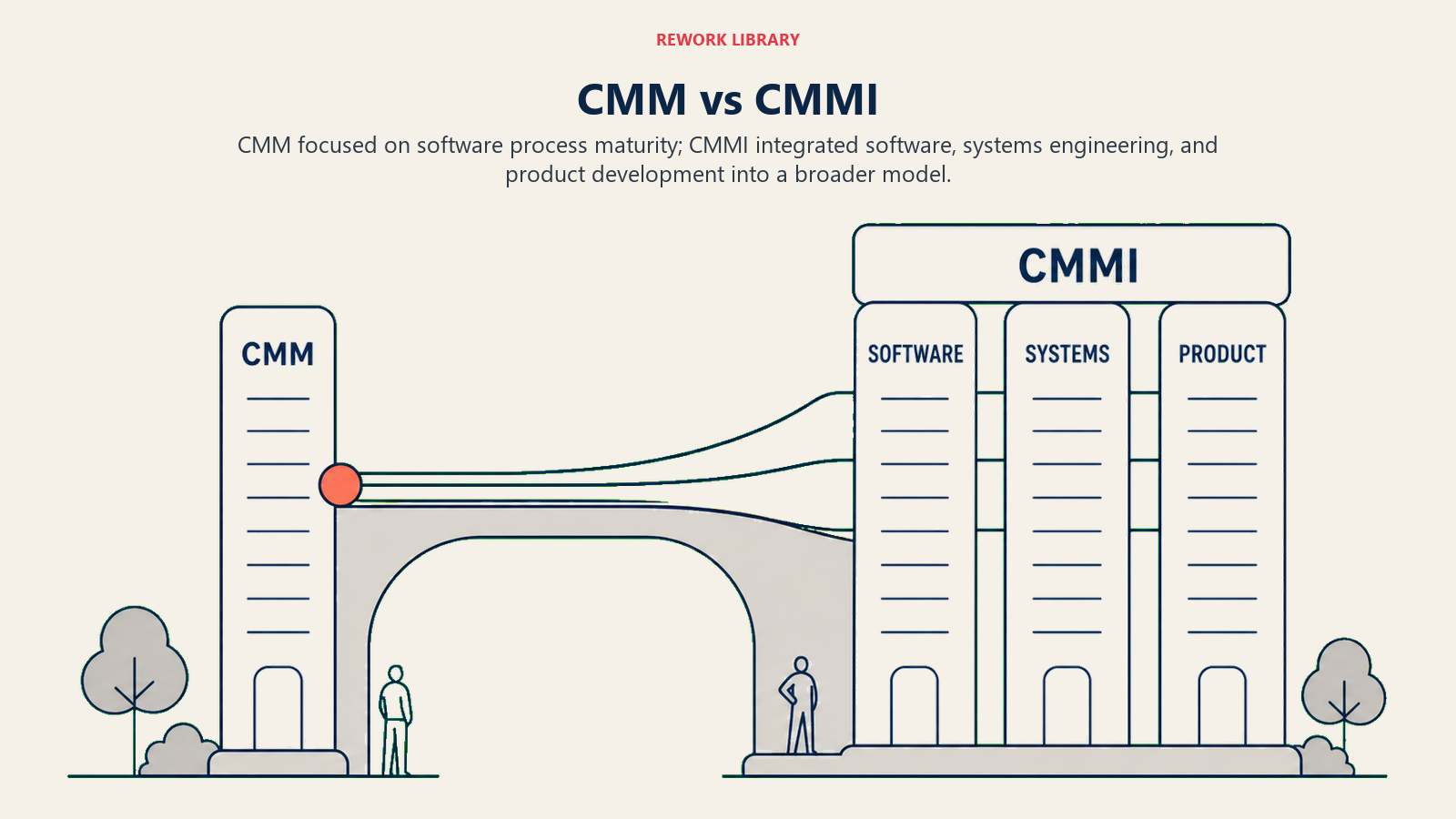
CMMI (Capability Maturity Model Integration) replaced it not by changing the concept but by broadening the scope. Three separate SEI models, covering software, systems engineering, and integrated product development, were merged into a single framework so organizations didn't have to maintain parallel appraisal programs.
The other significant difference is scope of application. CMM was for software teams. CMMI applies to any kind of product or service organization. The five-level structure is the same. The process areas within each level are broader and more comprehensive.
If you see someone reference "CMM level 3," they're probably using the original software-specific model or using the terms loosely. Current formal appraisals use CMMI and go through an authorized CMMI Institute appraisal method called SCAMPI.
Benefits of the Capability Maturity Model
Organizations pursue CMMI appraisals for concrete reasons, not just the certificate.
A common language for process quality. When every department measures maturity the same way, conversations about investment priorities get easier. You can compare "we're at Level 2 for onboarding" with "we're at Level 4 for software delivery" and know exactly what that gap means.
Improved predictability. Organizations that move from Level 1 to Level 3 see real reductions in project overruns. The causal mechanism is simple: defined processes reduce variation, and reduced variation makes outcomes more predictable.
Reduced dependency on key individuals. Level 1 organizations are fragile. Lose one expert and results drop. Defined, documented processes at Level 3 and above mean new team members can come up to speed faster and the organization isn't held hostage by institutional knowledge that lives only in people's heads.
Competitive differentiation for regulated or government work. Many government contracts, especially in defense and aerospace, require suppliers to demonstrate a minimum CMMI level. For organizations in those markets, moving from Level 2 to Level 3 opens doors that would otherwise stay closed.
A foundation for other improvement frameworks. CMMI coexists well with Six Sigma, ISO 9001, and Lean. It doesn't replace them. Think of CMMI as the scaffold and those methods as the specific tools you apply within that scaffold.
How to assess and improve process maturity
Moving up the maturity scale isn't automatic. It takes structured effort, and it always starts with an honest look at where you are today.
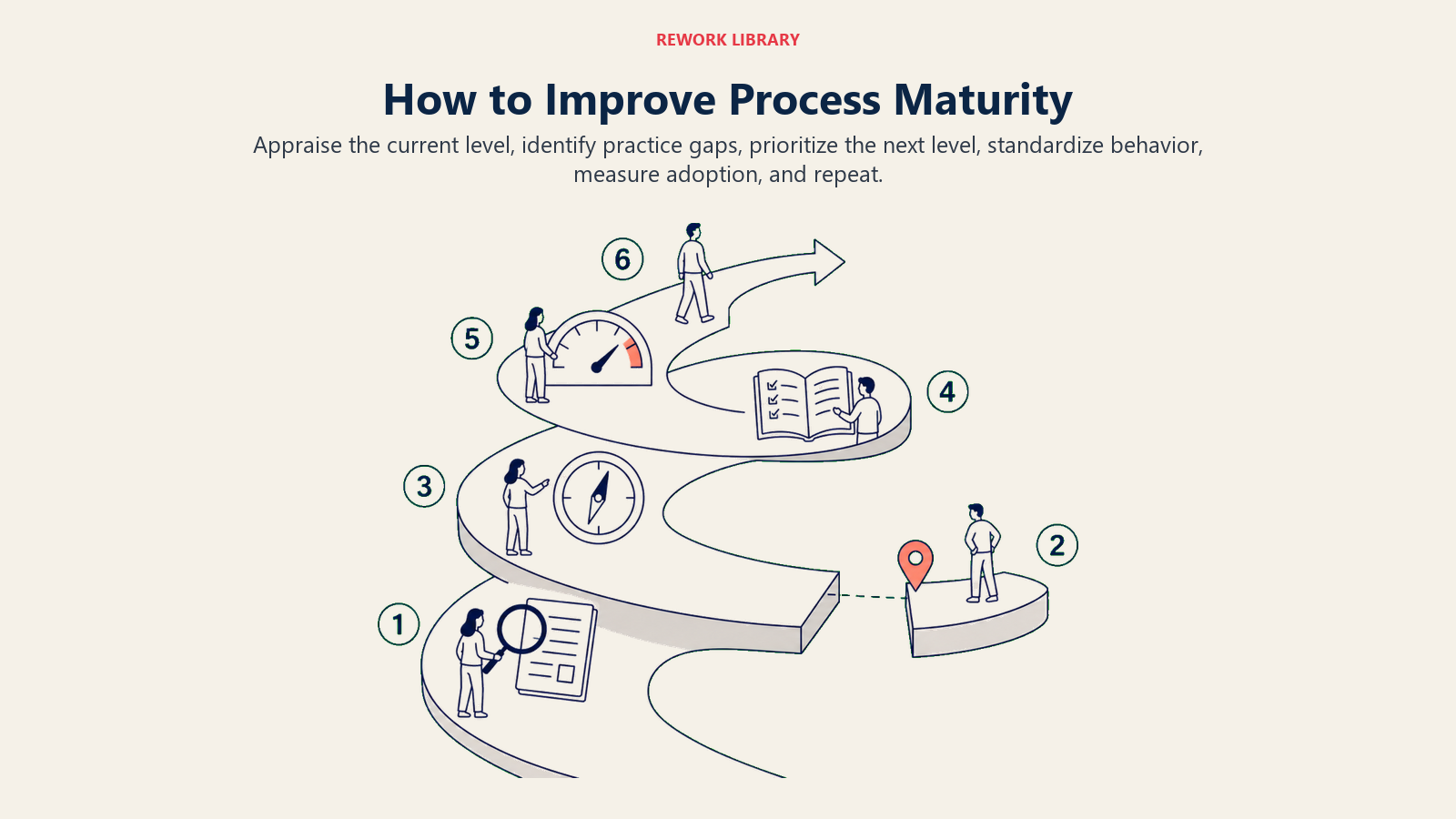
Appraise your current level. Use CMMI's official appraisal method (SCAMPI) for a formal rating, or run an internal gap analysis using the CMMI practice guides as a checklist. Either way, resist the urge to self-rate optimistically. An honest Level 2 is more useful than a wishful Level 3.
Identify the highest-priority gaps. Level 2 requires basic project management disciplines: planning, tracking, requirements management, configuration control, and process/product quality assurance. List which of those you're missing or inconsistently applying. That list is your near-term roadmap.
Standardize before you optimize. It's tempting to skip straight to metrics and improvement. Don't. You can't measure what isn't defined. Focus first on getting processes documented and consistently followed across projects. Standard operating procedures and process documentation are the workhorses of this stage.
Instrument your processes. Once processes are stable (Level 3), add measurement. Define the metrics that matter for each key process, set up collection mechanisms, and establish baselines. Process KPIs should tie directly to outcomes, not just activity.
Build continuous improvement into the process itself. At Level 4 and 5, improvement stops being a project and becomes a system. Kaizen events, retrospectives, and structured root-cause analysis feed improvements back into the standard process library. The organization gets smarter each cycle.
Capability Maturity Model examples
The model started in software but applies across functions and industries. Here's how the levels look in practice:
| Function | Level 1 behavior | Level 3 behavior | Level 5 behavior |
|---|---|---|---|
| Software delivery | Heroic pushes before every release, constant firefighting | Defined sprint process, code review standards, documented release procedures | Defect injection rates tracked statistically; process changes driven by predictive models |
| Customer onboarding | Each sales rep onboards clients differently | Standard onboarding playbook used across all reps, tracked in the CRM | Onboarding duration and early churn analyzed; playbook auto-updated based on outcome data |
| Finance close | Month-end is chaotic, timelines vary | Defined close checklist, clear ownership per task, consistent 5-day close | Close cycle time and error rate measured; process changes validated with statistical tests before rollout |
| Manufacturing | Production schedules built on guesswork | Business process management with defined workflows and quality checkpoints | Statistical process control on key metrics; predictive maintenance integrated into the workflow |
IT services firms working with government contracts are the most common CMMI adopters, but the framework shows up in aerospace, financial services, healthcare operations, and any sector where process consistency is a client requirement.
The long view on process maturity
Most organizations stall at Level 2. They've got the basics of project management down, but they haven't yet made the commitment to standardize across the whole organization. That gap between Level 2 and Level 3 is where most process improvement programs die, not because the concept is wrong but because the organizational will runs out.
The capability maturity model doesn't tell you the right answer. It tells you where to look, what to build, and how to measure whether you're making real progress. That's a framework worth understanding, whatever your industry or function.

Customer Success Operations Manager
On this page
- What is the Capability Maturity Model?
- The 5 maturity levels
- Level 1: Initial
- Level 2: Managed
- Level 3: Defined
- Level 4: Quantitatively Managed
- Level 5: Optimizing
- The five levels at a glance
- CMM vs CMMI
- Benefits of the Capability Maturity Model
- How to assess and improve process maturity
- Capability Maturity Model examples
- The long view on process maturity