Six Sigma: Principles, Belts, and DMAIC Explained
Turn this article into takeaways for your work.


Each assistant summarizes the article only for you and suggests best practices for your work.
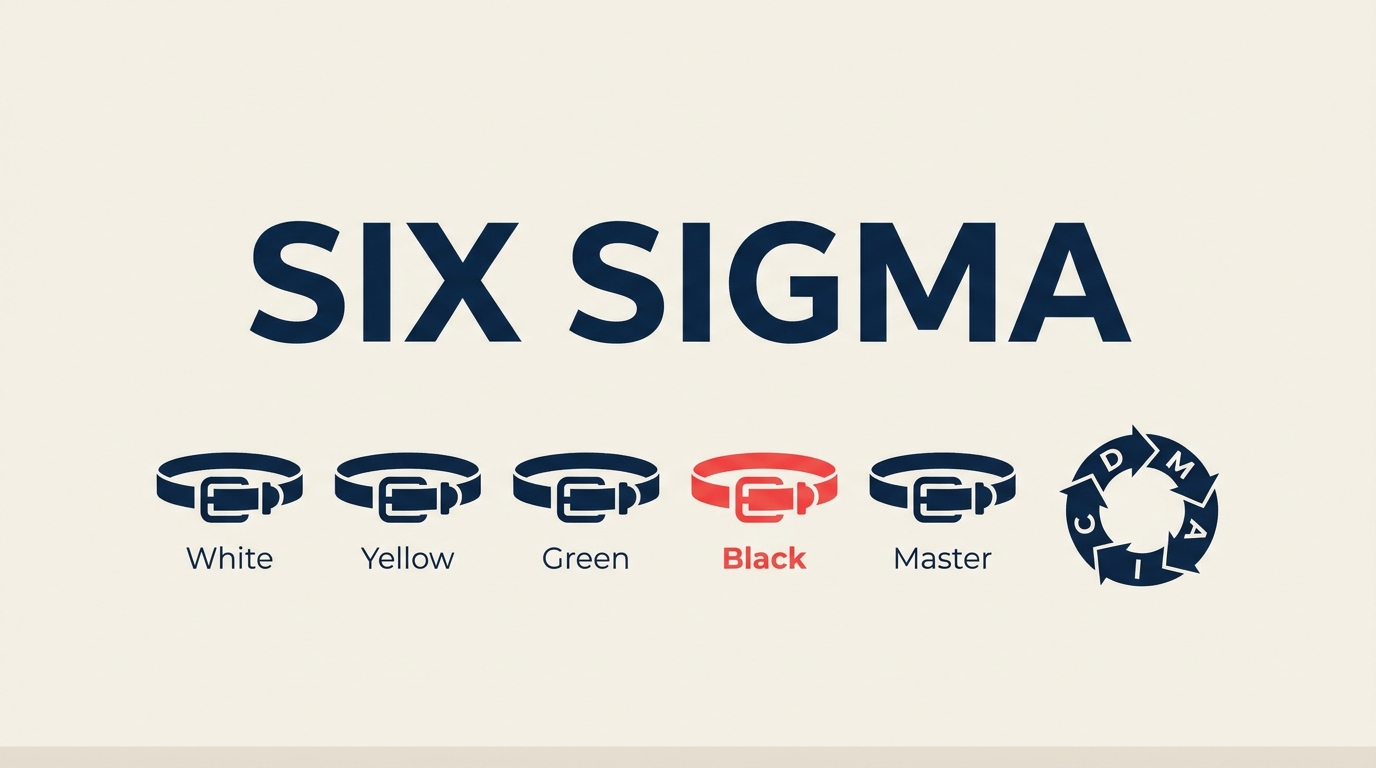
Six Sigma is the methodology that turned defect reduction into a science. When your team agrees on what "good enough" means at 3.4 defects per million opportunities, you stop guessing and start measuring.
What is Six Sigma?
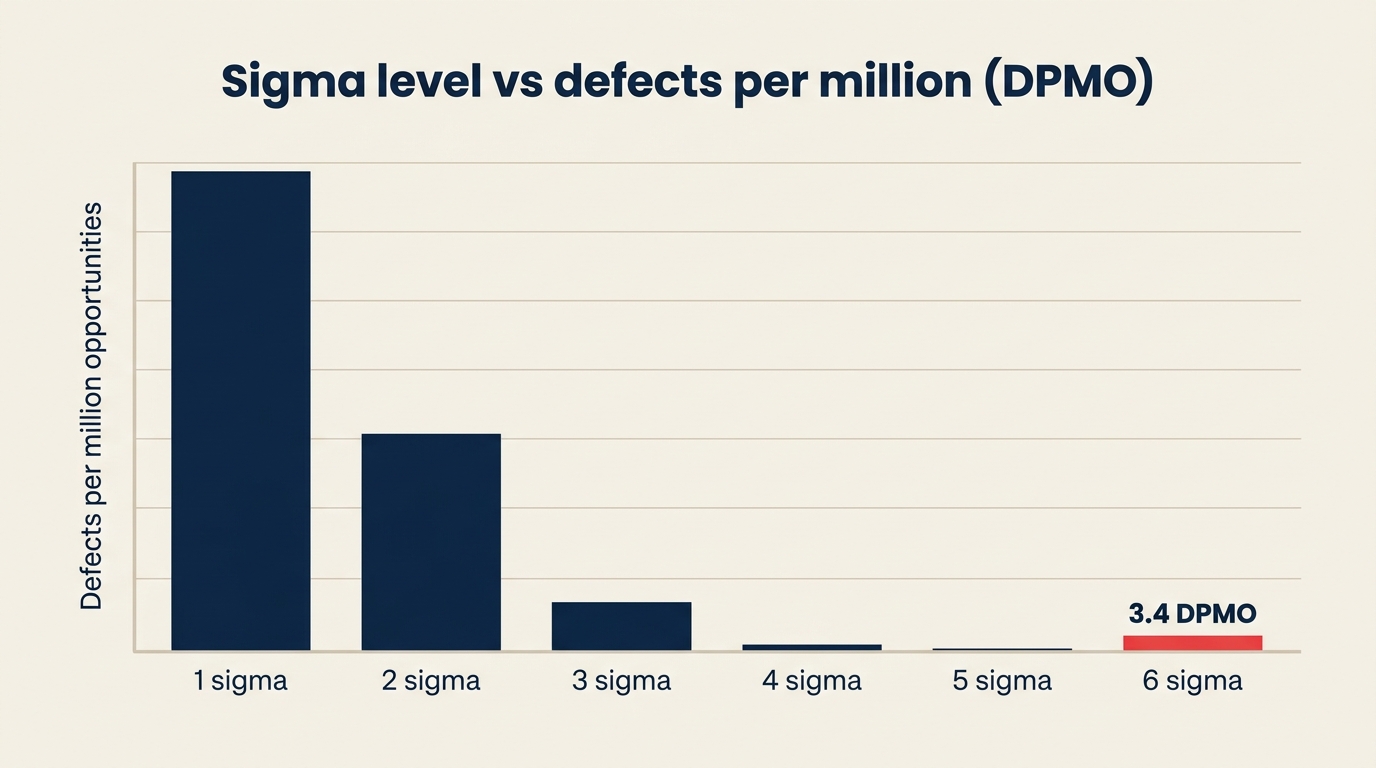
Six Sigma is a data-driven methodology for eliminating defects, targeting a quality level of 3.4 defects per million opportunities (DPMO). At six standard deviations (sigmas) from the mean, virtually every unit a process produces falls within specification.
Bill Smith, a reliability engineer at Motorola, formalized the method in 1986. Motorola used it to slash warranty costs and won the first Malcolm Baldrige National Quality Award in 1988. A decade later, Jack Welch made Six Sigma central to GE's operating system, embedding it across every business unit and reporting cumulative savings that cemented its reputation worldwide.
Key Facts
GE reported Six Sigma generated $10 billion in cumulative benefits in the program's first five years (GE Annual Report, 1999).
Motorola, the originator, has cited over $17 billion in documented Six Sigma savings since 1986 (Motorola, internal disclosure).
A 2024 LNS Research benchmark found that 70% of Fortune 500 companies have used Six Sigma or Lean Six Sigma at some point in their operations.
The 5 core principles of Six Sigma
Six Sigma combines customer value, measurement, analysis, control, and team discipline.
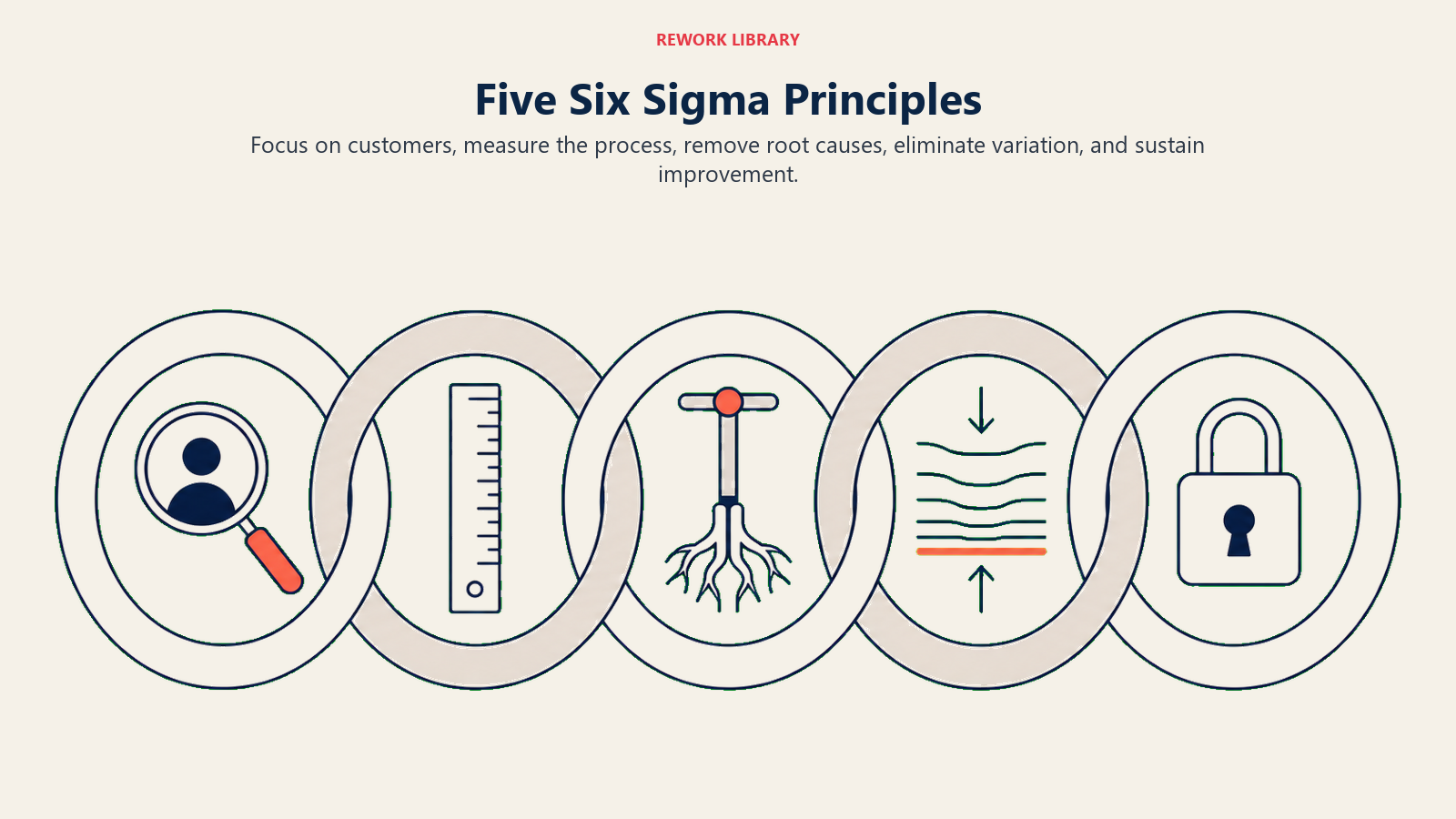
Focus on the customer. Every project starts by defining what the customer values and what failure looks like from their perspective. Quality is not an internal rating; it's a customer judgment. Teams that skip this step optimize for metrics nobody outside the building cares about.
Let data, not opinion, drive decisions. Gut feel is a starting point, not a conclusion. Six Sigma requires baseline measurements, statistical tests, and documented evidence before any change moves to implementation. If the data is inconclusive, the team collects more.
Target the process, not the person. When defects appear, the instinct is to blame the employee who made them. Six Sigma shifts that question: what does the process allow or encourage that produces this outcome? Fixing the system is permanent. Retraining individuals is not.
Manage proactively. Reactive quality teams fix problems after customers complain. Six Sigma teams monitor leading indicators, set action triggers, and intervene before variation becomes a defect. Control charts, run rules, and statistical process control (SPC) are the tools that make this possible.
Collaborate across functions. Defects rarely live inside a single department. A billing error may originate in sales, surface in finance, and damage the customer relationship in account management. Six Sigma projects pull cross-functional teams together with a shared charter and shared accountability.
Six Sigma belts: who does what
| Belt | Role | Training hours (approx.) | Typical projects |
|---|---|---|---|
| White Belt | Basic awareness; supports local improvement efforts | 4-8 | Department-level process tracking |
| Yellow Belt | Team member on DMAIC projects; collects data | 16-40 | Data collection, meeting facilitation |
| Green Belt | Part-time project leader; runs smaller DMAIC projects | 80-120 | Single-process improvements, cycle time reduction |
| Black Belt | Full-time project leader; statistical expert | 160-200 | Complex cross-functional projects, $100K-$500K impact |
| Master Black Belt | Coach and trainer; sets methodology standards | 200+ hours + years of practice | Program governance, training pipeline, culture change |
| Champion | Executive sponsor; removes organizational barriers | No fixed hours | Selects projects, secures resources, reviews progress |
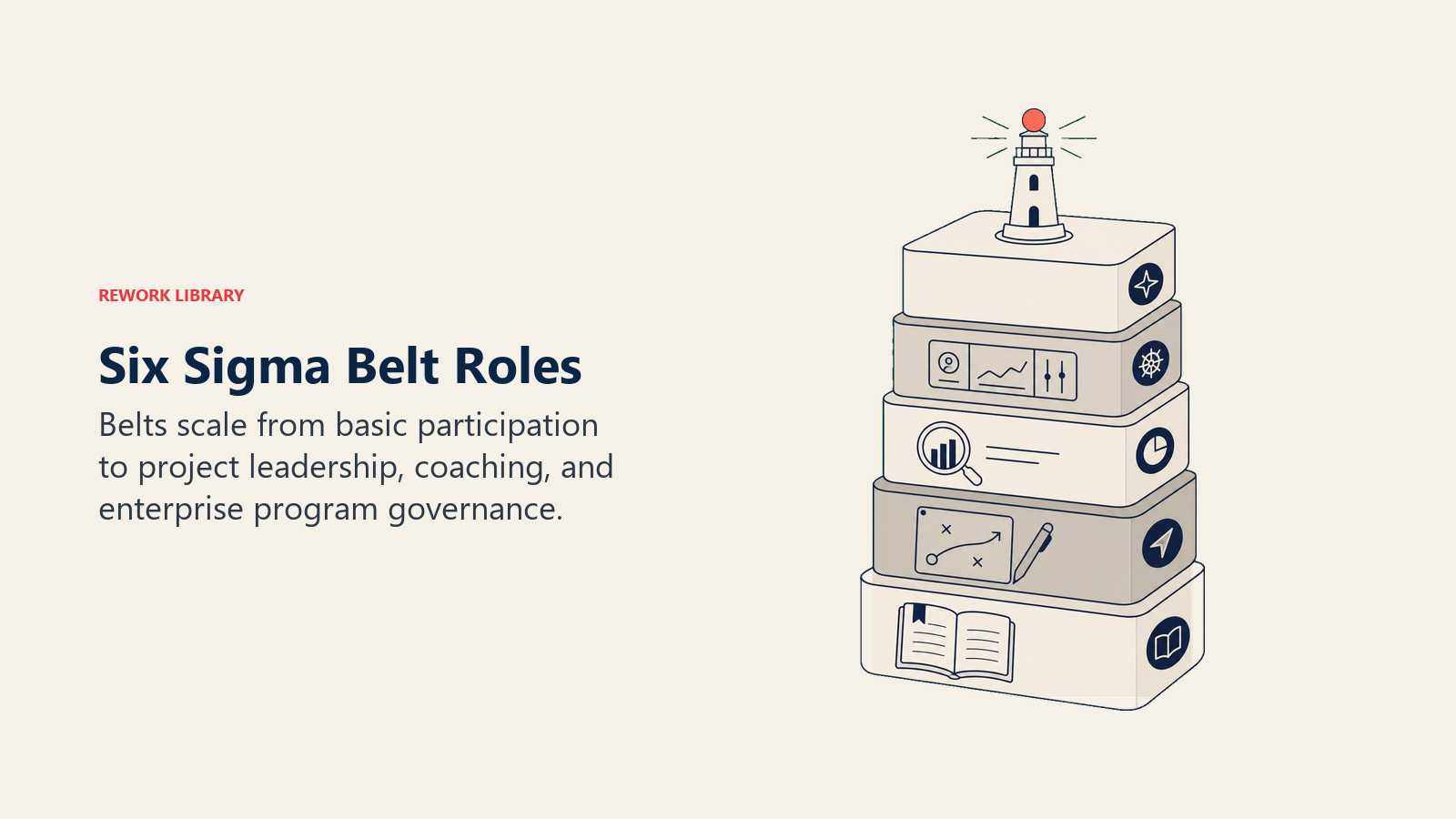
In practice, Green Belts do the bulk of the day-to-day project work. Black Belts typically lead three to five projects per year, each with a defined financial target. Master Black Belts sit above the project level and focus on building the organization's capability over time.
DMAIC vs DMADV: when to use each
| Dimension | DMAIC | DMADV |
|---|---|---|
| Use when | A process exists and needs improvement | A new process or product needs to be designed |
| Goal | Reduce variation and defects in current state | Design for Six Sigma quality from the start |
| Phases | Define, Measure, Analyze, Improve, Control | Define, Measure, Analyze, Design, Verify |
| Common projects | Order fulfillment, call center errors, scrap rate | New product launch, software feature, service rollout |
DMAIC is far more common because most organizations are improving existing processes, not building new ones from scratch. You reach for DMADV when the current process is so broken that redesign is cheaper than repair, or when you're introducing something entirely new and want to bake quality in before launch.
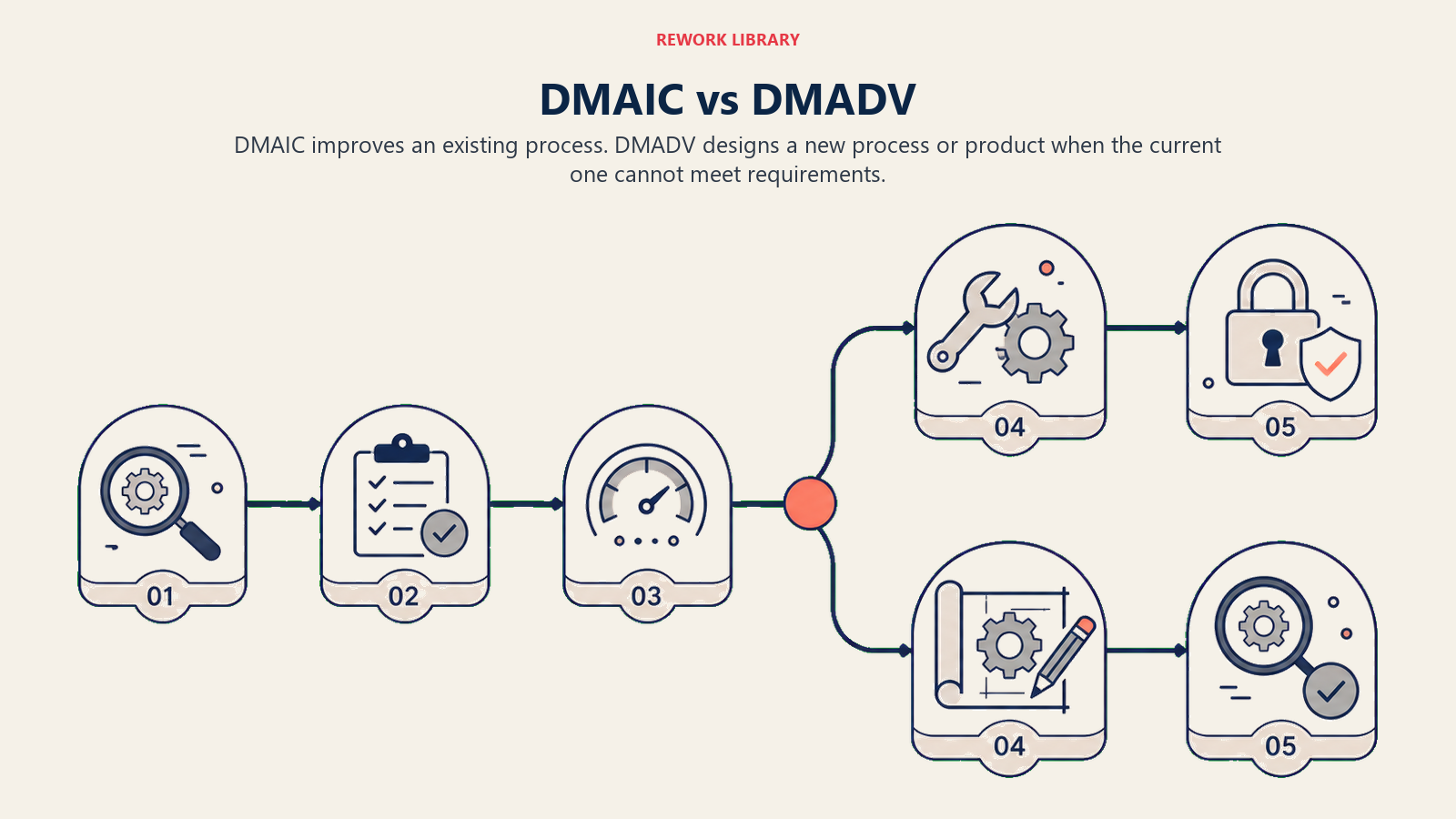
Both frameworks share the first three phases. The divergence happens at phase four, where DMAIC asks "how do we improve what's there?" and DMADV asks "how do we design what should be there?"
How to run a DMAIC project in 5 phases
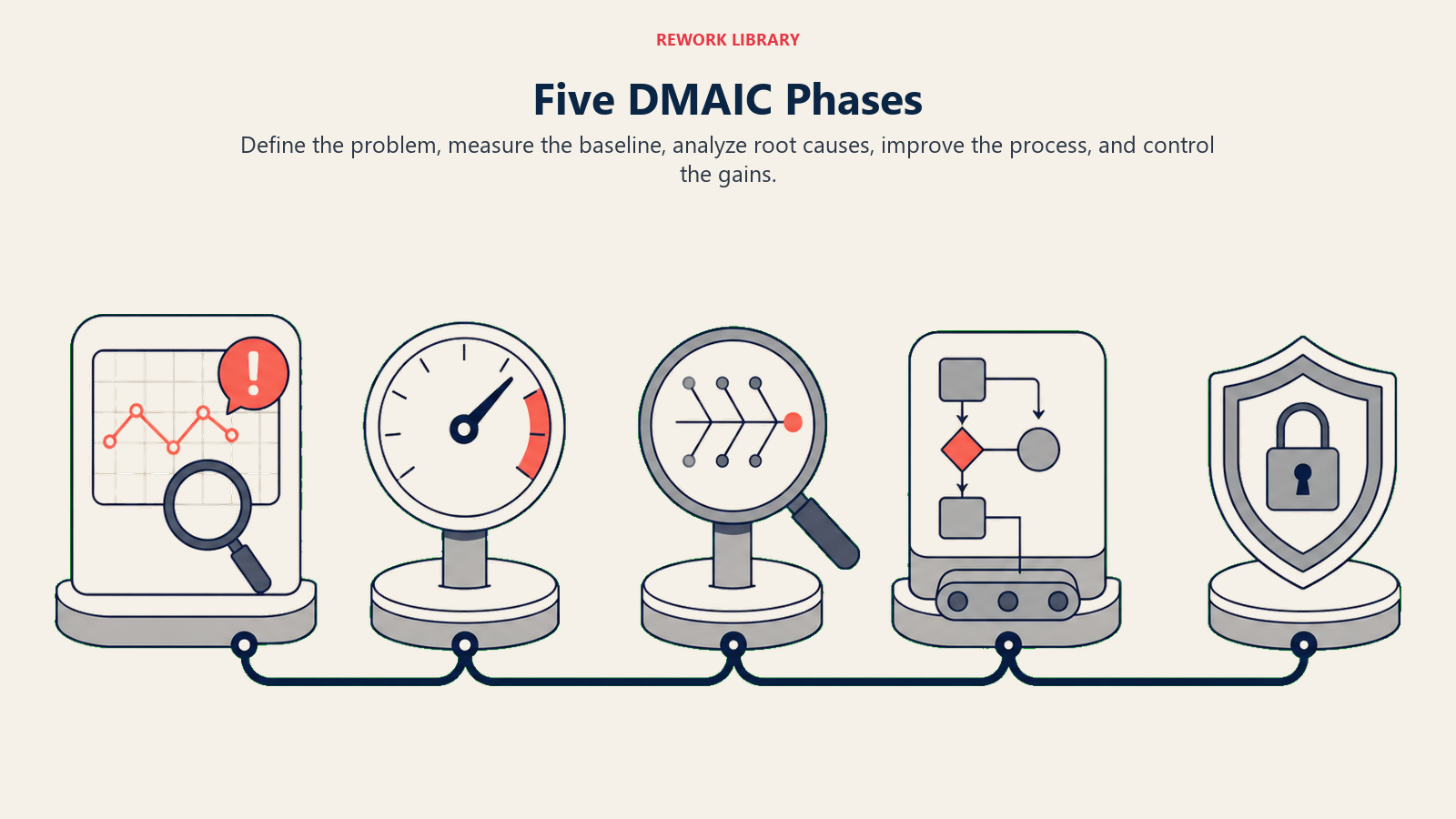
Define
State the problem in measurable terms and get stakeholder alignment before touching any data. A vague problem statement ("quality is bad") produces a vague project. A sharp one ("customer return rate for product line X is 4.2%, versus our target of 1.5%, costing $320K/year") gives the team a finish line.
Deliverables:
- Project charter with scope, timeline, and financial target
- SIPOC map (Suppliers, Inputs, Process, Outputs, Customers)
- Voice of the Customer (VOC) summary with critical-to-quality (CTQ) requirements
Measure
Establish a reliable baseline. You need to know exactly how bad the current process is before you can claim improvement. This phase also validates the measurement system itself.
Deliverables:
- Baseline DPMO and sigma level for the process
- Measurement System Analysis (MSA / Gauge R&R) confirming data reliability
- Data collection plan with sample sizes and collection frequency
Analyze
Find the root causes of variation and defects. This is the most data-intensive phase. The team uses statistical and visual tools to move from "here are symptoms" to "here is the verified root cause."
Deliverables:
- Fishbone (Ishikawa) diagram mapping potential causes
- Hypothesis tests confirming which factors are statistically significant
- Prioritized list of root causes with supporting evidence
Improve
Design, test, and implement solutions that directly address the confirmed root causes. Pilot before you scale. Document everything so the fix is repeatable.
Deliverables:
- Solution options evaluated by cost, impact, and feasibility
- Pilot results with before/after comparison
- Updated SOPs and work instructions for the new process
Control
Lock in the gains. A process management team that improves a process and then walks away will watch it drift back to the old state within months. Control plans and monitoring systems prevent that.
Deliverables:
- Control chart with defined control limits and response rules
- Control plan specifying what to monitor, how often, and who acts when limits are breached
- Handoff documentation transferring ownership from the project team to the process owner
Core Six Sigma tools
| Tool | Phase | Purpose |
|---|---|---|
| SIPOC | Define | Maps the process at a high level: Suppliers, Inputs, Process steps, Outputs, Customers |
| Voice of Customer (VOC) | Define | Translates customer feedback into measurable quality requirements (CTQs) |
| Fishbone diagram | Analyze | Visual cause-and-effect map grouping potential root causes by category |
| Control charts | Measure / Control | Time-series plot with statistical control limits to distinguish normal variation from signals |
| FMEA | Improve | Failure Mode and Effects Analysis: scores risk (severity x occurrence x detectability) to prioritize fixes |
| Hypothesis tests | Analyze | t-tests, ANOVA, chi-square, confirm whether observed differences are statistically real |
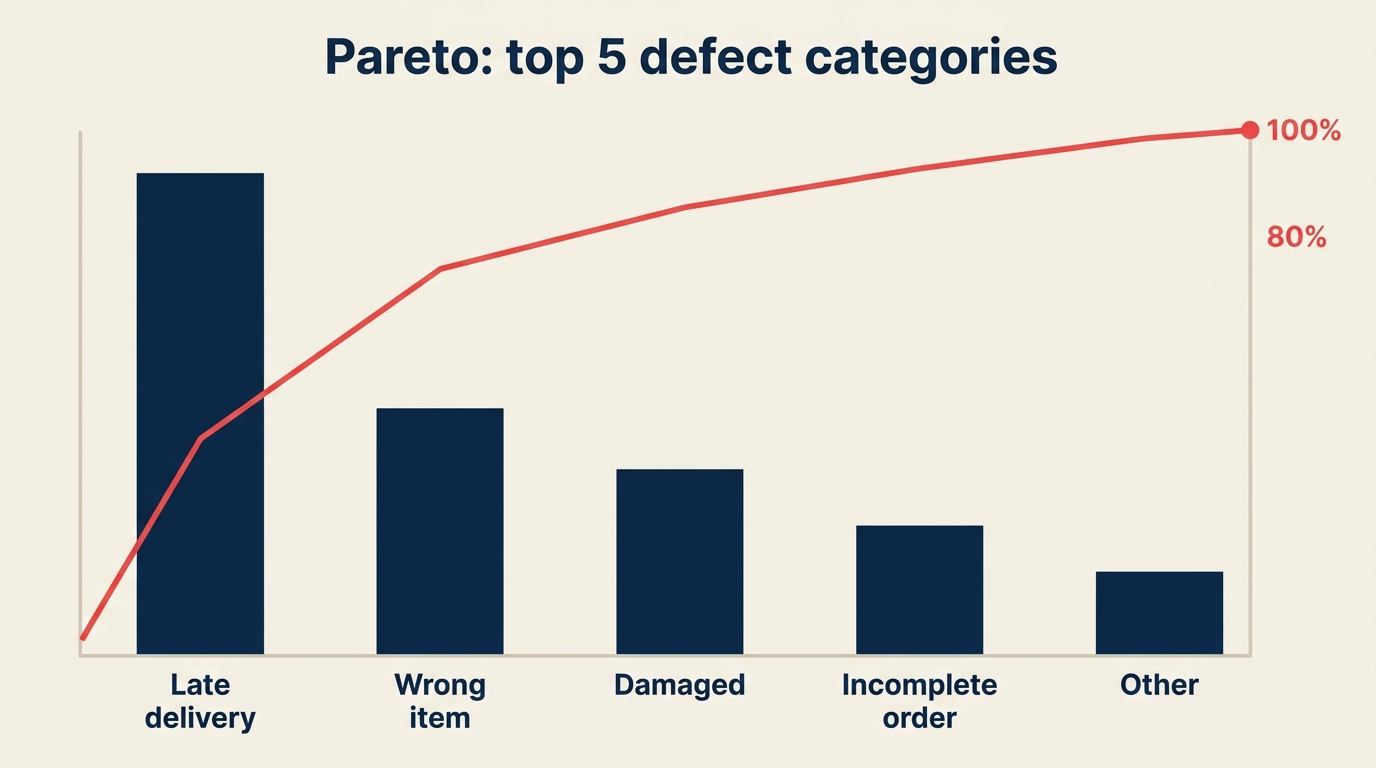
| Pareto chart | Analyze | Bar chart sorted by frequency; shows which few causes drive most of the defects (80/20) |
| Regression analysis | Analyze | Quantifies the relationship between input variables and output quality; identifies key drivers |
Six Sigma examples by industry
| Industry | Problem | Defect rate before | Improvement | Defect rate after | Estimated savings |
|---|---|---|---|---|---|
| Manufacturing | Welding defects on automotive chassis | 8,200 DPMO (3.9 sigma) | Redesigned fixture jigs; added in-line vision inspection | 410 DPMO (4.7 sigma) | $2.1M/year in scrap and rework |
| Healthcare | Medication dispensing errors in ICU | 4,500 errors/million doses | Barcode scanning at bedside; updated pharmacist workflow | 310 errors/million doses | Avoided estimated $1.8M in adverse-event liability |
| SaaS support | Ticket misrouting rate (wrong team receives ticket) | 11% of inbound tickets | Triage classifier retrained; routing logic rebuilt with data from 90-day audit | 1.8% of inbound tickets | 900 hours/year of agent rework time recovered |
These numbers are representative of documented industry outcomes, not hypothetical. The pattern across all three: measure first, find root cause, change the system, then re-measure.
Lean vs Six Sigma vs Lean Six Sigma
| Framework | Primary focus | Core question | Typical tools |
|---|---|---|---|
| Lean | Speed and waste elimination | Where does time get wasted? | Value stream maps, 5S, kanban, Kaizen |
| Six Sigma | Defect and variation reduction | Where does quality fail? | DMAIC, control charts, hypothesis tests, FMEA |
| Lean Six Sigma | Both | Where do we waste time and produce defects? | Combined toolset from both |
Lean and Six Sigma are complementary, not competing. Lean speeds the process up; Six Sigma makes it more accurate. Lean Six Sigma applies both lenses simultaneously, which is why most large organizations today run a combined program rather than choosing one. It pairs well with BPM frameworks and structured approaches like the PDCA cycle.
Benefits and limitations
What Six Sigma does well:
- Creates a common language for quality across departments and geographies
- Forces root-cause rigor, so fixes address causes, not symptoms
- Produces documented, auditable results with financial value attached
- Builds internal capability through the belt system, so expertise stays in-house
- Works at any scale, from a five-person operations team to a 50,000-person enterprise
Where teams run into friction:
- Heavy documentation and statistical analysis slow down projects; not suited for fast-cycle experiments
- Risk of "project theater" where teams complete the paperwork without actually changing the process
- Can feel top-heavy for small organizations without dedicated Black Belt resources
- Less effective when the problem is poorly defined or the data is unreliable
- Works best for repetitive, measurable processes; harder to apply to creative or knowledge work
Pairing Six Sigma with Lean principles and a healthy process maturity model addresses most of these gaps.

Customer Success Operations Manager
On this page
- What is Six Sigma?
- Key Facts
- The 5 core principles of Six Sigma
- Six Sigma belts: who does what
- DMAIC vs DMADV: when to use each
- How to run a DMAIC project in 5 phases
- Define
- Measure
- Analyze
- Improve
- Control
- Core Six Sigma tools
- Six Sigma examples by industry
- Lean vs Six Sigma vs Lean Six Sigma
- Benefits and limitations