Field Reporting and Demo Tracking: How Agri-Input Companies Turn Field Data Into Commercial Decisions
Turn this article into takeaways for your work.


Each assistant summarizes the article only for you and suggests best practices for your work.
The field reporting paradox sits at the center of most agri-input commercial operations: the companies that demand the most reports get the least reliable data. When reps spend ninety minutes at the end of a long day filling out call logs from memory, the data they enter is reconstructed, rounded, and occasionally invented. Managers get spreadsheets that look complete and mean very little. The fix isn't stricter enforcement, and it isn't more fields on the form. It's designing reporting systems that cost reps almost nothing to complete and give them something useful in return.
What Agri-Input Field Reporting Must Capture
Before designing a reporting system, get clear on what data actually changes decisions. There are four categories worth capturing, and one table helps teams audit whether their current forms are hitting the minimum standard or the gold standard. Once those categories are clear, the design question shifts: how do you capture them without the form itself becoming a burden?
Daily call reports record the basic rhythm of field activity: dealer visits, farmer contacts, activities completed. A rep working a district in Punjab needs to log which distributors she visited, how many farmers she spoke with at demonstration events, and what conversations happened. This data feeds territory coverage analysis and, when aggregated, feeds the territory analytics and dashboards that managers use to spot coverage gaps before the season ends.
Demo plot registration needs to happen at the point of establishment. That means capturing the crop and variety being trialed (corn hybrid, cotton variety, wheat cultivar), the inputs applied and rates, the GPS coordinates of the plot, and the farmer's name and contact details. A soybean trial in Iowa and a wheat trial outside Ludhiana both need the same core registration fields. Without GPS, you can't find the plot at harvest. Without input rates, you can't explain yield differences. Precision agriculture research confirms that spatial and temporal data capture at the plot level (exactly what structured demo registration provides) is what makes field trial evidence actionable rather than anecdotal.
Demo outcome capture closes the loop. Emergence observations at the two-week mark, crop stand assessments at mid-season, and yield comparisons against the farmer's control plot at harvest: each stage adds a layer of evidence that either confirms the product's performance claim or signals a problem worth investigating.
Market intelligence is the category that gets dropped first when forms are too long. But it's often the most commercially valuable. Competitor price levels observed in the market, new product introductions a competitor rep is pushing, complaints about product performance from farmers: this information, when aggregated, informs both sales response and product development. Make it easy to capture with a dropdown or a voice note. Don't make it a three-paragraph text box. A peer-reviewed study of agro-input dealers in Uganda found that knowledge gaps (dealers unable to identify active ingredients in their own bestselling products) are systemic. Field reporting that captures what dealers and farmers actually ask about is one of the few ways to surface these gaps before they damage brand credibility.
Call Report Field Audit
| Field | Minimum Standard | Gold Standard | What it enables |
|---|---|---|---|
| Dealer/farmer name | Name and village | Name, village, contact number | Follow-up scheduling, relationship history |
| Visit purpose | Category (visit type) | Specific objective and outcome | Activity effectiveness analysis |
| Products discussed | Product names | Product names + quantities discussed | Demand signal tracking |
| Competitor activity | Yes/No observed | Competitor product name + price observed | Competitive intelligence aggregation |
| Demo plot status | Registered/Not registered | Plot GPS, input rates, crop stage | Outcome tracking, field verification |
| Next action | Free text | Specific date and action committed | Pipeline hygiene, follow-up compliance |
Key Facts: Field Reporting and Demo Tracking
- Sales reps across industries spend only 28% of their working week on active selling, with the rest consumed by administrative tasks including reporting, per Salesforce's State of Sales research. Field reporting systems that reduce this burden even marginally translate directly into additional dealer visits during compressed selling windows.
- Structured demonstration plots increase the probability that smallholder farmers purchase improved agricultural inputs by 13 to 17 percentage points, according to a peer-reviewed study in PLOS ONE (Sseguya et al., 2021, Tanzania). Demo tracking workflows that capture outcome data at harvest are what make this lift visible rather than anecdotal.
- As a rough operational benchmark, agri-input companies using mobile-first, offline-capable field reporting tools typically see substantially higher rep adoption than those relying on desktop or web-based systems that require connectivity at point of entry. The exact gap varies by market and field force literacy, but the pattern is consistent across India, Southeast Asia, and sub-Saharan Africa based on practitioner experience.
Design Principles for High-Adoption Reporting
The reps who resist reporting aren't lazy. They're rational. When the reporting system is slow, confusing, or disconnected from anything that helps them do their job better, they find ways to minimize the time they spend on it. The data quality degrades. Managers chase compliance instead of outcomes. The whole system becomes a tax on field activity rather than an asset for it.
Three-tap call reporting means that the most common log entry, a standard dealer visit or farmer contact, takes no more than a handful of taps on a phone screen. Date auto-populates. Location auto-fills from GPS. The rep selects a contact from their existing list, picks the activity type from a short menu, and adds a voice note if there's anything worth flagging. That's it. If the form takes longer than ninety seconds for a routine visit, adoption will be below sixty percent regardless of management pressure.
Voice-to-text notes matter in field contexts where literacy levels vary or where typing on a phone is impractical. A rep standing at the edge of a cotton field in Maharashtra shouldn't have to type a detailed observation report. She should be able to speak it. Modern mobile CRM tools handle voice-to-text in local languages well enough to make this a practical standard, not an edge-case feature.
Offline-first architecture is non-negotiable in most agri-input geographies. Connectivity in rural Punjab, interior Iowa, or the Cerrado of Brazil is inconsistent. If a field app requires a live connection to save a report, reps will batch their entries in a parking lot with WiFi at the end of the day. Accuracy drops and timestamps become fiction. Offline-first means the app stores everything locally and syncs when connectivity returns. The rep never notices the difference.
Immediate rep-facing value is what separates systems that last from systems that get abandoned after the first season. If reporting data only flows upward to managers, reps have no incentive to make it accurate. But if the app shows a rep her own call count for the week, her demo plot conversion rate from last season, or the districts in her territory she hasn't covered yet, she has a reason to care about data quality. The data serves her, not just the organization.
Designed for the field looks like: auto-populated date and location, five-option dropdown for visit type, voice note for observations, one-tap submit. Designed for the boardroom looks like: seventeen required fields, a free-text box labeled "Describe all activities," a dropdown with forty-three options, and a submit button that only works when connected to company WiFi. The demo plot tracking workflow deserves the same design discipline, because it carries even more commercial weight than a routine call report.
The Demo Plot Tracking Workflow
Demo programs are the highest-investment field activity in most agri-input commercial operations. A company running three thousand demo plots across a season in Maharashtra, Rajasthan, and Punjab is spending significant budget on inputs, establishment support, and rep time. Without structured tracking, the investment produces anecdotes. With it, it produces evidence.
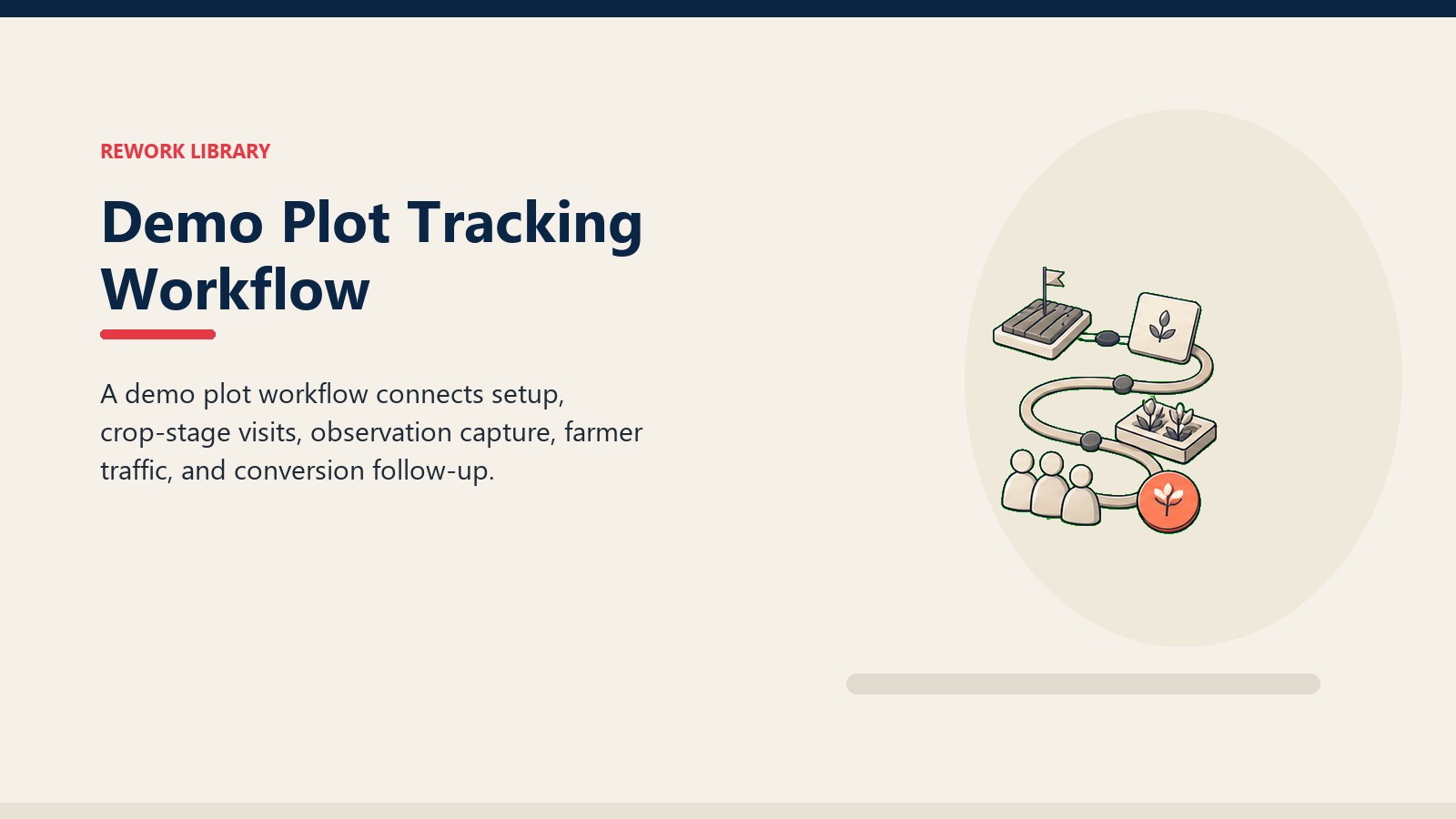
Demo Tracking Workflow
| Stage | What's captured | Who enters | Timeline | Output |
|---|---|---|---|---|
| Plot registration at establishment | Crop, variety, inputs applied, plot GPS coordinates, farmer name and contact, control treatment details, plot photo | Rep at plot establishment | Day of establishment | Registered plot in system, GPS-linked record |
| Mid-season check-in | Crop stage observation, visual stand comparison vs. control, any stress or pest issues noted, photo | Rep or agronomist | 45-60 days post-establishment (crop-dependent) | Updated plot health record, early flag for at-risk plots |
| Harvest outcome entry | Yield data (kg/acre or bushels/acre), farmer's subjective assessment, yield vs. control estimate, farmer willingness to purchase flag | Rep with farmer at or after harvest | At harvest or within two weeks post-harvest | Completed trial record with yield outcome |
| Automated conversion flag | System identifies plots where yield advantage achieved threshold, triggers follow-up task for rep | System-generated | Post-harvest data entry | Prioritized follow-up list, conversion opportunity queue |
The conversion flag at the final stage is what makes the tracking workflow commercial rather than just scientific. When a corn hybrid trial in Iowa shows a fifteen-bushel-per-acre yield advantage and the farmer has signaled interest, the rep shouldn't have to manually track that. The system should surface it as a conversion priority. This is the connection point to demo plot management and conversion: structured data makes structured follow-up possible.
Quotable Nugget: Demo plots increase the probability of improved agricultural input purchases by 13 to 17 percentage points in peer-reviewed research from Tanzania (Sseguya et al., PLOS ONE, 2021). Agri-input companies running demo programs without structured harvest outcome capture are investing in farmer relationships without measuring the commercial return, which makes program scaling decisions essentially blind.
Manager Review Cadence
Good field data without a review cadence is a library no one visits. Managers need a rhythm for engaging with field reports that matches the pace of the business and the urgency of the decisions being made.
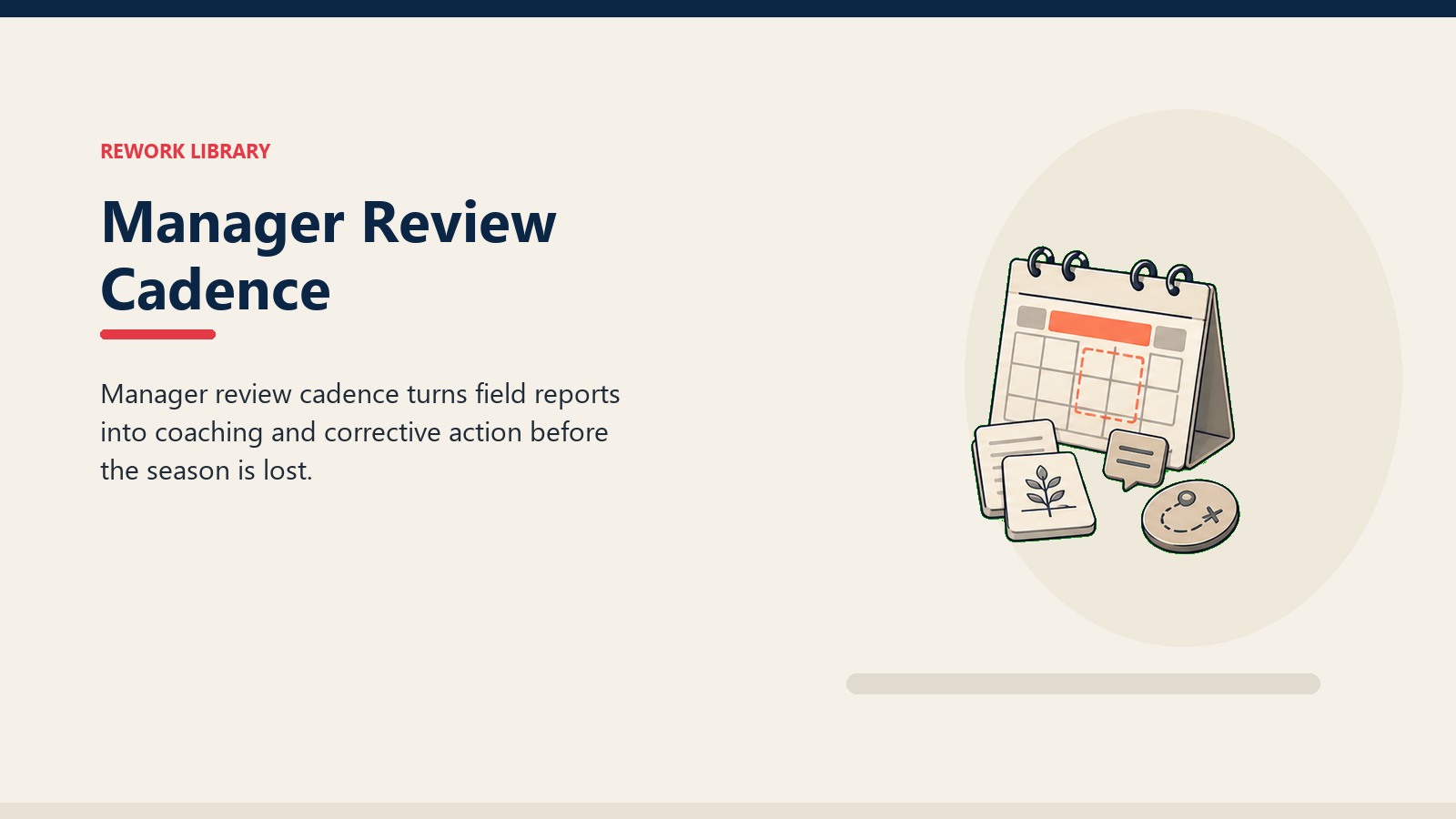
Manager Review Cadence
| Cadence | Audience | Key questions | Data reviewed | Action output |
|---|---|---|---|---|
| Daily exception review | District manager | Who missed their call target? Which demo plots are overdue for an update? | Call log completion rate, overdue plot registrations | Coaching conversations, compliance follow-up |
| Weekly territory review | District and regional managers | Is coverage tracking against the seasonal plan? Which demo plots are underperforming? | Coverage heat map, demo plot health scores, call activity by dealer tier | Territory reallocation, agronomist deployment to at-risk plots |
| Monthly business review | Commercial directors and heads of sales | Is field activity converting to outcomes? Where is our data quality strong enough to trust? | Activity-to-outcome correlation, data completeness by region, demo conversion rates by crop and territory | Product messaging adjustments, territory redesign inputs, season campaign recalibration |
The daily review isn't about micromanagement. It's about catching compliance gaps before they compound into a month of missing data. A missed demo plot check-in in week four is recoverable. A missed demo plot check-in in weeks four through twelve means you arrive at harvest with no mid-season record and a yield number you can't contextualize.
From Field Data to Commercial Decisions
Field data that doesn't change decisions is just overhead. The organizations that build durable field reporting systems are the ones that close the loop: data collected in the field shapes what happens next at the commercial level.
Demo yield data feeds product messaging. When your corn hybrid trials in Iowa show consistent fifteen-to-twenty bushel advantages over the local check variety across three seasons, that's a number worth putting in front of agronomists and dealers. FAO's Crop Calendar tool documents the seasonal windows (planting to harvest) within which trial outcomes must be captured to be commercially useful. Demo programs that miss those windows lose a full season of evidence. It's also a number that should inform how your season campaign is positioned. The season campaign planning process should pull from demo outcome data, not just from product registration claims.
Call pattern data informs territory redesign. If your field reports show that reps in a Maharashtra district are making ninety percent of their calls to large dealers in the district headquarters and almost none to the secondary markets, that's a coverage problem. Seeing it in the data lets a sales ops leader raise it before the season ends rather than after it's too late to do anything about it. The connection to sales ops and field force alignment is direct: field activity data is one of the primary inputs to territory and headcount decisions.
Market intelligence aggregates into competitive response. Individual reports of a competitor launching a new herbicide in Punjab at an aggressive price point are noise. Fifty reports in two weeks from different reps across the region are a signal. Aggregated market intelligence from call reports lets commercial teams respond to competitive moves faster than any other information source available to them.
Field data connects to CRM. The agri-input CRM isn't just a contact database. When it's integrated with field reporting and demo tracking, as described in agri sales CRM and SFA, the CRM becomes the commercial memory of the organization: which farmers trialed which products, what the outcome was, and when they're due for follow-up.
Why Do Agri-Input Field Reporting Systems Fail?
Most failures come from a reporting loop that asks for activity data but never turns that data into field decisions.
Forms that take longer than tasks they support. The symptom: reps batch their reports on Sunday evening, or not at all. The root cause: the form was designed by someone who doesn't work in the field, and it asks for more information than the company can actually use. The fix: audit every field. If you can't name the decision it informs, remove it.
Reporting designed for compliance, not for outcomes. The symptom: call logs show perfect activity numbers but pipeline and conversion don't move. The root cause: reps are filing reports to satisfy a quota, not to capture useful information. The fix: connect reporting to something reps care about, like their own demo conversion dashboard or their territory coverage score.
Offline capability treated as optional. The symptom: data from rural territories is systematically worse than data from urban territories. The root cause: the field app requires connectivity to submit, so rural reps either batch entries in connectivity zones or abandon real-time reporting entirely. The fix: rebuild the app architecture around offline-first data storage. This isn't a feature, it's infrastructure.
Demo plots registered but never followed up. The symptom: the system has hundreds of registered plots but harvest outcome data for only a fraction of them. The root cause: there's no automated reminder or accountability system for mid-season check-ins and harvest entry. The fix: build task triggers at defined intervals post-establishment and tie plot completion rates to manager review metrics.
Frequently Asked Questions about Field Reporting and Demo Tracking
How many fields should a standard call report have?
For routine visits, aim for five to seven fields maximum. Date, contact name, location, activity type, products discussed, and a voice note for exceptions. Anything beyond that should be optional or triggered only for specific activity types. Pharma learned through painful experience that form length is inversely correlated with data quality.
Should we require GPS verification for all field visits?
For demo plot registration, yes. GPS is non-negotiable: it's how you verify a plot exists, find it at harvest, and build a historical record of where trials have been conducted. For routine call reports, GPS auto-fill is useful for context but mandatory GPS verification for every dealer visit creates friction without proportional benefit. The standard should match the risk: high-investment activities like plots get GPS verification; routine calls get GPS auto-fill.
How do we handle reps who aren't smartphone-literate?
Start with the simplest possible interface and invest in onboarding. But don't design your entire system around the lowest-literacy user. Most agri-input companies have a bimodal field force: experienced reps who are resistant to new tools, and newer reps who are comfortable with smartphones. The right answer is a well-designed mobile app with voice-to-text and photo capture, paired with adequate training. Field literacy for digital tools has improved dramatically in markets like India and Brazil over the past five years.
What's the right frequency for rep-facing data feedback?
Weekly is the minimum. Daily is better for high-activity seasons. The goal is to make the rep's own data visible to them before the manager sees it, so they can self-correct. A rep who sees on Thursday that she's behind on her demo plot check-in schedule will act on it. A rep who finds out in a Monday morning call review won't feel ownership over the correction.
How do we connect field reporting data to [process KPIs](/libraries/process-management/process-kpis) at the organizational level?
Start by defining the three to five field activity metrics that most directly predict commercial outcomes in your business. Call coverage rate, demo plot conversion rate, and mid-season check-in completion rate are common starting points for agri-inputs. Once those are defined, field reporting data flows upward into operational dashboards and eventually into business review scorecards. The connection between field activity data and organizational KPIs should be explicit and documented, not assumed.
Learn More