Farmer Meetings and Field Days: A Field Rep's Playbook for Running Events That Drive Pre-Season Orders
Turn this article into takeaways for your work.


Each assistant summarizes the article only for you and suggests best practices for your work.
Two field days in the same district. Same crop, same product, same time of year. One generated eleven pre-season order commitments from thirty-two farmers. The other generated polite applause, a lot of tea consumption, and zero confirmed orders.
The difference wasn't budget. Both reps had the same event materials. It wasn't product, because both were presenting the same hybrid seed. The difference was what happened in the first twenty minutes.
At the successful event, the rep started with a local agronomist walking farmers through crop nutrition requirements for that specific soil type before any product was mentioned. Farmers were nodding, asking questions, leaning in. When the product segment arrived thirty minutes later, it was framed as a response to the agronomic challenge they'd just been discussing. The transition felt logical, not promotional.
At the other event, the rep opened with the product. Company slide, trial data, yield numbers. Farmers were polite. They sat through it. But the gap between what the rep was selling and what farmers were worried about never closed. The event ended without a commercial moment because the commercial moment was never set up.
Types of Farmer-Facing Events
Agri-input field teams run three distinct event formats, and each has a different commercial function:
Village meetings are small-group gatherings of ten to twenty-five farmers, typically held in the evenings during the planning season (before sowing). The format is conversational and advisory. The rep is there as a technical resource, not a presenter. Village meetings are best for introducing a new product concept or for deepening relationships in a cluster where the rep doesn't yet have strong penetration. Commercial outcomes are slower, but trust-building is faster.
Demo-plot field days are crop walks at a visible demo site during or just before harvest. Typically fifteen to fifty farmers attend. The field itself is the presentation. A working crop comparison between treated and untreated strips is more persuasive than any slide deck. Wikipedia's article on agricultural field days describes the format as focused on equipment, demonstrations, and processes rather than livestock judging, making it the natural format for input companies showing crop results to commercial farming audiences. See Demand Generation via Demo Plots for the full plot design and activation framework that makes this format work.
Crop-stage advisory sessions sit between the two. Held mid-season, these are problem-solving events tied to what's happening in the field right now: a fungal disease alert, a soil moisture stress, an emerging pest. The rep brings technical support, and product recommendations follow naturally from the diagnosis. These sessions generate the highest credibility because the rep shows up when farmers need help, not just when a product needs selling.
Each format needs a different agenda design. The planning section below applies primarily to village meetings and demo-plot field days, since they're the formats with the most structured commercial potential.
Key Facts: Farmer Meetings and Field Days
- Farmer field days in Odisha, India increased technology adoption by 12 percentage points, from 30% to 42% of attending farmers, and single-package seed purchases rose 59% compared to control villages. Field days cost approximately $200 per village and generated revenue gains of roughly 24,643 rupees (~$410) per village in the first growing season (Emerick et al., Review of Economics and Statistics, 2021, Vol. 103(4), pp. 680-693; doi:10.1162/rest_a_00917).
- Field days in the Odisha study averaged 41 farmers per event, representing approximately 59% of rice-farming households per village. Purchase benefits accrued only to farmers who attended in person; non-attendees in the same village did not show measurable adoption gains in the same season. Attendance quality and guest list selection therefore determine ROI more than event frequency.
- FAO's review of extension service modernization identifies the credibility separation between independent agronomist content and commercial sales content as essential to generating durable farmer adoption. When the technical segment is led by a trusted independent voice, farmers' trust levels for the subsequent product segment increase measurably (FAO, A. W. van den Ban and R. K. Samanta, eds., Changing Roles of Agricultural Extension in Asian Nations, fao.org/4/a0219e).
Planning the Event
A field day planned two weeks out almost always underperforms a field day planned six weeks out. Farmer attendance, dealer positioning, and the agronomy content all require lead time to get right.
Event Planning Checklist
| Task | Ownership | Timeline Before Event |
|---|---|---|
| Identify event location (demo plot, village common ground, dealer premises) | Rep | 6 weeks |
| Confirm with agronomist or KOL speaker | Rep + area manager | 5 weeks |
| Build farmer guest list (target 2x expected attendance for 50% conversion) | Rep with dealer input | 5 weeks |
| Issue personal invitations (rep to top-tier farmers, dealer to rest) | Rep + dealer | 3 weeks |
| Confirm dealer stock position for products being showcased | Rep + dealer | 3 weeks |
| Confirm scheme or pricing incentive for event-day orders | Rep + sales ops | 3 weeks |
| Final attendance confirmation calls | Rep | 5 days |
| Prepare materials: agronomy handout, yield comparison card, order sheet | Rep | 3 days |
| Brief dealer on event role and order process | Rep | Day before |
Guest list criteria determine whether you get the farmers who can generate word-of-mouth and order volume, or the farmers who come for the food. Prioritize: medium to large farmers with commercial acreage in the target crop, progressive farmers who influence their peer group, and farmers currently using a competitor product in the category you're selling. Use your Farmer Segmentation and Targeting data to pull names rather than relying on the dealer's informal list.
The dealer should be involved in invitations but not as the sole owner of the guest list. Dealers tend to invite the farmers they're most comfortable with, which is often their existing loyal buyers, not the prospects who represent switching opportunity.
Venue and timing should match the crop calendar and the farming community's schedule. Evening events work for village meetings in busy field periods. Mid-morning events work better for field days where farmers need to travel and be present for 2-3 hours. Avoid events during critical field operations (planting, harvesting) unless the event is specifically built around that activity.
Running the Agronomy Segment
The agronomy segment is what makes the event feel like something farmers should pay attention to, not something they should politely endure.
The format that works consistently: an independent agronomist or respected local KOL opens with 15-20 minutes on the practical agronomy of the crop in question. Not theoretical, not generic. Specific to the challenges that farmers in this location are facing this season. What pest or disease pressure has been worst this year? What soil type variations affect nutrition uptake? Where are the yield gaps and why?
The rep doesn't present during this segment. She might take questions from the group, but the agronomist or KOL holds the floor. This is intentional. The credibility of the agronomy segment comes from its separation from the commercial interest. If the rep leads the technical content, farmers unconsciously adjust their trust level because they know the rep has a product to sell. If the agronomist leads it, the technical content lands as expertise, not pitch. The FAO's guide to modernizing extension systems identifies this credibility separation as essential: extension agents who are perceived as independent technical advisors rather than commercial reps generate higher farmer trust and more durable adoption outcomes.
See Agronomist and KOL Engagement for how to identify and develop the right speakers for these events. The parallel in pharmaceutical field marketing is the medical education event format: credible clinical content presented by independent practitioners generates far more behavior change than the same content presented by a sales rep. See Medical Education Events as Lead Source for the structural analogy.
Practical agronomy topics that consistently generate farmer engagement:
- Soil pH and its effect on fertilizer efficiency in the local soil type
- Integrated pest management for the dominant pest pressure this season
- Water use efficiency and irrigation scheduling for drought-stressed periods
- Early disease identification and economic threshold for fungicide application
Farmers who are engaged during the agronomy segment stay engaged during the product segment. Farmers who are bored or disengaged during agronomy rarely re-engage when the product slides come out.
Handling the Product Segment Without Losing the Room
The product segment succeeds when it's positioned as a response to the agronomic problem just discussed, not as a separate product presentation.
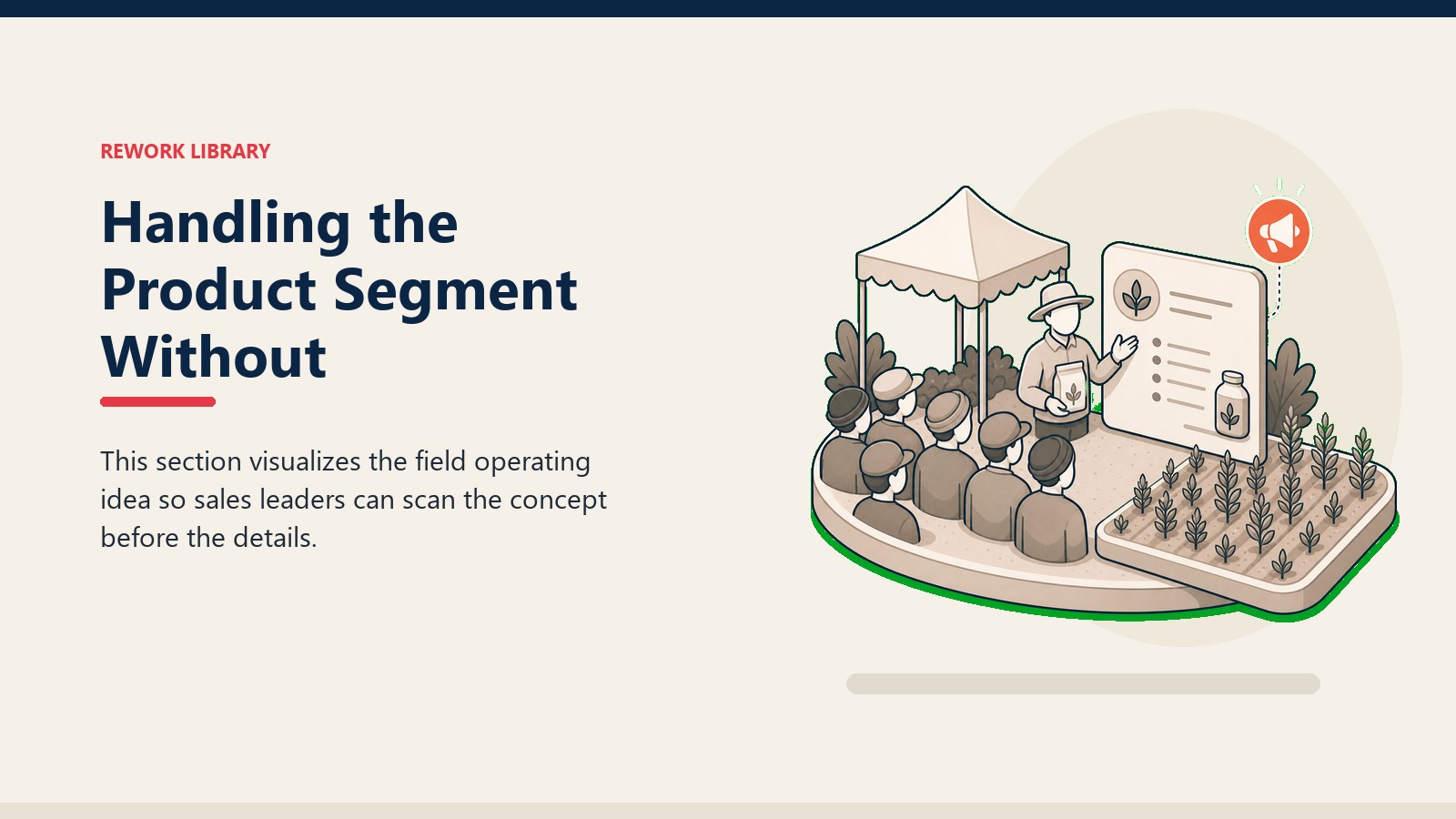
The rep's transition should be explicit: "So we've heard about the nitrogen efficiency challenge in clay soils. Let me show you what we've been testing in this district to address exactly that problem." The product is the solution to the known problem, not a proposition that needs to create its own problem statement.
What works in the product segment:
- One primary product per event. Farmers remember one thing clearly. Two products create choice paralysis or a general impression with no specific memory.
- Local trial data, not regional headquarters data. If there's a demo plot in the area, the yield comparison from that specific plot is worth more than a trial result from 500 km away.
- Farmer testimonial, even brief. The host farmer who ran the demo plot speaking for 90 seconds about what he observed carries more credibility than 15 minutes of rep presentation.
- Economic frame. Cost per acre, expected yield increase, farmgate price calculation. Farmers respond to math they can verify.
What loses the room:
- More than three data points. Farmers processing multiple numbers during a group event retain none of them clearly.
- Technical language that doesn't map to local farming practice.
- Claims that don't match what farmers have observed themselves. If farmers saw average crop performance on a neighbor's field last season, saying the product consistently produces 25% yield increases will feel dishonest.
Timing: the product segment should run 15-20 minutes, after the agronomy segment and before the Q&A and close. If it runs longer, the commercial moment gets delayed and farmer attention drifts.
How Do You Create an Order Commitment Moment in a Group Setting?
Group settings require a different close than one-on-one visits. You can't pressure or negotiate in front of a crowd. But you can create a commitment structure that makes it easy for interested farmers to say yes without feeling singled out.
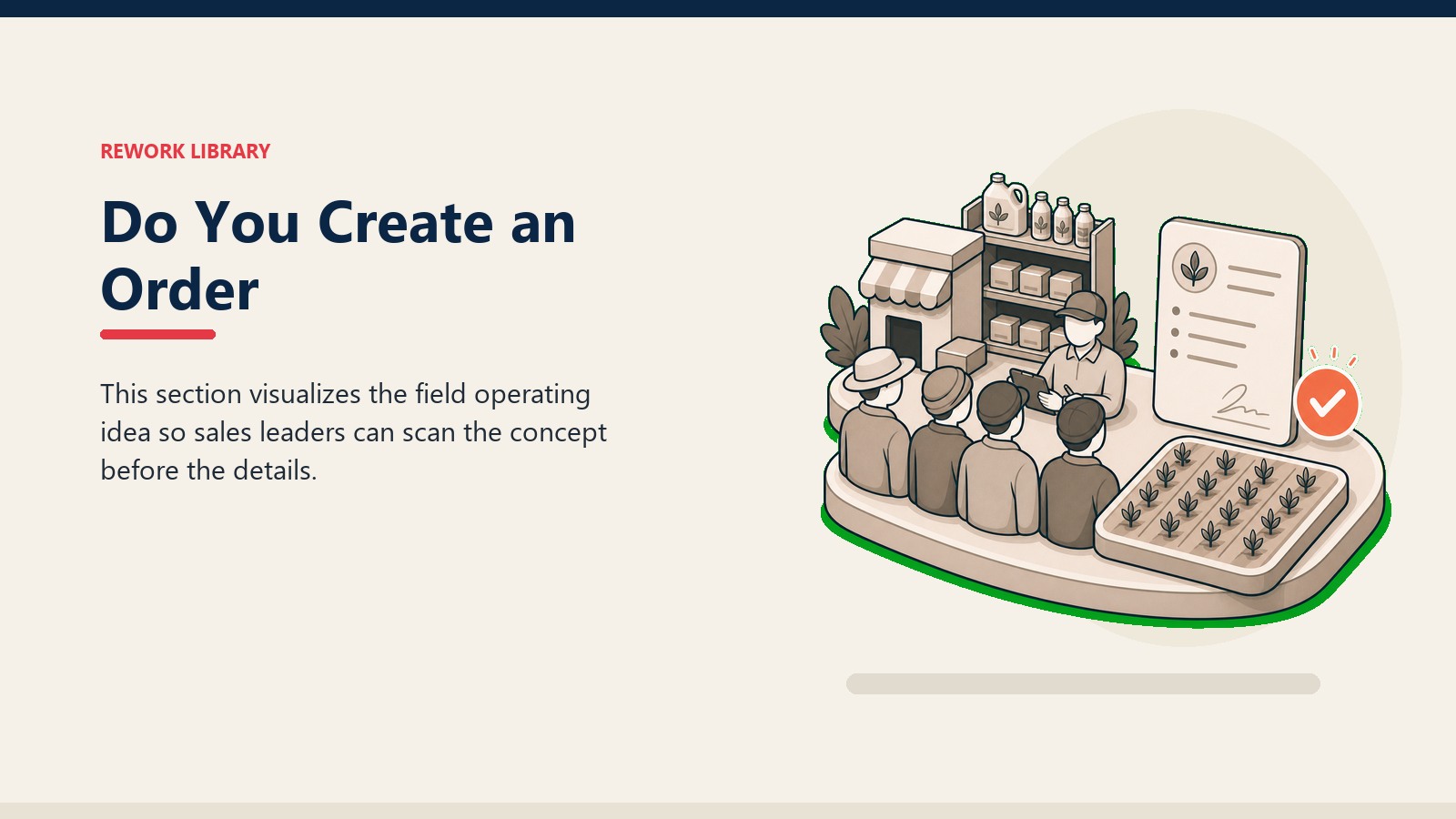
The soft close in a group setting works in two steps:
Step 1: The conditional expression. "For farmers here who are thinking about trying this on their wheat next season, we've arranged with [dealer name] to have stock available for anyone who wants to place an order today. There's also a pre-season pricing advantage if you commit before [date]." This makes the offer visible without targeting anyone specifically.
Step 2: The individual follow-up. After the formal close of the group event, the rep and dealer circulate separately while farmers are having tea or lunch. This is where individual conversations happen. The rep identifies the farmers who asked the most questions during Q&A (highest intent signals) and has brief one-on-one conversations about their specific acreage, which fields they'd use the product on, and whether they want to confirm an order directly or through the dealer.
The dealer captures order commitments on the day using a simple order sheet. Not formal invoices, just names and quantities committed. This list becomes the rep's follow-up call list for the next 48 hours. See Dealer Visit Playbook for how to brief the dealer on their role in this event-day capture.
Dealer's Role in Field Day Execution
The dealer is not a logistics partner for farmer events. Done right, the dealer is a commercial anchor.
The rep's role is to generate farmer interest and support the agronomy and product content. The dealer's role is to confirm that stock is available, explain the scheme terms clearly to any farmer who asks about pricing, and physically take order commitments when farmers are ready to commit.
Pre-event dealer briefing (day before) should cover:
| Topic | What to confirm |
|---|---|
| Stock position | Units on hand and ability to fulfill expected order volume |
| Scheme terms | Exact discount, rebate, or credit arrangement for event-day orders |
| Farmer names | Which farmers on the guest list are current customers vs. prospects |
| Role at event | Whether dealer presents, circulates, or stays near the order table |
| Post-event follow-up | How the dealer will handle farmers who express interest but don't commit on the day |
Dealers who are unprepared for the commercial moment at field events are a common failure point. The rep who invests in event planning but doesn't lock in the dealer's commercial readiness will find that interested farmers who approach the dealer for pricing information get an uncertain answer, which breaks the momentum of the close.
Quotable Nuggets
"A field day with no follow-up system is a brand activity. A field day with a structured conversion sequence is a sales event." Rework Agri-Inputs Growth Library
"Field days averaged 41 farmers per event (59% of rice-farming households per village) and increased technology adoption by 12 percentage points, with single-package purchases rising 59%. Benefits did not spill over to non-attendees." Emerick et al., Review of Economics and Statistics, 2021. Getting the right farmers in the room is the job; awareness-only programs that skip the in-person commitment step capture none of that return.
"Extension agents who are perceived as independent technical advisors rather than commercial reps generate higher farmer trust and more durable adoption outcomes." FAO guide to modernizing extension systems (fao.org/4/a0219e). The 15-20 minute independent agronomy segment at the start of every field day is not a formality; it is the mechanism that makes the product segment land.
The Field Day Conversion Sequence: Four stages that must run in order: (1) Independent agronomy content (15-20 min, led by agronomist or KOL, no product mention); (2) Product segment framed as a response to the agronomic challenge just discussed (15-20 min, one product, local trial data, cost-return math); (3) Soft group close with a visible pre-season offer and dealer on-site to take orders; (4) 48-hour individual follow-up calls to farmers who engaged during Q&A. Skip stage 4 and overall attendance-to-order rates drop by half.
Post-Event Follow-Up
A field day without a 48-hour follow-up system is a brand activity. The conversion from "interested farmer at an event" to "confirmed order" happens in the follow-up window, not always at the event itself.
48-hour follow-up call guide:
Within 48 hours of the event, the rep should contact every farmer who:
- Asked a direct question during the product segment or Q&A
- Had a one-on-one conversation with the rep or dealer during the close
- Was identified by the host farmer or dealer as showing strong interest
The call structure is short: "I wanted to follow up on [product name] from the event. You mentioned you were thinking about trying it on your [crop] this season. I've confirmed that [dealer name] has stock available. Did you want to secure the pre-season price while it's still available?" Four sentences. Clear ask. Specific tie to the event conversation.
The Lead Response Time principle applies directly: the longer the gap between a farmer expressing interest and a rep following up, the lower the conversion probability. A farmer who's interested on Wednesday is significantly more likely to commit by Friday than by the following Tuesday. Competing inputs, price comparison conversations with other dealers, and the general noise of farming life all dilute intent over time. Research on peer influence and extension services confirms this dynamic: farmers who expressed intent after a group learning experience were significantly more likely to follow through when social reinforcement from peers continued in the days immediately following, which is why the 48-hour follow-up call targets farmers who engaged with other attendees during the event, not just those who spoke directly to the rep.
Tracking Event Outcomes
The attendee-to-inquiry-to-order conversion funnel is the metric set that separates a field-day program that generates commercial results from one that generates activity reports.
| Stage | What to track | How |
|---|---|---|
| Invitations sent | Farmer names and contact information on the target guest list | Pre-event tracking sheet |
| Attendance | Farmers who actually attended | Sign-in sheet at event |
| Active engagement | Farmers who asked questions, stayed for Q&A, or had one-on-one conversations | Rep observation notes |
| Inquiry within 48 hours | Farmers who called the rep or dealer after the event | Rep call log; dealer walk-in record |
| Order commitment | Farmers who confirmed an order quantity and product | Dealer order sheet |
| Order fulfilled | Purchase orders delivered | Dealer secondary sales record |
Target conversion benchmarks for a well-planned and well-executed field day:
- Attendance-to-engagement rate: 60-70% (farmers who are actively participating, not just present)
- Engagement-to-inquiry rate: 40-50%
- Inquiry-to-order rate: 50-60%
- Overall attendance-to-order rate: 15-25%
An attendance-to-order rate below 10% consistently indicates a problem with either the event format (product-led opening, weak agronomy content) or the follow-up execution (no 48-hour calls, dealer unprepared). Coverage and call frequency frameworks from adjacent channels are useful here: see Coverage and Frequency Optimization for the call-frequency analysis that applies to territory-level event planning.
Track outcomes by rep, by territory, and by event format. Village meetings and field days will show different conversion profiles. Understanding which format generates the best returns in a specific territory type lets the area manager allocate event budgets more precisely. See Field Reporting and Demo Tracking for the reporting template.
Conclusion: A Field Day With No Follow-Up System is a Brand Activity, Not a Sales Activity
The rep who opened with an agronomist and came away with eleven orders understood something fundamental: farmers at a field day are making a decision, but the decision solidifies in the 48 hours after, not during the event itself. The event creates the preconditions for the sale. The follow-up is where the sale happens.
But the follow-up is only possible if you know who to follow up with. Which means you need attendance records and engagement notes from the event. Which means you need a guest list built from segmentation data, not just whoever the dealer felt like inviting. Which means the whole system is only as strong as the planning that preceded it.
Treat every field day as a structured sales conversion event with defined stages, measurable outcomes, and a 48-hour activation window. The teams that do this consistently don't just run better events. They build a demand-generation machine that compounds across seasons, because farmers who bought at a field day event come back the following season and bring neighbors. The ones who attended a polite product presentation go home and buy from whoever knocks on their door first.
Learn More

Senior Implementation Consultant
On this page
- Types of Farmer-Facing Events
- Planning the Event
- Event Planning Checklist
- Running the Agronomy Segment
- Handling the Product Segment Without Losing the Room
- How Do You Create an Order Commitment Moment in a Group Setting?
- Dealer's Role in Field Day Execution
- Quotable Nuggets
- Post-Event Follow-Up
- Tracking Event Outcomes
- Conclusion: A Field Day With No Follow-Up System is a Brand Activity, Not a Sales Activity
- Learn More