Dealer Segmentation and Classification: Tiering Your Agri-Dealer Network for Sales Focus
Turn this article into takeaways for your work.


Each assistant summarizes the article only for you and suggests best practices for your work.
A rep with 60 dealers in territory and five working days a week has roughly four visits per dealer per month if she spreads her time evenly. The problem is that dealer number 3 on her list moves 40 bags of fungicide per week and runs farmer advisory sessions every fortnight, while dealer number 47 places one small order at the start of kharif and goes quiet until rabi. Treating those two the same is how companies leave 30% to 40% of channel revenue on the table each season.
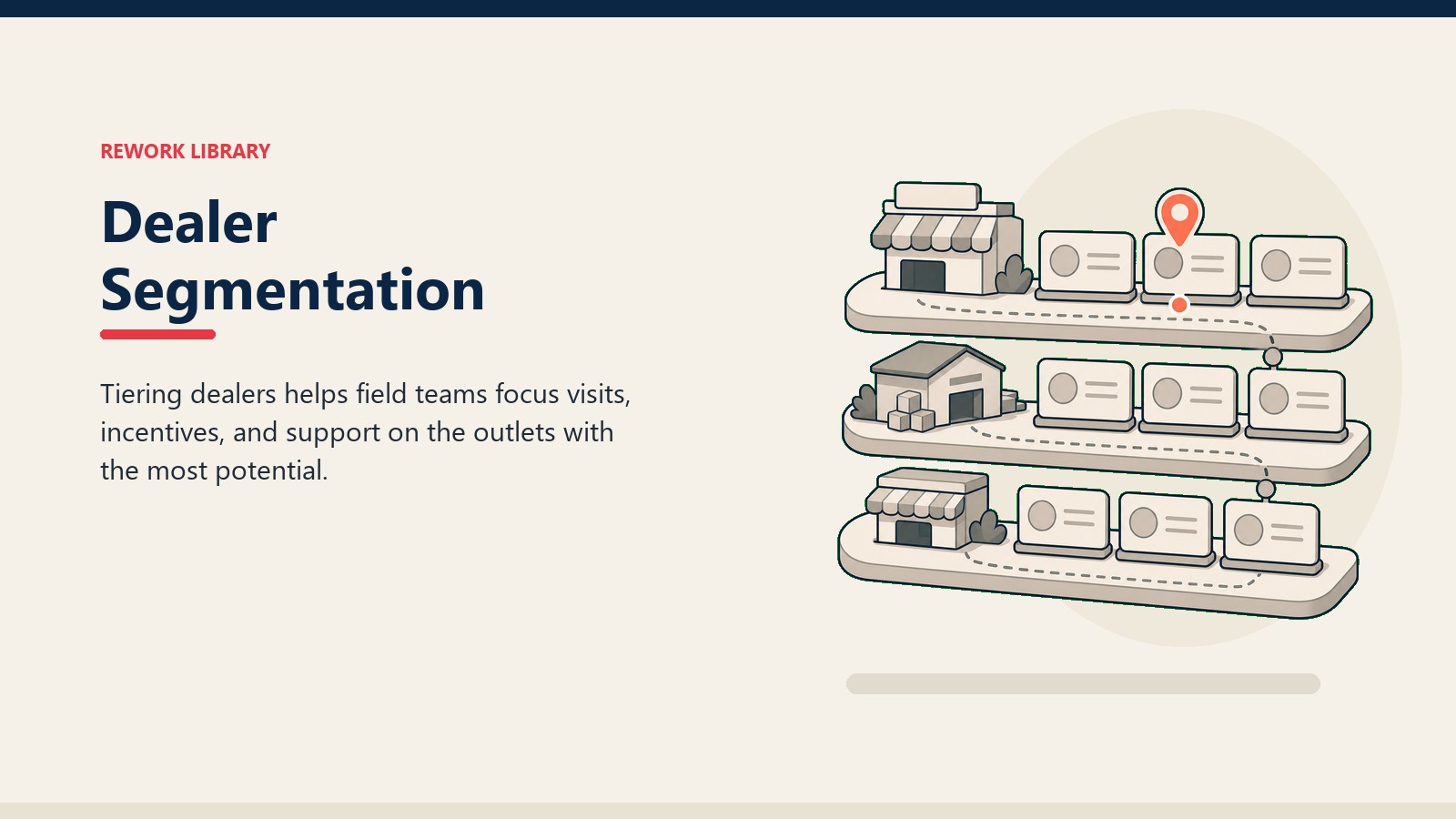
Dealer segmentation is the practice of classifying outlets by their commercial value and influence potential so your field force invests visit time and support resources where they generate the highest seasonal return. It's not a sorting exercise. It's a resource-allocation decision with real revenue consequences, and it belongs at the center of every territory plan.
Why Segmentation Matters in Agri-Input Channels
Key Facts: Dealer Segmentation and Channel ROI
- The IFC's Last Mile Retailer program identifies agro-input dealers as farmers' first stop for cultivation advice in rural communities, not just a point of sale. But most dealers lack the technical training to recommend confidently, making the quality of rep and agronomist support to the dealer the primary driver of what recommendation the farmer receives. (IFC Last Mile Retailer Program)
- In a census of agro-dealers across eight rural districts of Tanzania, less competitive remote dealers stocked fewer product varieties and charged higher prices, with each additional competitor in a cluster correlated with lower urea prices per bag. This makes dealer tiering by competitive position a market-access variable, not just a sales efficiency variable. (Mather et al., Food Security, 2021)
- Access to demonstration plots raised farmers' input purchase probability by 13 to 17 percentage points, with the effect strongest when product was available near the plot location. This finding supports directing demo-plot allocation to A-tier dealers whose catchment villages have active farmer populations near stocked outlets. (Sseguya et al., PLOS ONE, 2021)
Agri-input dealers aren't just retailers. In most smallholder markets, they're the primary advisory touchpoint for the farmer. A dealer who trusts your brand recommends it. A dealer who's ambivalent reaches for whatever's on the shelf or whatever the last rep left samples for. And a dealer who's been neglected for three visits recommends the competitor who showed up last week.
That advisory role makes the dealer relationship qualitatively different from a standard distribution channel. Uniform coverage treats all dealers as order-taking outlets. Segmentation treats the top dealers as commercial partners whose recommendation behavior directly shapes farmer adoption. The IFC's last-mile retailer program documents how agro-input retailers function as farmers' primary source for cultivation advice, not just a point of sale.
Dealer influence on farmer decisions also varies sharply by geography. In a village with 300 farmers and two dealers, the dealer who's been there for 20 years isn't just selling inputs. She's effectively deciding what chemistry gets used on half the crop acreage in that village. Identifying those influence nodes and investing in them disproportionately is the commercial logic behind tiering. Research on agro-dealer geography in rural Tanzania found that less competitive remote markets correlated with reduced product selection and higher prices, confirming that dealer clustering and quality aren't uniform across a territory.
See dealer universe mapping for how to identify the full dealer population before running the segmentation exercise. Segmentation only works on a complete universe; running it on an incomplete outlet list means your highest-potential outlets might not be in the system yet. Once the universe is mapped, here's the six-criteria model that turns outlet data into tier decisions.
What Criteria Should You Use to Score Each Dealer?
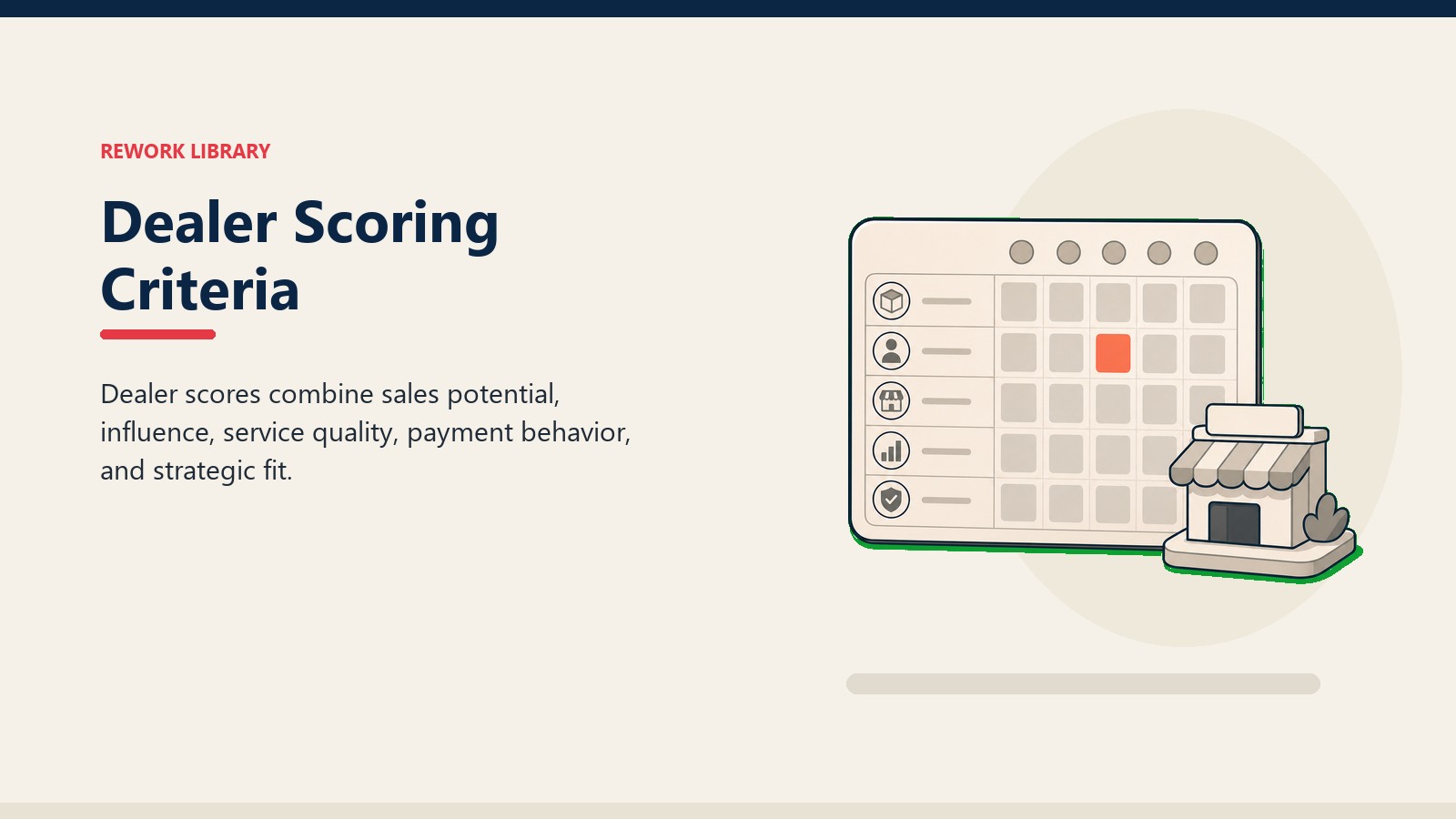
Effective dealer scoring uses six criteria. No single dimension tells the full story; the scoring works because it combines volume, influence, and loyalty into a composite view.
1. Volume contribution. Total seasonal offtake in your primary categories (pesticides, fertilizers, seeds, or all three). Use distributor billing data for the last two complete seasons. Weight this criterion most heavily; it's the most direct measure of commercial value.
2. Farmer influence radius. How many farmers does this dealer actively advise? Influenced farmer count isn't the same as farmer footfall; a dealer might serve 300 walk-in customers but only have a genuine advisory relationship with 80 of them. Estimated from village size, dealer tenure, and rep observation during farm visits.
3. Competitor share of wallet. What percentage of the dealer's total agri-input purchases come from your brand versus competitors? A dealer doing significant volume but 70% committed to a competitor is a different classification from a dealer doing the same volume at 80% of wallet with your brand. Share of wallet determines your actual position, not just gross offtake.
4. Product mix breadth. Does the dealer stock across your full range (crop protection, nutrition, and seeds) or only a single category? Multi-category dealers have higher revenue potential and are better candidates for bundled promotional programs. Single-category dealers may be strategic for that one category but aren't partnership candidates.
5. Credit reliability. Payment behavior on distributor credit. A dealer who consistently pays within terms is a low-risk partner for extended credit during season-opening stock programs. A dealer with a pattern of delays signals operational stress that may affect reorder behavior.
6. Seasonal stocking pattern. Does the dealer stock proactively before the input-purchase window opens, or do they wait and reorder reactively? Proactive stockers are stronger channel partners for new product launches and promotional campaigns. Reactive stockers need more push and generate less pull-through.
The Dealer Scoring Matrix
The Six-Criteria Dealer Scoring Model: assigns weighted scores across volume contribution (30%), farmer influence radius (20%), competitor share of wallet (20%), product mix breadth (15%), credit reliability (10%), and seasonal stocking pattern (5%). Each criterion is scored 1, 2, or 3. The weighted composite determines tier: 2.4 and above is A-tier, 1.8 to 2.39 is B-tier, and below 1.8 is C-tier. This structure ensures that visit frequency and support investment are allocated where commercial leverage is highest, not where habit or comfort dictates.
Score each dealer on all six criteria. The thresholds below are starting points; calibrate them to your territory's volume distribution before the first scoring cycle.
| Criterion | Weight | Score 1 (Low) | Score 2 (Medium) | Score 3 (High) |
|---|---|---|---|---|
| Volume contribution | 30% | Below 200 units/season | 200-600 units/season | Above 600 units/season |
| Farmer influence radius | 20% | Under 50 influenced farmers | 50-150 farmers | Above 150 farmers |
| Competitor share of wallet | 20% | Your brand under 30% | 30-60% | Above 60% |
| Product mix breadth | 15% | Single category | Two categories | Three or more categories |
| Credit reliability | 10% | Frequent delays | Occasional delays | Consistently on time |
| Seasonal stocking pattern | 5% | Reactive, wait-and-see | Mixed | Proactive, pre-season load |
Composite score calculation: multiply each score (1, 2, or 3) by its weight and sum across all six criteria. Maximum possible score is 3.0. Assign tiers as follows:
- A-tier (Platinum): Composite score 2.4 and above
- B-tier (Gold): Composite score 1.8 to 2.39
- C-tier (Silver): Composite score below 1.8
Run this calculation for every dealer in your universe, starting with the outlets that have distributor billing data. For new or unvisited outlets, use the preliminary classification from the universe mapping exercise until you have one full season of data to score properly.
Visit Frequency and Support Differentiation by Tier
Segmentation without differentiated treatment is just a spreadsheet exercise. The tier has to drive the resource allocation.
A-tier dealers: Weekly visits with structured agenda. The rep visits every week, not just when there's an order to confirm. A-tier visits include a stock check, a business review of sell-through data, and a forward-looking conversation about the crop calendar and upcoming input needs. Agronomist co-calls, where a technical specialist joins the rep, happen at least once a month at A-tier accounts. These dealers get first access to new product samples, lead placement in demo-plot programs, and priority on co-branded promotional materials.
B-tier dealers: Bi-weekly visits with active development agenda. The rep visits every two weeks. Visit agenda is similar to A-tier but shorter. The commercial discussion includes a conversation about what it would take to move the dealer to A-tier: what volume gap needs closing, what competitor share needs converting, what product categories need adding. B-tier dealers get demo-plot access and farmer-meeting support but on a secondary allocation basis after A-tier is served.
C-tier dealers: Monthly field visits supplemented by telecalling. The rep visits monthly. Between visits, the area office runs a structured telecalling program to maintain relationship presence, confirm stock status, and flag any issues before they compound. C-tier dealers get standard distributor credit terms and access to generic promotional materials but don't receive priority on demo-plot allocation or farmer-meeting co-investment.
| Support Element | A-Tier | B-Tier | C-Tier |
|---|---|---|---|
| Visit frequency | Weekly | Bi-weekly | Monthly + telecall |
| Agronomist co-calls | Monthly | Quarterly | On request only |
| Demo-plot allocation | Priority first | Secondary allocation | Not prioritized |
| Farmer-meeting support | Fully co-funded | Partially co-funded | Rep-only, no co-investment |
| Credit limit | Highest approved ceiling | Standard + seasonal top-up | Standard terms only |
| New product samples | First access | Second allocation | General distribution |
| Co-branded materials | Premium kit | Standard kit | Basic materials |
This isn't about rewarding dealers arbitrarily. It's about allocating finite agronomist time, demo-plot budget, and promotional investment to the outlets where they generate the most measurable pull-through. The dealer visit playbook structures how reps use the time at each tier visit. The programs that move the needle for dealers aren't the visit frequency itself, though. They're what you do while you're there.
Differential Support Programs
The support differentiation that matters most to dealers isn't the visit frequency. It's the programs that help them sell more to farmers. The FAO's agricultural channel management framework identifies market orientation of intermediaries as the primary selection criterion for distribution investment, a principle that maps directly to tier-based support allocation.
Demo-plot allocation. A-tier dealers get first selection of demo-plot locations in their catchment villages. A well-executed demo plot near an A-tier dealer creates a visible proof point that the dealer can walk farmers to during the crop season. That combination of rep-supported demo plus trusted dealer recommendation is the most reliable demand-generation mechanism in agri-inputs. See demand generation via demo plots for the full program design.
Credit and stocking programs. Extended credit at season-opening is one of the most commercially significant levers in agri-input distribution. Dealers who can stock up before the input-purchase window without straining their working capital are more likely to stock your brand at depth and at high visibility. Extend this to A-tier dealers as a differentiated benefit, not as a general channel offer. See channel credit and financing for the risk framework.
Farmer-meeting co-investment. Fund farmer advisory meetings in A-tier dealer catchment areas at 100% or near-100% of the event cost, with your brand's agronomist as the presenter. Fund B-tier events at 50%, requiring the dealer to co-invest. C-tier meetings are rep-run with no co-investment. This structure creates a tangible financial benefit tied to tier standing and gives B-tier dealers a concrete reason to push for upgrade.
Loyalty and incentive programs. Tie your dealer loyalty program structure to tier standing. A-tier dealers access the premium reward category. B-tier accesses the standard category. This connects directly to dealer loyalty and incentive programs design, where the incentive calendar should reinforce the tier structure rather than running parallel to it.
Moving a Dealer Up a Tier
Tier classification isn't permanent. The explicit possibility of tier upgrade is one of the most powerful behavioral levers in the segmentation model; dealers who see a clear path to A-tier treatment invest in the relationship differently than dealers who feel their classification is fixed.
Define upgrade triggers for each transition:
C to B upgrade triggers: sustained volume growth over two consecutive seasons, a measurable increase in share of wallet (e.g., from 25% to 45%), or proven credit reliability over 12 months of on-time payment.
B to A upgrade triggers: volume crossing the A-tier threshold, competitor share of wallet below 40%, and active participation in at least two co-funded farmer-meeting events in the prior season.
The rep's role in tier advancement is coaching, not charity. When a B-tier dealer is within range of A-tier thresholds, the rep should make the gap explicit: "You're at 480 units this season, and the A-tier threshold is 600. Here's what we can do together to close that in the next 12 weeks." Pair the target with a specific support commitment: an additional demo plot, a co-funded farmer meeting, or a small credit-line extension to help with season-opening stocking.
Review tier standing at the 90-day mark within a season, not just at seasonal rescore. A dealer who's tracking significantly ahead of prior-year volume in the first 90 days of kharif may warrant a mid-season upgrade to unlock the support programs that help them finish strong.
Seasonal Re-Scoring
Re-score the entire dealer network at the start of each kharif and rabi cycle. Volume contributions and loyalty patterns shift seasonally; a dealer who was a strong B-tier performer in kharif may have reduced activity in rabi if their village crop shifts to lower-input crops. A dealer who was C-tier last year may have invested in storage expansion and increased their stocking capacity.
The re-scoring process should take no more than two days for a territory with 60 to 80 dealers. Pull fresh distributor billing data, update the six criteria for each outlet, recalculate composite scores, and flag tier changes. Share the updated tier list with area managers and distributors before the season-opening call cycle begins.
A re-scoring also catches changes that aren't visible in billing data: dealer ownership changes, new competitor programs targeting your top outlets, shifts in village crop area. These require input from the rep who holds the field relationship, not just a data recalculation. The link between dealer tiers and B2B commercial logic is closer than most agri-input managers realize.
Linking to the Ideal Customer Profile
Dealer segmentation in agri-inputs has a direct parallel to ideal customer profile development in B2B sales. The ICP defines which prospects are most likely to convert quickly and generate long-term value. The dealer tier model defines which outlets in the channel are most likely to generate offtake and farmer pull-through at a level worth the investment.
The criteria overlap more than they differ: volume potential, fit with your product range, loyalty indicators, and influence within their peer network. Running both exercises in the same planning cycle creates a consistent commercial logic across the farmer-facing and channel layers of the territory.
For scoring mechanics, the lead scoring framework applies directly to dealer scoring: assign weighted criteria, set tier thresholds, build automated alerts for score changes, and review periodically. The same structure that works for lead qualification works for dealer classification once you've defined the agri-specific criteria.
Conclusion: Tier Discipline as a Revenue Lever
Dealer segmentation isn't a one-time classification project. It's an ongoing resource-allocation discipline that determines how your field force's most limited asset, time, gets deployed each season.
The companies that treat segmentation as annual planning theater, running the exercise once and then defaulting to the old visit patterns, see no measurable improvement in channel performance. But the companies that enforce the tier model through visit-frequency accountability, differential support allocation, and active upgrade coaching see measurable offtake shifts within two seasons.
Tier discipline isn't about playing favorites. It's about being honest with your field force about where the commercial leverage is, and giving them the structure to act on it.
Quotable Nuggets
"Agro-input retailers are uniquely positioned to support farmers through quality inputs and extension advisory services. But most small dealers lack the training or know-how to best advise their clients. The quality of the support a company provides to the dealer directly determines whether the farmer gets a technically grounded recommendation or a generic one." (Based on IFC Last Mile Retailer Program)
"Treating all dealers equally is not a neutral act. It is an active decision to allocate your most limited resource, rep time, uniformly across a highly non-uniform commercial landscape. The top quartile of dealers by volume accounts for the majority of seasonal offtake. Uniform coverage systematically underinvests in that quartile."
"Research on agro-dealer geography in rural Tanzania found that less competitive remote dealers stocked fewer product varieties and charged higher prices. Dealer tiering isn't just a sales efficiency tool. In thin-coverage geographies, it is the primary determinant of whether farmers can access your product at all." (Mather et al., Food Security, 2021)
Frequently Asked Questions about Dealer Segmentation and Classification
How often should dealer tiers be reviewed?
Formally at the start of each major crop season (twice yearly for kharif/rabi markets). Informally at 90-day intervals within a season when volume tracking shows significant deviation from prior-year patterns. Tier changes should be communicated to the dealer explicitly, both upgrades and downgrades, to maintain the credibility of the system.
What do I do if a high-volume dealer has poor credit reliability?
Maintain their volume-based tier placement but apply a separate credit-risk flag that limits their access to extended credit programs. A dealer doing 800 units per season with a consistent payment delay is still a strategic commercial partner; the risk is managed through credit-limit controls, not by dropping their tier. Track both the commercial value and the credit behavior as separate dimensions.
Can a dealer be A-tier in one category and C-tier in another?
Yes, and it's worth tracking this way if your product range spans distinct categories like pesticides, fertilizers, and seeds. A dealer who dominates pesticide sales in her village but has never stocked your fertilizer line is an A-tier pesticide partner and a new-development target for fertilizers. Cross-category expansion at existing A-tier dealers is often more efficient than recruiting new outlets.
How do I handle dealers who reject the tier framework?
A-tier dealers who are informed they're receiving premium support rarely object. The tier conversation becomes difficult when you're reducing service to a C-tier dealer who previously received the same level of attention as your top accounts. Frame it as an investment alignment: "We're putting our agronomist time and farmer-meeting budget where we can measure the return. Here's what you'd need to do to unlock more support." It's a commercial conversation, not a punitive one.
How should demo-plot allocation decisions connect to dealer tier?
Demo plots generate the strongest conversion when the product is available within a short distance of the plot location. Allocating demo plots near A-tier dealers creates a reinforcing cycle: the plot drives farmer demand, the A-tier dealer has adequate stock and farmer relationships to convert that demand, and the rep can use the visible crop result in sales conversations with surrounding dealers. Allocating plots near C-tier dealers with low stock levels, inconsistent farmer relationships, or remote locations significantly reduces the commercial return on the plot investment.
Learn More

Senior Implementation Consultant
On this page
- Why Segmentation Matters in Agri-Input Channels
- What Criteria Should You Use to Score Each Dealer?
- The Dealer Scoring Matrix
- Visit Frequency and Support Differentiation by Tier
- Differential Support Programs
- Moving a Dealer Up a Tier
- Seasonal Re-Scoring
- Linking to the Ideal Customer Profile
- Conclusion: Tier Discipline as a Revenue Lever
- Learn More