Route-to-Market for Agri-Inputs: Designing the Channel from Company to Crop
Turn this article into takeaways for your work.


Each assistant summarizes the article only for you and suggests best practices for your work.
Ask a national sales head at an agri-input company when they last formally audited their route-to-market structure, and the honest answer is usually "when we entered the territory." The channel was built to reach farmers as quickly as possible during a market expansion phase. The distributors were chosen based on financial capacity and geographic spread. The dealer list grew organically as reps empanelled whoever asked to carry the product.
That channel is now five to ten years old. The crop mix has shifted. Irrigated acreage has expanded in some zones and contracted in others. Competitors have gone direct to farmer with advisory programs that bypass the dealer counter. Input credit has dried up in some districts after bad seasons. And yet the channel structure from 2015 is still the channel structure in 2026, carrying the same tier depth, the same credit norms, and the same margin expectations that made sense in a different competitive environment.
Channel design is a strategic choice. When it becomes legacy infrastructure, it starts constraining growth instead of enabling it. A marketing channel is defined as the people, organizations, and activities necessary to transfer ownership of goods from production to consumption. In agri-inputs, that chain typically runs three to four tiers deep before product reaches the farmer.
What Does the RTM Architecture Actually Look Like?
Key Facts: Agri-Input Channel Dynamics
- Agro-dealers in remote, low-competition locations in developing markets stock fewer product varieties and charge structurally higher prices: studies in rural Tanzania found remote clusters had roughly 18% higher fertilizer prices than competitive urban-adjacent clusters. (Mather et al., Food Security, 2021)
- The IFC's Last Mile Retailer program identifies agro-input dealers as farmers' primary source of cultivation advice and inputs in rural communities, but notes that most dealers lack the technical training to advise confidently. (IFC Last Mile Retailer Program)
- The India agrochemicals market reached an estimated USD 33 billion in 2023 and is projected to reach USD 51 billion by 2030, but growth in market value has not translated into proportional distribution network depth for most mid-size players. (Grand View Research, 2024)
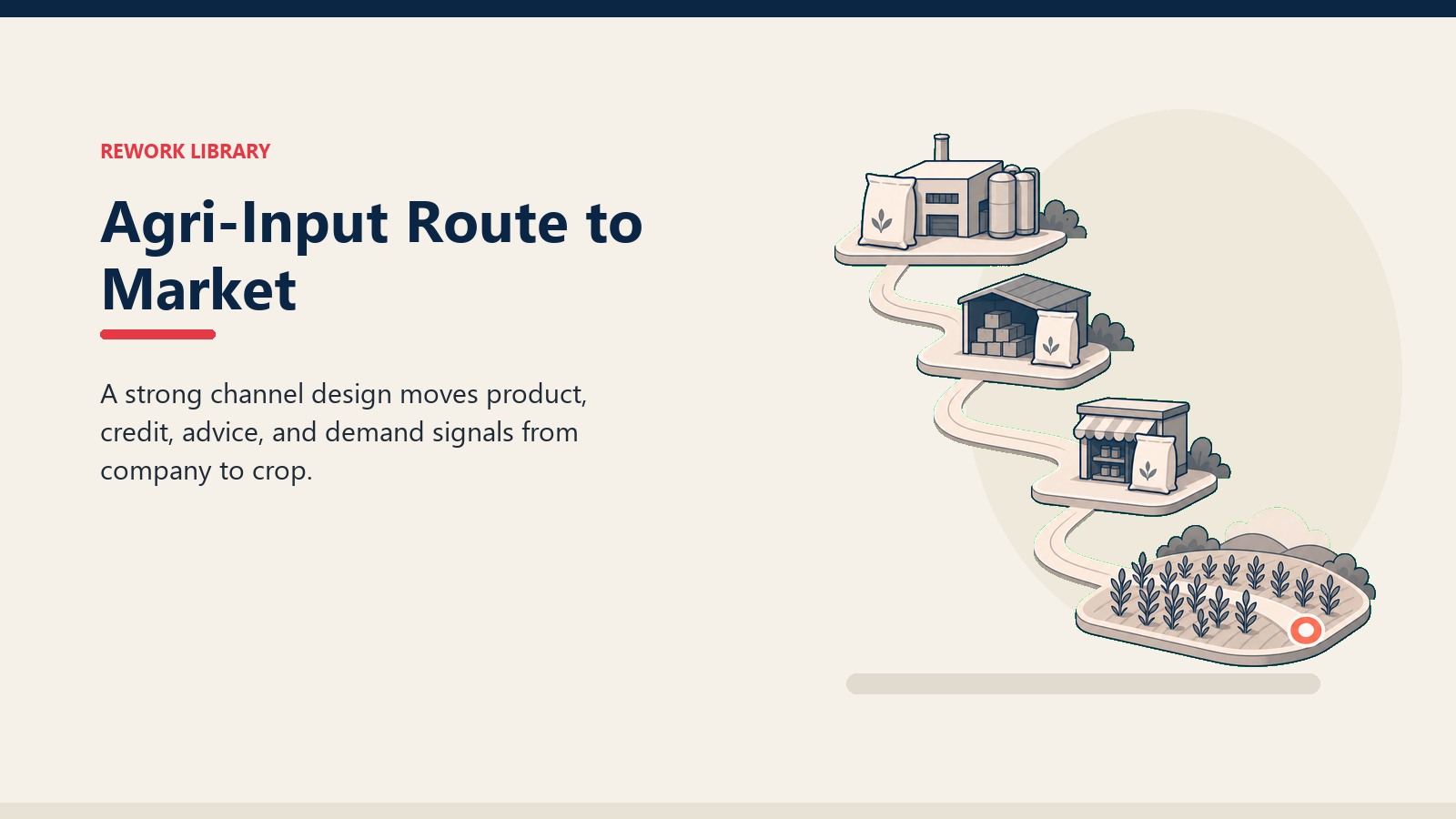
The standard agri-input route-to-market has four layers. Each layer is responsible for a distinct commercial job, earns a different margin, and generates different information that should flow back up the chain.
The Four-Layer RTM Job Framework: Company depot handles product availability and credit origination. Distributor handles financial buffering, secondary distribution, and credit intermediation. Agri-dealer handles last-mile stocking, farmer recommendation, and farmer credit. Farmer generates trial results, repeat intent, and word of mouth. Each layer earns a different margin and is accountable for a distinct information flow back up the chain.
| Layer | Primary Role | Margin Expectation | Key Information Flow |
|---|---|---|---|
| Company warehouse / regional depot | Product availability, credit origination, promotional management | n/a (company P&L) | Dispatch data, credit utilization by distributor |
| Distributor / super-stockist | Financial buffer, secondary distribution to dealers, credit intermediary | 3-6% on MRP depending on product category | Dealer offtake, credit health, competitor stock levels |
| Agri-dealer (rural retailer) | Last-mile stocking, farmer recommendation, credit to farmer | 10-18% on MRP depending on product | Farmer feedback, crop problem patterns, competitor products sold |
| Farmer | Product use, crop outcome | n/a | Trial results, repeat purchase intent, word of mouth |
The distributor or super-stockist layer is where most channel design problems concentrate. Distributors hold financial exposure, carry seasonal stock, and are supposed to replenish dealers on demand. But they're also the layer most sensitive to cash flow, most likely to slow-roll replenishment when credit is tight, and most capable of channeling their own preference for high-margin competitor products through their dealer network. The IFC's Last Mile Retailer program documents a consistent finding across emerging markets: agri-dealers are often the farmer's first point of advice, yet many lack the technical training to recommend confidently.
A distributor who is working well is a force multiplier. But a distributor who is financially stressed, has excess unsold stock from last season, or has divided loyalty across competing brands is a channel bottleneck. Most companies have both types in their distributor base and treat them identically.
Geography and Tier Mapping
Not every geography benefits from the same tier depth. The decision to run a two-tier model (company to dealer direct) versus a three-tier model (company through distributor to dealer) or a hybrid depends on three variables: geographic density of farmers, infrastructure for rep service frequency, and the financial capacity of local dealers.
| Geography Type | Characteristics | Recommended Tier Depth | Rationale |
|---|---|---|---|
| Irrigated command area (e.g., Maharashtra sugarcane belt, Punjab wheat zone) | Dense farmer population, high-value crops, year-round cultivation | Two-tier or hybrid | Dealer density supports direct service; high revenue per acre justifies lower distributor margin spend |
| Mixed rain-fed belt (e.g., Madhya Pradesh soybean-wheat zone) | Moderate farmer density, single-season dependency, variable credit access | Three-tier standard | Distributors absorb seasonal credit risk; rep density insufficient for direct dealer service |
| Tribal or remote belt (e.g., Jharkhand pulse-growing areas, Northeast India) | Low farmer density, poor infrastructure, limited dealer financial capacity | Three-tier with super-stockist | Single distributor can't cover remoteness; super-stockist adds a sub-distributor layer for reach |
| High-value horticulture zone (e.g., Maharashtra grape-growing belt, Himachal Pradesh apple zone) | Few farmers, very high per-acre spend, specialist product requirements | Direct-to-farmer or two-tier | High transaction values justify rep-direct relationships; dealer as advisory partner, not just stock point |
The two-tier model outperforms the three-tier model on margin capture and on information flow. When the company deals directly with dealers, it gets secondary sales data directly. It also has more control over credit terms, promotional compliance, and shelf presence. But it's expensive to run. You need enough rep density to visit hundreds or thousands of dealers at a frequency that keeps stock moving.
Companies that switch from three-tier to two-tier without adjusting their field force size typically find they can't maintain service frequency on the dealer base, and the channel underperforms despite the better margin structure. Use Territory-Based Routing principles to size the rep coverage model before committing to tier changes. Once the tier structure is right, the next question is whether you go direct to the farmer or keep the dealer as the primary relationship.
Direct-to-Farmer Versus Dealer-Led
Some agri-input companies have experimented with direct farmer engagement, running advisory programs, mobile apps, or agri-clinic models that create a company-to-farmer relationship that doesn't depend on the dealer counter. The commercial logic is appealing: if farmers trust the company's advisory enough to buy directly or to pull specifically for the company's brand at the dealer, the dealer becomes a fulfillment point rather than a recommendation source.
The reality is messier. Direct-to-farmer programs create channel conflict. Dealers who feel bypassed by a company's advisory app or mobile agronomy program respond by promoting competitor products. In extreme cases, dealers actively discourage farmers from using company-branded advisory tools. The short-term gain in farmer relationship depth can produce a medium-term loss in dealer shelf presence.
The hybrid model that actually works preserves the dealer as the commercial partner while using agronomist advisory to create farmer demand that pulls product through the dealer counter. The agronomist recommends the company's fungicide for powdery mildew on grapes in a Nashik village. The farmer goes to the local dealer and asks for it by name. The dealer sells it, maintains the relationship, and earns the margin. Nobody is bypassed. The company gets pull-through demand without channel conflict.
This model requires agronomists who are genuinely technical, not just product promoters, and a feedback loop that connects farmer advisory outcomes to dealer stocking decisions. See Agri-Input Sales Growth Model for how this agronomist-as-demand-bridge model fits the overall commercial engine.
Credit Flow Through the Channel
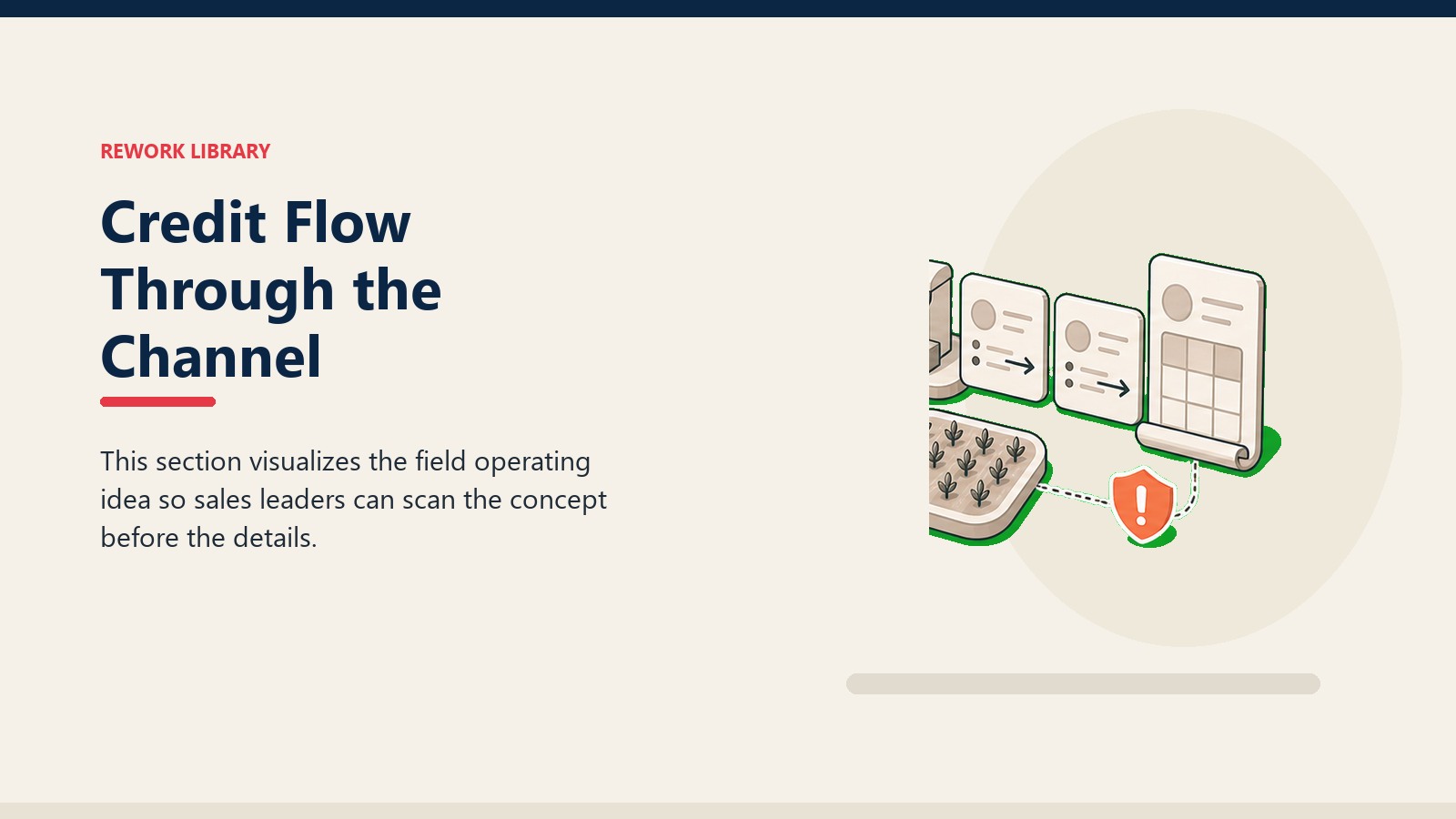
Agri-input sales run almost entirely on seasonal credit. Farmers buy on credit from dealers. Dealers stock on credit from distributors. Distributors load on credit from the company. The credit cycle is synchronized to the crop calendar, and when any link in the chain blocks, the entire stocking and offtake cycle breaks down. The World Bank's handbook Working with Smallholders identifies working capital constraints across the distribution chain as one of the most common barriers to effective input supply in developing market agriculture.
The risk concentration points are predictable.
Company to distributor: The company extends 60-90 day credit to move pre-season stock. If the previous season's collection was slow because farmer crop failures made it hard for dealers to pay distributors, the current season starts with distributors who are already carrying debt. A distributor who is 80% of his credit limit before pre-season loading starts can't load adequately for the upcoming season. He takes less stock, which means dealers in his territory start the season understocked.
Distributor to dealer: The distributor extends 30-60 day credit to dealers based on their relationship and historical payment behavior. But dealers in a bad-season geography have also been collecting slowly from farmers. A dealer who can't collect from farmers can't pay the distributor. When the distributor's credit exposure to that dealer reaches its limit, replenishment stops. In-season stock-out follows even if the distributor has product available at his godown (warehouse).
Dealer to farmer: Farmers in most developing market geographies pay for inputs after harvest. A failed crop, delayed payment from a crop insurance scheme, or a price crash at mandi (the agricultural commodity market) break the farmer's ability to pay the dealer. That triggers dealer credit stress, which cascades back up to distributor credit stress and ultimately to the company's collections problem.
Companies that track Channel Credit and Financing at the dealer level, not just the distributor level, identify these cascades early enough to intervene. The intervention options are limited, but early visibility allows the company to adjust stocking expectations, redirect inventory to healthier geographies, or offer temporary credit restructuring to prevent a full distribution breakdown. How you load the channel in the first place determines how much credit stress you create before the season even starts.
Seasonal Stock-Push Mechanics
Pre-season stock loading is the commercial equivalent of filling a reservoir before the monsoon. If you fill it at the right level with the right product mix, the in-season release into dealer shelves and ultimately to farmers is smooth. If you overfill it, you get channel stuffing. If you underfill it, you get stock-out at peak demand.
The mechanics of a well-designed pre-season push:
Stocking targets are built from demand data, not last-year dispatches. Use secondary sales data from the previous same season, adjusted for acreage trends and crop calendar shifts. A zone where soybean acreage expanded 15% year over year needs proportionally higher input stocking, not a straight-line extension of last year's primary sales target.
Loading is phased, not front-loaded. A common mistake is to push all pre-season stock in the first six weeks before kharif sowing. This maximizes primary sales recognition but front-loads credit exposure on distributors and creates stock-age risk if sowing is delayed by a late monsoon. Phased loading at eight, six, and four weeks before sow with replenishment trigger points gives the channel breathing room.
Liquidation has a formal plan before loading. Before the pre-season push begins, the previous season's unsold stock at dealer level should be identified and a liquidation plan executed. Product that sits past 60-70% of its shelf life is a channel health problem waiting to happen. Companies that don't track dealer-level expiry dates discover the problem when dealers start returning expired product at the end of the season.
The Distributor and Wholesaler Management article covers the operational mechanics of managing pre-season loading conversations and in-season replenishment cadence with individual distributors. The broader distributor relationship discipline from pharma and FMCG distribution management applies directly to the agri-input context (see Learn More below).
How Do You Run an RTM Audit?
Most agri-input channel structures haven't been formally audited since they were built. A structured RTM audit doesn't require months of work. It requires honest answers to a defined set of questions, organized by the four dimensions that matter: coverage, tier health, credit health, and information flow.
Coverage audit:
- What percentage of your target dealer universe is currently empanelled and active (ordered in the last 90 days)?
- Which high-potential micro-markets (identified by crop acreage and per-acre input spend) have no active dealer in the company's network?
- Are there geographies where you have dealer density but poor offtake because the dealers aren't credible in the local farming community?
Tier health audit:
- For each active distributor, what is the ratio of current credit outstanding to approved credit limit?
- Which distributors carry more than 60 days of sales in aged inventory from the previous season?
- Are there distributor territories where dealer offtake is significantly slower than in comparable territories managed by different distributors?
Credit health audit:
- What is the average collection cycle from dealer to distributor in each geography?
- Which dealer segments (by crop, by geography, by annual revenue tier) have the highest overdue rates?
- Does your pre-season loading model account for the credit health of distributors in stressed geographies, or does it apply a uniform loading target regardless of credit position?
Information flow audit:
- Do you have secondary sales data at the dealer level for the top 500 dealers by revenue? If not, you're flying blind on in-season channel health.
- Are agronomist field reports shared with area sales managers before the next beat visit cycle?
- Can you identify, in real time, which dealers are running below safety stock on your top three SKUs in a given week?
The Dealer Segmentation and Classification process should follow the coverage audit, because the remediation of coverage gaps depends on knowing which dealer tier you're targeting and what investment level that tier warrants. The Dealer Universe Mapping framework provides the geographic and market-sizing methodology for defining what the right coverage footprint should look like.
Conclusion
The agri-input route-to-market isn't a permanent infrastructure decision. It's a strategic choice that should be revalidated whenever the competitive environment, crop geography, or credit dynamics shift significantly enough to change what the channel needs to do.
Most companies that are stuck at channel efficiency plateaus are running a three-tier model designed for expansion-phase coverage in a market that now has enough dealer density to support direct-to-dealer service in core geographies, or they're running a two-tier model in remote geographies where distributor financial capacity is the only thing that makes last-mile reach possible.
The RTM audit framework above is designed to surface those misalignments before they become a margin or collections problem. Run it before each major season. Make the channel design fit the current geography, not the one from five years ago.
Quotable Nuggets
"Agro-dealers are not just retailers. In rural communities they are the farmer's first stop for cultivation advice, inputs, and product recommendations. But most lack the technical training to advise confidently, which means the quality of your rep and agronomist support to the dealer directly determines what recommendation the farmer receives." (Based on IFC Last Mile Retailer Program findings)
"When credit at any link in the agri-input chain tightens, the entire stocking and offtake cycle breaks down. The World Bank's handbook on working with smallholders identifies working capital constraints across the distribution chain as one of the most consistent barriers to effective input supply in developing market agriculture." (Based on World Bank Working with Smallholders handbook)
"Remoteness is a double penalty for the farmer: agro-dealers in less competitive locations stock fewer varieties and charge higher prices. Studies in rural Tanzania found that a move from a competitive cluster to a single-dealer remote location was associated with roughly an 18% fertilizer price premium." (Mather et al., Food Security, 2021)
Frequently Asked Questions about Route-to-Market for Agri-Inputs
What is an agri-input route-to-market structure?
A route-to-market structure describes the specific chain of intermediaries a company uses to move product from its manufacturing or warehouse operation to the farmer. In agri-inputs, this typically runs three to four tiers: company to distributor or super-stockist, then to agri-dealer, then to farmer. Each tier has a distinct commercial role, a different margin expectation, and is responsible for a specific set of information that should flow back up the chain to the company.
When should a company audit its RTM structure?
A formal RTM audit is warranted whenever a significant shift occurs in the competitive environment, crop geography, or credit dynamics of a territory. In practical terms, companies should run an audit before any major season where their channel efficiency has plateaued, when a new competitor has entered and is gaining dealer relationships, or when collections problems have persisted across two or more seasons. Many companies haven't formally audited since the channel was first built, which is the most common root cause of structural underperformance.
What is the difference between a two-tier and three-tier channel model?
A two-tier model has the company selling directly to agri-dealers, bypassing the distributor layer. This delivers better margin capture and faster information flow on secondary sales, but requires three to five times the sales force density because the company's reps must directly service every dealer. A three-tier model uses distributors as a financial buffer and secondary distribution layer, which extends reach without requiring proportional rep headcount, but costs margin and slows information flow. The right model depends on geography type, farmer density, and the company's existing rep coverage.
How does channel credit risk cascade through the distribution chain?
Credit problems in agri-input distribution are sequential. If farmers can't pay dealers after a poor harvest, dealer credit stress builds. When dealers can't pay distributors, distributors hit their credit limits and stop replenishing dealers mid-season even if product is physically available. If distributors carry debt from the prior season into the current pre-season loading period, they take less stock than needed, and dealers start the season understocked. Early visibility into credit utilization at the distributor level is the only way to anticipate and manage this cascade before it causes in-season stock-outs.
Can direct-to-farmer programs replace the dealer channel?
Not without serious channel conflict. Direct advisory programs, mobile apps, and agri-clinic models that create a company-to-farmer relationship tend to alienate dealers who feel bypassed. Dealers respond by recommending competitor products. The hybrid model that works is using agronomist advisory to create farmer demand that pulls product through the dealer counter rather than bypassing it. The dealer remains the commercial partner and earns the margin. The company gets pull-through demand without dealer conflict.
How often should the RTM structure be formally reviewed?
Before each major season, using the four-dimension audit (coverage, tier health, credit health, information flow) outlined in this article. A channel structure that hasn't been audited in two or more years is very likely misaligned with the current crop geography, competitive dynamics, or credit environment. The audit doesn't require months of work; it requires honest answers to a defined set of questions about the current state of each tier.
Learn More