Agri Sales CRM and SFA: The Operating System for Field Force Productivity in Agri-Input Companies
Turn this article into takeaways for your work.


Each assistant summarizes the article only for you and suggests best practices for your work.
Most agri-input CRMs quietly become attendance registers. A rep logs a visit, submits a call report, and the system registers presence. But whether that visit converted a demonstration plot, moved a dealer from Bronze to Silver classification, or captured which hybrid seeds a farmer is trialing this kharif season: that stays in the rep's head, if it gets captured at all. The platform becomes a compliance tool that management monitors and reps resent. And the commercial intelligence the business actually needs keeps living in spreadsheets, WhatsApp threads, and end-of-season memory.
The question for commercial technology and sales operations leaders isn't whether to deploy a CRM. It's whether the platform you choose is designed around how an agronomic field rep actually works, or whether it's a generic B2B sales tool bolted onto a context it was never built for. Sales force automation (SFA) systems, as defined in their core form, automate sales activities and pipeline management. But that baseline architecture was built for continuous B2B deal cycles, not seasonal crop windows and village-level dealer relationships.
What Agri CRM Must Cover That Generic B2B CRM Doesn't
Generic B2B CRM platforms are built for account managers working urban offices with reliable internet, managing continuous deal pipelines with defined close dates. Agri-input field reps work villages in Maharashtra or Central Java with patchy 4G coverage, manage relationships that reset with the season, and influence purchase decisions through agronomic demonstrations rather than sales presentations. The mismatch runs deep.
Dealer master data and classification records. Your CRM needs to hold more than a dealer contact card. It needs to track dealer tier (primary distributor, secondary dealer, rural stockist), geographic coverage territory, credit limit and payment behavior, competing brand portfolio, and seasonal purchase patterns. When a rep walks into a Cargill-aligned dealer who also stocks your competitor's insecticide line, the rep should see that context before the conversation starts, not after.
Farmer universe and segmentation linkage. Many agri-input companies operate two parallel sales motions: sell through the dealer channel and influence at the farmer level. A CRM that captures dealer visits without connecting them to the underlying farmer universe misses half the commercial picture. Farmer records need to hold crop mix (paddy, maize, soybean), farm size bands, technology adoption tier (early adopter, mainstream, or laggard), and existing product relationships. Dealer visits make sense when you can trace them to the farmers that dealer serves.
Demo plot registration and outcome capture. A demonstration plot for a new fungicide on tomatoes in Andhra Pradesh is a commercial asset, not just a field activity. The CRM needs to register the plot at planting: location, farmer, crop, target pest or nutrition gap, product being demonstrated, and the competing practice it's replacing. At harvest, the rep needs a structured outcome capture: yield comparison, farmer observation, any adverse events, and a conversion signal. Without this, demo programs run on faith rather than evidence. Field reporting and demo tracking extends this further into agronomist workflow integration.
Season-gated activity plans. Kharif and rabi are not just calendar markers; they're the commercial heartbeat of an agri-input business. A CRM with perpetual open pipelines doesn't model this correctly. Activity plans need to be season-specific: which dealers to visit before the input purchase window opens, which farmers to target for demonstration recruitment, which product campaigns are active in this geography for this crop season. Targets reset. Pipelines close and reopen. The CRM has to reflect that rhythm.
Offline-first mobile for low-connectivity field environments. This is a non-negotiable capability, not a feature flag. A rep working in a mandal 80 kilometers from the nearest town needs to log dealer visits, capture call report data, and update demo plot status without a live internet connection. The data syncs when connectivity returns. Any CRM that requires online access for basic data entry will fail in the field within three months of launch. IFC's Last Mile Retailer program illustrates how disconnected rural shops struggle with basic inventory and financial tracking, the same connectivity and systems gap that offline-first CRM architecture is designed to close. But having the right capabilities on paper is only the starting point. What actually drives field productivity is how those capabilities are implemented.
Agri CRM Capability Comparison
| Capability | Generic B2B CRM | Agri-Specific CRM |
|---|---|---|
| Dealer classification and tier tracking | Basic account type field | Full tier hierarchy with credit and portfolio data |
| Farmer universe linkage | Not supported | Native farmer-dealer relationship mapping |
| Demo plot lifecycle management | Workaround via custom fields | Purpose-built plot registration and outcome capture |
| Season-gated activity plans | Perpetual pipeline stages | Season-scoped targets that reset with crop calendar |
| Offline-first mobile | Offline viewing only | Full data entry and sync in offline mode |
| Secondary sales data ingestion | Manual import | Direct distributor POS (point of sale) / billing system integration |
| Agronomist workflow module | Not differentiated | Separate workflow for technical rep activities |
Key Facts: Agri CRM and Field Productivity
- Sales reps spend only 28% of their working week on active selling, according to Salesforce's State of Sales research. For agri-input reps working 6 to 10 week selling windows, the remaining 72% lost to admin and reporting represents a structurally larger commercial risk than in year-round businesses.
- Structured demonstration plots increase the probability that smallholder farmers purchase improved agricultural inputs by 13 to 17 percentage points, per peer-reviewed research in PLOS ONE (Sseguya et al., 2021). CRM systems that capture demo plot outcomes at the point of harvest are the mechanism that makes this conversion lift visible and repeatable.
- B2B field sales reps lose roughly 25% of their working week to administrative tasks and data entry, compared to 18% for B2C teams, according to SPOTIO's State of Field Sales 2026 survey. Reducing this gap through call report auto-population and offline-first mobile UX is one of the most direct levers for field productivity in agri-input operations.
Key Platform Capabilities That Drive Field Productivity
The platforms that actually improve field productivity do it by reducing the work reps don't want to do and making the work that matters faster.
Visit plan generation from dealer and farmer universe. Instead of a rep manually building a weekly beat plan, the system generates a recommended visit schedule based on: last visit date, dealer classification and strategic priority, proximity routing, and in-season activity objectives. A primary distributor for hybrid maize seed in Telangana should appear on the plan every two weeks before the kharif window. A rural stockist who hasn't moved secondary stock in 45 days should surface as a priority flag. Reps still exercise judgment, but the plan scaffolding comes from data.
Call report auto-population to reduce rep admin time. One of the most common complaints from field reps is that call reports take 15 to 20 minutes to complete after each visit. Auto-population changes that: the system pre-fills dealer name, location, last visit date, open action items from the previous visit, and any pending orders or credit issues. The rep adds what's new, confirms or updates pre-filled fields, and submits in under five minutes. This alone can shift rep adoption from grudging compliance to genuine use.
Secondary sales data ingestion from distributor systems. Primary sales (what you sell to the distributor) tells you inventory levels. Secondary sales (what the distributor sells to the trade) tells you market pull. CRMs that integrate with distributor billing systems or collect secondary sales data through a distributor portal can surface which products are actually moving through to farmers, which geographies are underperforming relative to inventory, and which distributors are accumulating stock without sell-through. This connects to the broader territory analytics and dashboards view that sales operations needs to run territory reviews.
Integration with inventory and order management. When a dealer asks about availability of a particular herbicide SKU, the rep shouldn't have to call someone back. Inventory visibility from the enterprise resource planning system (ERP), pushed into the CRM mobile app, means the rep can check current stock at the nearest depot, commit to a delivery timeline, and log a preliminary order, all within the same visit workflow.
What Are the Most Common Agri CRM Deployment Failures?
The failure modes in agri CRM deployments are remarkably consistent across markets.
Data entry treated as a monitoring tool. When reps believe the only purpose of call report submission is to prove they visited the dealer, they fill in the minimum required fields, submit immediately after the visit, and move on. The data is technically complete and commercially useless. Avoiding this requires designing the CRM so reps get something back: visit history visible to them, dealer credit status, pending action items from previous visits, territory performance against their own targets. The system has to give before it asks. Sales ops and field force alignment covers how to structure the operating cadence so rep compliance and commercial intelligence reinforce each other.
Disconnected dealer master between CRM and ERP. This is the most common structural failure in agri-input CRM deployments. The ERP has its own dealer records (with credit limits, billing addresses, and payment histories) and the CRM builds a parallel set. Over time, the two diverge. A dealer reclassified in the ERP doesn't update in the CRM. A new stockist added by the trade team in the ERP doesn't appear for the field rep. Resolving this requires a single dealer master source, usually the ERP, with the CRM reading from it rather than maintaining its own copy.
No agronomist workflow module separate from commercial rep. Many agri-input companies have two types of field personnel: commercial reps who sell and agronomists or technical service reps who advise. Their objectives differ, their visit cadences differ, and their call report structures should differ. Pushing both into the same CRM workflow forces an awkward compromise. The agronomist's visit to a demo plot farmer in a groundnut-growing district has a different purpose than the commercial rep's visit to the dealer who sells to that farmer. Both need to be captured, but through different lenses. FAO's guide on modernizing agricultural extension systems makes the same point about public advisory services: effective field advisory work requires a distinct methodology from commercial selling, and conflating the two degrades both.
Target and achievement not visible to rep in-app. A rep who can't see their own target versus achievement in the same app they're using for visit logging has no feedback loop. The target lives in a spreadsheet the manager shares monthly. Achievement gets calculated in a separate report. The CRM becomes a data submission channel rather than a personal performance system. Fix this by surfacing personal target versus achievement, call plan adherence, and demo plot conversion rate directly in the rep's home screen. Most companies don't start with a fully mature system. Understanding where your organization sits on the maturity curve tells you which of these failure modes to tackle first.
Quotable Nugget: B2B field sales reps lose roughly 25% of their working week to administrative tasks and CRM data entry, per SPOTIO's State of Field Sales 2026 survey. In agri-input companies where the entire selling season may last 8 to 10 weeks, this admin burden is not a background inefficiency. It is a direct reduction in the number of dealer visits and farmer contacts possible during the only window that generates revenue.
The Agri CRM Maturity Model
Most agri-input companies sit somewhere on a maturity continuum rather than being either "CRM-ready" or "CRM-failed."
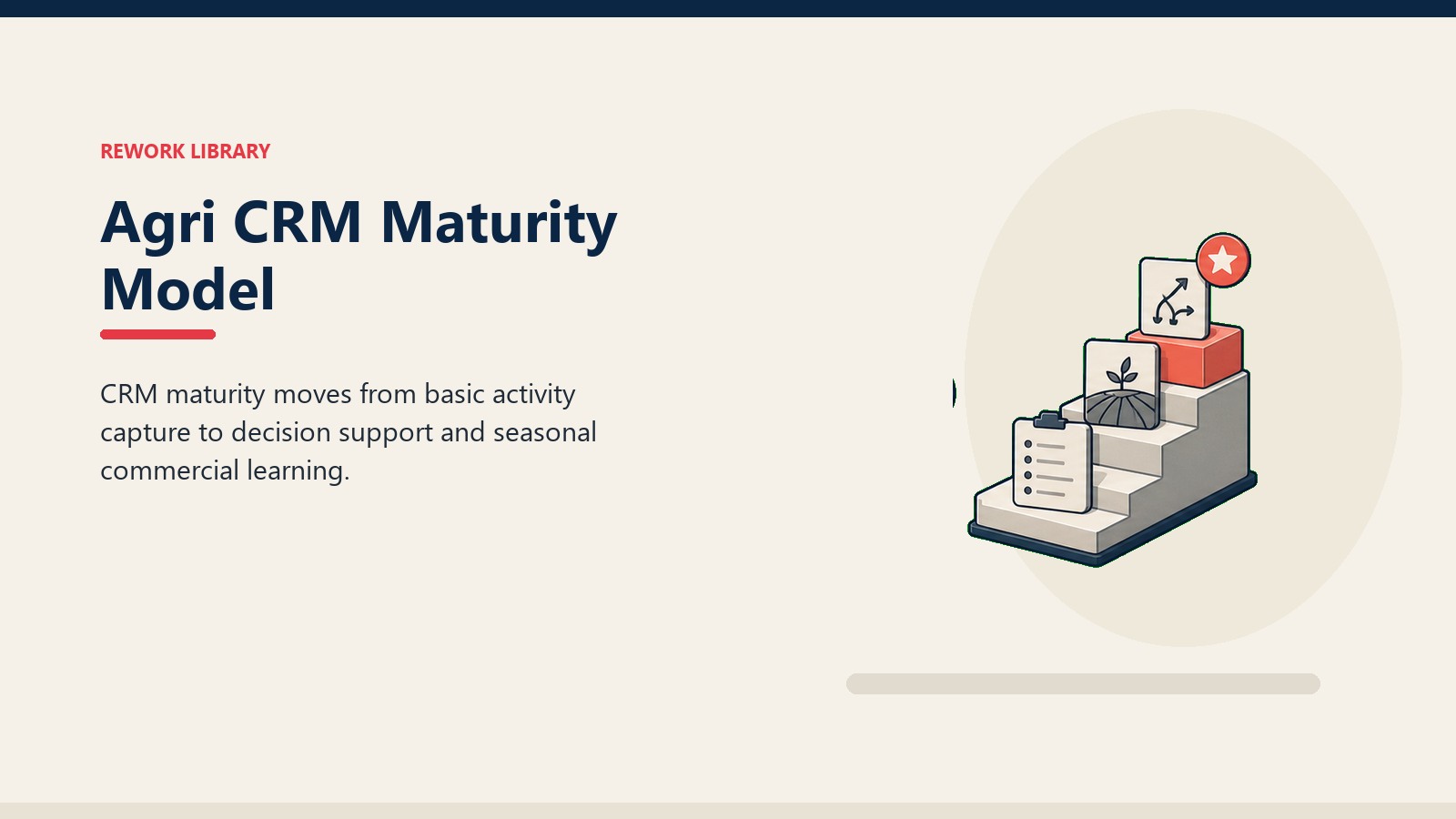
Stage 1: Manual call logging. Paper call reports, end-of-day or end-of-week submission, dealer records in spreadsheets. Data is fragmented, late, and largely used for attendance verification. Insights are anecdotal.
Stage 2: Basic digital attendance. Mobile app for call report submission with GPS tagging. Reps log visits in real time. But the data captured is shallow: visited dealer X, spoke about product Y, follow-up action logged. No secondary sales, no farmer linkage, no demo plot tracking. The system proves presence, not productivity.
Stage 3: Integrated field intelligence. Secondary sales data flows from distributor billing systems into the CRM. Demo plots are registered and tracked through to outcome capture. Farmer records link to dealer records. Territory performance is visible in dashboards that sales managers use for weekly review. Reps see their own performance data in the app. This is where the CRM starts functioning as a commercial asset rather than a reporting tool.
Stage 4: Predictive territory intelligence. AI-assisted call planning surfaces priority dealers based on stocking patterns, sales velocity, and competitor activity signals. Anomaly detection flags territories where secondary sales have dropped without a corresponding primary sales reduction, signaling stock return risk. Visit recommendations weight seasonal crop calendars automatically. This is a small number of agri-input companies today, but it's the direction the category is moving.
Governance and Data Quality
A CRM is only as useful as the data it holds, and agri-input data is structurally messy.
Dealer and farmer master data stewardship. Someone needs to own the dealer master: who adds new dealers, who reclassifies them, who removes dealers who've exited the trade. The same is true for the farmer universe if you're maintaining one. Without ownership, the records drift. Duplicate dealers accumulate. Inactive farmers stay active. The field rep who visits a dealer finds two versions of the same record and creates a third.
Duplicate record controls. Dealer master duplication is particularly common when CRM and ERP records aren't synchronized. But it also happens when field reps create new records for dealers they can't find in the system, because the existing record has a slightly different name or spelling. The system needs fuzzy match checking on record creation, and a deduplication workflow to merge records when duplicates are identified.
Sync cadence between field data and central analytics. Offline-first design means field data queues on the device until connectivity returns. That's the right tradeoff for rep usability. But it means central analytics can lag behind field activity by hours or, in very remote territories, by days. Define the sync cadence expectation explicitly: what's the acceptable lag for territory dashboards to reflect field activity? For most operations, 24-hour lag is acceptable; for anomaly detection systems, you want same-day.
Data Quality Checklist
| Data element | Owner | Check frequency | Failure indicator |
|---|---|---|---|
| Dealer classification tier | Trade sales manager | Monthly | Dealer in wrong tier vs. purchase volume |
| Dealer-territory mapping | Sales ops | Quarterly | Rep visiting dealers outside assigned territory |
| Farmer record completeness | Field rep + manager | Per season | Farmer records with no crop or farm size data |
| Demo plot outcome capture | Rep + agronomist | Per demo cycle | Plots registered with no outcome recorded |
| Secondary sales data sync | IT / distributor liaison | Weekly | Distributor with no secondary sales for 30+ days |
| ERP-CRM dealer master sync | IT / trade ops | Weekly | Dealer exists in ERP but not in CRM |
ROI Framework: Measuring CRM Value in Agri Operations
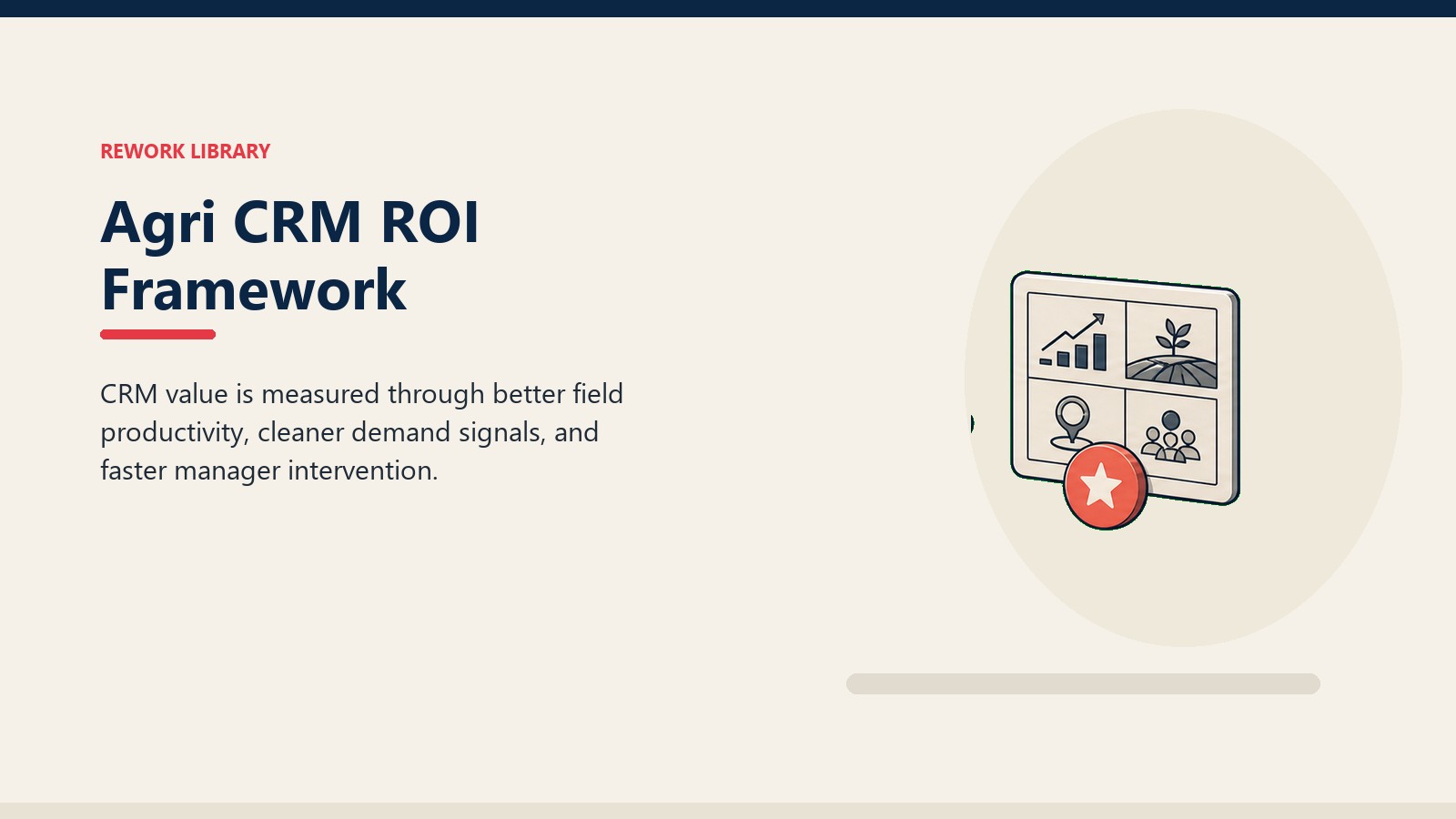
The ROI conversation for agri CRM is often framed incorrectly: the question gets asked as "what did we spend and what revenue did we add," when the more tractable question is "are field reps working more productively on the right things." These metrics give you that signal.
ROI Metrics
| Metric | What it measures | Target benchmark |
|---|---|---|
| Call plan adherence rate | % of planned visits actually completed in the week | 80%+ of planned visits executed |
| Dealer coverage % | % of active dealers visited at least once in the season | 90%+ of tiered dealers covered |
| Data completeness score | % of mandatory call report fields populated on submission | 95%+ completeness at submission |
| Time-to-report | Average minutes between visit end and call report submission | Under 10 minutes |
| Secondary sales capture rate | % of active distributors providing secondary sales data into CRM | 70%+ distributor participation |
Call plan adherence rate surfaces whether the visit strategy is being executed. Dealer coverage percentage tells you whether your highest-value dealers are actually getting face time. Data completeness score tells you whether the CRM is functioning as an intelligence tool or a checkbox exercise. Time-to-report is a proxy for how well the mobile UX fits into the rep's actual workflow. And secondary sales capture rate tells you whether the data pipeline from distributors is functioning, which is the input that drives most downstream analytics.
The dealer visit playbook documents how to structure the visit itself; these metrics tell you whether visits are happening and whether they're generating usable data.
Learn More

Senior Implementation Consultant
On this page
- What Agri CRM Must Cover That Generic B2B CRM Doesn't
- Agri CRM Capability Comparison
- Key Platform Capabilities That Drive Field Productivity
- What Are the Most Common Agri CRM Deployment Failures?
- The Agri CRM Maturity Model
- Governance and Data Quality
- Data Quality Checklist
- ROI Framework: Measuring CRM Value in Agri Operations
- ROI Metrics
- Learn More