Contract Farming and Buyback Channels: Selling Agri-Inputs Through Integrated Supply Models
Turn this article into takeaways for your work.


Each assistant summarizes the article only for you and suggests best practices for your work.
A potato processor in Punjab contracts with 400 farmers every season. It supplies certified seed. It specifies the fertilizer program and mandates the pesticide schedule. It buys the entire crop back at a pre-agreed price tied to quality grading. The farmers under that contract aren't walking into a dealer shop to decide what to buy. The processor has already decided. Its procurement team, not 400 individual farmers, is the actual buyer of your product.
This is a different sale entirely from retail agri-input selling, and it's growing. Food processors, exporters, agribusiness integrators, and large retail chains building private-label supply chains all run contract farming and buyback arrangements now. These have expanded across cash crops, vegetables, dairy-adjacent fodder, and specialty grains in most major agricultural economies. For an agri-input company, this channel means concentrated volume through a small number of institutional buyers, not fragmented volume through thousands of dealers. It requires a different set of skills than the field rep playbook built for retail.
What Makes Contract Farming a Distinct Sales Channel
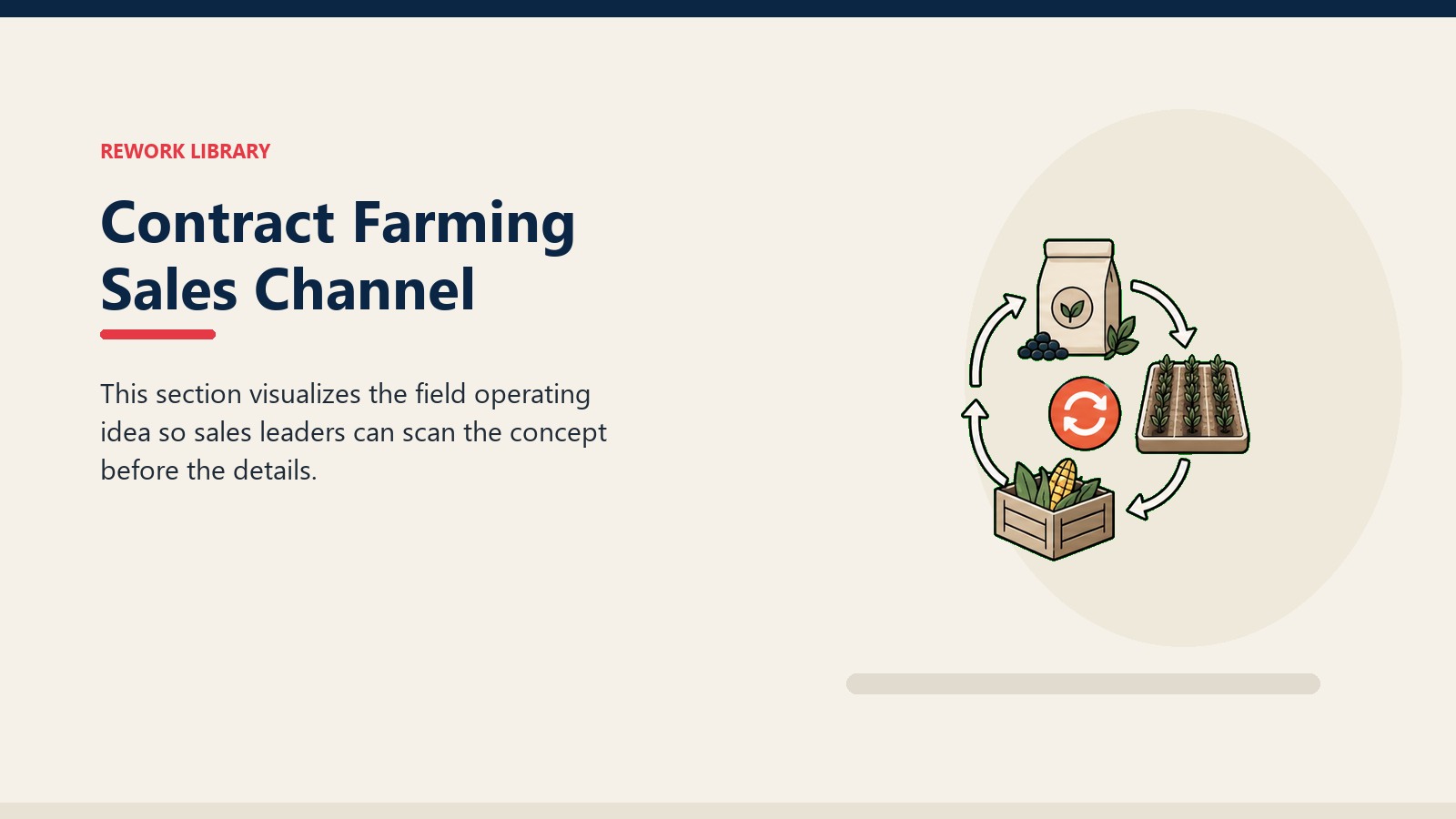
The buyer is an institution making a portfolio decision, not a farmer making an individual one. A processor, exporter, or integrator sponsoring a contract farming program is specifying inputs across its entire contracted acreage at once. A decision to switch fungicide brands isn't one farmer's choice, it's a decision that affects every contracted farmer in the program simultaneously. This concentrates your sales effort onto a handful of institutional accounts, but it also means a single lost account can represent the volume of hundreds of individual farmer relationships.
Input specification is often locked well before the season starts. Many buyback programs specify the exact product, dosage, and application schedule as part of the farming protocol the contracted farmer agrees to follow, sometimes because of quality or residue requirements on the output side (a processor exporting to a market with strict pesticide residue limits will specify inputs accordingly). Winning this business means getting your product written into the season's protocol before planting, not pitching farmer by farmer once the season is underway.
Payment flows differently than in retail channels. In many buyback structures, the sponsor company deducts the cost of inputs it has supplied or specified from the final payment it makes to the farmer for the harvested crop. This means your commercial relationship and your credit exposure sit primarily with the sponsor company, not with the individual farmer, which is a meaningfully different risk profile than the multi-tier dealer credit chain described in Channel Credit and Financing.
Technical and compliance requirements are often higher. A processor selling into an export market or a retail private-label program frequently has specific residue limits, traceability requirements, or certification standards (GlobalGAP-type schemes or equivalent) that flow down into which inputs are permitted. Selling into this channel sometimes means demonstrating regulatory compliance documentation before a product even gets considered, not just making a commercial pitch.
| Dimension | Retail / Dealer Channel | Contract Farming / Buyback Channel |
|---|---|---|
| Buyer | Individual farmer, at the dealer counter | Sponsor company (processor, exporter, integrator) |
| Decision unit | One farmer, one purchase | One institution, decision covers entire contracted acreage |
| Timing | Ongoing through the season | Locked into the season's protocol before planting |
| Payment | Cash or dealer credit at point of sale | Often deducted from final crop payment to the farmer |
| Compliance bar | Standard product registration | Often residue limits, traceability, certification requirements |
| Volume per account | Small, fragmented across many farmers | Large, concentrated in one institutional relationship |
Key Facts: Contract Farming and Buyback Models
- The Food and Agriculture Organization identifies contract farming as a mechanism for linking smallholder farmers to buyers and modern value chains, noting that arrangements commonly give producers access to technology, training, technical support, inputs, or finance as part of the contract. (Source: FAO, Contract Farming Resource Centre)
- The World Bank's agriculture and agribusiness practice highlights that vertically coordinated models, including contract farming and buyback arrangements, can improve smallholder access to quality inputs and technical extension that would otherwise be unavailable through fragmented retail channels. (Source: World Bank, Farming and Agribusiness)
- McKinsey's analysis of major agricultural-input chains across eight African countries found fragmented supply chains, where inputs typically change hands three times between importer and farmer, add a 20 to 50 percent markup over import price, a structural inefficiency that vertically integrated buyback models are partly designed to reduce. (Source: McKinsey, "Winning in Africa's Agricultural Market")
Who You're Actually Selling To
The sponsor company's procurement or agronomy team is usually the primary buying unit. In a processor-led buyback program, this might be an agronomy or farm services department responsible for specifying and sometimes physically distributing inputs to contracted farmers. In an exporter-led program, it might be a quality and compliance team focused as much on residue and traceability as on cost. Understanding which department leads the decision, and what they're optimizing for, shapes your pitch.
The field extension team the sponsor runs. Most serious contract farming operations run their own extension staff, agronomists employed by the sponsor company who work directly with contracted farmers on production practices. These extension staff are often the ones who actually apply or supervise input application. Building a relationship with this team, not just the procurement decision maker, matters because they're the ones who'll notice if your product underperforms in the field and will report that back to the people who decide next season's protocol.
Sometimes a farmer producer organization sits in the middle. In some models, the sponsor company contracts with an FPO or a farmer group rather than directly with individual farmers, and the FPO handles the last-mile distribution and support. Where this is the structure, the considerations in Selling to FPOs and Farmer Cooperatives apply as well, layered underneath the sponsor company relationship.
The contracted farmers themselves have limited but real influence. Even though farmers aren't the primary buying decision maker, a farmer group that's unhappy with a specified input, because of poor results, difficult handling, or a preference for an alternative they've used before, can create pressure on the sponsor to reconsider the protocol. Field reps shouldn't ignore farmer sentiment even in a channel where farmers aren't writing the purchase order.
Building the Case to Get Written Into the Protocol
Getting your product specified into a buyback program's input protocol is closer to a B2B enterprise sale than a retail agri-input sale. It requires a structured case, not a relationship visit. The Protocol Inclusion Case, the four-part evidence package below, is what separates a company that wins the specification from one that gets a polite meeting and no protocol change.
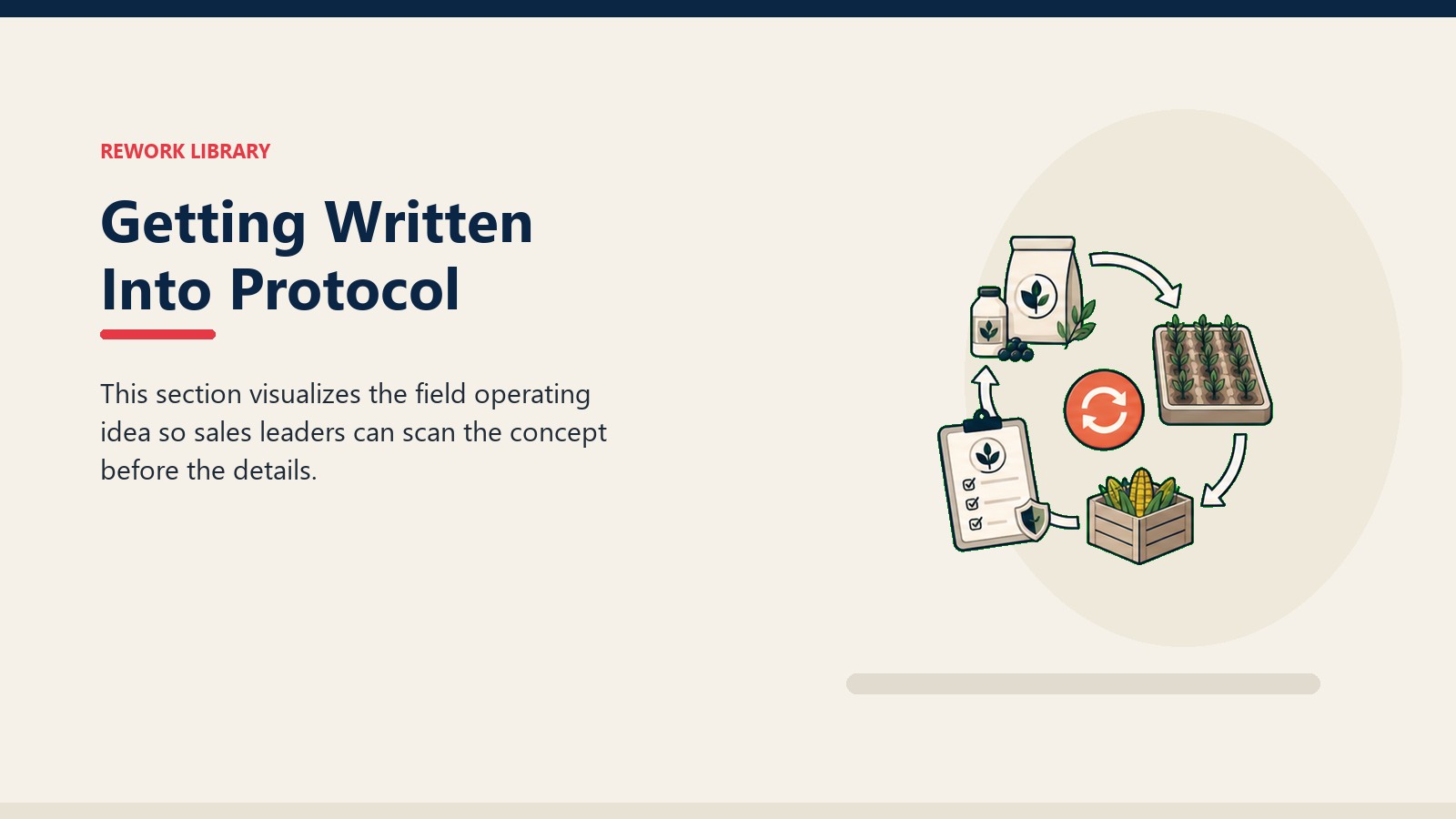
Bring agronomic and compliance data, not just a product pitch. A sponsor company deciding what to specify across hundreds of contracted acres wants efficacy data specific to the crop and region, residue data if the output is going to a market with strict limits, and ideally a track record from a comparable program elsewhere. This is a case built on evidence, assembled before the meeting.
Quantify the impact on the sponsor's actual economics. A processor's real interest isn't input cost minimization in isolation, it's the total economics of the program: yield, quality grade distribution, and the extension burden of managing the input program. A product that improves quality grade outcomes, reducing the share of harvest falling into a lower-value grade, can win the specification even at a higher input cost, if you can demonstrate it with data.
Propose a trial before asking for full-program specification. Sponsor companies managing acreage at scale are understandably cautious about changing a specification across an entire program based on one pitch. Proposing a trial on a subset of the acreage, with a measurement protocol agreed in advance, gives the sponsor a lower-risk path to evaluating your product.
Understand the sponsor's own buyback economics and timing pressure. A sponsor's willingness to change specification is shaped by when they need certainty for their own downstream commitments; an exporter that's already committed volume overseas has less appetite for specification risk close to the season. Timing your pitch to the sponsor's planning calendar, well before their protocol lock-in date, matters more here than in retail selling.
Contract farming sales readiness checklist:
- Identify whether the sponsor company runs procurement decisions centrally or delegates by region/crop manager
- Gather crop- and region-specific efficacy data, not generic product data
- Confirm residue limit or certification requirements relevant to the sponsor's output market
- Propose a measurable trial structure before asking for full-program adoption
- Map the sponsor's own protocol lock-in timeline and pitch well ahead of it
- Identify the extension team lead who will actually oversee field application, in addition to the procurement decision maker
Managing the Commercial Relationship Once You're In
Concentration risk cuts both ways. Winning a large buyback specification is valuable volume, but it means a meaningful share of your regional revenue now depends on one institutional relationship. If that sponsor changes suppliers, loses a downstream export contract, or scales back the program, the impact on your business is immediate and concentrated. Track buyback-channel revenue concentration explicitly and avoid letting any single sponsor become disproportionately large without a contingency plan.
Service delivery has to match the sponsor's extension calendar, not your standard field visit cadence. A sponsor running its own extension program expects your technical support, joint field visits, training for their extension staff, rapid response on field issues, to align with their crop calendar. Treating this account like a standard dealer territory undersells the relationship's importance.
Payment terms need underwriting specific to the sponsor's own business. Because payment in buyback-linked programs is often deducted from the crop payment at season end, your receivable exposure sits with the sponsor for the full season. Underwriting this means evaluating the sponsor's own creditworthiness and the health of its buyback business, not just farmer-level credit signals.
Protect the relationship from margin erosion via renewal negotiations. A sponsor that has built a season's confidence in your results is well positioned to negotiate hard at renewal, precisely because switching carries risk for them too. Go into renewal conversations with the same performance data you used to win the business, reframing around continued value rather than defending the existing price.
Where Contract Farming Fits in a Broader Channel Portfolio
Contract farming and buyback channels won't replace retail and dealer selling for most agri-input companies, and they shouldn't be expected to. What they offer is a different volume and risk profile: concentrated, protocol-driven, higher compliance bar, but potentially more stable once you've won the specification and proven results over a season or two.
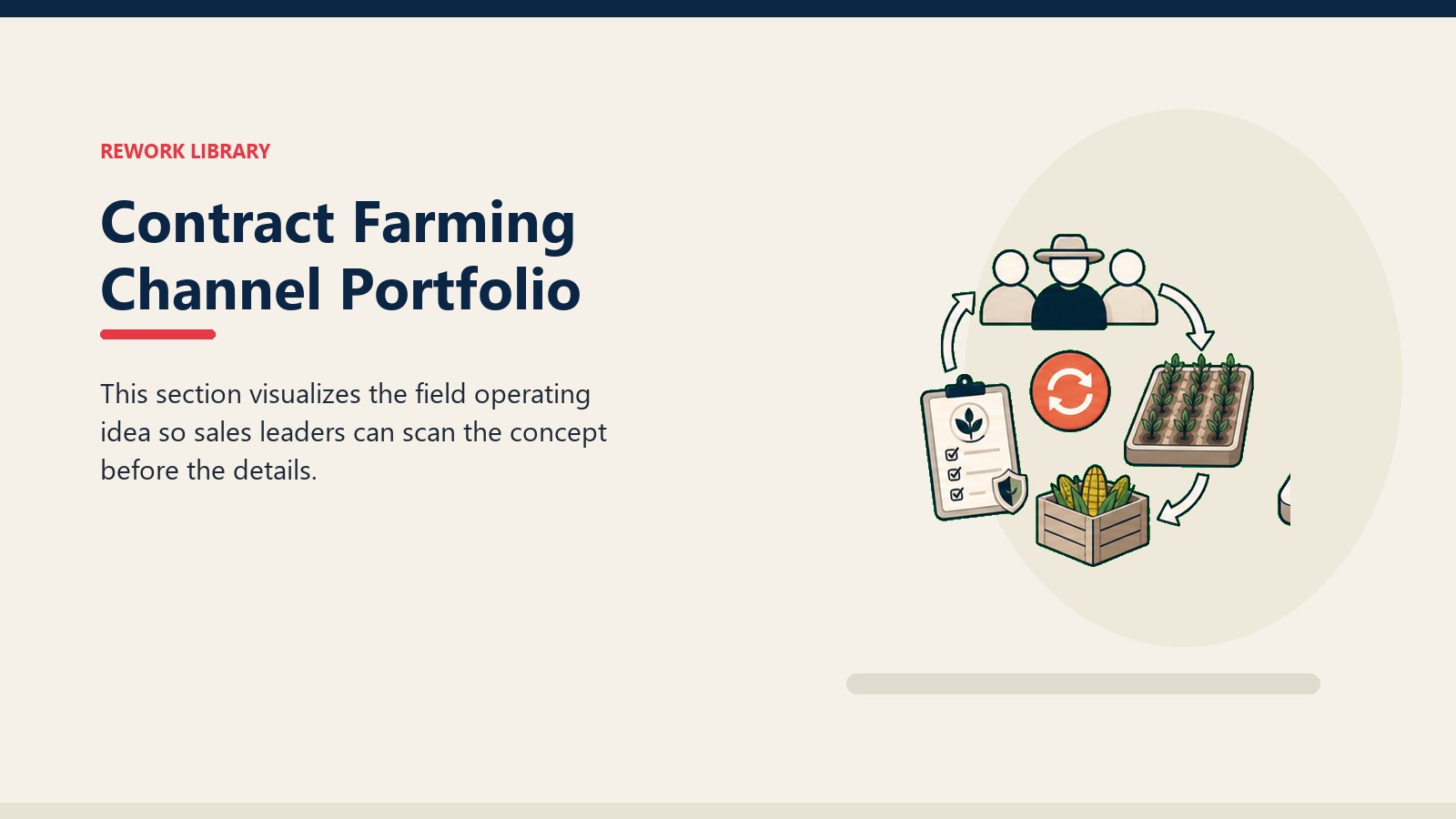
The commercial skill this channel demands looks more like enterprise B2B selling than classic field agronomy selling: building an evidence-based case, understanding an institutional buyer's own downstream economics, and managing a concentrated account relationship with the same discipline you'd apply to distributor credit or dealer segmentation elsewhere in the business. See Sales and Distribution Supply Alignment for how a concentrated institutional account like a buyback sponsor needs to be factored into broader supply and territory planning, since a large program's seasonal input needs can materially shift a territory's demand forecast.
Companies that treat contract farming as just another dealer account with a bigger order size tend to underinvest in the technical case and lose the specification to a competitor who did the work. Companies that build a dedicated institutional sales motion for this channel, distinct from but coordinated with their retail field force, capture volume that's genuinely hard for a less prepared competitor to dislodge once it's won.
Frequently Asked Questions about Contract Farming and Buyback Channels
How is selling into a contract farming program different from selling to a large distributor?
A distributor is a commercial intermediary that resells your product based on its own margin and demand read. A contract farming sponsor is specifying and often paying for the input as part of a farming protocol designed for a specific crop and quality outcome. The sale is closer to a technical specification decision than a stocking decision, and usually requires agronomic and sometimes compliance evidence rather than a relationship pitch alone.
What happens to our relationship with existing dealers if a buyback sponsor buys inputs directly from us?
This depends on how the sponsor sources product. Some purchase directly from manufacturers at volume-negotiated pricing, bypassing the dealer network for their contracted acreage. Others route purchases through an approved local distributor to keep logistics simple. Clarify this model before entering the relationship, and if direct sourcing is likely, communicate proactively with dealers in that territory so they don't assume they've lost the account unfairly.
How much agronomic data do we need before pitching a buyback sponsor for a protocol inclusion?
Enough to be specific to their crop, region, and quality outcome, not generic product performance data. A vague efficacy claim won't move a protocol decision affecting their entire contracted acreage. Crop- and region-specific trial data, ideally including a quality grade or yield outcome tied to the sponsor's own economics, is the minimum bar. If you don't have that data yet, proposing a measured trial on a subset of acreage is more credible than pitching for full adoption without evidence.
What's the biggest risk in relying heavily on contract farming and buyback channel volume?
Concentration risk. A small number of institutional relationships can represent a large share of regional volume, so losing one sponsor, or having its own buyback business contract, has an outsized impact compared to losing equivalent volume spread across many dealers and farmers. Track this concentration explicitly, diversify across sponsor relationships where the market allows, and maintain a genuine retail and dealer presence alongside institutional accounts rather than let one replace the other.
Do field reps still matter in a channel where the sponsor company makes the buying decision?
Yes, in a different role than the retail playbook. Reps and technical staff who build relationships with the sponsor's extension team, and who stay visible in contracted farmers' fields even though farmers aren't the buyer, generate the on-the-ground performance evidence and farmer sentiment that influences renewal and expansion decisions. The role shifts from closing individual transactions to sustaining the technical proof points an institutional account depends on.
How long does it typically take to win a protocol specification with a new sponsor?
Long enough that it should be planned as a multi-season effort, not a single sales cycle. Sponsors managing acreage at scale rarely change a specification quickly, especially one tied to compliance or export requirements. A trial in year one, expanded specification in year two based on trial results, and full-program adoption by year three is a realistic pattern for a new supplier relationship in this channel.
Learn More

Senior Implementation Consultant