Agronomy and Commercial Sales Alignment: Turning Technical Advice into Purchase Decisions
Turn this article into takeaways for your work.


Each assistant summarizes the article only for you and suggests best practices for your work.
A company agronomist visits a cotton farmer in Maharashtra, diagnoses a thrips infestation, and recommends a specific systemic insecticide at 1.5L/acre as the correct intervention. The farmer trusts the advice. He goes to the local dealer. The dealer doesn't stock that product. The dealer instead recommends a generic substitute he has in inventory at a lower price point. The sale goes to the competitor's product, and the agronomist's visit generated zero commercial return.
This scenario isn't unusual. It's the predictable result of two functions that share a territory but don't share an operating model. The agronomist optimizes for correct recommendation. The commercial rep optimizes for sell-out. Without a shared framework, they generate friction at exactly the moments they should be reinforcing each other.
The cost isn't just one missed sale. The thrips damage the cotton crop. The farmer blames the substitute product. Next season, he doesn't take the agronomist's advice because it didn't work out last time. The whole value chain breaks down from one dealer interaction that nobody planned for.
What Happens When Agronomy and Commercial Work from Separate Plans?
What the agronomist brings: scientific credibility, crop diagnosis skills, and the ability to stand in a paddy field and earn a farmer's trust in 20 minutes. Farmers who wouldn't take a commercial rep's word will follow an agronomist's recommendation without much hesitation. That trust is a commercial asset, but only if it converts into a purchase. Agricultural extension as a field of practice is built precisely on this dynamic: applying scientific research to agricultural practice through farmer education, with extension agents and company agronomists occupying different points on the same advisory spectrum.
What the commercial rep brings: dealer relationships, stock availability knowledge, pricing fluency, and sell-out accountability. The rep knows which dealers have fungicide inventory, which ones need restocking before the wheat vegetative stage, and when the buying window opens and closes.
Where they collide is predictable once you see the pattern:
- The agronomist recommends a product the dealer isn't stocked on
- The agronomist's recommended rate or application timing sets a price expectation the farmer refuses when the dealer adds margin
- The rep skips the agronomist visit to close a faster, lower-ticket sale and the farmer buys the wrong product, gets a poor result, and doesn't reorder next season
- The agronomist runs 15 farm visits per week with no commercial follow-through, so recommendation conversion is impossible to measure
Key Facts:
- When agro-input dealers actively engage with farmers, they influence product selection in 80% of cases, per a 2021 mystery-shopping study of 402 dealers in Uganda (pmc.ncbi.nlm.nih.gov/articles/PMC8411546). An agronomist recommendation only converts commercially if the dealer has been briefed to carry the recommendation forward at the counter.
- Peer-reviewed research on site-specific agronomic recommendations and adoption (pmc.ncbi.nlm.nih.gov/articles/PMC8960997) found that targeted, location-specific recommendations reduced the gap between recommended and actual fertilizer use by 13.2 kg per hectare and improved maize yields by approximately 15%, confirming that the quality and specificity of the agronomist's recommendation, not just its presence, is what drives measurable commercial outcomes.
- Personalized advisory programs that include tailored agronomic guidance (rather than generic field visits) are associated with 15 to 20% higher input intensity and 25 to 29% higher crop incomes among participating smallholder farmers in India, per a PLOS ONE study published October 2021 (pmc.ncbi.nlm.nih.gov/articles/PMC8553076). The commercial implication: structured agronomist visits that match recommendation to local crop conditions outperform generic advisory at every stage of adoption.
Both functions are doing their jobs individually. The failure is structural: there's no handoff, no shared plan, and no shared metric that makes both accountable for the same outcome.
The Integration Operating Model
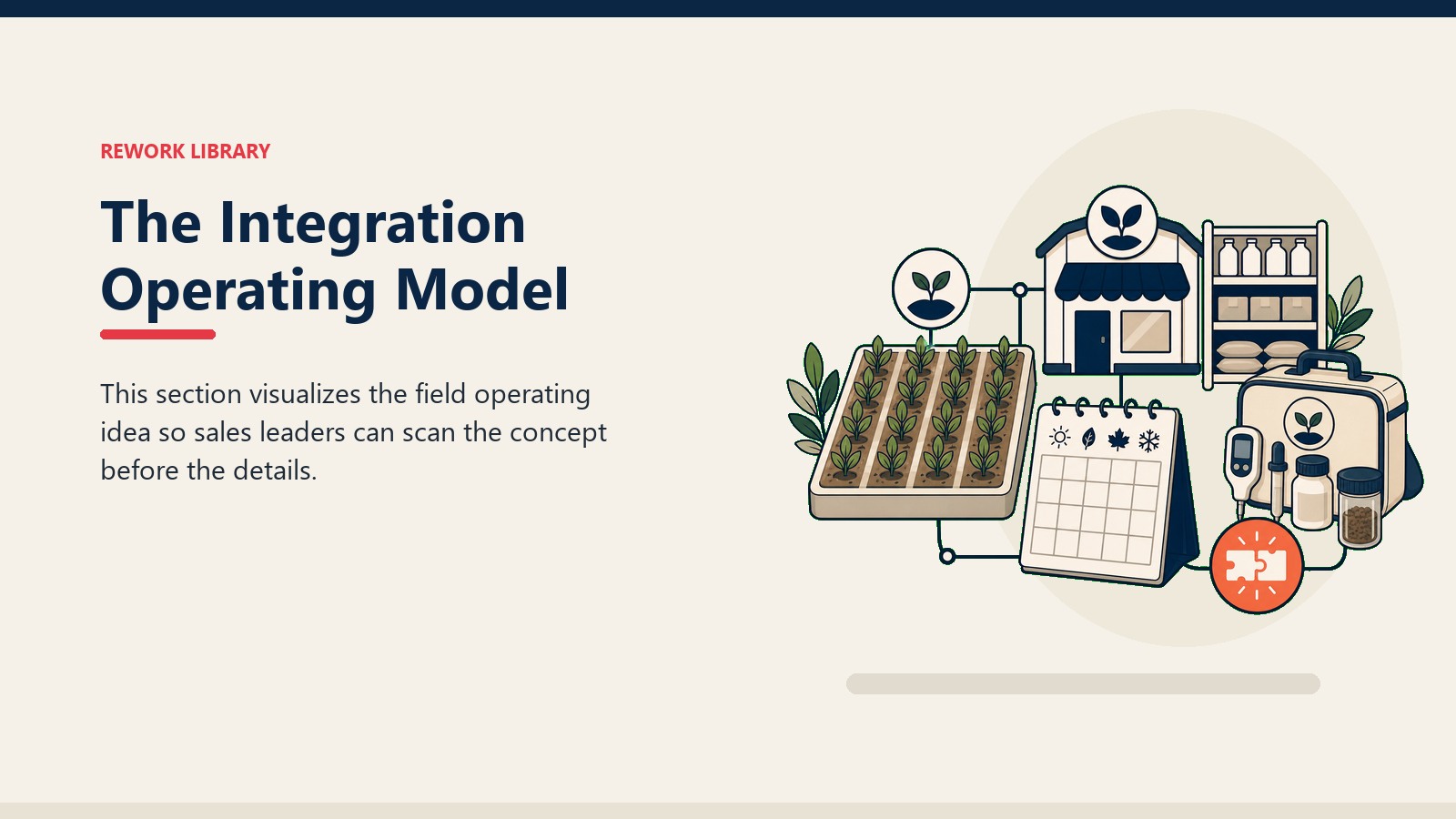
Three structural commitments fix most of the misalignment.
1. Pre-season joint territory planning
Before the season starts, the agronomist and the commercial rep for each territory sit down together and map out: which farmer segments get joint visits, which crop stages trigger an agronomist call vs. a commercial-only visit, and what products the dealer network is stocked to support. The agronomist does not recommend products the territory can't sell. This sounds simple. It requires discipline because the planning session has to happen before planting window pressure arrives.
The output of this session is a written territory plan, not a verbal agreement. Which farms, which crop stages, which products, which dealer gets briefed before which visit. Both functions sign off on it. The field sales manager holds them to it.
2. Staged handoff protocol
In a joint farmer interaction, the agronomist leads the technical diagnosis phase: crop assessment, problem identification, product recommendation. The commercial rep leads the commercial phase: quantity, pricing, dealer referral, purchase timing. The farmer doesn't see a contradiction because the two parts of the conversation are clearly sequenced, not overlapping.
The agronomist doesn't quote prices. The rep doesn't diagnose crop problems. Each plays the role they're credible in, and the farmer gets a coherent experience from start to finish.
3. When the agronomist hands to the rep
The agronomist's job in the interaction ends when the farmer has understood the recommendation and the product. The rep's job begins when the farmer asks "where do I buy this" or "how much will it cost." If both functions try to answer both questions, the interaction gets confused and the farmer gets mixed signals on who to trust on what.
Read more on the technical side of this handoff in agronomy-led product detailing.
Crop-Stage Triggers for Joint Visits
Not every farm visit needs both functions present. The goal is to put agronomist time where it has the highest commercial leverage. Using wheat as the example crop:
| Crop Stage | Timing (approx.) | Agronomist Role | Commercial Rep Role |
|---|---|---|---|
| Pre-sowing | 4-6 weeks before planting | Soil health check, seed variety recommendation, pre-emergent herbicide advisory | Seed and herbicide stocking confirmation with dealer; introduce rep to farmer |
| Sowing | Planting window | Seed treatment advisory, early weed management | Confirm seed treatment product purchase; demo plot enrollment |
| Vegetative (tillering/jointing) | 3-5 weeks after germination | Nutrient management, early pest/disease scouting | Fungicide and micronutrient push; pull-through check with dealer |
| Reproductive (heading/flowering) | Crop fills grain | Disease management (blast, rust); high-value intervention window | High-ticket fungicide close; confirm re-order before next application timing |
| Post-harvest | After crop lifted | Soil restoration recommendations, next season planning | Next season seed and input pre-booking |
The reproductive stage is the highest-value commercial window. Agronomist visits here have the strongest conversion because the crop outcome is visible and the cost of getting it wrong is highest. A wheat farmer looking at a heading crop facing rust pressure will follow a precise recommendation immediately. Both functions should prioritize this stage above all others in the season plan.
The same logic applies to cotton at boll formation and maize at tasseling. The principle is consistent: the higher the visible crop risk, the higher the agronomist's influence on purchase behavior.
See crop-stage recommendation selling for how to sequence the commercial conversation by crop development stage.
Translating Recommendations into Dealer Pull-Through
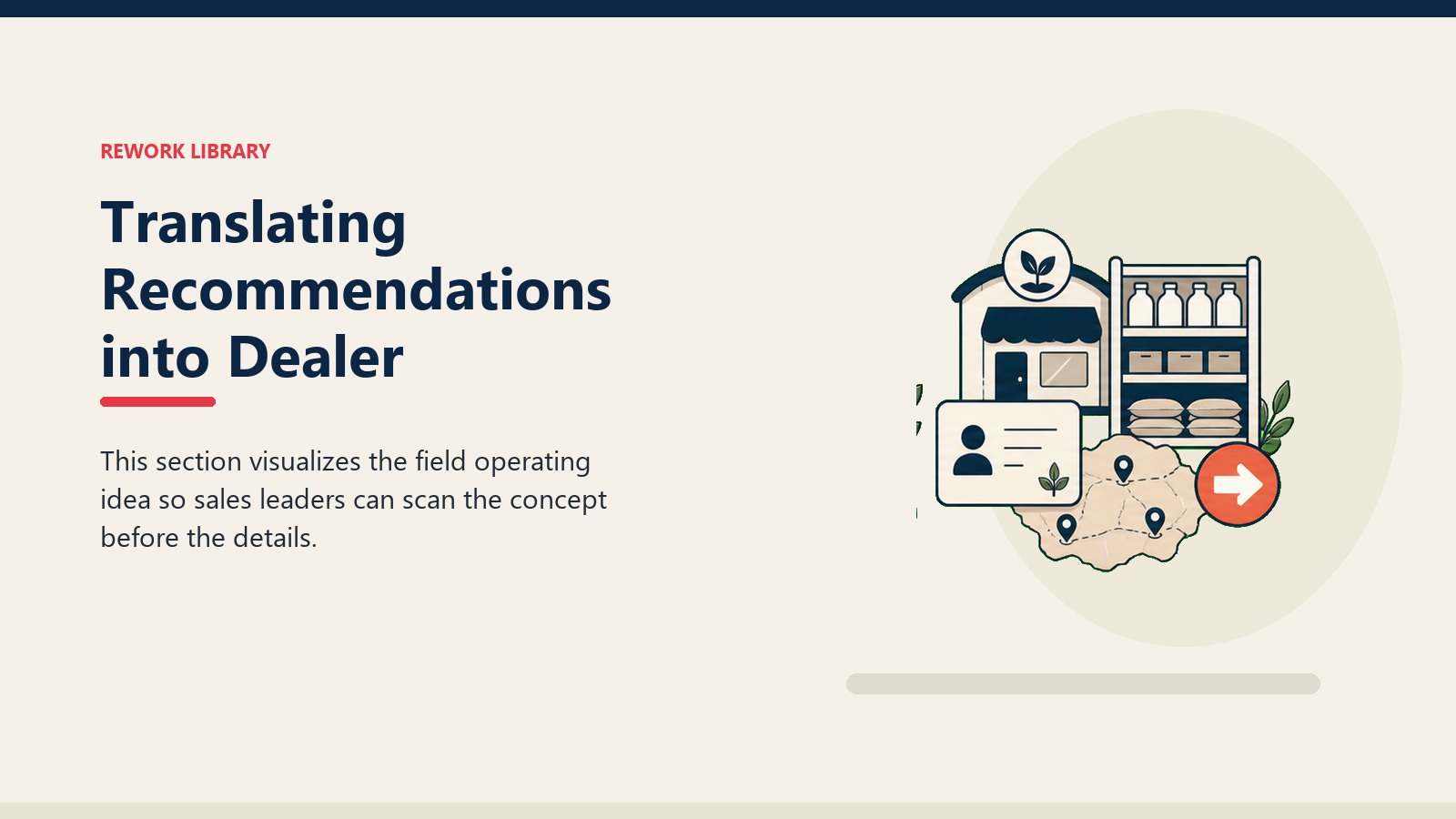
The agronomist recommendation is worthless if the dealer can't fulfill it. Three translation steps close that gap.
Step 1: Agronomist recommendation to dealer briefing
After a joint visit, the commercial rep (not the agronomist) briefs the dealer: which farmer visited, what was recommended, likely purchase timing. The dealer is put on notice before the farmer arrives. This eliminates the scenario where the dealer has no idea what was recommended and defaults to whatever's in stock. A dealer who knows a farmer is coming in for a specific systemic fungicide will pull it from the back shelf and won't substitute.
Step 2: Recommended product confirmed in dealer inventory
Before an agronomist-led advisory blitz in a territory, the rep confirms that the recommended products are in the dealer's stock at adequate volume. No recommendation goes to market for a product the dealer can't sell within the buying window. If the dealer is out of stock on the target product, the rep either restocks the dealer first or adjusts which product the agronomist leads with. The sequence matters: stocking before recommending, not recommending and hoping stocking follows.
Step 3: Price expectation management
The agronomist should know the dealer retail price of every product they recommend. Not to discuss pricing with the farmer (that's the rep's job), but to avoid recommending a 1.5L/acre rate of a premium insecticide when the farmer's budget clearly caps at 0.8L. An agronomist who recommends solutions the farmer can't afford is not helping anyone: the farmer feels the advice is out of reach, the dealer can't close, and the rep has to walk back a recommendation made by someone more credible than they are.
This also applies to demo plot design. Before setting up a demo plot to showcase a new fungicide, the rep should confirm that the plot is using the product at a rate the target farmer can actually afford at scale. Demonstration rates that can't translate to commercial purchases create aspirational showcases, not adoption.
See demo plot management and conversion and marketing and field sales alignment for how to connect field-level demonstration to territory-wide commercial execution.
Three Objection Scenarios and How to Resolve Them
Scenario 1: The agronomist recommends a higher-cost product and the farmer pushes back on price
What usually happens: the agronomist makes the recommendation and leaves. The rep then has to defend a price point the farmer already decided is too high. The rep is fighting uphill because the farmer's objection is fixed and the rep doesn't have the technical credibility to reopen it.
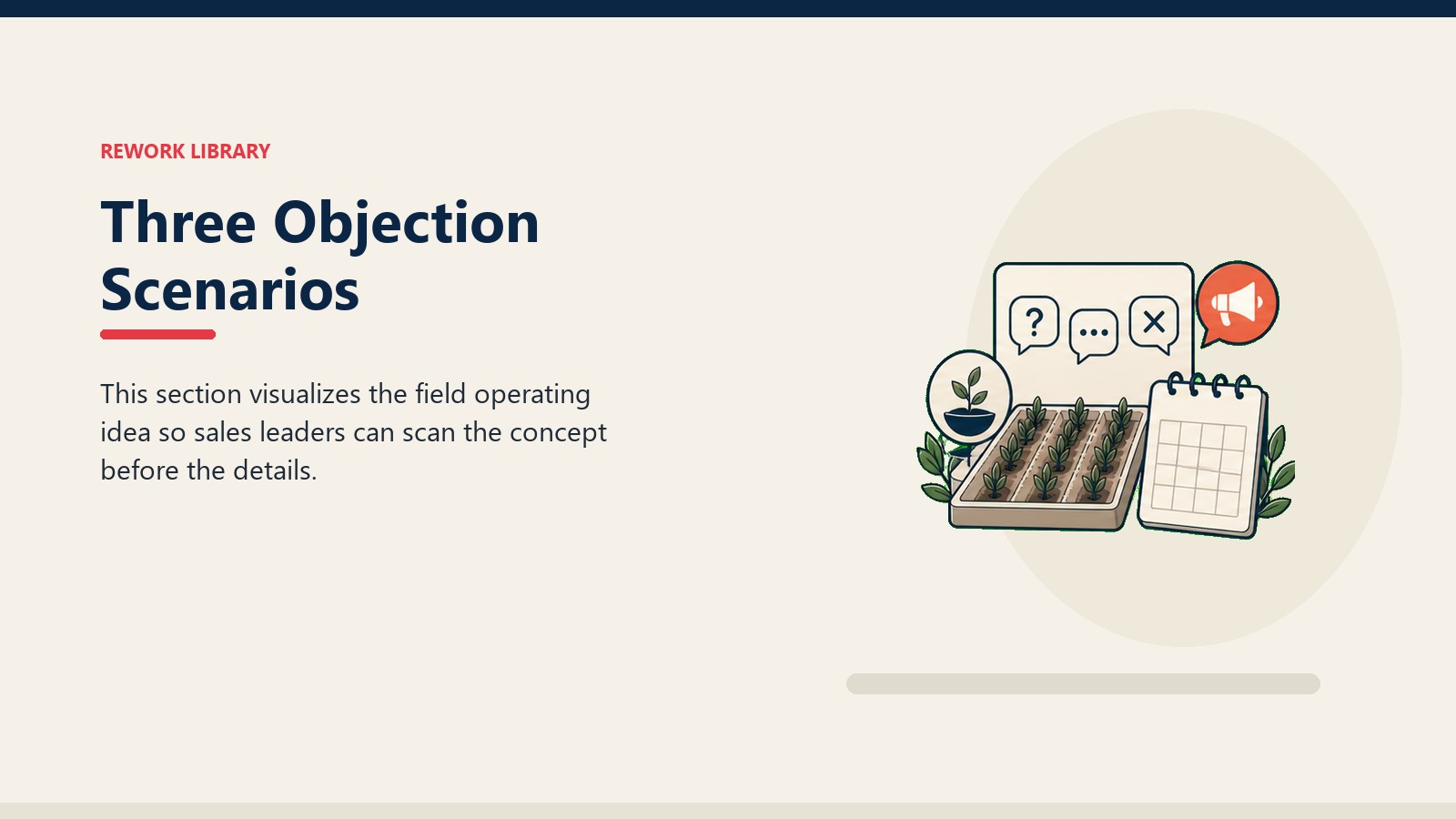
Resolution protocol: the agronomist stays in the room when the price question comes up. The agronomist, not the rep, explains why the higher-cost product is the correct intervention given the crop stage, disease pressure, and expected yield. The rep then handles the mechanics: quantity, dealer referral, payment terms. The agronomist's credibility carries the price conversation; the rep closes the commercial transaction. Farmers who resist a price quoted by a rep will often accept the same price explained by an agronomist who just diagnosed their field.
Scenario 2: The farmer trusts the agronomist more than the rep
This isn't a problem to fix. It's an asset to use. The rep should be the one who schedules the joint visit, introduces the agronomist to the farmer, and follows up after the agronomist visit. The rep builds relationship capital through association with the agronomist. The farmer who trusts the agronomist starts to trust the rep's product recommendations because the rep and the agronomist are clearly working as a team.
The risk version of this scenario: the rep feels sidelined, skips the agronomist visit, and tries to sell on product claims alone. The rep loses credibility, the farmer gets a suboptimal recommendation, and the relationship weakens. You'll see this pattern most often with reps who have high short-term sell-out numbers but low repeat purchase rates. The agronomist visit is what builds the relationship that generates the second and third purchase.
Scenario 3: The rep skips the agronomy visit to close faster
Short-term, the rep closes a faster sale on a lower-ticket product. Medium-term, the farmer uses the product without proper guidance, gets average results, and doesn't see enough reason to reorder. The rep's sell-out number looks fine for this quarter and falls next season.
Resolution: make the agronomy visit a non-negotiable part of the sales process for high-ticket products or first-time buyers. Measure demo-to-adoption rate, not just first purchase. If the rep's demo-to-adoption rate is low, the agronomy step is probably being skipped.
See agronomist KOL engagement for how to use field agronomists as credibility anchors in territory-wide influence programs, and multi-stakeholder navigation for managing complex field interactions where multiple influencers are present.
Shared Metrics for Both Functions
The alignment problem is partly a measurement problem. Agronomists are typically measured on technical output: number of visits, farmer training sessions, demo plot enrollment. Commercial reps are measured on sell-out. Neither metric requires the other to perform well. Both are sub-optimal in isolation because you can hit them without generating durable commercial outcomes.
Three shared metrics fix this:
| Metric | Definition | Who Is Measured | Why It Matters |
|---|---|---|---|
| Recommendation-to-purchase conversion rate | % of agronomist field recommendations that result in a documented farmer purchase within one crop cycle | Agronomist + Rep (jointly) | Closes the loop between technical advice and commercial outcome |
| Demo-to-adoption rate | % of demo plot attendees who purchase the demonstrated product in the following season | Rep (primary), Agronomist (supporting) | Measures whether agronomic demonstration translates to commercial behavior change |
| Joint visit efficiency | Revenue generated per joint visit day vs. revenue per solo rep visit day | Field sales manager | Quantifies the commercial lift of agronomist-rep integration |
When agronomists are measured on recommendation-to-purchase conversion, they start thinking about dealer stocking before they recommend products. When reps are measured on demo-to-adoption rate, they stop skipping the agronomy step because they know the first-season purchase without the agronomy visit won't produce the adoption rate they're accountable for.
The field sales manager's role is to track joint visit efficiency and use it to allocate agronomist time. If joint visits in one territory are generating 2.4x the revenue of solo rep visits, the manager should put more agronomist days into that territory and model why it's working.
For the full KPI framework for agri-input field sales, see the Learn More section below for agri sales KPIs and metrics, and sales capacity planning frameworks for how to size and schedule the joint visit model across a territory.
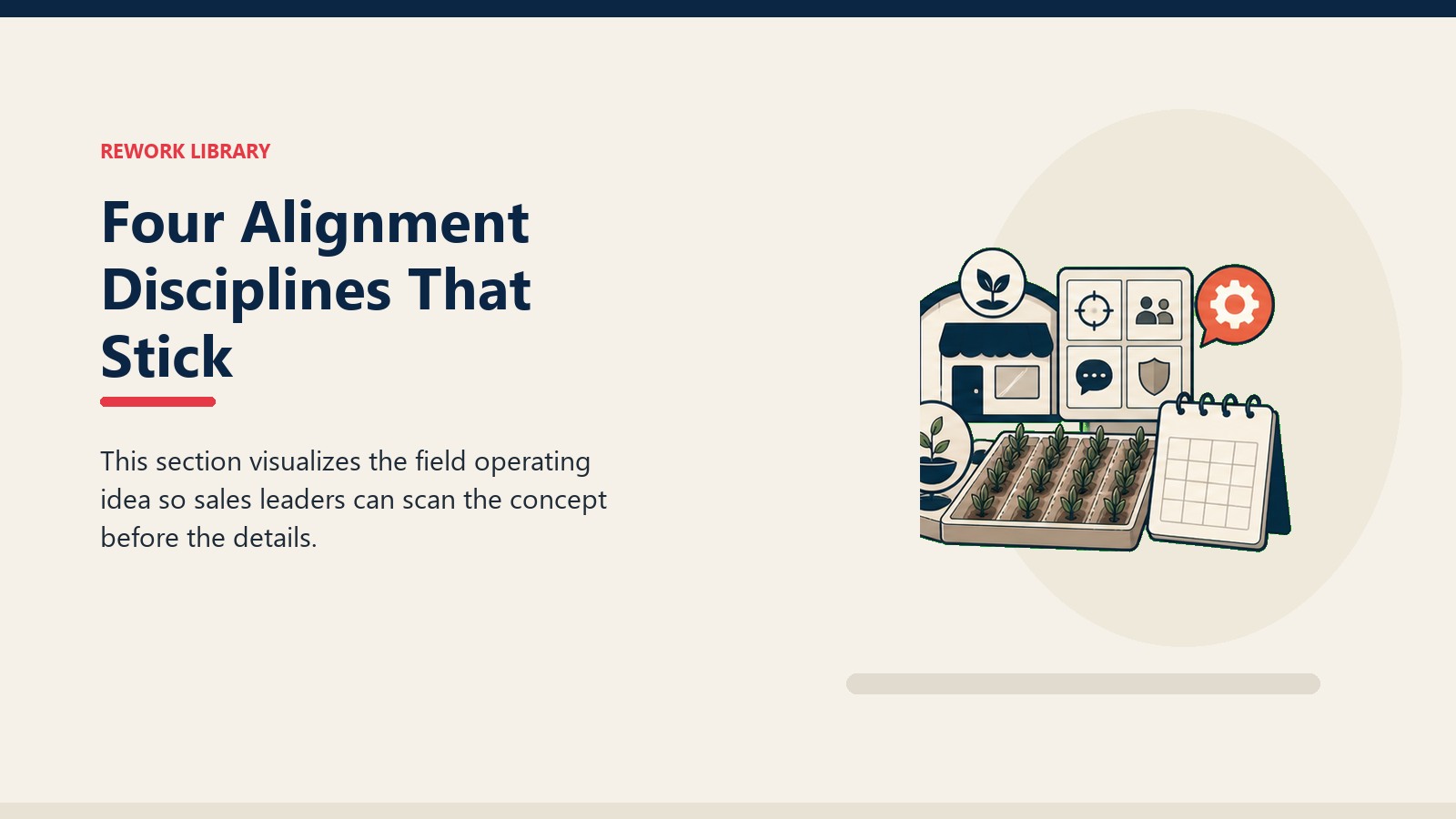
Four Alignment Disciplines That Stick
These aren't recommendations for a future state. They're operating disciplines that companies running aligned agronomy and commercial functions already practice.
1. Joint territory plans before each season
Written, signed, shared. Agronomist and rep map which farmers, which crop stages, and which products before the season starts. The plan isn't a document that gets filed. It's the reference point for every joint visit schedule, every dealer stocking conversation, and every monthly review through the season.
2. Agronomist product awareness
Every agronomist knows the dealer retail price and stock status of every product they recommend. This is a 15-minute weekly briefing from the rep, not a restructuring of the agronomy function. It doesn't require the agronomist to become a sales person. It requires them to know what's commercially viable in their territory before they make a field recommendation.
3. Post-visit follow-up owned by the rep
After every joint visit, the rep owns the commercial follow-through. Not shared. Not ambiguous. The agronomist's job ends when the recommendation is made; the rep's job ends when the dealer records the sale. If follow-through is shared, it gets dropped. One owner, one accountability, one outcome tracked.
4. Monthly conversion review
One meeting, both functions, reviewing recommendation-to-purchase conversion and demo-to-adoption rate by territory. The patterns in that data tell you where the model is breaking down before it costs a full season of revenue. A territory with high agronomist visit volume and low conversion rate has a dealer stocking problem or a follow-up gap. A territory with low joint visit rates and high per-visit conversion may need more agronomist days allocated. The review surfaces those decisions before the planting window closes.
These disciplines don't require new technology or new headcount. They require clarity on who does what and a shared number that makes both functions accountable for the same outcome. The Maharashtra cotton farmer who got the wrong product because nobody planned the handoff is the clearest argument for getting this right before the season starts.
The Diagnose-Recommend-Close Framework: Three sequenced phases for joint agronomist-rep visits. Phase 1 (Diagnose): the agronomist leads the crop assessment, identifies the problem, and proposes a solution. The rep observes and builds rapport. Phase 2 (Recommend): the agronomist explains the recommended product, rate, and timing. The rep notes the dealer who stocks it and the price expectation. Phase 3 (Close): the rep takes over for quantity, payment, dealer referral, and purchase timing. The agronomist answers technical follow-up questions but does not quote prices. Neither phase overlaps with the other's role. The farmer gets a single coherent experience.
Quotable Nuggets
"The agronomist earns the farmer's technical trust. The rep converts that trust into a purchase. When both show up without a plan for who does what, they confuse each other and the farmer defaults to whatever he already knows." (Agronomy-commercial integration operating principle)
"An agronomist who recommends a product the dealer doesn't stock isn't helping the farmer. He's created an expectation the system can't fulfill. Pre-season joint planning exists precisely to prevent this." (Pre-season joint territory planning practice)
"When agro-dealers engage with farmers at the counter, they influence product selection in 80% of cases. That's not a dealer-management problem. It's the clearest possible signal that agronomist recommendations must be followed by a dealer briefing before the farmer's next visit." (Uganda agro-dealer study, PMC 2021, pmc.ncbi.nlm.nih.gov/articles/PMC8411546)
Frequently Asked Questions about Agronomy and Commercial Sales Alignment
What's the most common reason agronomist recommendations don't convert to sales?
Dealer stocking is the single most common break point. The agronomist recommends a product in good faith, the farmer intends to buy it, and then walks into the dealer to find it's not in stock. The dealer fills the void with an alternative. The fix isn't a better recommendation. It's a stocking confirmation step built into the pre-visit process. No recommendation goes to a farmer for a product the rep hasn't confirmed is available at the catchment dealer.
How should the agronomist handle price questions from the farmer?
The agronomist should deflect price questions to the rep, not answer them. The reason is credibility and role clarity. The agronomist's authority is technical. When she starts quoting prices, she's operating outside her expertise and potentially giving the farmer a different number than what the dealer will charge. The appropriate response is: "That's something [Rep's name] can walk you through. He knows the dealer pricing and the payment options." This keeps the agronomist in the role the farmer trusts her in.
What triggers an agronomist visit rather than a rep-only visit?
Three conditions: first-time buyers for a high-ticket product (the risk of a bad first-season result is too high to skip technical backing); farmers with a visible crop problem where the diagnosis determines the product choice; and Moderate or Critical efficacy complaints where the root cause is unclear. Routine reorder visits for farmers who already know the product and have good application history don't need agronomist time. Agronomist time is the company's most valuable technical resource per day. It should go where the purchase decision is genuinely uncertain.
How do you measure whether the agronomy-commercial model is working?
Recommendation-to-purchase conversion rate is the primary metric: the percentage of documented agronomist recommendations that result in a farmer purchase within one crop cycle. A field manager who tracks this number by territory and by crop stage will quickly identify whether the breakdown is at the dealer level (farmer tried to buy but dealer substituted), the follow-up level (rep didn't close within the purchase window), or the recommendation level (farmers heard the recommendation but weren't convinced enough to act on it).
What happens when the rep consistently skips the agronomist step to close faster?
Short-term sell-out numbers look fine for that quarter. The rep closes a lower-ticket product faster without the joint visit overhead. But demo-to-adoption rates in that rep's territory will be below average, because farmers who received product without agronomic guidance get average-at-best results and don't see a strong enough reason to expand usage next season. The pattern is visible in the data if you track demo-to-adoption alongside first purchase. A rep with high first-purchase numbers and low adoption rates is almost always skipping the agronomic step.
Can the agronomist and rep relationship create conflict in front of the farmer?
It can, and it will unless they debrief before the farmer conversation. The most common version: the agronomist completes the field examination and forms a root cause hypothesis, the rep shares a preliminary conclusion with the farmer before the two have aligned, and the agronomist then gives a different assessment. The farmer hears a contradiction from the company's own people. The prevention is simple: agronomist and rep step aside for 10 to 15 minutes at the end of the field examination, agree on what to say, and present a unified position. This discipline is especially important in efficacy complaint visits, where the stakes are higher.
Learn More
Related reading on agronomy integration, commercial sales, and cross-functional alignment:

Senior Implementation Consultant
On this page
- What Happens When Agronomy and Commercial Work from Separate Plans?
- The Integration Operating Model
- Crop-Stage Triggers for Joint Visits
- Translating Recommendations into Dealer Pull-Through
- Three Objection Scenarios and How to Resolve Them
- Shared Metrics for Both Functions
- Four Alignment Disciplines That Stick
- Quotable Nuggets
- Learn More