Farmer Retention and Repeat Adoption: Turning First-Season Trials into Long-Term Brand Loyalty
Turn this article into takeaways for your work.


Each assistant summarizes the article only for you and suggests best practices for your work.
There are two farmers at the end of every successful demo plot or first-season trial. One of them walks away satisfied, tells three people in his village what worked, and asks for your product by name when the next planting window opens. The other one takes your product at an introductory price, gets a decent result, and switches to whatever his dealer recommends next season at a slightly lower price point.
The second farmer isn't disloyal. He's uninformed. No one showed up after the season to reinforce what the product did, explain what he saw in his crop, or give him a reason to repeat the choice. He filled the information gap with price.
That's the fundamental problem with agri-input retention: most organizations invest heavily in acquisition (demo plots, field days, introductory pricing) and almost nothing in the 90-day window after a farmer's first use. That window is when the loyalty decision is actually made.
Why Farmer Churn Happens
Farmer churn in agri-inputs isn't usually about product performance. When efficacy is comparable across competing brands, churn happens for a handful of predictable reasons that a structured retention system can address directly.
Farmer Churn Cause Matrix
| Churn Cause | Underlying Driver | Retention Intervention |
|---|---|---|
| Price sensitivity | No perceived differentiation vs. cheaper alternatives | Post-trial efficacy reinforcement, ROI framing |
| Efficacy perception gap | Farmer couldn't attribute results to the product | Agronomist follow-up with field observation |
| Lack of follow-up contact | No rep visit after first use | Systematic post-trial visit protocol |
| Competitor offer | Dealer or competitor rep pitched first next season | Early reorder engagement before next window |
| Crop failure attribution | Season underperformed; farmer blamed product | Technical explanation visit, agronomic context |
| Dealer recommendation switch | Dealer pushed a competitor with better margin | Dealer alignment on push behavior |
The majority of these causes are not product problems. They're relationship and communication failures. A farmer who blames a poor season on your insecticide because no one explained that the pest pressure was unusually high that year will switch. A farmer who receives a follow-up visit, sees his crop photos compared to an untreated control, and understands what the product actually did in a difficult season will likely stay. The World Bank's research on agricultural technology adoption in developing countries shows that post-trial follow-up and farmer advisory services are among the most reliable predictors of repeat adoption across crop input categories.
Key Facts: Farmer Retention in Agri-Inputs
- A PLOS One study in Tanzania (852 households) found that demonstration plots alone increased the probability of purchasing improved agricultural inputs by 13 percentage points, and plots combined with small trial packs increased it by 15 to 16 percentage points. Only 33 percent of households were purchasing improved inputs at baseline. Source: PLOS One / PMC, Impact of Demonstration Plots on Improved Agricultural Input Purchase in Tanzania, 2021.
- A Nepal rice farming RCT (1,396 households) found that training combined with digital extension follow-up services produced 11.4 to 15.7 percentage point higher adoption of split urea application compared to control groups, while training alone without follow-up produced only a 6.2 percentage point increase. Source: PLOS One, Impact of Training and Digital Extension Services on Agricultural Technology Adoption and Rice Yields.
- Farmers in more central social network positions are 4 to 9 percent more likely to adopt new agricultural technologies than more isolated peers, and a farmer with a peer using a specific input technology is 29 percent more likely to adopt it themselves. Source: Journal of Agricultural Education and Extension, 2025 and ResearchGate, Measuring Social Networks' Effects on Agricultural Technology Adoption.
The Post-Trial Follow-Up System
The post-trial follow-up visit is the single highest-return retention activity available to agri-input field teams. It happens in the 4-8 weeks after first use, when the farmer can still see or remember crop outcomes and before the next season's purchase decisions are made.
Post-Trial Follow-Up Checklist
- Confirm which product was used, at what rate, and on which crop stage
- Ask the farmer to describe what they observed in the field after application
- Walk the field if possible and look for visible efficacy indicators (weed control, pest reduction, crop vigor)
- Compare the treated area to any visible untreated area or neighbor's plot if available
- Address any concerns about the product's performance with specific agronomic context
- Link the observed outcome to product mechanism ("What you saw was the product working systemically through the leaf tissue. That's why it took 10 days to see full effect")
- Calculate or reference the yield or cost savings outcome where measurable
- Confirm the farmer's intent for next season (not a hard sell, an open question)
- Log the conversation outcome in the SFA against the farmer's profile
The visit shouldn't feel like a sales call. It should feel like agronomic support, because it is. A rep who shows up at a farmer's field six weeks post-harvest asking only about next season's order has miscued the purpose. The conversation that builds retention is the one about what happened this season, not the one about next season's product.
Farmer field visit and advisory protocols should include a post-trial visit as a standard stage in the farmer engagement cycle, not an ad hoc activity left to rep initiative.
Retention Triggers by Farmer Segment
Not every farmer retains on the same basis. Farmer segmentation and targeting produces three broad segments with meaningfully different retention drivers.
The Trial-Reinforce-Advocate Model: The three-phase retention cycle for agri-input farmers. In the Trial phase, the farmer uses the product for the first time, usually supported by introductory pricing or a demo plot; the commercial cost is highest here. In the Reinforce phase, the rep visits post-harvest to confirm what the farmer observed, explain the mechanism, and give them a reason to repeat; this is the phase most field teams skip. In the Advocate phase, the retained farmer becomes a peer reference for mainstream and subsistence adopters in the same cluster, converting acquisition cost into social proof. Each phase has a distinct set of rep behaviors and cannot be compressed or skipped without increasing churn at the next phase.
Progressive Farmers (early adopters, larger holdings)
Progressive farmers try new products early and base repeat decisions on measured outcomes. They want technical engagement: yield comparisons, ROI calculations, trial data from local demo plots, and conversations with agronomists who can speak credibly about product mechanisms. A rep who brings an agronomist on the post-trial visit and discusses varietal interaction with the chemistry earns credibility that a purely transactional visit won't.
This segment responds to early-access positioning. If progressive farmers believe they're the first in their area to use a new molecule or formulation, and that their experience with it puts them ahead of peers, that positioning becomes a retention driver in itself. Recognition programs that identify and acknowledge progressive farmers publicly in farmer group settings reinforce this.
Mainstream Adopters (mid-scale, risk-averse)
Mainstream adopters are the core commercial volume. They waited to see the progressive farmer's results before trying the product, so their repeat decision is heavily influenced by what they saw in that farmer's plot and what they hear from peers. Peer-to-peer reinforcement is the strongest retention lever for this segment.
A structured follow-up that connects mainstream adopters to satisfied progressive farmers (through farmer group meetings, field days, or WhatsApp group conversations) is more persuasive than any rep-delivered message. Farmer meetings and field days should deliberately create these connections, including case presentations from farmer-to-farmer rather than exclusively from rep to farmer.
Subsistence Farmers (small holdings, resource-constrained)
Subsistence farmers are the hardest to retain because price is a genuine constraint, not just a negotiating position. Retention for this segment works best through micro-pack availability (smaller purchase units that fit the cash flow cycle), flexible payment options where dealers support credit, and group purchase schemes through farmer cooperatives or self-help groups.
The retention message for this segment isn't about ROI per hectare. It's about risk reduction. A product that prevents crop failure is more valuable to a subsistence farmer than a product that optimizes yield. Framing grounded in loss prevention ("this protects what you've already invested") retains better than yield improvement framing. FAO's work on integrated pest management highlights that smallholder farmers respond most strongly to information that frames decisions in terms of protection against seasonal risk, not optimization of average outcomes.
Why Does Agronomist-Led Retention Outperform Rep-Only Follow-Up?
The highest-retention conversion in agri-inputs happens when an agronomist is involved in the post-trial follow-up. Not because the agronomist has a different script, but because the agronomist has technical credibility that a sales rep often doesn't.
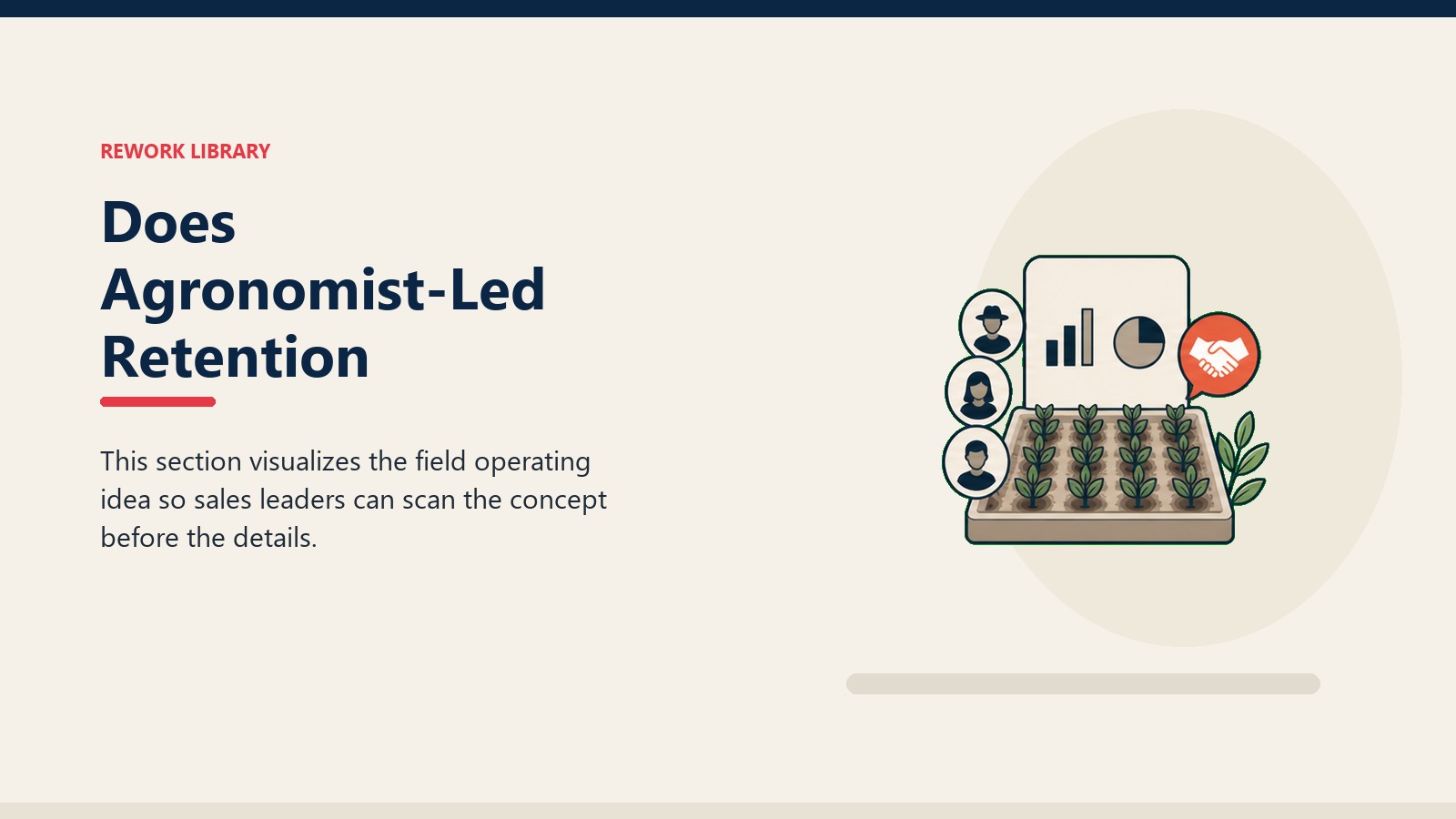
A farmer who wonders whether a product worked can be told by a rep that it did. Or they can be shown by an agronomist who walks their field, identifies the visible signs of efficacy, explains the biological mechanism, and puts the season result in the context of weather, soil type, and pest pressure. The second conversation changes perception in a way the first one doesn't.
Agronomy-led product detailing formally structures this. The agronomist's role in retention isn't ongoing. It's targeted to the 4-8 week post-trial window for first-season users, and to any farmer who raises a performance concern. Dedicating agronomist visits to retention moments rather than spreading them across routine calls is a resource allocation decision that meaningfully shifts retention rates.
When agronomist capacity is limited, a hybrid model works: the rep conducts the post-trial visit, logs any performance questions, and escalates to the agronomist for a follow-up visit where the farmer's concern is technical. This triage approach concentrates agronomist time on the conversations where technical credibility is genuinely needed.
Farmer Referral and Advocacy
Satisfied farmers are already influencing their neighbors' purchasing decisions. The question is whether that influence is happening in a structured way that the commercial team can track and reinforce, or informally and invisibly.
Farmer advocacy programs formalize what happens naturally in village-level farming communities. They're not complex: a structured nudge for satisfied farmers to bring a friend to the next demonstration, introduce a neighbor to their dealer, or share their crop photo in a farmer group, combined with acknowledgment when they do.
The referral mechanism doesn't need to be a formal points program. In many agri-input markets, a simple protocol works: at the post-trial follow-up visit, the rep asks the farmer directly, "If this worked well for you, who else in your village do you think should know about it?" and then offers to visit that person with the farmer present. That farmer-endorsed introduction converts at significantly higher rates than a cold rep visit.
Demo plot management and conversion creates natural advocacy moments. A progressive farmer whose demo plot shows visible efficacy is a live reference site. Bringing peer farmers to that plot (before harvest, at maturity, at harvest) converts observation into intent in a way that no brochure or rep presentation does.
Tracking Repeat Purchase at Field Level
Retention without tracking is invisible. Commercial teams who rely on aggregate seasonal data to understand farmer retention are working with a lag of at least one full season before a problem becomes visible. By then, it's too late to intervene.
Repeat Adoption Tracking Template
| Tracking Data Point | Collection Method | Frequency | Action Trigger |
|---|---|---|---|
| Post-trial visit completion | SFA log by rep | Within 8 weeks of first use | Unvisited farmers flagged for priority follow-up |
| Farmer-expressed intent to reorder | Logged at post-trial visit | Per visit | "Unsure" or "No" triggers agronomist escalation |
| Seasonal reorder confirmation | Dealer-reported off-take or SFA entry | Pre-season | No reorder by week 3 of purchase window flags at-risk farmer |
| Repeat purchase quantity vs. prior season | Dealer secondary data | Season end | Decline triggers retention review visit |
| Referral farmer conversions | SFA follow-up tagging | Per new farmer acquired | Tracks advocacy program effectiveness |
The rep's SFA is the practical tracking tool at field level. But it only works if rep logging discipline is enforced. Managers reviewing weekly SFA data should specifically look at the post-trial visit completion rate for first-season farmers and the reorder rate for second-season targets. Both are leading indicators of retention performance that arrive earlier than end-of-season sales data.
Connecting dealer-reported secondary sales to individual farmer purchase histories is the most complete tracking approach, and it requires dealer participation in secondary reporting. This is where secondary sales tracking infrastructure pays a retention dividend beyond its primary role in inventory management.
Is Repeat Adoption the Highest-ROI Activity Available to an Agri-Input Commercial Team?
The arithmetic of farmer acquisition vs. retention is clear in agri-inputs. Acquiring a new trialist requires demo plot investment, introductory pricing, rep visit time, and agronomist support. That cost per new farmer ranges from meaningful to significant depending on the crop and market. Retaining an existing user requires a post-trial visit, a targeted follow-up conversation, and early-season contact. The FAO's overview of agricultural input markets notes that in liberalized markets, where farmers choose suppliers freely, repeat purchase decisions are driven primarily by perceived service reliability and technical support, not product price alone.
The retention intervention costs less than a quarter of the acquisition investment in most organizations. But retention rates are measured and managed in far fewer organizations than acquisition rates.
Retention fundamentals applies to agri-inputs in the same way it applies to every B2B commercial relationship: the cost of replacing a lost customer with a new one almost always exceeds the cost of keeping the one you had. In agri-inputs, that arithmetic is amplified by the seasonal nature of the business. A farmer who doesn't reorder this season is likely building a new dealer relationship and a new product habit that will take multiple additional seasons to reverse.
Building a systematic repeat adoption program isn't a farmer welfare initiative. It's the most capital-efficient growth activity available to an agri-input commercial team. And it's the one most consistently underinvested.
Quotable Nuggets
"In a Nepal rice farming study of 1,396 households, training combined with digital follow-up extension services produced 35 to 56 percent higher rice yields compared to control groups, while training alone without the follow-up component produced only a fraction of that gain. The follow-up contact is what converts trial into repeat behavior, and what converts repeat behavior into yield improvement." Source: PLOS One, Training and Digital Extension Services on Adoption and Rice Yields, Nepal, 2025
"A farmer with a peer already using a specific input technology is 29 percent more likely to adopt it themselves. In farming communities where peer trust outweighs brand trust, the most efficient retention mechanism is converting one satisfied progressive farmer into a visible reference point for the cluster around them." Source: ResearchGate, Measuring Social Networks' Effects on Agricultural Technology Adoption
"Dis-adoption rates for improved crop varieties in Tanzania ranged from 22.8 percent to 58.4 percent across different varieties, with over half of dis-adopters quitting the crop category entirely rather than switching to an alternative. Churn in agri-inputs is rarely neutral: when a farmer stops using a product, they often stop engaging with the category." Source: Emerald / CIMMYT, Who Is Quitting? Dis-Adoption of Climate Smart Sorghum Varieties in Tanzania
Frequently Asked Questions about Farmer Retention and Repeat Adoption
When is the right time to visit a farmer after their first product use?
The optimal window is 4-8 weeks post-application, while the farmer can still observe or recall crop outcomes from the current season. Visits earlier than 4 weeks may be too close to application for results to be visible. Visits later than 8 weeks lose the connection between product use and outcome observation, and risk being too close to the next season's purchase window to function as a retention conversation rather than a sales call.
What's the most common reason first-season trialists don't repeat-purchase?
Lack of follow-up contact is the most common structural cause: the farmer never received a post-trial visit, so their positive experience wasn't reinforced and their questions weren't answered. Price sensitivity is the most common stated reason, but in most cases price sensitivity is a proxy for perceived lack of differentiation, which is itself a follow-up failure. Farmers who understand what a product did for their crop and can articulate why will pay a meaningful premium to repeat that outcome.
How do you build a farmer referral system without a formal rewards program?
The most effective farmer referral systems in agri-inputs are conversation-based, not transactional. At the post-trial follow-up visit, a direct question, "Who else should know about this?", combined with an offer to make a joint visit to that neighbor produces referrals because farmers genuinely want to share what worked. Adding a formal reward (credit, product sample, recognition at a field day) can reinforce the behavior, but the core mechanism is the direct ask at the moment of highest farmer satisfaction.
How do progressive farmer and mainstream adopter retention strategies differ?
Progressive farmers retain on technical credibility and exclusive access positioning. They want agronomist-level engagement, trial data, and the perception of being ahead of peers. Mainstream adopters retain on social proof and peer validation. They're more influenced by what they saw in a progressive farmer's field or heard from a neighbor than by a rep's efficacy claim. Retention programs that engage progressive farmers effectively tend to create the peer evidence that retains mainstream adopters, so the two strategies are sequential rather than parallel.
How does tracking secondary sales data connect to farmer-level retention?
Dealer-level secondary data aggregated by territory shows which farmers are repeat purchasers (buying the same product in consecutive seasons) versus trialists who haven't returned. That second-season absence in the secondary data is a churn signal, and it arrives earlier than any formal complaint or survey. Connecting secondary tracking to farmer profiles gives the commercial team a retention leading indicator, not just an inventory measure.
Learn More

Senior Implementation Consultant
On this page
- Why Farmer Churn Happens
- The Post-Trial Follow-Up System
- Retention Triggers by Farmer Segment
- Why Does Agronomist-Led Retention Outperform Rep-Only Follow-Up?
- Farmer Referral and Advocacy
- Tracking Repeat Purchase at Field Level
- Is Repeat Adoption the Highest-ROI Activity Available to an Agri-Input Commercial Team?
- Quotable Nuggets
- Learn More