Crop-Stage Recommendation Selling: Matching Agri-Input Products to Farmer Needs by Growth Stage
Turn this article into takeaways for your work.


Each assistant summarizes the article only for you and suggests best practices for your work.
Two reps visit the same farmer on the same morning in the Kharif paddy belt. The first one pulls out a printed catalog, flips to the fungicide page, and starts reading product names. The farmer glances at the field behind him, nods politely, and says he'll think about it. The second rep walks to the field boundary first, checks the crop canopy, and says: "You're at maximum tillering right now. That's when false smut pressure starts building. Do you want to talk about what your current fungicide program looks like at this stage?" The farmer turns around and gives him twenty minutes.
The difference between those two reps isn't product knowledge. They both know the same catalog. The difference is that the second rep tied every product to the moment the farmer actually needed it.
Crop-stage recommendation selling is that discipline applied systematically across every field visit, every crop, and every season.
The Crop-Stage Selling Model
Most agri-input reps sell the same way a hardware store clerk sells. Someone shows up, you find out what they want, you point them to the shelf. That works in a retail environment. It doesn't work in the field.
Farmers don't always know what they need at a given crop stage. They know what they've done before. They know what a neighbor used. They know what they bought at the cooperative last season. What they often don't know is whether last season's inputs matched their crop's actual phenological demand, or whether they were early, late, or redundant.
That's the gap a rep with a crop-stage framework fills.
When you recommend a product tied to a specific, visible, observable growth stage, three things happen. First, the farmer can see the connection between what you're selling and what's in front of him right now. Second, the recommendation feels like advice, not a sales pitch. And third, the conversation has a natural urgency: this stage won't last, and the window for this input will close. That urgency converts, without manufactured pressure.
Key Facts: Crop-Stage Selling
Key Facts: Why Stage-Aligned Selling Converts
- Neck blast in rice causes yield losses of 10 to 30 percent under normal conditions, and over 50 percent in severe epidemic years. A 2022 epidemic in Chitwan, Nepal affected 5,000 hectares of rice with nearly 100 percent yield loss, with research showing that each 1 percent increase in neck blast incidence causes 21 to 76 kg per hectare in yield reduction depending on variety. Source: Frontiers in Plant Science / PMC, Defending Rice Crop from Blast Disease in Nepal, 2025.
- Fungicide applications at the correct growth stage (anthesis/heading) achieve 50 to 70 percent disease control versus 27 to 39 percent for pre-anthesis applications in wheat Fusarium head blight trials, based on a 19-year U.S. dataset. The yield window is narrow: moving just 5 to 7 days past the optimal timing drops control efficiency by 10 to 15 percentage points. Source: University of Missouri Extension, Fusarium Head Blight Fungicide Timing, citing Paul et al. 2018 meta-analysis.
- Only 26.6 percent of farmers in a Uganda agro-dealer mystery shopping study (n=402 dealers, n=94 observed sales) received any crop advisory during a pesticide purchase, despite 97 percent of dealers self-reporting that advising customers was their responsibility. The gap between stated intent and actual counter behavior is the market opportunity for reps who sell with stage-specific knowledge. Source: PMC / Environmental Health, What Agro-Input Dealers Know, Sell and Say to Smallholder Farmers about Pesticides in Uganda, 2021.
Mapping Products to Crop Stages
The core tool in crop-stage selling is a product-to-stage matrix. It's not complicated. It maps each crop against its key phenological stages, identifies which input categories matter at each stage, and gives the rep a one-line talking point for each recommendation. You build it once per crop, adapt it seasonally for variety differences, and use it in every pre-visit check. The FAO Crop Calendar is a useful starting reference for understanding the planting and harvest windows for specific crops by geography, which anchor the timing of each stage in the matrix.
Here are matrices for three major crops. Use these as templates; adjust for local varieties, soil types, and regional pest pressure calendars.
Paddy (Kharif Season)
| Crop Stage | Timing (Approx.) | Key Inputs | Rep Talking Points |
|---|---|---|---|
| Soil Preparation | 4-6 weeks before sowing | Soil conditioners, basal fertilizers (DAP/MOP), pre-emergent herbicides | "What's your soil pH looking like this season? If we get the basal nutrition right now, you won't be chasing deficiencies at tillering." |
| Germination / Emergence | Days 1-10 after transplanting | Rooting stimulants, zinc sulphate, starter NPK | "Zinc deficiency shows up as khaira disease in seedlings. Are you applying zinc at transplanting or waiting to see symptoms?" |
| Active Tillering | Days 20-35 | Nitrogenous top-dress (urea), pre-tillering herbicides, early fungicide cover | "You're in the window for your first urea split. False smut and brown spot start here if the canopy is dense. What's your fungicide plan?" |
| Panicle Initiation / Booting | Days 45-60 | Micronutrients (boron, silica), second urea split, sheath blight fungicide | "Booting is the highest-risk stage for sheath blight spread. If you had any sheath blight last season in this block, now's the time to protect." |
| Flowering / Grain Filling | Days 65-80 | Potassium spray, blast fungicide, stem borer insecticide | "Blast at flowering can cut yield by 30 percent in susceptible varieties. Is your variety in the moderate-susceptible range?" |
| Maturity / Harvest | Days 85-100 | Pre-harvest interval checks, post-harvest soil replenishment planning | "Before we think about next Rabi season, what are you planning to address the soil potassium depletion after this crop?" |
Wheat (Rabi Season)
| Crop Stage | Timing (Approx.) | Key Inputs | Rep Talking Points |
|---|---|---|---|
| Soil Preparation / Sowing | October-November | Seed treatment fungicide, basal P and K, pre-emergent herbicide | "Seed treatment is the lowest-cost insurance you can buy before wheat goes in. Are you treating for loose smut and karnal bunt this year?" |
| Germination / Emergence | 7-14 days after sowing | Starter fertilizers, post-emergent narrow-leaf herbicide | "If you see wild oats coming through in the first two weeks, you've got a 10-day herbicide window before the crop canopy closes. After that it's very expensive to control." |
| Vegetative / Crown Root Initiation | 25-40 days | First urea top-dress, yellow rust fungicide scouting | "Crown root initiation is when yellow rust becomes visible if the temperature has been below 15 at night. Have you walked the field edges lately?" |
| Vernalization / Jointing | 45-60 days | Second urea split, aphid monitoring, systemic insecticide on threshold | "Aphids at jointing are invisible until the infestation is already economic. A quick sweep-net count this week will tell you whether you're approaching threshold." |
| Booting / Heading | 65-80 days | Foliar boron, flag leaf fungicide (powdery mildew cover) | "Flag leaf is the photosynthetic engine for grain fill. Protecting it now with a fungicide application is directly protecting your yield per acre." |
| Grain Filling / Dough Stage | 80-95 days | Potassium foliar spray, pre-harvest aphid check | "If aphid pressure is carrying virus from field to field in your district right now, your neighbors' decisions affect your crop. Worth checking." |
| Maturity / Harvest | 100-115 days | Desiccant only if lodging risk, post-harvest soil audit | "What were your yields per acre this season versus last? Let's plan the fertility program for next Rabi based on what you actually removed from the soil." |
Cotton (Kharif Season)
| Crop Stage | Timing (Approx.) | Key Inputs | Rep Talking Points |
|---|---|---|---|
| Soil Preparation | 4-6 weeks before sowing | Deep-tillage inputs, potassium sulphate, seed treatment | "Cotton is a heavy potassium feeder. If your soil test is showing low K, the best time to address it is before you sow, not after you see symptoms." |
| Germination / Seedling | Days 1-20 | Seed treatment insecticide, thrips control, rooting stimulant | "Thrips in the first 20 days carry leaf curl virus. The economic threshold is very low at this stage: 10 thrips per plant is already a threshold trigger." |
| Squaring | Days 40-55 | First potassium foliar, mite monitoring, irrigation scheduling input | "Mite pressure starts building in the canopy at squaring, especially after a dry period. Are you checking the underside of the third or fourth leaf from the top?" |
| Flowering / Boll Setting | Days 55-75 | Bollworm management (Bt spray or synthetic pyrethroid on threshold), boron spray, second K dose | "Bollworm is your highest-value protection window right now. Any egg mass above two per plant in your field means you're at economic threshold. What's your scouting data showing?" |
| Boll Development | Days 75-100 | Sucking pest monitoring, micronutrient foliar, boll rot fungicide in high-humidity seasons | "Boll rot is weather-driven this season if you've had standing water. A protective copper-based fungicide spray now costs less than one lost picking." |
| Maturity / Picking | Days 100-120 | Ethephon (defoliant or boll opener in some geographies), post-harvest soil replenishment | "Have you thought about what you're putting back into the soil before next season? Cotton removes a lot of potassium and sulphur." |
Building a Stage-Based Conversation
Knowing the matrix is not enough. The conversation still needs a structure, or the rep defaults to product-led pitching the moment a farmer asks a question. Here's how a stage-based advisory conversation runs from first observation to confirmed recommendation.
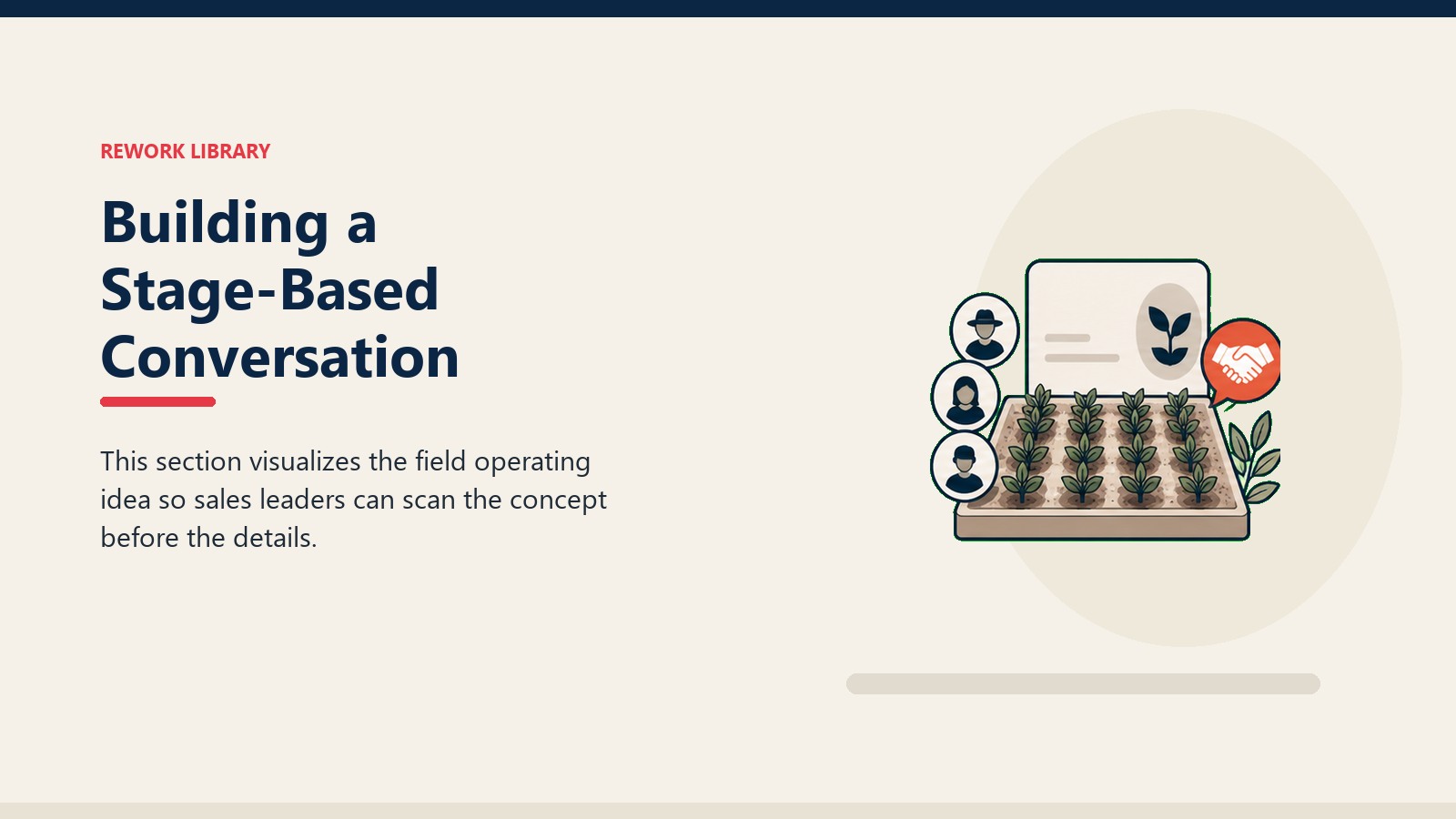
The Observe-Diagnose-Sequence Framework: The four-step structure that separates advisory selling from catalog selling in the field. Observe (walk the boundary, read the canopy), Diagnose (confirm stage and stress signals), Sequence (rank recommendations by urgency), Confirm (close on timing, not product). Each step builds on the last; skipping observation collapses the conversation back into a pitch.
Step 1: Open with a Field Observation
Don't start with the product. Start with what you see. Walk the field boundary, check the canopy, pull a plant if the farmer gives permission, and make an observation out loud.
"Your crop looks like it's at peak tillering. The tiller count on these three or four plants looks good. When did you transplant?"
That single question achieves three things. It establishes that you know what you're looking at. It positions the visit as agronomic, not commercial. And it gets the farmer talking about his crop, which is the only conversation he actually wants to have.
This approach is the foundation of the farmer field visit and advisory model: the visit is structured around crop observation first, product conversation second.
Step 2: Confirm the Stage and Any Current Stress
After the opening observation, confirm the phenological stage and look for any stress signals: leaf discoloration, insect damage, poor tillering uniformity, weed pressure, or water stress. These signals either confirm or override the stage-based recommendation you planned before the visit.
"I'm also seeing some yellowing on the older leaves, which at this stage usually points to nitrogen deficiency showing up. Have you applied your first top-dress yet?"
Stress signals open the diagnostic conversation. And diagnostics lead naturally to product recommendations. See agronomy-led product detailing for how to structure the technical explanation once you're in the diagnostic phase.
Step 3: Sequence Recommendations by Priority
Once the stage is confirmed and stress signals are identified, sequence your recommendations in priority order. Don't present everything in the matrix for this stage. Pick the one or two inputs with the highest yield-protection or yield-enhancement impact right now.
"Given where you are in the season, there are two things that matter most right now: getting the nitrogen top-dress in this week while the crop can still use it, and putting a fungicide cover on before the panicle initiation window. After that, we can talk about the micronutrient program, but those two are time-sensitive."
Prioritized, stage-specific recommendations convert better than a full product menu. The farmer knows you've filtered for his situation, not just presented options. This is the same logic that drives value selling: the rep who defines the decision for the buyer, rather than making the buyer sort through features, wins more often.
Step 4: Handle the "I Already Have That" Response
If the farmer says he already bought a product from a competitor for this stage, don't retreat. Ask about the timing and the rate.
"Did you already apply, or is it sitting in the store? If it's not applied yet, the question is whether you're in the right window for that product's mode of action. Some fungicides work pre-infection; if you apply them post-infection the efficacy drops significantly."
Stage knowledge is your competitive advantage here. A competitor's rep who sold a product without tying it to timing has left an opening. See agri objection handling for the full objection response framework.
What Separates Advisory Selling from Order Taking?
It's not the product knowledge. It's how the conversation starts.
There's a version of agri-input selling that's essentially order-taking in a tractor. The rep shows up, the farmer says he needs urea, the rep writes the order, and moves on. That model produces average order values, average loyalty, and no differentiation.
Advisory selling starts with the crop, not the order form. And it produces a different outcome: the farmer calls the rep before the season starts, not just when he's already decided what to buy.
The shift from vendor to trusted agronomist doesn't happen in one visit. It happens across several. Each time you correctly identify a stage, accurately diagnose a stress signal, recommend the right product at the right timing, and the crop responds well, you build a track record. That track record is worth more than any price concession.
The practical difference shows up in visit duration. An order-taking rep gets five minutes. An advisory rep who walked the field and identified something the farmer hadn't noticed gets as long as the conversation needs.
Using Demo Plots as Stage Evidence
Demo plots are the most powerful stage-selling tool an agri-input rep can use, and the most underused. A demo plot managed well is a live crop in the same field or district, at the same stage as the farmer's crop, showing the product's effect in real time.
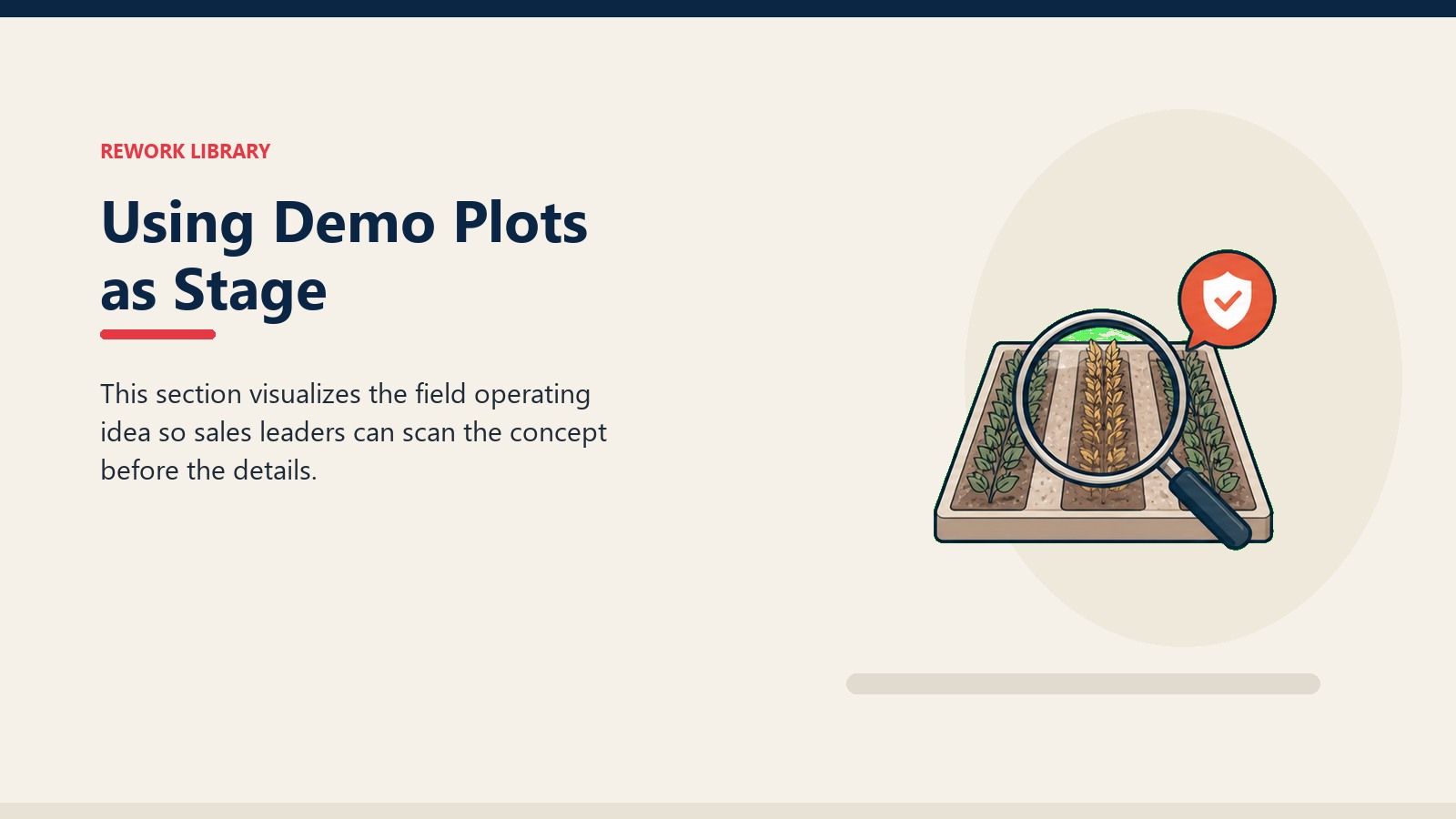
The demo plot conversation isn't "look how well our product works." It's "you're at the same stage as that demo plot right now. Come and see what the untreated check looks like versus the treated plot at this point in the season."
That comparison does what no catalog or technical data sheet can: it shows the farmer what he stands to lose or gain at his specific stage, in his local conditions, with varieties he recognizes.
Demo plot management and conversion covers the full setup and harvest protocol. The stage-selling connection is this: a well-managed demo plot is only valuable to the farmer if you visit it with him at the right crop stage. Showing him a demo plot result after the window for the input has closed in his own field produces polite interest, not a sale. Time the demo plot visit to arrive one to two weeks before the farmer needs to make the same input decision in his own crop.
How Should Field Visits Be Planned Around the Crop Calendar?
Stage-based selling only works if you're in the right field at the right time. A rep who arrives at maximum tillering stage is relevant. A rep who arrives two weeks after that window has closed is reviewing history.
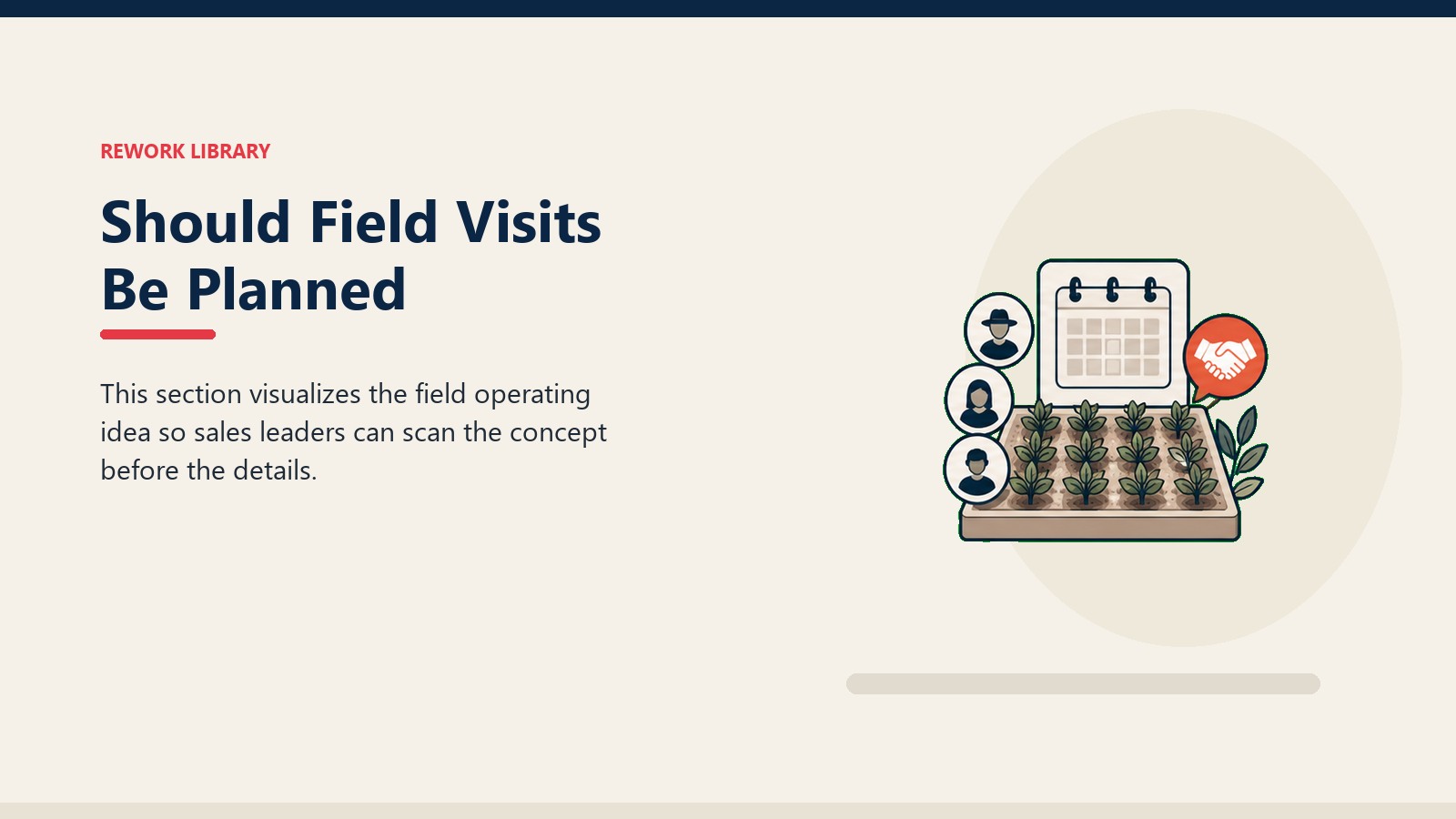
This means territory planning needs to work backward from crop calendars, not forward from convenience. The USDA Crop Progress and Conditions survey is one of the clearest public examples of how phenological stage tracking gets built into a systematic monitoring and reporting framework, showing what it looks like when an entire sector plans around crop development milestones rather than calendar dates.
Use the template below as a starting point. Fill in your actual district planting dates and adjust for local variety differences; Basmati paddy in the Punjab has a different phenological calendar than short-duration paddy in the coastal belts.
Sample Visit Calendar: Two-Crop Territory (Paddy Kharif + Wheat Rabi)
| Month | Paddy Stage | Wheat Stage | Priority Input Conversations |
|---|---|---|---|
| June | Nursery / soil prep | (off-season) | Basal fertilizers, pre-emergent herbicides, seed treatment for paddy |
| July | Transplanting / early tillering | (off-season) | Starter fertilizers, zinc sulphate, early herbicide application |
| August | Active tillering / panicle initiation | (off-season) | Urea top-dress (1st split), sheath blight fungicide, stem borer monitoring |
| September | Booting / flowering | (off-season) | Blast fungicide, boron foliar, potassium top-dress |
| October | Grain filling / maturity | Soil prep begins | Post-harvest soil audit, wheat basal fertilizer planning, seed treatment |
| November | Post-harvest | Sowing / emergence | Wheat starter NPK, post-emergent narrow-leaf herbicide |
| December | (off-season) | Crown root initiation | First urea split for wheat, yellow rust scouting |
| January | (off-season) | Jointing / booting | Aphid monitoring, flag leaf fungicide |
| February | (off-season) | Heading / grain fill | Powdery mildew cover, boron spray |
| March | Nursery planning begins | Maturity / harvest | Wheat post-harvest soil replenishment, paddy nursery preparation |
Schedule your high-frequency visits in the months where there's an active input decision window for your top-priority crop. In a paddy-dominant territory, that's July through September. In a wheat-dominant territory, it's November through February. Those are the months where an absent rep is losing business to whoever does show up.
Farmer segmentation and targeting gives you the framework to prioritize which farmers get the highest-frequency visits during those critical windows. A progressive large-holder who runs both Kharif and Rabi needs a different call frequency than a smallholder who grows a single crop per year.
Conclusion: Stage Alignment as the Foundation of Consultative Agri-Input Selling
Catalog selling works until a better-informed rep shows up in the same territory. Stage-aligned selling is a structural advantage that catalog sellers can't easily replicate, because it requires agronomic knowledge, field observation discipline, and visit timing that's planned months ahead.
The reps who build this model stop competing on price. They compete on timing accuracy, stage diagnosis, and the kind of advice that prevents yield loss before the farmer even knows he has a problem. That's a different category of value, and it earns a different quality of loyalty.
Build the matrix for your two or three major crops. Tie every product recommendation to a visible, observable stage. Walk the field before you open the bag. And plan your visits around crop calendars, not around convenience. The farmers who trust you most will be the ones you showed up for at exactly the right moment.
Quotable Nuggets
"Neck blast in rice is twice as yield-damaging as leaf blast, and in severe epidemic conditions it can approach total crop loss. Nepal's 2022 Chitwan outbreak affected 5,000 hectares with nearly 100 percent yield loss. Research shows that each 1 percent increase in neck blast incidence causes 21 to 76 kg per hectare in yield reduction, depending on variety. Fungicide timing to the booting-to-heading window is the single highest-return intervention available." Source: Frontiers in Plant Science / PMC, Defending Rice Crop from Blast Disease in Nepal, 2025
"Only 26.6 percent of farmers received any agronomic advice when purchasing pesticides from agro-dealers in a Uganda mystery shopping study, despite 97 percent of dealers stating that advising customers was their core responsibility. The advisory gap at the counter is the commercial opportunity for every rep who shows up with stage-specific knowledge." Source: PMC / Environmental Health, What Agro-Input Dealers Know, Sell and Say to Smallholder Farmers about Pesticides in Uganda, 2021
"Wheat fungicide applications at the correct heading stage achieve 52 percent control of Fusarium head blight versus 27 to 39 percent for pre-heading timing, based on a 19-year U.S. trial dataset. Moving just 5 to 7 days past the optimal window drops control efficiency by 10 to 15 percentage points. In crop protection, timing is the product." Source: University of Missouri Extension / IPM, citing Paul et al. 2018 meta-analysis
Frequently Asked Questions about Crop-Stage Recommendation Selling
What is crop-stage recommendation selling?
Crop-stage recommendation selling is the practice of matching agri-input product recommendations to the specific phenological stage a farmer's crop is currently in. Instead of presenting a catalog of products, the rep walks the field, identifies the crop stage and any current stress signals, and recommends only the inputs that are relevant and time-sensitive for that stage. It converts better than feature-led selling because the farmer can see the agronomic logic of the recommendation in his own field.
How do I build a crop-stage product matrix for my territory?
Start with your two or three highest-volume crops. For each crop, list the key phenological stages from soil preparation through harvest. At each stage, identify the input categories that are relevant: fertilizer type, pest pressure category, fungicide timing, or micronutrient window. Add one or two rep talking points per stage that connect the input to an observable crop condition. Adapt the matrix for local variety differences and seasonal calendar variations. Review it with an agronomist once per season to keep the timing guidance accurate.
How do I handle a farmer who already bought a product for a given stage from a competitor?
Ask about timing and application rate before conceding the sale. Many farmers buy inputs before the correct application window and hold them in storage. If the farmer hasn't applied yet, the conversation becomes whether his current product choice is correctly timed for its mode of action. Pre-infection fungicides applied post-infection lose significant efficacy. A systemic insecticide applied outside the economic threshold window wastes the farmer's money. Timing accuracy is your competitive advantage in that conversation.
How should I use demo plots to support stage-based recommendations?
A demo plot is most valuable when you visit it with the farmer at the same crop stage as his own field, ideally one to two weeks before he needs to make the same input decision. The comparison between treated and untreated checks at the relevant growth stage is a concrete, visible proof point that no product brochure can match. Time the demo plot visit deliberately: showing results after the farmer's window has closed produces interest, not an order.
How far in advance should I plan field visits around crop calendars?
Plan the seasonal calendar at least two months before a crop season starts. Identify which farmers are growing which crops and their expected planting dates. Work backward from key phenological windows to set your visit schedule: the first urea top-dress window, the fungicide timing window at tillering or booting, the pest pressure scouting visits at reproductive stage. Share the calendar with your territory manager so any visit conflicts or coverage gaps are caught before the season begins, not during it.
Why does crop-stage knowledge give reps a competitive edge over generic sellers?
Catalog-based selling treats every visit as a product conversation. Stage-based selling treats every visit as a crop diagnosis session, and the product recommendation emerges from the diagnosis. A competitor's rep who visits after the fungicide window has closed has no useful conversation to have. A rep who arrives two weeks before that window, with a stage-specific talking point and visibility into the farmer's crop, is providing value the competitor can't replicate without the same agronomic preparation.
Learn More

Senior Implementation Consultant
On this page
- The Crop-Stage Selling Model
- Key Facts: Crop-Stage Selling
- Mapping Products to Crop Stages
- Paddy (Kharif Season)
- Wheat (Rabi Season)
- Cotton (Kharif Season)
- Building a Stage-Based Conversation
- Step 1: Open with a Field Observation
- Step 2: Confirm the Stage and Any Current Stress
- Step 3: Sequence Recommendations by Priority
- Step 4: Handle the "I Already Have That" Response
- What Separates Advisory Selling from Order Taking?
- Using Demo Plots as Stage Evidence
- How Should Field Visits Be Planned Around the Crop Calendar?
- Sample Visit Calendar: Two-Crop Territory (Paddy Kharif + Wheat Rabi)
- Conclusion: Stage Alignment as the Foundation of Consultative Agri-Input Selling
- Quotable Nuggets
- Learn More