Agronomist and Rep Recruitment and Training: Building a Field Force That Earns Farmer and Dealer Trust
Turn this article into takeaways for your work.


Each assistant summarizes the article only for you and suggests best practices for your work.
Agri-input sales has a dual hiring failure that most commercial leaders have seen play out at least once. The first failure is the agronomist who knows every pest-resistance mechanism in the product portfolio but loses every dealer negotiation and goes silent when a farmer asks for a price. The second failure is the sales rep who can close a dealer on a promotional bundle but gets exposed the moment a progressive farmer asks a technical question about tank mixing.
Neither profile succeeds in modern agri-input field sales, where the commercial conversation depends on agronomic credibility and the agronomic recommendation is only as valuable as the rep's ability to convert it into an order. The field force that earns genuine farmer and dealer trust combines both, and building it requires a recruitment framework, onboarding structure, and continuous training system that are designed around the crop calendar rather than the HR calendar.
The Dual Failure Mode
Understanding why the two failure modes exist is the first step to designing around them.
The agronomist failure is a cultural product of agricultural education. B.Sc. and M.Sc. agronomy programs train people to analyze crop systems, diagnose pest and disease problems, and recommend management interventions. They don't train people to handle a dealer who's pushing for an extra two percent margin, to follow up five times on a committed order that hasn't been placed, or to close a conversation where the farmer is interested but noncommittal. These are selling skills, and they're largely absent from agricultural education. An agronomist hired into a field sales role without commercial training will fall back on what they know: technical presentations that inform farmers but don't move product.
The sales rep failure is the mirror image. A rep with a general business or commerce background and strong selling instincts can build dealer relationships and close commercial conversations quickly. But the moment a farmer asks why your fungicide performs differently from a competitor's product at the same active ingredient concentration, or wants to understand whether the product is safe to tank-mix with a micro-nutrient they're planning to use, the rep either deflects, guesses, or goes silent. In a market where agronomic credibility is the currency of trust, each of those responses erodes the brand.
The solution is a recruitment framework that defines the dual competency clearly, an onboarding program that builds the missing dimension in each profile, and a continuous training system that keeps both dimensions current as the product portfolio and pest landscape evolve.
Key Facts: Agri-Input Field Force Recruitment and Training
- In B2B field sales broadly, the average time for a new rep to reach full productivity has grown from 4.3 months in 2020 to 5.7 months in 2024, a 32% increase. For agri-input field roles with dual technical and commercial requirements, structured onboarding programs with defined ramp KPI gates typically reduce this to 3-4 months compared to informal onboarding (B2B benchmark from Chambr, "Sales Ramp Time Benchmarks 2026"; agri-input range is an industry operating norm).
- A Uganda mystery-shopping study of 402 agro-input dealers found that while 97% considered advising customers their responsibility, only 26.6% actually provided any safety advice at point of sale, a direct consequence of hiring dealer staff without technical grounding that applies equally to field rep recruitment. (Source: PMC, "Agro-input dealer advisory practices in Uganda," 2021)
- Cross-industry B2B data shows 41% of field sales teams report annual rep turnover of 50% or higher. For agri-input companies, attrition is typically highest in the first season, with inadequate technical and agronomic training commonly cited by exiting reps as the primary confidence-eroding factor. (Source: SPOTIO, "The State of Field Sales 2026")
What Does the Right Agri-Input Rep Profile Actually Look Like?
Before you can recruit the right people, you need clarity on what "right" looks like for your specific context.
Technical competency baseline: Every agri-input field rep, regardless of their educational background, needs to reach a minimum technical competency level before they can operate credibly in the field. This baseline includes: working knowledge of the dominant crops in their territory (growth stages, major pest and disease threats, critical application windows), understanding of the product portfolio they carry (mode of action, application rate, safety intervals, competitive positioning), familiarity with recommended integrated pest management protocols, and the ability to read and interpret basic field observation data from demo plots.
This doesn't mean every rep needs to be an agronomist. It means every rep needs enough technical grounding to have an informed conversation with a farmer and to know when to bring in a technical specialist.
Commercial competency baseline: Similarly, every agri-input field rep needs minimum commercial competency: the ability to manage dealer relationships and inventory negotiations, to conduct structured advisory selling conversations with farmers (needs assessment, recommendation, trial commitment), to plan and execute territory coverage efficiently, and to use your sales force automation tool to record visits and manage their pipeline. An agronomist hire who can't do these things fluently is a liability in the field, not an asset.
The agronomist-commercial hybrid: when to build versus when to hire two roles: In high-value crop territories, horticulture, specialty vegetables, high-input cotton, the agronomic complexity may require a genuine crop specialist who spends the majority of their time on technical farmer advisory work, with a separate commercial rep handling dealer relationships and order management. In commodity crop territories where the product set is simpler and the farmer advisory component is lighter, a hybrid profile who handles both dimensions is usually more cost-efficient and more effective for relationship continuity. The territory design decision should precede the hiring decision. See Field Force Sizing and Deployment for how to determine the right role mix by territory type.
Agri-Input Rep Competency Matrix
| Competency Domain | Agronomist Profile Hire | Sales Profile Hire | Hybrid Target |
|---|---|---|---|
| Crop science and pest/disease knowledge | Strong (needs minimal training) | Weak (needs significant training) | Medium to strong |
| Product portfolio depth | Medium (needs formulation training) | Weak (needs full technical training) | Medium to strong |
| Demo plot management and interpretation | Strong | Weak | Medium |
| Dealer negotiation and relationship | Weak | Strong | Medium to strong |
| Farmer advisory selling (convert advice to trial/order) | Weak | Medium | Strong |
| Territory planning and SFA use | Weak | Medium | Strong |
| Objection handling under competitor pressure | Weak | Strong | Strong |
Recruitment Framework
Sourcing channels: The best agri-input field reps come from three sourcing channels, each with different advantages and different onboarding requirements.
Agricultural colleges and universities are the primary source for agronomist-profile hires. The advantage is technical grounding and crop affinity. The disadvantage is that fresh graduates have no commercial exposure. When recruiting from agricultural colleges, target candidates who have done internships with agri-input companies or agricultural extension programs, because field exposure during education is the best predictor of adaptability to the sales role.
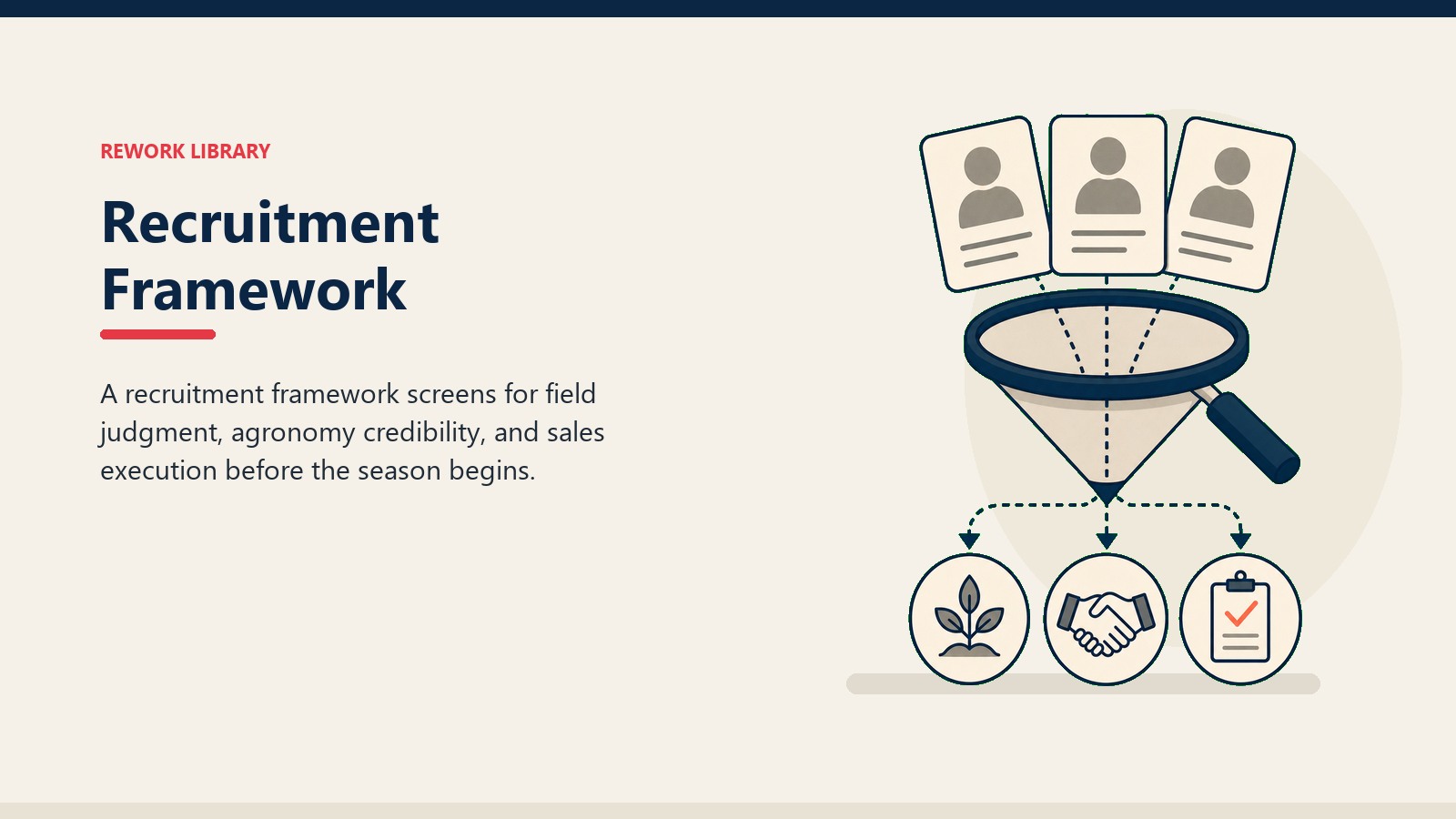
Competitor lateral hires bring territory knowledge, established dealer relationships, and (ideally) proven commercial competency. The risk is that they also bring competitor habits that may not fit your product and process culture, and they require a full technical onboarding on your product portfolio regardless of their prior experience. The dealer relationships they bring are a real asset but should not be over-valued in the hiring decision. Relationships are with the rep personally, and some will transfer, but a new company's products and support system have to earn the dealer's trust on their own merits.
Dealer networks are an underused sourcing channel. Experienced sales staff at large dealers sometimes have the agronomy-commercial hybrid profile already developed through years of advising and selling to farmers. They know the local crop calendar, the key farmers, the competitive landscape, and the product categories. Their weakness is usually the corporate structure and process discipline required in a company field role. But for territory-specific roles in markets where the cultural fit of a local hire matters significantly, this channel is worth developing actively. IFC's Last Mile Retailer program documents how many agro-input retailers lack formal training to advise customers, making experienced dealer staff with agronomic depth genuinely rare and valuable.
Structured interview scorecard for agronomy and selling aptitude: Don't rely on impression-based interviews for agri-input field hires. Use a structured scorecard that tests both dimensions explicitly.
For agronomy aptitude, include scenario questions: "A cotton farmer tells you his crop is showing leaf curl despite applying your recommended fungicide at the correct rate. What questions do you ask and what do you recommend?" For selling aptitude, use role-play: simulate a dealer negotiation or a farmer advisory close. Ask the candidate how they've handled a situation where a farmer or dealer rejected their recommendation and what they did next.
Red flags in hiring: Two patterns consistently predict poor performance in agri-input field roles. First, agronomy graduates with no field exposure whatsoever. Graduates who've done purely classroom programs with no field internship or practical work with farmers have usually not tested whether they're comfortable with the physical demands and interpersonal intensity of field sales. Second, sales backgrounds with no agricultural context at all, especially in markets where the farmer audience is skeptical of outsiders who don't understand farming. A PMC study on agro-input dealers in Uganda found that despite 97% of dealers considering customer advice their responsibility, only 26.6% actually provided it during observed interactions, a direct consequence of hiring without technical grounding. A rep selling FMCG consumer goods in urban markets has developed entirely different relationship instincts than what agri-input field sales requires.
Onboarding Program Design
The Ramp-Gate Onboarding Model: Effective agri-input onboarding follows four stages with explicit gates before the rep advances: Technical Foundation (weeks 1-2: product and crop knowledge, assessed against a minimum pass standard before field exposure begins), Observation (weeks 3-4: 30-plus complete visit interactions shadowing a senior rep, with structured debrief after each day), Supervised Execution (month 2: rep leads visits with supervisor present for the first 10-15, debrief weekly), and Ramp Gate Assessment (month 3: formal check of coverage rate, SFA compliance, technical knowledge, and first-order performance before full quota is assigned). The gate prevents the most common mistake: assigning a quota to a rep who isn't ready, which produces either fake call completion or early exit.
The most common onboarding failure in agri-input companies is the "product training camp" model: put new hires in a room for a week, run them through the product catalogue, and send them to the field. This produces reps who can recite product names but can't handle a real farmer conversation in week two.
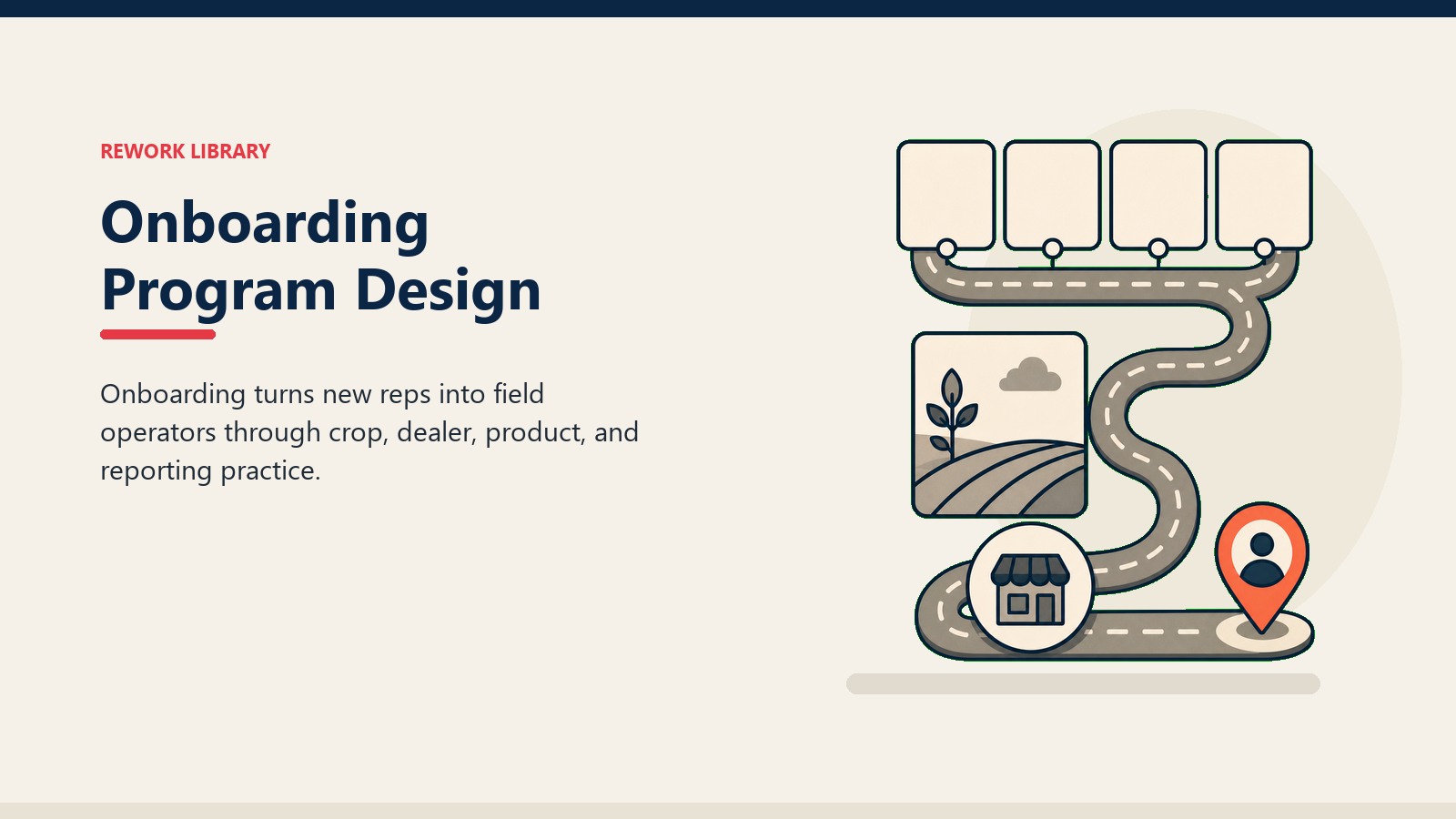
Good onboarding in agri-inputs builds the technical foundation, follows it immediately with supervised field exposure, and then stages independent coverage with coaching oversight before releasing the rep to full quota.
Week 1-2: Product knowledge and agronomic foundations: Begin with the technical layer. Product portfolio overview (not just specifications but positioning versus competitors and common objections), crop-specific use cases for the territory's dominant crops, field identification of major pests and diseases, and application protocols including safety handling. This phase should include field visits to demonstration plots or farmer fields, not just classroom sessions. Reps need to see what they're learning in a real agronomic context.
Week 3-4: Shadowing senior reps across dealer visits and farmer calls: Move the new hire into the field with an experienced rep. The purpose of this phase is pattern recognition: watching how an experienced rep opens a dealer conversation, handles a product objection, closes on an indent commitment, and pivots from a commercial discussion to an agronomy advisory without losing the thread. New hires should observe at minimum 30-40 complete visit interactions before they're expected to lead one. Structured debrief after each observation day is essential. The learning happens in the debrief, not just the observation.
Month 2: Supervised independent territory coverage with coach review: The new hire starts leading their own visits with the supervisor or a senior rep present for the first 10-15 calls. The supervisor's role is not to rescue the rep when they struggle but to observe and debrief afterward. Weekly coaching sessions review call quality, product recommendation accuracy, objection handling, and SFA discipline. The month-2 phase should include at least two full-day field rides with the direct manager.
Month 3: Ramp KPI gate before full quota assignment: Before releasing the rep to full quota responsibility, run a formal ramp KPI gate. The gate should assess: dealer visit coverage rate (are they hitting their call plan?), SFA completion rate (are they recording visits properly?), technical knowledge check (can they handle a structured product scenario without support?), and first-order performance (have they converted any dealer accounts from zero to first purchase?). Reps who don't clear the gate need an extended coaching month, not an immediate quota assignment they can't meet.
Onboarding Timeline
| Phase | Duration | Focus | Gate Criteria |
|---|---|---|---|
| Product and agronomic foundations | Weeks 1-2 | Technical knowledge, crop context, safety protocols | Product knowledge assessment pass |
| Shadowing and observation | Weeks 3-4 | Field pattern recognition, dealer and farmer conversation observation | 30+ observed interactions, debrief completion |
| Supervised independent coverage | Month 2 | Leading own visits with coaching feedback | 10-15 supervised calls, positive coach sign-off |
| Ramp KPI gate | Month 3 | Coverage rate, SFA compliance, technical check, first order | All four gate criteria met before full quota |
| Full territory responsibility | Month 4+ | Independent execution, weekly manager review | Full quota assignment |
Continuous Training Cadence
Recruitment and onboarding create the foundation. Continuous training keeps the field force competitive as the product portfolio, pest landscape, and competitive environment evolve.
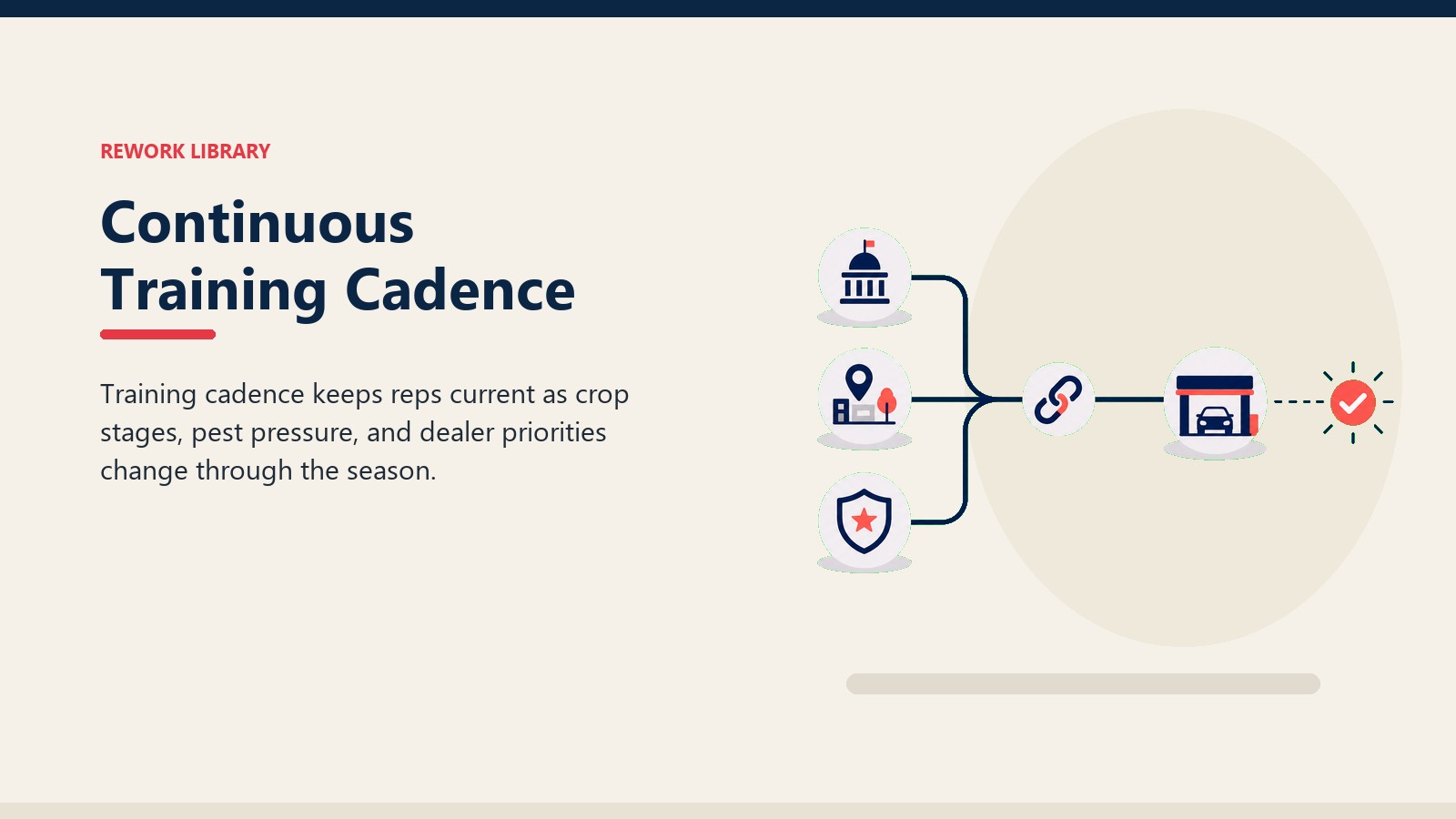
New product launch training tied to season calendar: Don't launch a product and then train the field force. Train the field force 4-6 weeks before the season in which the product will be sold, so reps have time to practice the product story with low-stakes customers before they're in front of their best accounts. Training should include: product efficacy data, competitive positioning, farmer-level value proposition in plain language, objection handling for the most likely competitive challenges, and demo plot setup if the product is a candidate for demonstration. Agronomy-Led Product Detailing covers the field execution of product launches in detail.
Objection-handling skill workshops pre-season: The six to eight weeks before season start are the highest-stakes commercial window for agri-input reps. Dealers are finalizing their stocking decisions. Farmers are making input sourcing choices. But most field force training calendars put workshops in January or February, three months before the Kharif window, when the information goes cold before it's needed. Pre-season workshops should run 2-4 weeks before peak season, covering the season's most anticipated competitive objections, price negotiation scenarios, and the key product messages for the season's priority SKUs.
Demo plot interpretation and data storytelling: Running a demonstration plot is a skill. Interpreting the results and presenting them to a skeptical farmer is a different skill. Training on demo plot methodology, how to design a valid comparison, how to measure and document results, how to present visual and yield data to farmers who may be literate but aren't comfortable with tables and percentages, belongs in the continuous training calendar, not just in onboarding. Field Reporting and Demo Tracking covers the data capture side.
Peer learning through regional field days: The most underused training format in agri-inputs is structured peer learning. A regional field day that brings together 20-25 reps to visit a well-managed demo plot, hear from a high-performing farmer advocate, and share what they've learned about objection handling in their territory produces knowledge transfer that no headquarters-designed training module can replicate. The reps learn from each other. They see what a well-run demo looks like. And they leave with fresh stories and language from peers who've solved problems in similar territories.
Ramp KPI Gate Criteria
| Criterion | Target | Assessment Method |
|---|---|---|
| Dealer visit coverage rate | 80%+ of planned call schedule completed | SFA call log review |
| SFA completion rate | 90%+ of visits recorded same day | System report |
| Technical knowledge check | Pass structured product scenario assessment | Written and role-play assessment |
| First-order performance | At least 2 dealer first-orders converted | Sales system verification |
| Coach sign-off | Direct manager positive assessment | Structured field ride debrief |
Performance-Linked Development
Training is only valuable if it's connected to something the rep cares about. Purely compliance-driven training completion rates are poor predictors of field performance improvement.
Linking training completion to incentive eligibility: Define training completion as a prerequisite for incentive eligibility in the quarter following the training. If the pre-season objection-handling workshop runs in May, completing it (and passing the associated assessment) is a condition for receiving the Q3 incentive payout. This isn't punitive; it's a signal that the company takes training seriously and that field force readiness is a commercial priority. See Incentives and Seasonal Target Setting for how to structure incentive architecture.
Career ladders from rep to senior agronomist to area manager: In most agri-input companies, the career path is opaque. Reps know they can become an area sales manager if they perform, but they don't know what that takes, how long it takes, or what skills they need to develop. Defined career ladders, rep to senior rep (typically after two seasons of performance above 90% achievement), senior rep to territory agronomist-manager, territory manager to area manager, with explicit competency milestones at each step create development visibility that retains high performers who would otherwise leave for a clearer career trajectory.
Agri Sales CRM and SFA enables the performance tracking that makes career ladder assessments objective rather than manager-subjective. Rep-level data on call completion, dealer conversion, product mix, and agronomist interaction frequency gives the manager the evidence base for a credible performance review.
Training Cadence Calendar Template
The training calendar should be built around the crop calendar, not the fiscal year.
Pre-Kharif (April-May): Season readiness workshop. Kharif crop pest and disease update. Priority SKU product training. Competitive objection handling for anticipated season challenges. SFA refresher.
Kharif season (June-September): Field coaching rides (bi-weekly with direct manager). Demo plot setup verification. Weekly call plan reviews via SFA. Mid-season product performance debrief.
Post-Kharif / Pre-Rabi (October-November): Season debrief and performance review. New hire ramp gate assessment for hires who started pre-Kharif. Rabi crop and product preparation. Year-end incentive planning discussion.
Rabi season (December-February): Field coaching rides. Rabi demo plot visits. Product review for new season launches.
Off-peak (March-April): Annual competency assessment. Career development conversation. New hire recruitment and intake. Annual training investment review.
The reference frameworks from analogous field-intensive industries are worth studying. Rep Onboarding, Training, and Coaching (Pharma) applies the same structured ramp-and-gate logic in a different context. DSR Recruitment and Training (FMCG) covers the distribution sales rep model in trade-intensive markets. Both provide architecture you can adapt to the agri-input context.
A System Built Around the Crop Calendar
Quotable Nuggets
"97% of agro-input dealers in Uganda said advising customers on pesticide safety is their responsibility. Only 26.6% actually provided any safety advice when mystery shoppers visited. That gap between stated responsibility and actual behavior is the direct result of hiring without technical grounding, and it applies to field rep recruitment as much as dealer staffing." (PMC, "Agro-input dealer advisory practices in Uganda," 2021)
"Average B2B sales rep time-to-full-productivity grew from 4.3 months in 2020 to 5.7 months in 2024 as product complexity and buyer sophistication increased. For agri-input roles with dual technical and commercial requirements, structured onboarding with ramp KPI gates compresses this materially versus informal sink-or-swim approaches." (Chambr, "Sales Ramp Time Benchmarks 2026")
"The IFC's Last Mile Retailer program recognizes that many agro-input retailers lack formal training to advise customers, making dealer staff with genuine agronomic depth rare and valuable sourcing targets for agri-input field rep roles." (IFC Last Mile Retailer, Improving Outcomes in Agribusiness)
The biggest structural weakness in most agri-input training systems is that they run on HR calendars. Induction happens when HR processes new joiners. Annual training events happen in January because the fiscal year starts then. Product launches are trained at the time of regulatory approval, not at the time of commercial need.
Crop calendars don't care about HR timelines. A rep who joins in July, goes through two months of generic onboarding, and arrives in the field in September for Rabi prep will spend their first full season in the market underprepared. A rep who joins in March, completes structured onboarding in April and May, and is supervised in the field during their first Kharif season has a fighting chance of being productive in season one.
Build the recruitment intake, the onboarding timeline, and the continuous training calendar around when the field work happens. Hire early enough before the season that the onboarding cycle completes before the season peaks. Train for the specific season's competitive environment, not a generic product catalogue. Review performance against ramp KPIs at season close, when the evidence of productivity is most clear.
A field force built around the crop calendar rather than the HR calendar earns farmer and dealer trust faster. And trust, in agri-input sales, is what converts agronomic advice into orders and repeat business into market share.
Frequently Asked Questions about Agronomist and Rep Recruitment and Training
What is the most important competency to develop in an agronomist hired into a field sales role?
Farmer advisory selling: the ability to convert a technical recommendation into a purchase commitment. Agronomists hired into sales roles typically have the product knowledge and field credibility they need. What they lack is the structured selling conversation, how to assess the farmer's situation, make a specific recommendation with a rationale, handle the "I'll think about it" deflection, and close on a trial commitment or indent. This is a learnable skill, and structured role-play practice in the onboarding program, followed by supervised field calls with debrief, is the fastest way to build it.
How do you handle a new rep who has strong technical knowledge but struggles with dealer negotiation?
Run targeted role-play on the specific dealer scenarios they find difficult: the dealer pushing for extra trade margin, the dealer threatening to switch to a competitor for the season, the dealer asking for a return credit on slow-moving stock. Role-play with a senior rep or manager acting as the dealer, followed by honest debrief, is more effective than general sales skills training. Also pair the struggling rep with a high-performing dealer relationship manager in their region for 3-4 field visits, with structured debriefs after each. Modeling high-performer behavior in real contexts accelerates skill transfer faster than classroom training.
What is a ramp KPI gate and when should it be used?
A ramp KPI gate is a formal assessment at the end of the onboarding period that confirms a new rep meets defined performance thresholds before receiving full quota responsibility. It prevents the mistake of assigning a quota to a rep who isn't ready, which typically produces one of two outcomes: the rep fakes call completion to appear productive while avoiding difficult accounts, or the rep fails visibly and exits within two seasons. Ramp gates should include coverage rate, SFA compliance, a technical knowledge check, and evidence of at least some first-order commercial success. Reps who don't pass get an extended coaching period, not an automatic quota assignment.
How should agri-input field force training handle the transition between Rabi and Kharif seasons?
Use the inter-season window (typically two to four weeks) as the primary training and reset period. Run the season debrief for the closing season and the readiness workshop for the opening season in the same period. This is also the best window for new hire intake, because new joiners who start during this period complete their onboarding cycle before the next season's peak. The inter-season window is the calmest point in the field force calendar and the highest-value moment for structured training and development investment.
How do you source field rep candidates from dealer networks, and is it worth the effort?
Yes, and it is underused. Experienced sales staff at large agro-input dealers sometimes have the agronomist-commercial hybrid profile already developed through years of advising and selling to farmers. They know the local crop calendar, the key farmers, the competitive landscape, and the product categories at the ground level. Their weakness is typically unfamiliarity with corporate process discipline (SFA use, structured call plans, QBR reporting). But the IFC's Last Mile Retailer program documentation identifies the scarcity of dealer staff with genuine agronomic depth as a structural gap across emerging agricultural markets, meaning the ones who do exist are high-value sourcing targets. Actively develop the referral channel by asking your best dealers who on their staff has the technical depth and commercial instincts that would translate to a field rep role. These candidates often join faster and retain longer than fresh graduates because they've already stress-tested their appetite for the field.
Learn More

Senior Implementation Consultant