Demo Plot Management and Conversion: Turning Trial Results into Confirmed Orders Before Harvest
Turn this article into takeaways for your work.


Each assistant summarizes the article only for you and suggests best practices for your work.
The rep had set up fourteen demo plots across his territory for the kharif season. He placed the seed, marked the treatment and control strips, took photos on planting day, and logged the plots in his system. He visited each one twice: once in mid-season and once at harvest. His plots looked good. Several showed genuine yield differences between treated and untreated sections. At harvest, when he arrived to show results and close, three farmers had already committed their next-season business to a competitor. Two more said they needed to think about it.
The competitor's rep had visited those farms four times during the season. He brought neighbor farmers to observe at mid-season. He'd photographed the crop progression every three weeks. He'd had the pre-harvest yield estimation conversation two weeks before harvest when the crop was still in the field and the visual evidence was undeniable. By the time harvest came, the farmers had already made their decisions.
Demo plots aren't agronomic experiments. They're sales pipeline stages. Treating them like experiments, setting them up and waiting for nature to produce a result, loses to competitors who treat them like active sales assets and work them accordingly.
The Demo Plot as a Sales Pipeline Stage
Every active demo plot in a territory represents a conversion opportunity at a specific stage of a sales pipeline. Host farmer, observer farmers, and the supplying dealer are all separate conversion targets within that single plot. Passive plot monitoring, checking once or twice during the season, means arriving at harvest to find the opportunity partially or fully closed by a competitor.
Active plot management means each demo plot has a visit cadence, a conversion target at each visit, and a specific closing sequence that begins weeks before harvest. It means the rep treats each visit as a sales call, not an agronomic inspection.
Key Facts: Demo Plot Conversion
- A peer-reviewed study of 852 smallholder households in Tanzania found that access to demonstration plots alone increased the probability of purchasing improved agricultural inputs by 13 percentage points, rising to 15 to 17 percentage points when demo plots were paired with small trial packs (source: PLOS ONE / PMC7810322).
- A 2021 study in India published in The Review of Economics and Statistics found that farmer field days on demonstration plots increased seed variety adoption from approximately 30% in control villages to 42% in field-day villages, with the effect concentrated among poorer farmers who had less access to other information channels (source: MIT Press, doi 10.1162/rest_a_00917).
- The Tanzania study found that the adoption effect was amplified significantly when improved inputs were available within a 5 km radius of the demo plot, linking demonstration effectiveness to downstream dealer availability (source: PMC7810322).
The evidence for this is strong. The Tanzania and India studies together confirm what experienced agri-input reps know from the field: passively set-up plots that farmers observe without structured engagement produce adoption rates far below what actively managed plots with timed rep visits deliver. The demo plot is a sales asset, not an agronomic exhibit.
Think of the demo plot pipeline this way:
| Pipeline Stage | Crop Stage | Primary Conversion Target | Success Metric |
|---|---|---|---|
| Plot Setup | Planting | Host farmer agreement confirmed, plot parameters set | Setup documentation complete |
| Germination Check | 10-15 DAS | Early performance discussion, observer farmers identified | Neighbor visit list compiled |
| Mid-Season Assessment | 40-60 DAS | Host farmer confidence building, observer farmer group walk | Observer attendance, testimonial captured |
| Pre-Harvest Close | 2-3 weeks before harvest | Host farmer next-season commitment, neighbor farmer trial agreements | Order commitments recorded |
| Harvest Close | Harvest day | Host + neighbor + dealer close, documentation captured | Volume orders confirmed, testimonials signed |
| Post-Harvest Review | 2-4 weeks after | Result documentation, next-season planning | Testimonial published, next plot planned |
Each stage has a setup standard that determines how much conversion potential exists at harvest.
Plot Setup Standards That Maximize Conversion Impact
A demo plot that isn't set up for visible, measurable comparison produces inconclusive results that can't close anyone. Plot setup is where the conversion potential is determined, not at harvest.
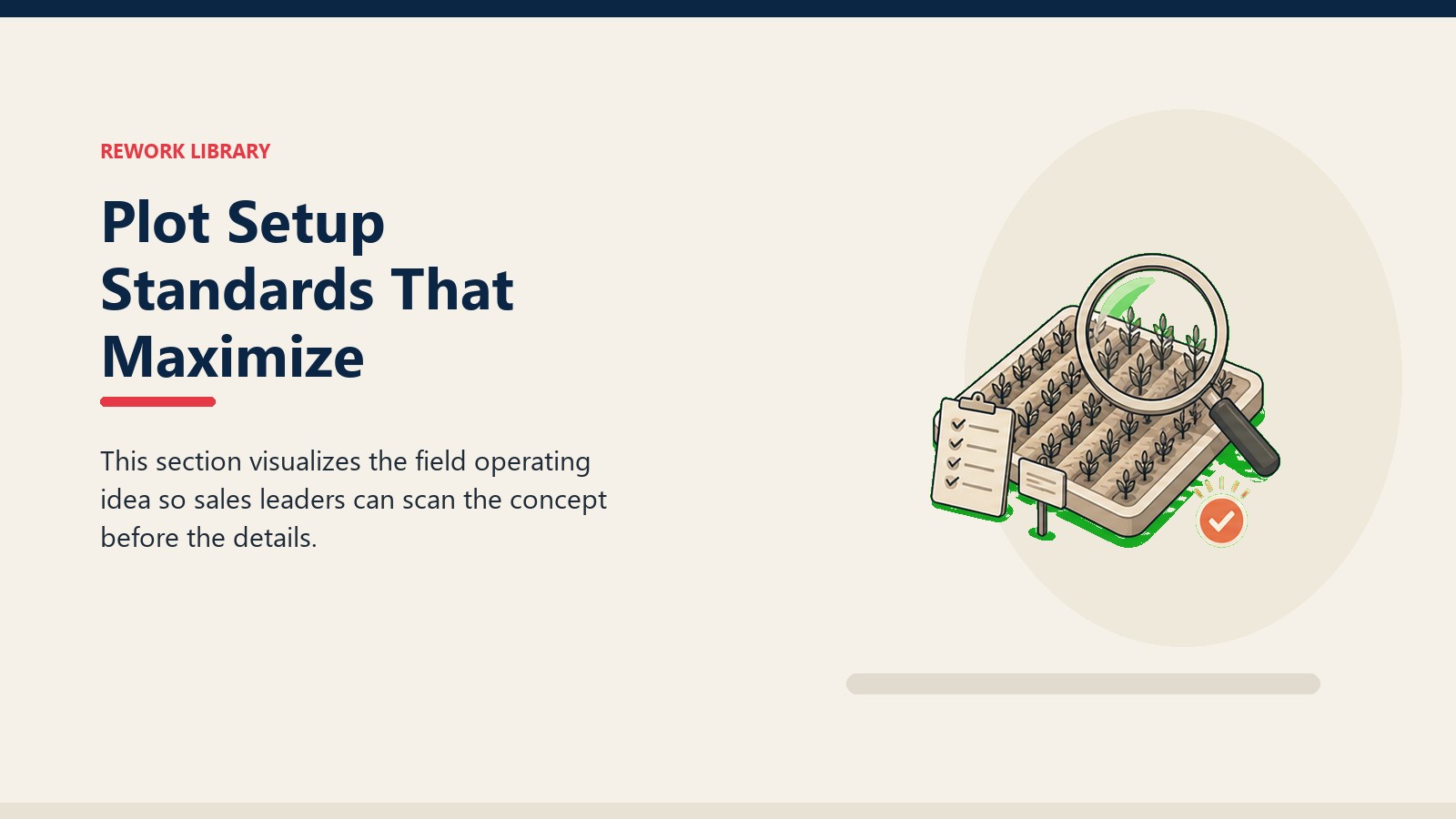
Control vs. treated strip width and visibility. The treated and untreated sections need to be wide enough that a standing observer can see the difference from the field edge. A control strip of one to two rows isn't visible at a glance. A 4 to 6 meter wide control strip running the length of the plot is. If the plot is alongside a road or accessible from a public path, that visibility extends to every farmer who passes during the growing season.
Measurement pegs and photo reference points. Place numbered pegs at equal intervals along the plot boundary. Take the first photos from a consistent camera position at each peg. This allows subsequent photos to be taken from the same position at the same angle, making visual comparison across visits accurate and persuasive. A photo sequence showing crop development at the same camera position from planting to pre-harvest is a stronger sales document than any brochure.
Plot signage. A visible board at the field edge with the product name, the trial protocol, and the rep's contact number serves three purposes: it generates walk-in inquiries from curious passing farmers, it reinforces the company brand in the geography, and it signals that this is a professionally managed demonstration rather than an informal trial. Field observation from agri-input territory managers consistently holds that signage-marked plots generate substantially more spontaneous observer traffic than unmarked trials of the same size, because passing farmers can identify what they're looking at and who to contact.
Keep the farmer's management of the plot consistent with his normal practices on the rest of his field. The only variable should be the tested product or protocol. A yield difference that comes from better management of the trial section rather than product performance won't convince a skeptical observer and will come apart under questioning. Once the setup is right, visit frequency is what separates an active sales asset from an abandoned experiment.
The Crop-Stage Visit Cadence
Each crop stage visit has a specific objective beyond agronomic observation. The visit cadence is a sales sequence, and each visit advances the conversion.
Germination or emergence check (10-15 DAS). Objective: verify plot setup integrity and establish baseline documentation. Walk the plot with the farmer, confirm the treated and control sections are clearly differentiated, note any establishment issues, and photograph from reference positions. At this visit, start building the observer list: "Who else in the village would be interested in seeing how this compares when the crop comes up? I'd like to organize a walk in about a month when the difference should be visible."
Mid-season performance assessment (40-60 DAS). Objective: generate observable evidence and activate observer traffic. This is typically the most important visit of the season. The treated section should be showing visible superiority in canopy density, color, or pest and disease incidence compared to the control. If it is, this is the moment to bring neighbor farmers to see it. The visual evidence of a performance difference, observed in the field by peers, is the most persuasive sales tool in agri-inputs. If the performance difference isn't yet visible, note what to expect at the next crop stage and book the group walk for a later visit.
Pre-harvest yield estimation (2-3 weeks before harvest). Objective: close the host farmer and begin closing observer farmers before the plot is cut. This is the highest-value visit in the entire demo plot sequence. The crop is still standing, the treated and control strips are at their maximum visible contrast, and the rep can conduct a crop-cut estimation that gives a concrete yield difference number. The section on the pre-harvest conversion window below explains exactly how to time and structure this ask.
Harvest measurement and documentation. Objective: close remaining uncommitted farmers and dealers, capture testimonial evidence. Measure actual yield from the treated and control sections using a crop cut. The difference in yield, converted to value per acre at current market prices, is the closing argument. Document everything: weights, photos, farmer statement.
How Do You Activate Observer Traffic During the Season?
Observer conversion is the multiplier effect of demo plot investment. A host farmer who commits to next-season purchase is one sale. A group of ten neighbor farmers who observe the plot at mid-season and discuss what they're seeing represents ten potential trials and a community conversation that continues without the rep present.
Activating observers isn't passive. The rep has to invite specific farmers by name, organize a time that works for the community, and structure the field walk so the visual evidence communicates clearly.
Identifying observer farmers. Use the host farmer's social network: "Who in this village are you most likely to discuss your crop results with?" Those are the farmers to invite. They're already in an information-sharing relationship with the host. If the host farmer vouches for what they're seeing, the credibility carries the conversation. Research on farmer adoption of new varieties in Bangladesh found that demo plots effectively substituted for pre-existing social networks in villages with weaker peer ties, enabling information to reach farmers who might otherwise never encounter a new input.
Organizing the group walk. A group of five to ten farmers is ideal. More than fifteen makes it difficult for everyone to observe the comparison closely. Schedule the walk for a time when the crop stage shows maximum visible difference. Mid-season, when pest or disease pressure is highest and the treated section shows the most visible protection benefit, is usually the best timing.
Structuring the walk for conversion. During the group walk, let the host farmer lead the narrative: "Tell them what you've seen this season compared to your other fields." Peer testimony from the host farmer in front of neighbor farmers is more credible than anything the rep can say. The rep adds agronomic context, explains the mechanism behind what they're observing, and invites questions. At the end, ask each observer what they'd like to try next season and record their answers. This is a soft trial commitment that becomes the basis for the next conversation.
The Pre-Harvest Conversion Window
The timing of the conversion ask determines whether the rep closes at full value or scrambles at harvest after a competitor has already had the conversation.
The pre-harvest window is the two to three weeks before the main crop is harvested, when the field is still standing and the visual evidence is at its clearest. At this point, the yield difference between treated and control sections is maximally visible. The rep can conduct a visual crop estimation that gives a projected yield number. And the farmer is psychologically in the "planning next season" mode, evaluating what he'll do differently.
The pre-harvest ask isn't a soft conversation: "Based on what you're seeing here, I'd like to discuss what you want to do differently next season. For the sections where you used [product], we're projecting 15 to 18 percent higher yield than the control based on the boll count we just did. What's your plan for the coming rabi season?"
Don't wait for exact harvest data before asking. Farmers who say "let me see the final yield first" are generally using that response to avoid commitment, not because the projected yield isn't already convincing. A rep who agrees to wait and come back after harvest often finds another rep has visited in the interim.
Harvest-Moment Close
Harvest is the final evidence moment, not the first conversion moment. If the pre-harvest close was executed well, the harvest visit is confirmation and documentation rather than a primary sales call. But it's still important and still carries conversion potential for observer farmers and dealers who weren't yet committed.
Host farmer close. If the host farmer gave a conditional commitment pre-harvest ("let's see how the yield works out"), harvest day is when the condition is met. Conduct the crop-cut measurement together, calculate the yield difference, convert it to value at current price, and state the conclusion clearly: "Your treated section yielded 1.8 quintals per acre more than the control. At the current MSP, that's approximately 3,600 rupees per acre difference. What would you like to do for the coming season?"
Neighbor farmer close. If neighbor farmers are present at harvest, which they often are because harvest is a community event in most Indian agricultural regions, the yield comparison is visible evidence that a peer group has witnessed. The rep can address them directly: "You've seen the comparison here today. Who wants to try the full protocol on one to two acres next season?"
Dealer close. The dealer who supplied the product for the demo should be at the harvest, or should receive the documented results the same day. A measurable yield advantage from a demo in his geography is the strongest next-season stocking argument available.
Harvest-day close script (host farmer):
"We planted this plot [X] days ago with your standard management on the control and the full [product name] protocol on the treated section. The crop-cut from the treated section shows [X] quintals per acre. The control shows [Y] quintals per acre. That's a [Z] quintal difference. At [current price], that's worth [value] per acre more in your pocket. For the coming season, I'd like to book your requirements for [full field area or target area]. How much would you like to commit to today?"
Documenting Results for Future Seasons
A demo plot result that isn't documented properly vanishes. A documented result with photos, yield data, and a farmer testimonial becomes a sales asset that works for the next three to five seasons.
Photo library. Organize photos by farm, plot reference number, and crop stage. A complete photo set for one plot runs from pre-planting soil condition through emergence, vegetative, flowering, pre-harvest, and harvest stages. The comparison images, treated vs. control from the same reference position, are the primary sales collateral for use with future prospects.
Yield data. Record the crop-cut measurements with the farmer present, using a standard format: date, location, plot area measured, treated section yield, control section yield, yield difference, value difference at current market price. Have the farmer sign or thumb-print the record, which makes it usable as a testimonial document.
Farmer testimonial. Ask the host farmer for a verbal testimonial that the rep can record on a mobile phone, with the farmer's consent. Two to three sentences describing what he observed and what he'll do next season. A dated, location-tagged video from a real farmer in the same geography as a prospective buyer is more persuasive than any national advertising.
Result documentation template:
| Field | Record |
|---|---|
| Farm name and location | |
| GPS coordinates (if available) | |
| Crop and variety | |
| Plot size (treated and control) | |
| Products applied (treatment protocol) | |
| Application date and rate | |
| Key observations at mid-season | |
| Treated section yield (crop-cut) | |
| Control section yield (crop-cut) | |
| Yield difference (absolute and %) | |
| Value difference per acre at current price | |
| Farmer commitment for next season | |
| Farmer testimonial (recorded/written) | |
| Photo reference numbers | |
| Observer farmers present at harvest |
Without complete documentation, a strong harvest result vanishes. With it, that same result becomes collateral for the next three to five seasons.
The Pre-Harvest Conversion Window Timing Guide
Getting the timing of each demo plot close right requires knowing what visual evidence is available at each crop stage and what farmer mindset that evidence produces.
| Weeks before harvest | Crop condition | Visual evidence | Farmer mindset | Conversion action |
|---|---|---|---|---|
| 8-10 weeks | Vegetative or early reproductive | Growth difference, pest or disease differential | Too early for yield commitment | Group walk for observers, discuss performance so far |
| 4-6 weeks | Grain fill or boll development | Yield structure differential clearly visible | Beginning to think about next season | Primary pre-harvest ask for host farmer |
| 2-3 weeks | Maturation, near-harvest | Maximum visual contrast, crop estimation possible | Planning actively | Confirm host farmer commitment, ask observer farmers |
| Harvest week | At or post-harvest | Yield data available | Comparing and validating | Final close, documentation, dealer stocking commitment |
| 2-4 weeks post-harvest | Result documentation | Confirmed data available | Past-season reflection, forward planning | Testimonial capture, seasonal review, next-plot planning |
See season campaign planning for how to align demo plot visit cadences with the broader seasonal campaign calendar. The GMAP framework below distills this into a four-stage sequence any rep can track.
The Demo Plot Sales Sequence Framework
The GMAP Framework structures active demo plot management across the growing season:
G (Germination): Document baseline, build observer list, confirm plot integrity within 10 to 15 days of planting.
M (Mid-season): Activate observer traffic, run group field walk, capture host farmer testimonial on visible performance difference.
A (pre-hArvest): Execute the conversion ask 2 to 3 weeks before harvest when visual evidence is at maximum contrast. This is the highest-value visit of the season.
P (Post-harvest): Document yield data with farmer, capture signed testimonial, brief the dealer, plan next season's plot.
Each stage has a specific conversion target. A plot managed through all four stages generates substantially higher host farmer commitment rates and neighbor trial agreements than one where the rep visits only at harvest.
Quotable Nuggets
"A demo plot your competitor visits four times is their demo plot. One you visit twice all season is their sales asset." Visit frequency is how ownership of the conversion opportunity is established. Physical presence at mid-season, with neighbor farmers watching, is the hardest competitive moment to recover from.
"The yield data at harvest doesn't close the farmer. The yield difference visible in the standing crop two weeks before harvest closes the farmer." Waiting for final harvest numbers is waiting for the farmer to have the same evidence he can get from anyone. Get to him first with the crop still standing and the visual comparison undeniable.
"A farmer who voluntarily tells a neighbor what he's using and why is worth ten brochures." Peer testimony from a host farmer in front of observer farmers is the most credible conversion mechanism in agri-inputs. A rep's job is to create the conditions for that conversation to happen, not to be the one saying the words.
Conclusion: Plot Conversion Is a Discipline of Consistent Visits, Not a Harvest-Day Event
The fourteen demo plots that underperformed didn't produce weak results. The crops showed genuine yield differences. What they produced was weak conversion, because the rep who managed them treated plot management as agronomic monitoring rather than active sales work.
A well-executed demo plot program is one of the highest-ROI investments a territory team can make. A single plot that generates a host farmer commitment plus three to five neighbor farmer trials creates a chain of social proof that runs through an entire village for years. But that chain only forms when the plot is worked actively: visited consistently, opened to observers at mid-season, closed on the pre-harvest ask window, and documented in a way that preserves the evidence for future selling seasons.
The competitive reality is straightforward. In any given territory, both you and your competitor are running demo plots. The one who wins isn't the one with better product performance, in most cases the performance differences are visible but not dramatic. The one who wins is the one who visited more often, brought more observers through, and had the conversion conversation at the right moment rather than after the competitor already had it.
Visit the plot. Bring farmers to it. Close before harvest. Document everything. That's demo plot management.
Frequently Asked Questions about Demo Plot Management and Conversion
How many demo plots should a territory rep manage per season?
The right number depends on territory size and geographic spread, but most territories can support 8 to 15 actively managed plots per season without diluting visit quality. The limiting factor is visit frequency, not plot count. Ten plots visited four times each during the season is far more effective than twenty plots visited twice.
What if the demo plot performs below expectation due to weather or farmer management errors?
Be transparent with the farmer. Walk the plot, diagnose what affected performance, and explain the contributing factors: "This section had waterlogging after the heavy rain in week three, which limited uptake at a critical growth stage. The part of the plot that had better drainage showed the expected performance." A rep who investigates an underperforming plot honestly and explains the causes builds more long-term credibility than one who avoids the conversation.
How should I handle a competitor who visits my demo plot and offers a counter-scheme to the host farmer?
Accelerate your pre-harvest close timeline. If a competitor is visiting your demo plots, it means your results are visible enough to attract attention. Bring the conversion conversation forward and document the farmer's commitment before the competitive visit can undermine it.
What's the right way to set up a control strip in a smallholder farmer's field where total area is limited?
Even in a small field, a visible comparison is possible with two rows of untreated crop between the third and fifth rows from one edge. This gives a visible side-by-side comparison even at small scale. The key is that both treated and control receive identical management on everything except the test variable.
Does it matter whether the demo plot is near a road or path?
Proximity to traffic matters a lot. Plots visible from a road or field boundary generate spontaneous observer interest from farmers passing during the season. A plot in the interior of a large farm requires deliberate organization to get observers to visit. When you have a choice of site, favor a plot that a passing farmer can observe from a distance. Visible treated-versus-control contrast at mid-season, observed casually from a field track, starts conversations you don't have to initiate.
How do you convert observer farmers who attend a mid-season group walk but don't commit on the day?
Follow up within one week with a specific offer: a small trial pack or a defined trial area on one to two acres at a price they can test without full field commitment. Research on demo plot adoption in Tanzania found that the combination of demonstration access and small trial pack availability raised input purchase likelihood by 15 to 17 percentage points, compared to 13 points for demo access alone. The small pack removes the full-field commitment barrier. Most observer farmers who don't commit on group walk day will commit to a trial if the ask is small enough.
Learn More

Senior Implementation Consultant
On this page
- The Demo Plot as a Sales Pipeline Stage
- Plot Setup Standards That Maximize Conversion Impact
- The Crop-Stage Visit Cadence
- How Do You Activate Observer Traffic During the Season?
- The Pre-Harvest Conversion Window
- Harvest-Moment Close
- Documenting Results for Future Seasons
- The Pre-Harvest Conversion Window Timing Guide
- The Demo Plot Sales Sequence Framework
- Quotable Nuggets
- Conclusion: Plot Conversion Is a Discipline of Consistent Visits, Not a Harvest-Day Event
- Learn More