Efficacy Complaint Management: How Field Reps Turn Farmer Complaints into Retention
Turn this article into takeaways for your work.


Each assistant summarizes the article only for you and suggests best practices for your work.
A farmer calls on a Tuesday morning: the fungicide didn't work. The wheat crop has developed visible disease pressure two weeks after application, and he's looking at potential yield loss. He's not calm, and he's not looking for a brochure. He wants to know if your company stands behind what it sold him. What your rep does in the next 48 hours will determine whether that farmer reorders this season, recommends you to his neighbors, or walks into the competitor's dealer next planting cycle and never comes back. Efficacy complaints aren't just service tickets. They're the highest-stakes commercial moments in the agri-inputs business, and most field teams don't treat them that way.
Why Do Efficacy Complaints Carry Such High Commercial Stakes?
Consumer product complaints are annoying. Efficacy complaints in agriculture are financially catastrophic for the farmer, which means they're commercially catastrophic for you if you handle them poorly. When a farmer says a fungicide, herbicide, or seed treatment didn't perform, that farmer isn't frustrated about a hundred-dollar purchase. He's frustrated about the protection of an entire season's investment: land, labor, input cost, and expected yield. The emotional and financial weight is different, and the response protocol has to match that weight.
The churn risk compounds beyond the individual farmer. In most agri-input markets, purchasing decisions travel through tight social networks. A farmer who feels abandoned after an efficacy failure doesn't just stop buying from you. He tells the cooperative meeting, the input dealer, and the three farmers whose land borders his. In village-level markets across South Asia, Southeast Asia, and Sub-Saharan Africa, one unresolved complaint can quietly cost five to ten referral relationships that the rep never gets a chance to recover.
But the dynamic cuts both ways. A farmer who watches a rep show up fast, take the complaint seriously, and work the problem to a real resolution has experienced something most companies don't deliver. That's a trust signal stronger than any product demo or promotional discount. The companies that build durable market share in crop protection win not because they have zero complaints, but because their field response to complaints is visibly better than the competition's.
Key Facts
- When agro-input dealers engaged with farmers, they influenced product selection in 80% of cases, according to a 2021 PMC study of agro-dealers in Uganda (pmc.ncbi.nlm.nih.gov/articles/PMC8411546). An unresolved efficacy complaint creates the opening for that substitution to happen on the next purchase visit.
- In one smallholder survey published in the Indian Journal of Agricultural Research, roughly two-thirds of farmers said fellow farmers strongly influence their pesticide buying decisions. A farmer who broadcasts a complaint through his social network reaches a wide buyer pool before any rep can counter-position.
- The EPA's pesticide resistance guidance notes that resistance develops when a significant proportion of a pest population survives exposure to a pesticide, which can appear clinically identical to product failure without on-site diagnostic investigation. Field teams that diagnose before concluding "product failure" avoid both incorrect compensation and missed resistance signals.
The Complaint Response Window: Based on field practice patterns across South Asian agri-input markets, reps who reach a farmer within 48 hours of a complaint tend to recover significantly more purchase intent than those who respond after five or more days. The window isn't precisely quantified in peer-reviewed research, but field sales managers consistently treat 48 hours as the outer boundary for a Moderate complaint and 24 hours for Critical. The logic is commercial: the farmer's dealer alternative is usually a visit away.
Complaint Classification: Severity and Root Cause
Before driving to the field, the rep needs to classify the complaint. Showing up without a classification leads to either under-resourcing (the rep comes alone when the situation needed an agronomist) or over-resourcing (a full technical team descends on a simple application timing issue). Classification takes ten minutes on the phone, and it determines everything that follows.
Use a two-axis system: severity and most likely root cause.
| Root Cause / Severity | Minor | Moderate | Critical |
|---|---|---|---|
| Application error (wrong rate, equipment calibration, timing off by days) | Rep resolves alone: corrective advisory, re-application guidance | Rep + agronomist visit: document the error, set remediation plan | Rep + agronomist + technical team: written root cause analysis, possible partial remediation |
| Timing mismatch (wrong crop stage, wrong disease pressure window) | Rep resolves alone: advisory on next application window | Rep + agronomist: diagnosis + season plan adjustment | Rep + agronomist: assess whether season is recoverable, plan remediation |
| Resistance (pathogen or pest has reduced sensitivity to the active ingredient) | Rep flags to technical team, adjusts program | Rep + agronomist: resistance confirmation, alternative mode of action recommended | Rep + agronomist + technical team: formal resistance investigation, territory-wide alert |
| Genuine product issue (formulation defect, cold chain failure, counterfeit) | Rep escalates to technical team immediately regardless of severity | Rep + agronomist + technical team: formal investigation, sample collection, potential compensation | Rep + agronomist + technical team + commercial leadership: full crisis protocol |
The severity judgment comes from the farmer's description of affected area and crop stage. A 10% affected plot in early vegetative stage is minor. A 60% affected plot at grain fill in wheat, or at boll development in cotton, is critical: the season may not be recoverable. Root cause classification is a hypothesis at this stage. The field visit confirms or revises it.
Classifying before visiting matters because it sets the resourcing decision, the tone of the visit, and the documentation requirements. It also sets expectations with the farmer about who's coming and what the visit will cover, which reduces the tension when the rep arrives.
The 5-Step Field Response Protocol
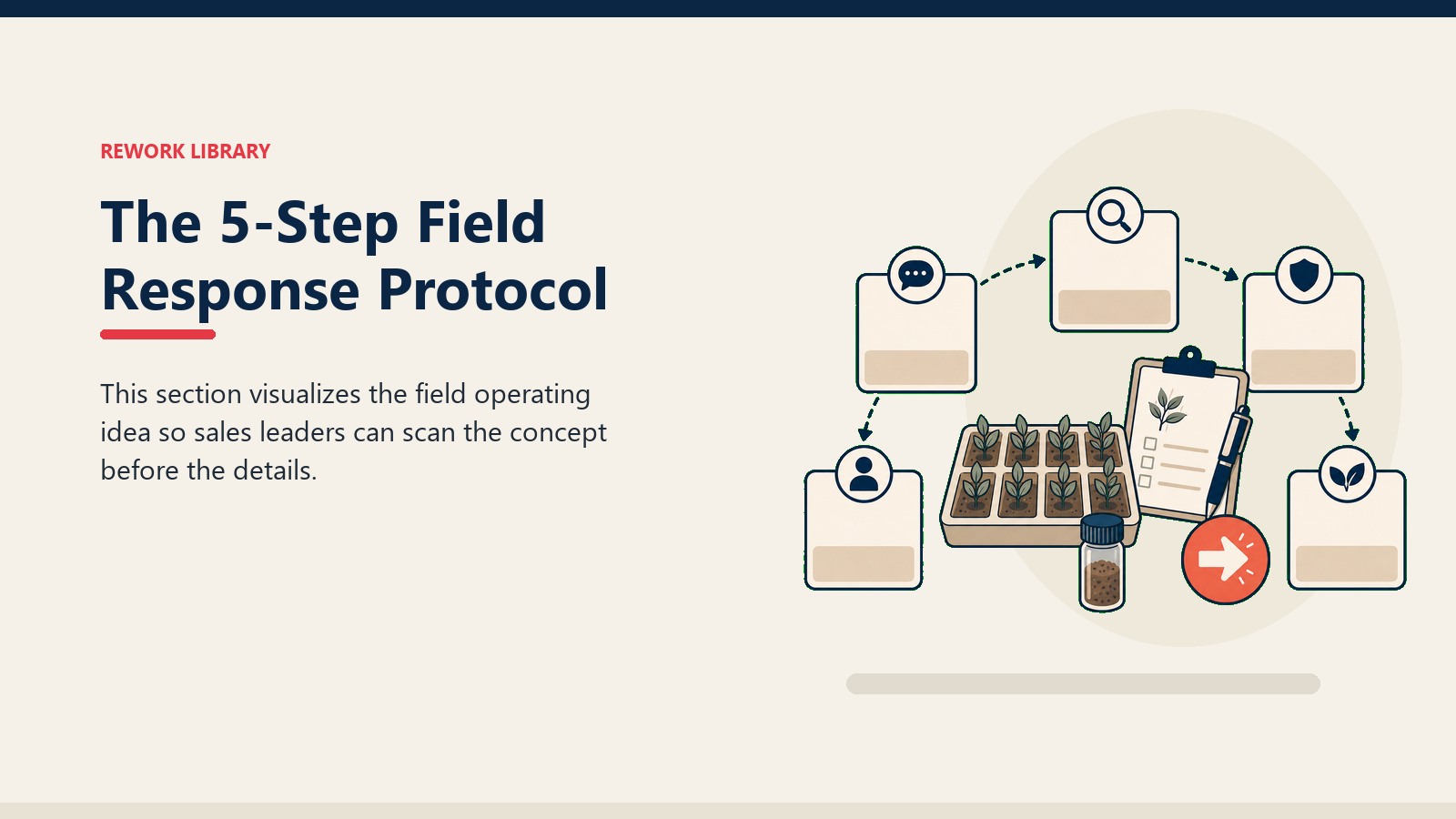
1. Acknowledge within 4 hours (call, not text)
When a complaint comes in, the rep calls the farmer back within four hours. Not a WhatsApp message. Not a forwarded note. A direct voice call. The call has three purposes: acknowledge the complaint, gather enough information to classify severity and root cause, and confirm the field visit timing. The farmer needs to hear a real person's voice committing to a real visit. Four hours is the window where the farmer is still in "waiting to be taken seriously" mode. After that, he's in "being ignored" mode, and the visit recovery is harder.
For a maize farmer reporting poor weed control after a pre-emergence herbicide application, the rep's call confirms: what product, what rate, what equipment, what was the soil moisture at application, how many days after planting. That information takes six minutes to gather and gives the rep a clear hypothesis before the visit.
2. Schedule field visit within 48 hours
For Minor complaints, 48 hours is the outer boundary. For Moderate and Critical, the rep should be aiming for the next morning. The visit timing communicates priority as clearly as anything the rep says. A rep who shows up the following morning sends a message. A rep who shows up five days later, after the farmer has already called the dealer twice, sends a different one.
Confirm the visit time in writing (WhatsApp message after the call is fine here): date, time, who's coming. If the agronomist is joining, name them. Farmers want to know the response is real and specific, not a vague promise.
3. Diagnose on site with agronomist if severity is Moderate or Critical
The joint field visit for Moderate and Critical complaints isn't optional. The rep's commercial relationship with the farmer is valuable. But the agronomist's diagnostic credibility is what makes the resolution stick. When an agronomist examines the crop, checks the spray records, looks at neighboring untreated areas, and gives a professional assessment, the farmer feels that his complaint received a serious technical response, not a sales defense.
The on-site diagnosis documents: affected area, crop stage, visible symptoms, spray records, weather data from the application window, and any relevant soil or water quality observations. Photos are taken and tagged with GPS and date. The rep takes notes in the SFA system before leaving the farm.
4. Resolve: remediation program, replacement, or credible explanation
Resolution takes one of three forms. If the root cause is an application error or timing mismatch, the resolution is a corrective program: a follow-up spray protocol, an adjusted schedule for the next application, and a clear explanation of what happened and what will prevent it. This isn't the rep blaming the farmer. It's the rep and agronomist working through the evidence together and reaching a conclusion that the farmer can accept as credible.
If there's a genuine product issue (confirmed formulation defect, cold chain failure, or a documented resistance pattern), the resolution moves to product replacement, commercial remediation, or a formal compensation review, depending on company policy and the severity of the loss. This path requires the technical team's involvement and usually a written report.
If the complaint is unresolvable within the visit (resistance confirmation pending lab results, for example), the rep sets a clear next step with a specific date. "We'll have the lab analysis in seven working days, and I'll call you on the 12th with the result" is a resolution. "We'll look into it" is not.
5. Follow-up advisory call at next crop stage
The protocol doesn't end at the visit. The rep logs the complaint resolution and sets a follow-up call timed to the farmer's next crop stage: the next irrigation window, the next application timing, the next scouting date. The follow-up call checks on crop recovery, positions the rep as an ongoing agronomic advisor, and closes the complaint loop with a human touchpoint that isn't purely commercial.
The Agronomist's Role in Complaint Resolution
The rep owns the commercial relationship. The agronomist owns the technical credibility. Complaint resolution at Moderate and Critical severity needs both, because no amount of goodwill from a rep can substitute for a technical assessment that the farmer can believe.
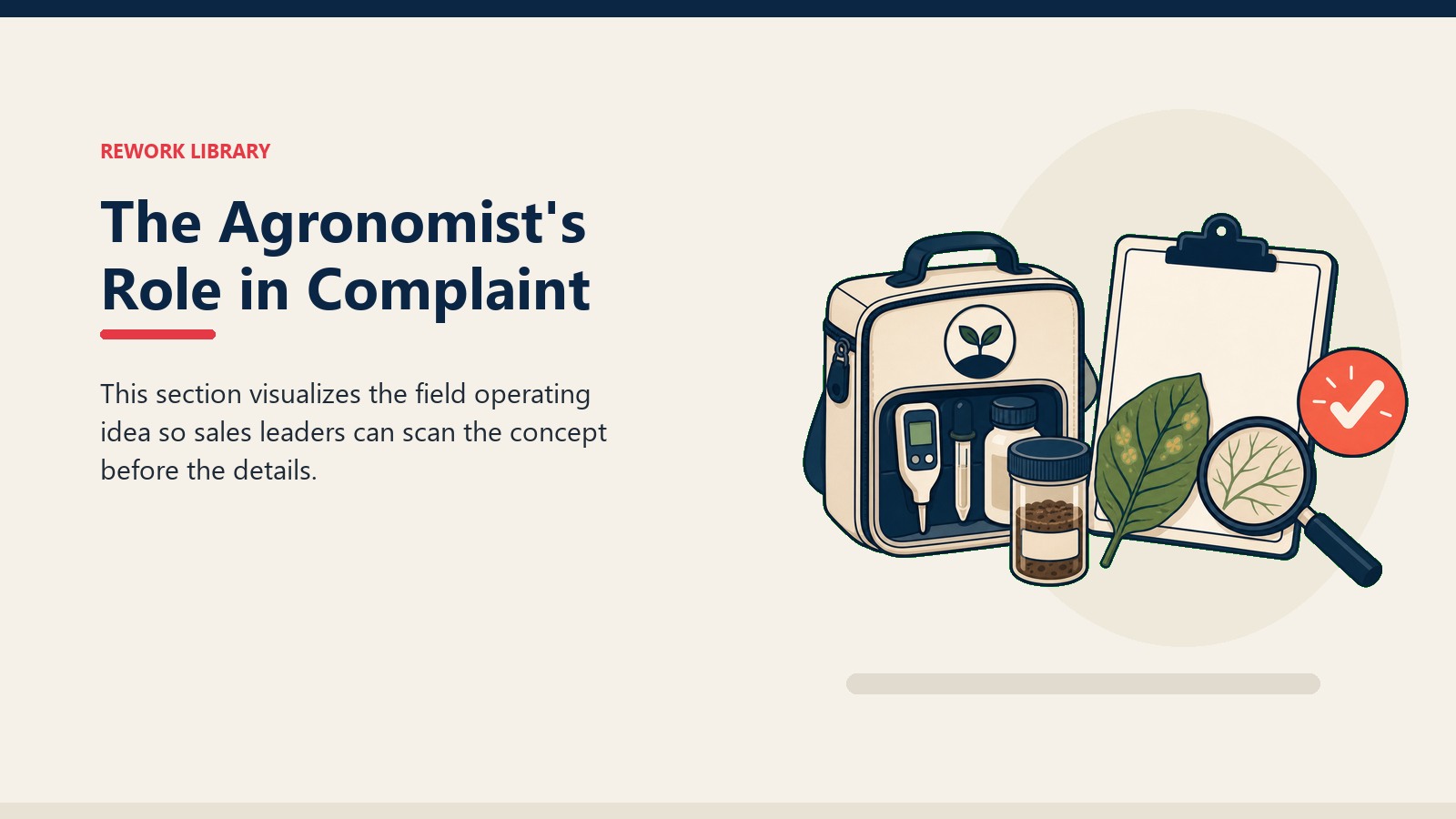
The escalation trigger for agronomist involvement is classification, not instinct. Moderate severity (meaningful crop impact, unclear root cause) and Critical severity (potential season-level loss or product failure hypothesis) both require a joint visit. Minor complaints where the rep can identify and communicate a clear application error don't always need the agronomist, but the rep should never guess at a disease or resistance diagnosis without agronomic backup.
The joint visit follows a structured sequence: the agronomist leads the field examination, the rep manages the farmer relationship and communication, and both align before speaking to the farmer about conclusions. The worst outcome of a joint visit is the rep and agronomist giving contradictory interpretations in front of the farmer. This happens when the two don't debrief before the conversation with the farmer. Fifteen minutes before the visit ends, the agronomist and rep should step aside, agree on the root cause assessment, and present it as a unified position.
The "application error vs. genuine product failure" determination matters commercially and legally. If the root cause is application error, no compensation claim is valid, but the rep still needs to handle that conversation with care. Farmers don't respond well to being told it was their fault. The framing is: "Based on the spray records and the weather data from that week, the application timing was a few days earlier than the disease pressure window. Here's what we recommend for the next application." The agronomist's presence makes that framing credible rather than defensive.
Internally, all complaint resolutions are logged in the SFA with root cause, resolution type, and whether the case required agronomist or technical team involvement. This internal reporting path is what allows the technical team to spot patterns: three complaints about the same fungicide product in the same geography within the same crop window is either an early resistance signal or a formulation consistency issue. Neither is visible without systematic logging. The Insecticide Resistance Action Committee (IRAC) provides mode-of-action classification tools and resistance management guidelines specifically designed to help field teams differentiate resistance from misuse failure at the point of complaint, and their resources are publicly available for agronomy teams to incorporate into complaint classification protocols. For more on how agronomists work in the commercial field structure, see agronomy-led product detailing and the frameworks in agronomist KOL engagement.
Keeping Dealers Informed During a Complaint
Dealers hear about complaints fast. Often before the rep does. A farmer who doesn't feel heard by the company will walk into the dealer and say the product failed. The dealer, who has two or three competing brands on the shelf and a commercial interest in moving product, will fill the vacuum with his own interpretation and possibly an alternative offer.
The rep's job is to brief the dealer before that vacuum fills. The dealer briefing should happen within 24 hours of a Moderate or Critical complaint, and it should cover: what product the complaint involves, what the rep's initial assessment is, that the rep is actively managing the case and visiting the farm, and what the dealer should say if the farmer contacts them (which is: "The rep is already on it, they're visiting the farm.").
What the rep should not share with the dealer: any preliminary conclusion about product failure, any suggestion of compensation that hasn't been approved internally, or any information that could be used commercially against the company. The dealer briefing is a holding measure. Its commercial purpose is to prevent premature substitution offers, and it works best when the dealer knows the rep is moving fast and has the situation under control. But controlling the dealer conversation is only half the work. What happens after the field visit determines whether the farmer stays or walks.
Turning Resolution into a Retention Moment
Post-resolution is the most underused window in field sales. The farmer just watched the rep show up within 48 hours, bring an agronomist, examine the crop seriously, and come back with a clear answer. That experience, when it goes well, is more powerful than any product demonstration or loyalty program. The trust it creates is earned through behavior, not marketing.
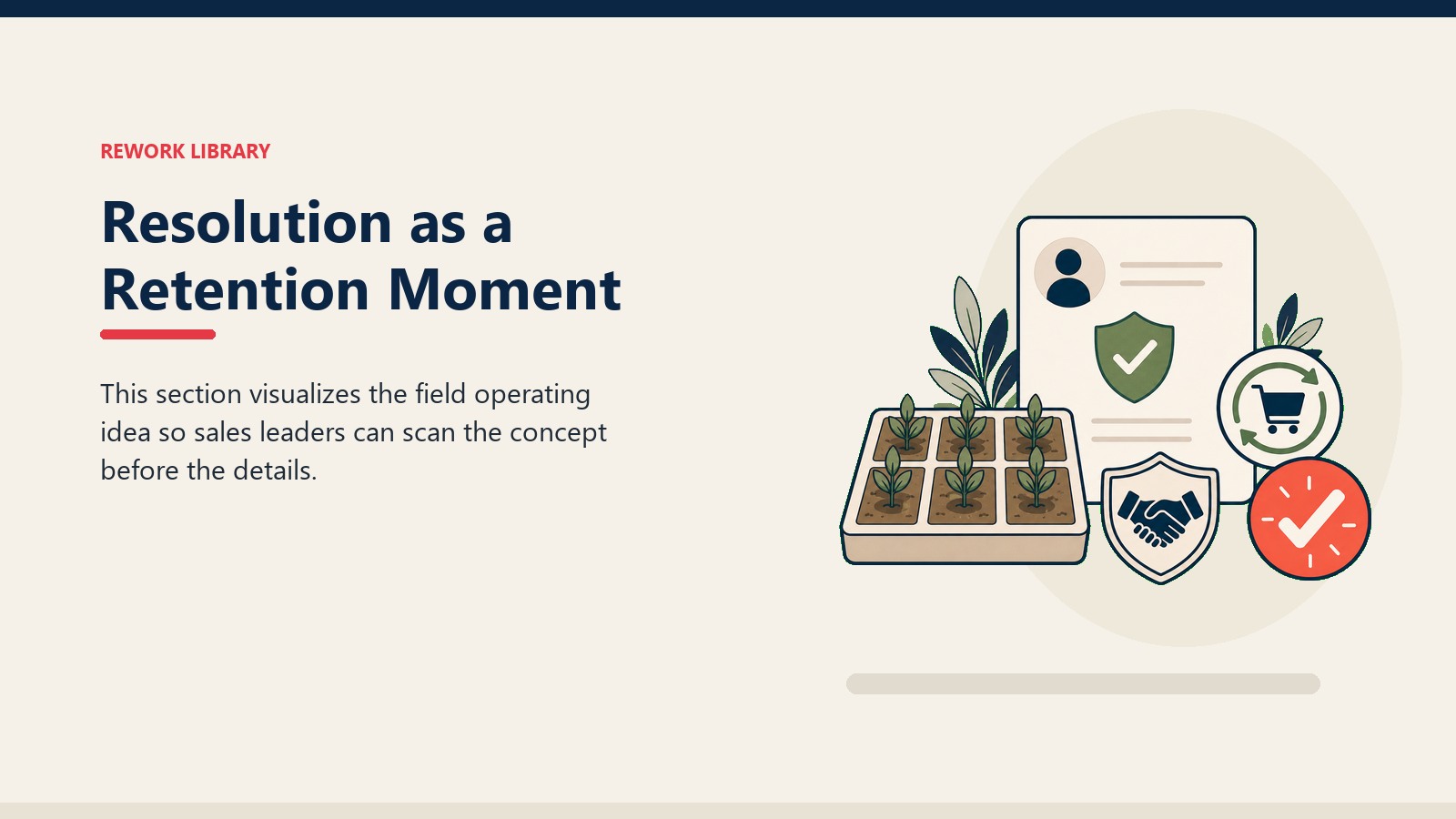
The post-resolution advisory sequence starts with the follow-up call at the next crop stage. But the sequence has a longer arc. At the next visit, the rep isn't just checking in on the complaint resolution. The rep is positioning as an agronomic partner for the season and, by extension, for next season. The conversation moves from "how is the crop recovering?" to "what are you planning for the next cycle?" That's the transition from complaint handler to trusted advisor, and it's the foundation of genuine long-term retention.
Next-season planning conversations, anchored by the trust built through complaint resolution, are where reps can introduce new products, seed treatments, or program approaches that the farmer would otherwise evaluate cautiously. The farmer has already seen how the company handles failure. That reduces the perceived risk of trying something new. For structured approaches to building on this kind of trust, see farmer retention and repeat adoption and the visit cadence model in farmer field visit advisory.
Tracking Complaints and Spotting Patterns
Individual complaint resolution is the operational layer. Pattern detection is the strategic layer, and it only works if reps log consistently.
Every complaint, regardless of severity, gets logged in the CRM or SFA with: farmer ID, product, crop, crop stage at time of complaint, root cause classification, resolution type, and close date. The SLA targets by severity:
| Complaint Severity | Target Close Time |
|---|---|
| Minor (application error, clear advisory path) | 7 days |
| Moderate (unclear root cause, agronomist involved) | 3 days |
| Critical (potential product failure, season-level impact) | 24 hours |
These aren't aspirational targets. They're the thresholds that determine whether the commercial team is managing complaints or being managed by them. Field sales managers should be reviewing open complaints by severity in their weekly team reviews. Any Critical complaint open past 24 hours is a direct management escalation.
The pattern detection value compounds over the season. Three complaints about the same fungicide product, in the same district, in the same crop stage window, within a four-week period: that's a signal. It could be early resistance in the local pathogen population, a batch quality issue, or a systemic application timing misunderstanding that got into the distributor network. None of those scenarios is visible to the technical team without logged field data. The rep who logs every complaint isn't just doing administrative work. They're generating the early warning system that protects the company's territory-level performance.
For the full CRM and SFA infrastructure that supports complaint logging, pipeline tracking, and pattern reporting, see agri sales CRM and SFA.
The best efficacy complaint programs turn field data into product performance intelligence. Reps who log well, escalate appropriately, and close complaints on SLA are doing more than service work. They're building the commercial evidence base that lets the company defend its products, identify resistance trends, and prioritize technical investment in the right geographies. FAO's Code of Conduct on Pesticide Management specifically requires that industry maintain post-market surveillance of product efficacy and adverse incidents, which means a structured complaint logging system isn't just commercial best practice but a regulatory expectation for responsible pesticide companies.
Quotable Nuggets
"An unresolved efficacy complaint doesn't just end one farmer relationship. It walks into every cooperative meeting and dealer conversation that farmer has for the next twelve months." (Field sales principle, agri-inputs commercial operations)
"The agronomist's presence in a complaint visit signals something the rep alone cannot: that the company takes the crop outcome seriously enough to send its best technical resource." (Agronomy-commercial integration practice)
"Logging every complaint isn't administrative overhead. It's the early warning system that tells the technical team whether they're seeing resistance, a formulation issue, or a field practice pattern. None of which is visible without systematic data from the field." (Field reporting and pattern detection practice)
Frequently Asked Questions about Efficacy Complaint Management
What qualifies as an efficacy complaint vs. a general product complaint?
An efficacy complaint is specific to product performance in the field: the fungicide didn't control disease, the herbicide left weeds standing, the seed treatment didn't protect against the pest it was labeled for. General product complaints cover packaging defects, labeling errors, or delivery issues. The distinction matters because efficacy complaints require on-site agronomic diagnosis, while general complaints route through standard customer service. When in doubt, treat the complaint as efficacy-related until the rep's initial call rules it out.
How should a rep handle a complaint where the farmer's application records are incomplete or unavailable?
This is common, especially with smallholder farmers who apply by habit rather than record. The rep should reconstruct the application history through the conversation: when did they apply, what equipment did they use, what was the weather like that week, what rate did they use based on how much product they purchased. Cross-referencing product purchase volume against labeled rate gives an approximate rate range. The agronomist can use crop symptom patterns to fill in timing gaps. Incomplete records aren't a reason to close the complaint without a visit. They're a reason to document the reconstruction method in the SFA log.
When does a complaint escalate to formal crop compensation?
Compensation reviews are triggered when the rep and agronomist's joint assessment confirms a genuine product failure (formulation defect, cold chain issue, or confirmed counterfeit) and the crop impact is Moderate to Critical. Application errors and timing mismatches, even severe ones, don't trigger compensation: the rep offers remediation and agronomic correction instead. The threshold and approval chain for compensation should be documented in the company's commercial policy before the season starts, not decided case-by-case in the field.
Can a complaint be closed without a field visit?
Minor complaints where the root cause is a clear application error, the affected area is small, and the farmer accepts the rep's corrective advisory without requiring physical verification can be closed by phone. But closing a complaint without a visit is a risk: the rep's assessment of severity may be wrong, and a farmer who agreed on the phone but still has visible crop damage will reopen the complaint later with far less goodwill. The default should be a field visit for anything that isn't clearly Minor.
How do you handle complaints where the farmer is also the dealer's customer for competing products?
This is common in markets where farmers buy inputs from multiple sources. The rep's job is to investigate the complaint on its merits and not assume the farmer is using it commercially. If the investigation shows the complaint involves a product that wasn't sourced from the company (a counterfeit or a different brand in the same pack), document that clearly and close the complaint with an explanation. If the complaint is legitimate, handle it the same way regardless of the farmer's other supplier relationships.
What's the right way to position an application error finding without damaging the farmer relationship?
The framing is the diagnosis, not the blame. "Based on what we found in the spray records and the weather data, the application went out three days before the disease pressure window opened in this district. Here's what the spray guide recommends for next application timing, and here's what the agronomist suggests for managing what's already on the crop." The farmer who hears that framing walks away with better agronomic knowledge and a remediation plan, not a feeling that the rep came to his farm to tell him he was wrong.
How do complaint resolution rates affect rep performance evaluation?
Complaint resolution rate (percentage of complaints closed within SLA by severity) should be a tracked KPI for every field rep, reviewed by field managers in weekly reviews. A rep who logs complaints and closes them on time is demonstrating commercial reliability. A rep with a pattern of late closures on Critical complaints, or who frequently re-opens closed complaints, has either a resourcing problem or a follow-through gap that the manager needs to address. Complaint resolution rate sits alongside visit completion and demo conversion as one of the three core behavioral indicators of field execution quality.
What named framework structures the complaint response process?
The Severity-Root Cause Grid: Complaints are classified on two axes before any field visit is scheduled. Severity (Minor, Moderate, Critical) is assessed from the farmer's description of affected area and crop stage. Root cause hypothesis (application error, timing mismatch, resistance, genuine product issue) is developed from the pre-visit phone call. The intersection of these two axes determines who goes to the field, what documentation is required, and what the resolution path looks like. The grid prevents both under-resourcing (Minor complaints handled without agronomist) and over-resourcing (Critical complaints handled by a rep alone).
Learn More
For teams building out the full field response and farmer relationship infrastructure, these resources cover the adjacent disciplines that make efficacy complaint management work in practice:

Senior Implementation Consultant
On this page
- Why Do Efficacy Complaints Carry Such High Commercial Stakes?
- Complaint Classification: Severity and Root Cause
- The 5-Step Field Response Protocol
- The Agronomist's Role in Complaint Resolution
- Keeping Dealers Informed During a Complaint
- Turning Resolution into a Retention Moment
- Tracking Complaints and Spotting Patterns
- Quotable Nuggets
- Learn More