Marketing and Field Sales Alignment in Agri-Inputs: Closing the Message Gap
Turn this article into takeaways for your work.


Each assistant summarizes the article only for you and suggests best practices for your work.
The brand team launched a TV and radio push for a new fungicide in March. Dealers received point-of-sale materials two weeks before airtime. Farmer awareness numbers looked strong in the third-party survey. But when the marketing manager called the regional sales head to ask how the launch was tracking, she got an uncomfortable answer: the reps were still liquidating last season's herbicide inventory and hadn't started talking about the new product at all.
The campaign spend went out. The field conversion didn't follow.
This isn't a communication failure. It's a structural problem. Marketing and field sales planned in different rooms, on different calendars, with different definitions of what "season launch" actually means. That's not fixed with a better kickoff email. It's fixed with a shared operating model that connects campaign timing, field readiness, and dealer stocking into one sequence before any spend is approved.
Why Does the Marketing-Field Disconnect Happen Every Season?
Three root causes drive most marketing-field misalignment in agri-inputs.

Separate planning calendars. Marketing plans by campaign window: Q1 launch, Q2 sustain, Q3 harvest push. Field sales plans by crop stage: pre-sowing, sowing, vegetative, reproductive, harvest. These calendars rarely map to the same dates in the same territory. A marketing team working from a national calendar might define "wheat sowing window" as October 15 to November 15. In Punjab, that's correct. In parts of Rajasthan, it runs three weeks later. The rep knows this. The campaign brief doesn't account for it.
HQ vs. territory timelines. What looks like the right launch window from headquarters is often off by two to four weeks in any given state or district because sowing dates, monsoon arrival, and crop variety selection vary by microclimate and local practice. An October fungicide campaign makes sense on paper. But if 60% of wheat farmers in your key district don't transplant until late November, you've spent reach budget before the purchase window opens.
Incentive structures that reward different outcomes. Marketing is typically measured on reach, brand awareness, share of voice, and campaign recall scores. The field is measured on sell-out volumes, secondary sales from dealer to farmer, and coverage of target villages. Neither metric requires the other function to succeed. So each team optimizes for its own number, and the shared outcome, actual farmer purchase at the right time, falls in the gap between the two scorecards. FAO's framework for agricultural and rural extension notes that commercial salespeople from input companies not only sell their products but also give advice on their use, effectively acting as a combined marketing and advisory function. That's why the two roles require explicit coordination when they're split across departments.
Key Facts: The Cost of Misalignment
- Organizations with tightly aligned sales and marketing functions achieve 38% higher win rates and 36% higher customer retention rates. This finding is widely cited across B2B research and attributed to MarketingProfs analysis; independent corroboration comes from Forrester, which found aligned organizations report 36% more revenue growth and up to 28% higher profitability (sopro.io/resources/blog/sales-marketing-alignment-statistics).
- When agro-input dealers actively engage with farmers at the counter, they influence which product the farmer buys in 80% of interactions, per a 2021 peer-reviewed study of 402 agro-dealers in Uganda (pmc.ncbi.nlm.nih.gov/articles/PMC8411546). A campaign that reaches farmers but doesn't align dealer talking points wastes most of its conversion potential at the final stage.
- Personalized advisory programs that feed field intelligence back into the recommendation cycle are associated with 15 to 20% higher input intensity among participating smallholder farmers in India, per a randomized study published in PLOS ONE (October 2021) (pmc.ncbi.nlm.nih.gov/articles/PMC8553076). The implication for marketing: field feedback loops aren't a reporting task, they're a commercial performance lever.
The Shared Campaign Calendar
The fix isn't more alignment meetings. It's a joint pre-season planning document that both functions commit to before any campaign spend is approved.
The shared campaign calendar has four components.
First, crop-stage trigger points by region. Not calendar dates, but agronomic triggers: when 70% of farmers in a zone are expected to reach sowing stage, when the monsoon front historically crosses into a district, when cotton bolling begins. Marketing campaigns and rep activity both anchor to these triggers, not to a national media plan date.
Second, a stocking confirmation gate. Before a campaign launches in a territory, the dealer network must confirm adequate inventory is in place. Marketing doesn't spend on demand generation into an out-of-stock dealer. This sounds obvious. It almost never happens without a formal gate in the approval process.
Third, rep briefing ahead of the media spend. Field reps need the campaign materials, key talking points, and product story at least two weeks before the campaign reaches farmers through television, radio, or digital channels. The farmer should hear a consistent message from the ad and from the rep on the same farm visit. When the rep hasn't been briefed and the farmer has already seen the ad, the rep looks unprepared.
Fourth, a clear handoff protocol: who owns each phase of the campaign. Marketing owns awareness generation. Field owns conversion from interested farmer to trial or purchase. The dealer owns point-of-sale engagement. Each function has defined entry and exit points, not shared accountability that means no one owns anything.
This connects directly to how you structure season campaign planning, where the same trigger-based logic applies to promotional timing.
Message Synchronization Protocol
The most common field complaint about marketing is that the campaign says one thing and the agronomic pitch the rep has been trained to deliver says something different. The message synchronization protocol solves this before it becomes a farmer-facing problem.

Three-layer message architecture:
The brand claim is what the company communicates at the category level: "the most trusted fungicide for wheat blast protection in North India." It's built for scale, designed for mass media.
The agronomic proof point is the field-specific evidence that backs the brand claim: trial data from demo plots in the district, yield uplift comparisons from the previous season, a local Krishi Vigyan Kendra endorsement, or an audio clip from a farmer leader who used the product. This is what the rep uses to convert farmer interest into belief.
The dealer talking point is what the dealer says when a farmer walks in and asks about the product. It's shorter than both the brand claim and the agronomic proof point. It's built for a three-minute counter conversation, not a farm demonstration.
All three must tell the same story. When marketing writes the brand claim without asking the field agronomist what farmers actually care about, the three layers diverge. The farmer hears "blast protection" from the TV ad, gets an efficacy trial from the rep, and then hears the dealer talk about price-per-bag. Three different frames on the same product. The farmer defaults to whichever product they already understand best.
The process: marketing drafts the brand claim, the field agronomist team reviews it against what's working in demo plots, a sample of five to eight frontline reps validates the talking points in mock conversations, and then the message matrix becomes the official field script for the season. It takes two weeks to do it properly and saves six months of misaligned field conversations.
This connects to the broader work of agronomy-commercial alignment and to how demo plot demand generation turns local proof into scalable commercial narrative.
Seasonal Promotion Coordination
Promotional timing in agri-inputs isn't about finding the right discount window. It's about crop stage alignment.
A stocking scheme that incentivizes dealers to load inventory in January for a March sowing window only works if the rep is actively creating farmer demand in late February and early March. If the rep is still conducting farm visits about last season's yield results when the stocking incentive expires, the dealer holds inventory that doesn't move. The dealer loses faith in the program. Next season, they're harder to convince to participate.
Three coordination rules that prevent this:
Stocking scheme timing must follow the rep activity plan, not the marketing calendar. The marketing team sets the campaign window. The sales team confirms when rep coverage of the target territory will actually hit. The stocking scheme runs in the window where both are active simultaneously.
Farmer offers, whether trial packs, application support, or outcome guarantees, must be communicated by the rep in person before they appear in any mass media. The farmer should not see a TV offer and then call the dealer to ask about it before the rep has explained it. The sequence is: rep visit, then media.
Field input feeds the next marketing brief. What worked at the farm gate this season (which proof points drove conversion, which demo format created the most purchase intent, which crop stage had the highest farmer receptivity) becomes the brief for next season's creative and promotional design. Marketing teams that skip this step repeat the same campaign mistakes every year.
The dealer visit playbook covers how to structure rep-dealer coordination during active campaign windows.
The Field-to-Marketing Feedback Loop
Marketing teams in agri-inputs often design campaigns without a reliable signal from the farm gate. The result is campaigns that are technically accurate about the product but commercially misaligned with what farmers are actually worried about.

A maize fungicide campaign launched in April might emphasize blast resistance because that's what last season's disease pressure showed. But if February rains changed the disease profile and farmers are now concerned about gray leaf spot, the campaign is speaking to last year's problem. The rep knows this. The marketing team doesn't, because there's no structured loop to carry that intelligence back.
The feedback loop is a structured weekly capture process, built into the end of the weekly rep call:
What three objections did farmers raise about this product this week? What competitor claim are farmers hearing in the market? Which campaign message is landing and which is being dismissed? What crop problem are farmers most focused on right now?
This takes ten minutes at the end of a weekly team call if it's structured with a standard form. The answers go to one named marketing contact (not a twelve-person CC chain) within 48 hours. The marketing team reviews it every two weeks and uses it to adjust dealer talking points, update the message matrix, and brief the creative team on what's changed in the territory.
Without this loop, marketing is working from launch-meeting assumptions six months old. With it, the next campaign starts from real farmer intelligence captured in the previous season. It's the difference between a campaign that resonates and one that gets politely ignored at the farm gate. Research on personalized digital extension services in India found that advisory programs tailored to local conditions drove 15-20% higher input intensity among participating farmers, a result that only happened when field intelligence was fed back into the recommendation cycle rather than treated as a one-way broadcast.
This connects directly to how you build a reporting culture that makes field intelligence visible. See agri sales KPIs and metrics for how to structure the capture cadence, and field reporting and demo tracking for the operational mechanics of weekly field data collection.
Metrics That Bridge Both Functions
The alignment problem is partly a metrics problem. When marketing tracks reach and field tracks sell-out, you have two teams optimizing for outcomes that don't require each other. The fix is a shared scorecard with three linked KPIs reviewed by both functions in the same monthly meeting.
| Metric | What It Measures | Who Owns It | Why It Links Both |
|---|---|---|---|
| Campaign reach-to-offtake conversion | Percentage of farmers in the campaign zone who purchased during the campaign window | Both functions jointly | Directly connects awareness spend to sales result in the same territory |
| Demo conversion rate | Percentage of demo plot attendees who purchased within one crop cycle | Field primary, marketing secondary | Validates both field execution quality and whether the campaign message is creating genuine interest |
| Dealer sell-out lift during campaign window | Percentage increase in dealer secondary sales versus the same window in the prior year | Field primary, marketing secondary | Shows whether the integrated campaign actually moved the market or just generated awareness |
When both teams sit in the same monthly review against the same three numbers, misalignment becomes visible and specific. Marketing can't report a "successful campaign" if sell-out in the target zone didn't move. Field can't report a "strong territory performance" if campaign reach was never converted. The numbers create shared accountability that meeting culture alone never will.
The same principle applies across commercial functions. The CRM adoption operating model covers how shared data infrastructure makes this kind of cross-functional scorecard operationally sustainable. Peer industries have worked through the same challenge: pharmaceutical marketing-field alignment and FMCG trade marketing alignment both offer transferable models for how to structure joint accountability in seasonal, territory-driven sales environments. But the scorecard only works if the operational disciplines underneath it run consistently every season.
Three Disciplines That Keep the Functions in Sync
No software platform solves this. No reorganization is required. What keeps marketing and field sales in sync is process commitment to three disciplines, run consistently every season.
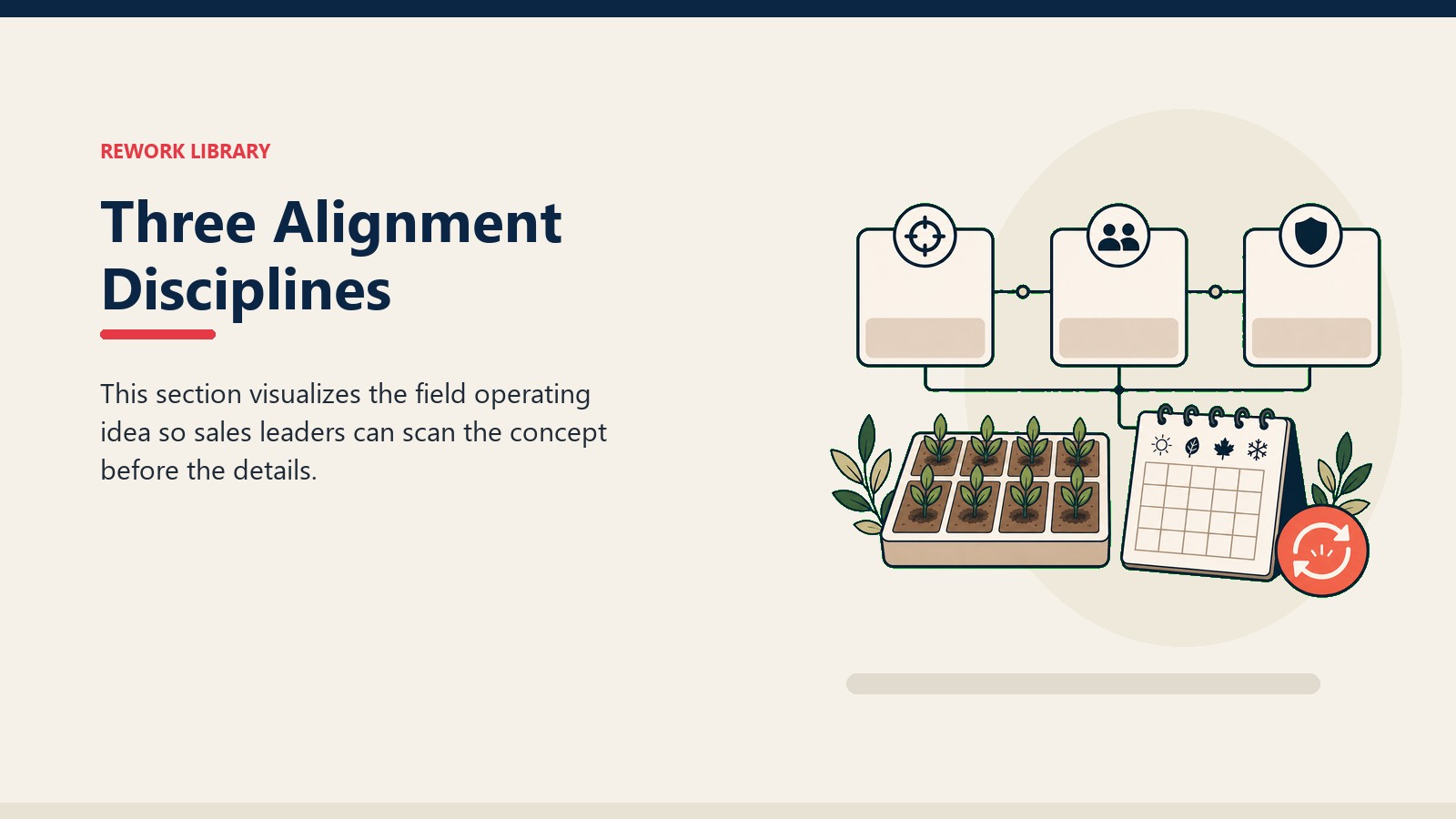
Pre-season joint sign-off. Marketing doesn't release campaign spend until field has confirmed territory readiness: stocking confirmed, reps briefed, crop stage alignment validated against agronomic triggers. One page. Both function heads sign it. The discipline isn't the document; it's the conversation that produces it. When marketing and field leadership sit in the same room to define what "ready to launch" means in each state, the misalignment surfaces before the spend goes out.
Campaign week field presence. For the first week of any major campaign in a territory, the marketing brand manager joins the field rep for two days of farmer visits. Not to present the product. To listen: to the objections, the competitor references, the crop concerns the farmer raises that the campaign brief didn't anticipate. This ends the "HQ doesn't understand the field" complaint permanently, because it's no longer true. And it changes how the next campaign is written.
Monthly shared review. One meeting, both functions, one scorecard: reach, demo conversion, and sell-out lift. Not a status update where each team reports their own numbers. A diagnostic: what caused the gap between campaign reach and sell-out in Region X last month, and what do we change before the next campaign window opens? Thirty minutes is enough if the data is prepared in advance and the conversation is structured around causes rather than excuses.
These three disciplines won't solve every misalignment. Monsoon timing will still surprise you. A competitor will still run a price promotion the week your launch goes live. But they'll catch the structural gaps, the ones that show up in the same way every season because no one ever fixed the underlying process, before campaign spend is committed against a field force that isn't ready.
The Three-Layer Message Architecture: Brand claim (category-level, designed for mass media) + Agronomic proof point (field-specific evidence: trial data, yield comparisons, KVK endorsements) + Dealer talking point (a 3-minute counter-conversation script, not a product brochure). All three layers must tell the same story. When marketing writes the brand claim without agronomist input, and the dealer talking point without a field test, the farmer hears three different framings of the same product and defaults to whichever product he already understands best.
Quotable Nuggets
"Marketing planned by campaign window while sales planned by crop stage. Until those two calendars share the same document and the same sign-off, every season will produce the same mismatch." (Marketing-field alignment operating principle)
"The farmer should hear the same product story from the TV ad, from the rep on his farm, and from the dealer at the counter. When those three are contradicting each other, the farmer doesn't switch brands. He stays with what he already knows." (Three-layer message architecture principle)
"Personalized advisory programs that close the field-to-marketing feedback loop are associated with 15 to 20% higher input intensity among participating farmers. That's not a marketing stat. That's a field execution stat that starts with marketing listening to the field." (PLOS ONE study on digital extension, India, October 2021, pmc.ncbi.nlm.nih.gov/articles/PMC8553076)
Frequently Asked Questions about Marketing and Field Sales Alignment in Agri-Inputs
Why do marketing and field sales keep misaligning even in companies that recognize the problem?
Incentive structures are the deepest cause. Marketing is typically measured on reach, awareness, and campaign recall. Field is measured on sell-out volumes and secondary sales. Neither metric requires the other function to perform. So each team optimizes toward its own number without needing the other to succeed. The fix isn't cultural. It's adding shared KPIs (campaign reach-to-offtake conversion, demo conversion rate, sell-out lift during campaign window) that create a number both teams have to contribute to.
What is the right sequence: campaign launch before or after dealer stocking?
Always dealer stocking first, then rep briefing, then campaign launch. The stocking confirmation gate exists specifically to prevent campaign spend from flowing into territories where farmers hear the ad and walk to an out-of-stock dealer. A marketing team that launches nationally before confirming stocking by territory is generating awareness spend that produces frustration, not conversion.
How many days before a campaign reaches farmers should field reps be briefed?
At minimum 14 days. Ideally three weeks. The rep needs enough time to brief dealers, adjust her territory visit schedule, and position the product in her advisory conversations before farmers start seeing the campaign. A rep who is still running a different product story when the campaign goes live looks unprepared in farmer conversations. That gap, where the farmer saw the ad but the rep hasn't been briefed, is one of the most common feedback complaints from field sales teams.
What should the field-to-marketing feedback loop actually contain?
Four categories, collected weekly: (1) the three most common objections farmers raised about the promoted product, (2) the competitor claim currently circulating in the territory, (3) which campaign message or proof point is generating the most conversion intent, and (4) which crop problem farmers are currently most focused on. This takes 10 minutes at the end of a weekly team call if it's structured with a standard form and routed to a single named marketing contact, not a committee.
How do you handle a situation where the field and marketing teams are in different regional offices and don't share a planning cycle?
The shared campaign calendar is the instrument, not the meeting. Marketing and field sign a joint document before campaign spend is approved: trigger points by region (agronomic, not calendar), stocking confirmation gate, rep briefing timeline, and handoff protocol by function. If both functions commit to the document before spend is released, the geography gap becomes a coordination problem rather than a structural failure. The pre-season joint sign-off is the discipline that makes the calendar more than a slideshow.
What metric best tells you whether a campaign worked in agri-inputs?
Campaign reach-to-offtake conversion: the percentage of farmers in the campaign zone who purchased the promoted SKU during the campaign window. Not awareness scores, not survey recall, not impressions. What matters is how many farmers who heard the campaign message actually bought the product at the dealer counter. This metric requires linking media reach data (by geography) to secondary sales data (by dealer catchment and SKU). It's harder to calculate than awareness scores, which is why most companies don't track it and repeat the same campaign mistakes every season.
Learn More
Related reading on campaign coordination, field execution, and cross-functional alignment in agri-inputs:

Senior Implementation Consultant