Agronomist and KOL Engagement: How Agri-Input Companies Use Scientific Credibility to Accelerate Farmer Adoption
Turn this article into takeaways for your work.


Each assistant summarizes the article only for you and suggests best practices for your work.
In a cotton-growing district in Maharashtra, an agri-input company had been trying to break into a cluster of villages for two seasons. The rep made visits, the dealer stocked the product, the price was competitive. Farmer uptake was close to zero.
Then a progressive farmer named Satish, who ran 22 acres and was known across four villages as someone who got consistently good yields, agreed to host a demo plot. When Satish started talking about the results at the local cooperative meeting, thirty farmers who'd politely declined the rep's pitch placed orders with the dealer within two weeks.
Nothing about the product changed. What changed was who was talking about it.
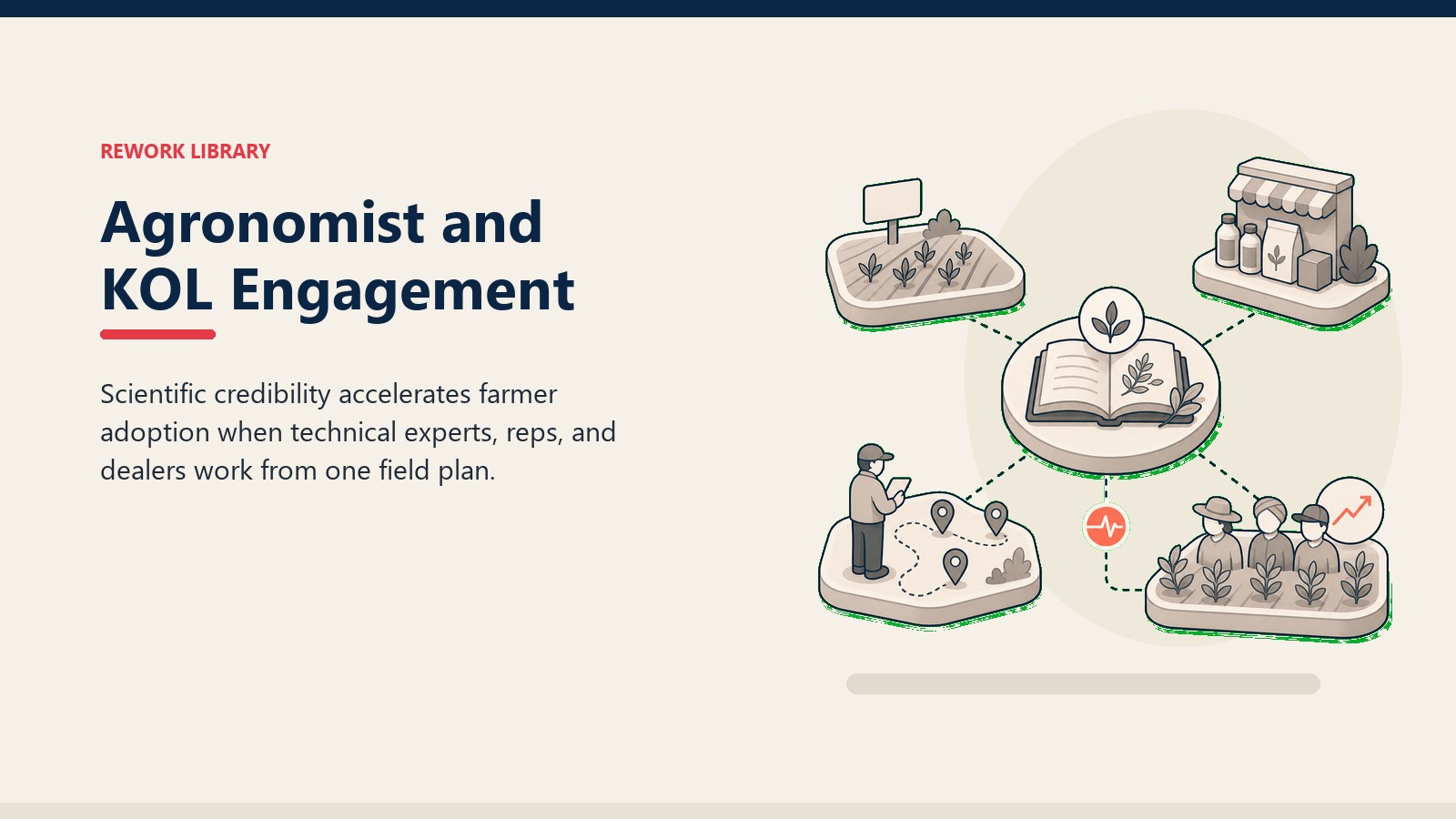
That's the fundamental dynamic behind KOL (Key Opinion Leader) engagement in agri-inputs. Farmers trust other farmers, especially farmers with a track record, more than they trust company representatives. KOLs, whether they're progressive farmers, government extension officers, cooperative leaders, or respected input dealers with agronomist credentials, are trust multipliers. They don't replace the rep's commercial work. They compress the trust cycle that normally takes multiple seasons down to weeks.
Who Counts as a KOL in Agri-Inputs
The KOL definition in pharmaceutical markets tends to be narrow: specialists, academic researchers, clinical opinion leaders with publications and speaking histories. In agri-inputs, the category is broader and more varied, which means field teams have more potential KOL relationships to develop but also more noise in identifying the right ones.
Progressive farmers are the most commercially potent KOL type in agri-inputs. These are medium to large farmers who are known for trying new techniques, getting better yields than neighbors, and being sought out for advice on crop management decisions. They carry credibility because their opinions are based on practical experience on real farms in the same conditions other farmers face. A progressive farmer who publicly endorses a product after running it on his own acreage shifts community purchasing behavior in ways that no amount of rep activity can replicate.
Government extension officers carry institutional authority. Farmers in many markets still give significant weight to recommendations from the local Krishi Vigyan Kendra (KVK), district agricultural office, or cooperative extension service. Extension officers won't endorse commercial products directly in most cases, but they will participate in technical field days, validate the agronomic claims behind a treatment, and recommend specific products when they genuinely believe they're the right agronomic choice. The relationship needs to be built on technical substance, not commercial transactions.
Cooperative heads and self-help group leaders have social authority. In farming communities organized around cooperatives or self-help groups, the leader's product preferences often become community preferences. These KOLs don't need to be agronomic experts. Their influence comes from trust and social position, not technical depth.
Input dealers with agronomist credentials are a unique category. The best-positioned dealers in many markets have become genuine agronomic advisors to their customer base. They diagnose crop problems, recommend integrated pest management approaches, and advise on nutrition programs. A dealer who recommends a product to a farmer is already operating as a KOL within his own customer network. Investing in this dealer's technical knowledge builds both the KOL relationship and the commercial partnership simultaneously.
Key Facts: KOL and Agronomist Engagement
- A randomized controlled trial in Malawi found that lead farmers trained in a new cultivation technique were 25.8 percentage points more likely to adopt in Year 1 than control farmers. Neighboring farmers who observed but did not receive direct training showed a 3.6 percentage point adoption increase in Year 2 (a 95% relative increase from a 3.8% base), demonstrating that peer learning from a credible progressive farmer continues to produce adoption gains across multiple seasons (J-PAL / Poverty Action Lab Malawi lead farmer RCT).
- Neighbor-to-neighbor learning has a more durable long-run effect on agricultural technology adoption than extension agent instruction. A panel study tracking Ethiopian farmers from 1999 to 2009 found that extension effects diminished over time while peer effects compounded. That's the core mechanism that makes KOL investment a multi-season commercial asset rather than a one-time activation (Krishnan and Patnam, American Journal of Agricultural Economics, 2014, Vol. 96(1), pp. 308-327).
- In a 2021 qualitative study of farmers in Hungary and the UK, farmers reported trusting other farmers most as a source of knowledge about new agricultural practices, and expressed lower trust in academic researchers and government agricultural institutions ("Have farmers had enough of experts?", Environmental Management, 2021; PMC8503873). The finding is consistent across multiple geographies: peer credibility is the primary trust mechanism in farming communities.
KOL Identification Criteria
Not every respected farmer or extension officer is a productive KOL relationship. The ones worth investing in share four characteristics:
Reach: How many farmers in the target geography actually listen to and act on this person's recommendations? A progressive farmer with 22 acres who's discussed agriculture with 200 neighbors over a decade is more valuable than a larger farmer who keeps to himself. Ask the dealer, ask other farmers, and watch who gets asked questions at community events.
Crop expertise aligned with your commercial priority: A respected cotton farmer is the right KOL for a cotton fungicide program, not necessarily for a wheat fertilizer program. Match the KOL's primary expertise to the category and crop where you're trying to drive adoption. This seems obvious, but field teams often develop relationships with whoever is most accessible rather than whoever is most commercially aligned.
Commercial neutrality: A KOL who's already on a competitor's paid program, who's a family member of a dealer for a rival brand, or who has vocal commercial commitments to competing products will not generate credible endorsement for yours. Independence, or at least the perception of independence, is essential. Farmers calibrate how much they trust a recommendation based on whether they believe it's self-interested. If the KOL is seen as bought, the endorsement is discounted.
Communication style: Some agronomically excellent farmers simply don't communicate in ways that influence others. They're quiet, or they speak in technical language that doesn't resonate in a village meeting setting. The KOLs worth developing for field activation are the ones who can explain agricultural observations clearly and engagingly to a peer group. Watch how they talk in informal settings before you bring them into a structured field day role.
KOL scoring matrix:
| Criteria | Score 1 | Score 2 | Score 3 |
|---|---|---|---|
| Farmer network reach (estimated farmers who follow their advice) | Below 20 | 20-50 | More than 50 |
| Crop category expertise match | Different category | Overlapping category | Direct match |
| Perceived commercial independence | Active competitor relationship | Neutral or unknown | Clearly independent |
| Communication effectiveness in group settings | Weak or reluctant | Adequate | Strong, engaging |
| Geographic coverage | Single village | 2-3 villages | 4+ villages or cooperative-level |
KOLs scoring 12 or above are Tier 1 investment priorities. Scores of 8-11 are Tier 2 (develop but don't anchor major events around them until tested). Below 8, maintain a basic relationship but don't invest program resources.
How Do You Build a KOL Relationship Before Making an Ask?
The most common KOL engagement mistake is reaching out to a potential KOL only when you need them to do something. A field day is coming up, the rep asks the progressive farmer to speak, the farmer shows up and says things that are technically accurate but lack conviction because there's no genuine relationship behind them. Farmers in the audience can tell.
The relationship has to be built on technical exchange first, commercial activation second. This takes time, which is why KOL development needs to be an ongoing rep responsibility throughout the year, not a burst activity before event season.
Technical knowledge exchange is the foundation. Bring the KOL early access to trial data, research findings, and agronomic technical support. Not as a commercial offer, but as a genuine partnership: "You're trying our product on your field this season. Here's what the research station found in similar soil conditions, and here's our agronomist's mobile number if you want to discuss application timing." KOLs who receive genuine technical support develop a real relationship with the company's agronomic team, which makes their subsequent endorsements authentic rather than obligatory. FAO's framework for agricultural extension services identifies exactly this knowledge-sharing dynamic as the backbone of sustainable technology diffusion in farming communities.
Demo plot co-ownership is the most effective relationship accelerator. When the KOL hosts a demo plot on his own farm and has genuine input into plot design and management, he becomes invested in the outcome. His harvest results are his results. When he talks to other farmers about what he saw, he's talking from personal experience, not from a script someone handed him. See Demand Generation via Demo Plots for how co-ownership differs from simply using a KOL's land as a plot location.
Recognition and non-monetary incentives matter in agri-KOL relationships, but they need to be chosen carefully. Farmers who are recognized publicly for their agronomic expertise and progressive practices (certificates, photographs in company materials, invitations to regional trials) respond well to that recognition. Cash payments for endorsements, by contrast, undermine the commercial independence that makes the KOL's opinion valuable. If farmers come to believe that a progressive farmer endorses products because he's paid to, his endorsements stop working. The incentive structure should reinforce the KOL's identity as a technical expert, not convert him into a brand ambassador with obvious financial interests.
Quotable Nuggets
"KOLs don't replace the rep's commercial work. They compress the trust cycle that normally takes multiple seasons down to weeks." Rework Agri-Inputs Growth Library
"Neighbor effects persisted and compounded while extension impact did not." Krishnan and Patnam, American Journal of Agricultural Economics, 2014. The commercial implication is direct: a KOL relationship that produces one good demo-plot result becomes more valuable each season as that progressive farmer's network absorbs the proof and passes it to new adopters.
"Farmers reported trusting other farmers most as a source of knowledge about new agricultural practices, and expressed lower trust in academic researchers and government institutions." "Have farmers had enough of experts?", Environmental Management, 2021. Independent progressive farmer endorsement is trusted precisely because it does not come from a commercial source.
The KOL Investment Ladder: Four stages of relationship deepening that move a progressive farmer from known contact to active demand-generation asset: (1) Identify: apply the five-criteria scoring matrix (reach, expertise match, commercial neutrality, communication style, geographic coverage); (2) Develop: lead with technical knowledge exchange and early trial data access before any event ask; (3) Co-own: place a demo plot on the KOL's farm and give him genuine input into plot design and management; (4) Activate: invite the KOL to present at harvest field days as a trial-result validator, not a company spokesperson. Each stage requires one full season before moving to the next.
Structuring KOL Involvement in Field Programs
Once the relationship is established, KOL involvement in commercial field programs takes three forms. Each has a different function and requires different preparation.
Field-day speakers provide the agronomy segment of farmer meetings and field days. The KOL or independent agronomist opens the event with technical content before the rep's commercial segment. This format works because it separates the expert voice from the commercial voice. The credibility is in the separation. See Farmer Meetings and Field Days for the event structure that positions KOL speakers most effectively.
Farmer group meeting facilitators work well for progressive farmer networks and self-help groups. Instead of the rep running a village meeting, the KOL facilitates it, with the rep present as a technical resource the KOL can call on for product specifics. This format shifts the social dynamic: the farmers are talking to their peer or their trusted advisor, who happens to be talking about a product he's used and found effective. The rep's role is confirmatory, not primary.
Trial result validators serve a specific function at harvest events. When the demo plot results are presented, having the KOL present who ran the plot and who can speak to what he did and what he observed carries much more weight than a rep presenting numerical results from a plot the KOL managed alone. The validator role is especially powerful when the KOL is not a company employee or paid advisor, because farmers understand that this person has no commercial reason to inflate the result.
Agronomist-Rep Collaboration Model
The rep leads commercial conversations. The agronomist or KOL leads technical conversations. The line between these isn't always clean, but getting it approximately right determines whether the field team generates genuine adoption or just goodwill.
Specifically:
Rep leads when:
- The conversation is about pricing, schemes, dealer availability, or order logistics
- The farmer is already convinced of the product's value and just needs a purchase path
- A direct question about the company's commercial terms or product warranty comes up
Agronomist or KOL leads when:
- The farmer is questioning whether the product is agronomically sound for his specific crop condition
- The conversation involves soil type, application timing, compatibility with other treatments, or expected crop response
- The audience is skeptical and needs technical credibility before they'll engage with commercial content
A rep who tries to handle technical agronomic challenges without appropriate KOL support will get into territory where she either overstates what the product can do (credibility risk) or admits uncertainty in ways that undermine the sale. Knowing when to step back and bring in the agronomist is a core field competency. See Agronomy-Led Product Detailing for the collaborative detailing format in one-on-one farmer visits.
The parallel in pharmaceutical field sales is the medical science liaison (MSL) and rep division of responsibility. MSLs handle clinical questions that exceed the promotional scope; reps handle the commercial conversation. The same functional separation applies in agri-inputs, with agronomists and KOLs playing the MSL-equivalent role. See Doctor Detailing Best Practices for the clinical parallel.
Managing KOL Independence
The tension in any KOL program is between activation and authenticity. You want the KOL to say positive things about your product. But you also need farmers to believe the KOL's opinion is genuine. Over-manage the KOL's message and you undermine the independence that makes the message credible.
Don't script the KOL. Give him the data, the trial results, and the key technical points. Let him translate those into his own language and his own framing. Farmers trust a progressive farmer who says "this worked on my 40 acres and here's what I saw" far more than a progressive farmer who delivers a rehearsed product benefit statement that doesn't sound like how he actually talks.
Don't ask for endorsements the KOL can't stand behind. If a KOL ran a plot that had mediocre results due to a weather event, don't push him to speak at a field day about that product. The most experienced progressive farmers will decline, and if a less experienced one complies, his credibility is damaged when other farmers learn the results were weak. KOL independence is a long-term asset. Protect it even when it costs a short-term commercial moment.
Do give KOLs visibility into your technical pipeline. KOLs who are part of technical networks, who get early access to new trial data, who are invited to company research sessions, feel invested in the brand's technical progress. This investment is what produces genuinely enthusiastic advocacy: the KOL who has followed a product's development across multiple trials and believes in it agronomically is a fundamentally different advocate than one who was asked to show up at a field day and say positive things.
Tracking KOL Impact
KOL programs need to justify commercial investment, which means tracking impact at the territory level. The metric that matters is adoption rate in KOL-influenced geographies versus comparable control territories.
Territory-level impact tracking table:
| Territory | KOL involvement (type, frequency, events) | Adoption rate: Kharif 2025 | Adoption rate: Kharif 2026 | Vs. control territory |
|---|---|---|---|---|
| Amravati East | Progressive farmer (3 events, demo plot) | 12% | 28% | +11 percentage points |
| Amravati West (control) | No KOL activation | 11% | 17% | Baseline |
| Yavatmal North | Extension officer (2 events, co-facilitated meetings) | 9% | 24% | +7 percentage points |
| Yavatmal South (control) | No KOL activation | 10% | 17% | Baseline |
Track the data at this level for at least two seasons before drawing conclusions. Single-season data can reflect other variables (weather, competitor activity, rep capability). Two-season trends with controlled comparison territories give you evidence that the KOL investment is producing adoptable rather than coincidental uplift.
The Ideal Customer Profile framework is useful for identifying which farmer segments in a territory respond most strongly to KOL-influenced recommendations, allowing you to focus future KOL activation events on the highest-conversion audience. See Agronomy and Commercial Alignment for how KOL impact data feeds back into territory sales planning.
Also see KOL Identification and Recruitment for the pharmaceutical parallel, where the scientific credibility mechanism and the independence management challenge are structurally identical, even though the audience differs.
Conclusion: KOLs Compress the Farmer Trust Cycle From Seasons to Weeks
Satish in Maharashtra wasn't a coincidence. He was what happens when a company invests systematically in a relationship, gives the KOL genuine technical support, creates the conditions for authentic experience, and then provides a platform for him to share that experience with his peer community.
Without that investment, Satish was just another farmer the rep had visited twice. With it, he became a node in the demand network that shifted community purchasing behavior faster than any combination of direct rep activity, trade promotion, or advertising could have.
KOL engagement works because it operates through the trust channels farmers actually use to make decisions: peer experience, expert observation, and community validation. It doesn't replace the rep's commercial execution. But it creates an environment where the commercial conversation happens after the trust is already established, which changes the entire dynamic of the sale.
Build the KOL network before you need it. Give before you ask. Protect independence even when it costs a short-term moment. Measure the impact at the territory level and invest accordingly. The field teams that do this don't just run better field days. They build community-level adoption curves that compound season over season.
Frequently Asked Questions about Agronomist and KOL Engagement
How many KOLs should a rep develop per territory?
A functional KOL network for a territory of 200-500 target farmers typically involves three to six active KOLs across different villages, crop categories, and relationship types. Quality matters more than quantity. Three highly credible, genuinely independent KOLs who speak authentically will outperform ten KOLs who are nominally on the program but have no real conviction about the product.
Should KOLs be compensated financially?
Non-monetary recognition (certificates, regional event invitations, early access to technical research) is generally more effective at preserving the independence that makes KOL endorsements credible. Where financial compensation is part of the program, it should be transparent and structured as honoraria for time spent at events, not as commissions tied to sales volumes. Farmers who learn that a KOL receives sales commissions will discount everything that KOL says. Keep the incentive structure clean.
How do you handle a KOL who starts making claims you can't substantiate?
Address it directly and early. A KOL who overstates product performance based on one good season is not helping the program. He's creating liability when the results don't match the claims in subsequent seasons. Provide the KOL with accurate data, help him calibrate his claims to what the evidence actually supports, and reinforce that his credibility is based on technical accuracy, not enthusiasm. KOLs who can't be calibrated without losing their willingness to participate are not stable program assets.
What's the best starting point for a rep building a KOL network from scratch?
Start with the host farmer for your first demo plot. Identify the most respected progressive farmer in the most commercially important village cluster in your territory. Invest in a genuine technical relationship through the planting season. Run the harvest activation together. If the results are good and the relationship is solid, that progressive farmer is your first KOL, and his visibility at the harvest event will identify three to five other farmers worth developing.
How long before a KOL relationship produces measurable adoption lift in the territory?
Expect one full season of relationship development before meaningful results appear, and two seasons before you have enough territory-level data to attribute adoption gains specifically to KOL influence rather than other factors (weather, competitor weakness, rep activity). The J-PAL Malawi lead farmer RCT found significant Year 1 adoption gains for trained lead farmers (25.8 percentage points over control), but neighbor spillover effects were modest in Year 1 and compounded in Year 2. Plan KOL investment on a two-to-three season horizon, track adoption rates in KOL-influenced villages against comparable control territories, and review the territory-level impact table after two full seasons before deciding whether to expand, maintain, or replace specific KOL relationships.
Learn More

Senior Implementation Consultant
On this page
- Who Counts as a KOL in Agri-Inputs
- KOL Identification Criteria
- How Do You Build a KOL Relationship Before Making an Ask?
- Quotable Nuggets
- Structuring KOL Involvement in Field Programs
- Agronomist-Rep Collaboration Model
- Managing KOL Independence
- Tracking KOL Impact
- Conclusion: KOLs Compress the Farmer Trust Cycle From Seasons to Weeks
- Learn More