New Dealer Acquisition: How to Onboard Agri-Dealers and Get First Orders Faster
Turn this article into takeaways for your work.


Each assistant summarizes the article only for you and suggests best practices for your work.
Companies pour money into trade shows, brand campaigns, and distributor conferences to attract new agri-dealers. Then they hand the new dealer a price list, confirm a trial order, and move on to the next territory task. Six weeks later the new dealer's storeroom still has half the opening stock, no farmer has visited the counter asking for the brand by name, and the rep is too busy with existing accounts to go back.
The failure mode isn't dealer disinterest. It's a lack of any structured process to take a new commercial relationship from first conversation to active, reordering partner within a single crop cycle. Without that process, most new dealers become what the industry calls "one-and-done": one trial order, no reorder, and a quiet exit from the network before the rabi season even starts.
A structured acquisition process isn't complicated. But it requires treating new dealer development as a repeatable commercial operation, not a side task that happens when the rep has a spare afternoon.
When Should You Recruit New Dealers?
Not every territory needs more dealers; some territories need better dealers, which is a dealer segmentation and classification problem, not a recruitment one. New dealer acquisition makes commercial sense in three specific situations.
White-space villages. The dealer universe mapping exercise identifies villages in the territory with significant crop area but no active dealer carrying your brand. These are the highest-priority recruitment targets because there's no incumbent relationship to displace and the farmer population has an unmet need for input availability and advisory support.
Competitor-hold areas. Villages where your current dealer network is thin or absent but a competitor has established a strong presence. Recruiting a second outlet in a competitor-hold area creates an alternative access point for farmers who'd switch brands but currently have no way to buy yours locally. The new outlet doesn't need to unseat the competitor immediately; it needs to be present and well-supported enough that farmers who trial your product have somewhere to buy it.
New crop-expansion zones. Areas where irrigation development, contract farming programs, or shifting crop patterns are creating new input demand that didn't exist in prior seasons. Recruitment in these zones happens before the demand fully materializes, which means being present when the first generation of farmers in the area makes their brand choices.
Don't recruit new dealers in already-dense coverage areas to create competition between your own outlets. Over-distribution in a single village cannibalizes per-dealer volume, reduces each dealer's margin visibility on your brand, and signals to the dealer network that you don't respect territory boundaries.
Key Facts: New Dealer Onboarding
- In Tanzania, 30% of smallholder farmers lived more than one hour's travel time from the nearest agro-dealer, according to a 2021 Food Security study of 299 dealers across eight districts (doi:10.1007/s12571-021-01181-9). That access gap is exactly the commercial opportunity white-space recruitment targets.
- In the agri-input supply chain, inputs typically change hands at least three times (importer to regional distributor to agro-dealer) before reaching a farmer, and 68% of surveyed dealers buy from local distributors rather than manufacturers directly. Dealers who don't know their distributor contact have reorder friction built in from day one (Food Security / Springer, 2021, Tanzania, n=299).
- IFC's Working with Smallholders handbook identifies financial standing and supply-chain readiness as the two most critical gateway checks before integrating any new distributor into an agribusiness supply chain. Companies that skip this qualification step face credit defaults and stock returns that consume more commercial time than the new account generates.
Qualifying a New Dealer
Financial and commercial qualification before the first order prevents most of the downstream problems that kill new dealer relationships. This step is skipped more often than it should be, either because the rep is eager to log a new account or because the qualification feels awkward when the dealer is keen. The IFC's Working with Smallholders handbook identifies financial standing and supply chain readiness as the two most critical gateway checks before integrating any new distributor into an agribusiness supply chain.
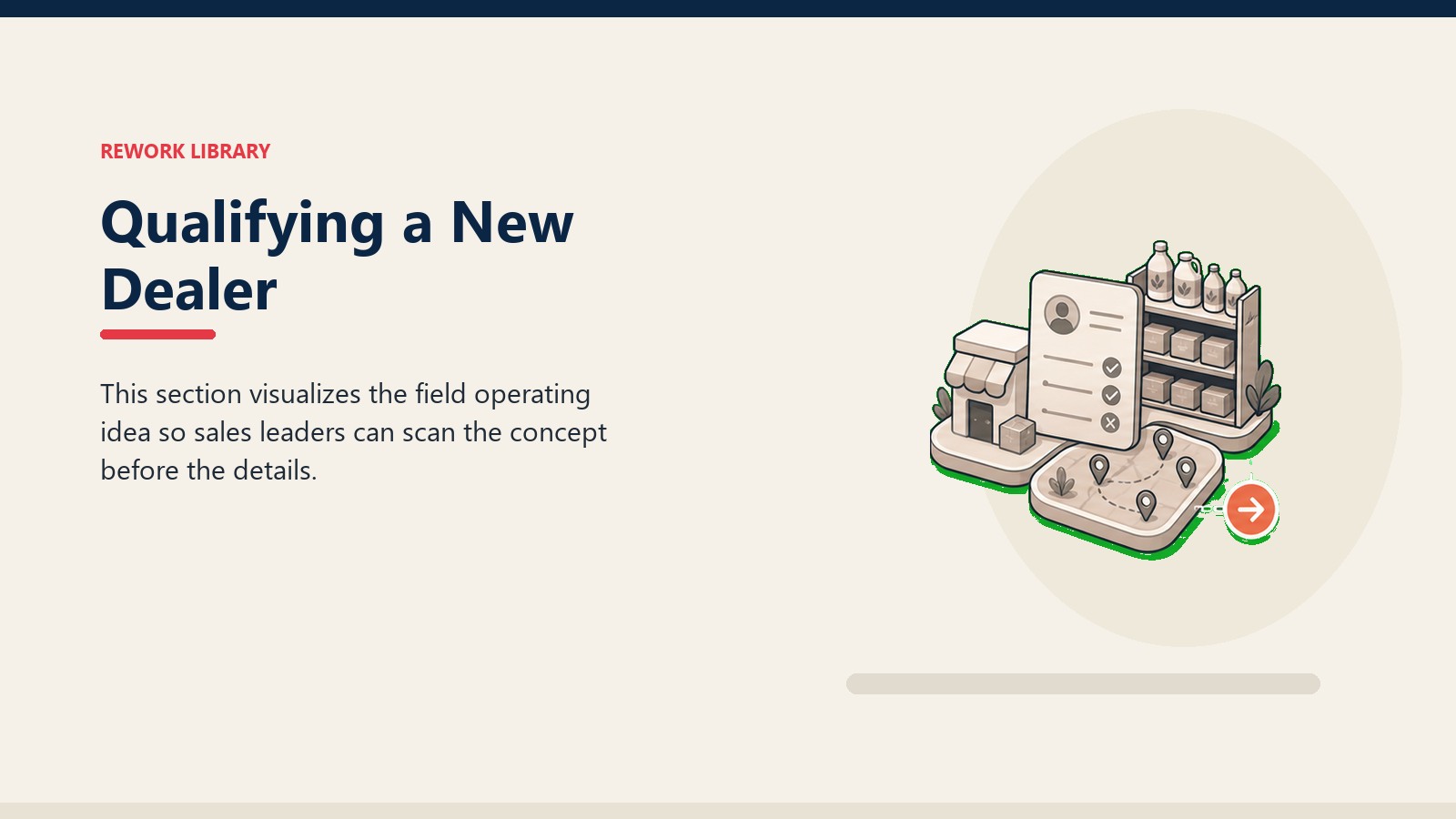
Run through these four qualification dimensions before committing to an opening order:
Financial standing and credit history. Check with your distributor whether the outlet has purchased inputs from the distribution network before and how they've handled credit. A dealer who's been extended credit by two other suppliers and is currently delinquent on both is a risk no matter how eager they are to carry your brand. For new outlets with no input-channel history, ask for a bank reference or a reference from another supplier. A modest cash-upfront first order is both lower risk and a genuine test of commitment.
Farmer footfall and relationship depth. How many farmers does this dealer currently serve, and how? A general merchant who sees 100 farmers a week but sells them primarily groceries and household items isn't the same as a specialist agricultural input dealer with 60 farmer families who trust their crop advice. The second dealer has influence; the first has traffic. For agri-inputs, influence matters more. Research on agro-input dealer behavior in Uganda found that while 97% of dealers reported advising customers as their responsibility, only 26.6% actually provided advice during mystery shopping visits, meaning claimed advisory depth needs field verification, not just a rep's impression from a first visit.
Storage capacity and product handling. Does the outlet have appropriate storage for agrochemicals and fertilizers? Improper storage degrades product, creates liability, and produces customer complaints that damage the brand before any farmer relationship is built. A quick store check during the qualification visit confirms this.
Willingness to commit to a minimum opening order. An opening order below a commercial viability threshold signals low commitment. It's not about the revenue from that single order; it's about whether the dealer is investing enough to have real skin in the success of the relationship. Set a minimum opening order threshold for your product range (e.g., 50,000 to 80,000 INR of mixed stock for a standard pesticide and fertilizer range) and stick to it.
Dealer Qualification Scorecard
Score each potential new dealer before committing resources to the onboarding sequence.
| Qualification Dimension | Pass | Conditional | Fail |
|---|---|---|---|
| Credit history | Clean, or no prior input channel (new entrant) | Minor delays, resolved | Current delinquencies |
| Farmer footfall | Above 80 farmer relationships | 40-80 farmer relationships | Below 40 or purely transactional |
| Storage adequacy | Appropriate storage confirmed | Upgradeable within 30 days | No viable storage |
| Opening order commitment | Meets minimum threshold | 70-100% of threshold | Below 70% of threshold |
| Village crop area | Above territory minimum threshold | Moderate crop area | Minimal crop area |
A scorecard with two or more "Fail" ratings is a no-recruit outcome. A scorecard with one "Fail" and two "Conditional" ratings needs an area-manager review before proceeding. Don't let enthusiasm for hitting a recruitment number override the qualification logic.
The Onboarding Visit Sequence
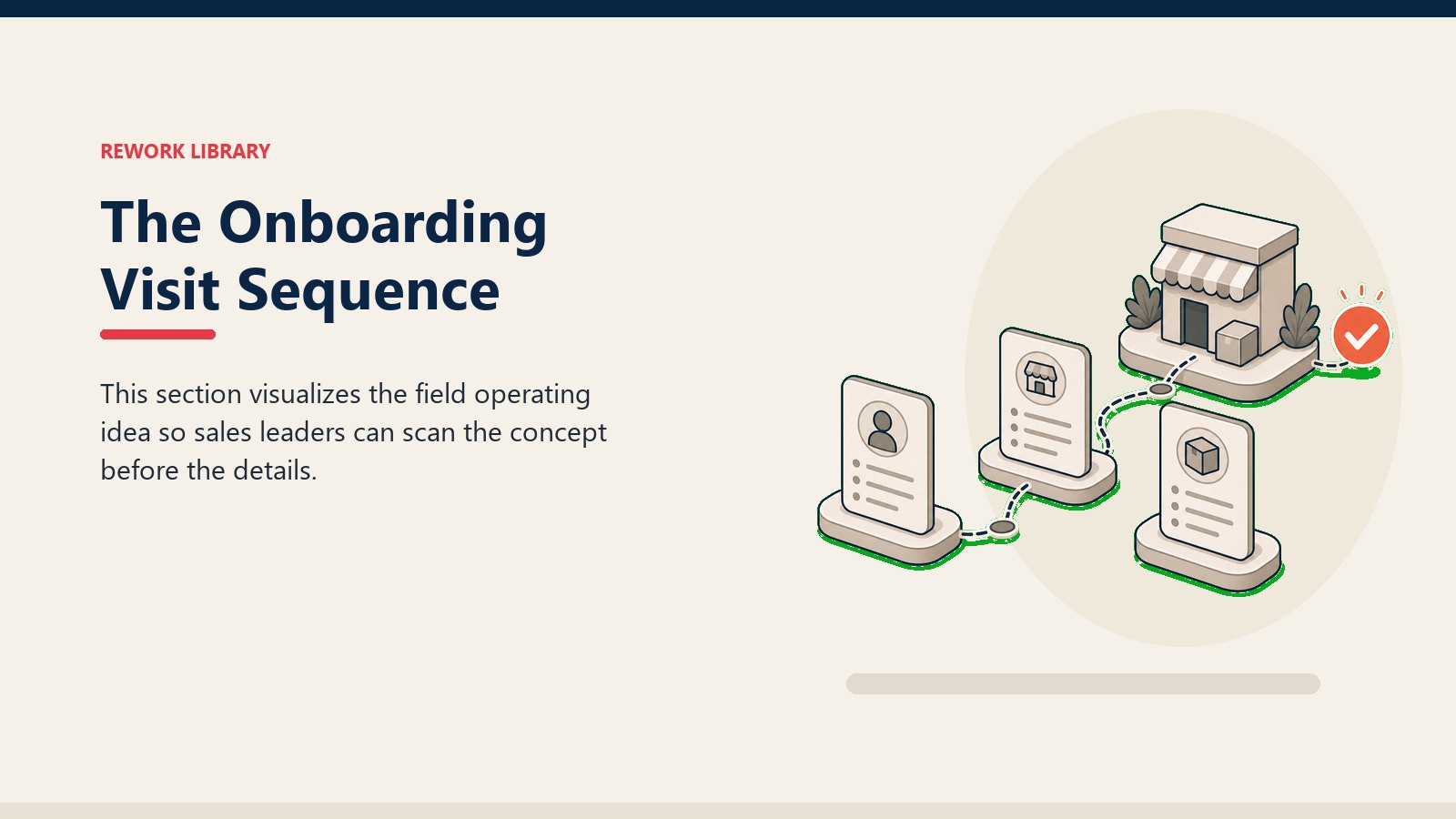
New dealer onboarding follows a five-step visit sequence. Each step has a specific objective and a decision point that gates entry to the next step.
Step 1: Introduction visit (Week 0). The rep introduces the brand, the product range, and the commercial terms. This visit is information-sharing, not selling. The goal is to establish credibility and understand the dealer's current product mix and farmer relationships. Duration: 30 to 45 minutes. Output: a preliminary sense of whether the dealer meets qualification criteria.
Step 2: Qualification visit (Week 1-2). Confirm the qualification scorecard dimensions. Inspect the store, ask the credit-standing questions, understand the farmer footfall, and get a realistic read on the dealer's commitment level. This visit often includes a brief tour of the storage area and a conversation about which competitor products the dealer currently recommends and why. Output: a completed qualification scorecard and a go/no-go recommendation to area manager.
Step 3: Commercial discussion (Week 2-3). Present the opening order program, credit terms for the trial period, and the first-season support package (demo-plot allocation, farmer-meeting support, co-branded materials). This is also where you introduce the dealer to the distributor relationship: who their distributor contact is, how reorder logistics work, and what the escalation path is for stock issues or delivery delays. Output: agreed opening order terms and a signed credit application if extending terms.
Step 4: First-order confirmation and stock delivery (Week 3-4). Confirm the opening order, arrange distributor delivery, and verify that stock arrives correctly and is shelved appropriately. The rep should be present at or immediately after first delivery to confirm product placement and confirm the dealer can display and demonstrate the products correctly. Output: stock delivered, rep photos of shelf placement in CRM.
Step 5: 30-day follow-up visit. Return 30 days after stock delivery. Check sell-through rate (how much has actually moved versus what's sitting in back stock), confirm the dealer has been recommending the products to farmers, address any questions or objections that have come up in farmer conversations, and confirm the timing of the co-funded farmer meeting or demo-plot visit planned for the first crop cycle. Output: 30-day sell-through data, confirmed farmer-engagement plan for the first 90 days.
| Step | Timeline | Rep Action | Output |
|---|---|---|---|
| 1. Introduction | Week 0 | Brand and range presentation | Initial dealer interest confirmed |
| 2. Qualification | Week 1-2 | Store check, scorecard completion | Go/no-go decision |
| 3. Commercial discussion | Week 2-3 | Opening order terms, distributor intro | Signed terms, credit application |
| 4. First-order delivery | Week 3-4 | Delivery confirmation, shelf placement | Stock in store, CRM logged |
| 5. 30-day follow-up | Day 30 | Sell-through review, farmer-plan confirm | Reorder timeline established |
First-Order Support Package
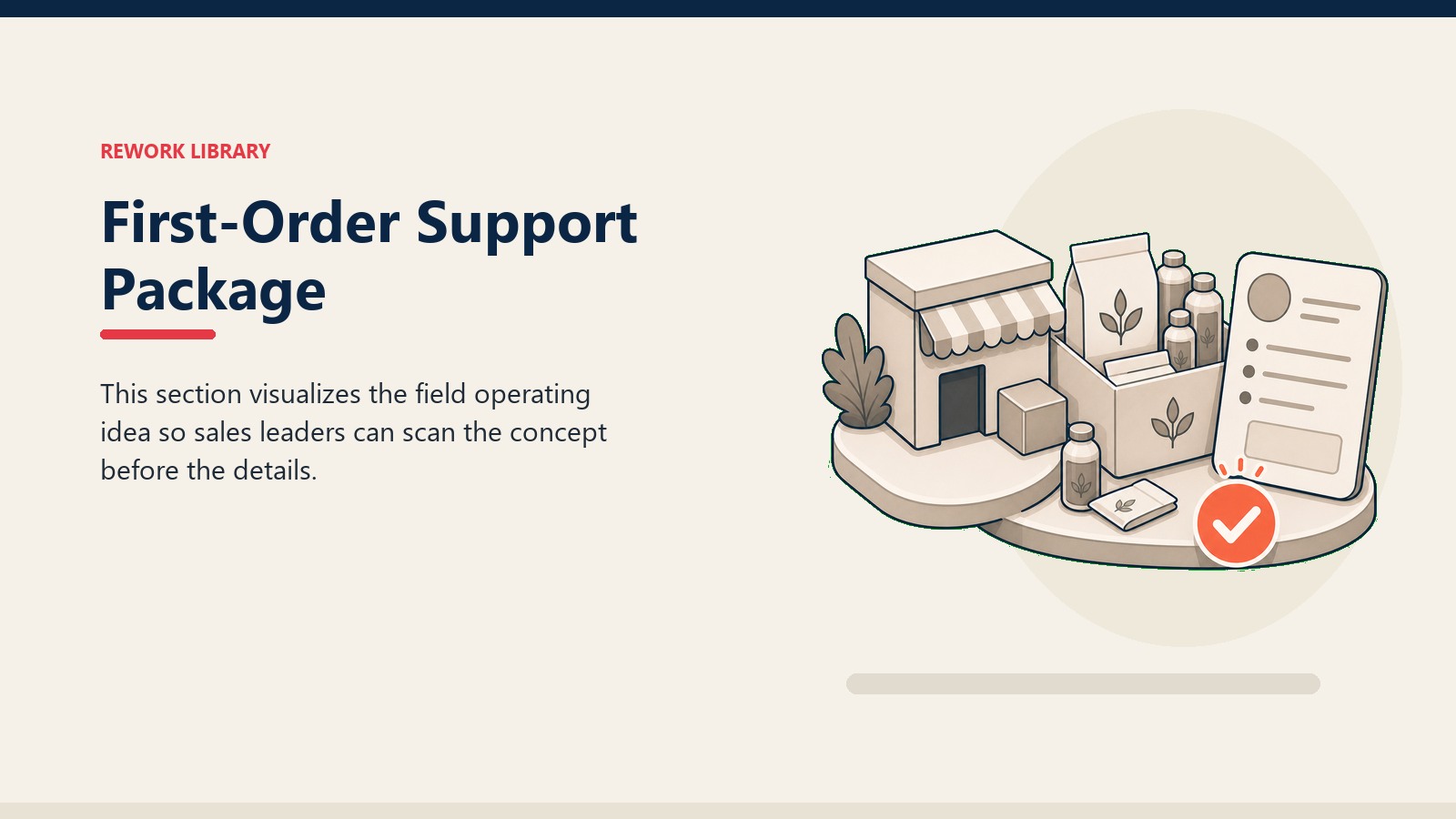
The support package in the first crop cycle is what converts a trial stocking decision into an active commercial partnership. Generic support (the same materials and credit terms you extend to every C-tier dealer) won't generate the pull-through a new dealer needs to justify continuing with your brand.
Trial credit terms. Extend marginally better credit terms for the opening order than you'd offer a standard C-tier account. It signals confidence in the relationship and reduces the dealer's cash-flow risk on an untested brand. Keep the extended terms time-bound: normal credit terms apply from the second order.
Demo-plot allocation in the dealer's village. A demo plot within walking distance of the dealer's store lets the dealer walk farmers to a visible proof point during the crop season. This is the single most effective tool for generating early pull-through at a new dealer. The conversation at the demo plot: "This is what the product does on a field like yours." The conversation at the counter afterward is easier. See demand generation via demo plots for setup and management protocols.
Co-branded farmer meeting in the first 60 days. Fund a farmer advisory meeting in the dealer's primary village within the first 60 days of onboarding. Bring your agronomist to present on the relevant crop challenges for that season. The dealer's name and store details go on the invitation materials. The event reinforces the dealer's credibility with her own farmer base while generating visible brand exposure. See farmer meetings and field days for the program design.
Introductory co-branded display material. Branded display stands, crop-advisory posters, and product shelf-talkers that the dealer can use to signal to farmers that your brand is now available at their local store. New dealers without existing brand materials at their counter look indistinguishable from an outlet that's never carried agri-inputs.
Distributor connection. Personally introduce the new dealer to their distributor sales representative. The distributor relationship is the logistical lifeline for reorders; a new dealer who doesn't know their distributor contact will have reorder friction at exactly the moment they need to move quickly to capture farmer demand. FAO's hub agro-dealer model shows that placing dealers at the center of distribution networks, with clear upstream connections to input suppliers, is what determines whether smallholder farmers can access inputs locally without long-distance travel.
Quotable Nuggets
"The measure of a successful new dealer acquisition isn't the opening order. Any dealer will take a first order if the price is right and the credit terms are easy enough. The measure is the reorder." Rework Agri-Inputs Growth Library
"A dealer who doesn't know how to place a reorder will wait for the rep to come back and take the order manually. That creates a bottleneck in the rep's schedule and a reorder delay at the dealer counter." Rework Agri-Inputs Growth Library
According to FAO's hub agro-dealer model, placing dealers at the center of distribution networks with clear upstream connections to input suppliers determines whether smallholder farmers can access inputs locally without long-distance travel (FAO, AFAP partnership program documentation).
The White-Space Activation Framework: The three-stage approach to new dealer territory expansion: (1) Identify: map white-space villages with crop area but no brand coverage; (2) Qualify: run the four-dimension scorecard before committing to an opening order; (3) Activate: deliver the 90-day support package with a demo plot, co-funded farmer meeting, and distributor introduction in the first 45 days. Each stage gates the next; recruitment that skips qualification produces one-and-done dealers, not active channel partners.
The 90-Day Activation Target
A new dealer who doesn't reach a reorder within the first 90 days is at serious risk of becoming dormant. Define your activation success criteria before onboarding begins and assign accountability to the area manager, not just the rep, for hitting them.
90-day activation metrics:
| Metric | Target for Activation |
|---|---|
| Reorder rate | At least one confirmed reorder within 90 days of opening order |
| Sell-through on opening stock | At least 50% of opening stock moved to farmers within 60 days |
| Farmer advisory events held | At least one co-funded farmer meeting completed |
| Farmer inquiries at counter | Rep observation of farmers asking for brand by name at dealer counter |
| Distributor relationship | Dealer has placed at least one direct reorder through the distributor |
An area manager review at day 90 checks each metric. A dealer who hasn't reached the reorder and sell-through targets by day 90 needs an intervention: a joint rep-manager visit, an agronomist drop-in at the store, or a targeted farmer-pull activity in the dealer's village catchment. Waiting until the season ends to diagnose the failure means losing the crop cycle entirely.
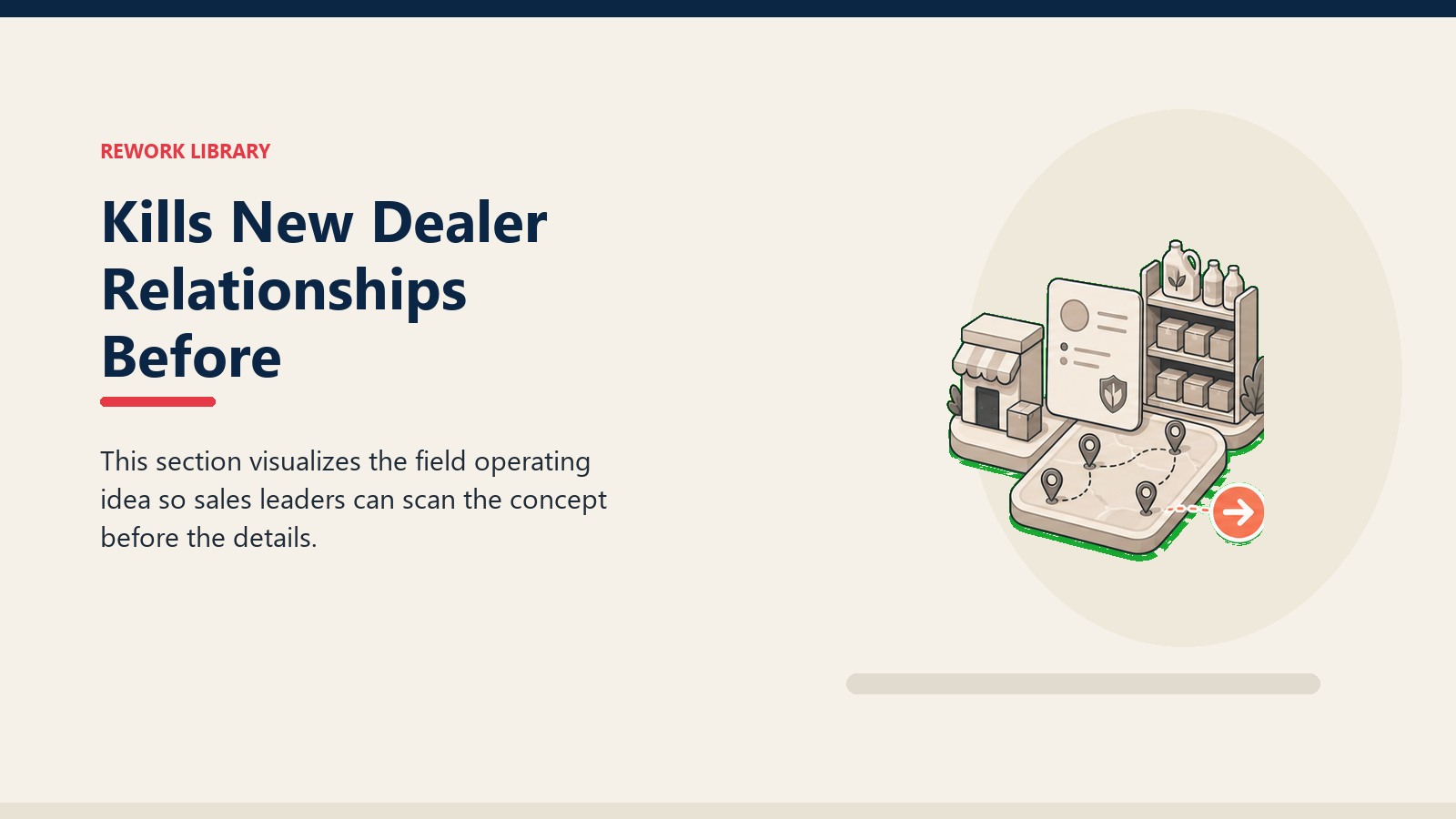
What Kills New Dealer Relationships Before They Start?
The patterns that kill new dealer relationships are predictable enough to prevent.
Recruiting in over-served markets. Adding a new dealer in a village that already has two active competitors and one of your own dealers won't generate incremental volume. It will dilute margin across all outlets, reduce every dealer's individual commitment to your brand, and create channel conflict with the dealer you've been developing. Discipline around geographic targeting is a pre-condition for successful new dealer acquisition.
Skipping financial qualification. A dealer with working capital problems will absorb your opening order and your extended credit terms and then go quiet. Reclaiming that stock or that credit damages the distributor relationship, consumes area-manager time, and produces no revenue. The awkwardness of asking a credit question is small relative to the cost of getting the answer wrong.
No agronomic support in the first crop cycle. A new dealer with your stock on the shelf and no agronomist visit, no demo plot, and no farmer event within the first 45 days is asking farmers cold whether they want to try a brand the dealer has never personally seen work. The pull-through rate from that setup is predictably low. Agronomic support in the first cycle isn't a bonus; it's the mechanism that creates the pull-through the dealer needs to justify reordering.
Failing to introduce the dealer to the distributor. A dealer who doesn't know how to place a reorder will wait for the rep to come back and take the order manually. That creates a bottleneck in the rep's schedule and a reorder delay at the dealer counter. Make the distributor introduction part of the commercial discussion visit, not an afterthought.
Linking New Dealer Acquisition to Prospecting
New dealer acquisition is a structured prospecting strategy applied to the agri-input channel. The same principles that govern B2B prospect identification and qualification apply: define your ideal outlet profile, identify and prioritize candidates from the universe map, follow a defined qualification process, and track conversion metrics from first contact to active reorder.
Speed of initial engagement matters in agri-input dealer recruitment just as it does in lead management. A new outlet that expresses interest in stocking your brand and doesn't hear back from a rep within a week has usually already been called by a competitor rep. The lead response time discipline that governs B2B inbound follow-up applies equally to dealer-inquiry follow-up. When an existing dealer refers a new outlet, when a distributor flags an interested retailer, or when a rep identifies a target during a farm visit, the first contact should happen within 48 hours.
For territories where new dealer recruitment spans multiple sub-geographies and multiple distributors, the rural distribution and sub-stockist management framework covers the logistical and relationship architecture needed to make recruitment scalable beyond what a single rep can manage.
Conclusion: Speed to First Reorder as the Activation Metric
The measure of a successful new dealer acquisition isn't the opening order. Any dealer will take a first order if the price is right and the credit terms are easy enough. The measure is the reorder: a dealer who buys again, within the same crop season, after seeing their opening stock move to farmers who came back to the counter satisfied.
Getting to that reorder requires structured qualification before the opening order, a co-funded support package that generates visible farmer pull-through within the first 45 days, and a 90-day review that catches failing activations before the season is lost.
A repeatable onboarding process is what makes new dealer acquisition scale. Without it, every new outlet is a one-time experiment. With it, every season's white-space map converts into active channel within one crop cycle.
Frequently Asked Questions about New Dealer Acquisition
How many new dealers should a rep recruit per season?
A practical target for a rep managing an established territory is three to five new dealer relationships per season, focused on white-space villages identified in the universe map. Quality of recruitment and onboarding support matters more than volume: five well-supported new dealers who reorder beat fifteen under-supported ones who go dormant. Area managers should validate recruitment targets against the universe map gaps, not arbitrary headcount goals.
What's the difference between recruiting a new dealer and reactivating a lapsed one?
Lapsed dealers have prior experience with your brand and your distribution network. The reactivation conversation is different: understand why they stopped, address whatever caused the break (usually a service issue, a credit dispute, or a competitor offer), and propose a trial re-engagement with a modest credit sweetener. Lapsed dealers typically reactivate faster than new dealers because the qualification work is already done and the farmer relationship exists.
Should a new dealer's opening order go through the distributor or direct?
Always through the distributor. New dealers who receive their opening order direct from the company and then transition to distributor logistics for reorders often experience a service-quality gap that creates early dissatisfaction. The opening order sets the service expectation for the relationship; it should come through the same channel as every subsequent order.
How do I handle a new dealer who wants our brand exclusively?
Exclusivity at the dealer level is commercially attractive but operationally complex in most agri-input markets where dealer income depends on carrying a full range across categories. A more realistic ask is primary brand commitment: your brand gets the first-shelf position, the primary recommendation to farmers asking for advice, and priority stocking depth. Exclusivity as a formal arrangement is more achievable in categories where you have a complete range that covers the dealer's full customer need.
How do I know if poor activation is a dealer problem or a rep problem?
Check the pattern across the rep's full portfolio of new dealers, not just one. If a single new dealer goes dormant while the rep's other new accounts are activating on schedule, it's likely a dealer-fit issue (qualification was too loose) or a territory issue (the village has less demand than projected). If multiple new dealers in the same rep's territory go dormant at the same step in the sequence, it's a rep execution problem. The rep isn't completing the onboarding visit sequence or isn't delivering the first-45-day support package. Area managers should track this at the rep level, not just the account level, to catch systemic gaps early.
Learn More

Senior Implementation Consultant
On this page
- When Should You Recruit New Dealers?
- Qualifying a New Dealer
- Dealer Qualification Scorecard
- The Onboarding Visit Sequence
- First-Order Support Package
- Quotable Nuggets
- The 90-Day Activation Target
- What Kills New Dealer Relationships Before They Start?
- Linking New Dealer Acquisition to Prospecting
- Conclusion: Speed to First Reorder as the Activation Metric
- Learn More