Navigating Government Schemes and Input Subsidies in Agri-Input Sales
Turn this article into takeaways for your work.


Each assistant summarizes the article only for you and suggests best practices for your work.
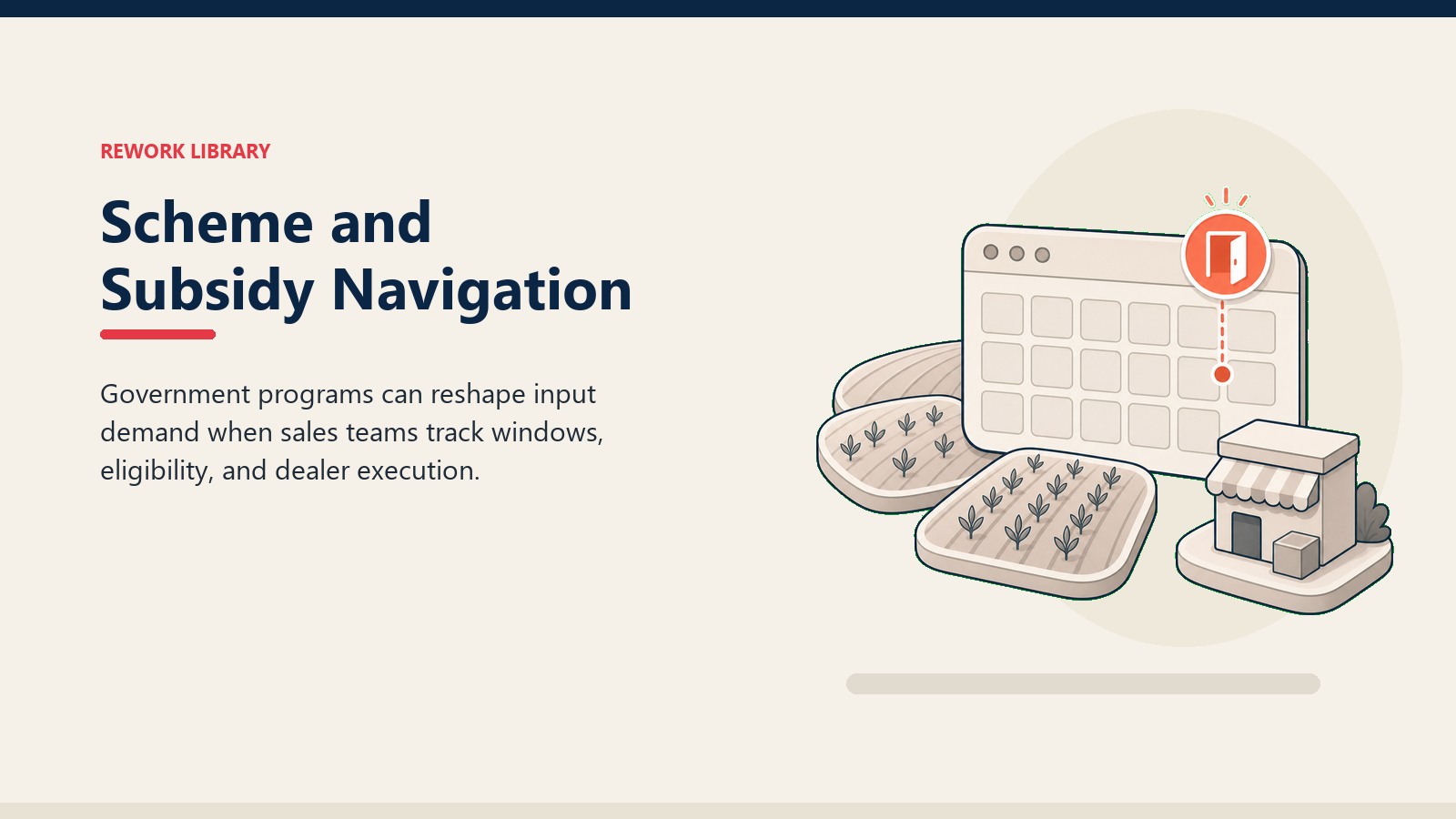
A district in central India announced a 50% subsidy on drip irrigation kits and micronutrient packages in March, timed to the pre-kharif stocking window. Two seed and fertilizer companies operated in that district with roughly equal dealer coverage. One had briefed its reps on the scheme details two weeks before the announcement went public, based on early signals from its government relations contact. The other found out when farmers started asking dealers about it.
The company that briefed early captured most of the subsidy-linked demand. Its reps walked into dealer counters already able to explain the application process, the documentation farmers needed, and which of their SKUs qualified. The other company's reps were still figuring out the scheme rules while farmers were already buying from whoever could answer their questions.
That six-week gap in scheme readiness turned into a season-long market share shift in that district. This is the pattern that repeats across agri-input markets wherever government subsidy programs exist: the company that treats scheme intelligence as a sales function outperforms the one that treats it as background noise.
Why Government Schemes Move Agri-Input Demand More Than Advertising Does
Subsidy programs change the economics of a purchase decision instantly, in a way that no promotional scheme a manufacturer runs can match. A farmer who was hesitant about a drip irrigation investment at full price becomes a buyer the day a 50% subsidy makes the payback period fall from four years to two.
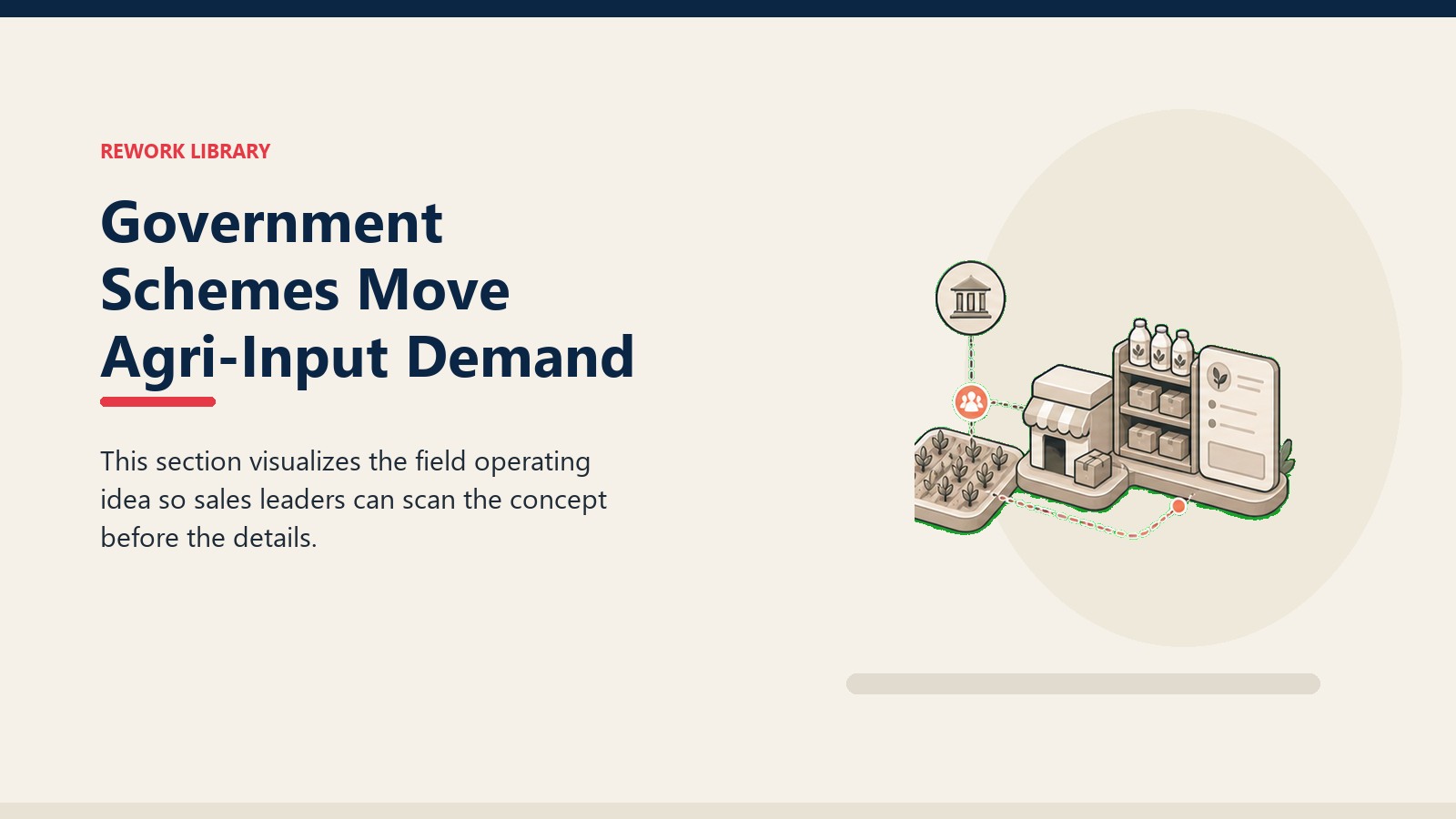
This isn't a marginal effect. It's a demand-shifting one. When a subsidy scheme launches or a fertilizer subsidy rate changes, purchase behavior in the affected category can move within days, not the weeks or months it takes a promotional campaign to build awareness and change buying intent.
The three subsidy categories that matter to agri-input sales:
| Scheme Type | What It Covers | Typical Mechanism | Sales Impact Window |
|---|---|---|---|
| Direct input subsidy | Fertilizer, seed, or crop protection cost reduction | Price paid by farmer reduced at point of sale, or reimbursed after purchase | Immediate, tied to scheme announcement date |
| Equipment and infrastructure subsidy | Drip irrigation, sprayers, storage, farm machinery | Capital cost subsidy, usually 25-75% depending on farmer category | Medium-term, tied to application and approval cycle |
| Credit and insurance-linked schemes | Subsidized crop loans, crop insurance premium support | Reduces farmer's cost of capital or risk, freeing budget for inputs | Indirect, shows up as increased willingness to spend on inputs |
Each category has a different sales motion attached to it, and conflating them is the most common mistake field teams make. A direct input subsidy is a today decision. An equipment subsidy is a weeks-to-months decision because of the application process. Confusing the two means selling urgency where there should be patience, or missing urgency where it actually exists.
Key Facts: Agri Subsidy Impact
- India's Union Budget allocates well over ₹1.7 lakh crore (more than $20 billion) to fertilizer subsidy in a single year, making it one of the largest input subsidy programs in the world and a primary driver of farmer purchase timing for urea and DAP. (Source: Ministry of Finance, Union Budget, Notes on Demands for Grants, Department of Fertilisers)
- A joint FAO, UNDP, and UNEP report found that governments worldwide spend roughly $540 billion a year supporting agri-food systems, shaping input demand patterns well beyond any single country's scheme calendar. (Source: FAO Director-General, launch remarks on "A Multi-Billion-Dollar Opportunity: Repurposing Agricultural Support to Transform Food Systems")
- A joint CEEW, CSTEP, and IISD evaluation of India's PM-KUSUM solar irrigation scheme found major components running far below rollout targets even with subsidy support in place, a reminder that scheme uptake depends on administrative and financing friction clearing up, not subsidy availability alone. (Source: CEEW, CSTEP, IISD, "Scaling Solar Power for Irrigation in India: Lessons from PM-KUSUM")
Building a Scheme Intelligence System
Most agri-input companies react to scheme announcements. The ones who win the window act on scheme signals before the announcement is final.
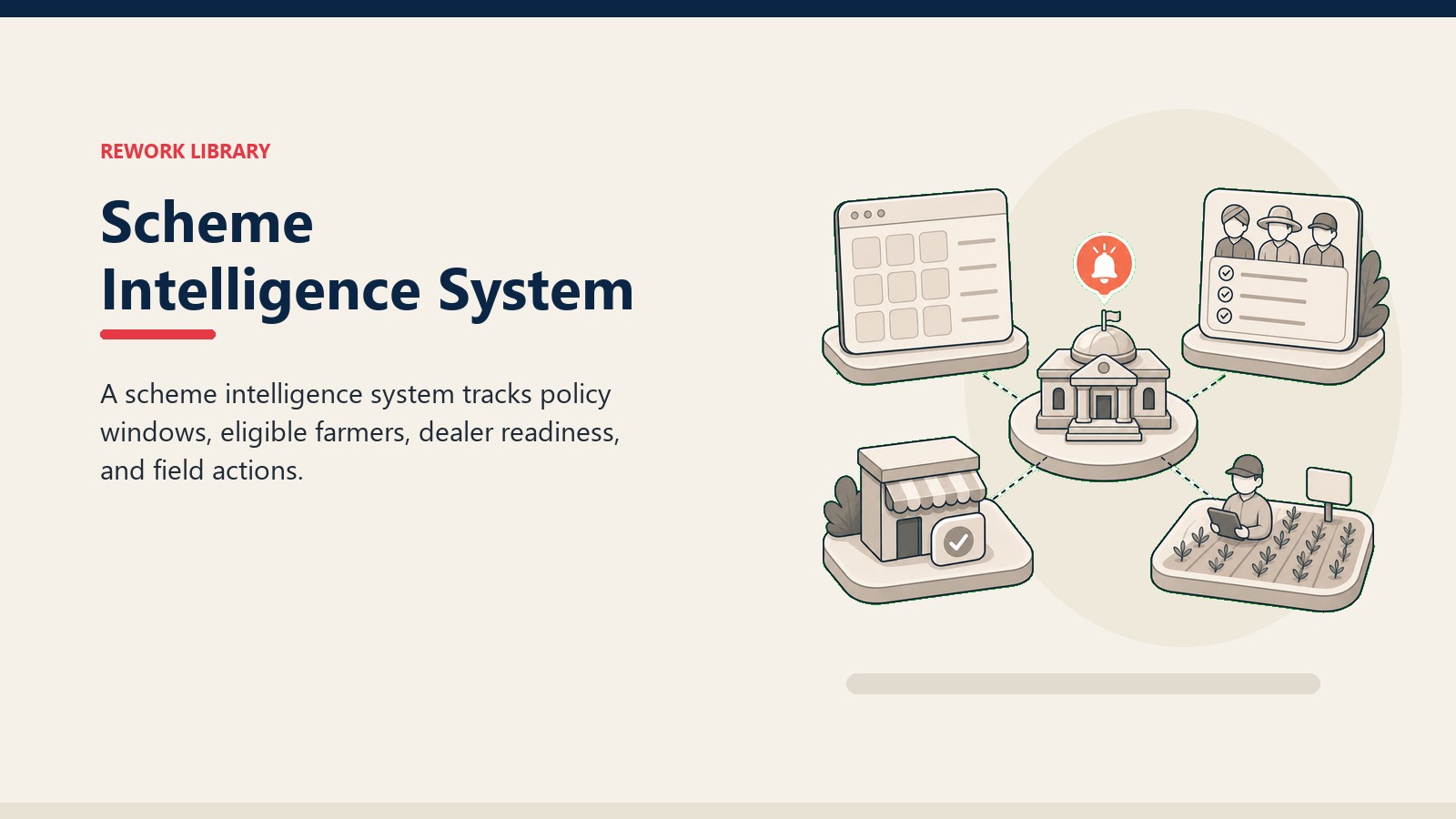
Where scheme signals appear before public announcement:
- State agriculture department budget discussions and pre-budget consultations, often reported in regional agricultural press
- Distributor and dealer associations, who frequently get informal briefings ahead of public rollout because they're expected to help with scheme implementation
- Progressive farmer and Farmer Producer Organization (FPO) networks, who often hear about scheme plans through cooperative extension channels
- State-level agriculture exhibitions and krishi melas, where department officials discuss upcoming programs informally
- Company government-relations or public-affairs contacts, if the organization has them, who track policy calendars directly
The scheme tracking template:
| Field | What to Capture | Update Frequency |
|---|---|---|
| Scheme name and administering body | Central government, state government, or joint scheme | On identification |
| Target crop / input category | Which of your SKUs are potentially eligible | On identification |
| Subsidy percentage and cap | Rate and maximum claimable amount per farmer or per hectare | On announcement |
| Application window and documentation | Dates, required farmer documents, dealer role in application | On announcement |
| Farmer category eligibility | Smallholder, marginal, SC/ST, women farmers, or general category rules | On announcement |
| Disbursement mechanism | Direct benefit transfer, dealer-adjusted price, or reimbursement | On announcement |
| Territory rollout status | Which districts are live, which are pending | Weekly during rollout |
A rep or territory manager who maintains this tracker for their operating districts has a genuine commercial advantage: they can tell a dealer exactly what's coming, when, and how to prepare, while competitors are still reading the same news the farmers are.
For the broader framework this scheme intelligence plugs into, see the Agri-Input Sales Growth Model, which treats external demand drivers like subsidies as a core input to territory planning, not a footnote.
Selling Around a Live Subsidy Window
Once a scheme is live, the sales motion shifts from persuasion to enablement. The farmer's buying decision is already favorable. The job becomes removing friction between intent and purchase.
The subsidy-window sales checklist:
- Confirm which specific SKUs qualify under the scheme's technical specifications (subsidy schemes often specify exact product categories, capacities, or certifications)
- Brief dealers on the documentation farmers need to bring (land records, Aadhaar or ID, bank account details for direct benefit transfer (DBT) schemes, prior crop declaration)
- Prepare a simple one-page explainer in the local language that dealers can hand to farmers or read aloud at the counter
- Identify the application process: is it online through a state portal, through the dealer, or through an extension officer, and pre-position dealers accordingly
- Flag stock levels early. A subsidy window that drives a demand spike with no product on the shelf converts to a competitor's sale, not a delayed sale
- Set up a simple tracking method for how many farmers in a dealer's catchment have applied versus how many have completed purchase, to spot bottlenecks early
Common friction points that kill subsidy conversion:
| Friction Point | What Happens | Fix |
|---|---|---|
| Farmer doesn't have required documents | Farmer abandons the application at the dealer counter | Pre-visit farmer WhatsApp groups or village meetings with a documentation checklist before the window opens |
| Dealer doesn't understand the scheme mechanics | Dealer gives wrong information, farmer loses trust in the dealer and the brand | Structured dealer briefing session before the window opens, not a memo nobody reads |
| Application portal is slow or unclear | Farmer gives up mid-process, especially older or less digitally literate farmers | Position a rep or a trained dealer staff member to walk farmers through the portal at the counter |
| Product isn't in stock when the window opens | Farmer buys a competing brand that has stock, subsidy or not | Sync scheme intelligence with Seasonal Supply Chain and Inventory planning at least one cycle ahead |
| Farmer doesn't know the scheme exists | Farmer misses the window entirely, demand doesn't materialize | Rep-led awareness at farmer meetings and field visits during the Demo Plot Demand Generation cycle, timed to scheme announcements |
Positioning Products for Scheme Eligibility Without Overpromising
One of the fastest ways to damage dealer and farmer trust is to imply a product qualifies for a subsidy when the eligibility criteria are ambiguous or the farmer's specific circumstances don't meet the requirement. Reps under pressure to move volume during a subsidy window sometimes stretch the truth on eligibility, and it comes back to bite the relationship when the farmer's claim gets rejected.
The disciplined approach: know the eligibility criteria cold, communicate them accurately, and if a specific farmer's situation is ambiguous, say so and help them verify rather than assume.
Eligibility conversation script structure:
- State what you know: "This subsidy applies to drip kits above this coverage size, for farmers with land holdings under this threshold."
- Ask the clarifying question: "Do you know if your land records are updated with the current survey number? That's usually where applications get stuck."
- Offer to help verify rather than guess: "Let's check with the dealer or the agriculture office before you commit, so there's no surprise later."
- If eligible, move to Execute: specific product, specific application steps, specific timeline.
This approach costs a little speed in the moment. It buys a lot of trust for the next scheme window, and for every other sale after that. A farmer who got accurate scheme guidance from your rep remembers it, and so does the dealer who watched the interaction.
This same problem, of communicating conditional or complex eligibility without overselling certainty, is a variation on general value selling discipline: sell the real value under the real conditions, not an inflated version that collapses under scrutiny.
Working With Dealers and Distributors as Scheme Implementation Partners
In most subsidy programs, dealers play an operational role beyond just selling: they collect documentation, submit applications, and sometimes handle the price adjustment at point of sale for direct-benefit schemes. That makes dealer readiness a direct input to how much of the scheme-driven demand your company actually captures versus a competitor.
What dealers need from you during a scheme rollout:
| Need | Why It Matters |
|---|---|
| Scheme rules explained clearly, in advance | Dealers who understand the scheme sell it confidently; dealers who are confused avoid mentioning it |
| Stock allocation prioritized to scheme-eligible SKUs | A dealer who runs out during a subsidy window loses the sale and blames the company, not the scheme |
| Application support materials (forms, checklists, local-language explainers) | Reduces the dealer's operational burden of onboarding farmers into an unfamiliar process |
| A clear escalation contact for scheme disputes or portal issues | Dealers who hit a wall with no support stop promoting the scheme actively |
| Recognition or incentive tied to scheme-linked volume, where compliant | Reinforces that scheme support is a priority activity, not an unpaid extra task |
This dealer-enablement work sits alongside the broader trust-building covered in Dealer Relationship Management and depends on the classification work covered in dealer universe mapping, to know which dealers in a subsidy-affected territory need the most support versus which are already equipped to handle it independently.
How Do You Qualify Which Farmers Are Genuinely Ready to Act on a Scheme?
Not every farmer who asks about a subsidy is ready to buy immediately. Some are gathering information for a decision months away. Others have already decided and just need the mechanics explained. Treating both the same way wastes rep time and creates false pipeline.
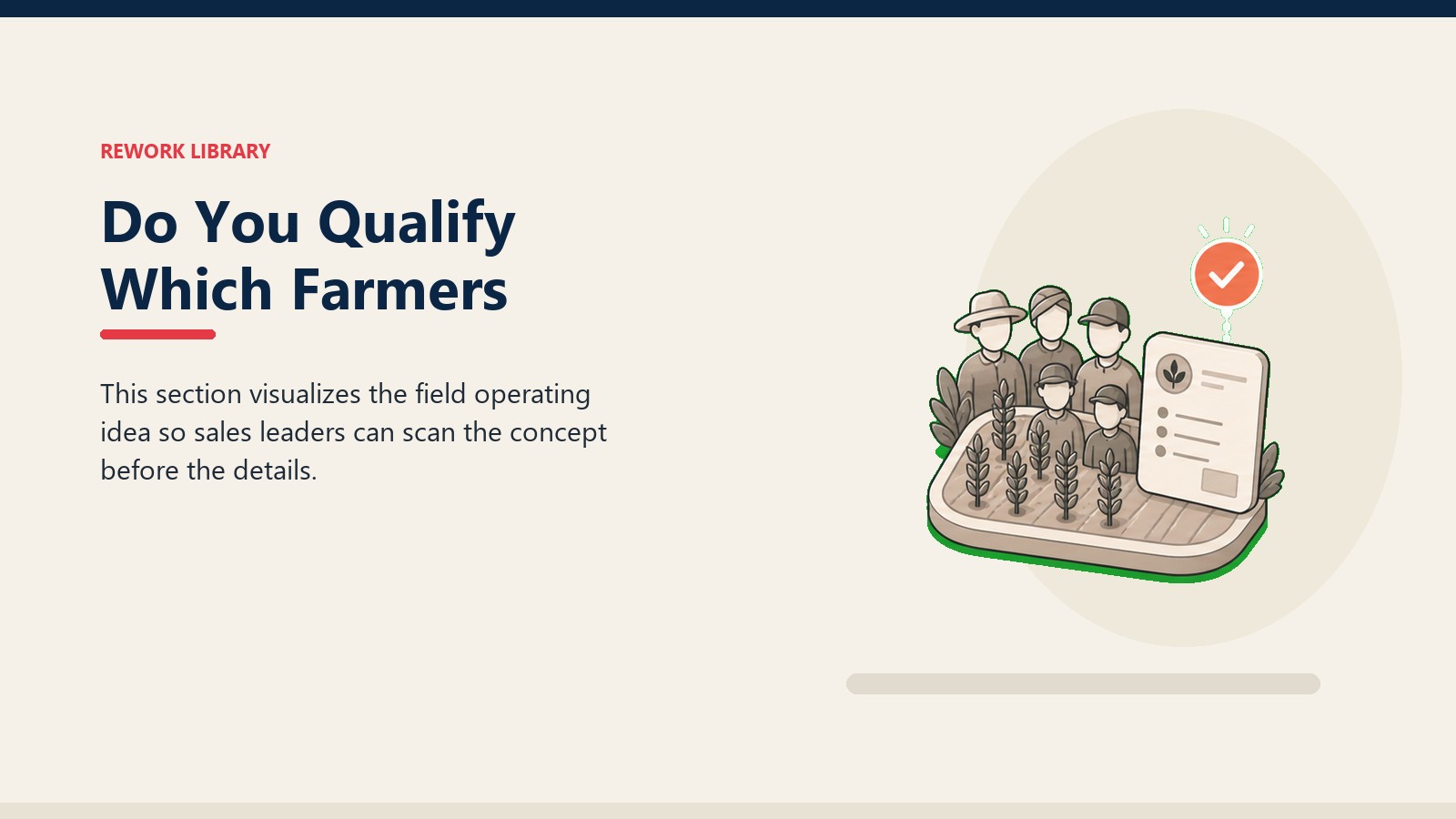
A simple qualification framework, adapted from general sales qualification discipline, works well here: does the farmer have the land and crop that make them eligible, do they have (or can they quickly get) the required documentation, is the application window actually open in their district, and do they have the budget for their portion of the cost even after the subsidy applies. A farmer who fails any of these isn't a lost cause, but they need a different follow-up cadence than one who clears all four. This maps closely to standard lead qualification frameworks: the criteria differ, but the discipline of separating genuine near-term intent from general interest is the same.
Scheme readiness quick-check:
| Question | Ready to Buy | Needs Follow-Up |
|---|---|---|
| Does the farmer's land and crop meet eligibility? | Yes, confirmed | Unclear, needs verification |
| Does the farmer have required documents? | In hand or easily obtained | Missing, needs weeks to gather |
| Is the application window open in this district? | Yes, live now | Announced but not yet live |
| Can the farmer afford their portion after subsidy? | Yes | Needs financing, route to Channel Credit and Financing |
What Happens When a Scheme Gets Delayed, Changed, or Cancelled Mid-Season?
Government schemes don't always roll out as announced. Budget allocations run out before every eligible farmer is served. Application portals launch late. Eligibility criteria get revised after farmers have already started the process. A sales team that built its seasonal plan entirely around a scheme that then gets delayed or scaled back needs a recovery plan, not just disappointment.
The practical response has three parts. First, communicate honestly and immediately when scheme status changes, rather than letting farmers find out from someone else and blame your dealer for the bad news. Second, have a fallback commercial offer ready, whether that's a company-funded promotional scheme, extended credit terms, or a smaller trial size, so the sales conversation doesn't collapse entirely when the government incentive disappears. Third, treat the disruption as useful signal for your scheme tracker: a program that got cancelled once due to budget exhaustion is a program to plan for more conservatively next cycle, not to bet the full territory forecast on again.
Reps should also be coached specifically on how to have this conversation, since delivering bad news about a subsidy is a different skill than selling into a live window. The framing that works best is one of continued partnership: "The scheme funding for this round is used up, but here's what we can do to still make this work for you this season." That keeps the relationship intact even when the external policy environment doesn't cooperate.
Turning Scheme Volatility Into a Structural Advantage
Government schemes will keep changing. Budgets get reallocated, eligibility rules get revised, new programs launch and old ones sunset. Treating this volatility as an occasional disruption to plan around misses the bigger opportunity: the company with the best scheme intelligence system has a durable, hard-to-copy advantage that has nothing to do with product quality or price.
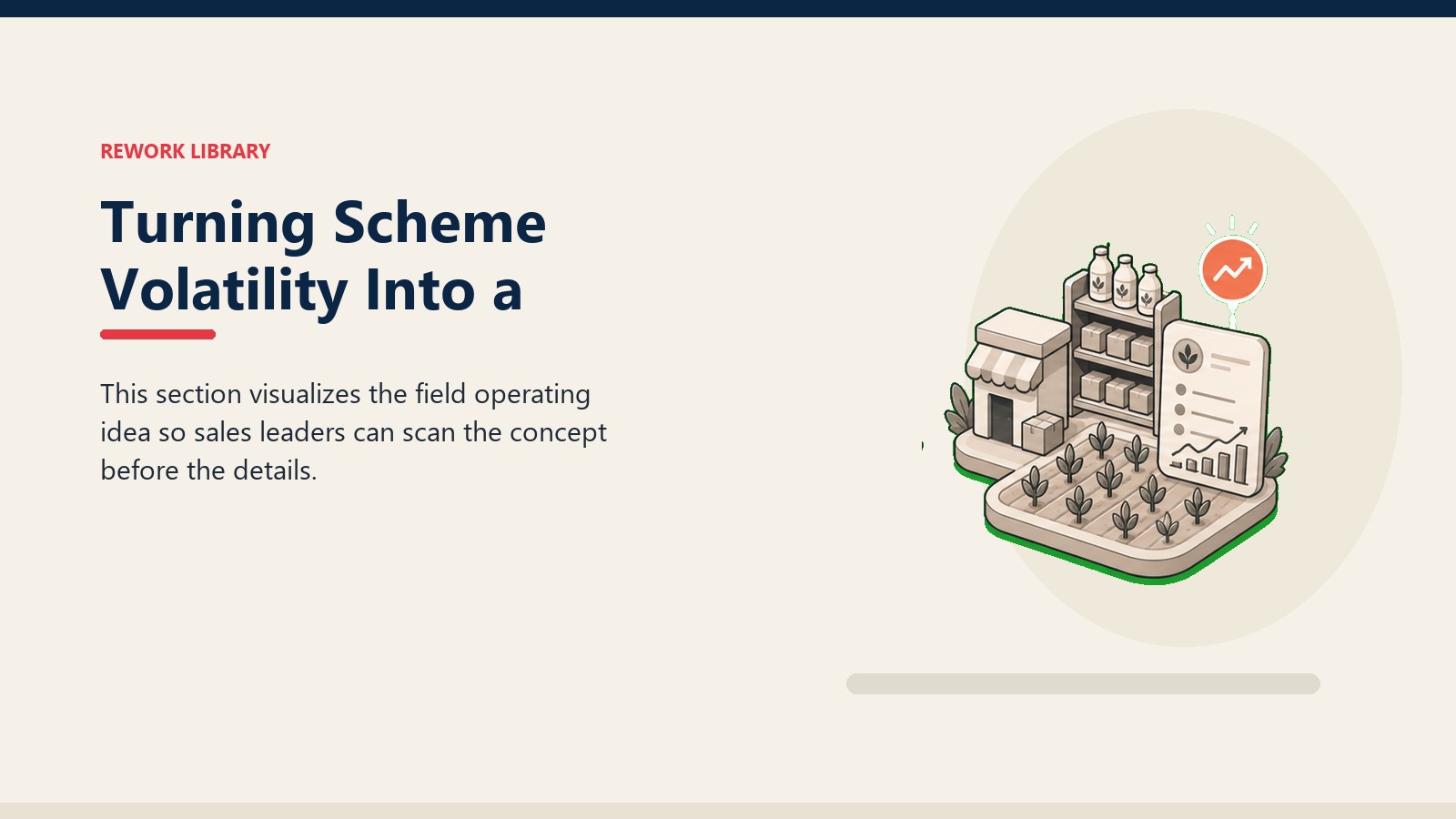
That advantage compounds. A dealer who got accurate scheme guidance from your team once will call your rep first the next time a new program is rumored. A farmer who had a smooth subsidy application experience because your dealer had the paperwork ready will trust your brand's next recommendation more than a competitor's. And a sales organization that tracks scheme signals as a routine part of territory planning, the same way it tracks weather and crop calendars, will consistently be six weeks ahead of the organization that finds out from the newspaper.
The teams that get this right don't treat government relations as someone else's job in head office. They treat it as a frontline sales input, gathered the same way crop stress signals and dealer credit signals get gathered: through the people who are actually in the field every week.
Frequently Asked Questions about Navigating Government Schemes and Input Subsidies in Agri-Input Sales
How do we avoid overpromising farmers on subsidy eligibility we're not certain about?
Build a simple internal rule: reps state what they know with confidence and flag what needs verification, every time. Never let a rep imply eligibility to close a sale faster. The short-term volume gain from an oversold subsidy claim is almost always smaller than the trust cost when the farmer's application gets rejected and the dealer takes the blame. Equip reps and dealers with a written, current eligibility summary so they're working from the same facts, not memory or rumor.
Should sales teams get involved in helping farmers with the application paperwork?
In markets where digital or bureaucratic literacy is a real barrier, yes, within reason. A rep or trained dealer staff member who helps a farmer navigate an unfamiliar online portal converts more of the subsidy-eligible demand than one who just tells the farmer to figure it out. This isn't a core sales activity, but it's a high-leverage one during a live scheme window, because the alternative is losing the sale to whichever competitor's team is willing to provide that support.
How far in advance can a company realistically get scheme intelligence?
It varies widely by market and scheme type. Well-publicized annual programs like a national fertilizer subsidy are predictable to within a budget cycle. Newer or state-specific programs can appear with only a few weeks of lead time, sometimes less. The goal isn't perfect prediction. It's building enough of an early-warning network, through dealers, FPOs, and any government-relations contact, that the company is rarely caught completely by surprise, and can move faster than competitors even on a short runway.
What's the biggest mistake companies make with government scheme sales?
Treating scheme-driven demand as a one-time spike rather than a recurring commercial cycle worth building a system around. Companies that scramble every single time a scheme launches never build the tracking discipline, dealer briefing process, or stock-sync habits that would let them capture the demand efficiently. The companies that treat scheme navigation as a permanent capability, the same way they treat demo plot programs or dealer segmentation, consistently outperform in scheme-affected categories over multiple seasons.
Do subsidy schemes ever hurt agri-input sales rather than help them?
Yes, in specific situations. A poorly administered scheme with a confusing application process can create farmer frustration that gets associated with the products involved, even though the company didn't design the scheme. A subsidy that favors one input category can also depress demand for a substitute category your portfolio includes. The mitigation is the same scheme intelligence discipline: understanding not just what a scheme subsidizes, but what it might displace, so the territory plan accounts for both effects.
Learn More

Senior Implementation Consultant
On this page
- Why Government Schemes Move Agri-Input Demand More Than Advertising Does
- Building a Scheme Intelligence System
- Selling Around a Live Subsidy Window
- Positioning Products for Scheme Eligibility Without Overpromising
- Working With Dealers and Distributors as Scheme Implementation Partners
- How Do You Qualify Which Farmers Are Genuinely Ready to Act on a Scheme?
- What Happens When a Scheme Gets Delayed, Changed, or Cancelled Mid-Season?
- Turning Scheme Volatility Into a Structural Advantage
- Learn More