Channel Credit and Financing: Managing Credit Risk and Seasonal Lending in Agri-Input Distribution
Turn this article into takeaways for your work.


Each assistant summarizes the article only for you and suggests best practices for your work.
In most industries, sales and credit are parallel functions that occasionally interact. In agri-inputs, they're the same function wearing two hats.
A field rep visiting a dealer in rural Andhra Pradesh in April isn't just selling a fungicide. They're deciding, implicitly or explicitly, how much credit the dealer can carry into the kharif season. The stocking commitment they build with the dealer only converts to primary sales if the distributor is willing to extend the credit terms that let the dealer take the product. And the dealer's ability to push product to farmers depends in part on the informal credit the dealer extends to smallholder farmers who won't pay until harvest.
That three-layer credit chain is what makes agri-inputs distribution both commercially potent and financially risky. A company that manages the credit chain well can move substantial volume through its channel network even in thin-margin rural markets. One that manages it poorly gets large primary sales numbers followed by large provisions for bad debts, and then a contraction in distributor willingness to take product the following season.
Getting channel credit right is not a finance department responsibility. It's a commercial discipline that field reps, sales ops, and commercial leadership have to own together.
The Seasonal Credit Cycle in Agri-Input Channels
Agri-inputs credit follows the crop calendar. That's obvious in principle but worth making concrete, because the specific timing shapes the risk profile at each tier of the channel.
Pre-sowing window (6-8 weeks before planting). This is when primary stocking happens. Distributors take product from the company on credit, often the largest single credit event of the season. Dealers take product from distributors on credit, building their display inventory ahead of farmer demand. Credit exposure at both tiers peaks during this window. The company is at maximum risk to the distributor. The distributor is at maximum risk to the dealer network.
Active sowing window (planting through early crop establishment). Farmer demand is highest. Dealers are selling through their stock and rolling the proceeds into repayments to distributors. Distributors are collecting from dealers and servicing their payables to the company. Cash velocity is highest during this window. Defaults that occur during the sowing window are the most damaging, because they hit during the peak selling period and signal that something has gone structurally wrong with the dealer or the crop.
Post-harvest / collection window (harvest through 4-6 weeks post-harvest). Farmers receive payment for their crop and settle their accounts with dealers. Dealers collect and settle with distributors. Distributors pay down company receivables. This is the expected collection timeline. When it breaks, it typically breaks here: a bad harvest, a commodity price collapse at procurement, or a monsoon failure means farmers don't have the cash to pay their dealers, and the cascade works backward through the channel.
The compounding risk at two layers. What makes agri-inputs credit more complex than single-tier channel credit is that the company is exposed to distributor risk, and the distributor is exposed to dealer risk, and dealer risk is directly tied to farmer income outcomes. A drought in a key growing district doesn't just hurt farmers. Within 90 days, it hurts dealers, then distributors, then the company. The field rep who is standing in that district in June, seeing crop stress, is looking at a credit risk event that will materialize as a collection problem in October.
Key Facts: Agri-Input Channel Credit
- Unmet demand for smallholder agricultural credit globally is estimated at $170 billion per year, representing 70% of total credit demand. This shortfall makes informal distributor-to-dealer-to-farmer credit chains the primary financing mechanism in most agri-input markets. (Source: Dalberg Advisors, "Towards Market Transparency in Smallholder Finance," 2022)
- Fewer than 10% of smallholder farmers have access to formal credit, even from programs specifically designed to reach them, with most formal financing reaching only those in well-established export value chains. (Source: IFC and World Bank, "Access to Finance for Smallholder Farmers")
- IFC's Global Warehouse Finance Program, which provides banks with liquidity backed by warehouse receipts to enable agricultural commodity loans, has supported over $6 billion in trade and reached more than 750,000 farmers across 66 emerging market countries. (Source: IFC Global Warehouse Finance Program)
That credit cascade is predictable. The question is whether you've built your credit management system to anticipate it, or to react after the damage is done.
Credit Limit-Setting
Credit limits in agri-inputs are not static annual figures. They're seasonal parameters that need to move with crop calendars, channel partner financial health, and market conditions.
Criteria for setting distributor credit limits:
| Criterion | Why It Matters | What to Look For |
|---|---|---|
| Historical primary offtake | A distributor's credit limit should be proportionate to their volume capacity | 3-season average of primary sales; look for growth trend vs. volatility |
| Financial statements or bank references | Undercapitalized distributors become credit risks at peak loading | Working capital versus planned peak stocking value; overdraft facility size |
| Payment track record | How consistently has the distributor paid within agreed terms | Days beyond due, history of rollovers, any credit block events in prior 2 seasons |
| Collateral or security deposit | Some companies require a security deposit or post-dated cheques for large limits | Documented security, not verbal assurance |
| Crop area under active cultivation in territory | Distributor offtake capacity is bounded by the farming base they serve | Current season crop area from state agriculture department or rep field estimate |
Dynamic credit limits. A distributor's credit limit should be reviewed twice a year: before the kharif season and before the rabi season. The review adjusts the limit based on the distributor's balance at the end of the prior season, the current season's crop outlook, and any changes in the dealer network they're servicing. A distributor who cleared their prior season balance cleanly and is serving a territory with expanding crop area under cultivation earns a higher limit. One who rolled over a balance, is carrying high dealer credit exposure, or whose territory is seeing crop stress gets a conservative limit revision.
The field rep's role in credit assessment. The field rep's visit notes contain the most current information about distributor and dealer financial health. Reps who are doing their jobs are picking up signals: the distributor who mentions that three of his dealers paid late last season; the dealer whose shop stock is visibly aging instead of turning over; the farmer who is asking for a longer credit window because the prior season's commodity price was low. These signals should feed into credit limit reviews, not sit in call reports that nobody reads.
The structural challenge here is well-documented: Dalberg Advisors estimates that annual unmet demand for smallholder credit globally stands at $170 billion, representing 70% of total demand (Dalberg Advisors, "Towards Market Transparency in Smallholder Finance," 2022). IFC and World Bank research confirms that even the most promising formal lending approaches reach fewer than one in ten smallholder farmers, primarily those in well-established export value chains (World Bank, "Access to Finance for Smallholder Farmers"). The gap is filled by informal credit chains: exactly the distributor-to-dealer-to-farmer cascade described in this article.
Credit limit-setting template:
| Input | Source | Update Frequency |
|---|---|---|
| Prior season balance (cleared or rolled) | Finance / accounts receivable | Season-end |
| Current season primary sales target | Sales ops | Pre-season |
| Working capital estimate | Distributor-provided or bank reference | Annual or on limit increase request |
| Rep field intelligence (payment behavior, market stress signals) | Field rep visit report | Quarterly or on exception |
| Crop area and weather risk | State agriculture data or agri-weather subscription | Pre-season |
| Proposed limit (floor and ceiling) | Finance + commercial leadership joint approval | Biannual |
For the distributor management framework that sits alongside this credit model, see Distributor and Wholesaler Management.
Seasonal Credit Windows and Collections
Extending credit is one decision. Collecting it is a different discipline, and the collection schedule needs to be built into the credit agreement before the product ships, not negotiated after the fact when the distributor is already carrying a full pre-season load.
Pre-season credit extension norms by channel tier. For a primary distributor, a typical pre-season credit structure looks like this: 30-40% of the seasonal invoice value is due at 30 days, another 30-40% at 60 days (tied to mid-season), and the balance at 90 days (post-harvest). These milestones align payment obligations with the cash flow events the distributor is expecting from their own dealer network.
For dealers, payment terms are set by distributors rather than manufacturers, but manufacturers can encourage reasonable structures by building dealer credit health into distributor scheme conditions. A distributor whose dealer credit exposure is clean earns better terms on their next loading; one whose dealers are persistently late gets flagged for a credit review.
Milestone-based collection schedule. The strongest collection mechanism in agri-inputs is tying payment milestones to identifiable crop events rather than to calendar dates. "30 days from invoice" is less effective in a drought year than "payment due 4 weeks after the primary sowing window closes," because the latter is tied to the cash flow event (dealers collecting from farmers at planting) rather than an arbitrary date.
| Collection Milestone | Timing | Basis |
|---|---|---|
| First installment | 3-4 weeks after pre-season loading | Dealer offtake during early sowing has started; distributor is collecting cash |
| Second installment | Mid-season (60-70 days from loading) | Active sowing period peak; highest cash velocity in channel |
| Balance settlement | Post-harvest (90-120 days from loading) | Farmer payments to dealers have been received; distributor has collected from trade |
Managing rollovers and credit block enforcement. A rollover happens when a distributor can't clear their prior-season balance before the next pre-season loading is required. Some rollovers are legitimate: a distributor in a drought-affected territory may need one additional season to collect from dealers. But a distributor who routinely rolls balances without clearing them is building a structural credit risk that compounds season over season.
Credit block is the supply-side enforcement mechanism. When a distributor exceeds their credit limit or misses a payment milestone, supply is held until the account is brought current. This is uncomfortable commercially, because it means no product in a territory during peak season. But a credit block enforced early and consistently is less commercially damaging than a large write-off at season end. Credit blocks should be managed by finance with advance notice to the field rep and RSM, so the commercial impact can be assessed before supply is stopped.
How Do Field Reps Spot Credit Risk Before It Appears in Receivables?
The earliest warning signals for channel credit problems don't appear in receivables reports. They appear in what field reps observe during dealer visits.
Early warning signal checklist:
- Dealer's display stock is aging: the same product is sitting in the same position across multiple weekly visits, suggesting secondary-sales velocity has dropped
- Dealer is requesting longer credit terms than prior season without a clear business rationale
- Distributor's van salesperson visit frequency to key dealers has dropped (distributor may be pulling back on their own credit extension to manage their own exposure)
- Local crop health reports are negative: stress signals, disease pressure, late monsoon in areas where the distributor is heavily weighted
- Dealer mentions competitor is offering longer credit terms: competitive credit push often signals a competitor trying to capture volume by relaxing credit standards
- Dealer cash position signals: dealer is struggling to pay for the current cycle's product before placing the next order
- Commodity price signals at local mandis (markets): low farm-gate prices at harvest predict slow collections 60-90 days later
Rep responsibility for collection follow-up versus finance team escalation. The field rep's role in collections is early warning and relationship management, not collections enforcement. A rep who is asked to collect overdue cheques is being pulled out of a sales role and put into a debt recovery role, which damages both their dealer relationships and their selling effectiveness. Define the line clearly: reps flag risk signals and maintain the commercial relationship; finance handles formal collection notices, supply blocks, and escalations beyond the first payment milestone.
Handling overdues without destroying the dealer relationship. An overdue dealer isn't necessarily a bad dealer. In a drought season, even a reliable dealer may miss their payment window because farmers haven't paid. The response should be proportionate: a field rep conversation to understand the cause, a payment plan proposal from finance if the cause is external (crop failure, commodity price), and tighter credit terms going forward once the overdue is cleared. A dealer who is genuinely struggling with an adverse agricultural event and gets a reasonable extension is a more loyal long-term partner than one who is cut off and switches brands. But that judgment requires ground-truth intelligence from the rep, not a blanket credit policy that doesn't account for crop context.
See Pre-Season Stocking and Liquidation for how pre-season credit decisions connect to the liquidation risk that builds when product doesn't move through to farmers, and Sales and Distribution Supply Alignment for how field credit signals should connect to supply planning decisions.
Why Does Primary Sales Outpacing Secondary Sales Create Hidden Risk?
The most dangerous credit pattern in agri-inputs is primary sales that outpace secondary sales. It looks like strong commercial momentum. It's actually a deferred risk event.
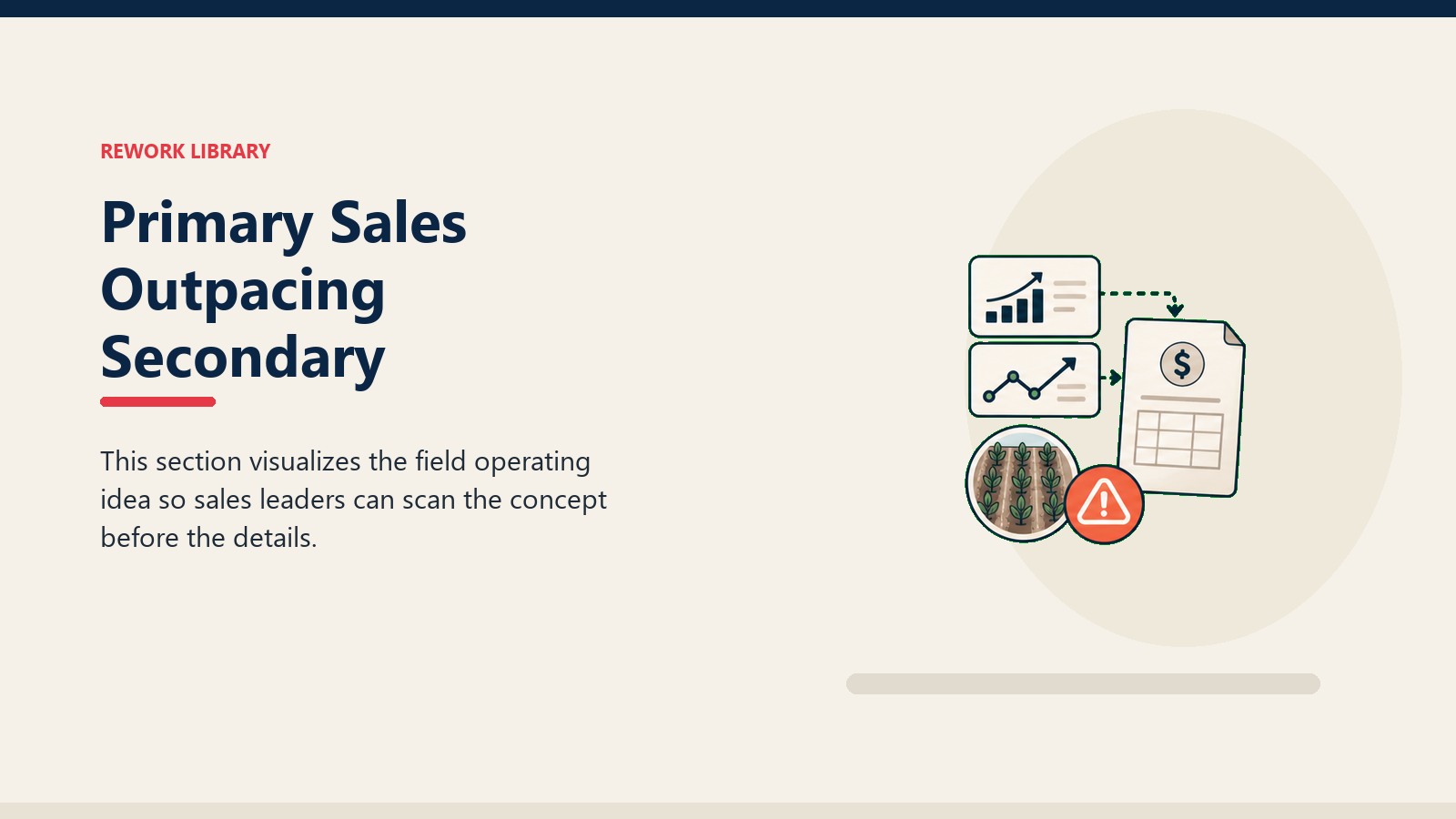
The Seasonal Credit Cascade: A field rep observing distributor and dealer behavior can follow credit risk through three predictable stages: pre-season loading (distributor credit peaks, manufacturer exposure peaks), active sowing (cash velocity peaks, dealer credit settles to distributors), and post-harvest collection (farmer income events settle dealer accounts, which settle distributor accounts, which settle manufacturer receivables). A crop failure disrupts the third stage, and the risk propagates backward through the chain within 90 days. Manufacturers who build weather-contingency clauses into their pre-season credit agreements before the season starts have more options than those who negotiate in September what should have been agreed in March.
Here's how it typically plays out. A company is under pressure to hit its Q1 primary sales number. The easiest lever is to push distributors to take more product on credit, often with extended payment terms as the incentive. Distributors load up. Primary sales look strong. But secondary sales haven't accelerated. The distributor is now sitting on 60 days of cover instead of 21, having paid for it (or taken credit for it) from their working capital. When the season ends without the secondary-sales pull-through to justify the load, returns start. Distributors roll balances. The following season's pre-season loading is constrained because distributors are already over-exposed.
This pattern repeats every time commercial pressure is resolved by relaxing credit terms rather than by improving secondary-sales pull-through.
Schemes and incentives as credit substitutes. When a territory's distributors are at their credit limits and you need to move volume, the alternative to pushing more credit is pulling more demand. Dealer loyalty programs, farmer demo plot investments, and in-season promotions that drive secondary pull-through are more sustainable than credit extension as a volume lever because they grow the channel's commercial capacity rather than borrow against it.
Distributor financing programs and third-party agri-fintech. Several agri-fintech players now offer distributor and dealer financing programs that sit outside the manufacturer's balance sheet: the fintech funds the distributor's stocking, the distributor repays from collections, and the manufacturer's credit exposure stays within limits. These programs are worth exploring for high-potential territories where a distributor's financial capacity is limiting their ability to carry adequate stock, particularly if the distributor's credit track record with the company is strong but their working capital is constrained. IFC's Global Warehouse Finance Program is one institutional model for this structure: it provides banks with liquidity or risk-sharing facilities backed by warehouse receipts, enabling agricultural producers and traders to access secured loans rather than selling inventory at distressed prices to service debt. The program has supported over $6 billion in global trade, reached 750,000 farmers, and operates across 66 emerging market countries including 29 IDA low-income countries, according to IFC program data.
The Agri-Input Sales Growth Model and Dealer Segmentation and Classification frameworks connect to this credit management challenge: different dealer tiers carry different credit risk profiles, and the credit model needs to reflect those differences rather than applying a single policy across the portfolio.
For a pharma-channel perspective on similar credit and financing dynamics in a regulated distribution environment, the Distributor and Stockist Management article covers analogous structures. For secondary-sales stock visibility as a tool for monitoring whether credit extension is generating genuine pull-through, see Secondary Sales and Stock Visibility.
Credit Discipline as Revenue Protection
Quotable Nuggets
"Annual unmet demand for smallholder credit globally is estimated at $170 billion, 70% of total demand, filling the gap through informal distributor-dealer-farmer credit chains. Managing that chain is a commercial discipline, not a finance function." (Dalberg Advisors, "Towards Market Transparency in Smallholder Finance," 2022)
"IFC's Global Warehouse Finance Program has enabled agricultural commodity financing backed by warehouse receipts across 66 emerging market countries, reaching over 750,000 farmers, demonstrating that formal financing structures can be built on top of commodity inventory where traditional collateral is unavailable." (IFC Global Warehouse Finance Program)
"A credit block enforced early and consistently is less commercially damaging than a large write-off at season end. Credit discipline protects revenue; it doesn't constrain it." (Agri-input channel credit management principle, consistent with IFC agricultural finance advisory documentation)
The framing that matters here is this: credit discipline in the field isn't a constraint on sales. It's a protection of revenue.
A bad-debt write-off from an over-extended distributor doesn't just hurt this season's P&L. It reduces the channel's capacity to serve the territory next season: the distributor's working capital is impaired, their dealer network pulls back, and the market coverage that took years to build degrades. Recovering from a channel credit crisis takes multiple seasons, not one.
The field rep who flags a dealer showing cash-flow stress is not being a pessimist about the commercial relationship. They're protecting it. The finance team that enforces credit blocks before exposure compounds is not blocking sales. They're preventing a larger revenue loss 90 days later.
Commercial leaders who build this framing into their teams, and into their own incentive structures, end up with channel credit models that fund growth in good seasons and survive adversity in bad ones. Those who treat credit discipline as a finance function separate from commercial decision-making typically end up managing both a sales crisis and a collections crisis at the same time.
Learn More

Senior Implementation Consultant