Product Stewardship and Safe Use in Agri-Inputs: Building Commercial Trust Through Responsible Field Practice
Turn this article into takeaways for your work.


Each assistant summarizes the article only for you and suggests best practices for your work.
When a farmer applies an agrochemical at twice the labeled rate because no one explained the dose, two things happen. The crop risk goes up. And when something goes wrong (a phytotoxicity incident, a residue issue at harvest, or an adverse health event), the brand takes the blame, not the misuse.
Product stewardship is how commercial organizations prevent that sequence. Most agri-input leaders still treat it as a compliance function: something legal and regulatory want documented, filed, and reviewed annually. The commercial team views it as overhead at best and a sales obstacle at worst.
That framing is wrong, and commercially expensive.
The companies that have invested in genuine stewardship programs (structured safe-use training, embedded agronomist guidance, dealer-level compliance support, and empty container management) report a specific commercial return: farmer trust that doesn't erode when a cheaper alternative appears on the shelf next to their product. A farmer who understands a product, received training on how to use it correctly, and has seen the brand show up to support them through a misuse concern trusts that brand in a way that a price discount from a generic supplier can't replicate. Stewardship builds the equity that makes brand loyalty rational.
What Product Stewardship Covers
Stewardship in agri-inputs isn't a single program. It's a set of interconnected practices that cover the product from the dealer's shelf to the farmer's field to the post-use disposal point.
Stewardship Program Component Checklist
| Component | What It Covers | Primary Responsible Party |
|---|---|---|
| Safe handling guidance | PPE requirements, mixing procedures, skin and eye contact protocols | Rep/agronomist at farmer training sessions |
| Correct application rates | Label rate compliance, crop-stage specificity, water volume guidance | Agronomist, dealer staff |
| Storage requirements | Temperature ranges, segregation from food/feed, container integrity | Dealer (at point of sale), farmer (at home storage) |
| Empty container management | Triple-rinsing, puncture, return program or approved disposal | Farmer with dealer collection point |
| Re-entry intervals | How long after application before field workers can safely re-enter | Rep, label communication |
| Pre-harvest intervals | Days between final application and harvest for export residue compliance | Agronomist, dealer staff |
| First aid and emergency response | Basic first-aid information, poison control contacts, hospital referral | Label, rep briefing |
| Counterfeit product identification | How to identify genuine vs. counterfeit packaging | Dealer training, farmer awareness sessions |
The label is the legal minimum. The stewardship program is what happens when the commercial team decides to make the label real rather than aspirational. The FAO International Code of Conduct on Pesticide Management sets out the responsibilities of both public and private entities across this entire lifecycle, from production through distribution to field use and post-use disposal. The Code defines product stewardship explicitly as the responsible and ethical management of a pesticide product from its discovery through to its ultimate use and beyond.
Key Facts: Product Stewardship in Agri-Inputs
- In Ethiopia, 95 percent of smallholder farmers in a pesticide knowledge study showed poor pesticide knowledge, 69 percent did not read or follow label directions, and 92 percent disposed of empty containers in fields. More than 90 percent used no personal protective equipment when handling pesticides. Source: PMC / Small-Scale Farmer Pesticide Knowledge and Practice in Ethiopia.
- FAO Farmer Field Schools on integrated pest management produced a 61 percent reduction in insecticide use in Indonesia, with applications declining from 2.8 to 0.02 per season in evaluated sub-districts, alongside a 21 percent yield increase, demonstrating that structured training programs change both behavior and crop outcomes. Source: FAO IPM Farmer Field Schools Evaluation.
- CropLife International's global container management network has collected over 1 million tonnes of empty plastic pesticide containers across more than 59 countries since 2005, with 140,000 tonnes collected in 2022 alone through company stewardship programs. Source: CropLife International Stewardship Programs.
The Rep's Stewardship Role
Field reps in agri-inputs cover the most critical stewardship touchpoint: the moment before the farmer opens the product. Not the regulatory office. Not the dealer. The rep who visits the field.
The challenge is that reps don't naturally frame stewardship conversations as sales activities. They're selling efficacy and trial conversion. A stewardship conversation can feel like a diversion. But it doesn't have to be treated that way.
The Embed-Observe-Correct Framework: The rep's three-part stewardship role in the field. Embed (integrate safe-use guidance into the product conversation naturally, so rate, timing, and PPE information arrives as agronomic advice, not a compliance appendix), Observe (notice misuse when visiting fields, including wrong rate, missing PPE, spray drift, or container disposal in the field), Correct (address misuse directly and professionally, because a rep who corrects a farmer respectfully is demonstrating that they care about the crop outcome, not just the sale). All three are commercial behaviors, not regulatory ones.
The most effective approach is to embed safe-use guidance into the product detailing conversation rather than separating it out as a compliance add-on. When a rep explains a new insecticide's mode of action, the correct application rate and timing are part of that explanation, not a legal disclaimer appended at the end. "This product works best at 250ml per acre applied at early infestation, before the pest pressure builds, and you'll want to wear gloves and wash hands after mixing" is a product conversation, not a compliance lecture.
Farmer field visit and advisory protocols should include stewardship moments as standard agenda items, not optional additions. A visit that covers application rate and timing, pre-harvest interval, and basic PPE guidance in the course of a normal agronomic discussion takes less than five minutes. That five minutes materially reduces misuse risk and positions the rep as a technical advisor rather than an order-taker.
The rep's other stewardship role is observation: noticing when a farmer is visibly misusing a product (wrong rate, missing PPE, spray drift into water bodies or neighboring crops) and addressing it in the moment. That's uncomfortable to do. But it's exactly what a trusted field advisor does. And a farmer who is corrected professionally by a rep who clearly has their interests in mind is more likely to trust that rep, not less.
Dealer Responsibilities in the Stewardship Chain
Dealers are the point-of-sale stewardship layer. They're the last qualified touchpoint between the product and the farmer in most rural markets, and they carry significant responsibility for what advice the farmer receives at the counter.
But dealer stewardship capacity is often weak. Counter staff may not understand application rates, pre-harvest intervals, or PPE requirements for the products they're selling. Dealers may substitute counterfeit or adulterated product that carries your packaging without your quality control. And few dealers have formal processes for handling empty containers or farmer complaints about product performance.
The commercial team's stewardship obligation to dealers covers three areas.
Training dealer staff: Counter staff who can answer basic application and safety questions correctly are a commercial asset, not just a regulatory requirement. A farmer who gets accurate guidance from the dealer counter is less likely to misuse the product and more likely to trust the brand when they return. Dealer training sessions (brief, practical, product-specific) are a stewardship investment with a direct retention return. Dealer relationship management visits are a natural vehicle for this.
Supporting counterfeit identification: Dealers who operate in markets with significant counterfeit product need practical tools to identify genuine packaging: authentication stickers, holographic seals, batch code verification, and clear instructions on what to do if they receive suspicious stock. A dealer who unknowingly sells counterfeit product bearing your brand is a stewardship and reputational liability. Equipping them to identify and refuse counterfeit supply protects both the farmer and the brand.
Setting up empty container collection: Dealer premises are the logical collection point for used empty agrochemical containers. A company that provides clearly labeled collection bins, runs a periodic collection program, and communicates to farmers that containers should be returned to the dealer has created a visible environmental commitment that differentiates from competitors who ignore the post-use stage. FAO guidance on pesticide-related waste management specifically designates manufacturers and distributors as responsible for providing facilities allowing users to dispose of empty containers safely, making dealer-based collection not just good practice but an obligation under the international Code of Conduct. CropLife International's stewardship programs operate container management initiatives in over 40 countries and provide practical templates commercial teams can adapt.
How Should Farmer Safe-Use Training Programs Be Structured?
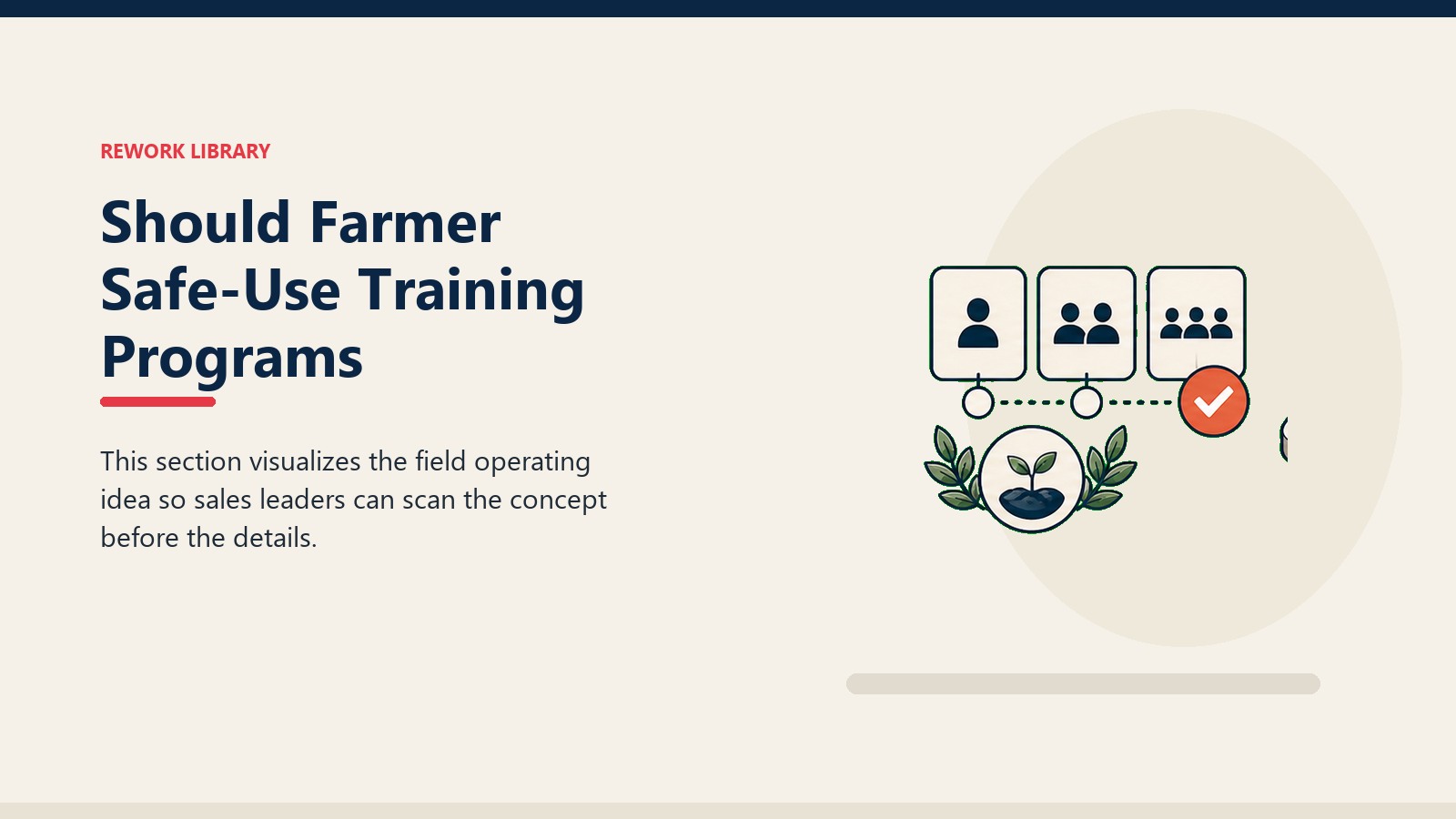
The most effective farmer stewardship delivery mechanism isn't the label. It's the structured training session conducted at field days, demo plots, and farmer group meetings where farmers can ask questions, see demonstrations, and hear directly from an agronomist.
Safe-Use Training Agenda Template
| Session Component | Duration | Content |
|---|---|---|
| Product introduction and mechanism | 10 min | What the product does and why the recommended rate works |
| Mixing and handling demonstration | 15 min | Live demonstration of correct mixing, measurement, and PPE use |
| Application timing and rate guidance | 10 min | Crop-stage specificity, water volume, nozzle selection |
| Storage and container handling | 5 min | Storage conditions, empty container rinsing and puncture |
| Pre-harvest and re-entry intervals | 5 min | Why intervals exist, what happens if ignored (residue, health risk) |
| First-aid and emergency response | 5 min | Skin/eye contact protocol, poison control reference |
| Q&A | 10 min | Farmer-led questions, agronomist responses |
Live demonstration of personal protective equipment (PPE) use (showing how to put on gloves, goggles, and a mask correctly before mixing) has significantly higher recall than verbal instruction alone. Farmers who watch a demo and then handle the equipment themselves remember the protocol. Farmers who hear about it in a presentation largely don't. WHO guidelines on personal protection when handling pesticides provide the technical basis for structuring these training sessions, covering mixing, application, equipment rinsing, and PPE selection for specific product classes.
Farmer meetings and field days should include a stewardship segment as standard. A field day focused entirely on product performance that skips safe-use guidance is a missed training opportunity and, in markets with significant illiteracy or limited label comprehension, a genuine risk exposure.
How Does Stewardship Function as a Brand Differentiator Against Generic Competitors?
The positioning value of stewardship is most visible in markets where generic agrochemical products have entered. Generic chemistry offers comparable efficacy at lower price points. Price-sensitive farmers make the rational switch.
But farmers who have received stewardship training from a branded company, been supported through a misuse concern or crop complaint, and seen the brand invest in their outcomes over multiple seasons don't make that switch as readily. The stewardship relationship creates switching costs that aren't reflected in the price comparison.
Agronomy-led product detailing makes this visible in the field. When an agronomist from a branded company provides genuine technical guidance (application timing, soil-moisture interactions, resistance management) that a generic supplier doesn't offer, the farmer is receiving differentiated value. That value sits in the relationship, not the molecule. And relationship value doesn't erode when a new generic enters the market.
Stewardship also enables premium pricing defense. A company that can demonstrate farmer training coverage, documented correct application rates, low misuse incident rates, and an active empty container management program has a substantive response to regulatory pressure, retailer queries about environmental standards, and export market compliance requirements. That's a position a generic supplier operating without a stewardship program cannot occupy.
Tracking and Reporting
Stewardship is a commercial investment. Like any investment, it should be measured.
Stewardship KPI Table
| KPI | Definition | Target | Reporting Frequency |
|---|---|---|---|
| Farmer training coverage | Percentage of target farmers who have attended at least one safe-use training session | 80% of active account farmers annually | Quarterly |
| Training completion rate | Percentage of planned training sessions successfully conducted | 90%+ of planned sessions | Monthly |
| PPE compliance rate | Percentage of farmers observed using correct PPE at application (rep field observation) | 70%+ of observed applications | Per campaign |
| Misuse-linked complaint rate | Number of efficacy complaints linked to confirmed misuse as a percentage of total complaints | Below 15% of total complaints | Quarterly |
| Empty container collection rate | Containers returned to dealer collection points vs. total containers sold (sampled) | Target set by regulatory requirement; track directionally | Season end |
| Counterfeit incident report rate | Number of confirmed counterfeit incidents reported by dealers or farmers | Near zero; any confirmed incident triggers investigation | Per incident |
| Dealer staff training coverage | Percentage of active dealer counter staff who have completed product stewardship briefing | 85% of active dealers annually | Biannual |
These KPIs connect stewardship activity to two commercial outcomes: reduced complaint-linked cost (misuse incidents generate the most expensive efficacy complaints) and regulatory compliance documentation.
Efficacy and complaint management teams benefit directly from stewardship investment. When a farmer complaint arrives after an application error, a company with documented training attendance for that farmer and agronomist visit records from the same season is in a fundamentally stronger position to investigate, attribute, and resolve the complaint than a company with no field-level records at all.
Voice of customer programs can include stewardship feedback as a structured component. Asking farmers whether they received application guidance, whether they understood the pre-harvest interval, and whether they're aware of the empty container program is both a stewardship audit and a relationship touchpoint that signals the company cares about how the product is used, not just that it was sold.
Conclusion: Companies That Own Safe Use Own Farmer Trust
Product stewardship is the long game in agri-inputs. It doesn't generate next-quarter revenue. It generates the farmer relationships and field-level credibility that sustain brand premium and protect market share when generic alternatives arrive.
A farmer who has been trained, supported, and genuinely helped to use a product correctly is not just a retained customer. They're a local reference point. They're the farmer who other farmers watch to see whether that brand delivers. And they're the farmer who tells their cooperative or farmer group that the company showed up, not just to sell, but to help.
HCP relationship retention in pharmaceutical markets demonstrates the same principle in a different industry: the commercial relationships that survive competitive disruption are those where the company provided substantive value to the professional, not just promotional support. In agri-inputs, the professional is the farmer. And the value is the combination of product efficacy and the agronomic support that allows the farmer to realize that efficacy correctly.
Companies that own safe use own farmer trust. And farmer trust is the competitive moat that no price-cutting generic manufacturer can erode.
Quotable Nuggets
"In a study of pesticide retailer recommendations across Bolivia, Ecuador, and Peru, 88.2 percent of recommendations to smallholder farmers contained at least one error, and 33.5 percent recommended doses up to eight times higher than reference standards. The advisory gap at the retail counter is the entry point for stewardship investment." Source: PLOS Sustainability and Transformation, Pesticide Retailer Recommendations in Andean Smallholder Agriculture
"FAO IPM Farmer Field Schools in Indonesia produced a 61 percent reduction in insecticide use per season alongside a 21 percent yield increase, demonstrating that structured farmer training changes both behavior and crop performance, not just compliance awareness." Source: FAO IPM Farmer Field Schools Evaluation
"Brazil's Campo Limpo container management program, active since 2002, has collected 400,000 tonnes of empty containers from 1.3 million farms, achieving a 94 percent plastic container collection rate and representing more than R$900 million (approximately USD 280 million) invested by manufacturers in the program since launch." Source: CropLife International, Brazil Container Management Case Study
Frequently Asked Questions about Product Stewardship and Safe Use in Agri-Inputs
Why should a commercial team invest in stewardship when it doesn't directly drive sales?
Stewardship drives sales indirectly through two mechanisms. First, it reduces misuse-linked complaints and returns, which are the most expensive post-sale cost in agri-inputs. A single phytotoxicity complaint requiring field investigation, compensation, and territory reputation repair costs significantly more than a stewardship training session. Second, it builds the technical relationship that makes farmers brand-loyal in the face of cheaper alternatives. The commercial team that treats stewardship as overhead is calculating cost without benefit.
How do you deliver safe-use training to farmers with low literacy?
Demonstration-based training works regardless of literacy level. Live demonstrations of PPE use, mixing procedures, and container disposal are universally accessible because they don't depend on reading. Pictorial communication materials (application rate cards with visual crop-stage indicators, PPE instruction sheets with illustrated steps) extend the message between visits. Where possible, training in the local language by an agronomist who speaks it fluently removes the comprehension gap that written labels in regional or national languages don't address.
What's the most practical approach to empty container management in rural markets?
A dealer-based collection point is the most practical approach in most markets: the company provides the dealer with a clearly labeled, covered container (or a designated area) for empty packs, communicates to farmers at the point of sale and during field visits that returns are expected, and arranges periodic collection either through a third-party waste management partner or directly. Linking empty container return to a token discount on next purchase has worked in several markets to overcome the friction of returning containers rather than disposing of them in situ.
How does product stewardship help with export market compliance?
Export buyers, particularly in EU and premium Asian markets, increasingly require documented pesticide residue management along the supply chain. A company that can demonstrate farmer training coverage, application rate compliance monitoring, and pre-harvest interval documentation provides the traceability evidence that export buyers require. This positions branded agri-input companies as supply chain partners in compliance, not just product suppliers, and can enable premium pricing in export-oriented markets where compliance is a selection criterion for sourcing.
What is the commercial case for branded companies investing in stewardship when generic competitors don't?
Generic agrochemical suppliers compete on price. They rarely invest in training programs, container management, or post-use support. A branded company that does invest in these creates a layer of farmer relationship that sits in the interaction between product use and outcome, not in the product chemistry itself. When a generic alternative appears at a lower price point, the farmer who was trained, supported through a concern, and has seen the brand show up at their field doesn't make a purely price-based comparison. They compare the full commercial relationship. That's the moat stewardship builds.
Learn More

Senior Implementation Consultant
On this page
- What Product Stewardship Covers
- The Rep's Stewardship Role
- Dealer Responsibilities in the Stewardship Chain
- How Should Farmer Safe-Use Training Programs Be Structured?
- How Does Stewardship Function as a Brand Differentiator Against Generic Competitors?
- Tracking and Reporting
- Conclusion: Companies That Own Safe Use Own Farmer Trust
- Quotable Nuggets
- Learn More