Season Campaign Planning: How Agri-Input Field Teams Build and Execute Campaigns That Win the Sowing Window
Turn this article into takeaways for your work.


Each assistant summarizes the article only for you and suggests best practices for your work.
The Maharashtra state head of a mid-sized agrochemicals company reviewed his kharif season numbers in October and found a result he'd seen two years running. His territory's revenues were 22 to 28 percent below plan across three of his four regions. Product quality wasn't the issue: trials showed competitive efficacy. Pricing wasn't the issue: his margins were in line with the market. The issue, visible in retrospect, was that his field teams started campaign activity an average of three weeks after competitors in those three underperforming regions. By the time his reps were placing demo plots and briefing dealers on schemes, the competing brands were already stocked at dealer counters and present in farmers' minds.
He rebuilt the planning process over one off-season. The following kharif, those three regions came in at 94 to 107 percent of plan. The product didn't change. The pricing didn't change. The team didn't change significantly. What changed was that the campaign started on time because someone had built a plan that told the team what to do, when to do it, and how to track whether it was working.
A season campaign isn't a revenue target set by finance and handed to sales. It's the operational document that translates a revenue target into daily field activities, organized against the sowing calendar of the crops and geographies in that territory.
The Agri-Inputs Season Calendar
Agri-inputs sales operates on a biological clock that doesn't accommodate delayed planning. Farmers make most of their input purchase decisions in a narrow window before sowing, when they're committing to a crop plan and buying seed, fertilizer, and prophylactic crop protection in one consolidated buying trip or dealer visit. Miss that window with stocking or demand activation and the revenue opportunity for that crop and that season is largely gone.
Key Facts: Season Campaign Timing
- Farmer field days run during pre-season demand activation increased seed adoption from approximately 30% in control villages to 42% in field-day villages in a large India study, confirming that demand activation before sowing, not during it, is when adoption decisions form (source: Review of Economics and Statistics, MIT Press, 2021).
- Late delivery of agricultural inputs is one of the primary drivers of poor crop production performance in seasonal farming systems, because it forces farmers into delayed planting or substitute purchasing from whichever supplier has stock available (source: FAO Agricultural Outlook analysis).
- A 2024 study of extension service participation in Bangladesh found that advisory contact raised technology adoption by 4.2% and cut production risk by 2.4%, showing that demand activation through advisory visits before sowing has measurable effects on both uptake and risk mitigation (source: PMC11292263).
In India, the primary season cycle runs on a kharif/rabi calendar. Kharif crops, primarily cotton, paddy, soybean, groundnut, maize, and pulses, are sown from late May to July depending on monsoon onset and geography. Rabi crops, including wheat, mustard, chickpea, and winter vegetables, are sown from October to December. Each season has its own demand activation logic, stocking lead time, and competitive pressure calendar. The FAO Crop Calendar provides crop-specific planting and harvest windows by country and agroecological zone, which territory managers can use to anchor pre-season activity timelines.
The campaign planning calendar works backward from the sowing window:
| Milestone | Timing relative to sowing peak |
|---|---|
| Campaign planning complete | 10-12 weeks before sowing peak |
| Distributor and dealer briefing on schemes | 8-10 weeks before sowing peak |
| Dealer stocking drive begins | 7-8 weeks before sowing peak |
| Dealer stocking target completion | 4 weeks before sowing peak |
| Farmer demand activation begins (field days, demo plots) | 6-8 weeks before sowing peak |
| KOL farmer activation and pre-season advisory visits | 5-7 weeks before sowing peak |
| Peak demand activation window | 2-4 weeks before sowing peak |
| Sowing window peak | Week 0 |
| In-season pull-through support begins | Sowing week to 4 weeks after |
| Post-season stock liquidation | 4-8 weeks after sowing peak |
| Season debrief and next-season planning begins | 8-10 weeks after sowing peak |
Missing the 8-week dealer briefing target by even two weeks creates a compression cascade: dealers receive schemes late, stocking drives start late, demand activation has less time to build farmer intent before the sowing window, and field team energy arrives when farmers have already committed to competitor products. Three inputs determine whether the plan that follows is grounded in reality or built on aspiration.
What Inputs Does a Credible Campaign Plan Require?
A campaign plan built without good data is a target dressed up as a plan. Three input categories determine whether the plan is grounded in territory reality or built on aspiration.
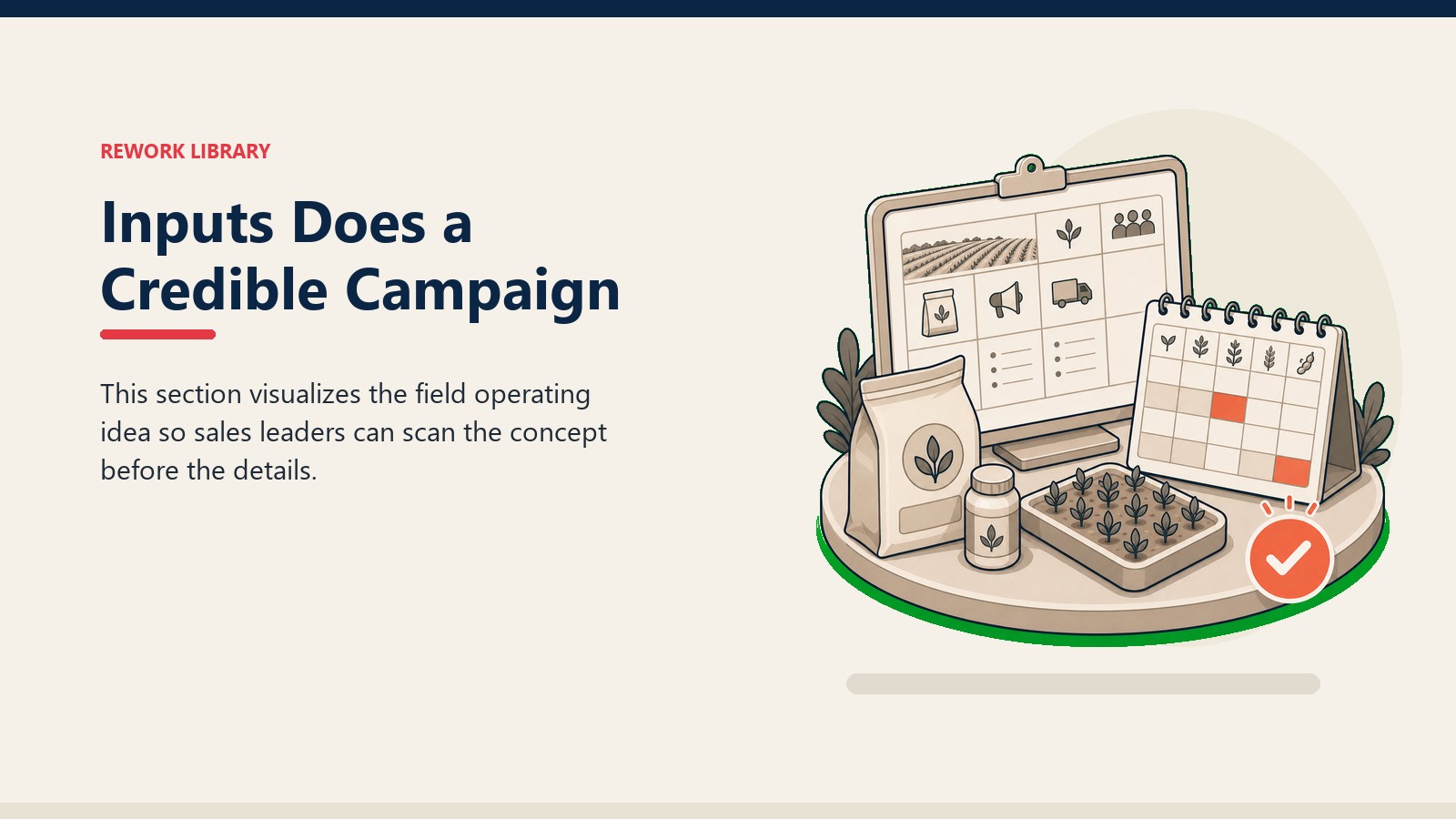
Last season performance data by territory and crop. Which crops in which sub-territories performed above and below plan? Which dealer clusters underperformed? Where did new farmer trials take place and at what conversion rate? Last season's data is the baseline for this season's territory objectives and the first checkpoint on whether a stretch target is credible.
Competitor positioning and scheme intelligence. What is the primary competitor offering dealers and farmers this season? What are their stocking incentives, their cash discount structure, and their field days calendar? Scheme intelligence doesn't come from the company's marketing deck; it comes from dealer conversations in the six weeks before campaign launch. A territory manager who doesn't know the competitor's scheme structure before finalizing his own plan is operating blind on the most commercially sensitive variable in the season.
Dealer and distributor inventory positions. What do dealers currently hold from last season? Dealers carrying unsold stock from the previous season have lower capacity and motivation to take on new stocking commitments. Territory plans that ignore carry-forward inventory produce over-optimistic stocking targets and distributor channel tension when the season actually begins. Once these three inputs are in hand, the objectives they support can be set at a level the field team will actually commit to.
Setting Campaign Objectives
Campaign objectives that work are specific, crop-anchored, and tied to field activity. "Grow the territory by 20 percent" is a finance objective, not a campaign objective. A campaign objective looks like this:
- Achieve 85 percent weighted distribution of [product portfolio] across 140 active dealer points by week minus 4 of kharif sowing.
- Conduct 24 demo plots on progressive cotton farmer fields in [districts A, B, C], with a target of 3 to 5 observer farmers per plot at mid-season.
- Generate 400 new farmer trials on [specific product] in the paddy belt through field days and KOL farmer referrals.
- Activate 12 KOL farmers for the rabi season in [sub-territory] by week 8 pre-sowing.
These objectives can be broken down to rep level, tracked weekly, and adjusted when mid-season data shows that one is running ahead or behind. They're not aspirations; they're commitments that the plan architecture has to support.
Campaign objective-setting framework:
| Objective category | What to set | How to track |
|---|---|---|
| Revenue target | Territory revenue by crop, by product category | Weekly primary sales vs. plan |
| Dealer activation | Number of active stocking dealer points by week minus 4 | Dealer coverage report |
| New farmer trials | Trial targets by crop, by sub-territory | Field visit logs, demo plot records |
| Demo plots | Number of plots by crop and geography | Demo plot register |
| KOL farmer activation | Named KOLs confirmed for the season | KOL engagement tracker |
| Field day attendance | Events planned, target farmer attendance per event | Field day records |
Campaign Architecture
A season campaign has four phases that follow the agricultural calendar. Treating them as discrete campaigns within a campaign, each with its own objectives and field-team focus, is what gives the plan structure rather than a single launch followed by hope.
Phase 1: Pre-Season Stocking Drive (dealer channel)
Objective: Get the portfolio to weighted distribution target before the sowing window opens.
This phase is fundamentally a channel sales push. Territory managers and reps are calling on distributors and dealers with scheme structures, stocking incentives, and the argument that early stocking captures the early-buyer premium. Dealer briefings happen in group format, by sub-territory, with scheme documentation, product demonstration, and a clear stocking calendar.
The stocking drive has a defined end date: distribution target achieved four weeks before sowing peak. Any stocking that hasn't happened by that date is at risk of missing the window. Territory managers tracking weekly stocking progress against the target can identify lagging dealer clusters and intervene with additional calls or scheme adjustments before the window closes.
Dealer and distributor briefing checklist:
- Season scheme structure presented and documented
- Stocking targets by SKU confirmed with distributor
- Display and point-of-sale materials placed
- Demo plot support commitment from local dealer confirmed
- Scheme claim process explained
- First order and payment terms confirmed
See pre-season stocking and liquidation for the detailed stocking drive mechanics. Demand activation runs in parallel and starts before the stocking drive ends.
Phase 2: Farmer Demand Activation (field days, demo plots, KOL activation)
Objective: Create farmer awareness and trial intent before the sowing window opens.
This phase runs in parallel with the stocking drive. Field reps are conducting pre-season advisory visits to KOL farmers (key opinion leaders), placing demo plots, and organizing field days in high-density farmer clusters. The goal is that when the sowing window opens and farmers make their buying decisions, the company's products are in the frame alongside or ahead of competitors.
Demand activation that begins only at the sowing window has already lost to competitors who began six weeks earlier. Farmers in most agri markets are information processors who talk to neighbors, attend local field days, and form purchase intentions over multiple conversations. The company whose rep was at a KOL farmer's field three weeks before sowing, discussing what to use this season, has a conversation lead that a scheme offered at the dealer counter the week of sowing can't fully recover.
See demand generation via demo plots for execution detail on the primary activation vehicle.
Phase 3: In-Season Pull-Through Support
Objective: Convert initial stocking into sell-through by supporting dealers and farmers during the season.
This is the phase where reps need to shift from pre-season push to in-season service. Farmers who trialled a product in week one of the season need a follow-up visit to assess the result. Dealers who stocked heavily in the pre-season need evidence of farmer demand to maintain confidence in their inventory position. Demo plots need the crop-stage visit cadence described in demo plot management and conversion.
Pull-through support also means monitoring for competitive switching activity. Which dealer clusters are showing slower-than-expected sell-through? Which rep territories have demo plots that aren't being visited by planned observers? In-season data identifies where the campaign is underperforming early enough to intervene with additional rep activity or promotional support before the window closes. FAO's integrated pest management guidelines are useful context when reps are coaching farmers on in-season crop protection decisions, since IPM-aligned advice builds credibility with progressive farmers who are aware of pesticide resistance risk.
Phase 4: Post-Season Liquidation and Debrief
Objective: Clear unsold channel inventory before it creates a dealer motivation problem for the next season, and capture learning for next-season planning.
Dealers carrying unsold inventory from the previous season are harder to stock in the next season. Post-season liquidation, through clearance pricing, scheme adjustments, or product transfers between dealer points, protects channel health for the following season.
The debrief is the input for next season's planning process. What drove above-plan performance in the territories that hit target? What held back the underperforming clusters? Which demo plot results can feed into next season's demand activation collateral? The debrief isn't a performance review; it's a planning input, and it should happen close enough to the season end that the territory team remembers what actually happened.
Territory-Level Execution Plans
A campaign plan that stays at the territory or state level fails at the point of implementation. The territory plan has to cascade to rep-level weekly activity targets that tell each rep what to do each week.
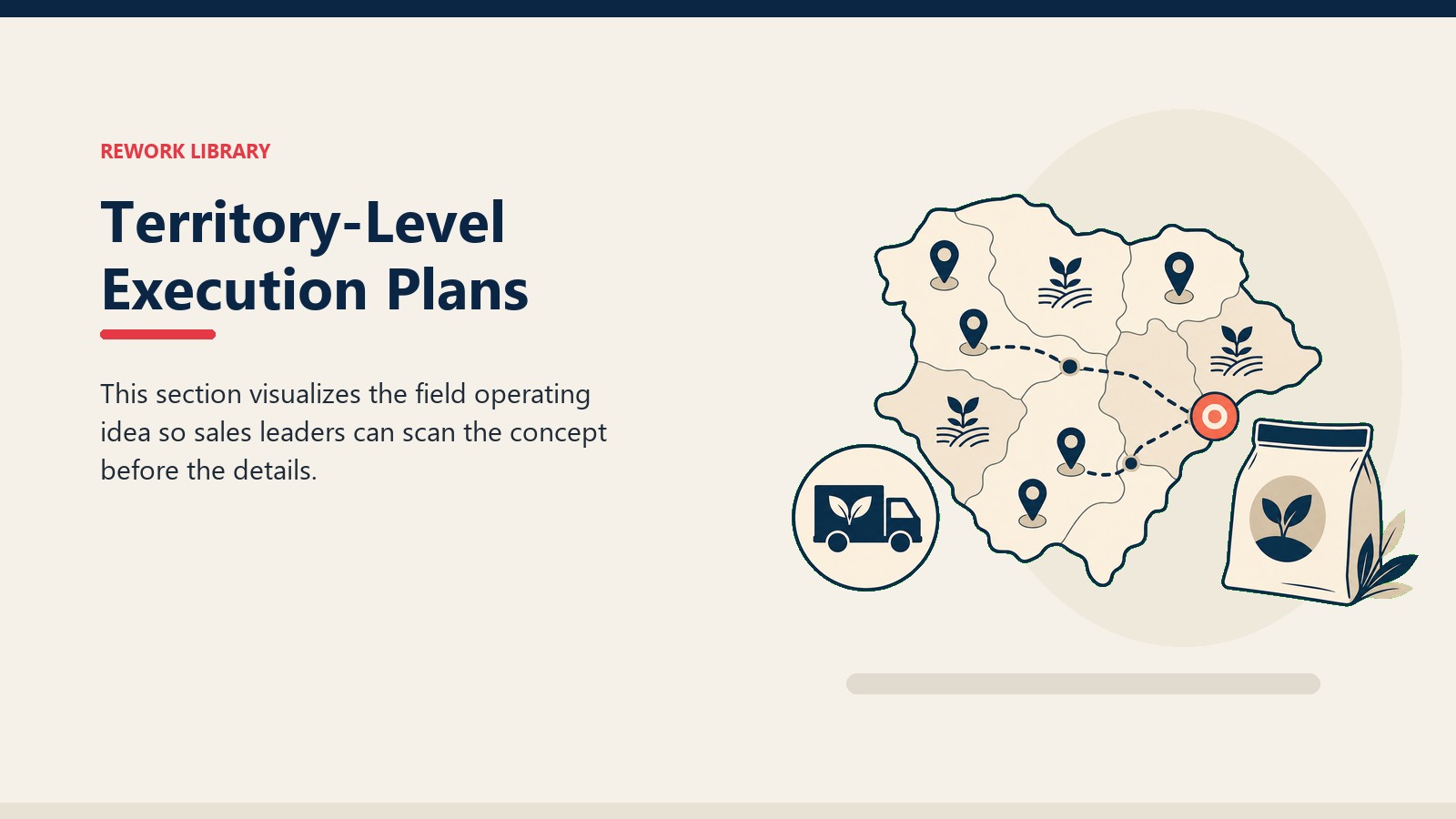
A rep-level activity plan for a kharif stocking campaign week looks like this:
| Activity | Weekly target | How to track |
|---|---|---|
| Dealer calls | 8-10 dealers visited | Call log in daily report |
| New dealer stocking conversations | 3-4 new dealer stocking commitments | Order intake |
| KOL farmer visits | 2-3 pre-season advisory visits | Field visit log |
| Demo plot placements confirmed | 1-2 new plots agreed | Demo plot register |
| Field day invitations sent | 15-20 farmer invitations confirmed | Attendance tracking |
Rep-level activity target table (kharif pre-season, weeks minus 10 to minus 4):
| Week | Dealer focus | Farmer focus | Demo plot focus | Weekly checkpoint |
|---|---|---|---|---|
| W-10 | Distributor briefing complete | KOL farmer list finalized | Site selection visits | Distributor scheme confirmed |
| W-9 | Dealer group briefing sessions | Pre-season advisory visits begin | Plot sites confirmed | 30% of dealer briefings done |
| W-8 | Dealer stocking targets confirmed | KOL farmer activation conversations | Plot planting schedule confirmed | 60% of dealer briefings done |
| W-7 | First stocking orders placed | Field day invitations distributed | First plots planted | 50% of stocking target in system |
| W-6 | Stocking follow-up on lagging dealers | Field day events executing | Germination visits | 70% of stocking target |
| W-5 | Closing lagging dealer points | Peak field day period | Observer farmer lists compiled | 85% of stocking target |
| W-4 | Distribution target achieved | Demand activation at peak | Mid-season plot walks planned | 100% of distribution target |
Dealer and Distributor Briefing
The pre-season scheme launch meeting is the single highest-impact event in the dealer channel activation phase. A well-run briefing produces distributor confidence, dealer stocking commitments, and field-team alignment on scheme structure and sales arguments. A poorly run briefing produces confusion, negotiation delays, and competitors who fill the gap.
An effective distributor briefing meeting runs 90 to 120 minutes and covers:
- Last season review: what worked, what didn't, what's different this season
- Season crop forecast and the opportunity it creates (estimated farmer demand in the geography)
- This season's product portfolio focus and any new product introductions
- Scheme structure: stocking incentives, cash discount terms, scheme claim timeline
- Demand activation support: field days, demo plots, KOL farmer program
- Stocking targets by SKU and payment structure
- Territory rep contact and escalation for scheme queries
The meeting should conclude with a signed or verbally confirmed stocking commitment from each distributor present. Commitments made in a group setting carry more social accountability than commitments made in one-on-one follow-up calls.
Consistency between the dealer briefing message and what farmers hear in the field is what prevents confusion at the counter when the sowing window opens.
Tracking and Adjusting Mid-Campaign
A campaign plan that doesn't include a tracking system is a guess that's been written down. Mid-campaign tracking is what separates a plan from a management tool.
Weekly tracking should cover the metrics that predict season-end performance, not just the metrics that confirm it:
Mid-campaign KPI dashboard:
| Metric | Why it's leading, not lagging | Alert threshold |
|---|---|---|
| Weighted dealer distribution (% of active dealers stocked) | Distribution gaps at week minus 4 predict revenue gaps at season end | Below 75% at week minus 4 triggers dealer blitz |
| Demo plot germination rate | Failed germination early in season eliminates conversion opportunity | Below 80% germination triggers replacement plot planning |
| KOL farmer activation rate | KOL activation drives community adoption velocity | Below 60% of target at week minus 6 triggers direct manager visits |
| Field day attendance vs. target | Low attendance signals poor farmer demand activation | Below 50% of target triggers venue or invitation-method change |
| Rep activity vs. plan (calls, visits, demos) | Activity shortfall predicts conversion shortfall | Below 80% weekly activity rate triggers same-week coaching |
| Primary sales (channel offtake) vs. weekly plan | Early season primary sales predict season-end trajectory | Below 85% of weekly plan by week minus 2 triggers scheme review |
Early warning signals that require in-season corrections include: dealer cluster reporting low farmer traffic despite being stocked (demand activation gap); demo plots where the rep hasn't visited since planting (plot management gap); sub-territories with below-80% field-day attendance (farmer engagement gap).
In-season corrections are limited. You can't add significant new dealer distribution in week minus 1. You can reallocate rep time toward lagging geographies, add additional field days in clusters where attendance was low, deploy additional trade promotions to stimulate dealer sell-through, and accelerate demo plot group walks in the territories where observer activity has been weak.
See sales forecasting methods for how to translate mid-campaign KPI data into an updated season revenue forecast.
Quotable Nuggets
"A season campaign plan is not a finance document reviewed once a quarter. It's a field-team operating guide used every week." The planning document's value is in the weekly rep-level activity targets it generates, not in the territory revenue number at the top.
"Demand activation that begins only at the sowing window has already lost to competitors who began six weeks earlier." Farmers in most agri markets form purchase intentions over multiple conversations across weeks. The company whose rep was at a KOL farmer's field three weeks before sowing has a conversation lead that a scheme offered at the dealer counter during sowing week can't fully recover.
"Starting three weeks late in an agri-inputs season campaign is structurally disqualifying." Dealers stocked late have fewer selling days. Farmers who didn't see a company rep before sowing decisions have already committed to whoever was there. The lost weeks don't compress; they simply disappear from the revenue opportunity.
The Season Campaign Architecture Framework
The PDPT Framework organizes a season campaign into four sequential phases, each with a distinct commercial objective:
Pre-season Stocking Drive: Push product to distribution target before the sowing window. Objective: weighted distribution achieved four weeks before peak sowing.
Demand activation: Create farmer awareness and trial intent. Field days, demo plots, KOL farmer visits. Objective: farmer pull-through established before farmers begin their consolidated input buying trip.
Pull-through support: Convert initial stocking to sell-through. Rep visits to trialling farmers, dealer confidence reinforcement, demo plot mid-season walks. Objective: primary sales converting to secondary sales at plan.
Debrief and planning: Clear unsold inventory, capture learning, begin next season's plan. Objective: clean channel, next campaign inputs documented.
Each phase has its own field activity targets, tracking metrics, and alert thresholds. A plan that treats the season as a single activity block, rather than four sequential phases with separate objectives, produces the compression and timing failures this article opens with.
Campaign Planning Is the Document That Turns a Target Into Field Activities
The Maharashtra state head's three underperforming regions didn't fail because of weak products, unmotivated teams, or unfavorable weather. They failed because the team started three weeks late, and starting three weeks late in an agri-inputs season campaign is structurally disqualifying. Dealers stocked late have fewer weeks to sell before the sowing window closes. Farmers who didn't see a company representative before they made their sowing decisions have already committed to competitors. Demo plots planted late run through fewer crop stages and produce less conversion evidence.
The rebuilt planning process solved this by giving the team a document that said, precisely, what had to happen in each of the ten weeks before sowing peak, who was responsible for each activity, and what the threshold was that triggered a management escalation. That document was the difference between aspiration and execution.
A season campaign plan is not a finance document reviewed once a quarter. It's a field-team operating guide used every week. Build it early, cascade it to rep level, track it weekly, and adjust mid-campaign when the data says something is running behind. That discipline is what wins the sowing window.
Frequently Asked Questions about Season Campaign Planning
When should season campaign planning start?
Planning should be complete 10 to 12 weeks before the sowing peak. For kharif in most Indian geographies, that means campaign planning begins in late February or early March for a June sowing window. For rabi, planning begins in July or August for a November sowing window. The planning process itself takes 2 to 4 weeks and involves performance data review, objective-setting, dealer intelligence gathering, and scheme design.
How do I set realistic rep-level activity targets without demoralizing the team?
Start with last season's actual activity data. What did the reps who hit plan actually do each week? How many dealer calls, farmer visits, and demo plot placements? Use those as the baseline and adjust for this season's specific objectives. Targets set from actual high-performer behavior are more credible than targets set from spreadsheet arithmetic.
What do I do if a competitor launches an aggressive scheme after I've already committed to a lower stocking incentive with my dealers?
First, assess whether the competitor scheme is sustainable or a one-season volume grab. If it's sustainable, you may need to adjust your scheme structure, which requires distributor renegotiation but is possible within the first 2 to 3 weeks of the stocking drive. If it's a one-season move, hold your structure and focus on farmer demand activation: a dealer who's seen strong farmer pull-through on your product will stock you regardless of the scheme differential.
How should I handle territories where the last season was poor due to drought or crop failure?
A territory with poor season outcomes due to weather has farmers who are financially cautious and dealers who may be carrying debt. Adjust the campaign focus toward new farmer trials on smaller acreages and dealer stocking terms that accommodate slower payment. Don't replicate last season's volume targets without adjusting for the financial capacity of the channel and the risk tolerance of farmers in the affected areas.
What is the single most dangerous mistake in campaign execution?
Starting the stocking drive late. Everything downstream of dealer stocking, farmer demand activation, demo plot management, pull-through support, depends on product being available at the dealer counter when farmers begin their buying cycle. A stocking drive that misses its four-weeks-before-sowing target creates an availability gap during the highest-demand period. By the time product arrives, some farmers have committed to whoever was stocked and some dealers have shifted attention to products they can actually sell. The lost weeks don't compress; they translate directly into missed volume that no mid-season intervention can recover.
How do I track whether farmer demand activation is working before it's too late to intervene?
Field-day attendance is the leading indicator. A field day with below 50% of the planned attendance is telling you that either the invitation method isn't reaching farmers, the timing doesn't work for them, or the topic isn't relevant at this stage. If you catch this in week minus 7 or minus 6, you can change the venue, the format, or the topic. If you catch it at week minus 2, you've lost the activation window. Track field-day attendance weekly and treat any event below threshold as an immediate signal to investigate and correct.
Learn More

Senior Implementation Consultant
On this page
- The Agri-Inputs Season Calendar
- What Inputs Does a Credible Campaign Plan Require?
- Setting Campaign Objectives
- Campaign Architecture
- Phase 1: Pre-Season Stocking Drive (dealer channel)
- Phase 2: Farmer Demand Activation (field days, demo plots, KOL activation)
- Phase 3: In-Season Pull-Through Support
- Phase 4: Post-Season Liquidation and Debrief
- Territory-Level Execution Plans
- Dealer and Distributor Briefing
- Tracking and Adjusting Mid-Campaign
- Quotable Nuggets
- The Season Campaign Architecture Framework
- Campaign Planning Is the Document That Turns a Target Into Field Activities
- Learn More