Field Force Sizing and Deployment: How Agri-Input Companies Build Coverage Without Burning Headcount Budget
Turn this article into takeaways for your work.


Each assistant summarizes the article only for you and suggests best practices for your work.
Most agri-input companies have a coverage problem hiding inside an org chart that looks fine on paper. Headquarters territory maps show neat, evenly-distributed blocks. But walk the ground and you find three reps competing for the same 40 dealers in a district town, while a belt of high-cropping-intensity villages 30 kilometers away hasn't seen a company rep in two months.
This happens because most field force sizing decisions are made with revenue history as the primary input and actual agricultural potential as a secondary consideration. Towns that already buy show up in the data. Under-penetrated rural belts don't, because nobody's been there to develop the market. The World Bank's agricultural value chain work consistently identifies under-coverage of high-potential rural areas as one of the primary constraints on agribusiness growth in emerging markets, and the root cause is almost always a sizing methodology that allocates reps to where revenue already exists, not where it could be developed.
The companies that build dominant rural coverage, the kind that makes them hard to displace even when a competitor launches an aggressive promotion, do it by working from workload requirements rather than historical revenue. The question isn't "where did we sell the most last year?" It's "where is the work, and how many people does it take to do it right?"
Why Does Agri-Input Field Staffing Concentrate in the Wrong Places?
The pattern repeats across agri-input companies in emerging markets. The district headquarters town gets two or three reps. It has a concentration of large dealers, it's where the zone manager sits, and it's where company visitors from head office want to see activity. The outer belt, where small and medium dealers serve farming villages and where the agronomic potential is often larger, gets one rep covering a geography that should have two or three.
This isn't random. It's a predictable outcome of sizing decisions made from aggregated sales data. Aggregated data underrepresents under-penetrated areas because underdevelopment is invisible in revenue numbers. And it overrepresents areas where the market is already developed, because those areas' revenue makes them look like the right place to concentrate attention.
The result is that the company's organizational energy goes into defending existing business in mature markets rather than building new business in high-potential ones. Growth slows. Market share in the developed areas erodes as competitors invest in rural coverage. And the under-covered belts become the source of the competitor's strength.
Key Facts: Agri-Input Field Force Sizing
- Cross-industry B2B sales data shows that 41% of field sales teams report annual rep turnover of 50% or higher, with territory design imbalance, over-coverage of mature areas and under-coverage of high-potential ones, consistently cited among the top drivers. (Source: SPOTIO, "The State of Field Sales 2026")
- In compact periurban areas, 8-10 dealer calls per day is achievable for field reps; in dispersed rural geographies with poor road conditions, 4-6 calls per day is a more realistic planning assumption. The gap between aspirational and actual call-rate assumptions is the most common source of field force under-staffing that only reveals itself mid-season (industry sizing norm, consistent with SFA data reported across agri-input distributor management systems).
- The World Bank's agricultural value chain work consistently identifies under-coverage of high-potential rural areas as one of the primary constraints on agribusiness growth in emerging markets, with revenue-based headcount allocation, which concentrates reps where business already exists rather than where it could be developed, as the root cause. (Source: World Bank Agriculture)
The Workload-Based Sizing Model
The Coverage-Potential-Management Triad: Effective agri-input field force design balances three variables simultaneously: potential (what you can sell in the territory, based on crop area, competitive white space, and demand forecast), workload (what it takes to serve the customer base, based on dealer count, geographic spread, and farmer advisory requirements), and management capacity (how many distributor and dealer relationships one rep can actively manage at the required quality level). Revenue-based allocation addresses only potential. Territory-size-based allocation addresses only a proxy for workload. Only a full workload model integrates all three variables and produces headcount that is correctly sized and correctly deployed.
The workload model starts not from revenue but from the customer universe and what it takes to serve it properly.
Dealer universe size and visit frequency norms: Start by mapping every active dealer outlet in the territory. Not just the 30 largest dealers your rep currently visits, but the full universe including smaller dealers who currently stock competitors. For each dealer tier, define the required visit frequency: large dealers monthly, medium dealers bimonthly, small dealers quarterly, for example. Multiply dealer count by visit frequency to get the annual call requirement for the territory.
Farmer segment coverage targets: Dealer coverage alone doesn't capture the agronomy-led portion of the field force role. If your reps do farmer field days, demonstration plot visits, or direct advisory calls with progressive farmers and KOLs, add those call requirements to the workload calculation. An agronomist covering a high-value horticultural belt might have 60% of their calls with farmers and only 40% with dealers. That's a different workload profile than a commercial rep in a commodity crop belt.
Season-adjusted call capacity per rep per day: A rep working during the peak planting season, driving rural roads between village dealers, makes fewer calls per day than a rep working in an off-season month covering a compact district town. Effective daily call capacity should be calculated as a season-weighted average. In the Indian context, a rep covering rural Telangana during Kharif peak might realistically make 5-6 dealer visits per day given travel distances. The same rep in off-season might manage 8-10. The sizing model needs to use realistic effective capacity, not theoretical maximum capacity.
Planned vs. effective working days: Field reps lose productive days to sales training, internal meetings, leave, and public holidays. In most agri-input companies, effective field days run 200-220 days per year against a 250-260-day working year. Don't size your field force for 250 days and then wonder why coverage targets aren't being met when reps are pulled into quarterly reviews and product training.
Sizing Methodology
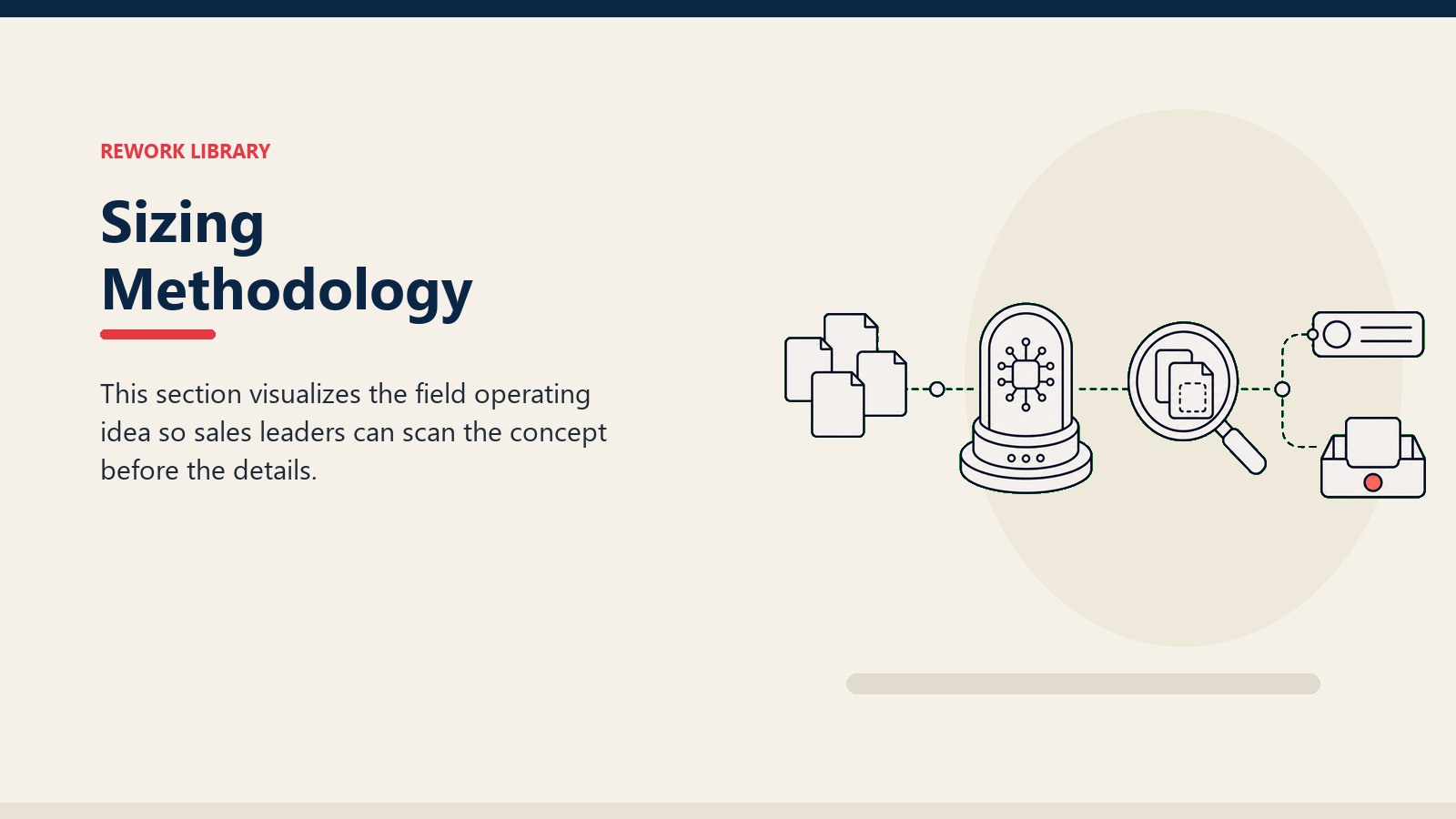
Bottom-up calculation: The core formula is straightforward.
Required headcount = Total annual calls required / Annual calls per rep
Where annual calls per rep = Effective daily call capacity x Effective working days per year.
Example: A territory has 150 active dealers, requiring an average of 8 visits per year each (mix of monthly large and quarterly small). Total annual calls required: 150 x 8 = 1,200 calls. A rep with 220 effective working days making 6 dealer visits per day produces 220 x 6 = 1,320 calls per year. Required headcount: 1,200 / 1,320 = 0.9, which rounds to 1 rep.
But add farmer call requirements of 300 visits per year (agronomist-component reps), and the total annual call requirement becomes 1,500. At 1,320 calls per rep per year, you need at least 1.1 reps, meaning either 2 reps (one commercial, one agronomist-support) or a significantly higher per-rep call rate than is realistic for the travel conditions.
Top-down sanity check: Revenue-per-rep benchmarking is the reality check on the bottom-up calculation. If the bottom-up model produces a headcount that would require 40% below industry benchmark revenue-per-rep to break even on coverage cost, you have either an overestimated call frequency assumption (are you really visiting every small dealer 4 times a year?) or a territory with insufficient commercial density to justify full coverage. The top-down check prevents over-coverage of genuinely low-potential areas.
Revenue per rep benchmark for your segment = Total addressable territory revenue / Competitive headcount for that territory type
Hybrid allocation between agronomists and commercial reps: In agri-inputs, the field role isn't homogeneous. Commercial reps drive dealer sell-in, manage distributor relationships, and handle order and credit functions. Agronomist-profile reps build farmer advisory relationships, run demo plots, and generate the technical pull that supports the commercial rep's dealer conversation. In territories with complex crops (horticulture, cotton, rice), the optimal team structure often separates these roles. In commodity crop territories with simpler product sets, a hybrid agri-commercial profile may be more efficient. The sizing model should specify headcount by role, not just total headcount. See Agronomist and Rep Recruitment and Training for how role design maps to hiring profiles. FAO's mobilizing rural and agricultural extension report points to the same underlying trade-off: technical advisory capacity and commercial coverage require different skills, different visit cadences, and often different funding models, and conflating the two roles typically produces underperformance in both.
Workload-Based Sizing Formula Summary
| Input | Source | Example |
|---|---|---|
| Dealer universe size | Dealer universe mapping | 150 active dealers |
| Visit frequency by dealer tier | Channel policy | Large: 12x/yr; Medium: 6x/yr; Small: 3x/yr |
| Farmer advisory calls | Agronomist coverage target | 300 calls/yr |
| Total annual calls required | Sum of dealer + farmer calls | 1,500 |
| Effective daily call capacity | Season-adjusted field norms | 6 calls/day |
| Effective working days | 250 days minus training, leave, meetings | 210 days |
| Annual calls per rep | Capacity x working days | 1,260 |
| Required headcount | Total calls / calls per rep | 1.19 (round to 2) |
Territory Design Principles
Getting the headcount number right is necessary but not sufficient. How you assign that headcount to geography determines whether reps are effective or burned out.
Balancing potential and workload: A good territory assignment balances two dimensions. Potential is what you can sell there: crop area, wallet share opportunity, competitive white space, and forecast growth in the next 3-5 years. Workload is what it takes to serve the customer base: dealer count, geographic spread, travel time, and the number of farmer advisory relationships required. Neither dimension alone is sufficient. High-potential but geographically vast territories burn reps. Compact territories with low potential don't generate enough revenue to justify the cost of coverage.
Avoiding over-territory and under-territory: Over-territory happens when a single rep is assigned a geographic area with more required calls than their capacity allows. The rep cuts corners: visiting large dealers frequently and skipping small dealers entirely, doing short courtesy calls instead of full product discussions, and prioritizing easy accounts over high-potential new ones. The data shows call completion, but the quality and coverage are missing. Under-territory is less common but wastes headcount: a rep with a small dealer universe and manageable geography who has meaningful idle time. This is usually the result of historical territory carve-outs that matched business conditions five years ago and haven't been updated as the market matured.
Season-sensitive territory boundaries: In markets where crop belts shift, where the same physical geography might be primarily cotton in one year and soybean in another, or where flood-prone areas change their crop mix annually, territory boundaries should be reviewed before each season, not just annually. A rep whose territory was defined around cotton coverage needs a different deployment in a soybean year. Fixed territory boundaries in seasonally variable crop geographies create misalignment between where the rep is assigned and where the crop demand is.
Territory Balance Scorecard
| Metric | Balanced Territory | Over-Territory | Under-Territory |
|---|---|---|---|
| Required calls per year | Within 10% of annual rep capacity | 20%+ above rep capacity | 20%+ below rep capacity |
| Travel time as % of field day | Under 25% | Above 40% | Under 15% |
| Dealer visit coverage | 90%+ of dealers visited in season | Under 70% | 95%+ with idle time |
| Revenue per rep vs. benchmark | Within 15% of benchmark | Under 80% of benchmark | Over 120% (underinvestment signal) |
Deployment Scenarios
The right deployment model depends on what the territory situation actually is, not on a one-size-fits-all approach from headquarters.
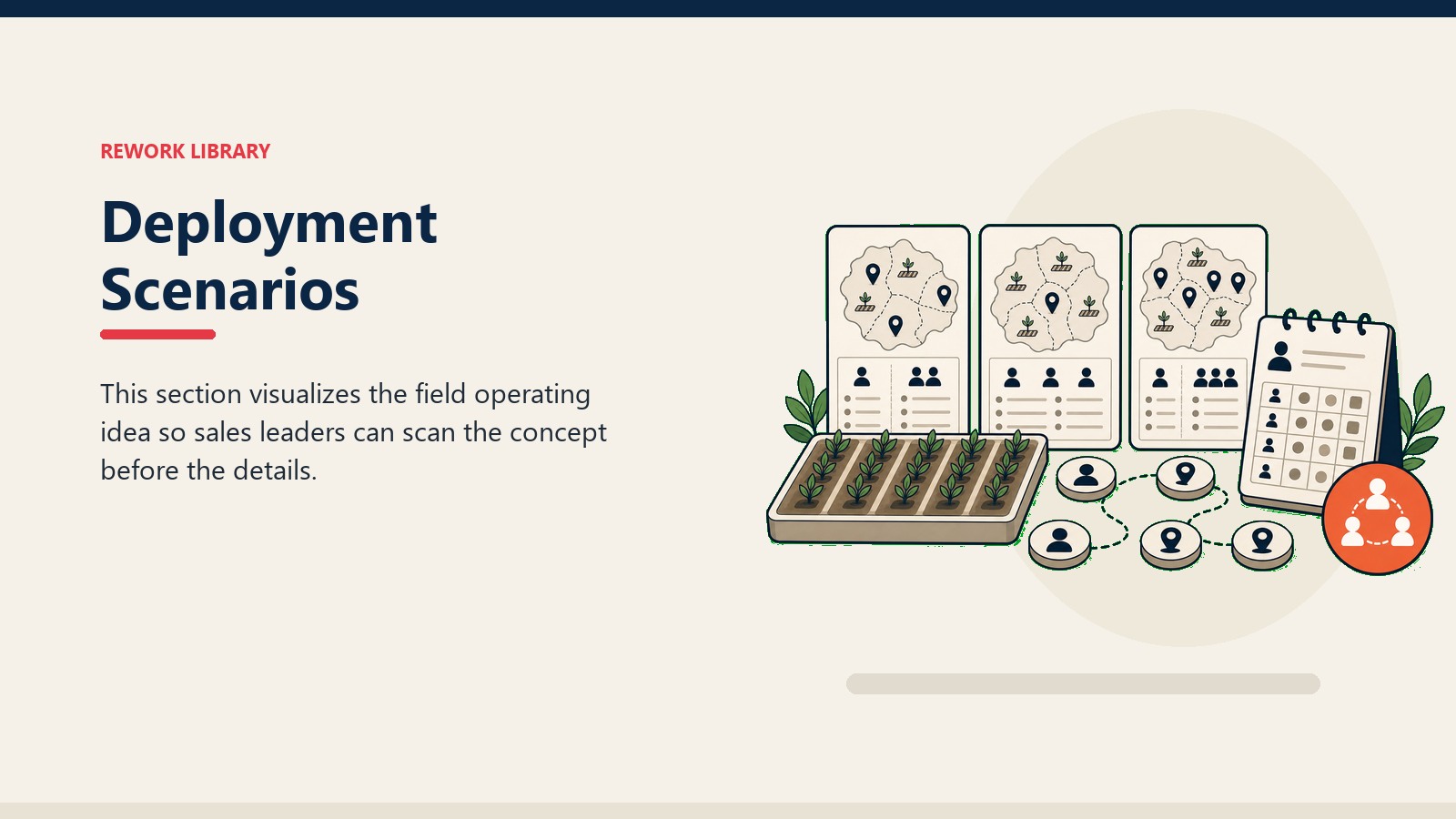
New geography expansion: hub-and-spoke starter model: When you're entering a new district or state where you have minimal presence, don't try to cover the whole geography immediately. Start with a hub rep in the largest commercial center, who handles the anchor dealers and builds distributor relationships. Spoke coverage, smaller dealers and farmer advisory visits in the surrounding villages, comes as volume builds and justified additional headcount. Premature full-coverage expansion in a new geography typically delivers weak economics for 18-24 months while the market is still being developed.
Competitive battleground territories: density-up before spreading: In territories where a major competitor has dominant coverage and strong dealer loyalty, the answer is not to spread your headcount thin across the full geography. It's to concentrate on a defensible core, your best dealers and your highest-potential crop belt, and build deep coverage and strong agronomic relationships there before expanding. A rep who knows 30 dealers really well and runs meaningful demo plots with 20 progressive farmers will outperform two reps who each know 30 dealers superficially.
Ageing dealer universe: rationalize before adding headcount: Some territories have a large dealer count that inflates the workload calculation, but many of those dealers are dormant, declining, or have poor sell-through because of location or competition. Before requesting additional headcount to cover an apparently over-loaded territory, audit the active dealer universe. If 30% of the dealer count is inactive or sub-threshold, the workload is smaller than the total count suggests. Rationalize the dealer universe first; add headcount to serve a cleaned-up, actively-buying base. Route to Market for Agri-Inputs covers the dealer rationalization methodology in detail.
Deployment Scenario Comparison
| Scenario | Recommended Model | Key Metric to Watch | Common Mistake |
|---|---|---|---|
| New geography | Hub-and-spoke, phased expansion | Dealer activation rate (new to active) | Full-coverage too early, weak economics |
| Competitive battleground | Concentration on defensible core, then expand | Market share in core zone | Spreading headcount to match competitor's footprint |
| Mature, well-penetrated | Maintain coverage, optimize territory balance | Revenue per rep, effective call rate | Adding headcount to solve a quality-of-coverage problem |
| Ageing dealer universe | Audit and rationalize, then resize | Active dealer count vs. total dealer count | Requesting more headcount before rationalizing inactive dealers |
Technology Inputs
Sizing models built from assumptions in spreadsheets drift away from reality within one season. Technology closes the gap between the model and what's actually happening in the field.
GIS-based territory mapping: Geographic Information System (GIS) tools allow you to visualize crop area, dealer locations, travel time between outlets, and population distribution in a single map layer. Territories designed on GIS data produce more equitable workload distributions because you can see the travel burden alongside the call requirement. A territory that looks compact by dealer count might be spread across difficult terrain with long inter-outlet travel times. GIS makes this visible before you set the territory, not after a rep has been burning out on it for six months.
SFA data on actual call patterns to validate design assumptions: Your sales force automation (SFA) tool records what reps actually do: who they called, when, how long the visit lasted, and what was discussed. Comparing the SFA call pattern against the territory design assumption is the continuous calibration mechanism. If the sizing model assumed 6 dealer calls per day but SFA shows an average of 4.2, either the travel assumption was wrong, the visit quality requirement is higher than assumed, or reps are working shorter days than planned. Each of these is a different problem requiring a different solution. Territory Analytics and Dashboards and Sales Ops and Field Force Alignment provide the framework for using SFA data to run this calibration continuously.
Review Cadence
Field force sizing and territory design aren't one-time decisions. They need a structured review cadence that distinguishes between adjustments that need annual planning cycles and those that need in-season response.
Annual redesign: Before the annual budget cycle, run a full territory balance review. Update the dealer universe (add new entrants, remove inactive dealers), revise crop area estimates for the coming year, and check revenue-per-rep actuals against benchmark. Where imbalances are persistent across two seasons, redesign the territory boundary. Annual redesign is also the right moment to address structural problems: over-territory in one zone, under-territory in another, role profile misalignment between the agronomy-heavy north and the commercial-heavy south.
Mid-season micro-adjustments: When a rep leaves mid-season, or a new product launch creates significant demand in a specific geography, you need the ability to make faster adjustments than the annual cycle allows. Define a mid-season review protocol that allows territory boundary adjustments, temporary coverage sharing between adjacent reps, and fast-track headcount requests for genuinely urgent situations. The review cadence checklist should include: a monthly call-rate review against territory design, a mid-season territory balance audit, and a post-season effectiveness review comparing planned versus actual coverage.
Sales Capacity Planning provides the financial modeling framework to connect field force sizing decisions to revenue plan assumptions. Agri Field Sales Economics grounds the cost-of-coverage calculation in agri-specific economics.
Right-Sizing as Continuous Calibration
Quotable Nuggets
"41% of field sales teams report annual rep turnover of 50% or higher. Territory design imbalance, reps with too many required calls and insufficient time to do any of them well, is a primary driver of that attrition." (SPOTIO, "The State of Field Sales 2026")
"FAO's work on rural extension systems draws the same distinction that agri-input companies face in field force design: technical advisory capacity and commercial coverage require different skills, different visit cadences, and often different funding models. Conflating the two roles typically produces underperformance in both." (FAO, "Mobilizing the Potential of Rural and Agricultural Extension")
"Right-sizing is not a once-a-year org chart exercise. It's a continuous calibration process using workload modeling to set structural headcount, SFA data to validate actual deployment, and a clear review cadence to make adjustments when reality diverges from the plan." (Agri-input field force design principle)
The instinct is to treat field force sizing as a once-a-year org chart exercise: set the headcount in the annual plan, lock the territories, and manage within that structure until next year's budget round. That approach is too slow for a business where crop calendars, competitive moves, and dealer universe changes shift the workload requirements faster than annual planning cycles can respond.
Right-sizing is a continuous calibration process. It uses workload modeling to set the structural headcount, SFA data to validate whether that headcount is actually deployed as designed, and a clear review cadence to make adjustments when reality diverges from the plan. The output isn't a fixed org chart. It's a living coverage model that tracks the agricultural and commercial opportunity as it evolves.
Field Force Sizing and Deployment (Pharma) and Field Force Sizing and Structure (FMCG) show how analogous industries have built these calibration systems. The agri-input version shares the same analytical logic while incorporating crop-calendar seasonality and the agronomist-commercial dual-role complexity that are specific to this sector.
Build the model. Use the data. Review on cadence. The companies that cover rural belts effectively don't do it by adding headcount. They do it by deploying the headcount they have where the work actually is.
Frequently Asked Questions about Field Force Sizing and Deployment
What is the workload-based sizing model and why is it better than revenue-based sizing?
The workload-based model calculates required headcount from the bottom up: total annual customer calls required divided by annual calls per rep, adjusted for effective working days and realistic daily call capacity. Revenue-based sizing allocates headcount in proportion to historical sales, which underrepresents under-penetrated territories (because they haven't been developed yet) and overrepresents mature ones. Workload-based sizing directs headcount to where the work is, not just where the existing business is.
How do you handle territories where seasonal crop mix varies significantly year to year?
Use a scenario-weighted average for the territory call requirement. If a belt is 60% cotton one year and 40% soybean the next (based on price signals and monsoon timing), calculate the call requirements under each crop scenario and weight them by the probability of each occurring. Run a pre-season territory review 4-6 weeks before planting begins, using agronomist crop area estimates to validate which scenario is materializing, and adjust territory boundaries or rep deployment as needed.
What effective daily call rate should be used for rural agri-input reps?
This depends heavily on geography and travel infrastructure. In compact periurban areas, 8-10 calls per day is achievable. In dispersed rural geographies with poor road conditions, 4-6 calls per day is more realistic. Use your SFA data from the previous season to establish your actual call rate baseline, and use that, not an aspirational target, for sizing calculations. Using inflated call rate assumptions produces under-staffing that only reveals itself when reps start missing coverage targets.
When is it right to separate the agronomist and commercial rep roles?
Separate the roles when the technical complexity of the product portfolio or crop advice requirement is high enough that a single rep can't maintain credibility in both dimensions. High-value horticultural crops, complex integrated pest management protocols, and new biological product categories typically require genuine agronomic depth that a commercially-trained rep can't fake. Commodity crop territories with simpler product sets and established farmer adoption often work fine with a hybrid agri-commercial profile, especially when headcount economics don't support two separate roles per territory.
How do you conduct a mid-season territory adjustment when a rep leaves or demand shifts unexpectedly?
Define a mid-season micro-adjustment protocol before you need it. The key elements: a temporary coverage-sharing agreement between adjacent reps (defining which accounts each will cover and at what reduced visit frequency), a fast-track headcount authorization process if the coverage gap is large enough to warrant an emergency hire, and a clear priority list for which accounts must maintain full coverage and which can be serviced at reduced frequency for the remainder of the season. The worst mid-season response is to split the departed rep's territory evenly across adjacent reps without accounting for their existing workload. That typically produces two over-loaded reps instead of one vacant territory.
Learn More