Dealer Visit Playbook: A Step-by-Step Call Structure for Agri-Input Field Reps
Turn this article into takeaways for your work.


Each assistant summarizes the article only for you and suggests best practices for your work.
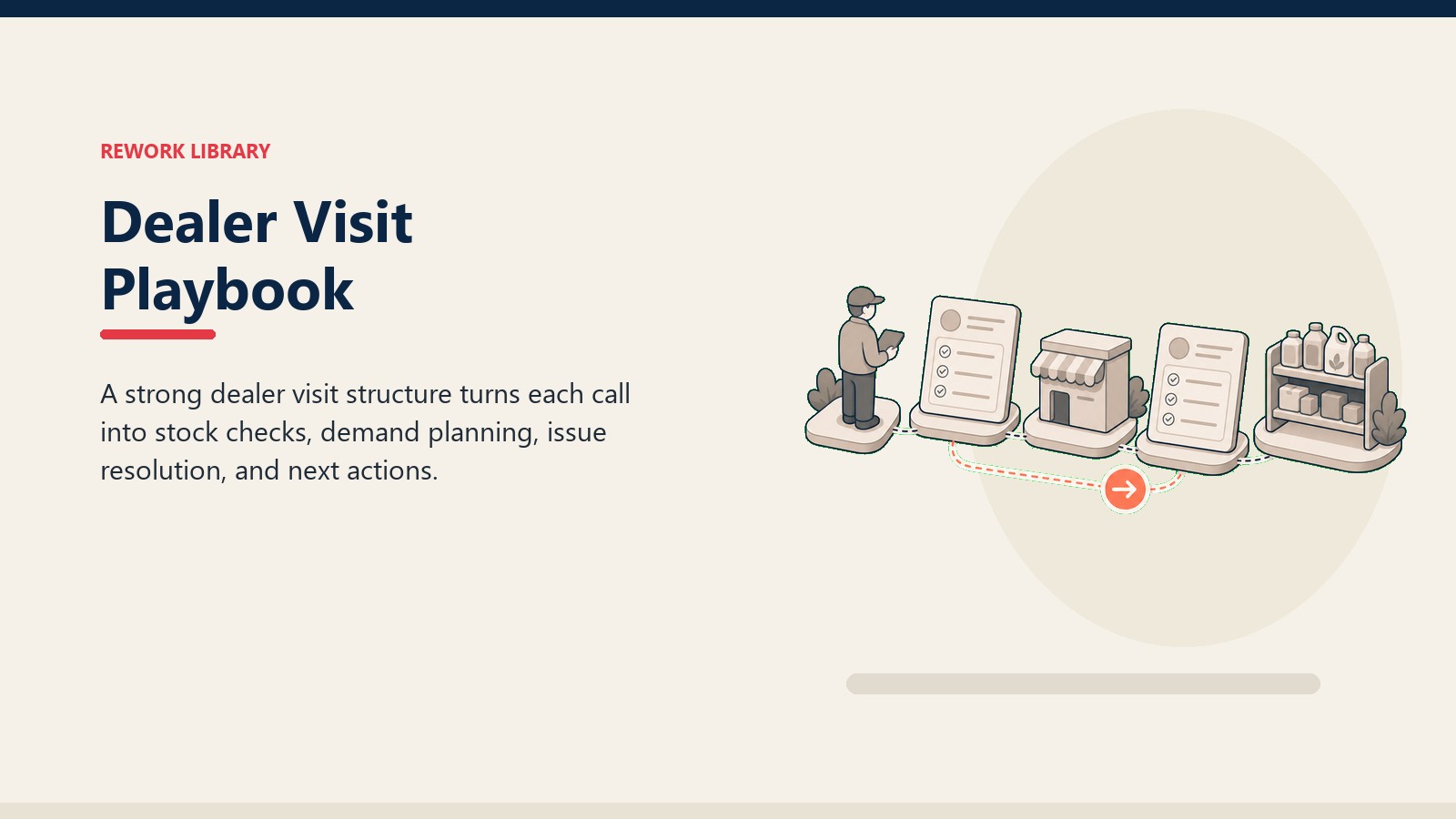
The rep arrived at 10:15 and left at 11:00. He and the dealer talked about a lot of things: the rains that were late this year, a neighboring farmer who'd complained about a product from a competitor, the upcoming cricket match, the government's new fertilizer subsidy announcement. The conversation was genuinely warm. The relationship was good.
He drove away without a confirmed order.
He didn't ask for one. Not directly. He mentioned that new stocks were available and that the scheme was running until end-of-month. The dealer said "we'll see how demand goes." The rep said "okay" and got in his car.
That exchange happened because there was no call structure. There was rapport, which is valuable. But rapport without a call structure is a relationship management activity, not a sales activity. The dealer liked the rep, but liking the rep didn't generate a stocking order.
A structured dealer visit doesn't sacrifice the relationship. It protects the commercial outcome. The two aren't in conflict. The rep who walks in with five clear objectives, hits them in 25 minutes, and leaves with a confirmed order builds the same relationship as the rep who spends 40 minutes chatting, because dealers respect reps who are organized, informed, and efficient. They don't respect reps who waste their time and then leave without a transaction.
The Five Objectives of Every Dealer Visit
Every dealer visit, regardless of territory, season, or relationship stage, should accomplish five things:
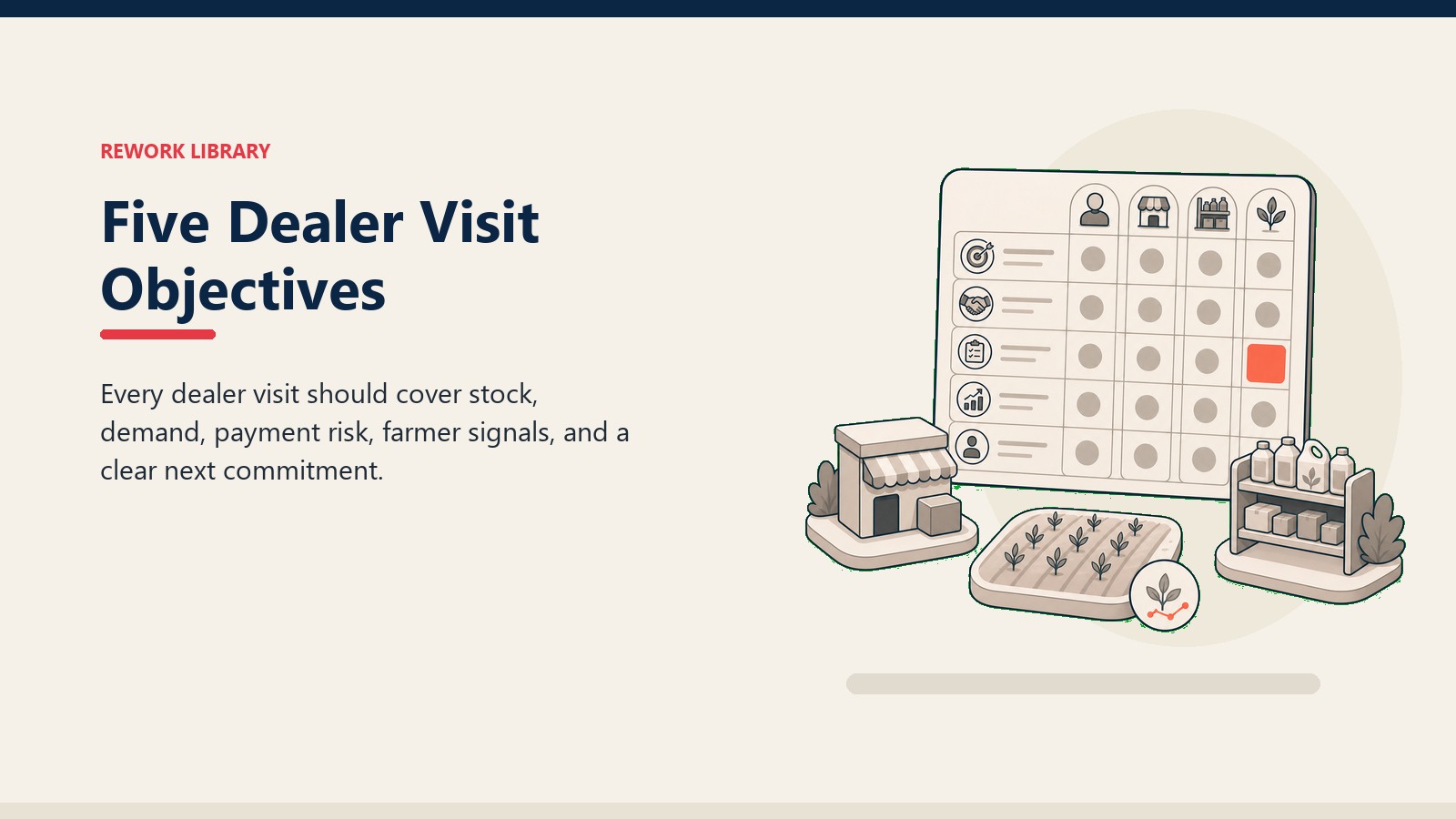
1. Stock audit: Know exactly what's on the shelf and in the back store. This is the foundation of the commercial conversation. You can't have a meaningful sell-in conversation without knowing the current stock position.
2. Relationship pulse: A brief, genuine check-in on how business is going and what farmers are saying. Not 30 minutes of conversation, but two to three minutes of real listening. The intel you get here shapes how you position the sell-in.
3. Scheme update: Communicate the current trade incentive clearly enough that the dealer can explain it to a farmer. If the dealer can't explain the scheme, the scheme doesn't exist commercially.
4. Sell-in: Recommend a specific order quantity with a business rationale the dealer can accept or push back on. Not "would you like to order?" but "based on your current stock and the seasonal demand pattern, I'd recommend 50 units of Product A this week."
5. Intel capture: Leave with information about farmer demand signals, competitor activity, and pricing pressure in the dealer's area. This feeds back into your territory planning and your area manager's market intelligence.
All five in 25 minutes is the target. Not every visit will hit it, but every visit should attempt it.
Key Facts: Dealer Visit Structure and Productivity
- In Tanzania, inputs pass through at least three supply chain layers (national importer to regional distributor to agro-dealer) before reaching a farmer, and 68% of surveyed agro-dealers procure from local distributors rather than directly from manufacturers. This chain makes the dealer visit the critical commercial touchpoint. The rep who visits without a clear scheme message and order ask leaves value in every link of that chain (Food Security / Springer, 2021, n=299 agro-dealers, 8 districts, Tanzania; doi:10.1007/s12571-021-01181-9).
- IFC agro-dealer training programs in Sub-Saharan Africa documented that dealers who received structured training on input handling and customer advisory converted more farmer inquiries into purchases, demonstrating that the dealer visit is not just an ordering transaction but a capability investment that determines downstream farmer conversion rates (IFC / ETG partnership program, 2022; ifc.org/en/pressroom/2022/etg-and-ifc-partner).
- An agro-input dealer advisory study in Uganda found that while 97% of dealers reported advising customers as part of their role, only 26.6% actually provided any substantive advice during mystery shopping visits (Matua et al., PMC8411546). Dealers who don't receive regular rep engagement and scheme education drift toward passive stocking behavior; the structured dealer visit is the intervention that keeps advisory quality active.
Pre-Visit Preparation
Unstructured dealer visits start before the rep walks through the door. The rep who arrives without reviewing last visit notes, without knowing the current stock position estimate, and without a clear scheme message for the day is already set up for a wasted call.
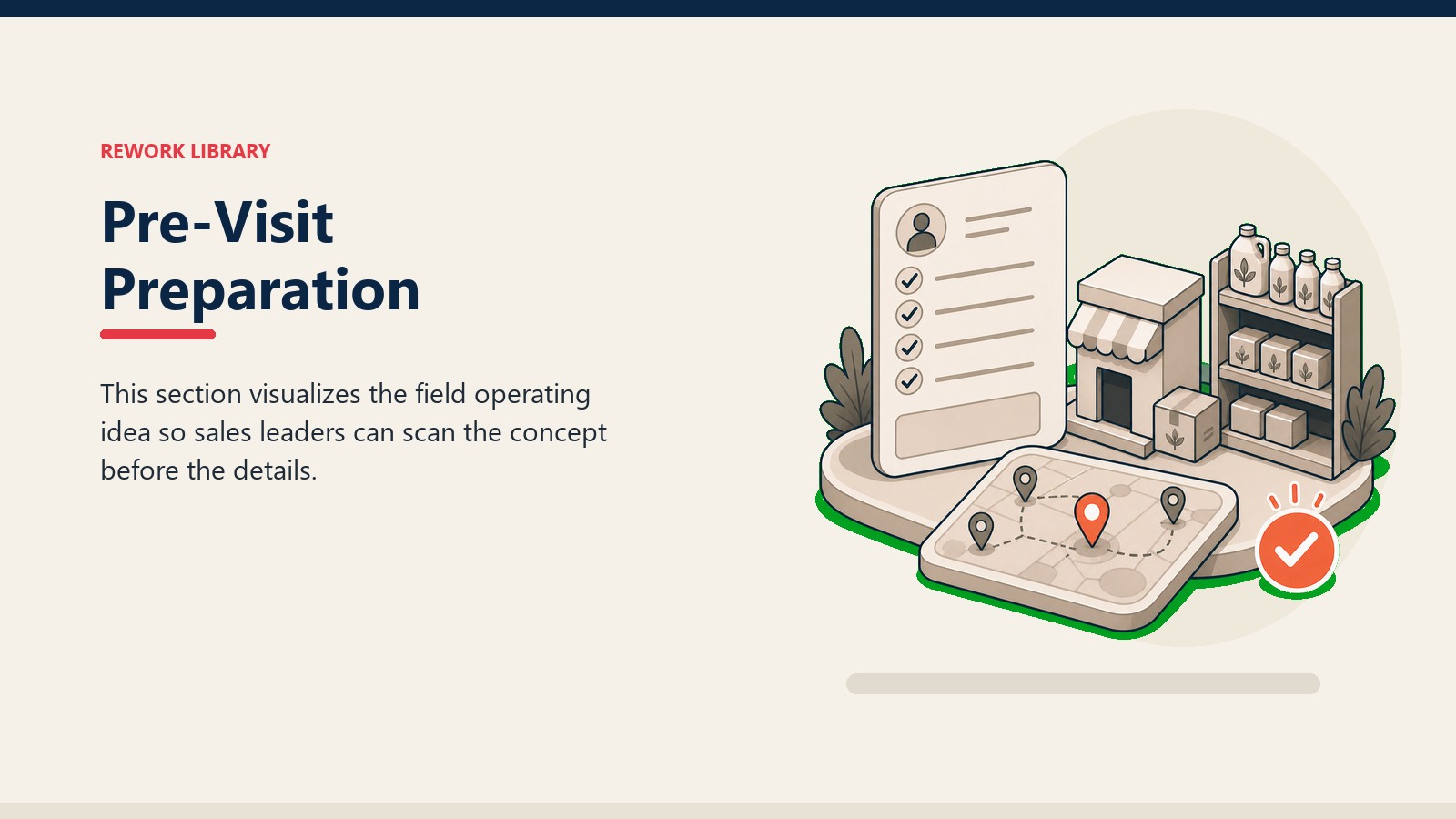
Last visit notes and open commitments: What did you promise at the previous visit? Did you commit to following up on a farmer complaint? Did you agree to get the dealer information on the extended payment terms? Open commitments left unaddressed erode trust faster than almost anything else. Review your visit notes before you walk in, and address open items in the first two minutes.
Stock position estimate: You should have a rough estimate of the dealer's stock position before you arrive, based on your last visit's audit and the time elapsed. If you sold 40 units in at the last visit four weeks ago, and the seasonal sales rate in this territory is roughly 10 units per week, you're expecting about zero to ten units remaining. Your order recommendation should be sized accordingly. Arriving without this estimate means you're having the stock conversation cold. Research on agro-dealer distribution in rural markets consistently shows that stock-out risk rises sharply in thin-coverage territories, making accurate pre-visit estimates even more important for reps managing wide geographies.
Scheme or campaign message: What's the commercial message for today's visit? Is there a pre-season stocking incentive? A volume rebate that expires at month-end? A new product launch with a dealer margin benefit? Know one clear scheme message per visit. Two is acceptable. Three or more and the dealer will remember none of them.
The Beat and Journey Planning framework from pharmaceutical field sales applies directly here: visit frequency, pre-call preparation, and call objectives are the three inputs that determine dealer visit productivity at the territory level. See also Sales Ops and Field Force Alignment for the territory-level planning that feeds the individual call preparation.
The Opening Two Minutes
The opening is about rapport and commitment review, in that order. Not two minutes of pure social conversation, but a genuine human check-in followed immediately by professional accountability.
"How's business been since last week? Farmers been asking about the early rains?" One or two questions, genuine interest in the answer. Let the dealer talk for 60 to 90 seconds. You're listening for demand signals (which products are moving, which farmers are asking for what) as much as you're being social. Good reps use the opening conversation as market intelligence.
Then: "I had one open item from my last visit. I promised to check on the credit terms for orders above 100 units. Here's what I confirmed." Closing open commitments in the first two minutes signals that you're organized and that your word means something. Dealers who trust that the rep follows through on commitments become more receptive to new commitments during the sell-in.
Don't mistake a warm opening for permission to extend the social phase indefinitely. Dealers are running businesses. Their time is limited. A rep who takes 20 minutes for rapport before getting to business is a rep who's either lacking confidence in the commercial portion of the visit or who hasn't prepared for it. Both are signals the dealer reads.
Stock and Display Audit
The stock audit has two functions: it gives you the sell-in data you need to make an evidence-based order recommendation, and it gives you a reason to be physically moving through the shop, which creates natural opportunities for display observations and conversations with farmers who are present.
What to check:
| Product | Shelf units | Back-store units | Near expiry? | Display position | Competitor share of shelf |
|---|---|---|---|---|---|
| [Your Product A] | __ | __ | Y/N | Front/Middle/Back | __ % |
| [Your Product B] | __ | __ | Y/N | Front/Middle/Back | __ % |
| [Competitor Primary] | __ | __ | Y/N | Front/Middle/Back | __ % |
Count your products first, then note competitor stock levels. Don't make the audit feel like an inspection. Frame it naturally: "Let me just take a quick look at how you're stocked so I can give you a proper recommendation."
How to use the stock audit in the sell-in conversation: The audit number becomes the anchor. "You've got 12 units of Product A left. Based on the pace of sales we discussed last visit, that's probably 8 to 10 days of stock. With the pre-season demand coming in the next three weeks, I'd recommend bringing in 50 units to cover the peak. Does that make sense given what you're hearing from farmers?"
This is a specific, evidence-based recommendation. It's not "would you like to order more Product A?" It's a quantity, a rationale, and a time frame. The dealer can agree, push back with a different number, or ask questions about demand assumptions. All of those are productive commercial conversations. "We'll see how demand goes" is not a productive response, and a rep with a stock-based rationale can push back on it: "Based on your current stock position, you'd run out before the peak if you wait. What would you want to hold for safety stock before ordering?"
See Pre-Season Stocking and Liquidation for the seasonal stocking strategy that the stock audit feeds into.
How Do You Communicate Schemes So Dealers Actually Use Them?
Trade schemes are only commercially effective if the dealer can explain them to farmers. A dealer who vaguely understands the terms of a volume rebate won't actively push product to qualify for it and won't communicate the benefit to farmers considering a purchase.
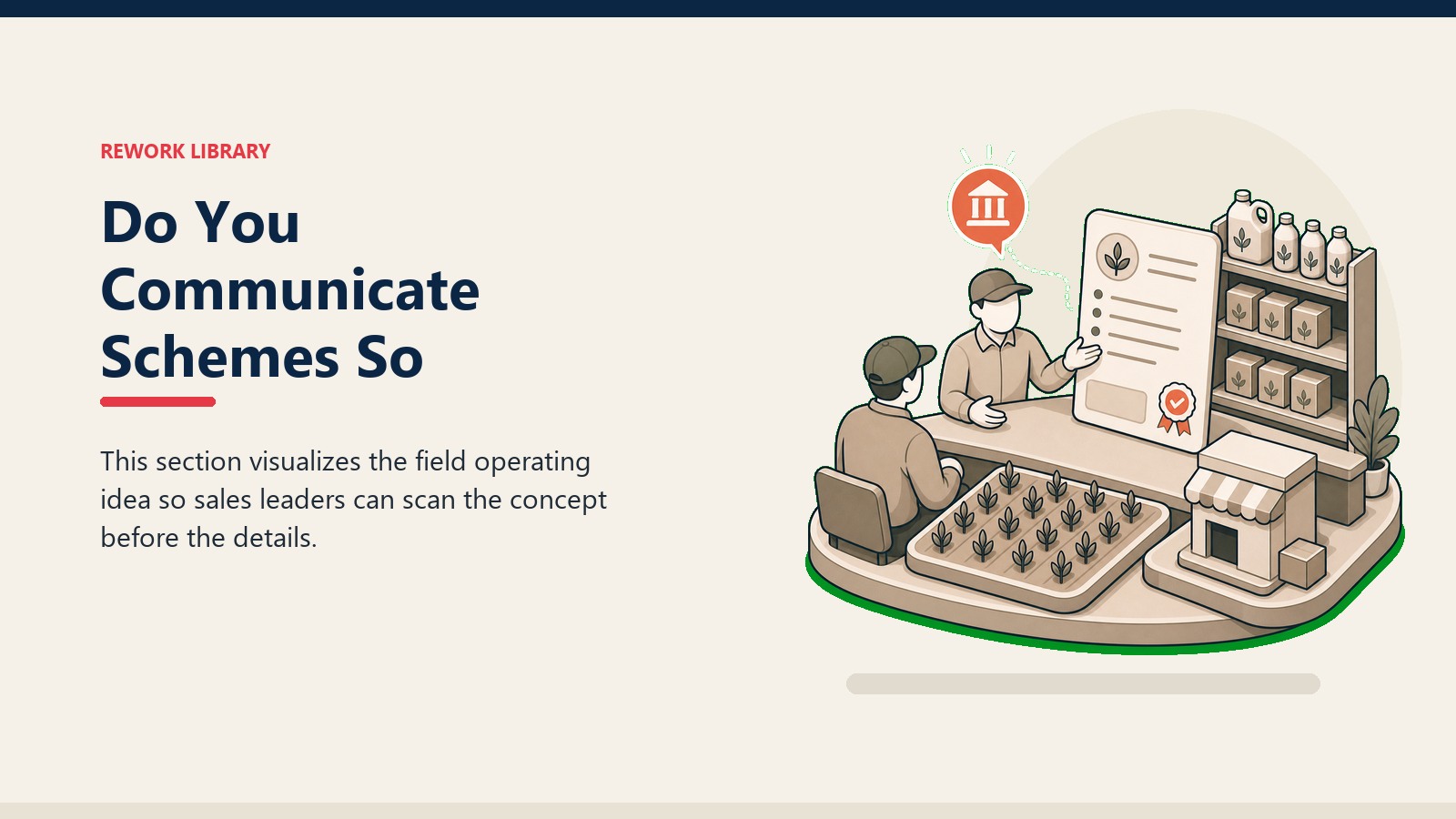
The scheme communication in a dealer visit has three parts:
State the scheme clearly. "The current scheme is: any dealer who orders 100 units or more of Product A before the 30th gets a 5% rebate on the invoice." Straightforward. No jargon about tier structures or conditional terms until you've established the basic mechanics.
Show the dealer what it means for their business. "At your normal margin, 100 units generates around Rs. 4,000 in gross margin. With the 5% rebate, that's an extra Rs. 2,000 on top. For stocking levels you'd likely hit anyway during peak season, you're essentially collecting a bonus for ordering now rather than waiting."
Give the dealer the farmer pitch. "If a farmer asks you why they should buy this week, you can tell them: the company's running a promotion on 5-kg packs, which brings the farmer price down by Rs. 50 per pack for any purchase before month-end." The dealer needs to be able to pass the benefit narrative to the farmer, or the scheme generates dealer stocking activity without actually accelerating farmer pull.
Dealers who can explain schemes fluently become active advocates for your brand because they can close farmer purchasing conversations on your behalf. IFC field programs in sub-Saharan Africa have documented the same finding: agro-dealer training and last-mile input distribution improve farmer uptake precisely because the dealer becomes the trusted local explainer, not just a stocking point. The Dealer Relationship Management framework covers how scheme communication fits into the broader dealer development strategy.
Quotable Nuggets
"Rapport without a call structure is a relationship management activity, not a sales activity." Rework Agri-Inputs Growth Library
"97% of agro-dealers in Uganda reported advising customers as their responsibility. Only 26.6% actually provided substantive advice during mystery shopping visits." Matua et al., PMC8411546. Dealers who receive regular rep visits with clear scheme communication and product training are significantly more likely to remain in the advisory-active category.
"Dealers who received structured training and last-mile distribution support improved farmer uptake precisely because the dealer became the trusted local explainer, not just a stocking point." IFC / ETG Partnership Program, Sub-Saharan Africa, 2022 (ifc.org/en/pressroom/2022/etg-and-ifc-partner). The dealer visit is the delivery mechanism for that training.
The Five-Objective Call Structure: Every dealer visit, regardless of territory or relationship stage, accomplishes five objectives in order: (1) Stock audit: count current units on hand and competitor stock before any sell-in conversation; (2) Relationship pulse: two to three minutes of genuine market intelligence gathering, not social filler; (3) Scheme update: communicate one clear commercial message the dealer can relay to farmers verbatim; (4) Sell-in: a specific quantity recommendation with a business rationale, not an open-ended "would you like to order?"; (5) Intel capture: leave with farmer demand signals and competitor activity notes logged before driving to the next outlet. All five in 25 minutes is the operational target.
The Sell-In Conversation
The sell-in is where commercial outcomes are determined. Everything before it (the audit, the relationship pulse, the scheme communication) has been setting it up.
A strong sell-in has three components: a specific recommendation, a business rationale, and an ask that invites a decision.
Specific recommendation: "I'd recommend 50 units of Product A and 20 units of Product B this week." Not "would you like to order?" Not "how much would you like?" A number. If the dealer pushes back on the quantity, you have a negotiation. If you don't give a number, you don't have a starting point.
Business rationale: "You're at 12 units of Product A, which is 8-10 days of stock at your current sales pace. With the peak demand for wheat treatment coming in the next three weeks, and the scheme running until end of month, bringing in 50 now covers your peak without overloading on inventory." The rationale connects the audit data, the seasonal calendar, and the scheme to a logical conclusion.
The ask: "Can we put through an order for those quantities today, or would you prefer to split it into two deliveries?" A binary close. Both options move toward yes. "Can we order today?" is a yes/no question where "no" stops the conversation. A choice close keeps the negotiation in a productive frame.
Handling the most common objections:
| Objection | What it usually means | Response approach |
|---|---|---|
| "Sales are slow right now" | Uncertain demand outlook, worried about stock risk | "I understand. Farmers are making decisions later this season. But when demand comes, it typically comes quickly. What stock level would make you comfortable for a 15-day demand surge?" |
| "Your price is higher than [competitor]" | Margin pressure, or using price as a negotiating opening | "The price difference is Rs. 30 per unit. The scheme running until end of month recovers Rs. 50 per unit on orders above 100 units. On net, you're ahead compared to the competitor price without a scheme." |
| "I'm already stocked from last time" | Either genuinely over-stocked or doesn't want to commit | Walk the back store and count together. If genuinely over-stocked, agree on a smaller order to maintain availability without overloading. If the number is lower than claimed, use the count as the conversation anchor. |
| "Let me wait and see demand this week" | Wants more certainty before committing | "That makes sense. I'll come back [specific day] to check where you're at. If demand moves this week, do you want me to confirm stock availability now so you're not waiting when you need to order?" |
See Agri Objection Handling for the full objection framework and the Objection Handling Framework for the general sales parallel.
Closing the Visit
The visit closes with three things confirmed: the next order, a follow-up commitment, and a visit note captured.
Confirmed next order: If you got the order, confirm delivery date and quantity. "So that's 50 units of A and 20 of B. I'll confirm delivery for Thursday morning." If you didn't get the order, confirm the specific condition and the specific next step. "You want to check demand this week. I'll be back Wednesday. If you've seen three to four farmer inquiries by then, does that give you enough signal to place an order?" A specific condition and a specific date.
Follow-up commitment: What are you doing before the next visit that advances the dealer relationship or the category? Sending a WhatsApp message with farmer field-day attendance numbers. Following up with the area manager on the credit query. Confirming the delivery timeline with logistics. State the commitment out loud before you leave and record it in your visit notes.
Visit note capture: Do this in the car, not two hours later. Capture: stock counts (your products and key competitors), order placed (or reason not placed and next step), key intel from the relationship pulse conversation, open commitments for next visit. The Field Reporting and Demo Tracking system is where these notes feed back into territory analytics.
Visit note template:
| Element | What to capture |
|---|---|
| Date and visit time | |
| Stock on hand (your SKUs) | Units per product |
| Competitor stock observed | Brand and approx. units |
| Order placed | SKU, quantity, delivery date |
| Reason for no order (if applicable) | |
| Key intel (farmer demand signals, competitor activity, pricing talk) | |
| Open commitments for next visit | |
| Next visit date confirmed |
Five minutes to fill. Worth far more than that in territory planning accuracy.
The Perfect Store Call Steps framework from FMCG distribution provides a useful structural comparison: the call objective hierarchy, the audit-to-sell-in transition, and the closing discipline are identical in concept, even though the product category and dealer type differ.
Conclusion: A Structured Dealer Visit Takes 25 Minutes and Generates Twice the Off-Take of an Unstructured Hour
The rep who spent 40 minutes talking and left without an order wasn't failing because he had a bad relationship. He was failing because a good relationship without a call structure doesn't generate commercial outcomes. Dealers like reps who are organized, who come prepared, who know their stock position, who have a clear scheme message, and who ask for a specific order. They don't place orders with reps out of friendship. They place orders because the rep made a clear case and asked for a decision.
The five-objective call structure is the mechanism that turns a good relationship into consistent commercial output. It doesn't take longer. It takes discipline. And it produces results you can measure: order frequency, average order size, secondary sales velocity, and dealer advocacy at the point of farmer purchase.
Territory managers who want to diagnose underperforming reps should ride with them for a dealer visit day and observe call structure, not just relationship quality. A rep who's warm with dealers but doesn't complete the audit or make a specific order recommendation will underperform regardless of how much everyone in the territory likes him. The structure is the thing.
Learn More

Senior Implementation Consultant
On this page
- The Five Objectives of Every Dealer Visit
- Pre-Visit Preparation
- The Opening Two Minutes
- Stock and Display Audit
- How Do You Communicate Schemes So Dealers Actually Use Them?
- Quotable Nuggets
- The Sell-In Conversation
- Closing the Visit
- Conclusion: A Structured Dealer Visit Takes 25 Minutes and Generates Twice the Off-Take of an Unstructured Hour
- Learn More