Incentives and Seasonal Target Setting: Motivating Agri-Input Field Teams Across Compressed Selling Windows
Turn this article into takeaways for your work.


Each assistant summarizes the article only for you and suggests best practices for your work.
A field rep selling corn herbicides in Iowa has about five weeks to move volume. Miss that window and no amount of hustle in July recovers the loss. The crop is already in the ground. Yet most agri-input companies run annual quota plans built for businesses where demand spreads across twelve months. The result is predictable: reps spend the first half of the year watching the calendar, sprint through an eight-week window under enormous pressure, then coast through autumn wondering what the bonus structure is even measuring.
Flat annual quotas don't just fail to motivate in seasonal businesses. They actively distort behavior, pushing channel stuffing during selling windows and creating dead weight in the off-season.
Fixing this means building incentive structures that match the crop calendar, reward secondary sell-through to farmers over primary loading into dealers, and give territory managers the data to set targets that are ambitious without being arbitrary.
The Seasonal Reality: When Agri-Input Selling Windows Compress
The crop calendar doesn't care about your fiscal year. In India's cotton belt, the Kharif window for insecticides and plant growth regulators opens in May and closes before July's monsoon arrives. In the Rabi cycle, wheat fungicides and micronutrients move in October and November. A rep working the Punjab or Haryana market is effectively running two separate selling seasons per year, each five to eight weeks long, with planning and logistics work filling the gap between them. FAO's Crop Calendar tool documents planting and harvesting windows across more than 100 crops in over 50 countries, and the same compressed seasonal logic makes flat annual quotas unworkable everywhere.
The US Midwest follows a similarly compressed pattern. Corn pre-emergent herbicide sales peak in April and May, immediately before planting. A single late frost that delays planting by two weeks compresses the selling window further. A field rep covering southern Minnesota might move 70 percent of her herbicide volume in a 30-day stretch.
Given this reality, the incentive architecture needs to map onto three distinct phases rather than a single annual arc. The next section explains how to build those targets from the ground up, starting with territory-level data instead of a national growth rate.
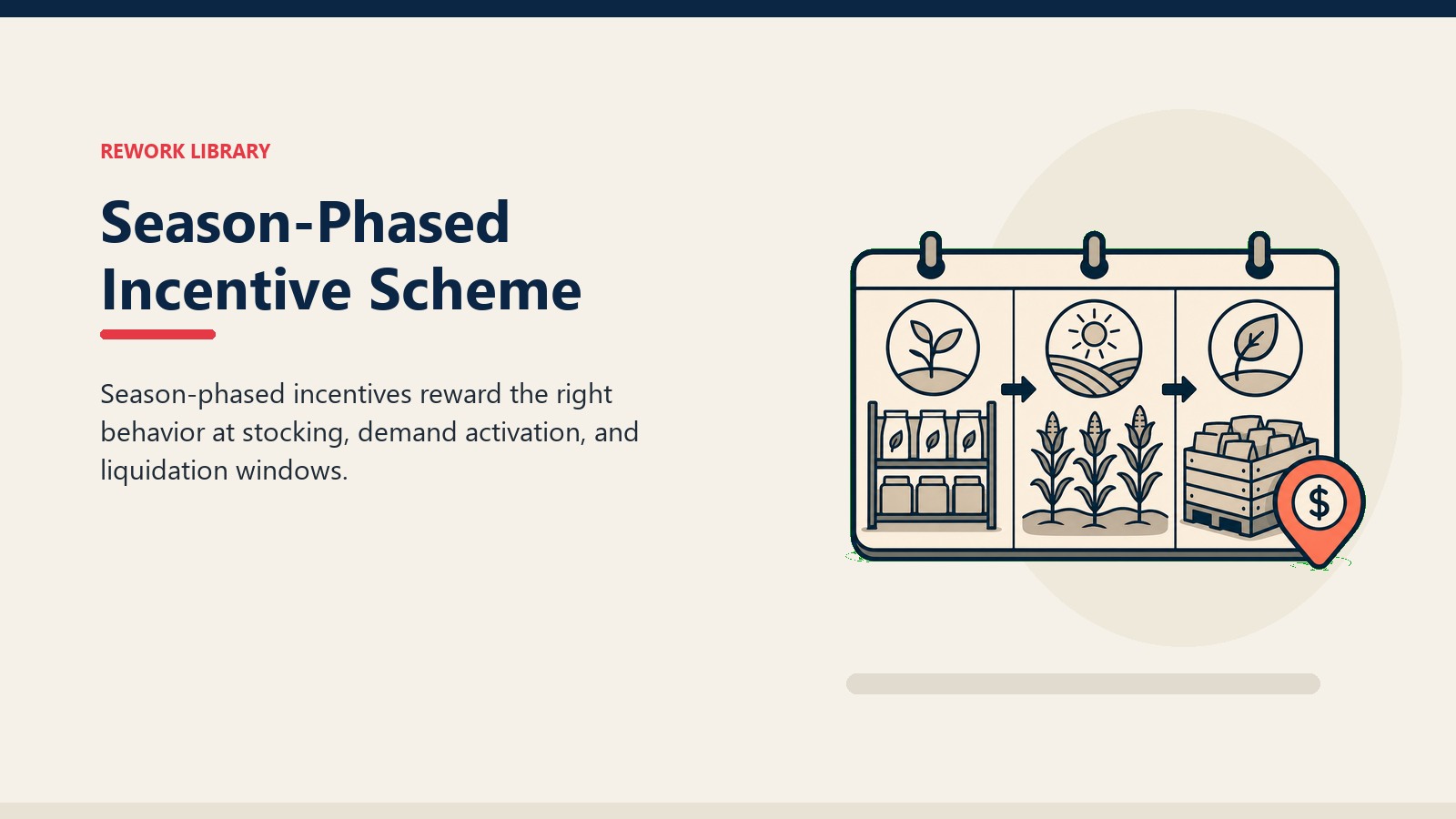
Pre-season stocking phase. This is when dealers and distributors take on inventory ahead of farmer demand. Activity metrics matter most here: dealer visits completed, credit terms negotiated, display placements confirmed, demo plots arranged. Outcome metrics are premature because farmer offtake hasn't begun.
In-season pull-through phase. The selling window is open. Farmer-level sales, demo conversion rates, and secondary offtake data become the primary scorecard. This is when the outcome-based portion of the incentive plan should carry the most weight, and when management attention on daily sell-through data pays dividends.
Post-season liquidation phase. Unsold inventory in the channel needs to move before it expires or gets returned. A World Bank analysis of African fertilizer markets shows how inefficient distribution networks and information gaps cause agri-input channel distortions that compound across seasons, the same structural risks that clawback provisions are designed to prevent. Reps managing pre-season stocking and liquidation effectively during this phase protect next season's dealer relationships and the company's working capital position. Partial liquidation bonuses and return-prevention metrics belong here.
Key Facts: Seasonal Incentive Design
- Sales reps across industries spend only 28% of their working week on active selling, with the remainder lost to admin, reporting, and non-selling work, according to Salesforce's State of Sales research. In compressed agri-input selling seasons, this ratio makes every admin hour disproportionately costly.
- Demonstration plots with structured outcome tracking increase the probability of farmers purchasing improved agricultural inputs by 13 to 17 percentage points, per a peer-reviewed study published in PLOS ONE (Sseguya et al., 2021, Tanzania). This finding underscores why activity incentives tied to demo plot completion matter during the pre-season phase.
- As a rough planning benchmark in South and Southeast Asian agri-input markets, 55 to 70 percent of annual seed and crop protection revenue typically books within a single 6 to 10 week primary selling window per season. This estimate reflects practitioner experience rather than a published study, and the exact share varies by crop category and geography.
Building a Bottom-Up Target Framework
The fastest way to destroy trust in a target-setting process is to apply a national growth rate uniformly across every territory. A rep who covered a district hit by drought last season gets a 15 percent growth target layered on top of an already depressed base. A rep in a district that expanded its irrigated area gets the same 15 percent target, which amounts to a massive underestimate. Both reps end up either sandbagging or checking out.
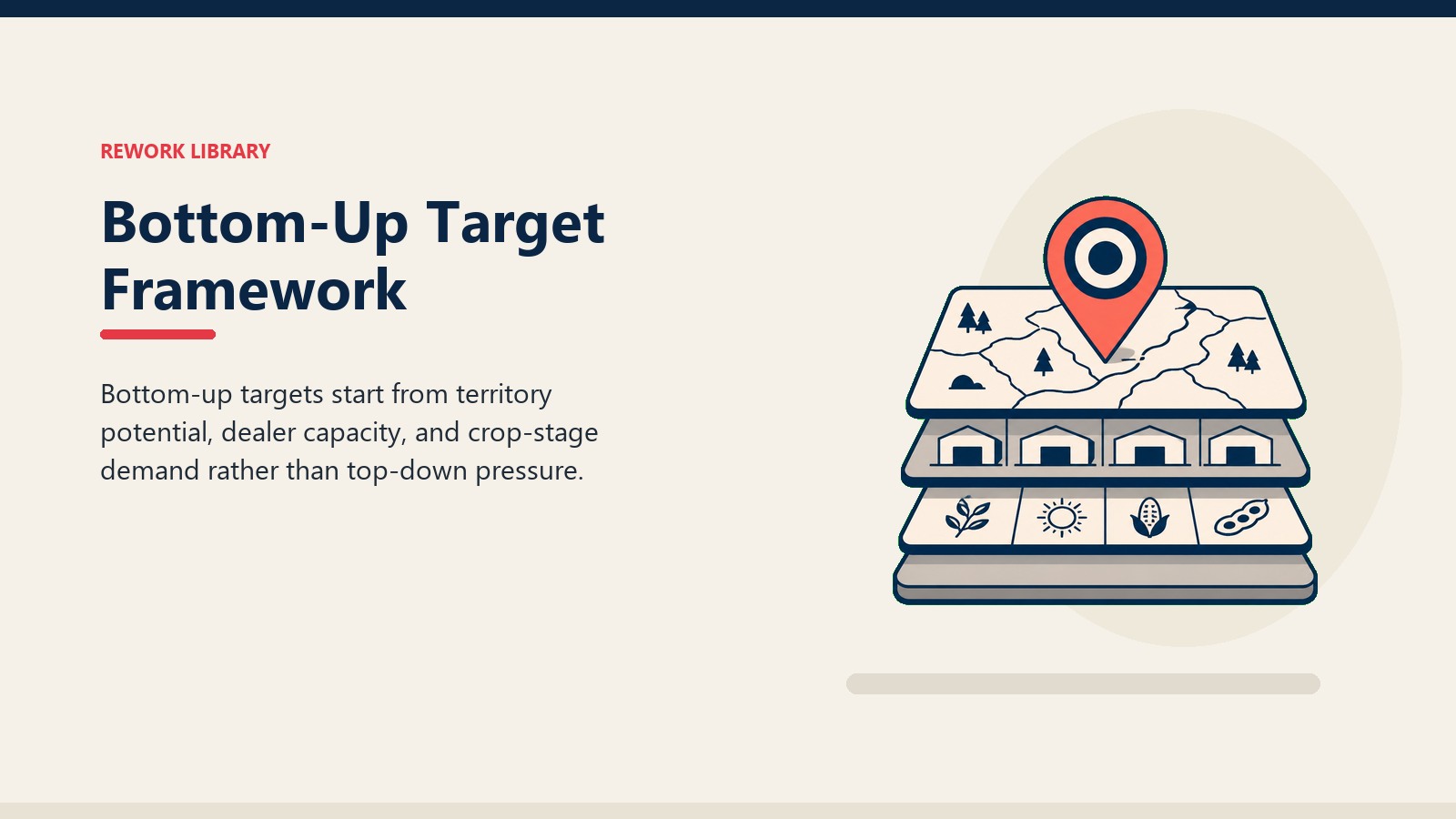
Bottom-up target setting starts with territory-level potential data: cropped area under the relevant crops, historical offtake from dealer-level secondary sales data, and competitive presence by input category. This is the same data foundation used for field force sizing and deployment decisions, which makes coordination between those two planning processes worthwhile.
Targets should then be adjusted for three factors that shift the baseline.
New product launches add demand that didn't exist in the prior year. A new-to-market fungicide for wheat blast shouldn't share the same growth rate as a mature insecticide where the category is already penetrated. Assign incremental targets separately and attribute them to the launch contribution.
Expanded geography captures newly assigned territories or towns. A rep who inherited two additional mandis from a colleague who left doesn't have a clean historical base to anchor targets. Use regional averages for those incremental areas, not the full territory's historical rate.
Fairness calibration is the hardest part. Legacy territories with established dealer networks and high penetration grow more slowly than greenfield territories where even basic distribution is being built. If the incentive plan doesn't account for this, you'll consistently over-pay reps in saturated territories and under-pay reps doing the hardest developmental work. One practical fix: cap maximum payout for territories that exceed a defined penetration threshold, and set a higher payout multiplier for greenfield territories that reach 80 percent of a lower absolute target. With the target inputs settled, the next design question is how to structure the payout mechanism itself across each season phase.
Target-Setting Input Checklist
| Input | Source | Notes |
|---|---|---|
| Cropped area by target crop | State agriculture department data, satellite acreage estimates | Update annually before season planning |
| Historical primary sales by territory | ERP or distributor billing data | 3-year average smooths weather anomalies |
| Historical secondary offtake | Dealer-level sell-out data, mobile POS | Key for identifying channel stuffing vs. real demand |
| Competitive market share estimates | Field intelligence, distributor surveys | Adjust potential where competitor is dominant |
| New product launch SKUs | Product management input | Add as incremental, not folded into base |
| Territory expansion or contraction | Sales ops | Prorate for partial-year territory changes |
| Agroclimatic risk factors | Weather forecasts, irrigation infrastructure changes | Adjust potential up/down for drought risk |
Season-Phased Incentive Scheme Design
A season-phased scheme replaces the single annual payout with a series of gates that mirror the selling cycle. Each gate has its own trigger condition, metric set, and payout timing. This is the architecture that keeps field reps engaged through all three phases rather than sprinting in peak season and disengaging during the transition.
Season-Phased Incentive Structure
| Phase | Duration | Gate Trigger | Primary Metrics | Payout Timing |
|---|---|---|---|---|
| Pre-season stocking | 8 to 12 weeks before crop sowing | Dealer stocking target achieved (volume and SKU range) | Dealer visits, credit placement, demo plot setup, strategic SKU stocking % | 4 weeks before season opens |
| In-season pull-through | Sowing to crop establishment | Secondary sell-out milestones (50%, 80% of target) | Farmer-level sell-out volume, new farmer conversions, strategic SKU pull-through | Rolling, at each milestone reached |
| End-of-season settlement | 6 weeks post-season | Final secondary offtake vs. target | Seasonal sell-through %, returns rate, outstanding dealer credit | 8 weeks after season close |
Product mix riders add a layer on top of the phase structure. If a company is pushing an integrated pest management portfolio or a new-generation systemic insecticide, it can attach an additional percentage bonus to reps who achieve defined thresholds of that SKU in the channel and in farmer hands. This prevents reps from hitting overall volume targets entirely on commodity products while ignoring the strategic portfolio, which is a distortion that harms long-term category margins.
Dealer expansion bonuses work similarly. If a territory has 40 active dealers but the potential supports 60, a rep who activates 8 new dealers during the season earns an incremental award. Running this alongside dealer loyalty and incentive programs aligns what the company rewards the rep for with what it rewards the dealer for.
Clawback provisions are non-negotiable in high-return categories like seeds and crop protection. A rep who ships product that comes back as returns shouldn't keep the primary-sales bonus attributed to that volume. Clean clawback language, applied at the end-of-season settlement, also eliminates the incentive for pushing product into dealers who can't move it. It's the structural enforcement of the principle that only sell-through to farmers counts.
How Should You Balance Activity and Outcome Incentives in Agri-Input Sales?
The tension between activity and outcome incentives is real in every field sales context, but it's particularly acute in agri-inputs because the outcome window is so short and so dependent on factors outside the rep's control: weather, pest pressure, competing crop prices. A rep who did everything right but saw her district get three weeks of unseasonal rain during the sowing window shouldn't tank her annual incentive because nature intervened.
Activity vs. Outcome Incentive Comparison
| Dimension | Activity-Based Incentives | Outcome-Based Incentives |
|---|---|---|
| What it rewards | Behaviors and effort: visits, demos, placements, outreach | Results: volume sold, sell-through to farmer, new accounts |
| When to use | Pre-season, developmental territories, new product launches | In-season peak, established territories, mature products |
| Key risk | Rewarding effort without results; high cost, low accountability | Penalizes reps for external factors (weather, input prices); demotivates in bad seasons |
| Agri-input examples | Demo plot setup count, new dealer activations, business development center (BDC) visits completed | Secondary sell-out volume, farmer conversion rate, share of wallet at key dealers |
The practical calibration shifts through the season. Pre-season, 60 to 70 percent of the bonus opportunity should sit on activity metrics because outcomes are premature. During the in-season pull-through phase, flip that ratio: 60 to 70 percent on outcome metrics, with the remainder on sustaining key activities like farmer meetings and demo follow-ups. Post-season, the settlement is almost entirely outcome-based, anchored to final sell-through and returns rates.
Don't try to hold the same ratio all year. A flat 50/50 activity-outcome split applied uniformly across all phases sends conflicting signals. Pre-season, it under-incentivizes the preparation work that determines peak-season success. Post-season, it over-incentivizes activity that doesn't translate to results when the selling window has closed. Reviewing your agri sales KPIs and metrics framework before setting the ratios each season ensures the tracked metrics are actually available and clean enough to pay on.
Non-Cash Recognition That Sustains Mid-Season Momentum
Mid-season is when burn-out risk peaks. The pre-season preparation work is done. The first flush of farmer demand has hit. The rep is running on five hours of sleep and trying to cover 15 to 20 towns in a fortnight. Cash payouts are still weeks away. This is when non-cash recognition does work that financial incentives can't.
In-season leaderboards published weekly, with territory-level and cluster-level standings, tap into peer visibility as a motivator. Field reps in agricultural markets often have strong professional identity tied to being known as the person who runs the best territory. A leaderboard that their regional manager and peers see doesn't just reward the leader: it pulls the second and third-ranked reps forward through competitive pressure.
Daily or weekly recognition calls from the regional sales manager (RSM) or territory manager, specifically calling out activities rather than just results, sustain engagement during stretches where the outcome numbers haven't moved yet. Recognizing a rep for completing 18 farmer group meetings in a week costs nothing and reinforces the behaviors that will drive end-of-season sell-through.
Annual conventions and top-performer programs should be structured around in-season achievement, not just full-year outcomes. A rep who delivered 130 percent of secondary sell-through in the peak window, then had a weak post-season because of flooding in her district, deserves recognition at the annual event. Weighting convention qualification toward peak-season performance also ensures the event rewards the reps who matter most during the critical window. Even the best recognition programs, though, can't compensate for a structurally broken incentive design. The next section names the failure modes that show up most often.
Incentive plans that reward demo plot completion and structured outcome capture are investing in one of the highest-yield conversion activities available to an agri-input field team. Peer-reviewed evidence from Tanzania puts the farmer purchase lift from structured demonstrations at 13 to 17 percentage points. That makes demo activity a metric worth paying on, not just tracking.
Common Failure Modes in Agri-Input Incentive Design
Failure Mode Diagnostic
| Symptom | Root Cause | Fix |
|---|---|---|
| High primary sales, high returns at season end | Incentive pays on primary loading, not sell-through; reps push product into dealers who can't move it | Add clawback on returns; shift 40%+ of bonus to secondary sell-through metric |
| Rep disengagement in Q1 and Q4 | Annual quota feels irrelevant in off-season months; reward feels too distant | Introduce phase gates with payouts timed to season close, not calendar quarter |
| Star reps leaving after bonus season | Payout timing falls well after season close; reps don't see connection between effort and reward | Compress settlement timeline to 6 to 8 weeks post-season; add in-season milestone payments |
| Greenfield reps consistently miss targets | National growth rate applied to underdeveloped territories without penetration adjustment | Build territory potential model; set lower absolute targets with higher payout multipliers for greenfield |
| Product mix skewed to commodity SKUs | Mix riders absent; reps hit overall targets on mature volume | Add strategic SKU achievement gate as prerequisite for top-tier bonus tier |
| Incentive budget overrun in good years | No cap on payout in windfall territories; weather creates outsized outcomes | Set payout caps at 150 to 180% of target for weather-driven upside territories |
Tracking liquidation and secondary sales tracking data accurately is the prerequisite for avoiding most of these failure modes. You can't pay on sell-through you can't measure. Research on agro-input dealer behavior in Uganda confirms how disconnected dealer reporting (only a fraction provided actual advisory records despite claiming responsibility) mirrors the secondary data gaps that undermine incentive accuracy across developing markets. Companies that invest in dealer-level POS data collection, even through simple mobile-based daily reporting, unlock the metric that makes season-phased incentives actually work.
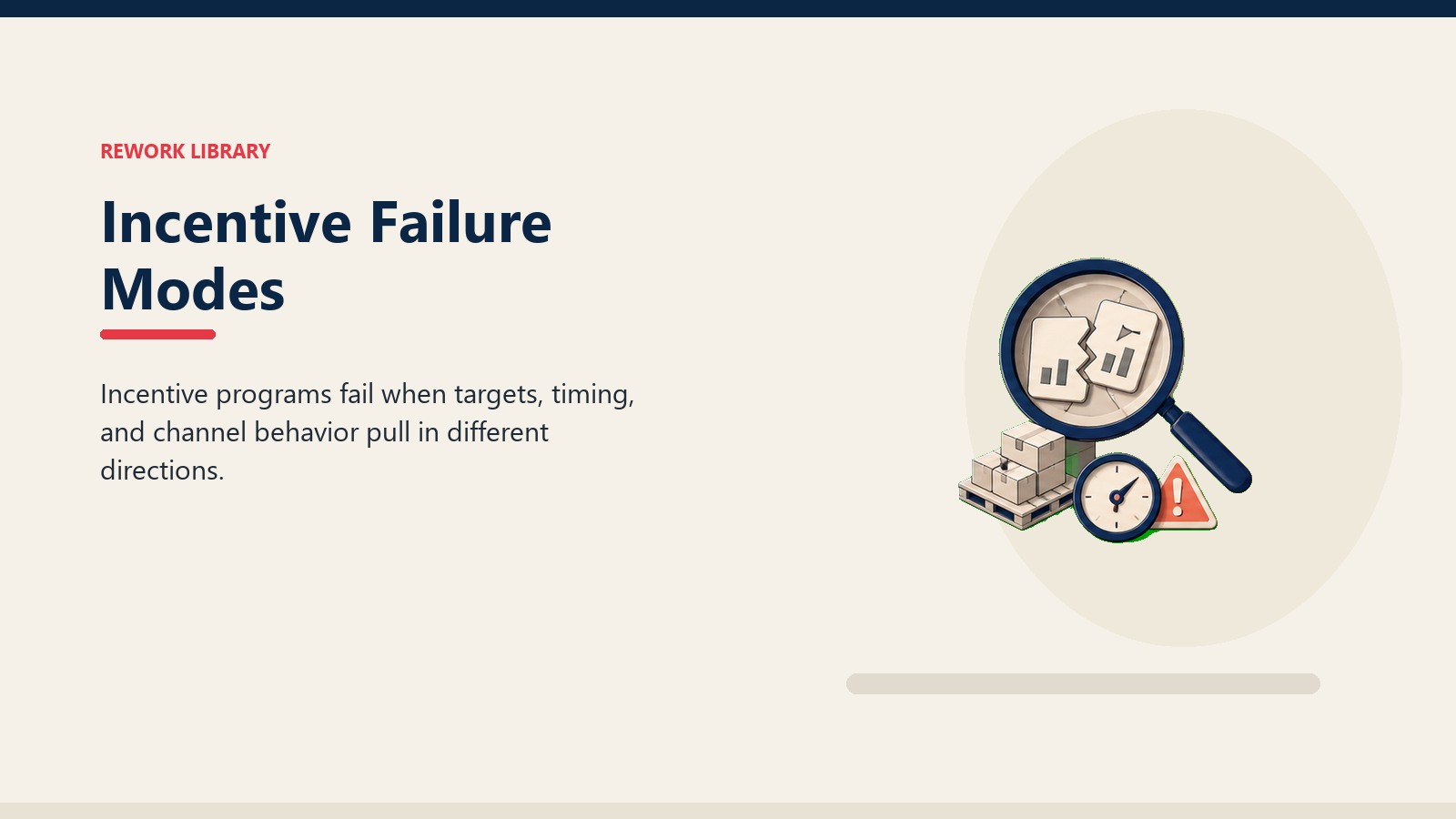
In a 6 to 10 week agri-input selling window, admin burden is not a background inefficiency. It is a seasonal business risk. Incentive structures that front-load activity rewards before the window opens, rewarding call planning, dealer visits, and demo plot setup during the pre-season phase, directly offset the time that would otherwise go to reporting and non-selling tasks.
Frequently Asked Questions about Incentives and Seasonal Target Setting
How should we handle incentive design when a new product is being launched mid-season?
Treat launch incentives as a separate overlay, not folded into the base quota. Set a standalone launch target expressed in trial plots, new farmer users, or initial offtake volume, then pay it through a separate scheme with its own payout timing. This prevents launch performance from being drowned out in the base quota calculation and lets the company evaluate the launch's true commercial traction independent of the mature business.
What's the right approach when secondary sell-out data is incomplete or unreliable?
Start with the best proxy available: distributor dispatch data minus estimated returns, combined with mobile reporting from the rep's own dealer visits. It won't be perfect, but it's directionally better than paying purely on primary. As data systems improve, shift the weighting of the secondary metric upward. Running parallel primary and secondary scorecards for one season, without paying on the secondary metric, also builds rep trust in the data before it becomes part of their compensation.
How do we prevent reps from gaming the leaderboard through selective reporting?
Cross-validate leaderboard inputs with distributor billing data and spot audits. Reps who know field managers conduct periodic dealer verification visits are far less likely to inflate activity counts. Also, structure the leaderboard so that secondary outcomes, which are harder to fake than visit counts, carry significant weight in the ranking.
Should we use the same incentive structure for all rep seniority levels?
The phase structure and metrics should be the same, but the absolute targets and the ratio of fixed-to-variable pay should differ. Senior reps with large, established territories can carry a higher variable ratio because their income history makes variable income more predictable. Newer reps with developmental territories need a higher base with a smaller but achievable variable component during their first two seasons.
How often should we refresh the incentive scheme?
Refresh the phase structure annually at a minimum, before each crop calendar planning cycle. But don't change the fundamental architecture every year: reps who understand the scheme deeply perform better within it. What should change year to year is the target inputs, the strategic SKU list, and any new dealer expansion objectives. Major structural changes belong in a new season, not mid-season.
Learn More

Senior Implementation Consultant
On this page
- The Seasonal Reality: When Agri-Input Selling Windows Compress
- Building a Bottom-Up Target Framework
- Season-Phased Incentive Scheme Design
- How Should You Balance Activity and Outcome Incentives in Agri-Input Sales?
- Non-Cash Recognition That Sustains Mid-Season Momentum
- Common Failure Modes in Agri-Input Incentive Design
- Learn More