Selling Precision Ag and Drone Spray Services to Farmers and Dealers
Turn this article into takeaways for your work.


Each assistant summarizes the article only for you and suggests best practices for your work.
An agri-input company in Punjab added drone spraying as a service line, expecting the same reps who sold crop protection products to simply add the service to their pitch. Six months in, uptake was flat. The reps were describing the drone the way they described a new fungicide: faster application, better coverage, lower labor cost. Farmers nodded politely and kept using their knapsack sprayers and hired labor.
What changed the trajectory wasn't a better drone or a lower price. It was a shift in what the reps were actually selling. Instead of leading with the machine, they led with a live demonstration on a neighbor's field. They timed it to a specific pest pressure window. The farmer stood at the field edge and watched the drone work in real time. Adoption in that territory tripled over the following season.
The lesson generalizes beyond drones: precision ag services are not a product line sold the way inputs are sold. They're a trust-and-proof sale, closer to selling a new agronomic practice than selling a new SKU, and companies that staff and train for that difference outperform those that don't.
Why Precision Ag Services Sell Differently Than Physical Inputs
A bag of fertilizer or a bottle of insecticide is a known category. A farmer has bought fertilizer his whole life; the decision is which brand, which formulation, which price. A drone spray service, a soil-mapping subscription, or a variable-rate application program asks the farmer to change how a task gets done, not just which product does it. That's a fundamentally harder decision, and it triggers different psychology.
What makes the precision ag sale different:
| Factor | Traditional Input Sale | Precision Ag Service Sale |
|---|---|---|
| Category familiarity | High, farmer has bought the category before | Low to moderate, category is new or unfamiliar |
| Decision reversibility | Low stakes, easy to switch next season | Higher stakes, involves changing an established practice |
| Trust requirement | Product trust (does it work) | Provider trust (will the operator do this correctly) plus product trust |
| Evidence needed | Efficacy comparison | Visual proof of execution quality, not just outcome |
| Who influences the decision | Farmer, sometimes dealer | Farmer, progressive neighbor, sometimes an agronomist or KOL |
| Sales cycle | Can be same-visit | Usually multi-touch, starts with awareness, ends with a booked service slot |
Reps who don't understand this difference apply the wrong pace and the wrong proof points, and the service line stalls exactly the way it did in that Punjab territory before the reset.
Key Facts: Precision Ag and Drone Adoption
- India's Sub-Mission on Agricultural Mechanization funds drone purchase grants of up to 75-80% of project cost for Farmer Producer Organizations and Cooperative Societies, with a lower 40-50% grant tier for Custom Hiring Centers, a deliberate policy push to route drone ownership through shared institutional channels rather than individual farmers. (Source: Press Information Bureau, Government of India, "Government to Promote Drone use in Agriculture")
- A peer-reviewed review of unmanned aerial spraying systems found operating efficiency has climbed from 2-3 hectares an hour to 15-20 hectares an hour within a few years, cutting exploitation cost by shortening application time and reducing the volume of crop protection product applied. (Source: Characteristics of Unmanned Aerial Spraying Systems and Related Spray Drift: A Review, PMC)
- FAO guidance on precision agriculture for smallholder farmers notes that cost, digital skills gaps, and thin rural infrastructure keep ownership-based adoption low, and that service-based delivery models are what actually get these technologies into smallholder fields at scale. (Source: FAO, "Precision Agriculture for Smallholder Farmers")
The Awareness-to-Booking Funnel for a New Service Category
Because precision ag services are a new category for most farmers, the sales funnel has an extra stage that physical input sales usually skip: category awareness before product consideration even begins.
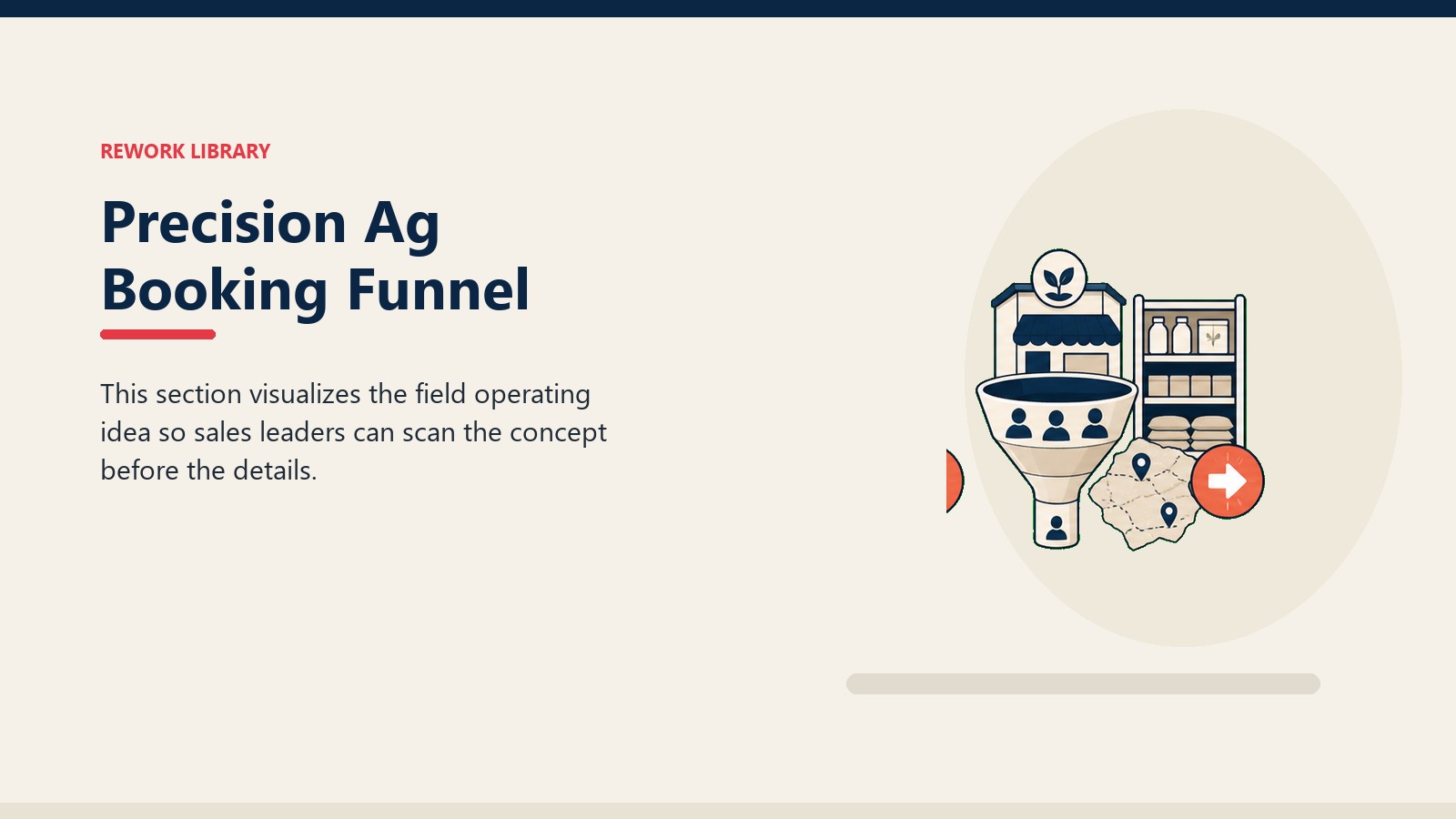
The Trust-Before-Trial Funnel names that extra stage explicitly, four steps that move a farmer from never having heard of the service to booking it a second time on their own initiative:
- Category awareness. The farmer needs to understand that drone spraying or soil mapping exists as an option at all, and roughly what problem it solves. This happens through farmer meetings, demo events, and word of mouth from early adopters, not through a one-on-one sales pitch.
- Credibility building. The farmer needs to believe the specific provider (your company, your operator) can execute reliably. This is where a live demonstration, not a brochure, does the heavy lifting.
- Trial commitment. The farmer agrees to try the service on a limited area, usually the same acreage logic used in Demo Plot Demand Generation: small enough to feel low-risk, large enough to be a meaningful test.
- Repeat booking and referral. A farmer who had a good first experience becomes a repeat customer and, more valuably, a reference point for neighbors who were watching the trial from the field edge.
Skipping stage one and two, and jumping straight to asking for a paid booking, is the most common reason precision ag services underperform in a new territory. The rep who tries to close a booking on the first mention of the service is applying an input-sale cadence to a service-sale problem.
Running a Drone Demo That Actually Converts
A drone demonstration is not a spectacle. Farmers who've seen a drone fly and spray once are curious, not sold. What converts is a demonstration built around answering the specific questions a farmer has about reliability, coverage, and cost, not just showing that the technology works.
Drone demo planning checklist:
- Choose a field with visible, relevant pest or disease pressure, not just any available plot; an demo on a healthy crop with no visible problem doesn't create urgency
- Invite a mix of the host farmer's immediate neighbors and a few progressive farmers from slightly further out who are known to influence others
- Have the operator explain, in plain terms, coverage width, flight time per battery, water/chemical mixing ratio, and how drift is managed near sensitive areas like water bodies or neighboring crops
- Show, don't just tell, the time comparison: have someone with a knapsack sprayer working an adjacent section at the same time so farmers see the pace difference directly
- Address the labor-cost question directly, since labor scarcity and cost is usually the real driver, more than the technology itself
- Collect names and contact details of farmers who show genuine interest, and follow up within 48 hours while the demo is still fresh in their mind
- Follow up 10 to 14 days later with a visible field comparison (treated vs. untreated, or drone-treated vs. manually-treated) so the outcome, not just the process, gets reinforced
Objection-to-response table for the drone demo conversation:
| Farmer Objection | Underlying Concern | Response Approach |
|---|---|---|
| "How do I know the coverage is even, not just fast?" | Fear of missed spots and reduced efficacy | Show the flight pattern on the operator's app, and point to the treated-vs-untreated comparison from a prior booking in the area |
| "What if it drifts onto my neighbor's field?" | Liability and relationship risk with adjacent farmers | Explain buffer zones, wind-speed cutoffs the operator follows, and any insurance or guarantee the service includes |
| "This seems expensive for a small farm" | Per-acre cost comparison against manual labor they already have | Break down the per-acre cost against current labor cost and time, and mention any Farmer Producer Organization (FPO) or cooperative booking option that reduces per-farmer cost |
| "I've never used this, I don't trust it yet" | General unfamiliarity with an unproven category | Offer a small trial area first, at a lower price point if needed, rather than asking for full-field commitment |
| "Will this work for my crop specifically?" | Doubt about crop-specific applicability | Reference or arrange a local demo on the same crop type and growth stage, not a generic company case study from elsewhere |
Positioning Precision Ag Services with Dealers and FPOs
Individual farmer sales are only part of the precision ag services growth path. Dealers and FPOs are often the more efficient channel, because they can aggregate demand across many small farmers into bookable service volume.
Working with dealers as service booking agents. A dealer who understands the service well enough to describe it credibly at the counter, and who has a simple way to take a booking or interest signal, extends your reach far beyond what a limited number of drone operators can cover directly. This requires the same trust-building foundation used across the channel, covered in Dealer Relationship Management: a dealer who trusts the company's core input business will extend that trust to a new service line faster than one with a thin relationship.
Working with FPOs and cooperatives for aggregated bookings. An FPO or farmer cooperative that books drone spraying for its member base in a single coordinated session solves two problems at once: it lowers the per-farmer cost through aggregation, and it gives individual smallholders social proof from peers in the same cooperative. This channel is worth developing specifically because FPOs already have the organizing structure and trust relationships needed to move a group of hesitant individual farmers toward a collective yes. See FPO and Cooperative Channel Selling for the broader playbook on selling through these aggregated buyer structures.
Precision ag channel comparison:
| Channel | Strength | Best Use Case |
|---|---|---|
| Direct farmer sale | Highest margin per booking, direct relationship | Large or progressive farmers with sufficient acreage to justify per-farmer economics |
| Dealer-booked service | Wide reach, low incremental sales cost | Smallholder-dense territories where the dealer already has trust and foot traffic |
| FPO/cooperative aggregation | Lower per-farmer cost, strong peer proof | Territories with active, well-organized FPOs and fragmented small landholdings |
| Custom Hiring Center partnership | Shared asset utilization, government-subsidized in some markets | Regions where CHCs already exist and are actively promoted by state agriculture departments |
Pricing and Packaging Precision Ag Services
Precision ag services need pricing structures that make sense to a farmer thinking in cost-per-acre or cost-per-application terms, not to a company thinking in cost-per-flight-hour or subscription-tier terms.
Common pricing structures:
- Per-acre application fee. Simplest to explain, easiest for a farmer to compare against manual labor cost. Works best for one-time or occasional spray services.
- Seasonal package. Bundles a set number of applications across the crop cycle at a discount versus per-visit pricing. Works well for progressive farmers who are already sold on the category and want predictable costing.
- Subscription with soil/crop monitoring add-on. Positions the drone or precision service as part of a broader advisory relationship, not just a spray tool. This is a higher-value, higher-trust offer that usually only lands after a farmer has already had a successful trial experience.
- Bundled with input purchase. Ties a discounted first drone application to a qualifying purchase of the company's crop protection or fertilizer products, which can accelerate trial for farmers who are already loyal input customers but haven't tried the service.
Whichever structure is used, transparency on what's included (number of passes, chemical cost separate from application fee, what happens in case of a weather delay or reschedule) prevents the kind of dispute that kills a service relationship faster than a pricing complaint about a physical product would. The pricing conversation itself works best when it's framed around the outcome the farmer is buying, not the equipment. That's the same logic behind value selling in any B2B context: a farmer comparing your per-acre fee against a neighbor's manual labor cost needs to see the full outcome, saved time, better coverage, fewer missed spots, not just a number on a rate card.
Training Reps to Sell a Service, Not Just a Product
Reps who've spent years selling physical inputs often default to input-sale habits when asked to sell a service: leading with specs, rushing to close, and treating the first "no" as a dead lead rather than a "not yet."
What reps need to unlearn and relearn:
| Old Habit (Input Selling) | New Approach (Service Selling) |
|---|---|
| Lead with product features and price | Lead with the problem the service solves and social proof from a completed demo |
| Push for a same-visit close | Expect and plan for a multi-touch cycle: awareness, demo, trial, repeat |
| Treat "not interested" as final | Treat early hesitation as a signal to follow up after a nearby demo or trial result becomes visible |
| Sell to the individual farmer only | Also sell to dealers and FPO leadership as aggregation and credibility channels |
| Measure success by immediate bookings | Measure success by demo attendance, trial conversion, and repeat-booking rate over a full season |
This mirrors a broader qualification discipline worth borrowing from adjacent sales functions: understanding where a prospect actually sits in their decision journey, rather than assuming every conversation is ready to close, which is the same thinking behind structured lead qualification frameworks used across other sales organizations.
How Do You Handle a Bad First Experience With the Service?
A drone that has a mechanical issue mid-application, a coverage gap that shows up as visible crop damage, or an operator who arrives late during a tight weather window will happen eventually. How the company responds to that first bad experience determines whether the service line survives in that territory or gets written off by word of mouth before it has a chance to build trust.
The disciplined response has three parts. First, acknowledge the problem quickly and directly with the affected farmer, without minimizing what happened. Second, make it right in a way that's visible to others watching, whether that's a free re-application, a partial refund, or direct compensation for any yield impact if it's clearly attributable to a service failure. Third, treat the incident as a training input for the operator team, and communicate that correction transparently to the dealer or FPO who referred the farmer, so the relationship recovers at the referral-source level too, not just with the individual farmer.
A bad first experience handled well often produces more durable trust than a flawless one that farmers simply take for granted, because it demonstrates that the company stands behind an unfamiliar service the way it would stand behind a defective product batch under standard product stewardship and safe use principles.
Building Precision Ag Into the Seasonal Sales Calendar
Precision ag services aren't a side project that happens whenever a drone operator has free time. They need to be planned into the same seasonal calendar that governs input sales, because the demand windows for spray services are tied to the same pest, disease, and growth-stage triggers that drive crop protection product sales.
Coordinating drone service availability with the crop calendar prevents the common failure mode where farmer interest peaks during a pest outbreak and the service has no available booking slots because scheduling wasn't planned in advance. Building this into route and territory planning connects directly to the discipline covered in Route to Market for Agri-Inputs, where service delivery capacity needs the same seasonal foresight as physical product distribution.
Learn More

Senior Implementation Consultant
On this page
- Why Precision Ag Services Sell Differently Than Physical Inputs
- The Awareness-to-Booking Funnel for a New Service Category
- Running a Drone Demo That Actually Converts
- Positioning Precision Ag Services with Dealers and FPOs
- Pricing and Packaging Precision Ag Services
- Training Reps to Sell a Service, Not Just a Product
- How Do You Handle a Bad First Experience With the Service?
- Building Precision Ag Into the Seasonal Sales Calendar
- Learn More