Agronomy-Led Product Detailing: How to Sell Agrochemicals and Seeds Through Science, Not Persuasion
Turn this article into takeaways for your work.


Each assistant summarizes the article only for you and suggests best practices for your work.
A seed company's eastern India territory had two reps with similar product portfolios and overlapping geographies. One consistently topped the region in trial conversions and reorder rates. The other ran average numbers and complained frequently about dealer margins and farmer price resistance.
When a field manager spent a week traveling with both, the difference was obvious before either rep had spoken to a single farmer. The top rep arrived at each farm with a specific problem in mind for that crop stage. He asked questions that revealed whether his hypothesis matched the farmer's actual situation. He explained why his product worked the way it did before he ever named it. The other rep opened every visit with the product name, the scheme, and the recommended rate. He was efficient and confident. He just wasn't addressing anything the farmer was worried about.
Farmers in most markets aren't difficult to sell to when they understand why a product solves their problem. They're resistant, skeptical, and price-sensitive when they don't. The difference between those two states isn't product quality or promotional value. It's the quality of the agronomic conversation that precedes the commercial ask.
The Agronomy-First Principle
Feature-benefit selling works in categories where the buyer can evaluate the outcome before purchase. Farmers can't do that with agrochemicals and seeds. They're making decisions in advance of a result they won't see for weeks or months, under weather and soil conditions they can't fully predict.
This makes trust the primary purchase driver. And trust in agri-inputs is built through demonstrated agronomic competence, not promotional generosity.
Key Facts: Agronomy-Led Detailing
- When agro-dealers in Kenya actively engaged with farmers at point of sale using product knowledge and agronomic guidance, they influenced varietal selection in 80% of cases, showing how advisory competence at the counter directly converts to purchase (source: Sticking with the old seed, PMC7307449).
- Farmer field days in India, where a rep explains a new variety on an actual demonstration farm, increased seed adoption from approximately 30% to 42% in treatment villages compared to control villages with no field day support, a 40% relative increase (source: Review of Economics and Statistics, MIT Press, 2021).
- Agronomists and extension officers are rated as the most trustworthy source of agri-input information by surveyed farmers, above neighboring farmers, sales representatives, and online sources, confirming that technical credibility is the primary lever in farmer purchase decisions (source: Agrochemicals brand preferences, ScienceDirect 2026).
A farmer who understands that a systemic fungicide works by inhibiting sterol biosynthesis in the fungal cell membrane knows why it must be applied before visible infection, why coverage matters, and why the interval between applications affects disease control. That knowledge reduces misuse, reduces complaint rates after application, and gives the farmer a technical reason to reorder rather than a promotional reason to trial. This is the same rationale behind integrated pest management as a discipline: informed, timed intervention beats blanket chemical application every time, and it depends entirely on the farmer understanding the "why."
The principle is: diagnosis first, mechanism second, product third, ask last. Every step in that sequence is necessary. Skipping the diagnosis means skipping the reason the product matters. Skipping the mechanism means the product becomes interchangeable with anything else that claims the same label benefit. These aren't steps that happen to be in a sensible order. They're the building blocks of farmer conviction. The ACE structure below makes that sequence something a rep can execute without thinking about it.
The ACE Detailing Structure
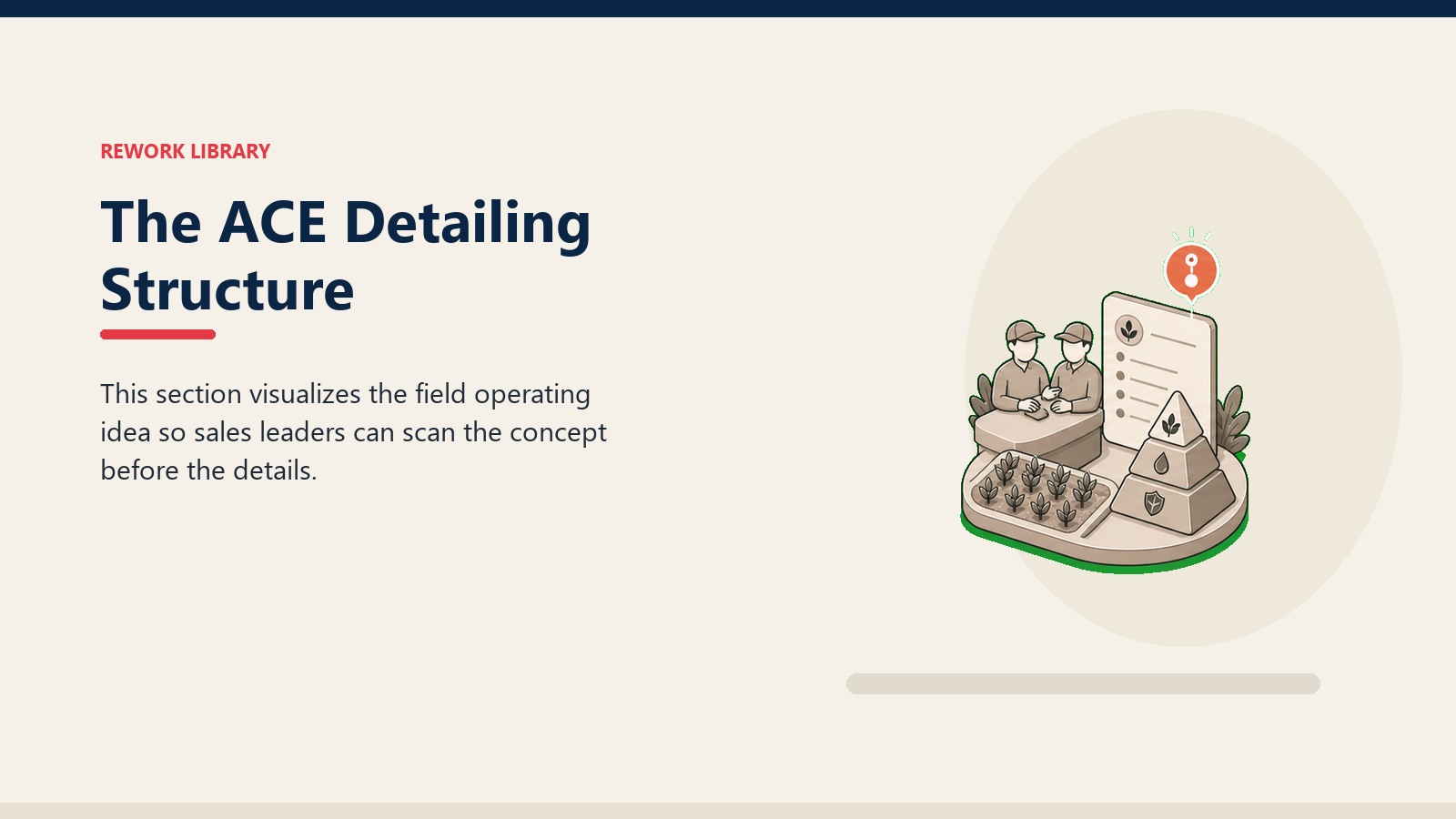
ACE is the three-stage detailing framework that organizes an agronomy-led product conversation from field observation to commercial close.
Assess
Assess is the crop observation and problem identification stage. It happens before any product is named, and it has to be genuine, not performative.
The rep walks the field with the farmer, observes the crop, and identifies the primary stress signal. This might be visible disease symptoms on leaves, insect damage on shoot tips, nutrient deficiency patterns in the canopy, or weed competition at a critical growth stage. The observation should produce a specific finding: not "the crop looks stressed" but "there's yellowing on the lower leaves between the veins, and that pattern is consistent with zinc deficiency at this growth stage."
Then the rep confirms with the farmer: "Have you noticed this in other parts of the field, or is it mainly in this section?" This step matters because it positions the rep as a consultant, not a salesman, and it surfaces farmer knowledge that may refine the diagnosis.
Assess ends with a shared problem statement: the rep and farmer have agreed on what the primary issue is. Without that agreement, the rest of the detail is just a pitch.
Connect
Connect is where agronomy becomes commercial. The rep explains why the product's mechanism addresses the identified problem. Not what the product does in general. Why it addresses this specific finding, at this crop stage, under these conditions.
"Zinc deficiency at this growth stage affects enzyme activity that controls chlorophyll synthesis, which is why you're seeing the inter-veinal yellowing. A foliar zinc application corrects this faster than soil application at this point because leaf uptake bypasses the slow soil mobility of zinc. Our chelated zinc formulation has higher uptake efficiency than standard sulphate because the chelate keeps the zinc soluble in the alkaline conditions typical of this soil type."
Three sentences. One mechanism explanation. No product features list. No efficacy claim without a reason. The mechanism explanation is what separates a technical detail from a brochure reading.
Connect also includes the evidence anchor: a trial efficacy chart, a disease-cycle visual, or a yield comparison from a demo plot in the same or a similar geography. The visual is a reference, not a script. The rep points to the relevant data point, states it clearly, and moves on.
Execute
Execute is the specific recommendation: rate, timing, application method, and any conditions that affect performance. Specificity here is what converts an informative conversation into an actionable one.
"Apply at 300 grams per 200 liters of water, this week, before the crop moves past the vegetative stage. Apply in the evening when temperatures are below 32 degrees for best uptake. Make sure the sprayer nozzle gives you a fine mist for good leaf coverage on the underside of the lower canopy where the deficiency is most visible."
The rate and timing advice does two things: it demonstrates technical credibility, and it reduces application errors that would produce suboptimal results and damage the product's reputation with this farmer.
Execute ends with the commercial ask. "I'd recommend starting with one acre of the most affected section. I'll come back in two weeks to see how the crop responded." The ask is specific, small, and tied to observable follow-up. A trial of defined scope, with a follow-up to assess the result, converts to repeat purchase at much higher rates than a one-time sale with no outcome tracking. The audience in front of you determines how much mechanism depth lands and which evidence type carries weight.
ACE Detailing Framework Card:
| Stage | What happens | What not to do |
|---|---|---|
| Assess | Observe crop, identify primary stress signal, confirm with farmer | Don't skip to product before naming the problem |
| Connect | Explain product mechanism relative to the identified problem, anchor with evidence visual | Don't list features; explain the mechanism for this specific problem |
| Execute | Give specific rate, timing, and application guidance, then make the trial ask | Don't give a range; give a number, a date window, and a follow-up commitment |
Tailoring Detail Depth by Audience
The ACE structure holds across all farmer and trade audiences. What changes is the depth of mechanism explanation, the evidence type that carries weight, and the vocabulary used.
Progressive large farmer. This farmer wants to understand the mechanism because he's been in agri-inputs long enough to have been burned by oversimplified claims. Give him the full science: the biochemical mode of action, the trial data with sample sizes, the soil type caveats. He'll push back, and that's fine. His pushback is engagement, not resistance. FAO's integrated pest management framework is a credible shared reference for mechanism discussions with scientifically literate farmers, since it grounds chemical decisions in monitoring thresholds and timing rather than blanket application.
Smallholder farmer. This farmer makes decisions based on what worked for the progressive farmer in his village, not on biochemistry. The Connect stage for a smallholder should lead with outcome: "This is what [KOL farmer's name] used on his cotton last season and you can see the comparison from his demo plot." The mechanism explanation still happens, but it's shorter and more outcome-anchored.
Dealer with technical background. A dealer who has agronomic training will evaluate your technical claims against his own knowledge. He's not going to stock heavily on a product he can't explain to farmers. Give him the mechanism, the trial data, and the farmer objection responses so he can represent the product correctly at the counter. If you don't equip him, a competitor's rep will.
General input retailer. This dealer cares about margin, sell-through rate, and scheme support. Lead with the commercial story but anchor it in the agronomic: "Farmers who understand what this product does at this growth stage reorder it. Farmers who just buy on the first-season scheme don't. That's the difference in your repeat business model." The matrix below turns these distinctions into a quick pre-call planning tool.
Audience tailoring matrix:
| Audience | Mechanism depth | Evidence anchor | Commercial ask |
|---|---|---|---|
| Progressive large farmer | Full mechanism, trial data with stats | Efficacy chart from published study or regional demo | Full-season trial on target crop area |
| Smallholder | Outcome-led, mechanism in one sentence | KOL farmer result from nearby demo plot | 1-2 acre trial, neighbor farmer as reference |
| Agronomist peer | Deep mechanism, peer-reviewed references if available | Trial data comparison vs. standard practice | Co-detail opportunity, advisory referral |
| Dealer (technical) | Mechanism + farmer objection responses | Demo plot yield comparison by product | Stock recommendation + display support |
| Dealer (general retailer) | Outcome framed as sell-through story | Local demo result, farmer testimonial | Season stocking target + scheme terms |
Using Technical Collateral Without Reading It
A trial efficacy chart or disease-cycle visual is an anchor, not a teleprompter. The same failure mode that appears in pharma detailing, where reps read from detail aids rather than referencing them, shows up in agri-inputs when reps walk farmers through every column of a data table.
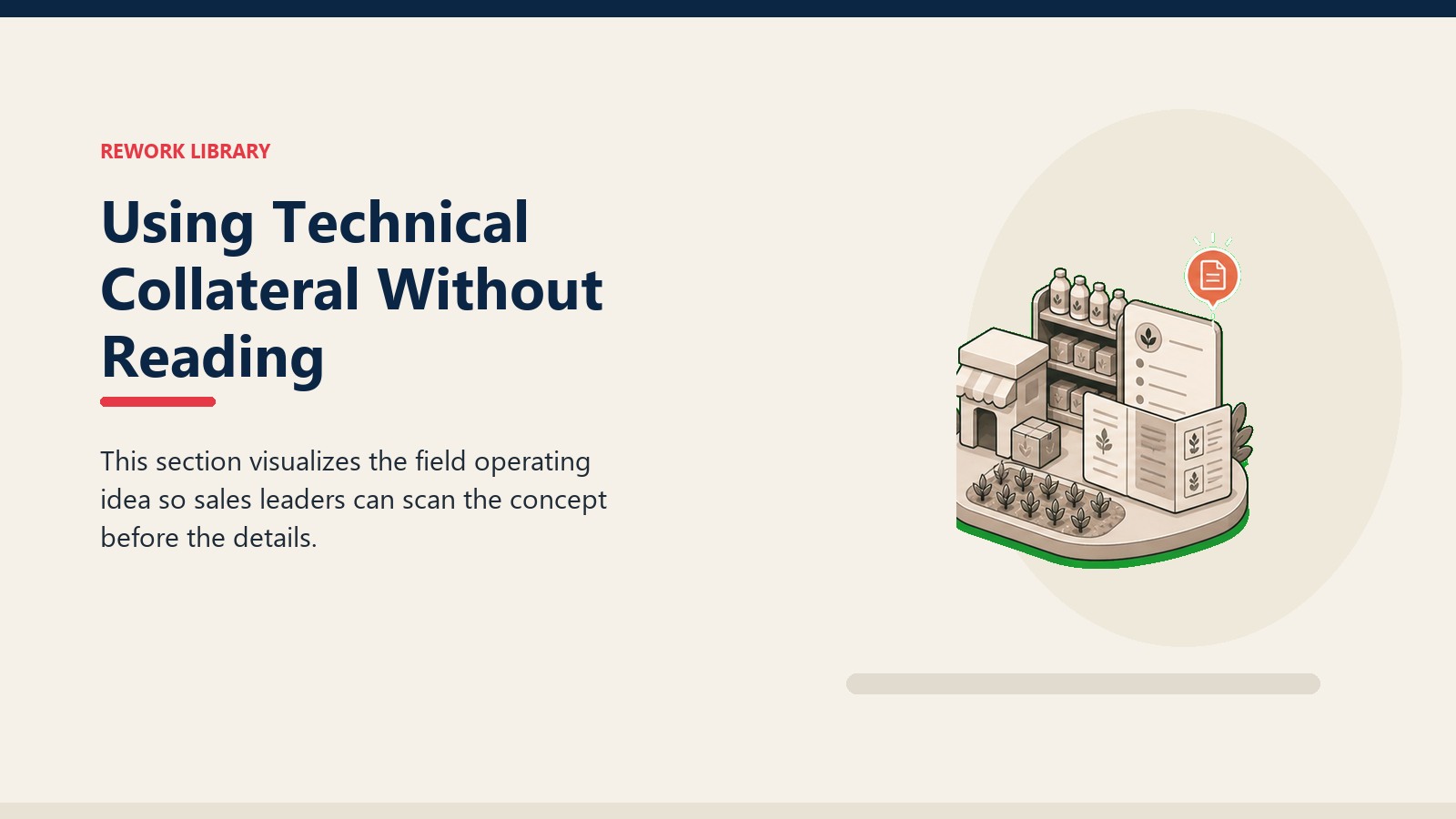
The correct use of technical collateral in the Connect stage: point to the specific data point being discussed, state it conversationally, and let the farmer look at the visual while the rep holds it. "This graph shows the disease incidence comparison between treated and untreated plots over the 45-day observation period in the Gujarat trial. You can see the separation starting at day 14, which is consistent with the two-week activity window I mentioned."
The rep should be able to complete Assess and Execute without any collateral at all. If he can't describe the mechanism or the application parameters without a brochure, the preparation wasn't sufficient. Technical collateral is support material for the evidence moment, not a crutch for the entire conversation.
For demo plot results specifically, a geo-tagged photo comparison from a local plot carries far more weight than a corporate efficacy chart from a distant geography. "This is a demo plot from a farm in your taluka, same soil type, same hybrid, same rainfall this season. Left side is treated, right side is control. That's the difference you'd expect on your field." Local evidence beats distant data in almost every farmer conversation. The hardest version of this principle shows up when the farmer doesn't believe the product works at all.
How Do You Handle "Does It Really Work?" Without Getting Defensive?
Farmer efficacy skepticism is not a buying objection. It's a quality signal. A farmer who asks whether a product really works is engaged enough to evaluate it; a farmer who doesn't ask has already decided not to trial.
The defensive response to efficacy skepticism is to double down on product claims: "Yes, it definitely works, and here's the data." This sounds like a sales pitch because it is one.
The agronomy-first response is different. It acknowledges the question, addresses the mechanism, and shifts the burden of proof to observable trial conditions: "I understand why you'd want to see it for yourself rather than just taking my word for it. The product works through the same mechanism as [well-known standard product] but with a longer residual activity. The best way to test it is a comparison plot on two to three acres alongside your standard program. That way you're not relying on what I'm telling you; you're seeing the crop response yourself."
This response does three things: it respects the farmer's skepticism, it explains the scientific basis, and it turns the objection into a trial commitment opening. A farmer who agrees to a comparison plot is no longer skeptical; he's curious, which is a much better buying state.
Technical objection response table:
| Farmer objection | Defensive response (avoid) | Agronomy-first response |
|---|---|---|
| "It didn't work for me last season" | "Are you sure you applied it correctly?" | "Let me ask you a few questions about timing and rate. Sometimes the crop stage or rainfall timing affects the result significantly." |
| "Competitor's product is cheaper and works the same" | "No it doesn't, ours is better because of X" | "The active ingredient might be similar, but the formulation affects uptake efficiency in your soil conditions. Let me show you the comparison from the local demo." |
| "I've heard complaints from other farmers" | "Those farmers probably misapplied it" | "That's worth understanding. What did they observe? Sometimes application timing or water quality affects performance in ways that look like product failure." |
| "I'll wait and see how your demo plot turns out" | "It's going to do very well, you should stock up now" | "That's exactly the right approach. The demo is there for that reason. Can I invite you to the mid-season observation we're organizing?" |
The Commercial Ask After the Agronomy Lead
One failure mode in agronomy-led selling is using the agronomic conversation as a reason to avoid the commercial ask. Reps who are technically confident sometimes deliver an excellent diagnosis and mechanism explanation and then fail to close because they feel the ask would undermine the advisory relationship.
It doesn't. A farmer who has just been given a credible diagnosis and a specific recommendation expects to be asked what he wants to do about it. The ask is the natural conclusion of the advisory conversation, not a departure from it.
The ask should be specific, small, and tied to follow-up: "I'd recommend trialling this on two acres in the section that's showing the most deficiency. I'll note down the rate and timing we discussed, and I'll come back in two weeks to walk the field with you." This is a trial close framed as an agronomic service commitment, not a transaction.
If the farmer hesitates on even a small trial, the response is an observation commitment rather than a sales close: "That's fine. I'll book a time to come back and walk this section with you at the next growth stage, and we can see how the situation develops." What separates reps who close consistently is whether a manager has ever coached them through this moment in the field.
Manager Coaching Checklist: What to Look For on a Co-Visit
A co-visit with a rep in a detailing situation is the highest-return field coaching opportunity a manager has. One afternoon of structured observation and debrief produces more durable behavior change than a day of classroom training.
Agronomy-led detailing observation scorecard:
| Element | What to observe | Score (1-3) |
|---|---|---|
| Pre-visit preparation | Did the rep know the crop stage and likely problems before arriving? | 1 = No prep / 2 = Partial / 3 = Specific hypothesis prepared |
| Assess: Field observation | Did the rep spend 10+ minutes in the field before naming a product? | 1 = Product-first / 2 = Brief walk, then product / 3 = Thorough observation, diagnosis named |
| Assess: Diagnostic question | Did the rep ask the farmer to describe his concern before presenting findings? | 1 = No question / 2 = Generic "any problems?" / 3 = Specific diagnostic question anchored to observation |
| Connect: Mechanism explanation | Was the product mechanism explained relative to the identified problem? | 1 = Feature list / 2 = Benefit claim without mechanism / 3 = Clear mechanism tied to observed finding |
| Connect: Evidence use | Was technical collateral used as a visual anchor, not a script? | 1 = Read from brochure / 2 = Referenced but multiple data points / 3 = One clear point, collateral as anchor |
| Execute: Specificity | Was a specific rate, timing, and application method given? | 1 = Generic recommendation / 2 = Rate given, no timing / 3 = Rate, timing, method, follow-up date |
| Execute: Trial ask | Was a small trial proposed with a specific acreage and follow-up commitment? | 1 = No ask / 2 = Generic "try it" / 3 = Specific area, follow-up booked |
| Audience calibration | Was the depth of detail appropriate for this farmer or dealer type? | 1 = Same detail for all / 2 = Partially adapted / 3 = Fully calibrated to audience technical level |
A total score below 16 triggers an immediate coaching conversation the same day. One improvement priority per visit, not a comprehensive list. Reps who leave a coaching debrief with three things to fix change none of them. One clear priority, repeated on the next three co-visits, produces real change.
Quotable Nuggets
"Farmers who understand why a product works are fundamentally different buyers than farmers who tried something once and moved on." Understanding converts to referral; one-time trial converts to nothing. The mechanism explanation is the investment that keeps paying.
"A farmer who agrees to a comparison plot is no longer skeptical. He's curious. Curiosity is a much better buying state." Shifting the frame from 'should I buy this?' to 'I want to see what happens' is the most reliable conversion mechanism in agri-input selling.
"The rep who can diagnose a crop problem and explain a mechanism is simply harder to displace than one who can recite a features list." Price and scheme competition erodes over time. Agronomic competence compounds.
Conclusion: Product Detailing Built on Agronomy Earns the Reorder
The difference between the two reps in eastern India wasn't charm, persistence, or product knowledge. It was sequencing. One rep put the farmer's crop problem first and let the product follow. The other put the product first and hoped the farmer would find a reason to care.
Farmers who understand why a product works are fundamentally different buyers than farmers who tried something once and moved on. They can explain their choice to a neighbor, which makes them a referral source. They know what conditions produce the expected result, which reduces complaint rates when the weather doesn't cooperate. And they reorder because their conviction came from understanding, not promotion.
The ACE structure, done consistently, builds that conviction at every farm visit. It also builds the kind of field team that can compete on something other than price, because a rep who can diagnose a crop problem and explain a mechanism is simply harder to displace than one who can recite a features list. Train the diagnostic habit first. The commercial results follow from it.
Frequently Asked Questions about Agronomy-Led Product Detailing
How long should the Assess stage take before naming a product?
A minimum of 10 to 15 minutes in the field for a crop showing active stress symptoms. For a healthy crop where the conversation is more preventive, a shorter observation period may be sufficient, but the diagnostic question still comes first. Rushing Assess to get to the product name is the most common failure mode in agronomy-led detailing.
What if the farmer already knows what he wants to buy?
Go through a brief Assess anyway. "Before we get to that, let me take a quick look at your crop and make sure we're recommending the right thing for the current stage." A farmer who already has a product in mind is usually happy to have his decision validated by an agronomic observation, and occasionally the field walk surfaces something that changes the recommendation to his benefit.
How do I explain mode of action to a farmer with limited formal education?
Use analogies anchored in things the farmer already understands. "This fungicide works like an antibiotic for the fungus: it stops it reproducing rather than just killing what's already visible, which is why you need to apply it early." You don't need biochemical language to explain a mechanism. You need a clear cause-effect that matches the farmer's observable experience.
How should I handle a farmer who wants multiple product recommendations in one visit?
Rank the problems you observed and address the most consequential one with the full ACE structure. Mention the others briefly: "I also noticed some signs of early-stage aphid pressure in the upper canopy. That's lower priority right now, but I'd want to monitor it at the next visit." This keeps the conversation focused and schedules the next interaction naturally.
Does agronomy-led detailing work at the dealer counter or only in the field?
It works at both, but the format changes. At a dealer counter, you can't do a crop walk, so Assess becomes a question: "What are your farmers dealing with at this crop stage right now?" A dealer who trusts you to have a good answer to that question, and who can use your mechanism explanation when a farmer asks him why to buy your product, will represent it more confidently than a dealer who only has a brochure to work from. Research on agrochemical brand preferences consistently shows that brand reputation and extension-officer recommendations are the two biggest drivers of repurchase decisions. Equipping your dealer with agronomic language lets him play that role.
How do I know when the ACE detail worked?
The clearest signal isn't that the farmer bought on the first visit. It's that he asks the right question on follow-up: "Did the spray work the way you said it would?" A farmer who asks that question understood the mechanism, applied the product, and is now evaluating whether his experience matches your explanation. That's exactly the state you want. A farmer in that state who gets a "yes" on the follow-up becomes a reference for neighbors. One who gets a "no" gives you a diagnostic conversation that still builds more trust than a rep who never promised anything specific.
Learn More

Senior Implementation Consultant
On this page
- The Agronomy-First Principle
- The ACE Detailing Structure
- Assess
- Connect
- Execute
- Tailoring Detail Depth by Audience
- Using Technical Collateral Without Reading It
- How Do You Handle "Does It Really Work?" Without Getting Defensive?
- The Commercial Ask After the Agronomy Lead
- Manager Coaching Checklist: What to Look For on a Co-Visit
- Quotable Nuggets
- Conclusion: Product Detailing Built on Agronomy Earns the Reorder
- Learn More