RevOps Maturity Model: How to Diagnose Your Revenue Operating System
RevOps maturity is not measured by whether the company has a Head of RevOps title.
A company can have a RevOps title and still operate from disconnected dashboards, vague lifecycle stages, and forecast calls that turn into CRM cleanup. Another company can have one strong operator, a simple CRM, and a revenue process that works reliably across marketing, sales, customer success, and finance.
Maturity is about operating reliability. Can the company define revenue stages, move work between teams, trust the data, inspect performance, and improve the system without heroic manual effort?
Use this model after reading What Is Revenue Operations? and the Revenue Operations Framework. The framework explains what RevOps governs. The maturity model shows how strong that governance is.
Gartner's RevOps guidance frames revenue operations as an end-to-end model that integrates people, process, and technology. That integration is what this maturity model measures.
Key operating facts
- RevOps maturity is not about team size or title. It is about how reliably the company can run, inspect, and improve revenue.
- Maturity can differ by area. A company may be mature in new-business reporting and immature in renewal visibility.
- The model should be used to choose the next operating improvement, not to label the company.
- Moving up a maturity stage usually requires governance, adoption, and decision rights, not only better tools.
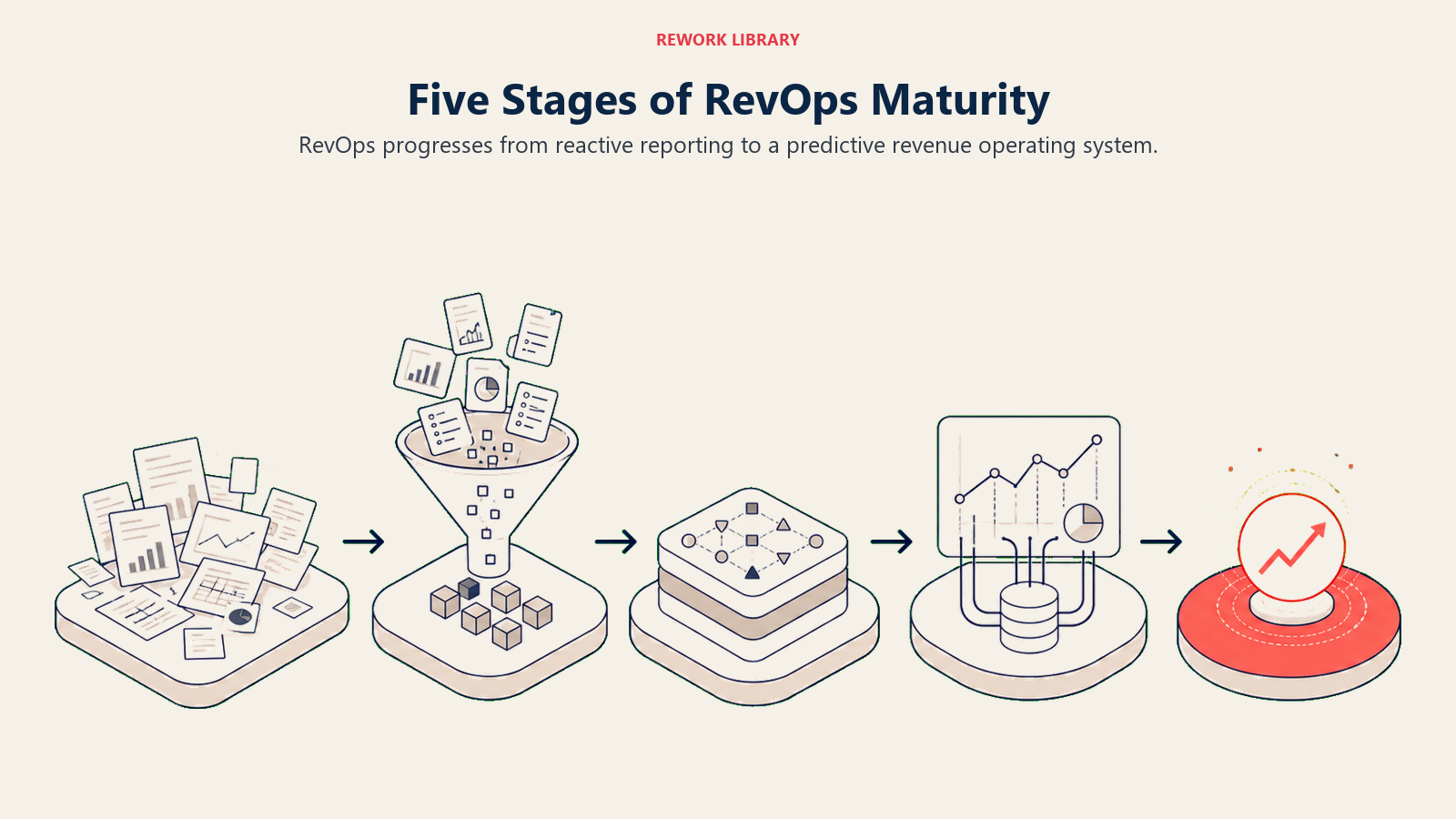
The five stages of RevOps maturity
| Stage | Operating pattern | Main risk |
|---|---|---|
| 1. Reactive reporting | Reports are pulled when leaders ask | Data explains the past but does not improve execution |
| 2. Sales Ops support | Sales process and CRM hygiene get attention | Marketing, CS, and finance remain disconnected |
| 3. Funnel governance | Lifecycle stages, handoffs, and dashboards are standardized | Governance depends on a small number of people |
| 4. Revenue operating system | Teams run on shared definitions, cadence, and source of truth | Change management becomes the bottleneck |
| 5. Predictive RevOps | AI-assisted scoring, forecasting, and risk detection improve decisions | Automation scales bad data if governance is weak |
The stages are not a status badge. They are a diagnostic tool. A company can be Stage 4 in acquisition reporting and Stage 2 in renewal visibility. A company can have strong funnel governance and weak forecast governance. The goal is not to label the whole company with one number. The goal is to see where the revenue operating system needs work.
Turn this article into takeaways for your work.


Each assistant summarizes the article only for you and suggests best practices for your work.
Maturity by operating area
Score maturity by area instead of forcing one company-wide grade.
| Area | What to inspect |
|---|---|
| Lifecycle | Are stages defined, owned, and enforced? |
| Data | Are source-of-truth rules and field owners clear? |
| Forecast | Are categories, evidence, and accuracy reviews governed? |
| Handoffs | Do teams pass enough context at each transition? |
| Customer revenue | Are renewal, churn, and expansion visible? |
| Cadence | Do recurring meetings produce decisions and follow-through? |
| Systems | Do tools support the operating model without hidden workarounds? |
This makes the maturity model useful. Leaders can see where to invest next. A company does not need to become Stage 5 everywhere. It needs enough maturity in the areas that create current revenue risk.
How to use the model
Use the maturity model in three passes.
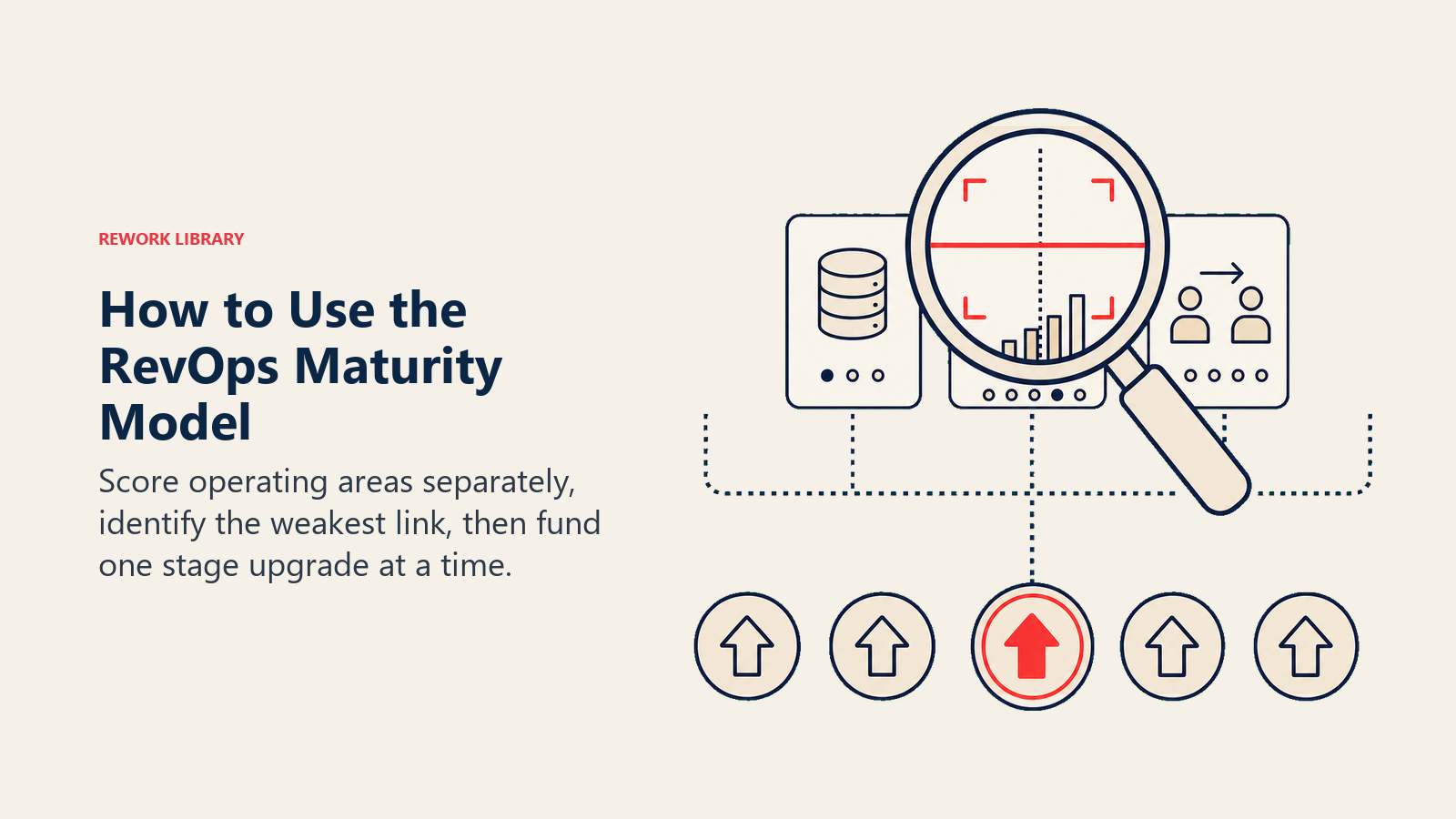
First, score each major revenue area separately: acquisition, pipeline, forecasting, customer handoff, renewal, expansion, systems governance, and reporting. Do not average the scores too quickly. The gaps matter more than the average.
Second, identify the lowest-maturity area that creates the highest revenue risk. A weak renewal process may matter more than a weak campaign dashboard if retention is the current board-level concern. A weak MQL definition may matter more than an expansion dashboard if the company is trying to scale inbound pipeline.
Third, pick the next operating layer to strengthen. If the issue is Stage 1 reporting chaos, fix definitions and source-of-truth rules. If the issue is Stage 2 sales-only operations, build cross-functional handoffs. If the issue is Stage 3 personality dependence, formalize governance and cadence.
This prevents the common mistake of copying another company's RevOps roadmap. Maturity work should follow the current bottleneck, not a generic best-practice list.
Stage 1: Reactive reporting
At this stage, RevOps is not really operations yet. It is reporting support.
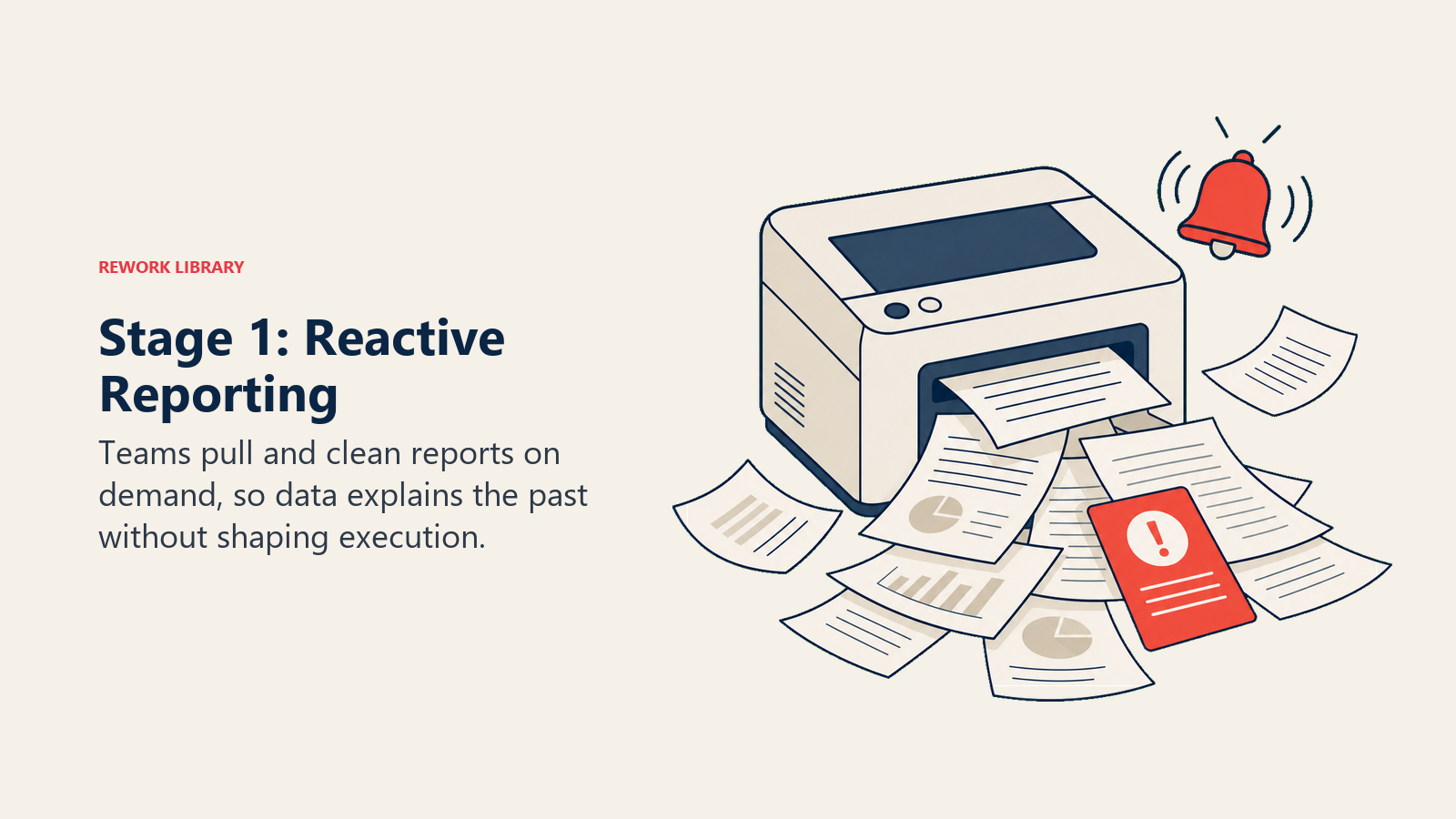
Leaders ask for pipeline by source, win rate by segment, churn by cohort, or lead conversion by campaign. Someone exports data, cleans it, and prepares a deck. The work is useful, but every answer requires manual effort.
Common symptoms:
- Dashboards are not trusted.
- Metrics require spreadsheet cleanup.
- Definitions vary by team.
- Reports arrive after the decision window has passed.
- Different leaders present different versions of the same number.
- The person who knows how the report was built becomes a bottleneck.
The fix is not more reporting. The fix is shared definitions and source-of-truth rules. Before a company can improve revenue operations, it needs to define the data it is already using.
The first step out of Stage 1 is a simple revenue data dictionary: lifecycle stages, source fields, opportunity fields, forecast categories, and customer status fields. That dictionary should connect to CRM field governance, not live as a forgotten document.
Stage 1 exit criteria
You are ready to leave Stage 1 when:
- Leaders agree on core lifecycle definitions.
- The company has one source-of-truth map for revenue fields.
- The most-used reports can be rebuilt without one person's memory.
- Manual cleanup is reduced to exceptions, not the normal process.
- RevOps can explain known data quality limits clearly.
Do not rush past this. A company that skips definition work usually rebuilds the same reporting mess inside a better-looking dashboard.
Stage 2: Sales Ops support
Sales Ops creates the first real operating discipline.
Territories, quotas, stages, pipeline hygiene, rep productivity, and forecast rollups become clearer. Managers get more consistent reports. Reps know what fields matter. The CRM becomes more useful for the sales team.
This is valuable, especially for sales-led companies. But the model still breaks when revenue problems cross team boundaries.
Common symptoms:
- Sales stages improve, but lead handoffs remain messy.
- Pipeline reports improve, but attribution is debated.
- Forecasting improves, but CS handoff data is incomplete.
- Marketing Ops and Sales Ops use similar words differently.
- Finance still rebuilds numbers outside the CRM.
The next move is to expand from sales execution to full-funnel governance. That does not mean Sales Ops disappears. It means sales operations becomes one specialist lane inside a broader revenue operating model.
For the boundary, see RevOps vs Sales Ops.
Stage 2 exit criteria
You are ready to leave Stage 2 when:
- Sales process definitions are stable enough to connect to marketing and CS.
- Lead assignment and acceptance rules are documented.
- Forecast categories are understood by sales and finance.
- Sales Ops has enough capacity to participate in cross-functional process design.
- Leadership sees the need for a broader revenue operating owner.
Stage 2 is not bad. Many companies need a strong Sales Ops foundation before RevOps can work. The problem is staying there after the company has added marketing, CS, finance, and systems complexity.
Stage 3: Funnel governance
This is where RevOps starts to become RevOps.
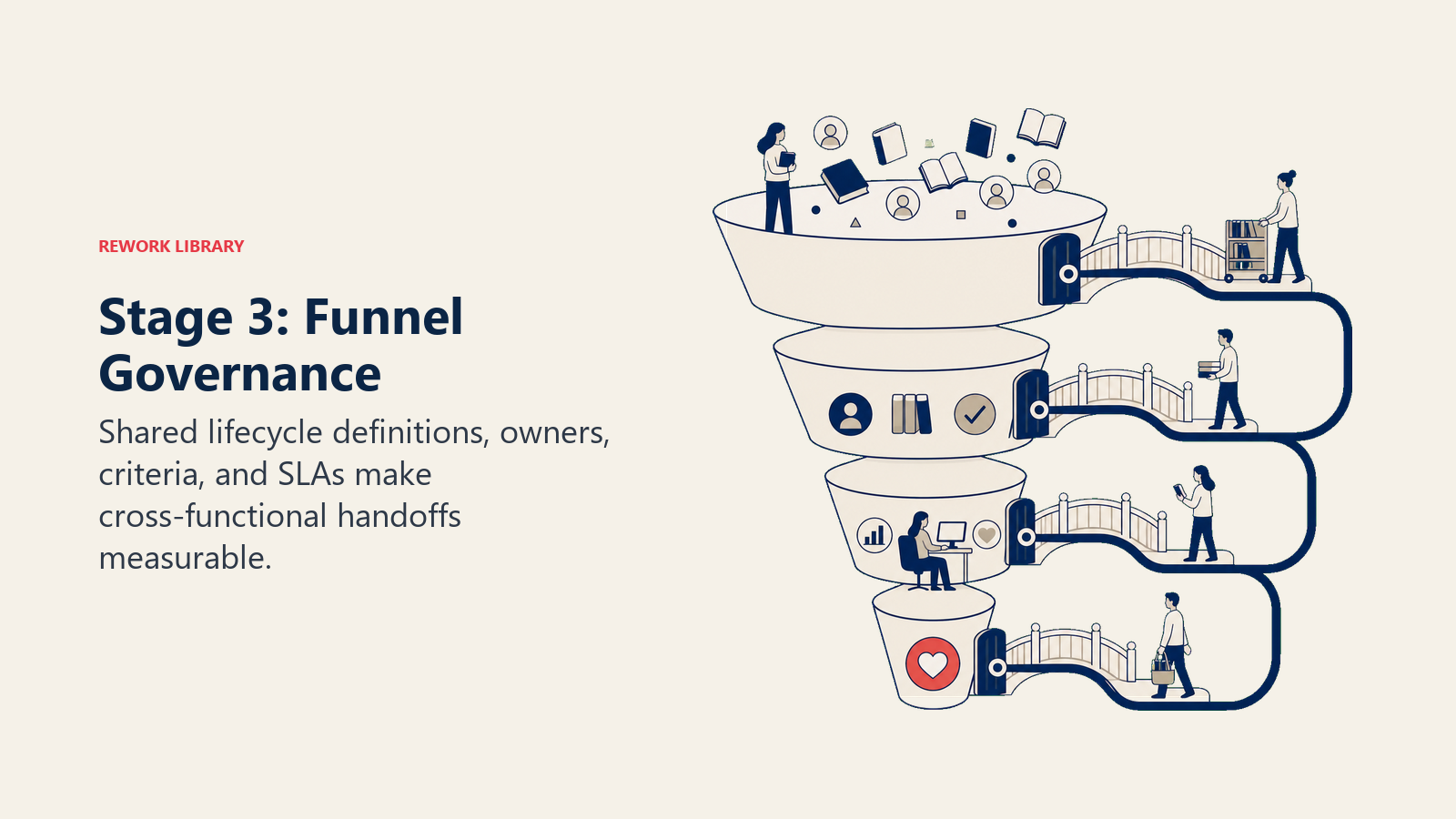
The company defines lifecycle stages from lead to renewal. Marketing, sales, and CS agree on entry and exit criteria. Handoffs have owners and SLAs. Shared dashboards become possible because the definitions underneath them are stable.
Common signs of Stage 3:
- MQL, SQL, opportunity, closed-won, onboarded, renewal, and churn definitions are documented.
- Lead routing rules match the current go-to-market strategy.
- MQL rejection reasons are captured in the CRM.
- Opportunity creation criteria are clear.
- Closed-won handoff fields are required.
- Monthly funnel review uses one source of truth.
Useful companion articles include Funnel Governance, Revenue Funnel Stages, and Lead to Opportunity Process.
The risk at Stage 3 is personality dependence. Often one strong operator holds the system together. If that person leaves, definitions decay and process quality drops. The way forward is governance: decision rights, change control, and operating cadence.
Stage 3 exit criteria
You are ready to leave Stage 3 when:
- Lifecycle changes have an approval path.
- Handoff SLAs are visible in dashboards.
- Required fields are tied to stage movement.
- Marketing, sales, CS, and finance use the same core definitions.
- Monthly funnel review produces decisions, not only discussion.
This is the point where RevOps should become less reactive. The team should still support day-to-day operations, but it should also have a roadmap for system improvement.
Stage 4: Revenue operating system
At this stage, RevOps owns the operating rhythm of revenue.
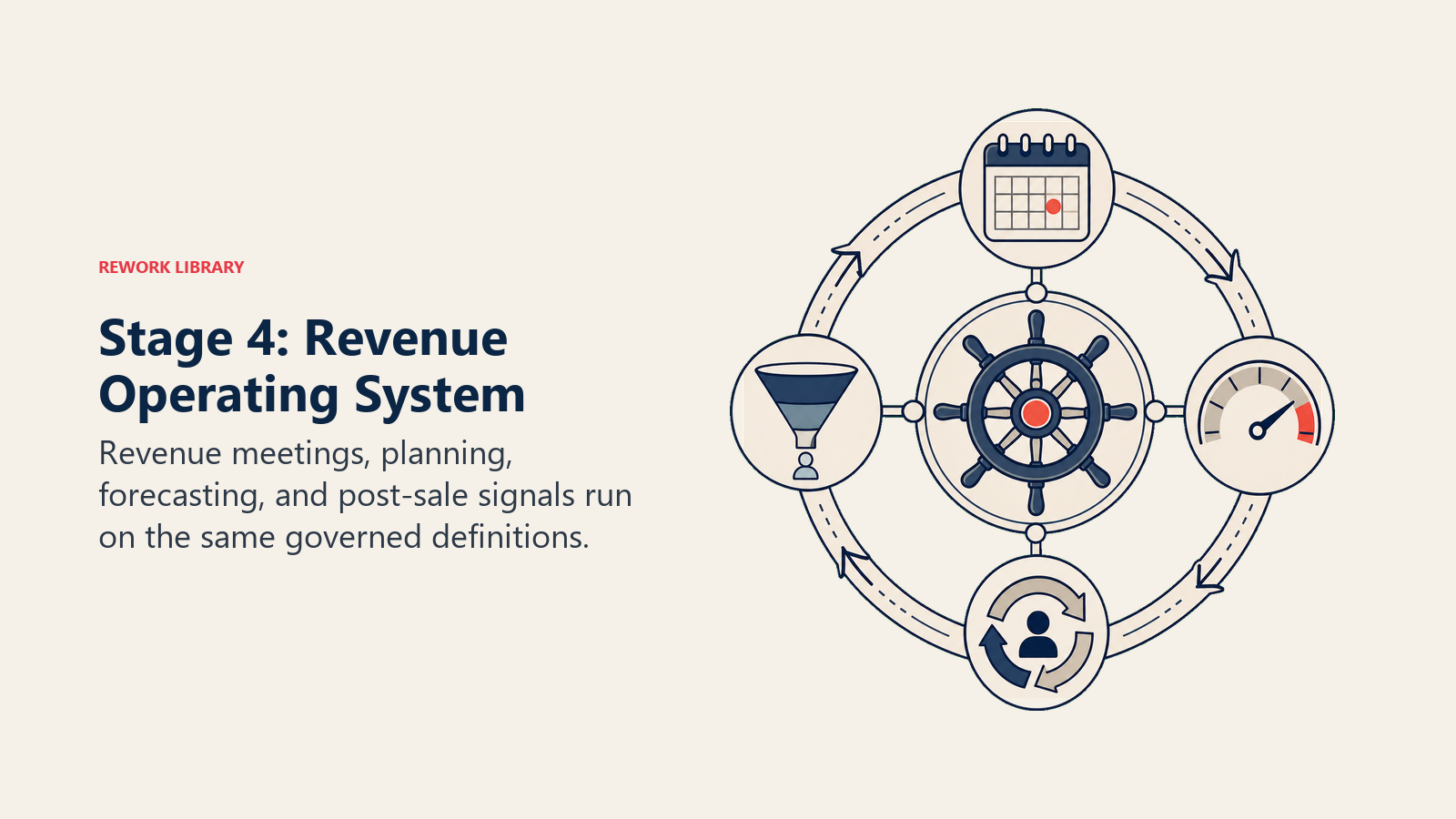
Weekly pipeline review, monthly funnel review, quarterly planning, and forecast governance all use the same definitions. Finance trusts the revenue data. CS risk data feeds renewal planning. Marketing and sales use the same source-to-revenue view. Leaders argue about what to do, not whose number is right.
Common signs of Stage 4:
- The executive dashboard, RevOps working dashboard, and functional dashboards use governed definitions.
- Revenue meetings have clear inputs, owners, decisions, and follow-up.
- CRM changes follow a change-management process.
- Forecast accuracy is tracked over time.
- Renewal and expansion data influence acquisition planning.
- RevOps has proactive roadmap capacity, not only ticket response.
This is the stage where RevOps becomes a real operating system. But the risk changes. The system is no longer chaotic, but it can become slow if every change requires too much governance.
Good Stage 4 teams protect standards without turning every field change into a committee meeting.
Stage 4 exit criteria
Stage 4 is strong enough for predictive RevOps when:
- Data quality is monitored continuously.
- Forecast accuracy is measured by period and segment.
- Customer success data feeds planning.
- RevOps has a change-management process for CRM and workflow updates.
- The executive team trusts the revenue dashboard enough to make planning decisions from it.
The company does not need perfection. It needs enough reliability that automation and AI will improve the system instead of magnifying its defects.
Stage 5: Predictive RevOps
Predictive RevOps uses AI and automation to improve speed and coverage.
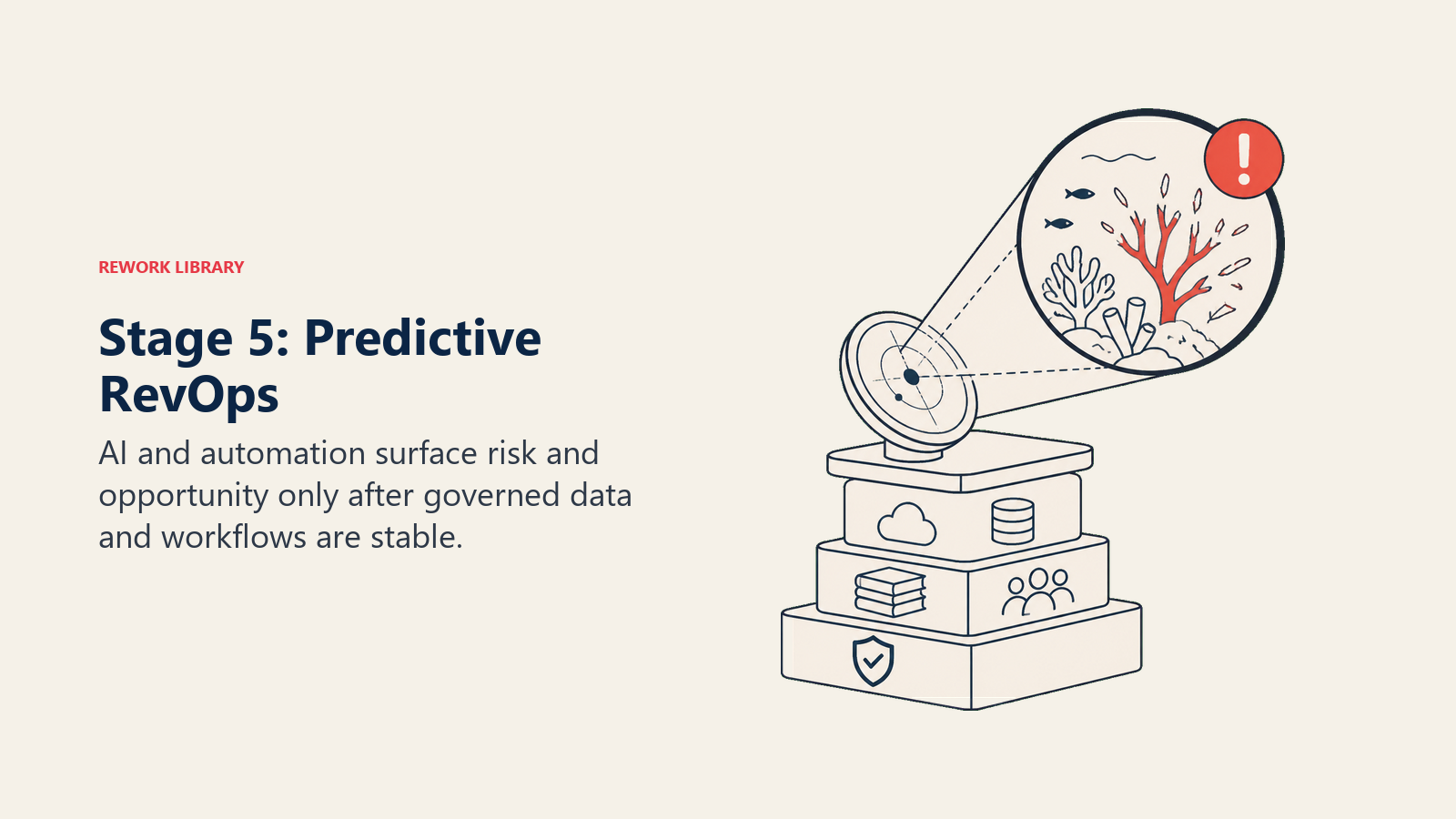
Examples include automated lead scoring, stale deal detection, forecast risk signals, CRM hygiene copilots, renewal risk alerts, and expansion signal detection. The best teams do not automate first. They automate after definitions, data quality, and governance are strong.
For adjacent AI patterns, see CRM Data Hygiene With an AI Copilot, AI Lead Scoring Beyond Rules-Based Models, and AI in Revenue Operations.
The failure mode is overconfidence. A model trained on poor stage data, incomplete source fields, or biased historical routing rules will produce polished recommendations from weak inputs. Predictive RevOps is powerful only when the operating foundation is already strong.
Gartner's research on AI in sales forecasting points to AI's role in improving data capture, prediction, and insight. That is the right frame. AI should improve the operating system, not cover for an unclear one.
Stage 5 guardrails
Predictive RevOps needs explicit guardrails:
- Every automated recommendation should have an owner.
- High-impact changes should keep human approval.
- Model outputs should be audited by segment and source.
- CRM writebacks should create an audit trail.
- Data quality should be monitored before and after automation.
The mature version of predictive RevOps is not "AI makes the decision." It is "AI surfaces signal earlier, and the operating team knows how to act on it."
How to diagnose your current stage
Run a practical diagnostic instead of debating maturity in the abstract.
Pull a sample:
- 20 recent leads
- 20 active opportunities
- 10 closed-won customers
- 10 churned or renewal-risk customers
For each record, ask:
- Is the current stage obvious?
- Is the owner obvious?
- Is the required data complete?
- Is the next action clear?
- Is the source of truth clear?
- Would a leader trust this record in a forecast or board report?
If the answer is no across most records, the maturity issue is not theoretical. It is visible in the operating data.
Diagnostic questions
Ask these ten questions:
- Do all revenue leaders use the same lifecycle definitions?
- Can a record's stage be explained from clear entry criteria?
- Are handoff SLAs visible and enforced?
- Does finance trust CRM pipeline data?
- Are forecast calls about risk, not cleanup?
- Can marketing trace source to revenue without manual reconciliation?
- Does CS receive complete closed-won context?
- Are CRM field changes governed?
- Are dashboards tied to operating decisions?
- Is RevOps improving the system, or only responding to requests?
If most answers are no, start with Stage 2 or Stage 3 work. If most are yes, the company is ready for stronger cadence, governance, and selective automation.
90-day maturity upgrade plan
Use the maturity model to choose one stage upgrade, not five simultaneous projects.
| Current stage | 90-day upgrade target | Practical focus |
|---|---|---|
| Stage 1: Reactive reporting | Stage 2 basics | Define owners, clean the most-used dashboard, and stop one-off reporting from hiding source issues |
| Stage 2: Sales Ops support | Stage 3 funnel governance | Add shared lifecycle definitions, handoff SLAs, and rejection reasons |
| Stage 3: Funnel governance | Stage 4 revenue operating system | Extend governance to CS, finance, renewal, expansion, and systems change control |
| Stage 4: Revenue operating system | Stage 5 readiness | Add predictive use cases only where data, cadence, and approvals are already trusted |
| Uneven maturity by team | Shared minimum standard | Bring the weakest operating area up before adding advanced workflows elsewhere |
The upgrade should produce visible operating changes:
- One definition improved.
- One handoff governed.
- One dashboard trusted.
- One cadence tied to decisions.
- One change-control rule enforced.
That is enough for a quarter. A maturity model becomes useful when it guides sequencing. It becomes harmful when leaders use it to demand enterprise-level governance from a team that still lacks basic definitions.
Do not skip the boring stage
Most failed maturity programs skip the middle, which is one of the common reasons RevOps fails.
They jump from reactive reporting to predictive RevOps because AI scoring, automation, and executive dashboards look more impressive than field definitions, stage criteria, and handoff SLAs. But predictive workflows need governed inputs. If the lifecycle is unclear, a model will predict from inconsistent behavior. If forecast categories mean different things by manager, AI forecast risk will inherit the confusion.
The boring stage is where RevOps earns compounding value: definitions, ownership, source of truth, cadence, and change control. Once those are stable, advanced analytics and automation have something real to improve.
Frequently Asked Questions about RevOps Maturity Model
What is RevOps maturity?
RevOps maturity is the degree to which a company can run revenue through shared definitions, governed data, reliable handoffs, trusted dashboards, and decision-focused cadence.
What stage should most companies target first?
Most growth-stage companies should target Stage 3: funnel governance. It creates the foundation for better dashboards, forecasting, and automation.
Can a small company be mature?
Yes. A small company with simple, clear, trusted revenue processes can be more mature than a larger company with fragmented systems.
Should AI be part of RevOps maturity?
Yes, but late in the sequence. AI should be layered onto clean data, clear process, and explicit governance.
Learn more

Senior Operations & Growth Strategist
On this page
- The five stages of RevOps maturity
- Maturity by operating area
- How to use the model
- Stage 1: Reactive reporting
- Stage 1 exit criteria
- Stage 2: Sales Ops support
- Stage 2 exit criteria
- Stage 3: Funnel governance
- Stage 3 exit criteria
- Stage 4: Revenue operating system
- Stage 4 exit criteria
- Stage 5: Predictive RevOps
- Stage 5 guardrails
- How to diagnose your current stage
- Diagnostic questions
- 90-day maturity upgrade plan
- Do not skip the boring stage
- Learn more