RevOps vs Marketing Ops vs Sales Ops: How the Functions Fit Together
Marketing Ops, Sales Ops, and RevOps are often treated like competing org labels. They are not.
They answer different operating questions.
Marketing Ops asks: how do we make demand generation measurable and scalable?
Sales Ops asks: how do we make the sales team more productive and predictable?
RevOps asks: how do we make the full revenue system work across marketing, sales, customer success, finance, data, and systems?
The confusion starts when a company uses one title to cover all three jobs without deciding which mandate matters most.
Forrester describes marketing ops, sales ops, and customer success ops as integral components of revenue operations in many B2B organizations. That is a useful distinction. The functions are connected, but they are not identical.
Key operating facts
- Marketing Ops optimizes demand operations. Sales Ops optimizes selling operations. RevOps governs the shared revenue system across functions.
- The functions should not compete for ownership. They should clarify which decisions are local and which affect shared definitions, systems, reporting, or handoffs.
- RevOps becomes necessary when local optimization creates cross-functional problems: conflicting dashboards, weak handoffs, unreliable forecast, or source-of-truth disputes.
- Embedded Marketing Ops and Sales Ops can still exist inside a RevOps model if they follow shared governance.
The quick comparison
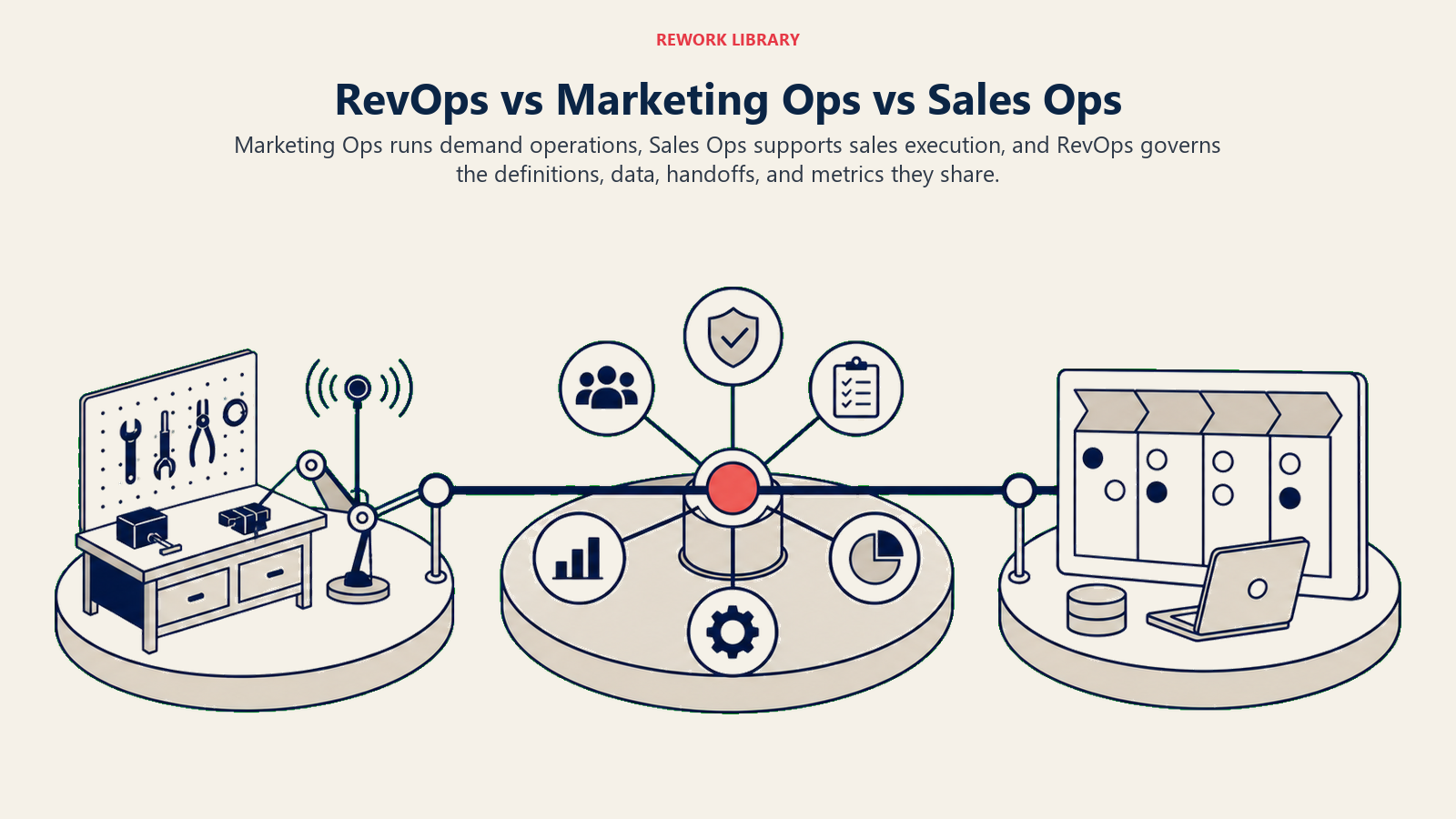
Marketing Ops optimizes demand, Sales Ops optimizes selling, and RevOps governs the shared revenue lifecycle across functions.
Turn this article into takeaways for your work.


Each assistant summarizes the article only for you and suggests best practices for your work.
| Function | Primary scope | Main customer | Core metrics |
|---|---|---|---|
| Marketing Ops | Campaigns, marketing automation, attribution, lead capture | CMO and demand team | Source conversion, campaign ROI, MQL quality |
| Sales Ops | Sales process, territories, quotas, pipeline, rep productivity | VP Sales and sales team | Quota attainment, pipeline hygiene, win rate, forecast inputs |
| RevOps | Full revenue lifecycle, shared data, handoffs, governance | CRO, CEO, finance, GTM leaders | Funnel conversion, velocity, forecast quality, retention, data quality |
For the narrower two-way comparison, see RevOps vs Sales Ops.
Decision-rights split
The practical difference shows up in decision rights.
| Decision | Marketing Ops | Sales Ops | RevOps |
|---|---|---|---|
| Campaign tracking setup | Responsible | Informed | Governs source standards |
| Lead scoring criteria | Responsible with sales input | Consulted | Governs lifecycle impact |
| Territory or routing changes | Consulted | Responsible | Governs shared rules and SLA |
| Opportunity stage definitions | Informed | Responsible | Governs consistency and reporting |
| Executive dashboard metrics | Consulted | Consulted | Accountable with finance |
| CRM field governance | Consulted | Consulted | Accountable for shared data model |
| Closed-won handoff fields | Informed | Responsible with CS | Governs workflow and completeness |
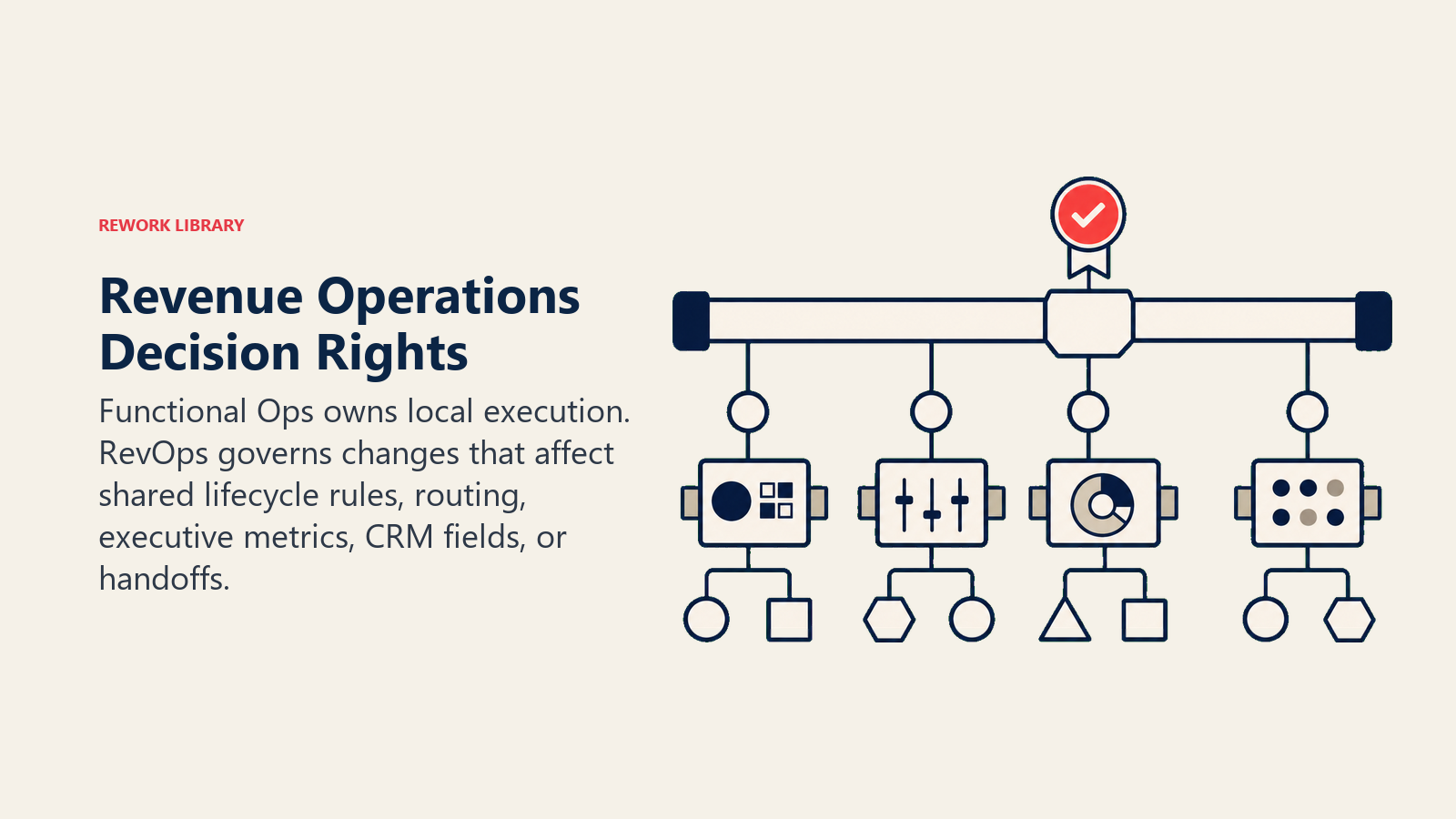
This split prevents the common mistake of treating RevOps as a bigger name for Sales Ops. RevOps should not pull every local task into a central team. It should govern the shared operating layer that local teams depend on.
What Marketing Ops owns
Marketing Ops owns the operating layer for demand creation.
Typical responsibilities include:
- Marketing automation platform administration
- Campaign tracking and UTM governance
- Lead source definitions
- Form strategy and capture rules
- Lead scoring inputs
- Email operations
- Attribution reporting
- Marketing database hygiene
- Consent and subscription workflows
Marketing Ops is critical because demand data enters the revenue system before sales ever sees it. If source fields are inconsistent, forms capture the wrong data, or scoring rules are stale, every downstream report is weaker.
Marketing Ops connects closely to Lead Management, Lead Scoring Systems, and Marketing-Sales Alignment.
What Sales Ops owns
Sales Ops owns the operating layer for sales execution.
Typical responsibilities include:
- CRM sales process
- Opportunity stages
- Territory rules
- Quota support
- Forecast rollups
- Sales tooling
- Rep productivity reporting
- Pipeline hygiene
- Deal approval support
Sales Ops becomes essential once the sales team needs repeatability. Clear territories, stage discipline, quota planning, and pipeline inspection cannot live in someone's head forever.
Sales Ops connects closely to Sales Quota, Quota Attainment, and Forecasting Fundamentals.
Salesforce research has reported that reps spend only a minority of their time selling. That is one reason Sales Ops work matters: process, tooling, and CRM discipline affect rep capacity directly.
What RevOps owns
RevOps owns the shared system.
It does not replace Marketing Ops or Sales Ops. It governs the definitions, handoffs, systems, dashboards, and cadence that make those functions work together.
Typical responsibilities include:
- Revenue lifecycle definitions
- Cross-functional SLAs
- Source-of-truth rules
- CRM, MAP, CS, billing, and BI alignment
- Shared funnel dashboards
- Forecast governance
- Closed-won handoff governance
- Retention and expansion visibility
Forrester's revenue operations responsibility model frames RevOps around alignment across the growth engine. That is the difference. Marketing Ops and Sales Ops optimize functions. RevOps optimizes the operating system between functions.
Where the functions overlap
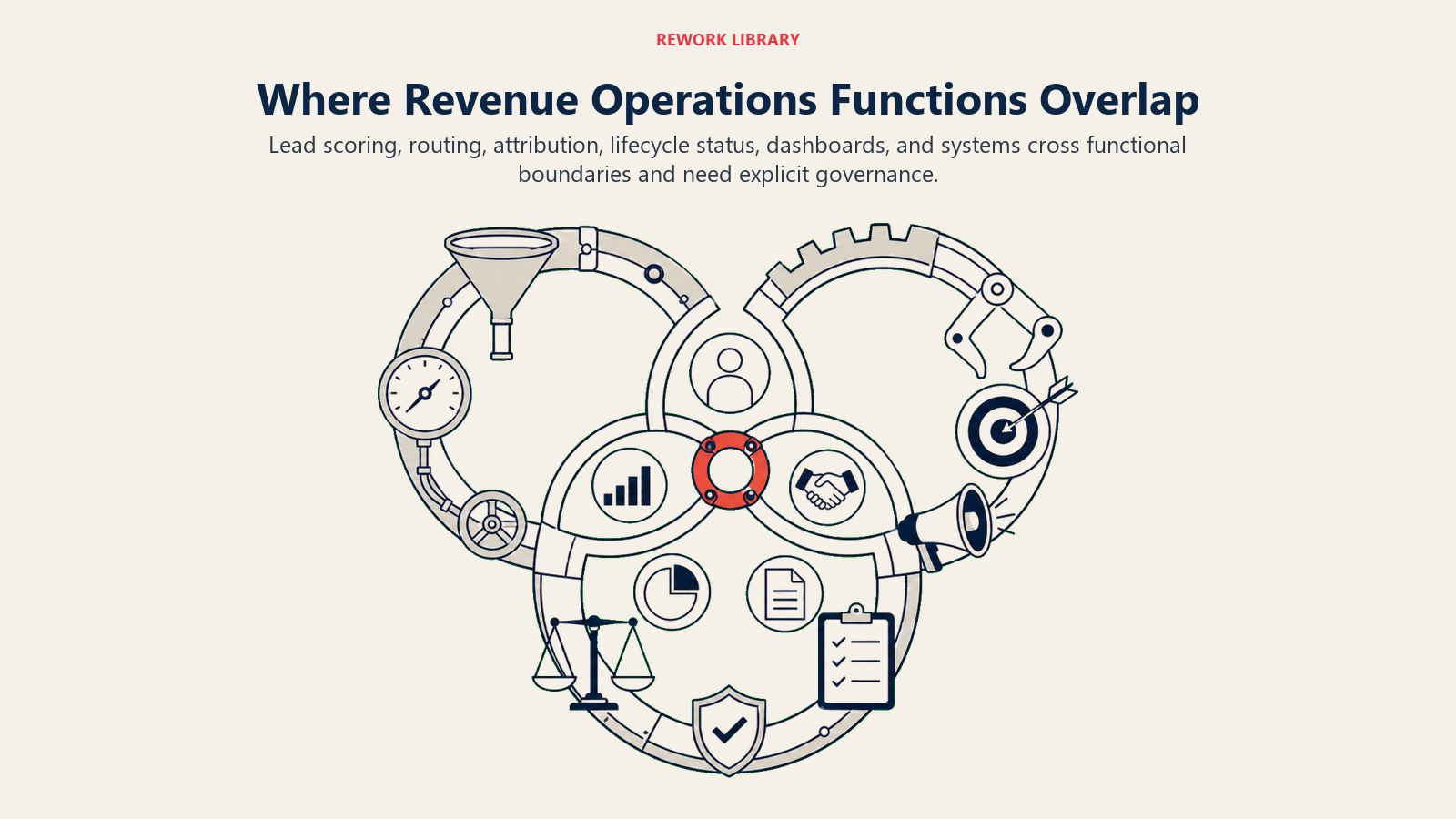
The overlap is where most confusion happens.
| Topic | Marketing Ops role | Sales Ops role | RevOps role |
|---|---|---|---|
| Lead scoring | Operates scoring inputs and campaign signals | Gives feedback on sales acceptance | Governs definition, review cadence, and conversion impact |
| Lead routing | Captures source and form data | Manages rep capacity or territory logic | Owns routing rules across fit, speed, and fairness |
| Attribution | Tracks campaigns and source data | Ensures opportunities preserve source context | Defines source-to-revenue model with finance |
| Lifecycle status | Manages early-stage statuses | Manages opportunity stages | Governs full lifecycle definitions |
| Dashboards | Marketing performance | Sales performance | Shared revenue performance |
| Systems | MAP and campaign tools | CRM sales workflows | Cross-system architecture and source of truth |
The functions should not fight for territory. They should define decision rights.
Example: lead scoring. Marketing Ops may build and operate the scoring model. Sales Ops may care about whether scored leads convert to pipeline. RevOps should govern the definition, acceptance process, reporting, and change cadence.
Example: attribution. Marketing Ops may own campaign tracking. Sales Ops may own opportunity source fields. Finance may care about revenue credit. RevOps should define the source-of-truth model so the company does not run three versions of ROI.
Example: lifecycle status. Marketing Ops may update early statuses. Sales Ops may update opportunity stages. CS Ops may update customer health or renewal statuses. RevOps should govern the full lifecycle map.
A practical ownership matrix
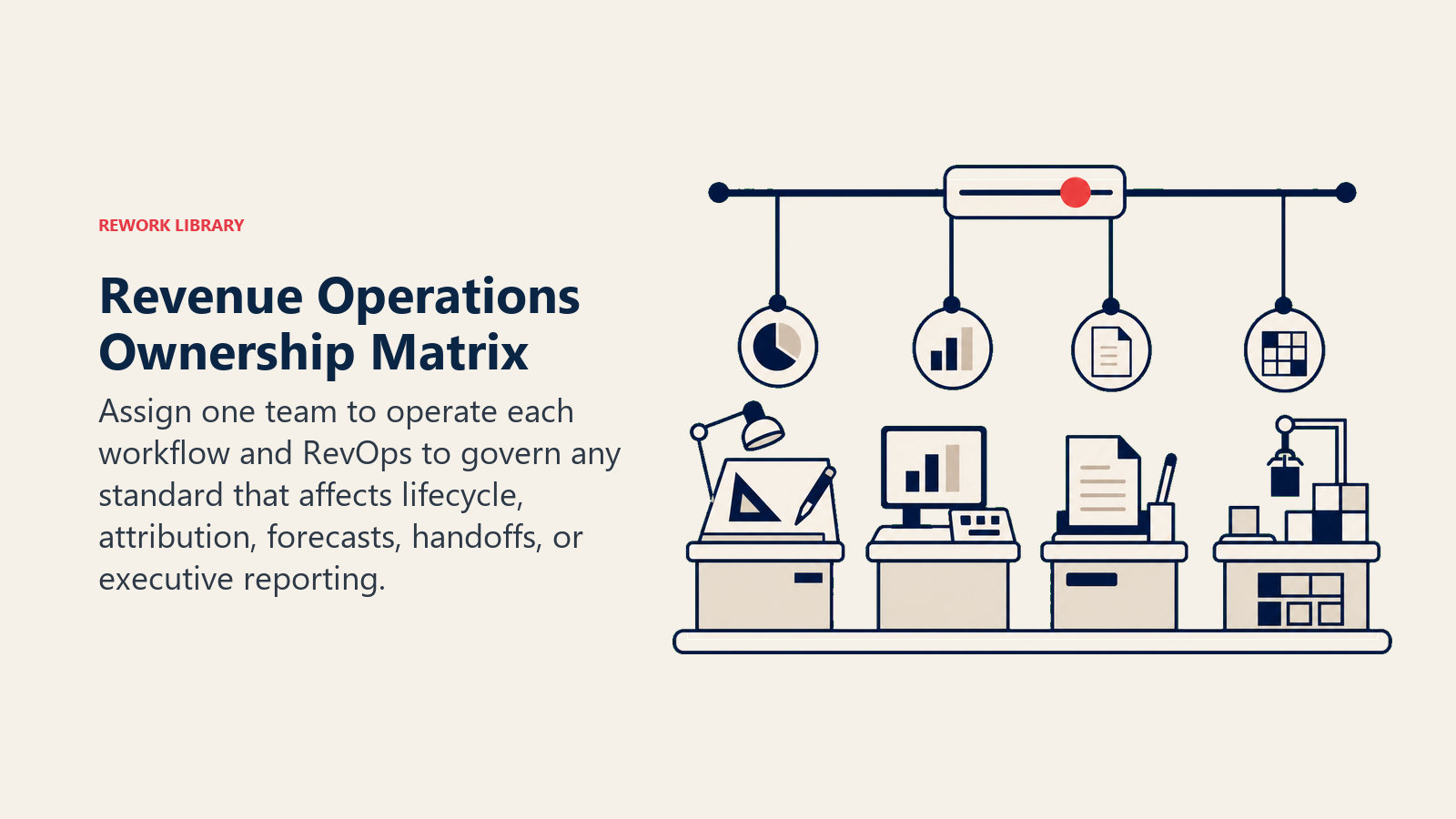
The cleanest way to prevent conflict is to separate operation from governance.
| Work item | Operates day to day | Governs shared standard |
|---|---|---|
| Campaign source tracking | Marketing Ops | RevOps |
| Form fields | Marketing Ops | RevOps if fields affect routing or reporting |
| Lead scoring inputs | Marketing Ops | RevOps with Sales input |
| Lead routing rules | RevOps or Sales Ops | RevOps |
| Opportunity stages | Sales Ops | RevOps with Sales leadership |
| Forecast categories | Sales Ops and Finance | RevOps with CRO and Finance |
| Closed-won handoff | Sales Ops and CS Ops | RevOps |
| Executive revenue dashboard | RevOps analytics | RevOps and Finance |
This structure lets functional teams keep speed while protecting the shared revenue model. Marketing Ops should not need a committee to adjust a campaign naming convention. Sales Ops should not need RevOps approval to fix a rep view. But if the change affects lifecycle, attribution, forecast, or handoff, it needs governance.
Example: the MQL definition
The MQL definition is a useful test case because it touches all three functions.
Marketing Ops may operate the scoring logic in the marketing automation platform. It knows which forms, campaigns, content offers, and engagement signals contribute to the score. Sales Ops sees whether accepted leads become real pipeline. RevOps should own the definition review cadence and the system-level answer: does this definition create qualified pipeline at an acceptable rate?
If marketing changes the score threshold alone, sales may see lead quality drop. If sales changes acceptance expectations alone, marketing may lose a stable target. If RevOps owns the operating cadence, both teams can review acceptance rate, rejection reasons, conversion, and source quality from the same data.
That is the role of RevOps. It does not replace Marketing Ops or Sales Ops. It prevents shared definitions from drifting between them.
Example: attribution
Attribution creates similar tension.
Marketing Ops is usually closest to campaign tracking. Sales Ops is closest to opportunity creation and source fields. Finance is closest to revenue recognition and board reporting. If each team defines attribution locally, every revenue meeting turns into a methodology debate.
RevOps should define the source-to-revenue model:
- Which system captures original source?
- Which field stores current source?
- How are campaign touches associated with opportunities?
- When can a source field be edited?
- Which dashboard is used for budget decisions?
- How are sourced and influenced pipeline separated?
Once those rules are clear, Marketing Ops can operate campaigns, Sales Ops can maintain opportunity process, and Finance can trust the reporting model.
When each function should lead
Use this decision rule:
- If the work affects only campaign operations, Marketing Ops should lead.
- If the work affects only sales execution, Sales Ops should lead.
- If the work affects shared definitions, data, handoffs, dashboards, or systems across functions, RevOps should lead.
That rule sounds simple, but it prevents many operating disputes.

If marketing wants to change a form field used only for campaign segmentation, Marketing Ops can own it. If that field affects lead routing, scoring, SDR workflow, or pipeline attribution, RevOps should govern the change.
If sales wants a new opportunity field for manager coaching, Sales Ops can own it. If finance uses that field in forecast reporting or CS uses it in handoff, RevOps should govern the definition.
Org design options
The best model depends on complexity. A small company may need one practical operator. A larger company may need RevOps plus specialist lanes.
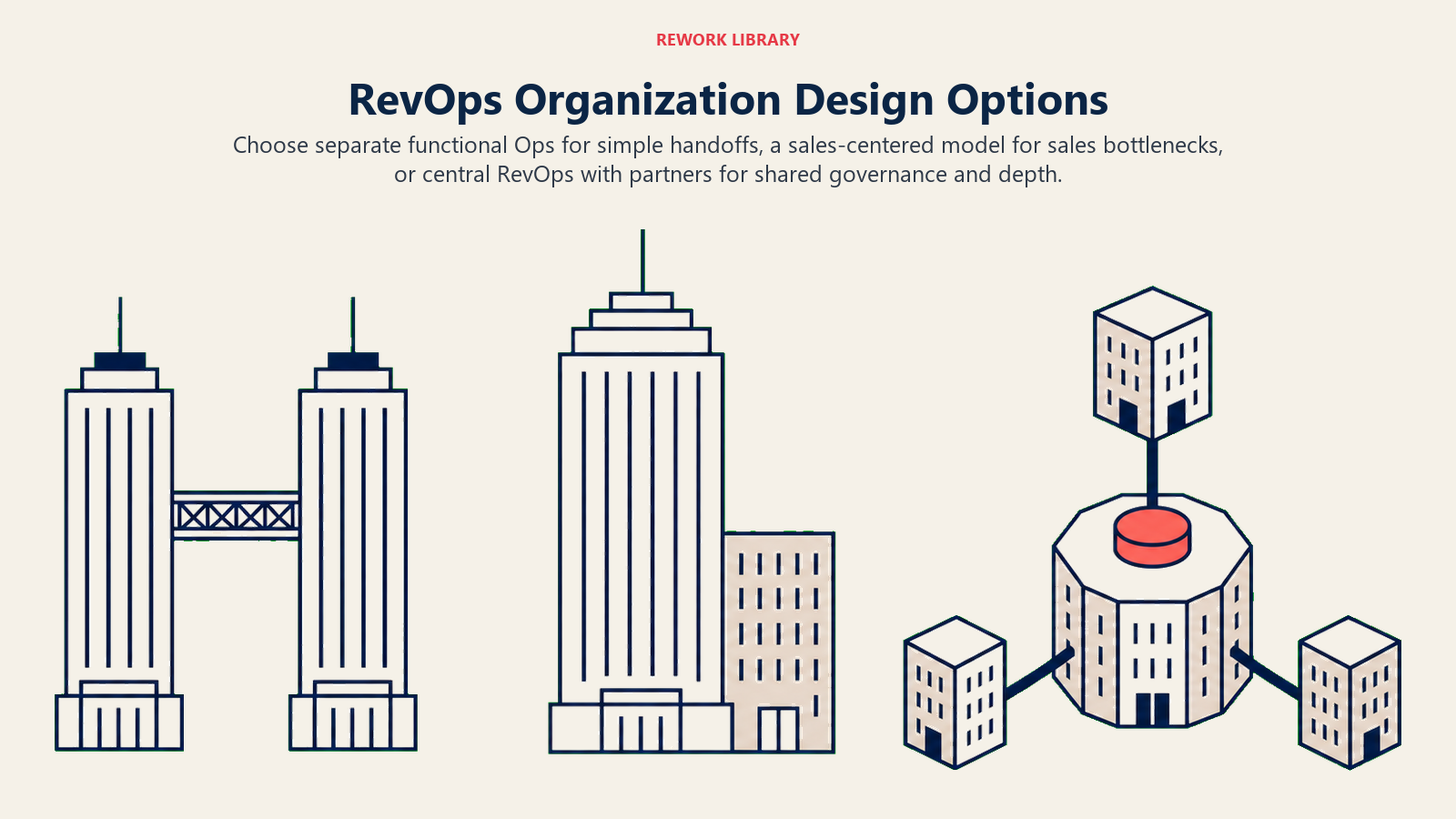
| Model | Works when | Breaks when |
|---|---|---|
| Separate Marketing Ops and Sales Ops | Company is small or handoffs are simple | Definitions drift across teams |
| Sales Ops renamed RevOps | Sales is the main operating bottleneck | Marketing, CS, and finance expect broader ownership |
| Central RevOps with functional partners | Company needs governance and functional depth | Decision rights are not written down |
For org design, see RevOps Team Structure and Centralized vs Embedded RevOps.
Common failure modes
Marketing Ops owns source, Sales Ops owns opportunity, and nobody owns attribution. The result is a source-to-revenue report nobody trusts.
Sales Ops changes CRM fields without marketing context. The field works for pipeline inspection but breaks campaign reporting.
Marketing Ops changes lead scoring without sales acceptance data. The score becomes a marketing metric, not a revenue signal.
RevOps centralizes everything too early. Functional teams lose speed and context, then build workarounds.
RevOps lacks authority. The function is blamed for cross-functional data quality but cannot approve or reject changes.
How to choose the right model
Use operating complexity as the guide.
If the company has one marketer, one sales leader, and no dedicated CS team, separate functions are unnecessary. One operator can handle campaign tracking, CRM hygiene, routing, and reporting.
If the company has meaningful campaign volume and a growing sales team, Marketing Ops and Sales Ops may both be needed. RevOps can start as a governance layer: lifecycle definitions, source-of-truth rules, and shared dashboards.
If the company has marketing, sales, CS, finance, multiple systems, and recurring revenue, RevOps should become a formal operating function. At that point, keeping Marketing Ops and Sales Ops fully separate without governance usually creates conflicting numbers.
For most mid-market companies, the winning model is not "centralize everything." It is central governance plus functional depth.
How to govern overlap without slowing teams
The main fear with RevOps governance is that it will slow every functional team. It should not.
Use a two-lane rule.
| Lane | Examples | Approval path |
|---|---|---|
| Local execution | Campaign naming cleanup, sales manager view, rep list layout, email operations detail | Functional ops owner |
| Shared revenue system | Lifecycle stage, source field, lead scoring definition, routing rule, forecast category, executive dashboard metric | RevOps governance |
This keeps teams fast where the decision is local and disciplined where the decision changes shared truth.
The test is simple: if the change affects another team's workflow, a shared dashboard, finance planning, or customer handoff, it belongs in RevOps governance. If it affects only one team's execution surface, the functional ops owner can move.
Quarterly operating review
The functions should review overlap quarterly, especially when the company changes ICP, channels, sales motion, or systems.
Review:
- Which lifecycle definitions caused debate?
- Which dashboard definitions changed?
- Which source or attribution rules caused confusion?
- Which lead scoring or routing changes affected sales acceptance?
- Which CRM fields were added, removed, or ignored?
- Which handoffs created rework?
- Which functional requests should become shared governance items?
The review should produce a short change log and a decision-rights update if needed. Role clarity decays as the company grows. A quarterly review keeps it current without forcing every small change into a committee.
What changes as the company grows
The right split changes by stage.
Early stage: one operator may cover campaign tracking, CRM cleanup, lead routing, and basic reporting. The danger is over-specialization. The company needs speed and learning more than formal governance.
Growth stage: marketing and sales both need dedicated operating support. This is when Marketing Ops and Sales Ops often split. The danger is definition drift. Each team starts optimizing its own dashboard.
Mid-market stage: RevOps becomes necessary as a governance layer. Marketing Ops, Sales Ops, and CS Ops may still exist, but RevOps owns shared definitions, source-of-truth rules, and revenue cadence.
Enterprise stage: functional specialization increases again. The company may have regional ops, channel ops, product-line ops, sales comp ops, and analytics teams. RevOps becomes more architectural: standards, operating model, data governance, and executive reporting.
The lesson is that maturity does not always mean every operator reports into one team. Maturity means the company knows which decisions are local and which decisions must be governed centrally.
How to prevent role confusion
Document five boundaries:
- Which function owns each system.
- Which function owns each lifecycle stage.
- Which function owns each shared field.
- Which function owns each dashboard definition.
- Which function approves changes that affect multiple teams.
Then review those boundaries quarterly. Role confusion tends to return when the company adds a new channel, changes ICP, buys a new tool, or reorganizes revenue leadership.
The goal is not to make every decision slow. The goal is to keep shared revenue truth from becoming accidental.
Frequently Asked Questions about RevOps vs Marketing Ops vs Sales Ops
Is Marketing Ops part of RevOps?
It can be. In mature companies, Marketing Ops often sits inside RevOps or follows RevOps governance while staying close to the marketing team.
Is Sales Ops part of RevOps?
Often, yes. Sales Ops can be a specialist lane inside RevOps, focused on sales execution while RevOps governs the full revenue system.
Which function should own attribution?
Marketing Ops may operate campaign tracking, but RevOps should govern the shared source-to-revenue model because attribution affects sales, finance, and executive reporting.
Can one person cover all three functions?
Yes, in an early-stage company. But the person still needs to know which hat they are wearing: campaign operations, sales execution, or full-system governance.
Learn more

Senior Operations & Growth Strategist
On this page
- The quick comparison
- Decision-rights split
- What Marketing Ops owns
- What Sales Ops owns
- What RevOps owns
- Where the functions overlap
- A practical ownership matrix
- Example: the MQL definition
- Example: attribution
- When each function should lead
- Org design options
- Common failure modes
- How to choose the right model
- How to govern overlap without slowing teams
- Quarterly operating review
- What changes as the company grows
- How to prevent role confusion
- Learn more