GTM Operations vs Revenue Operations: What Is the Difference?
GTM Operations and Revenue Operations are close enough that many companies use the terms interchangeably.
That is understandable. Both functions deal with process, systems, data, reporting, and cross-functional execution. Both care about marketing, sales, customer success, finance, product signals, and operating cadence.
The difference is emphasis.
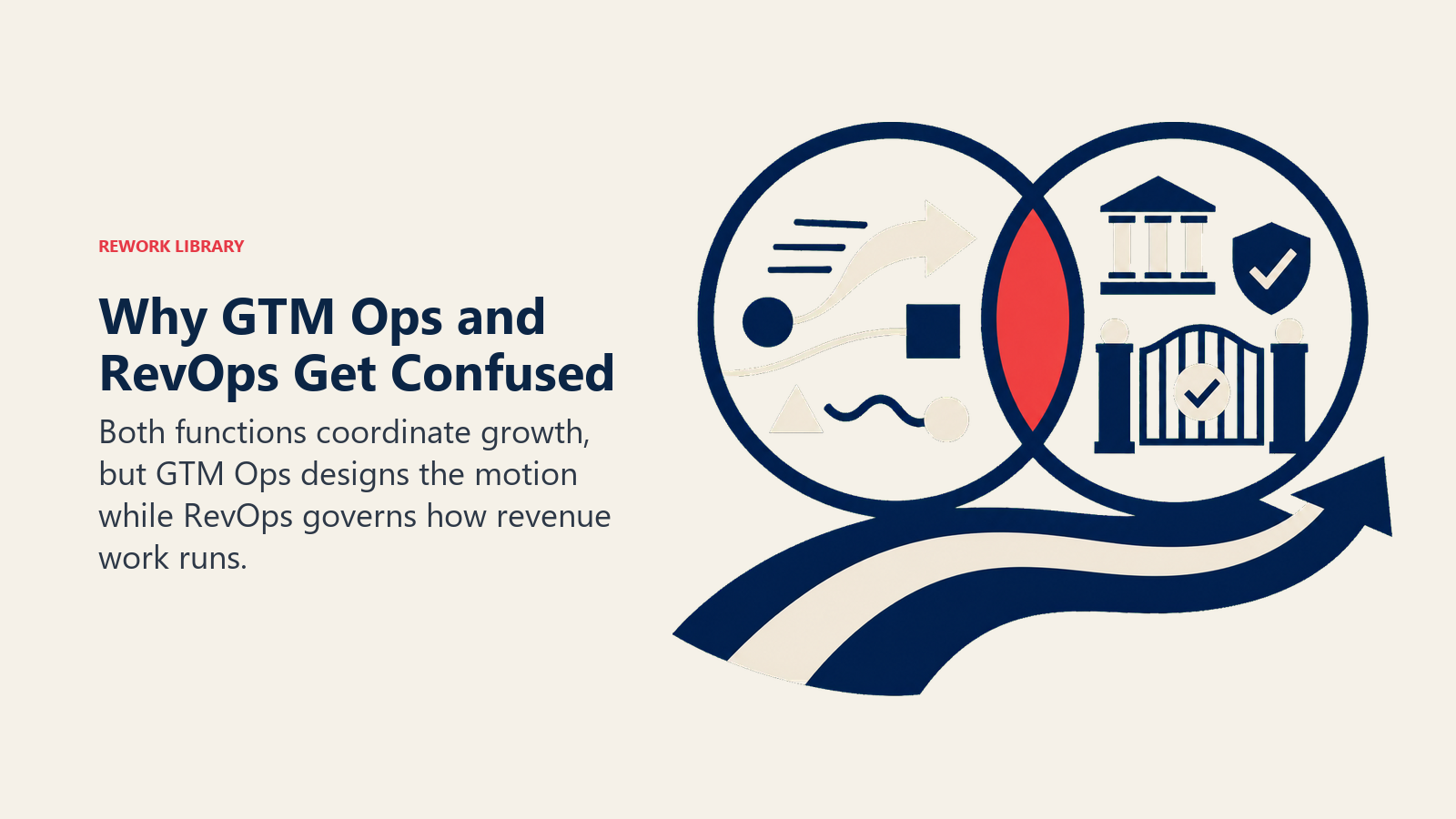
GTM Operations usually covers the operating model for how a company goes to market. Revenue Operations covers the operating system that turns that motion into measurable, inspectable revenue.
In a small company, one person may own both. In a larger company, the distinction matters.
McKinsey's B2B growth research points to the importance of integrated data, analytics, and coordination across commercial teams. GTM Ops and RevOps both support that coordination, but they usually enter from different sides of the problem.
Key operating facts
- GTM Operations is usually closer to market motion: segments, launches, channels, plays, enablement, and execution coordination.
- Revenue Operations is usually closer to revenue system reliability: lifecycle, data, handoffs, systems, metrics, forecast, and cadence.
- In smaller companies, one operator may own both. In larger companies, the difference matters because GTM change and revenue governance need different rhythms.
- The two functions should share definitions and operating cadence. GTM Ops should not create motion-specific reporting that breaks revenue source of truth.
Simple definitions
Go-to-market operations is the operating discipline that supports market strategy, segmentation, motion design, launch planning, channel coordination, enablement, and cross-functional GTM execution.
Revenue operations is the operating discipline that governs lifecycle stages, revenue data, handoffs, systems, metrics, forecast quality, and revenue cadence from first touch to renewal.
GTM Ops is closer to market motion. RevOps is closer to revenue system reliability.
Side-by-side comparison
| Dimension | GTM Operations | Revenue Operations |
|---|---|---|
| Core question | How do we execute our market motion? | How do we run and improve the revenue system? |
| Scope | Segments, motions, launches, channels, enablement | Funnel, data, handoffs, dashboards, cadence, forecast |
| Primary partners | Product, marketing, sales, enablement, partnerships | Marketing, sales, CS, finance, systems, analytics |
| Operating horizon | Campaigns, launches, segment plays, GTM planning | Weekly, monthly, quarterly revenue operations |
| Success signal | GTM execution is coordinated | Revenue performance is measurable and improvable |
The two functions should not fight for territory. They should clarify handoffs.
Where the handoff happens
The cleanest split is between motion design and revenue governance.
| Work | GTM Ops emphasis | RevOps emphasis |
|---|---|---|
| New segment launch | Segment plan, ICP, channels, play design | Lifecycle fields, routing, reporting, attribution |
| Product launch | Launch process, enablement, campaign coordination | Pipeline tracking, handoff rules, dashboard definitions |
| Partner motion | Partner workflow and field execution | Source rules, ownership, forecast treatment |
| Expansion play | Account motion and messaging | Trigger rules, owner model, expansion pipeline criteria |
| Annual planning | Market coverage and motion design | Capacity, forecast assumptions, funnel math, data model |
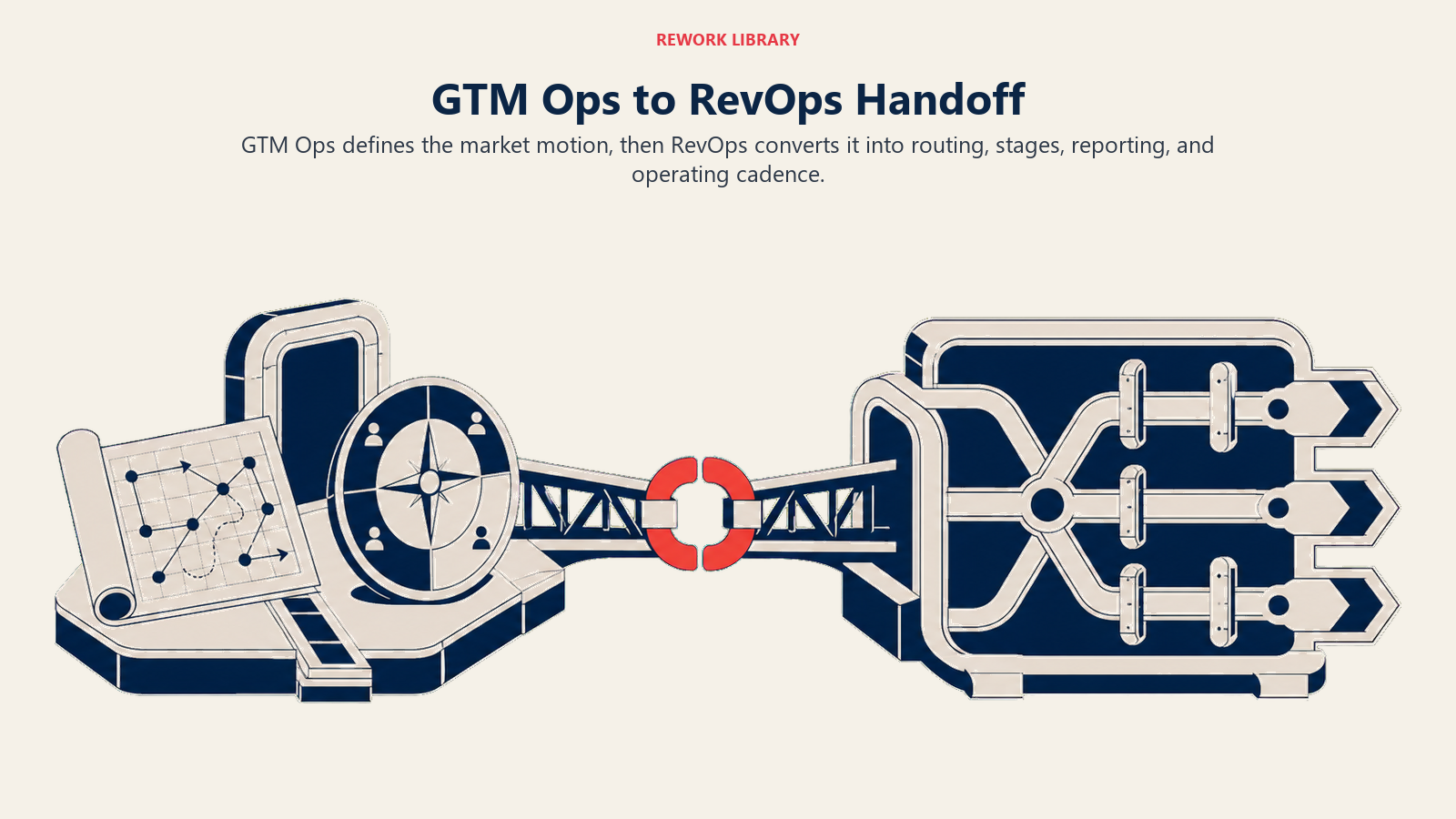
The handoff should be explicit. GTM Ops may design a new motion, but RevOps should define how that motion enters systems, reporting, and revenue cadence. Without that handoff, every new motion becomes a custom reporting problem later.
Why the terms get confused
The terms get confused because both functions show up when the company outgrows informal coordination.
A founder-led company does not need a separate name for GTM Ops or RevOps. The founder, sales lead, and marketer talk every day. The CRM is simple. The product line is narrow. Everyone knows the target customer.
Turn this article into takeaways for your work.


Each assistant summarizes the article only for you and suggests best practices for your work.
As the company scales, that stops working. Segments multiply. Campaigns grow. Sales motions split. Customer success adds renewal and expansion processes. Finance needs more predictable reporting. Product launches require more coordination.
At that point, teams start using labels like GTM Ops and RevOps to describe the operating work that used to happen informally. The danger is adopting the label before defining the mandate.
If the company needs better launch execution, segment plays, enablement, and market coordination, it is probably talking about GTM Ops. If it needs cleaner lifecycle stages, CRM data, forecast governance, attribution, and revenue cadence, it is probably talking about RevOps.
Where they overlap
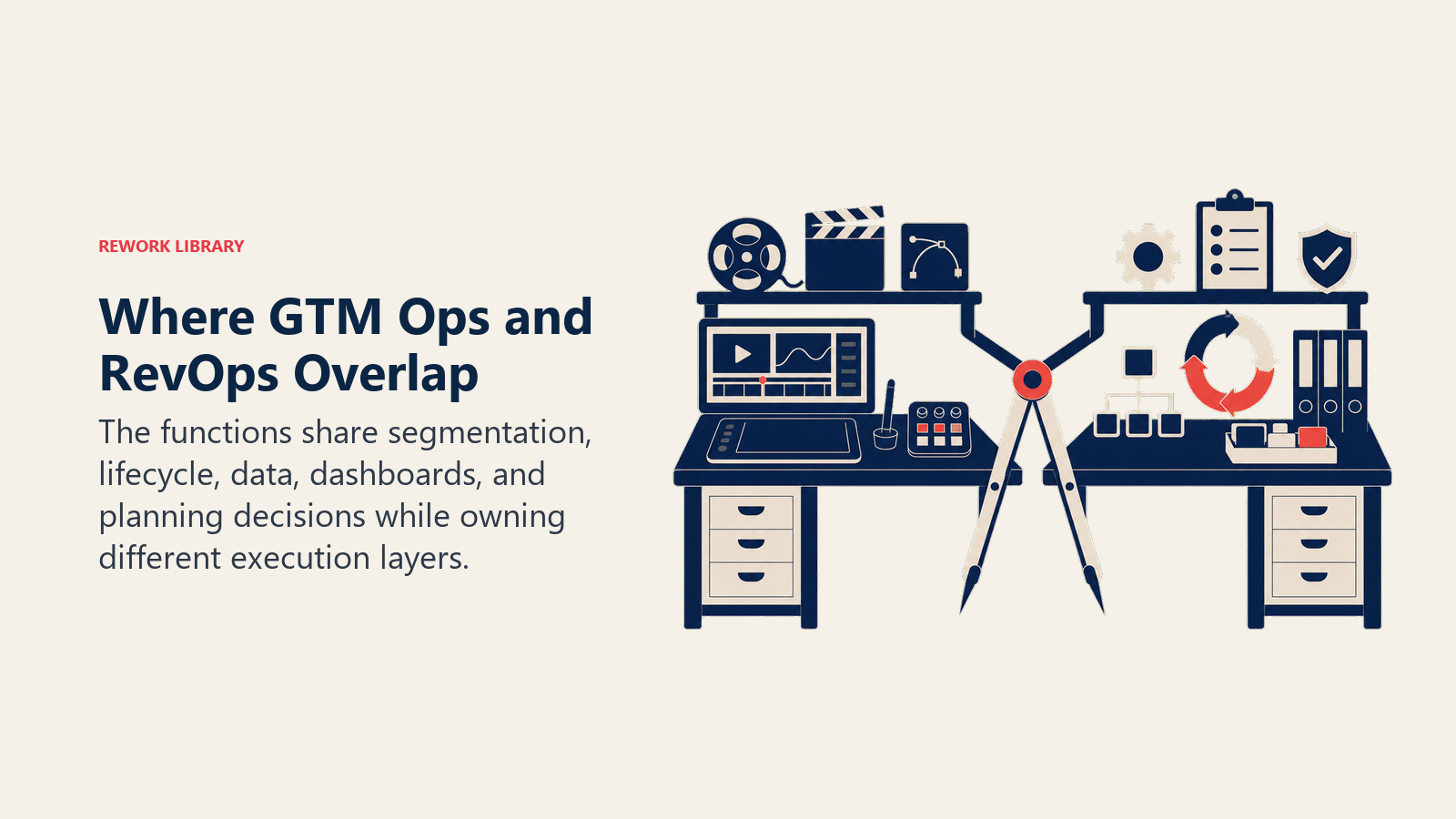
They overlap on segmentation, lifecycle design, data, dashboards, and planning.
For example, GTM Ops may help define a new mid-market motion. RevOps then updates lead routing, lifecycle rules, pipeline stages, forecast categories, dashboards, and handoff requirements to support that motion.
If the company launches a partner channel, GTM Ops may define the partner motion and launch plan. RevOps governs how partner-sourced leads enter the CRM, how attribution works, how pipeline is forecast, and how closed-won partner customers are handed off.
If the company changes pricing and packaging, GTM Ops may coordinate launch readiness, enablement, and market messaging. RevOps should update product fields, quote workflows, deal approval rules, pipeline reporting, and revenue dashboards.
This is why a strong Revenue Operations Framework starts with revenue strategy. RevOps cannot govern the system if GTM strategy is unclear.
A handoff example
Suppose the company creates a new enterprise motion.
GTM Ops should help answer:
- Which accounts are in the enterprise segment?
- What is the sales play?
- Which messages and proof points matter?
- Which channels will create demand?
- What enablement does the field need?
- How will launch readiness be tracked?
RevOps should help answer:
- How are enterprise accounts tagged in the CRM?
- How are leads routed?
- Which lifecycle stages apply?
- What fields are required before opportunity creation?
- How will pipeline coverage be measured?
- How will enterprise deals be forecast?
- What handoff data does CS need after close?
Both sets of questions matter. Mixing them together creates confusion. Separating them creates a cleaner operating model.
When to use GTM Operations
Use GTM Operations when the biggest problem is market execution.
Common triggers:
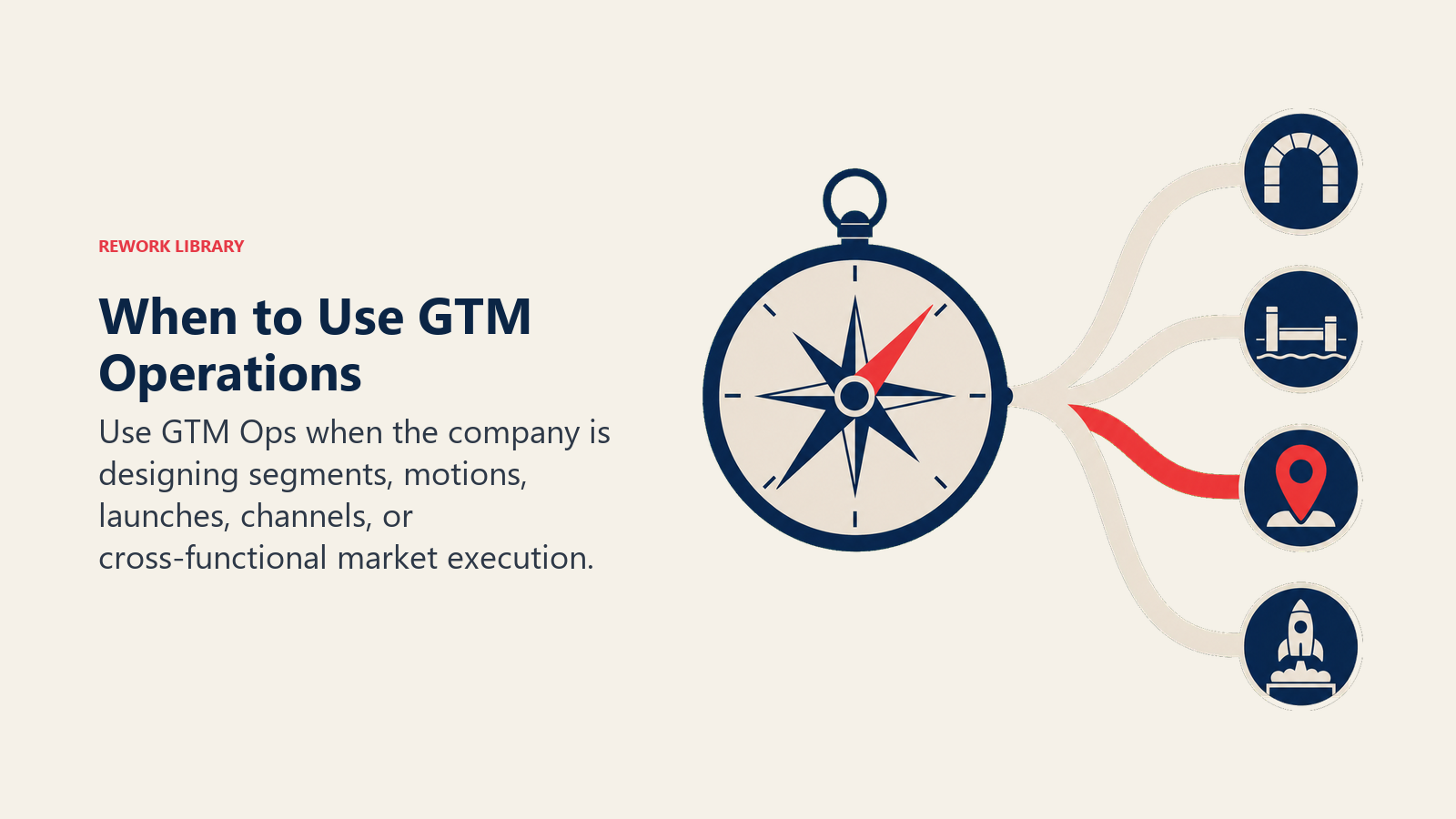
- Multiple segments need different motions.
- Product launches require better cross-functional coordination.
- Partnerships or channels are becoming important.
- Sales, marketing, and product need a shared launch process.
- Enablement content and field execution are inconsistent.
- Regional or vertical plays need repeatable operating support.
GTM Ops is especially useful when the company is changing where or how it sells.
Example: the company decides to move from founder-led SMB sales into mid-market account-based selling. GTM Ops can coordinate ICP definition, account selection, launch plan, enablement, messaging, channel mix, and field readiness.
RevOps then makes sure the operating system supports that motion: account tiers, routing rules, lifecycle stages, CRM fields, dashboards, and pipeline inspection.
When to use Revenue Operations
Use Revenue Operations when the biggest problem is system reliability.
Common triggers:
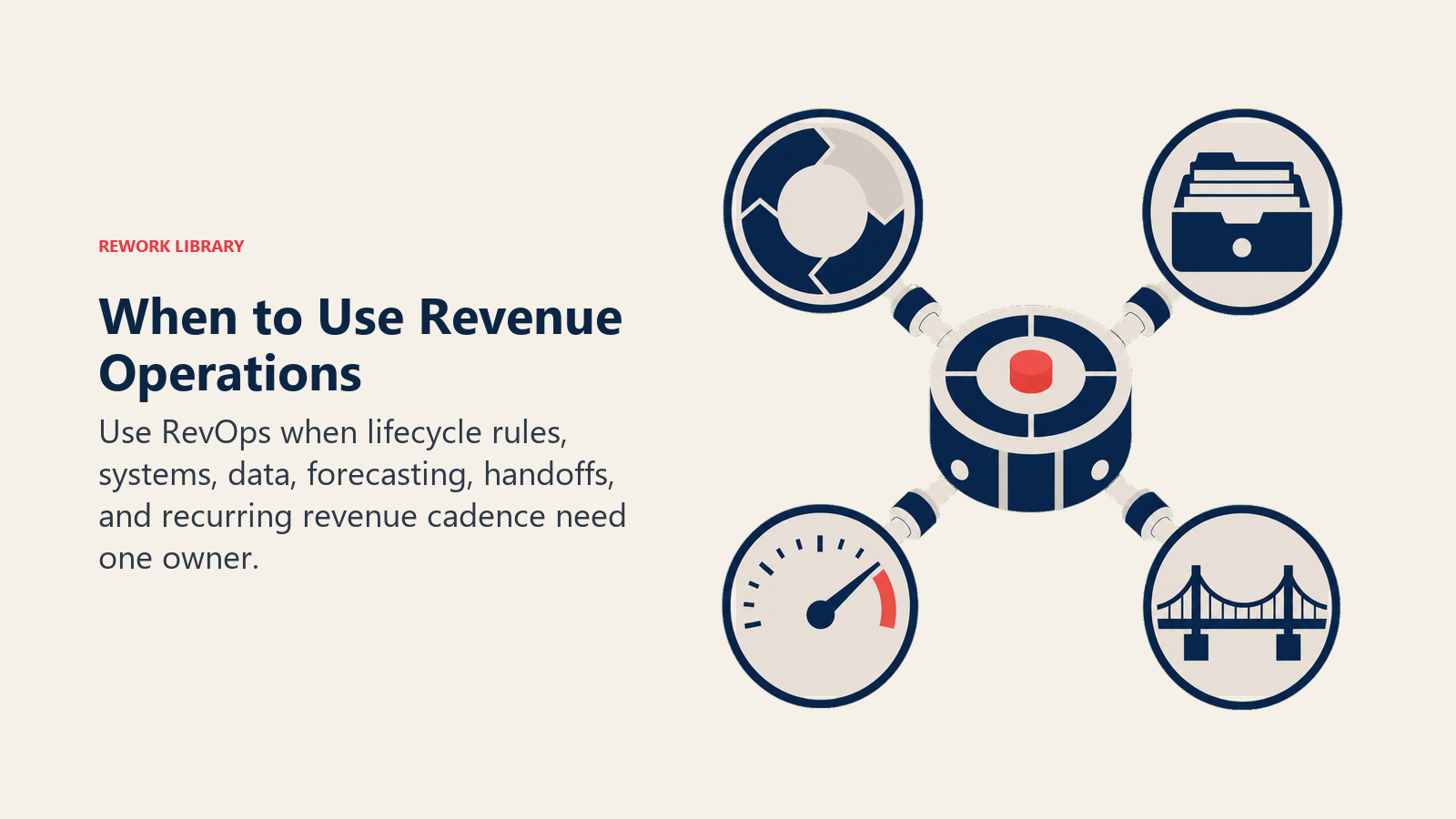
- Lead stages are unclear.
- Forecasts are not trusted.
- CRM data quality is weak.
- Marketing and sales debate attribution.
- Sales and CS handoffs are incomplete.
- Leadership cannot see one revenue view.
- Finance rebuilds revenue reporting outside the CRM.
- Tooling changes break downstream reports.
These are RevOps problems because they affect the measurable revenue operating system.
Gartner describes RevOps as an end-to-end model that unifies engagement across functions and integrates people, process, and technology. That is a system reliability mandate.
The best structure
For most companies between 20 and 500 employees, one RevOps function can cover GTM operating needs if the company is not running many product lines, regions, or channels.
As complexity grows, a GTM Ops partner may sit close to strategy and launches while RevOps owns the durable revenue system.
The clean rule:
- GTM Ops designs how the company goes to market.
- RevOps governs how that motion turns into revenue data, workflows, and decisions.
When the same person owns both
In many companies, the same operator owns both. That can work if the person separates strategic GTM coordination from revenue system governance.
The risk is priority conflict. Launches are urgent and visible. Systems governance is quieter but durable. If one person owns both, urgent GTM work can crowd out CRM hygiene, forecast governance, or handoff quality.
The fix is a visible operating roadmap. Split the roadmap into two lanes:
- GTM execution: launches, segment plays, enablement, account motions
- Revenue system: lifecycle, data, routing, dashboards, forecast, cadence
That way leaders can see when GTM urgency is consuming RevOps capacity.
Metrics that separate the functions
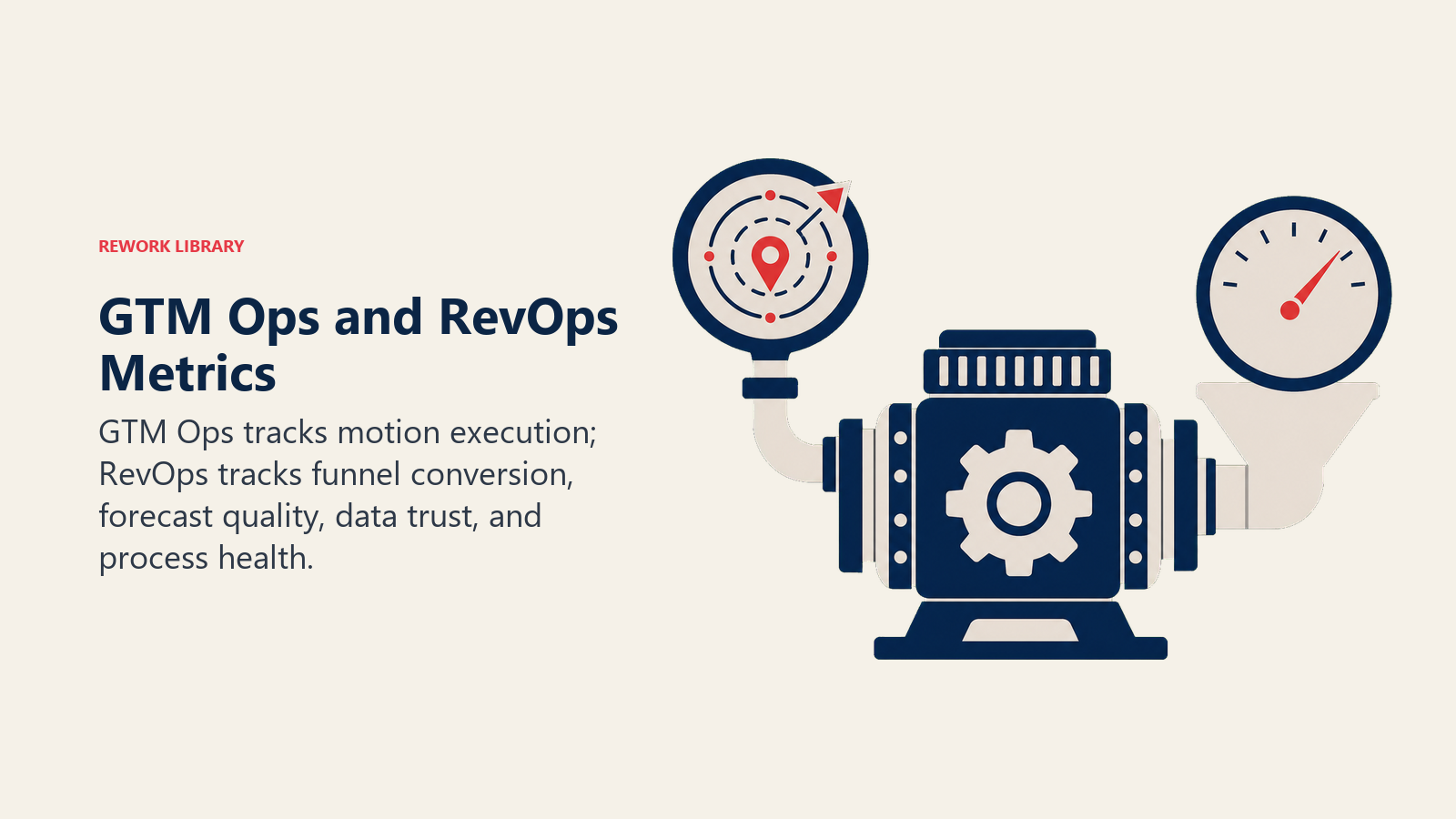
The metrics also show the difference.
GTM Ops often tracks:
- Launch readiness
- Segment play adoption
- Account coverage
- Sales play usage
- Enablement completion
- Campaign readiness
- Channel activation
RevOps tracks:
- Funnel conversion
- Pipeline velocity
- Pipeline coverage
- Forecast accuracy
- SLA compliance
- CRM completeness
- Handoff quality
- Retention and expansion visibility
Some metrics overlap. For example, a new enterprise motion may be judged by pipeline created, opportunity conversion, and sales cycle. GTM Ops cares because those numbers show whether the motion is working. RevOps cares because those numbers must be defined, captured, and reported consistently.
That distinction is useful. GTM Ops asks whether the motion should change. RevOps asks whether the system can measure and operate the motion reliably.
Common operating conflicts
GTM wants speed, RevOps wants governance. A launch team may want a new field, route, or dashboard immediately. RevOps needs to protect definitions and downstream reporting. The solution is a lightweight launch intake process, not ad hoc changes.
GTM defines the segment, RevOps maintains it. If the ICP or segment model changes, RevOps needs a clean data rule. Otherwise the strategy exists in slides but not in the CRM.
GTM launches a play, RevOps measures it differently. The launch plan should define measurement before launch. Waiting until after launch usually creates attribution debates.
RevOps gets treated as launch support only. RevOps can help with launches, but if launch work consumes all capacity, the durable revenue system degrades.
A simple operating agreement
Create an agreement between GTM Ops and RevOps:
- GTM Ops owns motion design and launch coordination.
- RevOps owns system readiness and data capture.
- Both agree on success metrics before launch.
- RevOps signs off on fields, routing, dashboards, and integrations.
- GTM Ops signs off on play design, enablement, and field rollout.
This agreement keeps market execution and revenue governance connected without making them the same job.
What happens when the agreement is missing
Without an operating agreement, teams usually make local changes under launch pressure.
Marketing creates a new campaign source naming pattern. Sales adds a new account tier. A RevOps analyst creates a temporary dashboard for the launch. Finance later asks why the launch pipeline does not reconcile with the bookings report. Nobody made a bad decision on purpose. The problem is that the motion changed faster than the operating system.
This is the core reason GTM Ops and RevOps need to work together. GTM strategy changes the shape of revenue work. RevOps makes sure the system can absorb that change.
Before any major launch, ask:
- Which CRM fields need to change?
- Which dashboards will measure the motion?
- Which routing rules are affected?
- Which lifecycle stages apply?
- Which teams need new handoff rules?
- Which reports will finance use?
If those questions are answered before launch, the GTM motion is easier to inspect after launch.
Where product fits
Product often sits closer to GTM Ops than RevOps during launch planning, but product data eventually becomes RevOps data.
Feature adoption, usage milestones, activation, plan limits, and expansion triggers all matter after the customer enters the revenue system. GTM Ops may help launch the motion. RevOps needs to govern how those signals appear in customer health, renewal, and expansion workflows.
This is especially important for SaaS companies where the line between acquisition, onboarding, adoption, and expansion is continuous.
Decision table
| Problem | Better owner |
|---|---|
| New product launch readiness | GTM Ops |
| Lead source values do not match closed-won reporting | RevOps |
| Segment-specific sales play rollout | GTM Ops with Sales leadership |
| Pipeline coverage by segment | RevOps with Sales and Finance |
| Partner channel launch | GTM Ops and RevOps together |
| Forecast category definitions | RevOps |
| Account-based campaign operating plan | GTM Ops with Marketing Ops |
| Routing rules for target accounts | RevOps |
The more the problem touches durable systems of record, lifecycle definitions, and executive reporting, the more RevOps should govern it.
Decision table takeaway
GTM Operations and Revenue Operations should not compete for identity. GTM Operations helps the company design and run the go-to-market motion. Revenue Operations makes the full revenue system measurable, governed, and trustworthy across acquisition, sales, retention, expansion, finance, and systems.
The distinction matters because leadership needs both motion design and operating discipline. If the company has launches, segments, and channel execution complexity, GTM Ops may need dedicated focus. If the company has funnel definitions, source-of-truth, forecast, handoff, and reporting trust problems, RevOps should own the operating system.
That boundary should be explicit in planning.
Otherwise the same team gets pulled between launch execution and system governance without enough capacity for either job.
Ownership by company stage
GTM Ops and RevOps often split as complexity grows.
| Stage | Better operating model | Reason |
|---|---|---|
| Founder-led go-to-market | One operator or founder-owned ops | Too early to split motion design from revenue governance |
| First repeatable sales motion | Sales Ops or GTM generalist | Sales process and market learning matter most |
| Marketing plus sales engine | GTM Ops with RevOps-style governance | Campaigns, lead flow, and sales handoffs now share data |
| Recurring revenue with CS | RevOps becomes more important | Renewal, expansion, and customer handoff affect revenue quality |
| Multi-segment company | GTM Ops and RevOps may both exist | Launch motions and revenue system governance are both large enough to own separately |
The split should follow the work. If the company is still discovering the motion, GTM Ops may lead more. If the company is trying to make a known motion predictable across teams, RevOps should lead more.
Shared decision review
Some decisions need both functions.
Use a joint review when the decision changes:
- ICP or segment focus.
- Channel mix.
- Lead qualification rules.
- Routing and territory design.
- Opportunity stage definitions.
- Expansion ownership.
- Forecast categories.
- Executive revenue dashboard metrics.
GTM Ops can explain why the motion is changing. RevOps can explain what the change will do to systems, handoffs, dashboards, and planning. The best decisions include both views.
Frequently Asked Questions about GTM Operations vs Revenue Operations
Is GTM Ops the same as RevOps?
Not exactly. They overlap, but GTM Ops focuses more on market execution and motion design, while RevOps focuses more on revenue system governance.
Which one should a startup hire first?
Most startups should hire a RevOps-minded operator first, because CRM hygiene, lead routing, pipeline visibility, and handoffs become painful before formal GTM Ops is needed.
Can one team own both?
Yes. Many growth-stage companies use one RevOps team to cover both GTM operating support and revenue system governance.
When does GTM Ops deserve a separate function?
Create separate GTM Ops when the company has multiple launches, segments, channels, regions, or product lines that need coordinated market execution beyond the RevOps team's operating capacity.
Learn more

Senior Operations & Growth Strategist
On this page
- Simple definitions
- Side-by-side comparison
- Where the handoff happens
- Why the terms get confused
- Where they overlap
- A handoff example
- When to use GTM Operations
- When to use Revenue Operations
- The best structure
- When the same person owns both
- Metrics that separate the functions
- Common operating conflicts
- A simple operating agreement
- What happens when the agreement is missing
- Where product fits
- Decision table
- Decision table takeaway
- Ownership by company stage
- Shared decision review
- Learn more