RevOps Team Structure: Centralized, Embedded, and Hybrid Models Compared
The same RevOps job title can mean three different things.
At one company, RevOps is a single operator maintaining HubSpot, routing leads, and building the weekly report. At another, RevOps is a centralized department under the CRO with sales ops, marketing ops, CS ops, analytics, and systems all inside it. At a third, RevOps is a governance function while operations specialists stay embedded in marketing, sales, and customer success.
All three can work. All three can fail.
The right RevOps team structure depends on operating complexity: number of revenue teams, sales motions, lifecycle stages, systems, segments, and decision rights. Structure should follow the revenue system, not the other way around.
For the function definition, see What Is Revenue Operations?. For the operating model, see the Revenue Operations Framework.
Forrester's RevOps organizational design research notes that revenue operations can bring together work from marketing, sales, and customer engagement around one aligned purpose. That broad scope is why the structure matters. A team can be called RevOps and still fail if it has no authority over the shared operating layers.
Forrester's RevOps myths analysis also points out that successful structures can range from decentralized to fully centralized. That matters because there is no universal org chart. The structure has to fit the company's operating complexity.
Key operating facts
- RevOps team structure should follow operating complexity: motions, segments, systems, lifecycle stages, and decision rights.
- Centralized teams protect shared standards. Embedded teams protect functional context. Hybrid teams need clear RACI.
- A first RevOps hire should usually be a builder with cross-functional judgment, not only a dashboard owner.
- Team structure should be reviewed when request volume, reporting conflict, system complexity, or handoff risk changes.
What a RevOps team actually owns
Before choosing a structure, define the mandate.
A RevOps team usually owns six areas:
- Process governance across the revenue lifecycle
- Revenue data definitions and quality
- Systems administration or systems governance
- Reporting and analytics
- Operating cadence
- Cross-functional issue resolution
That does not mean RevOps makes every decision. It means RevOps owns the operating system that makes those decisions possible.
For example, marketing owns campaign strategy. Sales owns deal execution. Customer success owns onboarding and retention. RevOps owns the shared lifecycle definitions, CRM fields, handoff requirements, dashboards, and escalation paths that let those teams work from the same system.
Model 1: Centralized RevOps
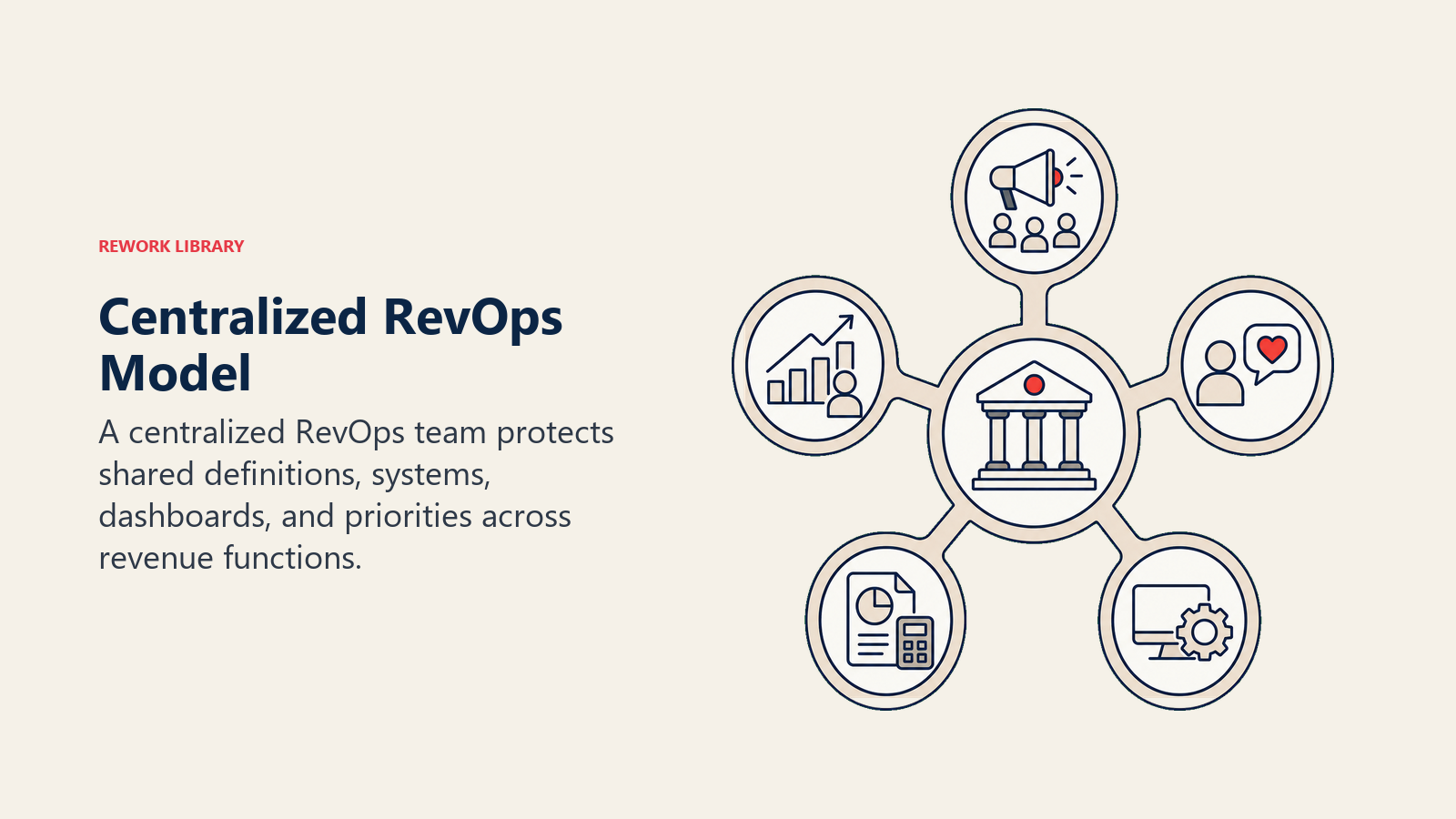
In a centralized model, one RevOps team serves marketing, sales, customer success, finance, and leadership. For a deeper comparison of the tradeoffs, see Centralized vs Embedded RevOps.
Turn this article into takeaways for your work.


Each assistant summarizes the article only for you and suggests best practices for your work.
This structure usually includes a Head of RevOps or RevOps Director, plus specialists for CRM, analytics, marketing ops, sales ops, and customer success ops as the company grows.
Best for: companies that need standardization, one source of truth, and strong system governance.
Strengths:
- Shared definitions are easier to enforce.
- Tooling decisions are less likely to fragment.
- Dashboards can be governed from one source.
- Cross-functional priorities are easier to balance.
- RevOps has a neutral mandate if it reports to the CRO, COO, or CEO.
Risks:
- The team can become a bottleneck.
- Functional teams may feel RevOps is too far from day-to-day reality.
- Ticket queues can consume capacity.
- Specialists may lose context if they are not close to sales, marketing, or CS work.
Centralized RevOps works best when the company has enough complexity to justify standardization and enough leadership support to protect RevOps from becoming only a request queue.
Model 2: Embedded RevOps
In an embedded model, operations specialists sit inside the functions they support. Marketing Ops reports to marketing. Sales Ops reports to sales. CS Ops reports to customer success.
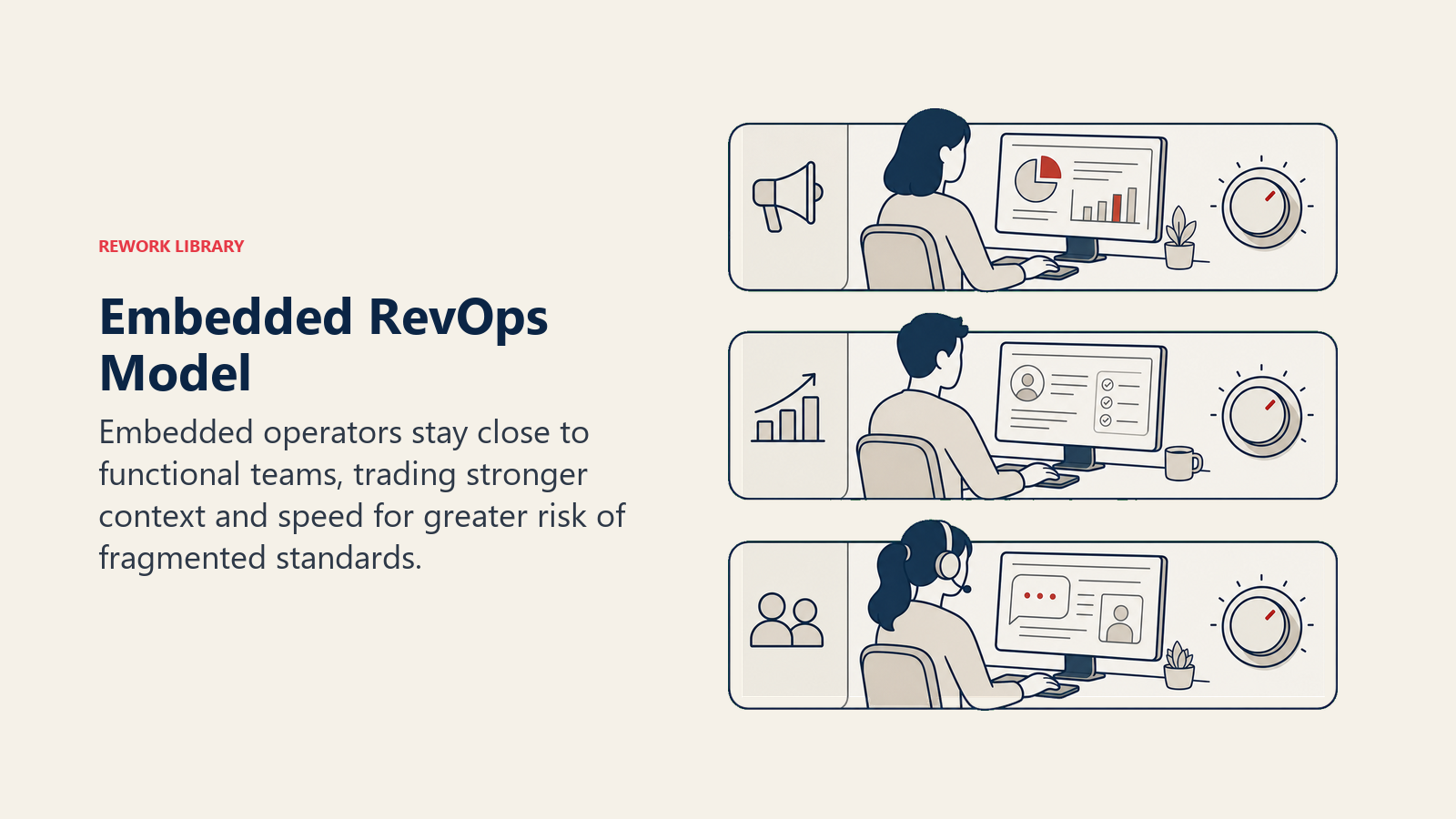
This model is common before companies formally create RevOps.
Best for: speed, functional context, and early-stage teams where each department needs hands-on operating support.
Strengths:
- Operators stay close to the teams they support.
- Requests move quickly.
- Functional nuance is easier to understand.
- Leaders feel direct ownership of their operating capacity.
Risks:
- Definitions fragment.
- Tools multiply.
- Dashboards disagree.
- Cross-functional handoffs lack a neutral owner.
- Each ops person optimizes for their leader's metrics.
Embedded ops can work when the company has strong governance. Without governance, it often creates the exact problem RevOps is meant to solve: every team runs its own version of the funnel.
Model 3: Hybrid RevOps
The hybrid model combines central governance with functional proximity.
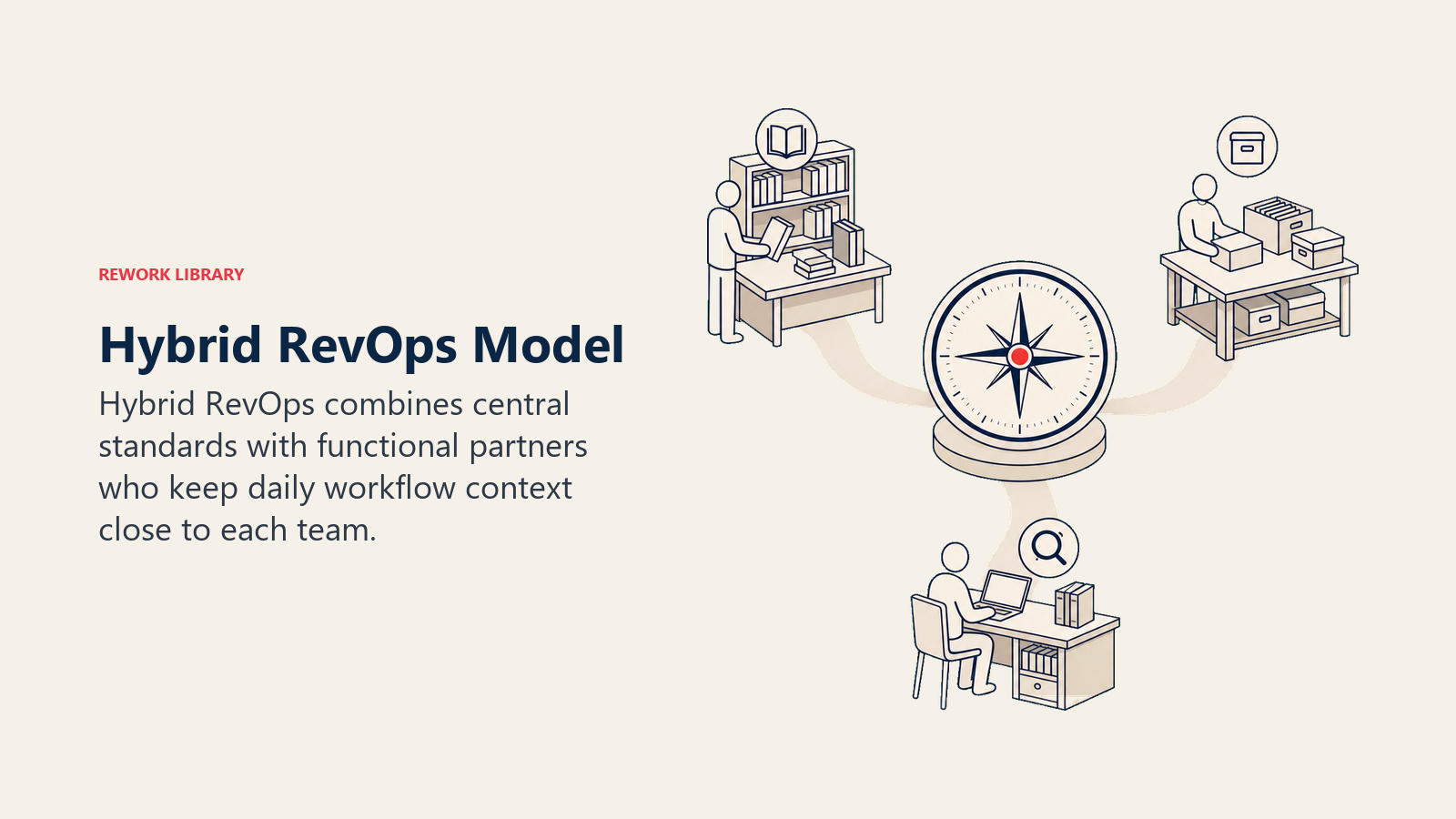
A central RevOps leader owns the revenue operating model, data governance, systems standards, dashboards, and cross-functional cadence. Functional ops partners may sit close to marketing, sales, or CS, but they follow shared RevOps standards.
Best for: mid-market companies that need both standardization and functional speed.
Strengths:
- Shared definitions are protected.
- Functional teams still get close support.
- Specialists keep context.
- Cross-functional decisions have an owner.
- The model scales better than one central queue.
Risks:
- Decision rights can blur.
- Functional leaders may bypass governance.
- Central RevOps can become advisory without authority.
- Embedded partners can drift if the charter is weak.
Hybrid only works with a written charter. It should state who approves field changes, dashboard definitions, lifecycle changes, system integrations, and handoff rules.
Team structure by stage
| Stage | Typical structure | What matters most |
|---|---|---|
| Under 50 employees | Founder, sales leader, or one ops generalist | Keep the funnel simple and visible |
| 50 to 150 employees | Sales Ops or RevOps generalist | Clean lead routing, CRM hygiene, basic dashboards |
| 150 to 500 employees | RevOps lead plus CRM or analytics support | Shared definitions, handoffs, forecast trust |
| 500+ employees | Central RevOps with functional specialists | Governance, scale, systems architecture, decision rights |
The company stage is only a guide. A 90-person company with complex enterprise sales, partners, and renewals may need RevOps earlier than a 200-person company with a simple product-led motion.
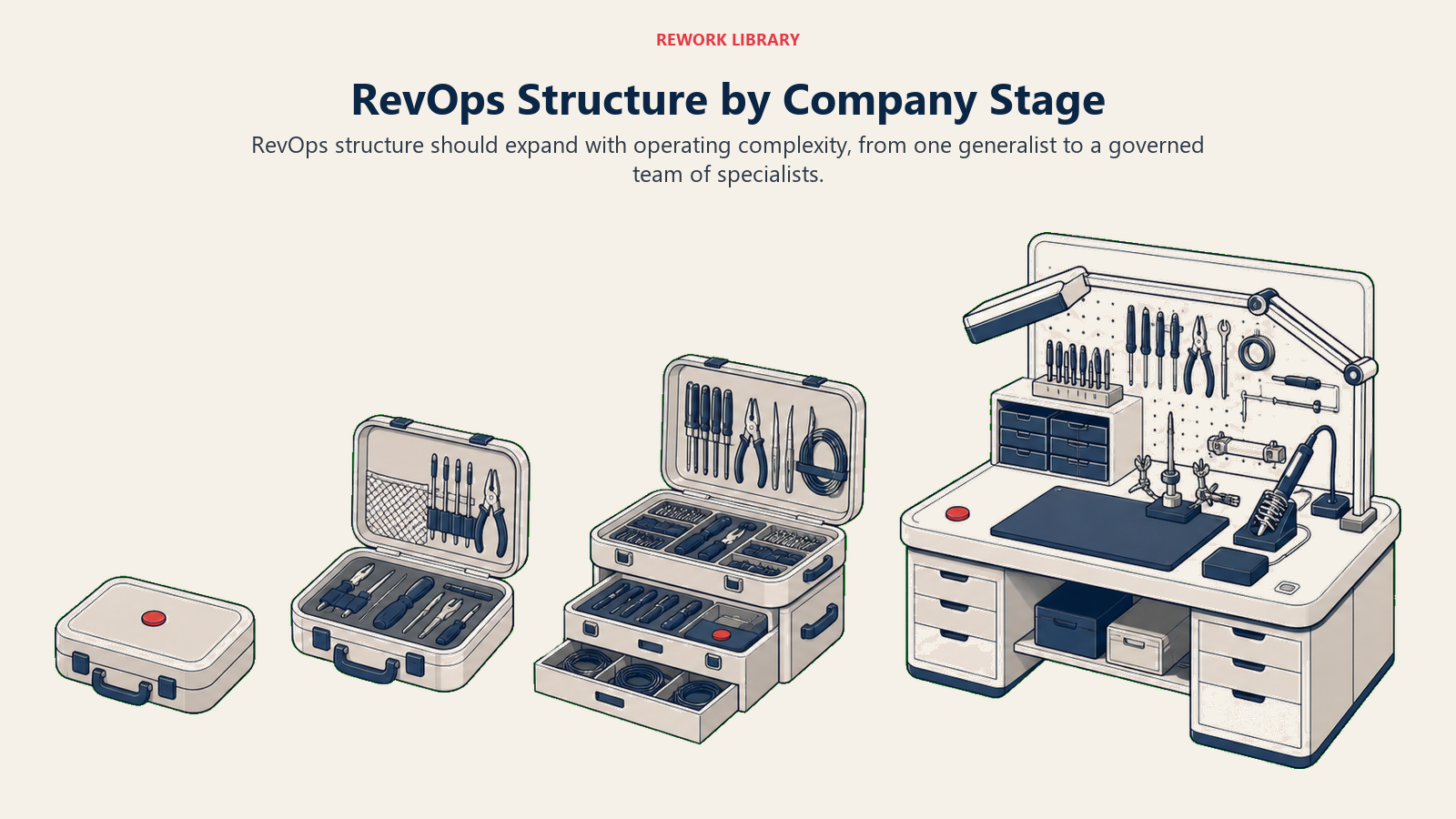
Use operating complexity as the real signal.
Reporting line options
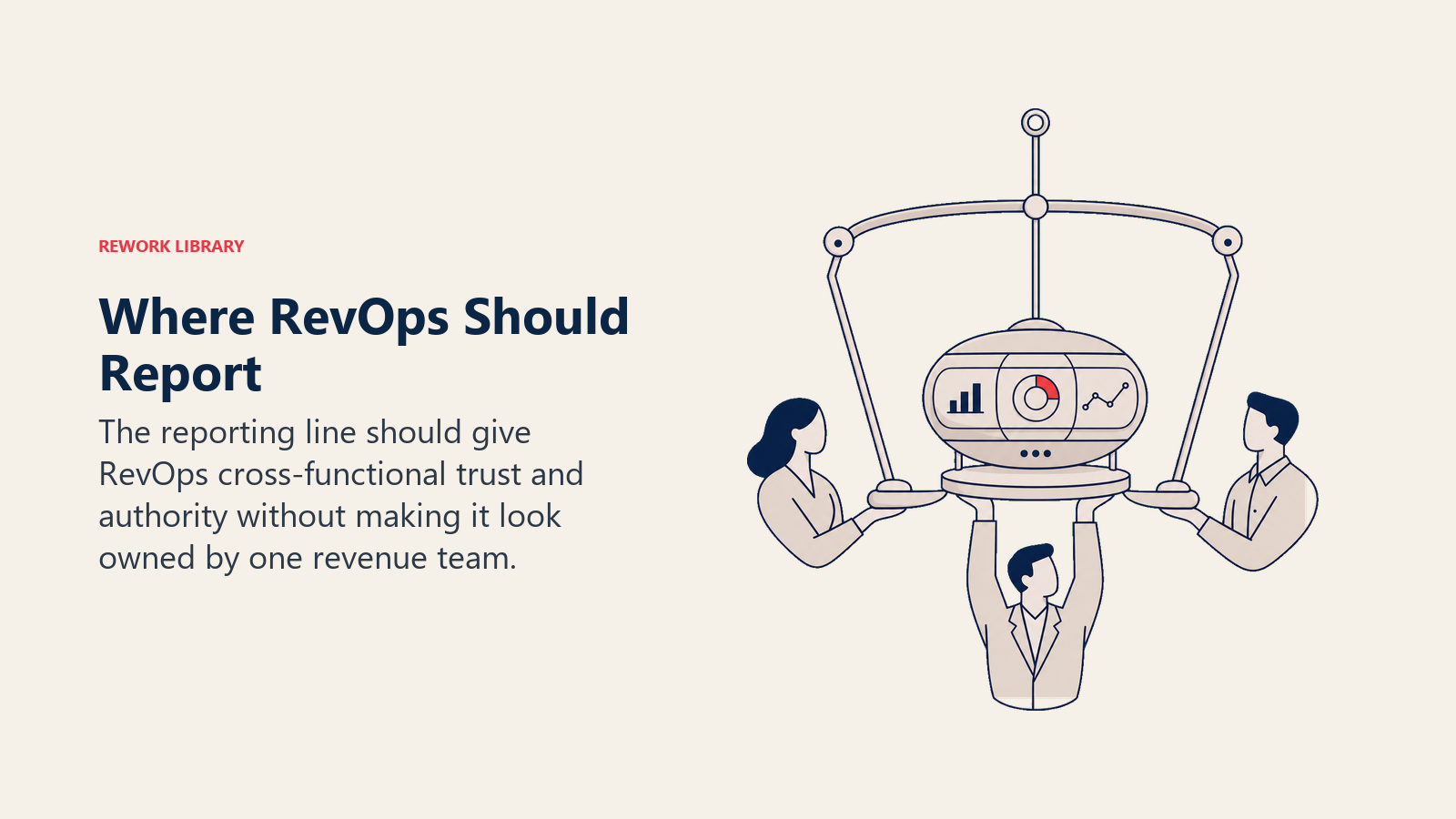
Where RevOps reports shapes how the function is perceived.
| Reporting line | Works when | Risk |
|---|---|---|
| CRO | Revenue leadership is unified under one owner | Sales may dominate if CRO is sales-heavy |
| COO | Operating discipline is the main need | RevOps may feel farther from commercial strategy |
| CFO | Forecast, planning, and data trust are the biggest issues | Teams may see RevOps as finance control |
| CEO | Company is early and cross-functional authority is needed | CEO becomes the escalation path for too many process decisions |
| VP Sales | Sales execution is the main problem | Marketing and CS may distrust shared decisions |
| CMO | Demand operations is the main problem | Sales may distrust attribution and lifecycle rules |
The cleanest reporting line is usually CRO, COO, or CEO. The wrong answer is not always a specific executive. The wrong answer is any reporting line where RevOps is expected to govern cross-functional systems but is seen as belonging to only one function.
Core RevOps roles
RevOps lead. Owns the operating model, priorities, governance, and cross-functional alignment. This person should be able to translate strategy into process and system requirements.
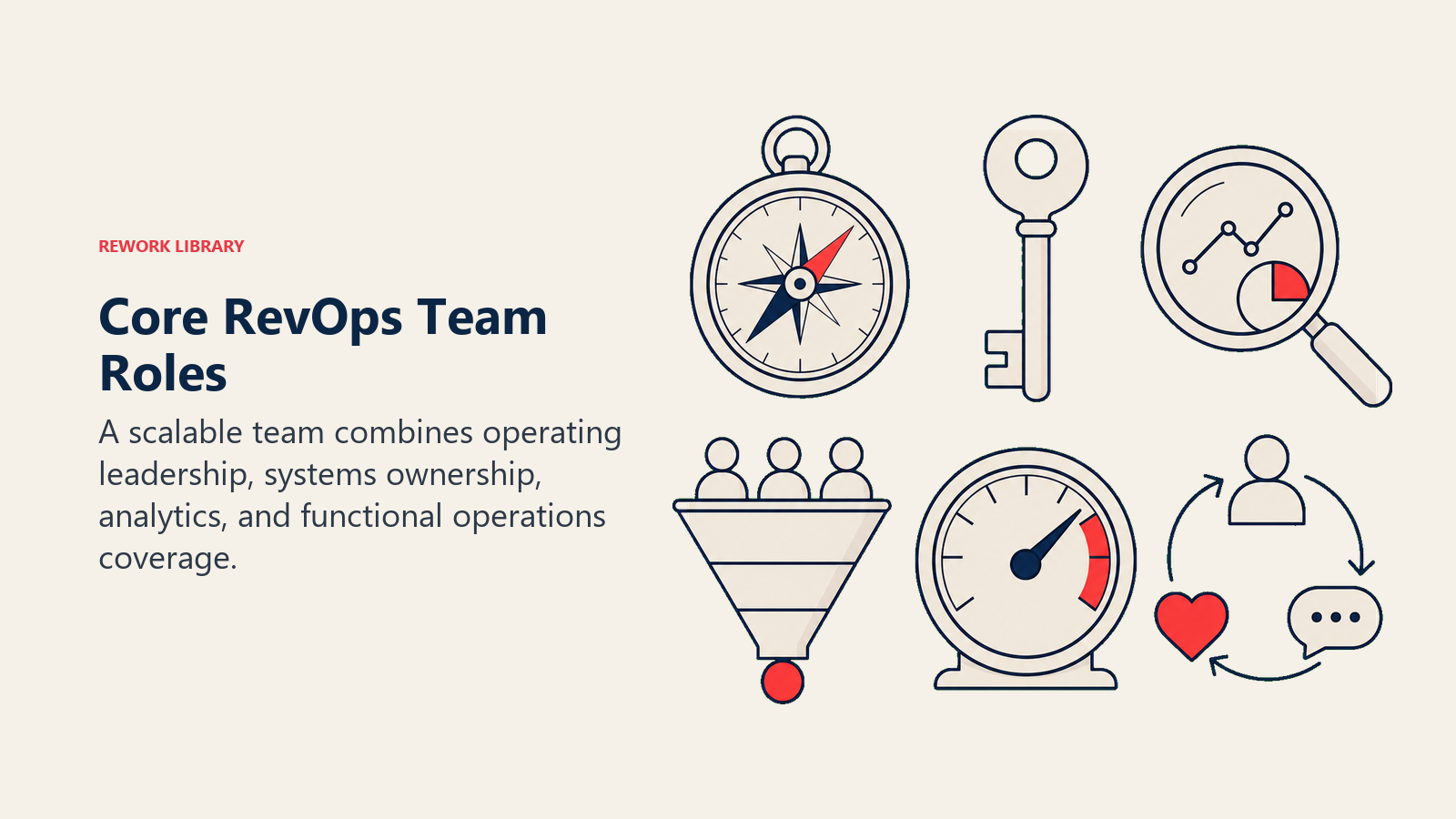
CRM or systems owner. Maintains the core revenue platform, fields, automations, permissions, integrations, and change control.
Revenue analyst. Owns reporting logic, dashboard quality, funnel analysis, forecast support, and performance diagnostics.
Marketing Ops partner. Owns campaign operations, lead source governance, scoring inputs, marketing automation, and attribution hygiene.
Sales Ops partner. Owns sales process, territory rules, quota support, pipeline hygiene, sales tooling, and rep productivity analysis.
CS Ops partner. Owns onboarding workflow, renewal data, customer health inputs, expansion triggers, and post-sale reporting.
Most companies do not hire all six at once. The first hire should match the biggest bottleneck. If the CRM is untrusted, do not hire only a dashboard analyst. If handoffs are broken, do not hire only a Salesforce admin. If leadership lacks a revenue operating model, hire an operator who can design systems, not just report on them.
Decision rights and RACI
RevOps needs authority, not just responsibility.
A RACI matrix is useful because it separates who does the work from who is accountable, consulted, and informed. For decision-heavy work, the RACI vs RASCI vs DACI distinction also matters. RevOps often needs both task ownership and decision ownership.
| Decision | Responsible | Accountable | Consulted | Informed |
|---|---|---|---|---|
| Add a revenue lifecycle stage | RevOps | CRO | Marketing, sales, CS, finance | GTM teams |
| Add or change a CRM field | Systems owner | RevOps | Affected function, analytics | Field users |
| Change MQL definition | RevOps and Marketing Ops | CRO or CMO/CRO pair | Sales, SDR leader, analytics | Marketing and sales teams |
| Change sales stage criteria | Sales Ops | VP Sales | RevOps, finance | Sales managers |
| Change closed-won handoff requirements | CS Ops and RevOps | CRO or COO | Sales, CS, implementation | Sales and CS teams |
| Publish executive revenue dashboard | Revenue analyst | RevOps | Finance, sales, marketing, CS | Executive team |
The table is less important than the habit. Every recurring RevOps decision should have one accountable owner.
How to keep the structure from breaking
The structure will fail if the operating rules stay informal.
A centralized RevOps team needs intake rules so it does not become a ticket queue. Define which requests are urgent, which belong in a monthly governance review, and which should be rejected because they damage shared data quality.
An embedded model needs standards. Marketing Ops, Sales Ops, and CS Ops can sit close to their teams, but they should not create separate definitions for lifecycle status, source, forecast categories, or customer handoff fields.
A hybrid model needs a charter. Functional partners need to know when they can act locally and when a change needs central approval. Without that, hybrid becomes the worst of both models: central RevOps is blamed for standards, while embedded teams quietly change the system.
For most mid-market teams, the practical rule is simple: centralize definitions, data model, systems governance, and executive reporting. Keep workflow detail close to the function that uses it every day.
A practical mid-market structure
A 150-person B2B company often needs a small hybrid team, not a large department.
The structure can be:
- Head of RevOps reporting to the CRO or COO
- CRM or systems owner
- Revenue analyst
- Marketing Ops partner, full-time or shared
- Sales Ops partner, full-time or shared
- CS Ops coverage, often part-time until renewals become complex
This gives the company enough central governance to protect definitions and dashboards, while keeping functional workflow knowledge close to the teams doing the work. The Head of RevOps should own the operating roadmap. The systems owner should protect data quality and workflow reliability. The analyst should make performance visible. Functional partners should make sure the model works in real team behavior, not only in the process document.
If that structure still feels too heavy, start with the RevOps lead and one systems-capable analyst now. Add functional partners when request volume, reporting demand, and handoff complexity justify them.
Request intake model
Team structure breaks when every request reaches RevOps through side channels.
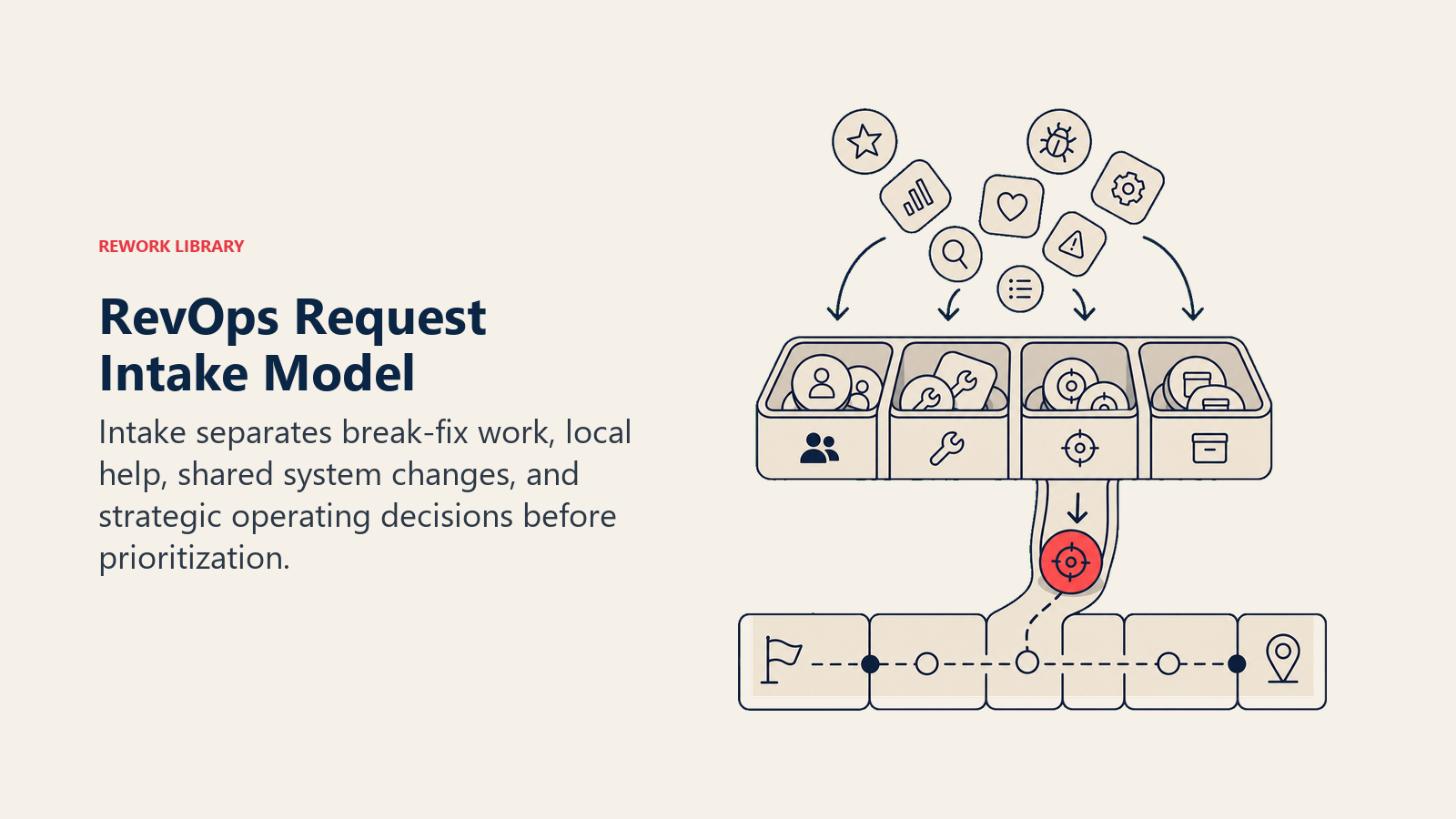
Use an intake model that separates support tasks from operating changes.
| Request type | Example | Handling rule |
|---|---|---|
| Break-fix | Routing stopped working or dashboard data is wrong | Triage quickly and fix through the owner |
| Local workflow help | Sales wants a manager view or marketing wants campaign cleanup | Functional ops can handle if no shared definition changes |
| Shared system change | New required CRM field, lifecycle stage, routing rule, or dashboard definition | RevOps governance review |
| Strategic operating change | New segment, sales motion, renewal process, or source-of-truth change | Executive sponsor plus RevOps roadmap review |
This protects the team from becoming a queue while still keeping urgent work moving. A centralized team needs this because all requests come to one place. A hybrid team needs it because embedded partners can otherwise bypass shared standards.
Operating model by team size
The org chart matters less than the operating rhythm.
| Team size | Practical operating model |
|---|---|
| One RevOps generalist | Weekly priorities with CRO or COO, monthly funnel review, simple change log |
| Two to three people | Split systems, analytics, and process ownership; use a shared backlog and monthly governance |
| Four to seven people | Add functional lanes for sales ops, marketing ops, CS ops, or analytics; centralize definitions and dashboards |
| Eight or more people | Formalize roadmap planning, systems architecture, data governance, intake tiers, and specialist ownership |
Small teams need ruthless focus. One person cannot own every dashboard, CRM request, forecast issue, handoff problem, and executive analysis request at the same quality. The charter should name the highest-value work and protect time for it.
Signs the structure needs to change
Review the RevOps structure when the same operating problem repeats.
Common signals:
- The team spends most of its time reacting to tickets.
- Sales, marketing, CS, and finance still use different definitions.
- Executives ask for manual reporting before every major review.
- Embedded ops partners make changes that break shared dashboards.
- Central RevOps is too far from day-to-day workflow details.
- Forecast, attribution, or handoff disputes keep escalating to executives.
- Systems changes ship quickly but create downstream cleanup.
Those signals do not all point to centralization. Sometimes the fix is a clearer charter. Sometimes it is functional embedding. Sometimes it is a stronger systems owner. The right change depends on where the operating failure lives.
Common hiring mistakes
Hiring an analyst when you need an operator. Analysts can find problems. Operators redesign workflows, decision rights, and systems so the problems stop recurring.
Hiring a Salesforce admin when you need a process owner. System skill is valuable, but a CRM admin should not be expected to define the revenue operating model alone.
Hiring RevOps too late. By the time the forecast is distrusted, attribution is political, and CS handoffs are broken, the work is harder. RevOps is cheaper before the system is deeply messy. The signals for when to hire RevOps usually show up well before that point.
Giving RevOps responsibility without authority. If RevOps is accountable for data quality but cannot enforce field rules or system change control, the mandate is performative.
Copying a late-stage org chart. A small company does not need a VP RevOps, four managers, and a governance council. It needs clear ownership, a simple lifecycle, and disciplined handoffs.
How to choose your model
Choose centralized RevOps if:
- Multiple teams depend on the same revenue data.
- Dashboards frequently disagree.
- Tooling decisions need stronger governance.
- Leadership wants one owner for revenue operating quality.
Choose embedded ops if:
- The company is early-stage.
- Functional speed matters more than standardization.
- The funnel is simple.
- Leaders can maintain alignment informally.
Choose hybrid RevOps if:
- You need shared governance and functional context.
- Marketing, sales, and CS each have meaningful operating needs.
- The company has multiple motions or segments.
- Central RevOps alone would become a bottleneck.
Learn more

Principal Solution Architect
On this page
- What a RevOps team actually owns
- Model 1: Centralized RevOps
- Model 2: Embedded RevOps
- Model 3: Hybrid RevOps
- Team structure by stage
- Reporting line options
- Core RevOps roles
- Decision rights and RACI
- How to keep the structure from breaking
- A practical mid-market structure
- Request intake model
- Operating model by team size
- Signs the structure needs to change
- Common hiring mistakes
- How to choose your model
- Learn more