When to Hire RevOps: Signals Your Revenue System Needs an Owner
Most companies hire RevOps after the pain is already expensive.
Marketing and sales are arguing about lead quality. Forecast calls are full of stale opportunities. Customer success is receiving incomplete closed-won context. Finance is rebuilding revenue reports outside the CRM. The company finally decides it needs "someone RevOps."
That hire helps, but the system is already messy.
The better time to hire RevOps is when the revenue motion has become too cross-functional to run through informal coordination.
RevOps is not the first operations hire every company needs. It is the hire you need when the revenue system has become shared enough that no single function can fix it alone.
Forrester's revenue operations responsibilities model frames RevOps around alignment across the growth engine. That is the point of the hire: not to add another reporting person, but to give the shared system an owner.
Key operating facts
- Hire RevOps when revenue problems cross team boundaries: lifecycle, source of truth, routing, handoffs, forecast, customer expansion, or reporting trust.
- Hiring too early can create a title without mandate. Hiring too late creates cleanup debt.
- The first RevOps hire should have authority over the shared operating system, not only responsibility for dashboards.
- If the pain is purely inside one function, Sales Ops, Marketing Ops, or CS Ops may be the better first hire.
The short answer
Hire RevOps when revenue problems no longer belong cleanly to one team.
Sales process issues can be handled by Sales Ops. Campaign operations can be handled by Marketing Ops. Onboarding process can be handled by CS Ops. RevOps becomes necessary when the problem sits between teams: lifecycle definitions, handoffs, source of truth, forecast trust, attribution, and revenue cadence.
For the role distinction, see RevOps vs Sales Ops and RevOps vs Marketing Ops vs Sales Ops.
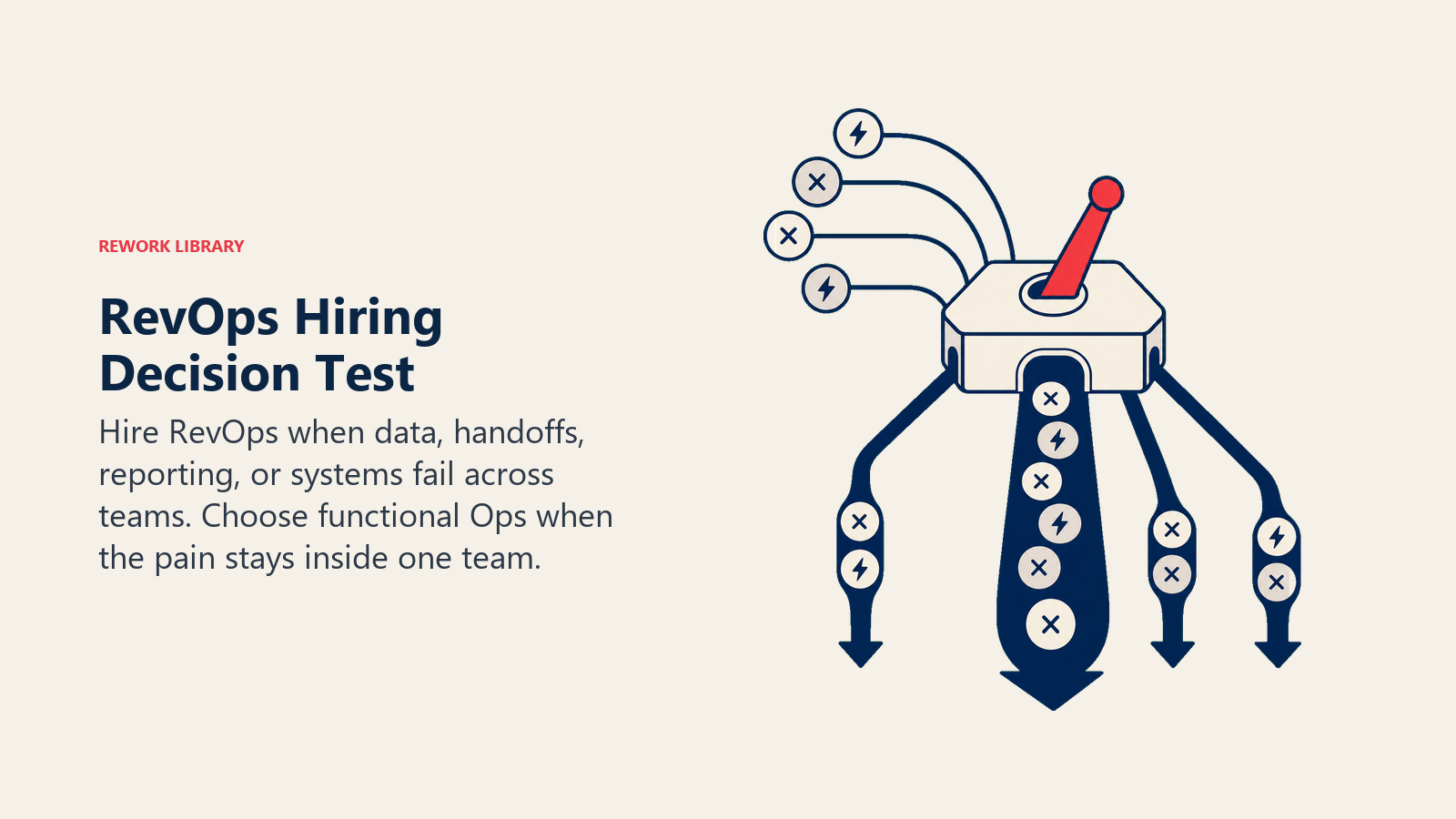
Hiring decision test
Use this test before opening the role.
| Question | If yes |
|---|---|
| Do multiple teams use the same fields differently? | RevOps likely needed |
| Does finance rebuild revenue reporting outside the operating system? | RevOps likely needed |
| Are handoffs failing between marketing, sales, CS, and finance? | RevOps likely needed |
| Is the problem mostly quota, territory, and sales process? | Sales Ops may be enough |
| Is the problem mostly campaign ops and attribution? | Marketing Ops may be enough |
| Is the problem mostly onboarding, renewal, and health? | CS Ops may be enough |
The role should match the system pain. Do not hire RevOps because the title sounds mature. Hire RevOps because the company needs a shared revenue operating owner.
Turn this article into takeaways for your work.


Each assistant summarizes the article only for you and suggests best practices for your work.
Strong hiring signals
You are ready for RevOps when several of these are true:
- Marketing and sales disagree about what counts as qualified.
- Lead routing rules are unclear or outdated.
- Reps distrust lead scoring.
- Managers distrust opportunity stage data.
- Finance uses a shadow spreadsheet for forecast or revenue reporting.
- Customer success receives incomplete handoff information.
- Campaign ROI cannot be tied cleanly to revenue.
- CRM fields are added without governance.
- Tooling decisions in one team affect another team.
- Revenue meetings are mostly data reconciliation.
These are not "more dashboard" problems. They are operating ownership problems.
Stage-based guide
Company size is less important than complexity. A 40-person enterprise SaaS company may need RevOps earlier than a 200-person company with a simple self-serve motion.
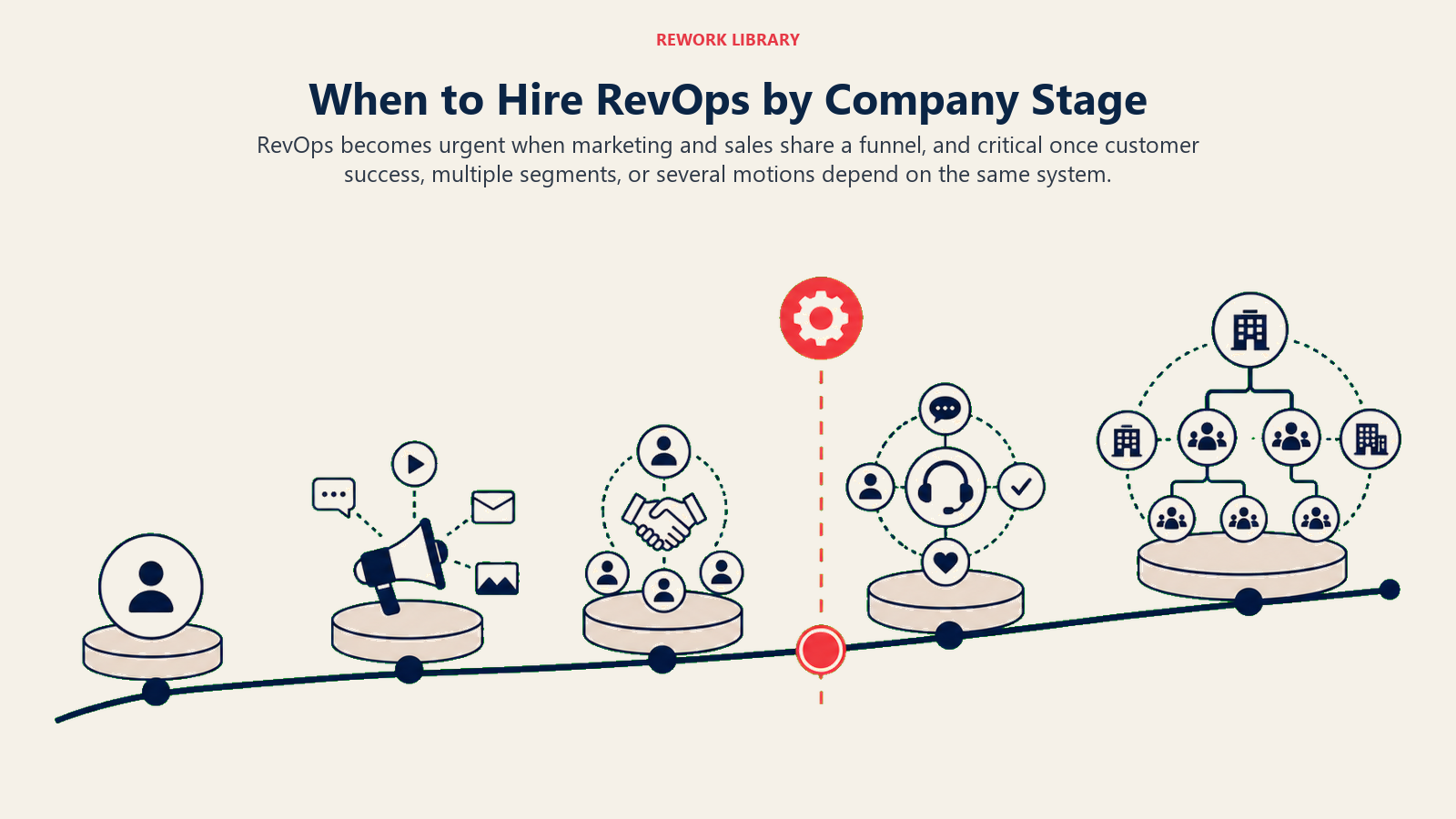
| Company stage | RevOps need | Recommended move |
|---|---|---|
| Founder-led sales | Low | Keep the process simple and visible |
| 3 to 10 sellers | Emerging | Add Sales Ops or an ops generalist |
| Marketing plus sales engine | High | Assign or hire RevOps ownership |
| Sales plus CS renewal motion | Very high | Build RevOps across acquisition and retention |
| Multiple segments or motions | Critical | Formalize RevOps team structure |
Use operating complexity as the real signal.
Trigger 1: lead handoffs are leaking revenue
The first common trigger is lead handoff failure.
Marketing creates leads. Sales does not follow up consistently. SDRs reject leads without structured reasons. Routing rules do not match territory or segment strategy. Campaign reports show volume, but pipeline reports show little movement.
At this point, the issue is not only marketing quality or sales discipline. It is the handoff system.
RevOps can define:
- MQL and SQL criteria
- Lead assignment rules
- Acceptance and rejection workflow
- SLA and escalation path
- Source-to-opportunity reporting
- Monthly lead quality review
If the lead-to-opportunity process is a recurring argument, the company probably needs RevOps ownership.
Trigger 2: forecast trust is breaking
The second trigger is forecast distrust.
Sales says the forecast is realistic. Finance applies a haircut. The CEO asks for a separate view. Managers spend forecast calls cleaning close dates and stage names. The team has enough pipeline on paper, but the number does not close.
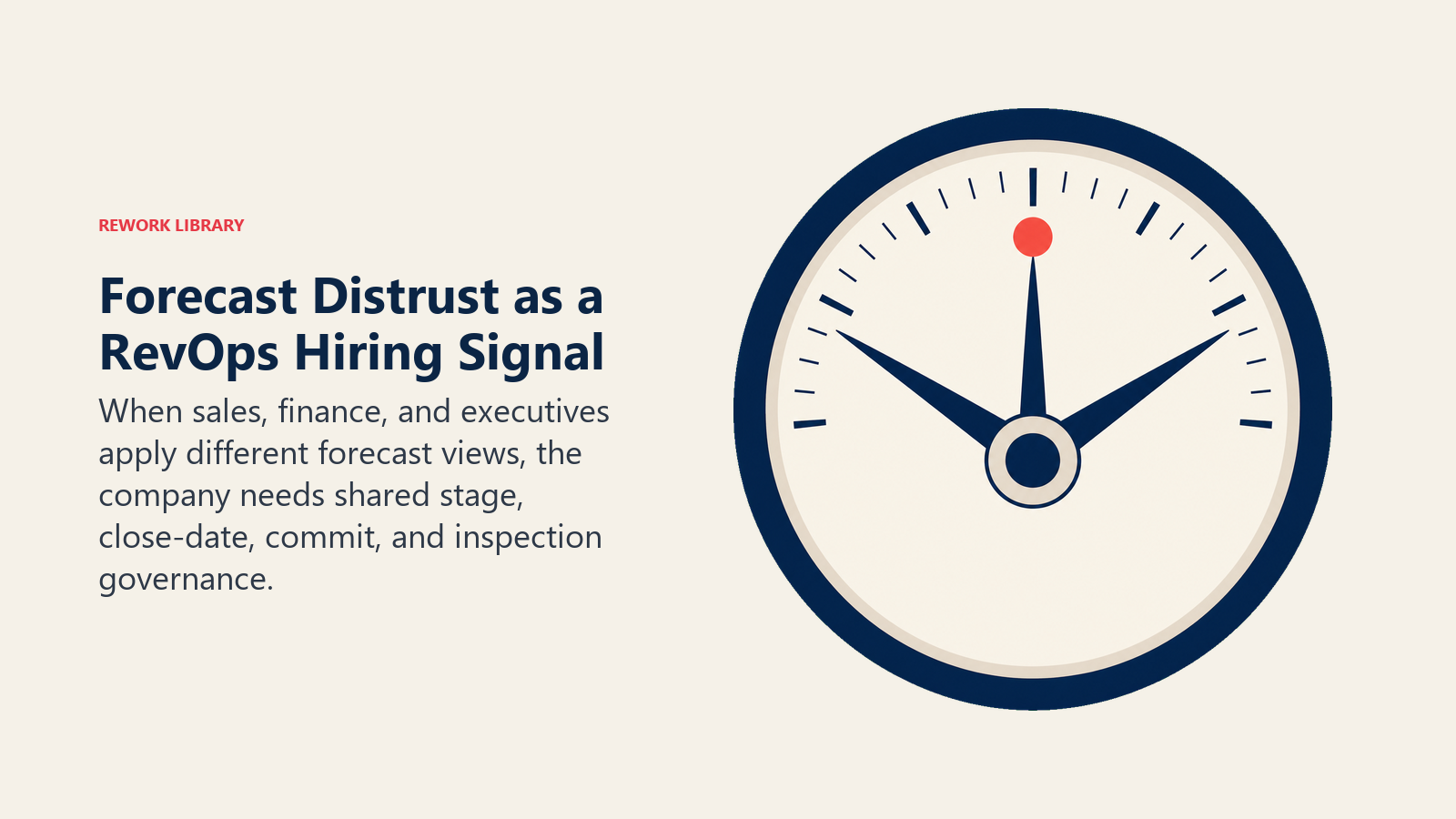
This is rarely solved by a better spreadsheet. Forecast quality depends on stage definitions, close-date hygiene, commit criteria, manager inspection, and CRM data quality.
CIO Dive summarized Gartner research showing that less than half of sales leaders and sellers had high confidence in forecast accuracy. RevOps helps by treating forecast quality as a system problem, not just a sales judgment problem.
Trigger 3: customer success inherits bad context
If customer success repeatedly says, "We didn't know this was promised," the company needs stronger post-sale operating governance.
Closed-won is not the end of revenue. It is the start of onboarding, adoption, renewal, and expansion. RevOps should make sure the customer context sold by sales becomes structured data CS can use.
That includes:
- Use case
- Success criteria
- Stakeholders
- Contract scope
- Promises made
- Implementation risks
- Renewal date
- Expansion signals
This connects directly to Sales-CS Alignment and RevOps and Customer Success.
Trigger 4: finance does not trust revenue data
Finance distrust is a serious signal.
If finance rebuilds pipeline, bookings, attribution, or forecast numbers outside the revenue systems, the company has a source-of-truth problem. That problem will get worse as the company grows.
RevOps does not replace finance. Finance owns the plan and financial reporting. RevOps owns the operating data and process that make the plan inspectable.
See RevOps and Finance for the partnership model.
Hiring too early
Hiring too early creates a different problem: process overhead before the company has learned enough.
You may be too early if:
- One founder still owns most sales.
- Marketing is not yet a real acquisition channel.
- The CRM has fewer than a few hundred meaningful records.
- The sales process changes every month.
- Leadership still needs discovery more than governance.
In that case, use a lightweight Revenue Operations Framework but do not overbuild.
The first operating owner may be a Sales Ops generalist, marketing ops contractor, or founder's operator. The goal is to keep the system visible without creating unnecessary governance.
Hiring too late
Hiring too late is more common.
Late signals include:
- Forecast misses are blamed on rep judgment, but the stage definitions are weak.
- Lead disputes happen every month.
- No one can explain source-to-revenue performance without cleanup.
- CS churn analysis never reaches qualification rules.
- Revenue leaders no longer trust the operating data.
At this stage, the first RevOps hire spends months untangling historical mess before they can improve the system.
Late hiring is expensive because every broken definition becomes embedded in reports, dashboards, workflows, and team habits.
What type of hire do you need?
Not every RevOps hire solves the same problem.
| Current pain | Better first hire |
|---|---|
| CRM fields, routing, and workflows are broken | Systems-capable RevOps manager |
| Leaders need better funnel analysis | RevOps analyst with operating judgment |
| Handoffs and definitions are unclear | Process-oriented RevOps operator |
| Forecast and finance alignment is weak | RevOps leader with planning experience |
| Multiple functions need governance | Head of RevOps or Director of RevOps |
If you need someone to design the operating model, do not hire only a dashboard analyst. If you need CRM cleanup, do not hire only a strategy leader. Match the hire to the bottleneck.
The before-and-after test
A useful test is to describe what should be visibly different six months after the hire.
If the answer is only "we will have better dashboards," the role is probably under-scoped. Dashboards matter, but they are a result of clearer definitions, better fields, stronger handoffs, and a cadence that forces inspection.
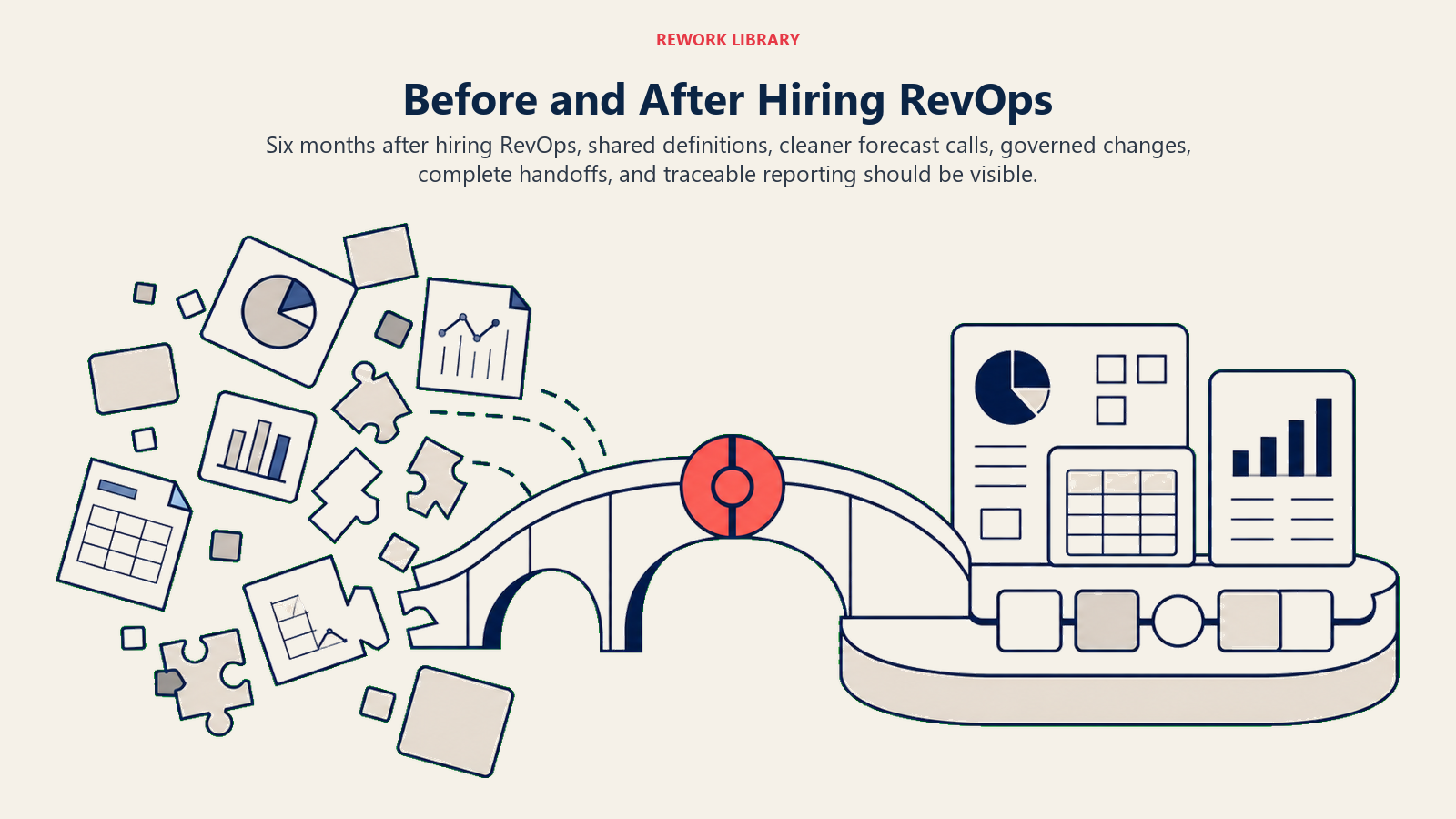
A real RevOps before-and-after might look like this:
| Before RevOps | Six months after RevOps |
|---|---|
| Lead status means different things to marketing and sales | Lifecycle stages have agreed definitions and owner handoffs |
| Forecast calls begin with cleanup | Forecast calls inspect risk and next actions |
| CRM fields are added by request | Field changes go through governance |
| CS learns deal context in Slack | Closed-won handoff data is required and reviewed |
| Finance rebuilds sales reports manually | Finance can trace revenue assumptions back to operating data |
This test keeps the hiring decision tied to business change. It also protects the first hire from becoming a reactive service desk.
Hiring timing checklist
Use this checklist when the company is unsure whether to hire now or wait:
- Do at least three revenue leaders depend on the same data?
- Are handoff mistakes creating measurable lost pipeline, delay, churn risk, or rework?
- Do meetings repeatedly revisit definitions instead of decisions?
- Are systems changes creating downstream effects that no one owns?
- Is manual reporting taking enough time to delay planning or management decisions?
- Would one cross-functional owner reduce friction across more than one team?
If most answers are yes, waiting will likely cost more than hiring.
If only one team is feeling pain, solve the local operating gap first. That may mean Sales Ops, Marketing Ops, a CRM admin, or a contractor. RevOps should arrive when shared operating ownership is the constraint.
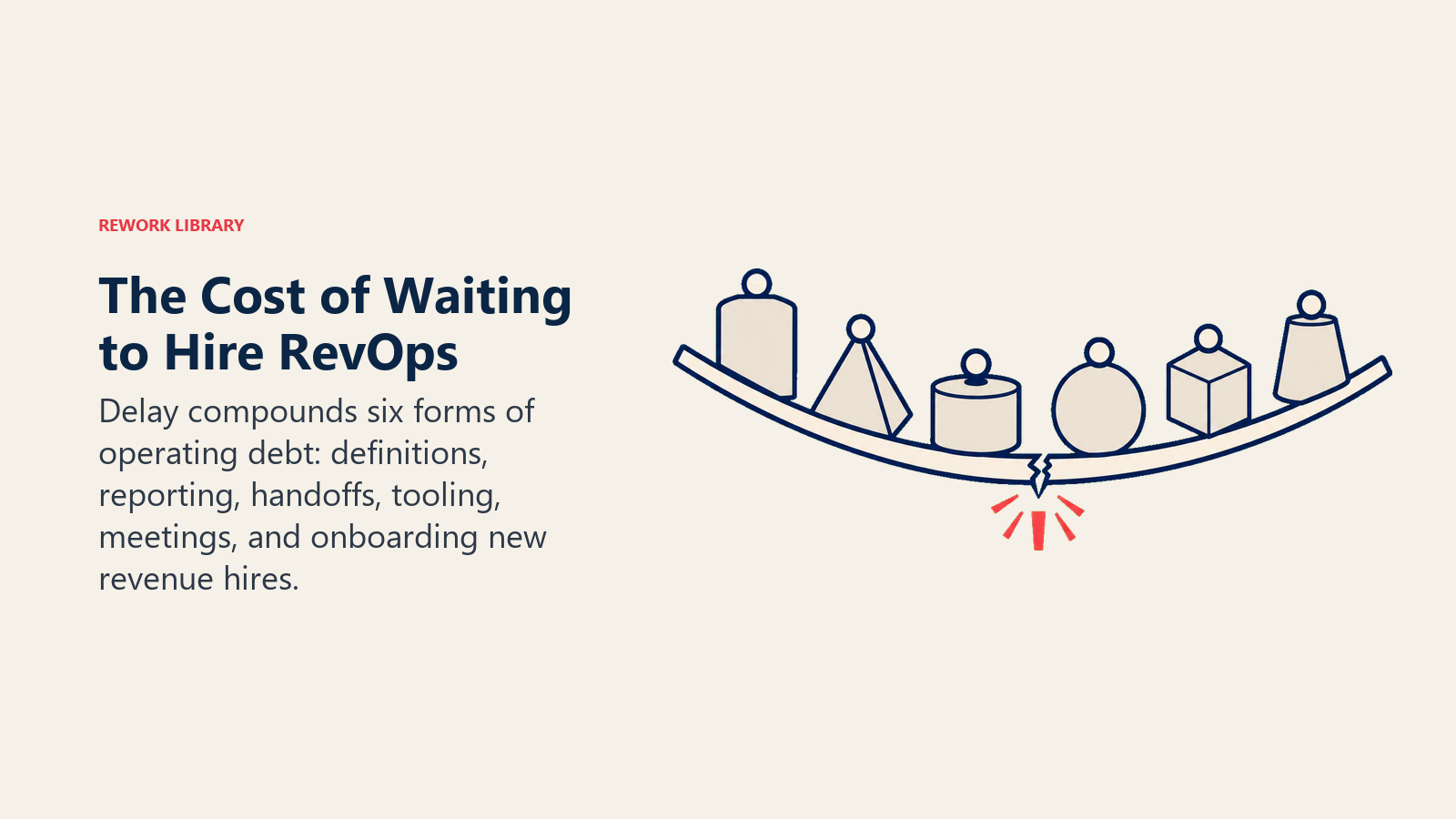
Cost of waiting
Waiting is not always wrong. But waiting has a cost when the pain is already cross-functional.
| Waiting cost | What it looks like |
|---|---|
| Definition debt | Teams keep using different meanings for lead, SQL, commit, churn, or expansion |
| Reporting debt | Finance, sales, and marketing maintain separate versions of revenue truth |
| Handoff debt | CS receives incomplete context, and onboarding risk becomes normal |
| Tooling debt | Fields, workflows, and integrations are added without a shared model |
| Meeting debt | Leaders spend recurring time reconciling data before making decisions |
| Hiring debt | New sellers, marketers, and CSMs join a system that is already hard to use |
The hiring question is not only whether RevOps would be useful. It is whether the company is already paying for weak operating ownership through wasted management time, lost conversion, delayed forecast decisions, and customer handoff rework.
A 30-day proof before hiring
If leadership is unsure, run a 30-day proof instead of debating the job title.
Assign one owner, even part-time, to produce four outputs:
- A lifecycle map from lead through renewal.
- A list of the top five recurring handoff or reporting disputes.
- A record audit across leads, opportunities, closed-won deals, and renewal-risk customers.
- A prioritized RevOps roadmap with estimated business impact.
If this short project uncovers cross-functional confusion that no current function owns, the RevOps case is stronger. If the findings are mostly local to sales, marketing, or CS, hire or assign the narrower operations role first.
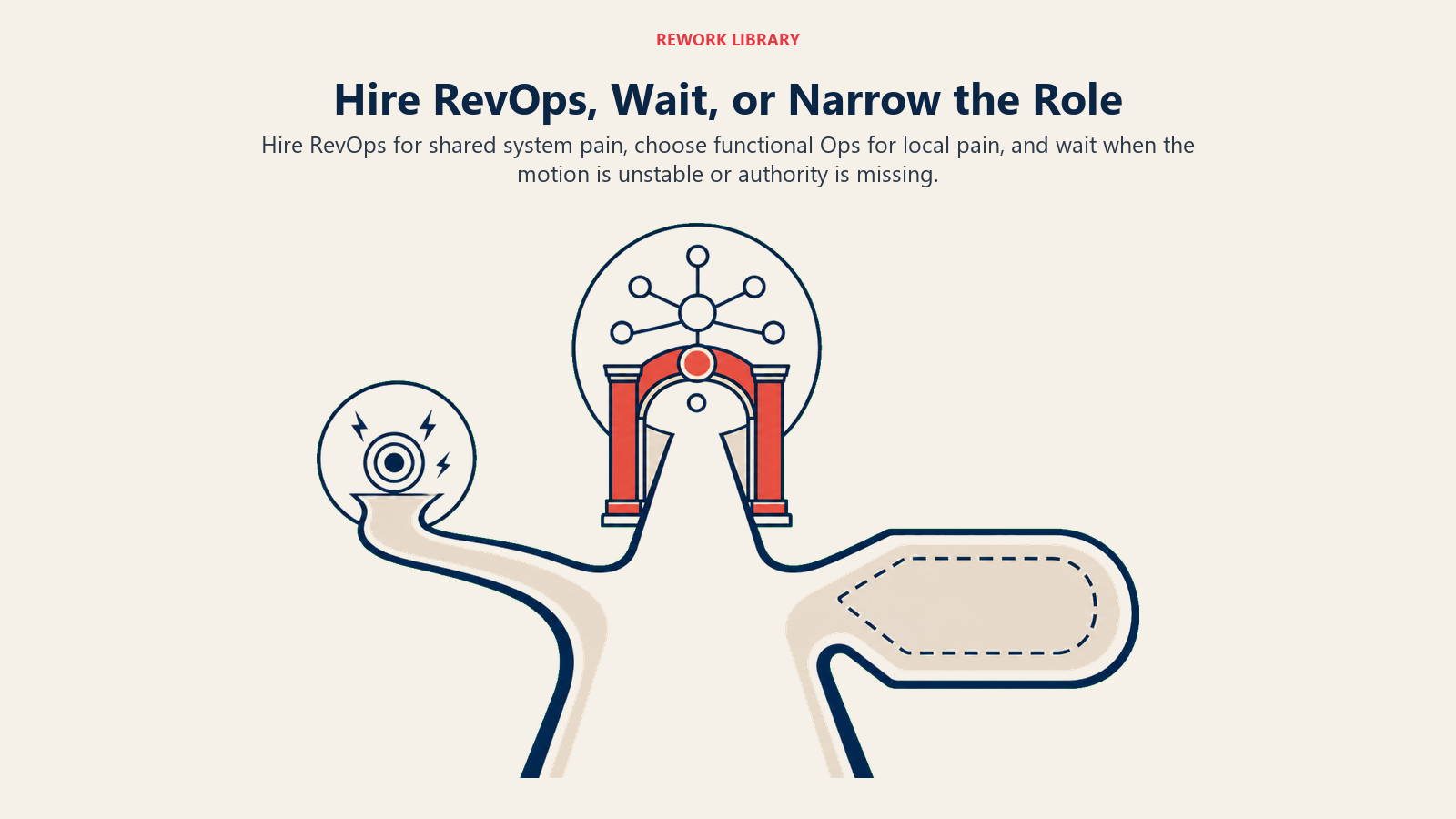
Hire now, wait, or narrow the role
Use this decision table.
| Situation | Better move |
|---|---|
| Sales stages, quota support, territories, and forecast rollup are the main pain | Hire Sales Ops or strengthen sales operations |
| Campaign tracking, lead capture, and marketing automation are the main pain | Hire Marketing Ops or a marketing systems operator |
| Onboarding, renewal health, and expansion data are the main pain | Hire CS Ops or a customer operations owner |
| Lifecycle, handoffs, reporting trust, and systems governance break across teams | Hire RevOps |
| Pain is real but leadership will not give cross-functional authority | Wait or fix the mandate before hiring RevOps |
| Process is still changing weekly and no motion is repeatable | Use a lightweight ops generalist first |
The worst move is hiring RevOps with only a dashboard mandate while expecting cross-functional outcomes. That creates disappointment on both sides.
What to put in the job description
Many RevOps job descriptions are too broad. They ask for systems administration, business intelligence, compensation design, forecasting, GTM strategy, campaign operations, data engineering, enablement, and executive reporting in one role.
That may describe the function over time. It should not describe one first hire.
A cleaner job description should include:
- The revenue motion the person will support
- The main operating problems they will inherit
- The systems they will govern
- The handoffs they will improve
- The metrics they will be judged on
- The decision rights they will have
- The first 90-day outcomes expected
For example, if the real problem is lead leakage, say that. If the real problem is forecast trust, say that. If the real problem is CRM governance, say that. The strongest candidates want the real operating problem, not a polished list of generic RevOps responsibilities.
The job description should also say what RevOps will not own. Revenue leaders still own quota, pipeline creation, win rate, retention, and expansion strategy. RevOps owns the operating system that makes those outcomes visible and governable.
The business case
The RevOps business case is usually not "hire someone to build reports."
It is:
- Reduce pipeline leakage.
- Improve forecast trust.
- Shorten revenue meetings.
- Improve lead acceptance.
- Reduce manual reporting.
- Improve closed-won handoff quality.
- Make revenue data usable for planning.
The strongest business case ties RevOps work to a few measurable leaks. For example: leads aging past SLA, opportunities with stale close dates, closed-won deals missing onboarding data, or pipeline reports requiring manual reconciliation.
For early-stage teams, one strong business case is manager time. If every revenue meeting needs a leader to reconcile reports before the real discussion starts, the company is paying senior people to compensate for weak operating design. A RevOps hire should remove that recurring work by making the system clear enough that leaders can inspect decisions, not rebuild evidence.
What success looks like after six months
A good first six months is not a total rebuild. It is a small number of high-trust improvements that change how the revenue team runs.
Strong signs include:
- One agreed lifecycle map from lead to renewal
- A short RevOps charter with clear decision rights
- Fewer ungoverned field and workflow changes
- A cleaner forecast call with fewer data debates
- A dashboard leaders use without asking for manual cleanup
- A documented closed-won handoff
- A prioritized roadmap instead of a request backlog
The most important change is trust. Leaders may still disagree on strategy, but they should stop arguing about what the numbers mean.
That is why RevOps hiring timing matters. Hire before the company has any repeatable process, and the role creates overhead. Hire after the operating system is already distrusted, and the role starts in repair mode. The best timing is when complexity is real, the pain crosses teams, and leadership is ready to give one owner the mandate to fix the system.
Frequently Asked Questions about When to Hire RevOps
Should the first RevOps hire be technical?
They need enough systems fluency to understand CRM and data flows, but the first hire should be an operator first. Process design, decision rights, and cross-functional trust matter more than pure admin skill.
Can Sales Ops become RevOps?
Yes, if the mandate expands. The person needs authority across marketing, sales, CS, finance, and systems, not just a new title.
Who should RevOps report to?
Usually the CRO, COO, CEO, or another cross-functional leader. Reporting only to sales or marketing weakens neutrality.
What is the risk of waiting?
The longer you wait, the more broken definitions, shadow spreadsheets, manual workarounds, and reporting distrust become normal operating behavior.
Learn more

Senior Operations & Growth Strategist
On this page
- The short answer
- Hiring decision test
- Strong hiring signals
- Stage-based guide
- Trigger 1: lead handoffs are leaking revenue
- Trigger 2: forecast trust is breaking
- Trigger 3: customer success inherits bad context
- Trigger 4: finance does not trust revenue data
- Hiring too early
- Hiring too late
- What type of hire do you need?
- The before-and-after test
- Hiring timing checklist
- Cost of waiting
- A 30-day proof before hiring
- Hire now, wait, or narrow the role
- What to put in the job description
- The business case
- What success looks like after six months
- Learn more