Revenue Funnel Stages: A Full Lifecycle Map from Lead to Expansion
Revenue funnel stages define how a person, account, opportunity, and customer move through the revenue system.
A sales pipeline is only one part of that map. RevOps needs the full lifecycle: lead capture, qualification, sales acceptance, opportunity creation, closed-won, onboarding, renewal, and expansion.
Forrester's revenue operations responsibilities model is useful here because it frames RevOps across the commercial engine, not only sales reporting. McKinsey's B2B growth research also reinforces the need for connected commercial systems as buyer behavior and growth motions become more complex.
The funnel stage map is the operating language for that system.
Key operating facts
- Revenue funnel stages should cover the full lifecycle: demand, qualification, opportunity, customer onboarding, renewal, and expansion.
- Add a stage only when it changes ownership, required action, reporting, customer state, or management decision.
- Each stage needs entry criteria, exit criteria, owner, expected aging, required data, and an exception path.
- Stage names matter less than evidence. A stage is useful only if managers can inspect whether a record belongs there.
A practical stage map
| Stage | Primary owner | Exit signal |
|---|---|---|
| Lead | Marketing or SDR | Meets routing or nurture rule |
| MQL | Marketing and RevOps | Meets qualification threshold |
| SQL | SDR or sales | Sales accepts and confirms fit |
| Opportunity | Sales | Qualified deal with value and next step |
| Closed-won | Sales | Contract signed |
| Onboarding | CS or implementation | Customer reaches launch milestone |
| Active customer | CS | Product is adopted and renewal path is tracked |
| Renewal | CS and finance | Renewal outcome is forecastable |
| Expansion | CS and sales | Expansion opportunity is qualified |
Each stage needs entry criteria, exit criteria, owner, required fields, and SLA. Without those, the stage is only a label.
Why lifecycle stages matter
Lifecycle stages are not just CRM statuses. They define who owns the record, what action should happen next, and which metrics leaders can trust.
When lifecycle stages are weak:
- Marketing and sales argue about lead quality.
- SDRs are unsure which records to work.
- Sales creates opportunities too early.
- Forecast reports include deals with weak evidence.
- CS receives customers without outcome context.
- Finance cannot connect funnel assumptions to revenue planning.
When lifecycle stages are clear, each team knows what a record means and what should happen next.
Stage design principles
Use these principles when designing the map:
| Principle | Meaning |
|---|---|
| Fewer stages are better | Add a stage only when it changes ownership, action, or reporting |
| Evidence matters | Movement should require observable criteria |
| Ownership must be clear | Every stage needs a functional owner |
| Post-sale belongs in the map | Renewal and expansion are part of revenue |
| Definitions must be auditable | Leaders should be able to inspect whether criteria were met |
The goal is not to model every nuance. The goal is to create stages that support decisions.
Turn this article into takeaways for your work.


Each assistant summarizes the article only for you and suggests best practices for your work.
When to add or remove a stage
Do not add stages because teams want more reporting detail. Add a stage when the business needs a different operating action.
Good reasons to add a stage:
- Ownership changes between teams.
- SLA or response expectation changes.
- Required data changes.
- Forecast or planning treatment changes.
- Customer state changes.
- Manager inspection needs a distinct checkpoint.
Weak reasons:
- A team wants to see more activity labels.
- A CRM template includes the stage.
- A leader wants a dashboard cut but no workflow changes.
- Reps use informal language that does not affect ownership.
Stages should also be removed. If a stage no longer changes action, creates confusion, or has low-quality data, merge it into a simpler model. A simpler lifecycle that managers enforce is better than a detailed lifecycle no one trusts.
Stage ownership model
Each stage should have one primary operating owner, even when multiple teams contribute.
| Stage area | Primary owner | RevOps role |
|---|---|---|
| Lead capture | Marketing Ops | Govern source and lifecycle fields |
| MQL | Marketing with sales input | Govern criteria and reporting |
| SQL acceptance | SDR or sales leadership | Govern status, rejection reasons, and SLA |
| Opportunity | Sales leadership | Govern creation criteria and stage evidence |
| Closed-won handoff | Sales and CS | Govern completeness and workflow |
| Onboarding | CS or implementation | Connect milestone data to customer lifecycle |
| Renewal | CS and finance | Govern renewal date, risk, and forecast category |
| Expansion | CS and sales | Govern trigger, owner, and opportunity criteria |
This owner model prevents lifecycle stages from becoming labels with no behavior. If no one owns movement, stale records stay stale. If no one owns criteria, stage changes become subjective. If no one owns reporting impact, dashboards drift.
RevOps should publish the owner model with the stage map. Managers should know which team acts, which fields matter, and which exception path applies when a record does not fit the standard flow.
Lead and demand stages
Lead stages should separate raw demand from qualified demand.
Common stages:
| Stage | Meaning | Governance note |
|---|---|---|
| Inquiry or captured lead | A person or account entered the system | Source and consent fields must be reliable |
| Nurture | Not ready for sales action | Marketing owns timing and content |
| MQL | Meets marketing qualification threshold | Criteria should include fit and behavior |
| Routed lead | Assigned for sales follow-up | SLA and owner must be visible |
| Rejected lead | Sales rejected with reason | Reasons should feed scoring and targeting |
The most important rule is that MQL should not mean "marketing likes this lead." It should mean the record meets an agreed threshold for sales review.
For deeper handoff design, see Lead to Opportunity Process.
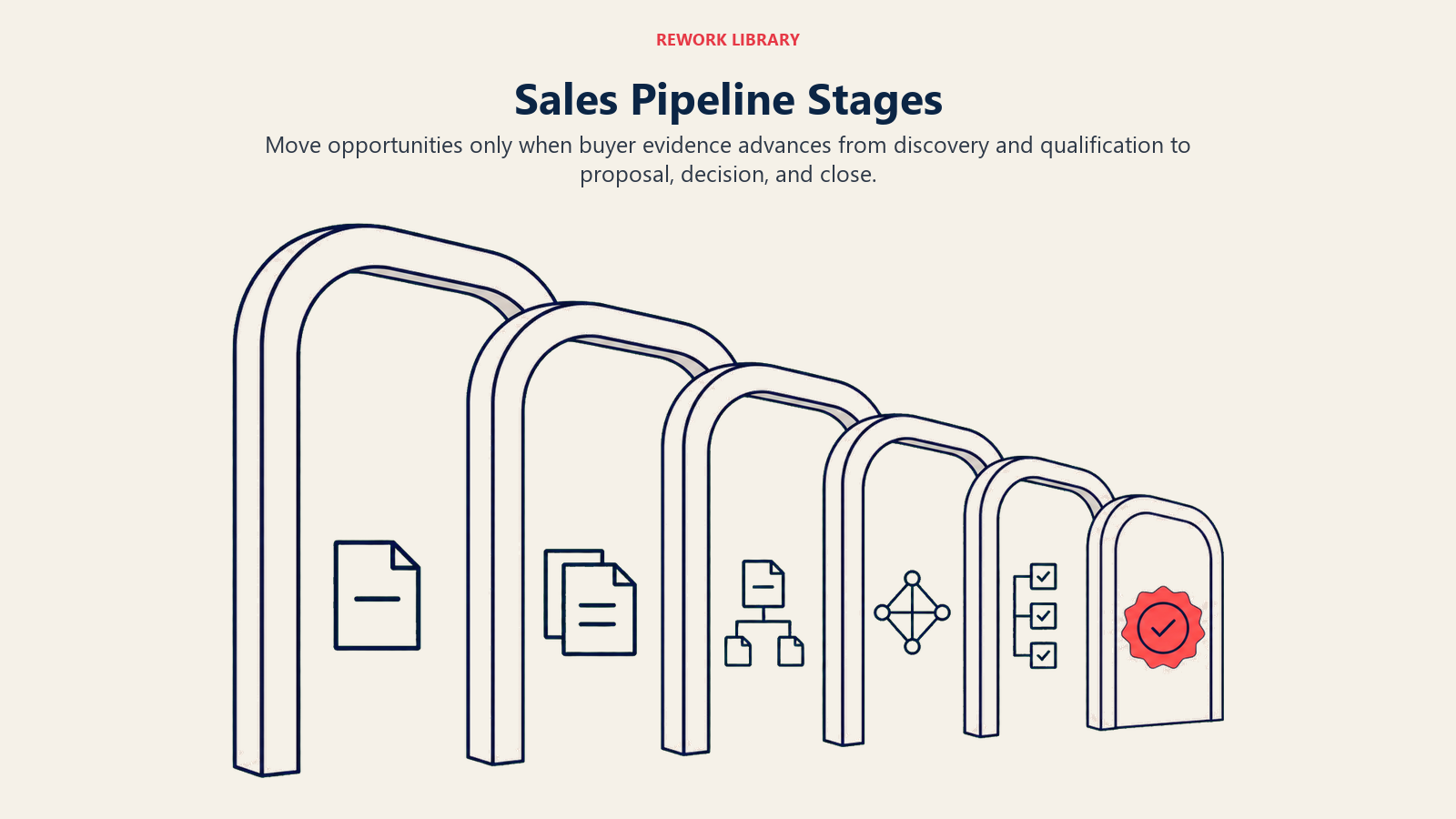
Sales pipeline stages
Opportunity stages should describe buying progress, not seller activity.
Weak stages sound like:
- Contacted
- Follow-up
- Demo done
- Proposal sent
Those may be useful activities, but they do not always prove deal quality.
Stronger stages use evidence:
| Stage | Evidence |
|---|---|
| Qualified opportunity | Business problem, fit, owner, and next step confirmed |
| Discovery complete | Pain, impact, stakeholder context, and process are known |
| Solution fit | Buyer agrees the approach could solve the problem |
| Commercial review | Pricing, scope, risk, and decision path are active |
| Commit or closing | Mutual close plan and decision criteria are clear |
Every company will name stages differently. What matters is that movement requires evidence.
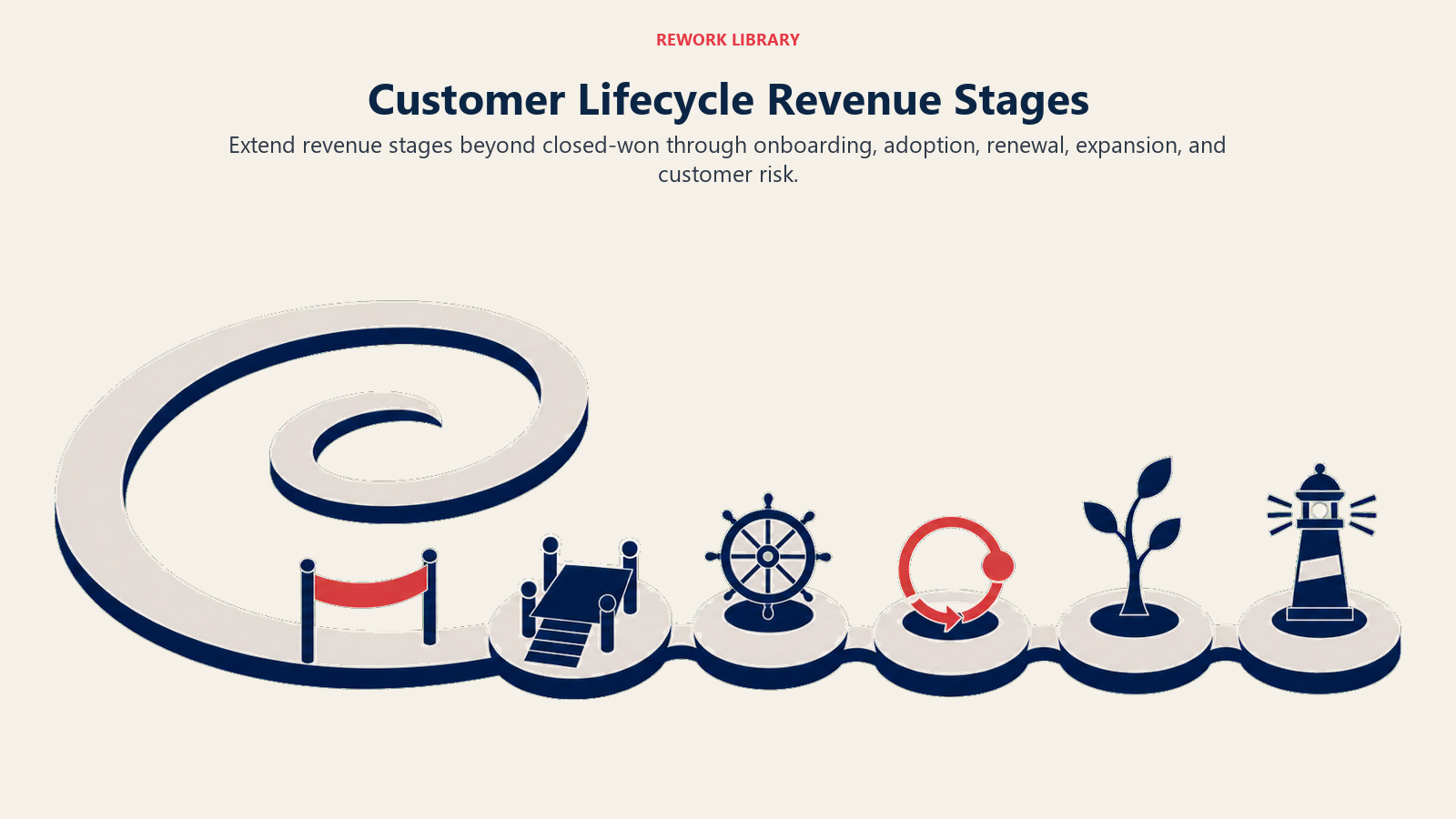
Customer lifecycle stages
Recurring revenue companies need stages after closed-won.
Common customer stages:
| Stage | Meaning | Governance note |
|---|---|---|
| Closed-won | Contract signed | Handoff data must be complete |
| Onboarding | Customer is being implemented | Success criteria and launch milestone required |
| Active customer | Customer is live and managed | Health and adoption signals should be tracked |
| Renewal approaching | Renewal window is visible | Forecast category and risk fields required |
| Renewal risk | Churn or contraction risk exists | Escalation path must be clear |
| Expansion candidate | Growth signal exists | Routing to CS, sales, or joint owner required |
This connects revenue stages to RevOps and Customer Success. Without these stages, the company may celebrate new bookings while missing risk inside the customer base.
Account vs person vs opportunity stages
Many teams confuse object stages.
A person can be a lead. An account can be target, active, customer, or churned. An opportunity can be qualified, late-stage, closed-won, or closed-lost. A customer can be onboarding, active, renewal risk, or expansion candidate.
RevOps should define which object owns which stage:
| Object | Stage examples | Common mistake |
|---|---|---|
| Person or lead | Inquiry, MQL, SQL | Treating multiple contacts as separate buying processes |
| Account | Target, active prospect, customer | Missing account-level fit and ownership |
| Opportunity | Qualified, proposal, commit | Creating opportunities before a real deal exists |
| Customer | Onboarding, active, renewal, expansion | Losing lifecycle visibility after closed-won |
This matters because reporting breaks when teams mix objects. A lead conversion report should not be used as an account progression report. An opportunity forecast should not stand in for renewal health.
Required fields by stage
Each stage should have a small number of required fields.
Examples:
| Stage | Required data |
|---|---|
| MQL | Source, segment, qualification reason, owner |
| SQL | Acceptance status, rejection reason if rejected, follow-up date |
| Opportunity | Amount, close date, stage, next step, primary use case |
| Late-stage opportunity | decision criteria, risk, economic buyer, forecast category |
| Closed-won | Success criteria, stakeholders, contract scope, implementation notes |
| Renewal | Renewal date, forecast category, health signal, risk reason |
| Expansion | Trigger, use case, owner, expected value |
Keep required fields tight. Too many required fields create bad data. Use Required Fields vs Useful Fields for field governance.
Stage review cadence
Review stages quarterly or when the GTM motion changes.
Triggers for review:
- New segment or product line
- Shift from sales-led to product-led motion
- New renewal or expansion motion
- Major CRM or marketing automation change
- Repeated disputes about definitions
- Forecast or board reporting mismatch
The stage map should be stable enough for reporting and flexible enough to match the business.
Readiness checklist
Before publishing the lifecycle map, confirm:
- Every stage has one primary owner.
- Every stage has entry and exit criteria.
- Every stage has required fields tied to decisions.
- Stage movement can be audited.
- Post-sale stages are included.
- Finance understands which stages affect planning.
- Dashboards use the same definitions.
- Managers know how to handle exceptions.
If the answer is no, the stage map is not ready for governance.
How to roll out new stages
Changing lifecycle stages is risky because it affects reports, workflows, automations, dashboards, and habits.
A practical rollout should include:
- Map the current stages and identify what each one is used for.
- Define the new stage model and the reason for each change.
- Map old stages to new stages.
- Check dashboards, workflows, and integrations that depend on stage values.
- Review impact with marketing, sales, CS, finance, and systems.
- Train managers on entry and exit criteria.
- Migrate records carefully and document assumptions.
- Monitor stage movement for the first month.
Do not rename stages casually. A small label change can break reporting history or confuse teams.
Stage aging
Every stage should have an expected age range.
Stage aging helps managers see where records are stuck:
| Stage | Aging question |
|---|---|
| MQL | Has sales accepted or rejected in time? |
| SQL | Has qualification happened? |
| Early opportunity | Is there a real next step? |
| Late opportunity | Is the close plan current? |
| Onboarding | Has the customer reached the launch milestone? |
| Renewal risk | Has the risk been escalated or resolved? |
The right threshold depends on motion. A high-velocity inbound lead may age in hours. An enterprise opportunity may age in weeks. The important point is to define the threshold instead of treating stale records as normal.
Closed-lost and disqualified stages
A complete lifecycle map includes negative outcomes.
Disqualified, rejected, closed-lost, churned, and contraction stages are not failures to hide. They are learning points.
RevOps should standardize reason codes:
- Bad fit
- No budget
- No authority
- No clear pain
- Timing
- Competitor
- Missing feature
- Duplicate
- Unreachable
- Implementation risk
These reasons should feed future decisions. If bad-fit leads are common, change targeting. If timing is common, improve nurture. If missing feature is common, route the insight to product. If no authority is common, improve discovery.
Source-of-truth rules
The lifecycle map should state where each stage lives.
For example:
- Lead status lives on the lead or contact record.
- Account lifecycle lives on the account.
- Sales stage lives on the opportunity.
- Customer lifecycle lives on the account or customer object.
- Renewal and expansion status may live on opportunity, account, or subscription objects depending on the system.
Write this down. If teams do not know which object is authoritative, dashboards will disagree.
For related governance, see Revenue Operations System of Record.
Stage map quality review
Review the map with real records.
Pick ten recent leads, ten opportunities, five closed-won deals, five renewal-risk accounts, and five expansion candidates. Ask whether each record is in the right stage and whether the next action is clear.
If reviewers disagree, the definition is not clear enough. If the next action is unclear, the stage is not useful. If required fields are blank or filled with junk values, the data model needs work.
This record-level review is better than debating stage names in the abstract.
Common mistakes
Too many stages. If every minor status becomes a lifecycle stage, reporting gets noisy.
No exit criteria. A stage without evidence becomes subjective.
Sales-only lifecycle. Recurring revenue companies need customer and expansion stages too.
Tool-driven stages. Do not use a stage just because the CRM template included it.
No owner for stale stages. If a record sits too long, someone should know who acts.
Ignoring closed-lost and churn data. Lost and churned records tell the company which stages were poorly qualified.
Different stage maps by team. Local stages can exist, but executive reporting needs one shared lifecycle.
Example lifecycle policy
A simple policy can make the map easier to enforce:
A lifecycle stage may be added only when it changes ownership, required action, reporting, or customer state. Every stage must have entry criteria, exit criteria, an owner, required data, expected aging, and an exception path. Stages used in executive reporting must be approved through RevOps governance and documented in the data dictionary.
That policy prevents stage sprawl.
Stage change checklist
Before changing a stage, ask:
- Which reports use this stage?
- Which workflows or automations depend on it?
- Which teams enter or update it?
- Which historical comparisons will break?
- Which fields become required or optional?
- Which training or manager inspection changes?
- Which dashboards need updated definitions?
Most stage changes are more expensive than they look. RevOps should make that cost visible before the change is approved.
Practical recommendation
Start with a simple full lifecycle map, then add detail only where decisions require it.
For many B2B companies, the first version should cover:
- Captured lead
- MQL
- SQL
- Opportunity
- Closed-won
- Onboarding
- Active customer
- Renewal risk
- Expansion candidate
That is enough to connect acquisition, sales, customer success, and planning. More granular stages can be added later when the company has evidence that they improve management, not just reporting detail.
The best stage map is boring in a good way. Leaders understand it, managers can enforce it, systems can support it, and new employees can learn it without private explanations. If the map needs constant interpretation, it is not finished.
Stage governance review packet
A lifecycle-stage review should show more than the list of stages.
Include:
- Stage name and definition.
- Entry criteria.
- Exit criteria.
- Primary owner.
- Required fields.
- SLA or timing rule.
- Exception path.
- Dashboard impact.
- Downstream handoff impact.
This packet keeps stage changes practical. If a proposed stage does not change ownership, evidence, timing, reporting, or customer handoff, it may not deserve to exist. Extra stages should reduce ambiguity, not add labels.
Frequently Asked Questions about Revenue Funnel Stages
How many revenue funnel stages should we have?
Use as few as needed to make ownership and decisions clear. Most B2B companies can start with 8 to 10 lifecycle stages.
Who owns revenue funnel stages?
RevOps should govern the full lifecycle, with functional leaders accountable for execution in their stages.
Learn more

Senior Operations & Growth Strategist
On this page
- A practical stage map
- Why lifecycle stages matter
- Stage design principles
- When to add or remove a stage
- Stage ownership model
- Lead and demand stages
- Sales pipeline stages
- Customer lifecycle stages
- Account vs person vs opportunity stages
- Required fields by stage
- Stage review cadence
- Readiness checklist
- How to roll out new stages
- Stage aging
- Closed-lost and disqualified stages
- Source-of-truth rules
- Stage map quality review
- Common mistakes
- Example lifecycle policy
- Stage change checklist
- Practical recommendation
- Stage governance review packet
- Learn more